Scaling MongoDB with Horizontal
and Vertical Sharding
Manosh Malai
CTO, Mydbops LLP
07th Oct 2023
Mydbops 14th Opensource Database Meetup
Interested in Open Source technologies
Interested in MongoDB, DevOps & DevOpSec Practices
Tech Speaker/Blogger
CTO, Mydbops LLP
Manosh Malai
About Me
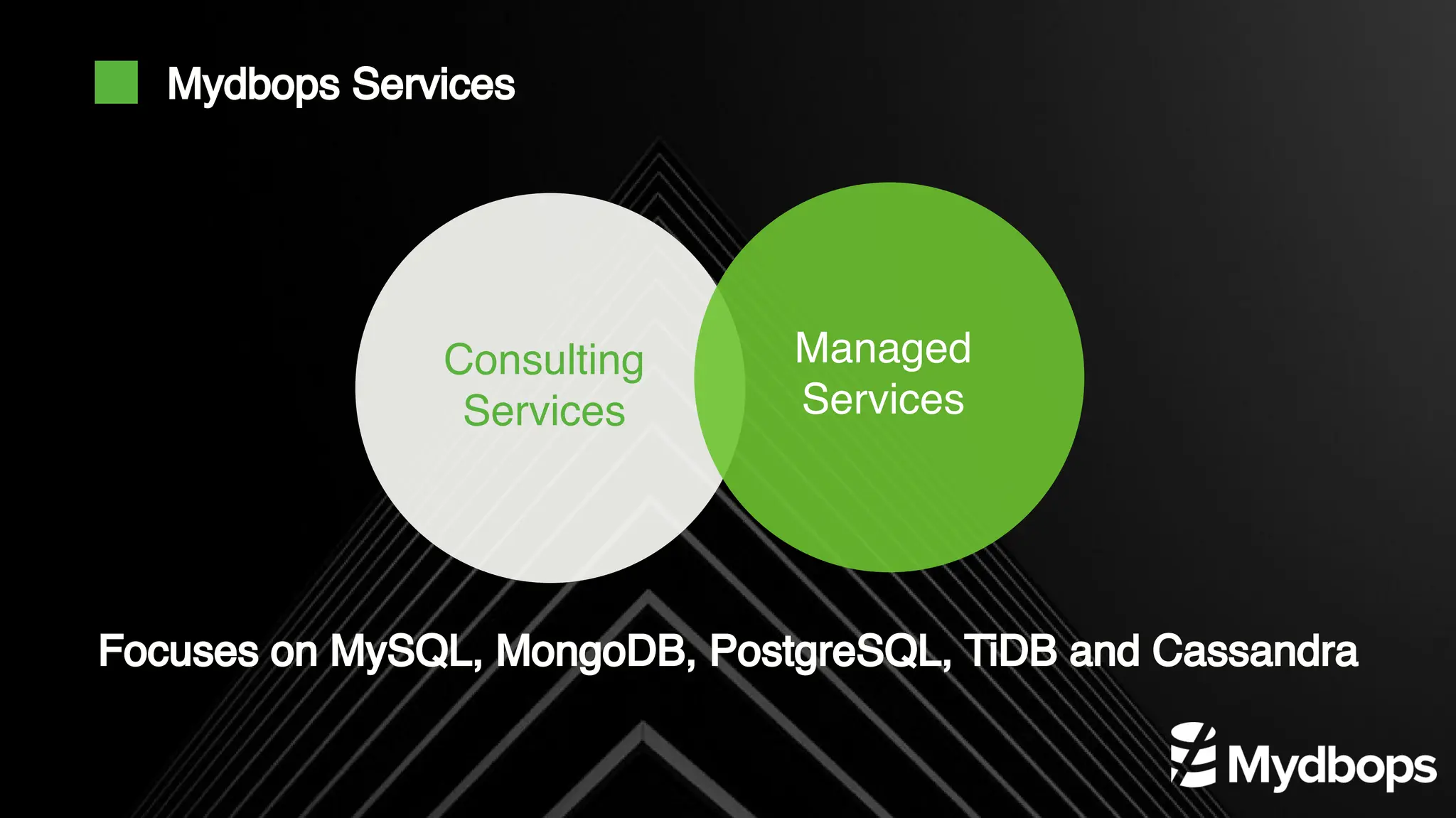
Consulting
Services
Managed
Services
Focuses on MySQL, MongoDB, PostgreSQL, TiDB and Cassandra
Mydbops Services
Our Clients
1M+ DB Transactions
handling per day
3000+ Servers
Monitored
100+ Database
Migrations to cloud
300+ Happy Clients
Vertical Sharding
Horizontal Sharding
Introduction
Agenda
INTRODUCTION
Database Sharding
Database sharding is the process of storing a large database across
multiple machines
WHEN TO SHARD ?
When To Shard - I
Size of Data: If your database is becoming too large to fit on a single server,
sharding may be necessary to distribute the data across multiple servers.
Performance: Sharding can improve query performance by reducing the amount
of data that needs to be processed on a single server.
When To Shard - II
Scalability: Sharding enables you to horizontally scale out your MongoDB
database by distributing data across multiple nodes.
Availability and Redundancy: Sharding can improve query performance
by reducing the amount of data that needs to be processed on a single
server.
When To Shard - III
Availability: Sharding can improve the overall availability of your database
by providing redundancy across multiple nodes.
Flexibility: Sharding enables you to distribute data across multiple nodes
based on your specific requirements.
Type Of Sharding
Vertical
Sharding
Horizontal
Sharding
Will MongoDB Support Vertical Sharding?
Vertical Sharding
Session
Session
Product Catalog
Carts
Product Catalog
Checkouts
Carts
Checkouts
Distributing tables across multiple Standalone / Replica / Shards
Vertical Sharding Strategy - Pros
Different data access patterns:
Vertical sharding may be useful when different table are accessed at different frequencies or
have different access patterns.
▪
By splitting these tables into different shards, the performance of queries that only need to
access a subset of columns can be improved.
▪
Better data management:
Vertical sharding can provide better control over data access, as sensitive or confidential data
can be stored separately from other data. This can help with compliance with regulations such
as GDPR or HIPAA.
▪
Vertical Sharding Strategy - Cons
Data Interconnectedness:
Vertical sharding may not be the best solution for databases with heavily interconnected data. If
there is a need for complex joins or queries across multiple columns, horizontal sharding or
other scaling strategies may be more appropriate.
▪
Limited Scalability:
Only Suitable for Small or Medium data size.
▪
How We Can Achieve Vertical Sharding?
Service Discovery
▪
Consul
▪
Etcd
▪
ZooKeeper
▪
Data Sync
▪
Mongopush
▪
mongosync
▪
mongodump&mongorestore
▪
Vertical Sharding Strategy
Vertical Sharding: Service Discovery and Data Migration
Use Consul to dynamically discover the nodes in your MongoDB cluster and route traffic to them accordingly.
▪
Mongopush sync the data from X1 Cluster to X2 Cluster
▪
Type Of Sharding
Vertical
Sharding
Horizontal
Sharding
Will MongoDB Support Horizontal Sharding?
What MongoDB Horizontal Sharding and Its Components
Each shard contains a subset of the sharded data
Mongos
Config Server
Shards
Shard Key
Collection Shard Key
Divide and distribute collection evenly using shard key
The shard key consists of a field or fields that exists in the every document in a collection
MongoDB Shard Key
IO Scheduler
Range Sharding
Hash Sharding
Zone Sharding
Pros Cons
Even Data Distribution
▪
Even Read and Write Workload
Distribution
▪
Range queries likely trigger
expensive
•
broadcast operation
•
Pros Cons
Even Data Distribution
▪
Target Operation for both single
and ranged queries
▪
Even Read and Write Workload
Distribution
▪
Susceptible to the selection and
usage of good shard key that used
in both read and write queries
•
Pros Cons
Isolate a specific subset of data on
the specific set of shards
•
Data geographically closet to
application servers
•
Data tiering and sla's based on
shard hardware
•
Susceptible to the selection and
usage of good shard key that used
in both read and write queries
•
Target and Broadcast Operation
db.collection.find({ })
Target Query
Broadcast Query
db.collection.find({ })
Shard Key Indexes
2.0 + 100%
Single-field Ascending Index
2.0 + 100%
Single-field Hashed Index
2.0 + 100%
Compound Ascending Index
4.4+ 100%
Compound Hashed Index
Declare Shard Key
sh.shardCollection("db.test", {"fieldA" : 1, "fieldB": "hashed"}, false/true, {numInitialChunks: 5, collation: { locale: "simple" }})
sh.shardCollection(namespace, key, unique, options)
When the collection is empty, sh.shardCollection() generates an index on the shard key if an index for that
key does not already exist.
▪
If the collection is not empty, you must create the index first before using sh.shardCollection()
▪
It is not possible to have a shard key index that indicates a multikey index, text index, or geospatial index on
the fields of the shard key.
▪
MongoDB can enforce a uniqueness constraint on ranged shard key index only.
▪
In a compound index with uniqueness, where the shard key is a prefix
▪
MongoDB ensures uniqueness across the entire key combination, rather than individual components of the
shard key.
▪
Shard Key Improvement After MongoDB v4.2
WITHOUT PREFIX COMPRESSION
Mutable Shard key value (v4.2)
Refinable Shard Key (v4.4)
Compound Hashed Shard Key (v4.4)
Live Resharding(v5.0)
What and Why Refinable Shard Key (v4.4)
Shard Key: customer_id
Refining Shard
Key
db.adminCommand({refineCollectionShardKey:
database.collection, key:{<existing Key>, <New Suffix1>: <1|""hashed">,...}})
21%
15%
64%
Shard A Shard B Shard C
Refine at any time
▪
No Database downtime
▪
Refining a collection's shard key
improves data distribution and resolves
issues caused by insufficient cardinality
leading to jumbo chunks.
Refinable Shard Key (v4.4)
Shard Key: vehical_no Refining Shard
Key
db.adminCommand({refineCollectionShardKey: "mydb.test", key:
{vehical_no: 1, user_mnumber: "hashed"}})
Avoid changing the range or hashed type for any existing shard key fields, as it can lead to
inconsistencies in data. For instance, refrain from changing a shard key such as { vehicle_no: 1 }
to { vehicle_no: "hashed", order_id: 1 }.
For refining shard keys, your cluster must have a version of at least 4.4 and a feature compatibility version of 4.4.
▪
Retain the same prefix when defining the new shard key, i.e., it must begin with the same field(s) as the existing
shard key.
▪
When refining shard keys, additional fields can only be added as suffixes to the existing shard key.
▪
To support the modified shard key, it is necessary to create a new index.
▪
Prior to executing the refineCollectionShardKey command, it is essential to stop the balancer.
▪
sh.status to see the status
▪
Guidelines for Refining Shard Keys
Compound Hashed Shard Key (v4.4)
21%
15%
64%
Shard A Shard B Shard C
Existing Shard Key: vehical_no
New Shard Key: vehical_no, user_mnumber
sh.shardCollection( "test.order", {"vehical_no": 1, "user_mnumber": "hashed"})
sh.shardCollection( "test.order", {"vehical_no": "hashed", "user_mnumber": 1})
Overcome Monotonicall
increase key
▪
Live Resharding(v5.0)
Resharding without downtime
Any Combinations Change
Compound Hash Range
Range Range
Range Hash
Resharding Process Flow
Before starting a sharding operation on a collection of 1 TB size, it is recommended to have a minimum of
1.2 TB of free storage.
▪
I/O: Ensure that your I/O capacity is below 50%.
▪
CPU load: Ensure your CPU load is below 80%.
▪
Rewrite your application's queries to use both the current shard key and the new shard key
rewrite your application's queries to use the new shard key without reload
Monitor the resharding process, use a $currentOp pipeline stage
Deploy your rewritten application
Resharding Who's Donor and Recipients
Donor are shards which currently own chunks of the sharded collection
•
Recipients are shards which would own chunks of the sharded collection according to the new
shard key and zones
•
Resharding Internal Process Flow
Commit Phase
Clone, Apply, and Catch-up
Phase
Index Phase
Initialization Phase The balancer determines the new data distribution for the sharded collection.
A new empty sharded collection, with the same collection options as the original one, is
created by each shard recipient.
This new collection serves as the target for the new data written by the recipient shards.
Each shard recipient builds the necessary new indexes.
Each recipient of a shard makes a copy of the initial documents that it would be
responsible for under the new shard key
•
Each shard recipient begins applying oplog entries from operations that happened after the
recipient cloned the data.
•
When all shards have reached strict consistency, the resharding coordinator commits
the resharding operation and installs the new routing table.
•
The resharding coordinator instructs each donor and recipient shard primary,
independently, to rename the temporary sharded collection. The temporary collection
becomes the new resharded collection
•
Each donor shard drops the old sharded collection.
•
Resharding Process Command
db.adminCommand({
reshardCollection: "mydb.test",
key: {"vehical_no": 1, "user_mnumber": "hashed"}
})
Start the resharding operation
Monitor the resharding operation
db.getSiblingDB("admin").aggregate([
{ $currentOp: { allUsers: true, localOps: false } },
{
$match: {
type: "op",
"originatingCommand.reshardCollection": "mydb.test"
}}])
Abort resharding operation
db.adminCommand({
abortReshardCollection: "mydb.test"
})
To summarize, what issue does this feature resolve?
Jumbo Chunks
•
Uneven Load Distribution
•
Decreased Query Performance Over Time by Scatter-gather queries
•
Improvement From Mongodb 5.2 and 7.X
Default Chunk Size 128 megabytes - 5.2
•
AutoMerger - 7.0
•
Reach Us : Info@mydbops.com
Thank You

Scaling-MongoDB-with-Horizontal-and-Vertical-Sharding Mydbops Opensource Database Meetup 14

  • 1.
    Scaling MongoDB withHorizontal and Vertical Sharding Manosh Malai CTO, Mydbops LLP 07th Oct 2023 Mydbops 14th Opensource Database Meetup
  • 2.
    Interested in OpenSource technologies Interested in MongoDB, DevOps & DevOpSec Practices Tech Speaker/Blogger CTO, Mydbops LLP Manosh Malai About Me
  • 3.
    Consulting Services Managed Services Focuses on MySQL,MongoDB, PostgreSQL, TiDB and Cassandra Mydbops Services
  • 4.
    Our Clients 1M+ DBTransactions handling per day 3000+ Servers Monitored 100+ Database Migrations to cloud 300+ Happy Clients
  • 5.
  • 6.
  • 7.
    Database Sharding Database shardingis the process of storing a large database across multiple machines
  • 8.
  • 9.
    When To Shard- I Size of Data: If your database is becoming too large to fit on a single server, sharding may be necessary to distribute the data across multiple servers. Performance: Sharding can improve query performance by reducing the amount of data that needs to be processed on a single server.
  • 10.
    When To Shard- II Scalability: Sharding enables you to horizontally scale out your MongoDB database by distributing data across multiple nodes. Availability and Redundancy: Sharding can improve query performance by reducing the amount of data that needs to be processed on a single server.
  • 11.
    When To Shard- III Availability: Sharding can improve the overall availability of your database by providing redundancy across multiple nodes. Flexibility: Sharding enables you to distribute data across multiple nodes based on your specific requirements.
  • 12.
  • 13.
    Will MongoDB SupportVertical Sharding?
  • 14.
    Vertical Sharding Session Session Product Catalog Carts ProductCatalog Checkouts Carts Checkouts Distributing tables across multiple Standalone / Replica / Shards
  • 15.
    Vertical Sharding Strategy- Pros Different data access patterns: Vertical sharding may be useful when different table are accessed at different frequencies or have different access patterns. ▪ By splitting these tables into different shards, the performance of queries that only need to access a subset of columns can be improved. ▪ Better data management: Vertical sharding can provide better control over data access, as sensitive or confidential data can be stored separately from other data. This can help with compliance with regulations such as GDPR or HIPAA. ▪
  • 16.
    Vertical Sharding Strategy- Cons Data Interconnectedness: Vertical sharding may not be the best solution for databases with heavily interconnected data. If there is a need for complex joins or queries across multiple columns, horizontal sharding or other scaling strategies may be more appropriate. ▪ Limited Scalability: Only Suitable for Small or Medium data size. ▪
  • 17.
    How We CanAchieve Vertical Sharding? Service Discovery ▪ Consul ▪ Etcd ▪ ZooKeeper ▪ Data Sync ▪ Mongopush ▪ mongosync ▪ mongodump&mongorestore ▪
  • 18.
  • 19.
    Vertical Sharding: ServiceDiscovery and Data Migration Use Consul to dynamically discover the nodes in your MongoDB cluster and route traffic to them accordingly. ▪ Mongopush sync the data from X1 Cluster to X2 Cluster ▪
  • 20.
  • 21.
    Will MongoDB SupportHorizontal Sharding?
  • 22.
    What MongoDB HorizontalSharding and Its Components Each shard contains a subset of the sharded data Mongos Config Server Shards
  • 23.
    Shard Key Collection ShardKey Divide and distribute collection evenly using shard key The shard key consists of a field or fields that exists in the every document in a collection
  • 24.
    MongoDB Shard Key IOScheduler Range Sharding Hash Sharding Zone Sharding Pros Cons Even Data Distribution ▪ Even Read and Write Workload Distribution ▪ Range queries likely trigger expensive • broadcast operation • Pros Cons Even Data Distribution ▪ Target Operation for both single and ranged queries ▪ Even Read and Write Workload Distribution ▪ Susceptible to the selection and usage of good shard key that used in both read and write queries • Pros Cons Isolate a specific subset of data on the specific set of shards • Data geographically closet to application servers • Data tiering and sla's based on shard hardware • Susceptible to the selection and usage of good shard key that used in both read and write queries •
  • 25.
    Target and BroadcastOperation db.collection.find({ }) Target Query Broadcast Query db.collection.find({ })
  • 26.
    Shard Key Indexes 2.0+ 100% Single-field Ascending Index 2.0 + 100% Single-field Hashed Index 2.0 + 100% Compound Ascending Index 4.4+ 100% Compound Hashed Index
  • 27.
    Declare Shard Key sh.shardCollection("db.test",{"fieldA" : 1, "fieldB": "hashed"}, false/true, {numInitialChunks: 5, collation: { locale: "simple" }}) sh.shardCollection(namespace, key, unique, options) When the collection is empty, sh.shardCollection() generates an index on the shard key if an index for that key does not already exist. ▪ If the collection is not empty, you must create the index first before using sh.shardCollection() ▪ It is not possible to have a shard key index that indicates a multikey index, text index, or geospatial index on the fields of the shard key. ▪ MongoDB can enforce a uniqueness constraint on ranged shard key index only. ▪ In a compound index with uniqueness, where the shard key is a prefix ▪ MongoDB ensures uniqueness across the entire key combination, rather than individual components of the shard key. ▪
  • 28.
    Shard Key ImprovementAfter MongoDB v4.2 WITHOUT PREFIX COMPRESSION Mutable Shard key value (v4.2) Refinable Shard Key (v4.4) Compound Hashed Shard Key (v4.4) Live Resharding(v5.0)
  • 29.
    What and WhyRefinable Shard Key (v4.4) Shard Key: customer_id Refining Shard Key db.adminCommand({refineCollectionShardKey: database.collection, key:{<existing Key>, <New Suffix1>: <1|""hashed">,...}}) 21% 15% 64% Shard A Shard B Shard C Refine at any time ▪ No Database downtime ▪ Refining a collection's shard key improves data distribution and resolves issues caused by insufficient cardinality leading to jumbo chunks.
  • 30.
    Refinable Shard Key(v4.4) Shard Key: vehical_no Refining Shard Key db.adminCommand({refineCollectionShardKey: "mydb.test", key: {vehical_no: 1, user_mnumber: "hashed"}}) Avoid changing the range or hashed type for any existing shard key fields, as it can lead to inconsistencies in data. For instance, refrain from changing a shard key such as { vehicle_no: 1 } to { vehicle_no: "hashed", order_id: 1 }. For refining shard keys, your cluster must have a version of at least 4.4 and a feature compatibility version of 4.4. ▪ Retain the same prefix when defining the new shard key, i.e., it must begin with the same field(s) as the existing shard key. ▪ When refining shard keys, additional fields can only be added as suffixes to the existing shard key. ▪ To support the modified shard key, it is necessary to create a new index. ▪ Prior to executing the refineCollectionShardKey command, it is essential to stop the balancer. ▪ sh.status to see the status ▪ Guidelines for Refining Shard Keys
  • 31.
    Compound Hashed ShardKey (v4.4) 21% 15% 64% Shard A Shard B Shard C Existing Shard Key: vehical_no New Shard Key: vehical_no, user_mnumber sh.shardCollection( "test.order", {"vehical_no": 1, "user_mnumber": "hashed"}) sh.shardCollection( "test.order", {"vehical_no": "hashed", "user_mnumber": 1}) Overcome Monotonicall increase key ▪
  • 32.
    Live Resharding(v5.0) Resharding withoutdowntime Any Combinations Change Compound Hash Range Range Range Range Hash
  • 33.
    Resharding Process Flow Beforestarting a sharding operation on a collection of 1 TB size, it is recommended to have a minimum of 1.2 TB of free storage. ▪ I/O: Ensure that your I/O capacity is below 50%. ▪ CPU load: Ensure your CPU load is below 80%. ▪ Rewrite your application's queries to use both the current shard key and the new shard key rewrite your application's queries to use the new shard key without reload Monitor the resharding process, use a $currentOp pipeline stage Deploy your rewritten application
  • 34.
    Resharding Who's Donorand Recipients Donor are shards which currently own chunks of the sharded collection • Recipients are shards which would own chunks of the sharded collection according to the new shard key and zones •
  • 35.
    Resharding Internal ProcessFlow Commit Phase Clone, Apply, and Catch-up Phase Index Phase Initialization Phase The balancer determines the new data distribution for the sharded collection. A new empty sharded collection, with the same collection options as the original one, is created by each shard recipient. This new collection serves as the target for the new data written by the recipient shards. Each shard recipient builds the necessary new indexes. Each recipient of a shard makes a copy of the initial documents that it would be responsible for under the new shard key • Each shard recipient begins applying oplog entries from operations that happened after the recipient cloned the data. • When all shards have reached strict consistency, the resharding coordinator commits the resharding operation and installs the new routing table. • The resharding coordinator instructs each donor and recipient shard primary, independently, to rename the temporary sharded collection. The temporary collection becomes the new resharded collection • Each donor shard drops the old sharded collection. •
  • 36.
    Resharding Process Command db.adminCommand({ reshardCollection:"mydb.test", key: {"vehical_no": 1, "user_mnumber": "hashed"} }) Start the resharding operation Monitor the resharding operation db.getSiblingDB("admin").aggregate([ { $currentOp: { allUsers: true, localOps: false } }, { $match: { type: "op", "originatingCommand.reshardCollection": "mydb.test" }}]) Abort resharding operation db.adminCommand({ abortReshardCollection: "mydb.test" })
  • 37.
    To summarize, whatissue does this feature resolve? Jumbo Chunks • Uneven Load Distribution • Decreased Query Performance Over Time by Scatter-gather queries •
  • 38.
    Improvement From Mongodb5.2 and 7.X Default Chunk Size 128 megabytes - 5.2 • AutoMerger - 7.0 •
  • 39.
    Reach Us :Info@mydbops.com Thank You