

Scaling SolrCloud to a Large Number
of Collections
Anshum Gupta
Lucidworks
• Anshum Gupta, Apache Lucene/Solr PMC member
and committer, Lucidworks Employee.
• Interested in search and related stuff.
• Apache Lucene since 2006 and Solr since 2010.
• Organizations I am or have been a part of:
Who am I?
Apache Solr is the most widely-used search
solution on the planet.
Solr has tens of thousands of
applications in production.
You use everyday.
8,000,000+
Total downloads
Solr is both established
and growing.
250,000+
Monthly downloads
2,500+
Open Solr jobs and the largest
community of developers.
Solr Scalability is unmatched
The traditional search use-case
• One large index distributed across multiple nodes
• A large number of users searching on the same data
• Searches happen across the entire cluster
— Arthur C. Clarke
“The limits of the possible can only be defined by
going beyond them into the impossible.”
• Analyze and find missing features
• Setup a performance testing environment on AWS
• Devise tests for stability and performance
• Find bugs and bottlenecks and fixes
Analyze, measure, and optimize
• The SolrCloud cluster state has information about all collections,
their shards and replicas
• All nodes and (Java) clients watch the cluster state
• Every state change is notified to all nodes
• Limited to (slightly less than) 1MB by default
• 1 node restart triggers a few 100 watcher fires and pulls from ZK
for a 100 node cluster (three states: down, recovering and active)
Problem #1: Cluster state and updates
• Each collection gets it’s own state node in ZK
• Nodes selectively watch only those states which they
are a member of
• Clients cache state and use smart cache updates
instead of watching nodes
• http://issues.apache.org/jira/browse/SOLR-5473
Solution: Split cluster state and scale
• Thousands of collections create a lot of state updates
• Overseer falls behind and replicas can’t recover or
can’t elect a leader
• Under high indexing/search load, GC pauses can
cause overseer queue to back up
Problem #2: Overseer Performance
• Optimize polling for new items in overseer queue -
Don’t wait to poll! (SOLR-5436)
• Dedicated overseers nodes (SOLR-5476)
• New Overseer Status API (SOLR-5749)
• Asynchronous and multi-threaded execution of
collection commands (SOLR-5477, SOLR-5681)
Solution - Improve the Overseer
• Not all users are born equal - A tenant may have a few very
large users
• We wanted to be able to scale an individual user’s data —
maybe even as it’s own collection
• SolrCloud could split shards with no downtime but it only splits
in half
• No way to ‘extract’ user’s data to another collection or shard
Problem #3: Moving data around
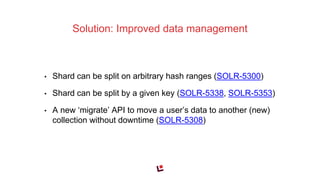
• Shard can be split on arbitrary hash ranges (SOLR-5300)
• Shard can be split by a given key (SOLR-5338, SOLR-5353)
• A new ‘migrate’ API to move a user’s data to another (new)
collection without downtime (SOLR-5308)
Solution: Improved data management
• Lucene/Solr is designed for finding top-N search results
• Trying to export full result set brings down the system due
to high memory requirements as you go deeper
Problem #4: Exporting data
Solution: Distributed deep paging
• Performance goals: 6 billion documents, 4000 queries/sec, 400
updates/sec, 2 seconds NRT sustained performance
• 5% large collections (50 shards), 15% medium (10 shards), 85%
small (1 shard) with replication factor of 3
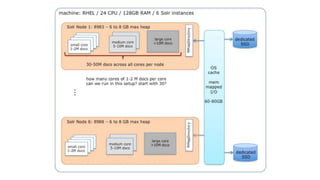
• Target hardware: 24 CPUs, 126G RAM, 7 SSDs (460G) + 1 HDD
(200G)
• 80% traffic served by 20% of the tenants
Testing scale at scale
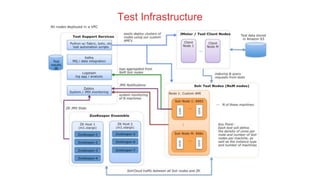
Test Infrastructure
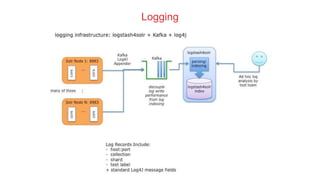
Logging
• Tim Potter wrote the Solr Scale Toolkit
• Fabric based tool to setup and manage SolrCloud
clusters in AWS bundled with collectd and SiLK
• Backup/Restore from S3. Parallel clone commands.
• Open source!
• https://github.com/LucidWorks/solr-scale-tk
How to manage large clusters?
• Lucidworks SiLK (Solr + Logstash + Kibana)
• collectd daemons on each host
• rabbitmq to queue messages before delivering to log stash
• Initially started with Kafka but discarded thinking it is overkill
• Not happy with rabbitmq — crashes/unstable
• Might try Kafka again soon
• http://www.lucidworks.com/lucidworks-silk
Gathering metrics and analyzing logs
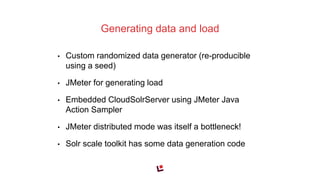
• Custom randomized data generator (re-producible
using a seed)
• JMeter for generating load
• Embedded CloudSolrServer using JMeter Java
Action Sampler
• JMeter distributed mode was itself a bottleneck!
• Solr scale toolkit has some data generation code
Generating data and load
• 30 hosts, 120 nodes, 1000 collections, 6B+ docs,
15000 queries/second, 2000 writes/second, 2 second
NRT sustained over 24-hours
• More than 3x the numbers we needed
• Unfortunately, we had to stop testing at that point :(
• Our biggest cluster cost us just $120/hour :)
Numbers
• Jepsen tests
• Improvement in test coverage
After those tests
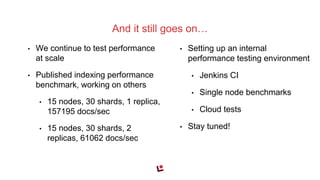
• We continue to test performance
at scale
• Published indexing performance
benchmark, working on others
• 15 nodes, 30 shards, 1 replica,
157195 docs/sec
• 15 nodes, 30 shards, 2
replicas, 61062 docs/sec
And it still goes on…
• Setting up an internal
performance testing environment
• Jenkins CI
• Single node benchmarks
• Cloud tests
• Stay tuned!
Pushing the limits
• SolrCloud continues to be improved
• SOLR-6816 - Review SolrCloud Indexing Performance.
• SOLR-6220 - Replica placement strategy
• SOLR-6273 - Cross data center replication
• SOLR-5750 - Backup/Restore API for SolrCloud
• SOLR-7230 - An API to plugin security into Solr
• Many, many more
Not over yet
Connect @
http://www.twitter.com/anshumgupta
http://www.linkedin.com/in/anshumgupta/
anshum@apache.org

Scaling SolrCloud to a large number of Collections

  • 2.
    Scaling SolrCloud toa Large Number of Collections Anshum Gupta Lucidworks
  • 3.
    • Anshum Gupta,Apache Lucene/Solr PMC member and committer, Lucidworks Employee. • Interested in search and related stuff. • Apache Lucene since 2006 and Solr since 2010. • Organizations I am or have been a part of: Who am I?
  • 4.
    Apache Solr isthe most widely-used search solution on the planet. Solr has tens of thousands of applications in production. You use everyday. 8,000,000+ Total downloads Solr is both established and growing. 250,000+ Monthly downloads 2,500+ Open Solr jobs and the largest community of developers.
  • 5.
  • 6.
    The traditional searchuse-case • One large index distributed across multiple nodes • A large number of users searching on the same data • Searches happen across the entire cluster
  • 7.
    — Arthur C.Clarke “The limits of the possible can only be defined by going beyond them into the impossible.”
  • 8.
    • Analyze andfind missing features • Setup a performance testing environment on AWS • Devise tests for stability and performance • Find bugs and bottlenecks and fixes Analyze, measure, and optimize
  • 9.
    • The SolrCloudcluster state has information about all collections, their shards and replicas • All nodes and (Java) clients watch the cluster state • Every state change is notified to all nodes • Limited to (slightly less than) 1MB by default • 1 node restart triggers a few 100 watcher fires and pulls from ZK for a 100 node cluster (three states: down, recovering and active) Problem #1: Cluster state and updates
  • 10.
    • Each collectiongets it’s own state node in ZK • Nodes selectively watch only those states which they are a member of • Clients cache state and use smart cache updates instead of watching nodes • http://issues.apache.org/jira/browse/SOLR-5473 Solution: Split cluster state and scale
  • 11.
    • Thousands ofcollections create a lot of state updates • Overseer falls behind and replicas can’t recover or can’t elect a leader • Under high indexing/search load, GC pauses can cause overseer queue to back up Problem #2: Overseer Performance
  • 12.
    • Optimize pollingfor new items in overseer queue - Don’t wait to poll! (SOLR-5436) • Dedicated overseers nodes (SOLR-5476) • New Overseer Status API (SOLR-5749) • Asynchronous and multi-threaded execution of collection commands (SOLR-5477, SOLR-5681) Solution - Improve the Overseer
  • 13.
    • Not allusers are born equal - A tenant may have a few very large users • We wanted to be able to scale an individual user’s data — maybe even as it’s own collection • SolrCloud could split shards with no downtime but it only splits in half • No way to ‘extract’ user’s data to another collection or shard Problem #3: Moving data around
  • 14.
    • Shard canbe split on arbitrary hash ranges (SOLR-5300) • Shard can be split by a given key (SOLR-5338, SOLR-5353) • A new ‘migrate’ API to move a user’s data to another (new) collection without downtime (SOLR-5308) Solution: Improved data management
  • 15.
    • Lucene/Solr isdesigned for finding top-N search results • Trying to export full result set brings down the system due to high memory requirements as you go deeper Problem #4: Exporting data
  • 16.
  • 17.
    • Performance goals:6 billion documents, 4000 queries/sec, 400 updates/sec, 2 seconds NRT sustained performance • 5% large collections (50 shards), 15% medium (10 shards), 85% small (1 shard) with replication factor of 3 • Target hardware: 24 CPUs, 126G RAM, 7 SSDs (460G) + 1 HDD (200G) • 80% traffic served by 20% of the tenants Testing scale at scale
  • 18.
  • 19.
  • 21.
    • Tim Potterwrote the Solr Scale Toolkit • Fabric based tool to setup and manage SolrCloud clusters in AWS bundled with collectd and SiLK • Backup/Restore from S3. Parallel clone commands. • Open source! • https://github.com/LucidWorks/solr-scale-tk How to manage large clusters?
  • 22.
    • Lucidworks SiLK(Solr + Logstash + Kibana) • collectd daemons on each host • rabbitmq to queue messages before delivering to log stash • Initially started with Kafka but discarded thinking it is overkill • Not happy with rabbitmq — crashes/unstable • Might try Kafka again soon • http://www.lucidworks.com/lucidworks-silk Gathering metrics and analyzing logs
  • 23.
    • Custom randomizeddata generator (re-producible using a seed) • JMeter for generating load • Embedded CloudSolrServer using JMeter Java Action Sampler • JMeter distributed mode was itself a bottleneck! • Solr scale toolkit has some data generation code Generating data and load
  • 24.
    • 30 hosts,120 nodes, 1000 collections, 6B+ docs, 15000 queries/second, 2000 writes/second, 2 second NRT sustained over 24-hours • More than 3x the numbers we needed • Unfortunately, we had to stop testing at that point :( • Our biggest cluster cost us just $120/hour :) Numbers
  • 25.
    • Jepsen tests •Improvement in test coverage After those tests
  • 26.
    • We continueto test performance at scale • Published indexing performance benchmark, working on others • 15 nodes, 30 shards, 1 replica, 157195 docs/sec • 15 nodes, 30 shards, 2 replicas, 61062 docs/sec And it still goes on… • Setting up an internal performance testing environment • Jenkins CI • Single node benchmarks • Cloud tests • Stay tuned!
  • 27.
  • 28.
    • SolrCloud continuesto be improved • SOLR-6816 - Review SolrCloud Indexing Performance. • SOLR-6220 - Replica placement strategy • SOLR-6273 - Cross data center replication • SOLR-5750 - Backup/Restore API for SolrCloud • SOLR-7230 - An API to plugin security into Solr • Many, many more Not over yet
  • 29.

Editor's Notes

  • #8 Other use cases, different from the general one. Large setup
  • #9 Our plan
  • #19 Didn’t use Zabbix as JMX wasn’t being really useful for us. RabbitMQ instead of Kafka
  • #20 collectd daemon on each of the hosts
  • #21 i2.4xlarge machines
  • #29 10 x r3.2xlarge nodes, each running 1 instance of Solr 4.8.1 vs 5 35k vs 75k docs/s (130 mn Docs)