Effective  Testing  in  DSE
Predrag Knežević
predrag.knezevic@datastax.com
@pedjakknezevic
Why  Taking  Care?
• Automated  testing  for  quality  control  of  shipped  product/service
• Number  of  tests  and  total  testing  times  increase  over  time
• Shorter  delivery  cycles  →  continuous  testing
• Run  tests  on  each  pre-­merge  check,  but
• Keep  feedback  cycles  short
• Ensure  repeatable  test  execution  anywhere
©  DataStax,  All  Rights  Reserved. 2
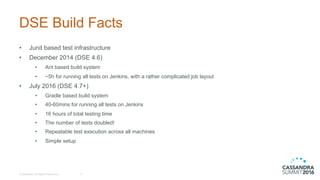
DSE  Build  Facts
• Junit  based  test  infrastructure
• December  2014  (DSE  4.6)
• Ant  based  build  system
• ~5h  for  running  all  tests  on  Jenkins,  with  a  rather  complicated  job  layout
• July  2016  (DSE  4.7+)
• Gradle based  build  system
• 40-­60mins  for  running  all  tests  on  Jenkins
• 16  hours  of  total  testing  time
• The  number  of  tests  doubled!
• Repeatable  test  execution  across  all  machines
• Simple  setup
©  DataStax,  All  Rights  Reserved. 3
Why  Moving  to  Gradle?
• Built-­in  support  for  parallel  test  execution
• Readable  -­ build  scripts  based  on  Groovy  (easy  learning  for  Java  devs)
• Repeatable  builds/environment  setup  across  machines
• Powerful  dependency  management
• Sane  conventions,  but  configurable  when  needed
• Easy  project  modularization
• Excellent  Eclipse/IntelliJ  support
• Easy  extendable  through  plugins  or  additional  Java/Groovy  code  living  in  the  script  or  project
• All  Ant  tasks  still  available
©  DataStax,  All  Rights  Reserved. 4
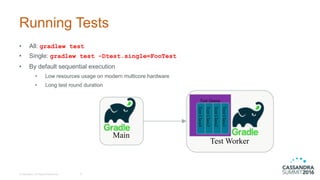
Running  Tests
• All:  gradlew test
• Single:  gradlew test -Dtest.single=FooTest
• By  default  sequential  execution
• Low  resources  usage  on  modern  multicore  hardware
• Long  test  round  duration
©  DataStax,  All  Rights  Reserved. 5
Main
Test Worker
Test Queue
TestClass1
TestClass2
TestClass3
TestClass4
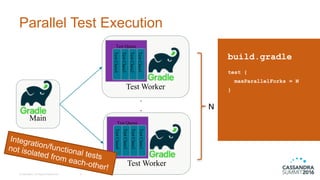
Parallel  Test  Execution
©  DataStax,  All  Rights  Reserved. 6
build.gradle
test {
maxParallelForks = N
}
Main
Test Worker
Test Queue
TestClass1
TestClass2
TestClass3
TestClass4
Test Worker
Test Queue
TestClass1
TestClass2
TestClass3
TestClass4
.
. N
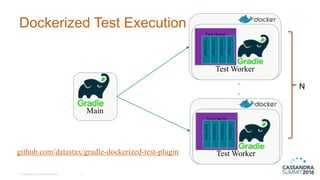
Dockerized Test  Execution
©  DataStax,  All  Rights  Reserved. 7
Main
.
.
Test Worker
Test Queue
TestClass1
TestClass2
TestClass3
TestClass4
Test Worker
Test Queue
TestClass1
TestClass2
TestClass3
TestClass4
N
github.com/datastax/gradle-dockerized-test-plugin
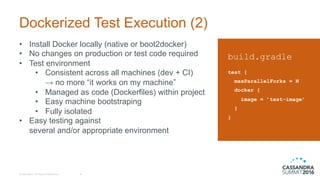
Dockerized Test  Execution  (2)
©  DataStax,  All  Rights  Reserved. 8
build.gradle
test {
maxParallelForks = N
docker {
image = ’test-image’
}
}
• Install  Docker  locally  (native  or  boot2docker)
• No  changes  on  production  or  test  code  required
• Test  environment
• Consistent  across  all  machines  (dev  +  CI)
→  no  more  “it  works  on  my  machine”
• Managed  as  code  (Dockerfiles)  within  project
• Easy  machine  bootstraping
• Fully  isolated
• Easy  testing  against  
several  and/or  appropriate  environment
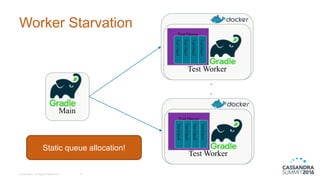
Worker  Starvation
©  DataStax,  All  Rights  Reserved. 9
Main
.
.
Test Worker
Test Queue
TestClass1
TestClass2
TestClass3
TestClass4
Test Worker
Test Queue
TestClass1
TestClass2
TestClass3
TestClass4
Static  queue  allocation!
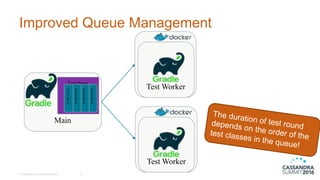
Improved  Queue  Management
©  DataStax,  All  Rights  Reserved. 10
Test Worker
Main
Test Queue
TestClass1
TestClass2
TestClass3
TestClass4
Test Worker
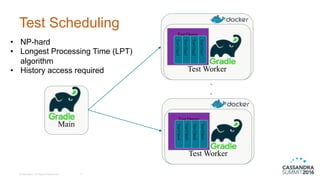
Test  Scheduling
©  DataStax,  All  Rights  Reserved. 11
Main
.
.
Test Worker
Test Queue
TestClass1
TestClass2
TestClass3
TestClass4
Test Worker
Test Queue
TestClass1
TestClass2
TestClass3
TestClass4
• NP-­hard
• Longest  Processing  Time  (LPT)  
algorithm
• History  access  required
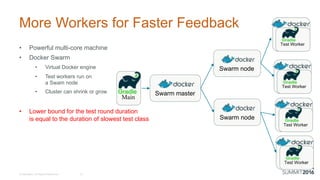
More  Workers  for  Faster  Feedback
• Powerful  multi-­core  machine
• Docker  Swarm
• Virtual  Docker  engine
• Test  workers  run  on  
a  Swam  node
• Cluster  can  shrink  or  grow
• Lower  bound  for  the  test  round  duration  
is  equal  to  the  duration  of  slowest  test  class
©  DataStax,  All  Rights  Reserved. 12
Swarm  master
Main
Swarm  node
Swarm  node
Test  Worker
Test  Worker
Test  Worker
Test  Worker
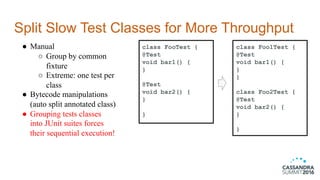
Split  Slow  Test  Classes for  More  Throughput
class FooTest {
@Test
void bar1() {
}
@Test
void bar2() {
}
}
class Foo1Test {
@Test
void bar1() {
}
}
class Foo2Test {
@Test
void bar2() {
}
}
● Manual
○ Group by common
fixture
○ Extreme: one test per
class
● Bytecode manipulations
(auto split annotated class)
● Grouping tests classes
into JUnit suites forces
their sequential execution!
No  Embedded  DSE  Nodes
• Running  cluster  within  single  test  worker  JVM  possible  only  by  using  separate  classpath loaders
• Still  requires  a  good  amount  of  hacking  to  make  it  work  decently
• Node  shutdowns  might  still  be  problematic
• Thread  can  hang  around
• Some  objects  cannot  be  garbage  collected  →  memory  leaks
• Standalone  nodes  enable  reusage across  test  classes
©  DataStax,  All  Rights  Reserved. 14
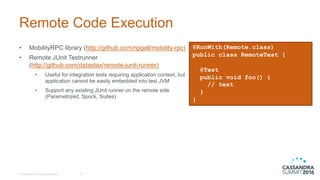
Remote  Code  Execution
• MobilityRPC library  (http://github.com/npgall/mobility-­rpc)
• Remote  JUnit  Testrunner
(http://github.com/datastax/remote-­junit-­runner)
• Useful  for  integration  tests  requiring  application  context,  but  
application  cannot  be  easily  embedded  into  test  JVM
• Support  any  existing  JUnit  runner  on  the  remote  side  
(Parametrized,  Spock,  Suites)
©  DataStax,  All  Rights  Reserved. 15
@RunWith(Remote.class)
public class RemoteTest {
@Test
public void foo() {
// test
}
}
Injecting  Faults
• JBoss Byteman (http://byteman.jboss.org)
• Inject  at  runtime
• Exceptions
• Delays
• Arbitrary  side-­effects
• Enables/simplifies  testing  of  edge/uncommon  cases
©  DataStax,  All  Rights  Reserved. 16
Logging
• Logback (http://logback.qos.ch/) based  infrastructure
• Log  file  per  a  test  case
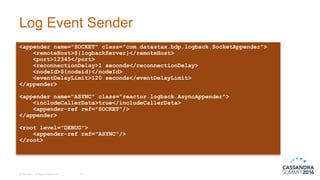
• Send  all  log  messages  to  the  single  logback server  asynchronously  (reactor-­logback adapter)
keeping  DSE  nodes  responsive  
• Route  log  statements  to  the  proper  file  using  SiftingAdapter and  appropriate  discriminator
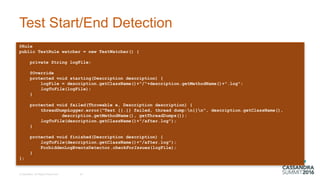
• Use  JUnit  rules  to  mark  the  beginning  and  the  end  of  a  test  and  
propagate  this  information  to  the  logback discriminator
• Write  thread  dumps  in  case  of  a  failure
• Scan  log  files  for  known  issues  and  fail  tests  if  they  occur  (e.g.  Netty memory  leaks)
• Turn  DEBUG  messages  on  to  help  later  digging  in  a  case  of  failure
©  DataStax,  All  Rights  Reserved. 17
Log  Event  Sender
<appender name="SOCKET" class="com.datastax.bdp.logback.SocketAppender">
<remoteHost>${logbackServer}</remoteHost>
<port>12345</port>
<reconnectionDelay>1 seconds</reconnectionDelay>
<nodeId>${nodeid}</nodeId>
<eventDelayLimit>120 seconds</eventDelayLimit>
</appender>
<appender name="ASYNC" class="reactor.logback.AsyncAppender">
<includeCallerData>true</includeCallerData>
<appender-ref ref="SOCKET"/>
</appender>
<root level="DEBUG">
<appender-ref ref="ASYNC"/>
</root>
©  DataStax,  All  Rights  Reserved. 18
Log  Event  Router
<appender name="SIFT" class="ch.qos.logback.classic.sift.SiftingAppender">
<discriminator class="com.datastax.bdp.test.ng.LogFileDiscriminator">
<key>TEST_LOG_FILE</key>
<defaultValue>system.log</defaultValue>
</discriminator>
<sift>
<appender name="FILE-${TEST_LOG_FILE}" class="ch.qos.logback.core.FileAppender">
<filter class="com.datastax.bdp.test.ng.ForbiddenLogEventsDetector">
<logFile>${TEST_LOG_FILE}</logFile>
<detector class="com.datastax.bdp.test.ng.NettyLeakDetector"/>
</filter>
<encoder>
<pattern>%X{nodeid} %5p [%t] %d{ISO8601} %F (line %line) %m%n</pattern>
<immediateFlush>false</immediateFlush>
</encoder>
<file>${LOG_DIR}/${TEST_LOG_FILE}</file>
<append>true</append>
</appender>
</sift>
</appender>
©  DataStax,  All  Rights  Reserved. 19
Test  Start/End  Detection  
@Rule
public TestRule watcher = new TestWatcher() {
private String logFile;
@Override
protected void starting(Description description) {
logFile = description.getClassName()+"/"+description.getMethodName()+".log";
logToFile(logFile);
}
protected void failed(Throwable e, Description description) {
threadDumpLogger.error("Test {}.{} failed, thread dump:n{}n", description.getClassName(),
description.getMethodName(), getThreadDumps());
logToFile(description.getClassName()+"/after.log");
}
protected void finished(Description description) {
logToFile(description.getClassName()+"/after.log");
ForbiddenLogEventsDetector.checkForIssues(logFile);
}
};
©  DataStax,  All  Rights  Reserved. 20
Resources
• Gradle (gradle.org)
• Docker  (docker.com)
• Gradle Dockerized Test  Plugin  (github.com/datastax/gradle-­dockerized-­test-­plugin)
• MobilityRPC (http://github.com/npgall/mobility-­rpc)
• Remote  JUnit  Testrunner (http://github.com/datastax/remote-­junit-­runner)
• JBoss Byteman (http://byteman.jboss.org)
• Logback (http://logback.qos.ch/)
• Project  Reactor  Addons (github.com/reactor/reactor-­addons),  Logback adapter
©  DataStax,  All  Rights  Reserved. 21
Thank  you!
Questions?
©  DataStax,  All  Rights  Reserved.22

DataStax | Effective Testing in DSE (Lessons Learned) (Predrag Knezevic) | Cassandra Summit 2016

  • 1.
    Effective  Testing  in DSE Predrag Knežević predrag.knezevic@datastax.com @pedjakknezevic
  • 2.
    Why  Taking  Care? •Automated  testing  for  quality  control  of  shipped  product/service • Number  of  tests  and  total  testing  times  increase  over  time • Shorter  delivery  cycles  →  continuous  testing • Run  tests  on  each  pre-­merge  check,  but • Keep  feedback  cycles  short • Ensure  repeatable  test  execution  anywhere ©  DataStax,  All  Rights  Reserved. 2
  • 3.
    DSE  Build  Facts •Junit  based  test  infrastructure • December  2014  (DSE  4.6) • Ant  based  build  system • ~5h  for  running  all  tests  on  Jenkins,  with  a  rather  complicated  job  layout • July  2016  (DSE  4.7+) • Gradle based  build  system • 40-­60mins  for  running  all  tests  on  Jenkins • 16  hours  of  total  testing  time • The  number  of  tests  doubled! • Repeatable  test  execution  across  all  machines • Simple  setup ©  DataStax,  All  Rights  Reserved. 3
  • 4.
    Why  Moving  to Gradle? • Built-­in  support  for  parallel  test  execution • Readable  -­ build  scripts  based  on  Groovy  (easy  learning  for  Java  devs) • Repeatable  builds/environment  setup  across  machines • Powerful  dependency  management • Sane  conventions,  but  configurable  when  needed • Easy  project  modularization • Excellent  Eclipse/IntelliJ  support • Easy  extendable  through  plugins  or  additional  Java/Groovy  code  living  in  the  script  or  project • All  Ant  tasks  still  available ©  DataStax,  All  Rights  Reserved. 4
  • 5.
    Running  Tests • All: gradlew test • Single:  gradlew test -Dtest.single=FooTest • By  default  sequential  execution • Low  resources  usage  on  modern  multicore  hardware • Long  test  round  duration ©  DataStax,  All  Rights  Reserved. 5 Main Test Worker Test Queue TestClass1 TestClass2 TestClass3 TestClass4
  • 6.
    Parallel  Test  Execution © DataStax,  All  Rights  Reserved. 6 build.gradle test { maxParallelForks = N } Main Test Worker Test Queue TestClass1 TestClass2 TestClass3 TestClass4 Test Worker Test Queue TestClass1 TestClass2 TestClass3 TestClass4 . . N
  • 7.
    Dockerized Test  Execution © DataStax,  All  Rights  Reserved. 7 Main . . Test Worker Test Queue TestClass1 TestClass2 TestClass3 TestClass4 Test Worker Test Queue TestClass1 TestClass2 TestClass3 TestClass4 N github.com/datastax/gradle-dockerized-test-plugin
  • 8.
    Dockerized Test  Execution (2) ©  DataStax,  All  Rights  Reserved. 8 build.gradle test { maxParallelForks = N docker { image = ’test-image’ } } • Install  Docker  locally  (native  or  boot2docker) • No  changes  on  production  or  test  code  required • Test  environment • Consistent  across  all  machines  (dev  +  CI) →  no  more  “it  works  on  my  machine” • Managed  as  code  (Dockerfiles)  within  project • Easy  machine  bootstraping • Fully  isolated • Easy  testing  against   several  and/or  appropriate  environment
  • 9.
    Worker  Starvation ©  DataStax, All  Rights  Reserved. 9 Main . . Test Worker Test Queue TestClass1 TestClass2 TestClass3 TestClass4 Test Worker Test Queue TestClass1 TestClass2 TestClass3 TestClass4 Static  queue  allocation!
  • 10.
    Improved  Queue  Management © DataStax,  All  Rights  Reserved. 10 Test Worker Main Test Queue TestClass1 TestClass2 TestClass3 TestClass4 Test Worker
  • 11.
    Test  Scheduling ©  DataStax, All  Rights  Reserved. 11 Main . . Test Worker Test Queue TestClass1 TestClass2 TestClass3 TestClass4 Test Worker Test Queue TestClass1 TestClass2 TestClass3 TestClass4 • NP-­hard • Longest  Processing  Time  (LPT)   algorithm • History  access  required
  • 12.
    More  Workers  for Faster  Feedback • Powerful  multi-­core  machine • Docker  Swarm • Virtual  Docker  engine • Test  workers  run  on   a  Swam  node • Cluster  can  shrink  or  grow • Lower  bound  for  the  test  round  duration   is  equal  to  the  duration  of  slowest  test  class ©  DataStax,  All  Rights  Reserved. 12 Swarm  master Main Swarm  node Swarm  node Test  Worker Test  Worker Test  Worker Test  Worker
  • 13.
    Split  Slow  Test Classes for  More  Throughput class FooTest { @Test void bar1() { } @Test void bar2() { } } class Foo1Test { @Test void bar1() { } } class Foo2Test { @Test void bar2() { } } ● Manual ○ Group by common fixture ○ Extreme: one test per class ● Bytecode manipulations (auto split annotated class) ● Grouping tests classes into JUnit suites forces their sequential execution!
  • 14.
    No  Embedded  DSE Nodes • Running  cluster  within  single  test  worker  JVM  possible  only  by  using  separate  classpath loaders • Still  requires  a  good  amount  of  hacking  to  make  it  work  decently • Node  shutdowns  might  still  be  problematic • Thread  can  hang  around • Some  objects  cannot  be  garbage  collected  →  memory  leaks • Standalone  nodes  enable  reusage across  test  classes ©  DataStax,  All  Rights  Reserved. 14
  • 15.
    Remote  Code  Execution •MobilityRPC library  (http://github.com/npgall/mobility-­rpc) • Remote  JUnit  Testrunner (http://github.com/datastax/remote-­junit-­runner) • Useful  for  integration  tests  requiring  application  context,  but   application  cannot  be  easily  embedded  into  test  JVM • Support  any  existing  JUnit  runner  on  the  remote  side   (Parametrized,  Spock,  Suites) ©  DataStax,  All  Rights  Reserved. 15 @RunWith(Remote.class) public class RemoteTest { @Test public void foo() { // test } }
  • 16.
    Injecting  Faults • JBossByteman (http://byteman.jboss.org) • Inject  at  runtime • Exceptions • Delays • Arbitrary  side-­effects • Enables/simplifies  testing  of  edge/uncommon  cases ©  DataStax,  All  Rights  Reserved. 16
  • 17.
    Logging • Logback (http://logback.qos.ch/)based  infrastructure • Log  file  per  a  test  case • Send  all  log  messages  to  the  single  logback server  asynchronously  (reactor-­logback adapter) keeping  DSE  nodes  responsive   • Route  log  statements  to  the  proper  file  using  SiftingAdapter and  appropriate  discriminator • Use  JUnit  rules  to  mark  the  beginning  and  the  end  of  a  test  and   propagate  this  information  to  the  logback discriminator • Write  thread  dumps  in  case  of  a  failure • Scan  log  files  for  known  issues  and  fail  tests  if  they  occur  (e.g.  Netty memory  leaks) • Turn  DEBUG  messages  on  to  help  later  digging  in  a  case  of  failure ©  DataStax,  All  Rights  Reserved. 17
  • 18.
    Log  Event  Sender <appendername="SOCKET" class="com.datastax.bdp.logback.SocketAppender"> <remoteHost>${logbackServer}</remoteHost> <port>12345</port> <reconnectionDelay>1 seconds</reconnectionDelay> <nodeId>${nodeid}</nodeId> <eventDelayLimit>120 seconds</eventDelayLimit> </appender> <appender name="ASYNC" class="reactor.logback.AsyncAppender"> <includeCallerData>true</includeCallerData> <appender-ref ref="SOCKET"/> </appender> <root level="DEBUG"> <appender-ref ref="ASYNC"/> </root> ©  DataStax,  All  Rights  Reserved. 18
  • 19.
    Log  Event  Router <appendername="SIFT" class="ch.qos.logback.classic.sift.SiftingAppender"> <discriminator class="com.datastax.bdp.test.ng.LogFileDiscriminator"> <key>TEST_LOG_FILE</key> <defaultValue>system.log</defaultValue> </discriminator> <sift> <appender name="FILE-${TEST_LOG_FILE}" class="ch.qos.logback.core.FileAppender"> <filter class="com.datastax.bdp.test.ng.ForbiddenLogEventsDetector"> <logFile>${TEST_LOG_FILE}</logFile> <detector class="com.datastax.bdp.test.ng.NettyLeakDetector"/> </filter> <encoder> <pattern>%X{nodeid} %5p [%t] %d{ISO8601} %F (line %line) %m%n</pattern> <immediateFlush>false</immediateFlush> </encoder> <file>${LOG_DIR}/${TEST_LOG_FILE}</file> <append>true</append> </appender> </sift> </appender> ©  DataStax,  All  Rights  Reserved. 19
  • 20.
    Test  Start/End  Detection  @Rule public TestRule watcher = new TestWatcher() { private String logFile; @Override protected void starting(Description description) { logFile = description.getClassName()+"/"+description.getMethodName()+".log"; logToFile(logFile); } protected void failed(Throwable e, Description description) { threadDumpLogger.error("Test {}.{} failed, thread dump:n{}n", description.getClassName(), description.getMethodName(), getThreadDumps()); logToFile(description.getClassName()+"/after.log"); } protected void finished(Description description) { logToFile(description.getClassName()+"/after.log"); ForbiddenLogEventsDetector.checkForIssues(logFile); } }; ©  DataStax,  All  Rights  Reserved. 20
  • 21.
    Resources • Gradle (gradle.org) •Docker  (docker.com) • Gradle Dockerized Test  Plugin  (github.com/datastax/gradle-­dockerized-­test-­plugin) • MobilityRPC (http://github.com/npgall/mobility-­rpc) • Remote  JUnit  Testrunner (http://github.com/datastax/remote-­junit-­runner) • JBoss Byteman (http://byteman.jboss.org) • Logback (http://logback.qos.ch/) • Project  Reactor  Addons (github.com/reactor/reactor-­addons),  Logback adapter ©  DataStax,  All  Rights  Reserved. 21
  • 22.
    Thank  you! Questions? ©  DataStax, All  Rights  Reserved.22