© 2014 VMware Inc. All rights reserved. 
Scale Up Your Thinking 
Reactive Programming with Scala and Akka 
Lior Shapsa 
Yardena Meymann 
February 24, 2014
About us 
• Lior Shapsa – Leads Benchmark Development (lshapsa@vmware.com) 
• Yardena Meymann - Group Architect (ymeymann@vmware.com) 
2
The Project 
• New Generation Business Management Products 
• Manage Financial Aspects of the Cloud 
• Help CFOs to optimize the cloud cost 
• Benchmarking – Compare to Industry Best Practices 
3
What Do We Need 
• Web Scraping – naïve way isn’t good enough 
• Crowd Sourcing 
• Analyze Data 
– Build a reliable price list 
– How efficient is my virtual infra vs. industry? (cost, capacity) 
– How fast am I responding to business challenges 
• Start With Single Instance and Scale Out Fast!
Why to Scale Out 
Moore’s Law 
• The Clock Speed Has 
Reached Its Limit in 2006 
• Free Lunch Is Over
Why to Scale Out 
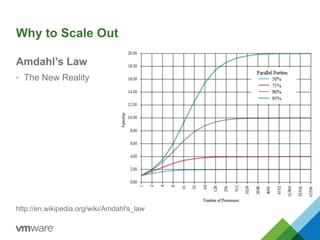
Amdahl’s Law 
• The New Reality 
http://en.wikipedia.org/wiki/Amdahl's_law
The Challenge 
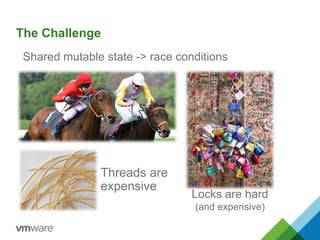
Shared mutable state -> race conditions 
Threads are 
expensive 
Locks are hard 
(and expensive)
The Challenge 
8 Fallacies of Distributed Computing: 
– The network is reliable 
– Latency is zero 
– Bandwidth is infinite 
– The network is secure 
– Topology doesn't change 
– There is one administrator 
– Transport cost is zero 
– The network is homogeneous
Reactive Programming 
• React to Events 
– Pushing rather than pulling (No Shared State) 
• React to Load 
– Focus on scalability rather than single-user performance. 
• React to Failure 
– Resilient systems with the ability to recover quickly at all levels. 
• React to Users 
– Combine the above traits for an interactive user experience 
9
Chosen Solution: Actor Model 
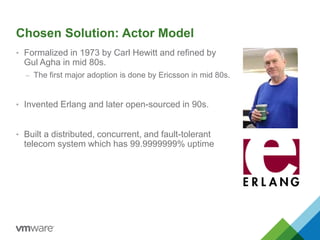
• Formalized in 1973 by Carl Hewitt and refined by 
Gul Agha in mid 80s. 
– The first major adoption is done by Ericsson in mid 80s. 
• Invented Erlang and later open-sourced in 90s. 
• Built a distributed, concurrent, and fault-tolerant 
telecom system which has 99.9999999% uptime
Chosen Solution: Actor Model 
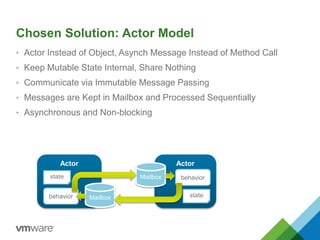
• Actor Instead of Object, Asynch Message Instead of Method Call 
• Keep Mutable State Internal, Share Nothing 
• Communicate via Immutable Message Passing 
• Messages are Kept in Mailbox and Processed Sequentially 
• Asynchronous and Non-blocking 
Actor Actor 
Mailbox 
state 
Mailbox behavior 
behavior state
Actor Example (Scala) 
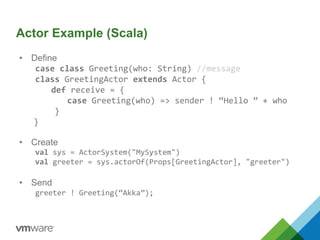
• Define 
case class Greeting(who: String) //message 
class GreetingActor extends Actor { 
def receive = { 
case Greeting(who) => sender ! “Hello ” + who 
} 
} 
• Create 
val sys = ActorSystem("MySystem") 
val greeter = sys.actorOf(Props[GreetingActor], "greeter") 
• Send 
greeter ! Greeting(“Akka”);
Actor Libs For the JVM 
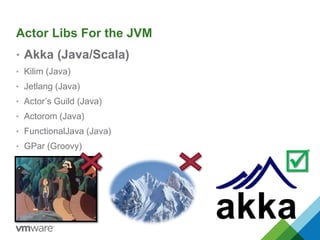
• Akka (Java/Scala) 
• Kilim (Java) 
• Jetlang (Java) 
• Actor’s Guild (Java) 
• Actorom (Java) 
• FunctionalJava (Java) 
• GPar (Groovy) 

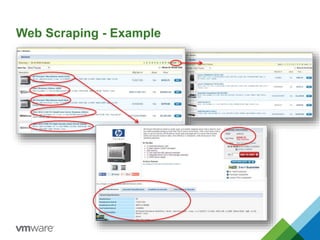
Web Scraping - Example
Dispatch 
Crawling 
library 
Netty 
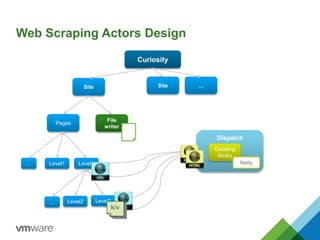
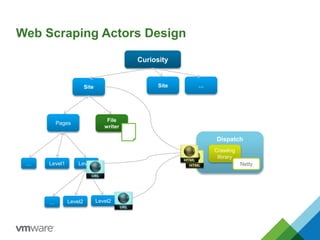
Web Scraping Actors Design 
Curiosity 
Site … 
Pages 
Level1 Level1 
Level2 
… 
Level2 
File 
writer 
Site 
… 
k/v
Example Site 
class Servers extends Site { 
override def start(): Unit = goto[ListPage] “…” 
} 
class ListPage extends Page { 
override def processResult(result: Response): Unit = { 
val links = listProductLinks(result.content) 
links foreach goto[ProductPage](_, pageType = Child) 
val next = getNextPage(result.content) 
next foreach goto[ListPage](_, pageType = Sibling) 
} 
} 
class ProductPage extends Page { 
override def processResult(result: Response): Unit = { 
val spec = productTitle(result.content) ++ 
generalSpec(result.content) ++ 
pricingInfo(result.content) 
writeToFile(spec) 
} 
}
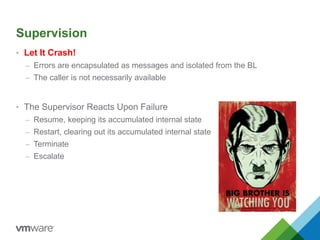
Supervision 
• Let It Crash! 
– Errors are encapsulated as messages and isolated from the BL 
– The caller is not necessarily available 
• The Supervisor Reacts Upon Failure 
– Resume, keeping its accumulated internal state 
– Restart, clearing out its accumulated internal state 
– Terminate 
– Escalate
Supervision – Example (optional) 
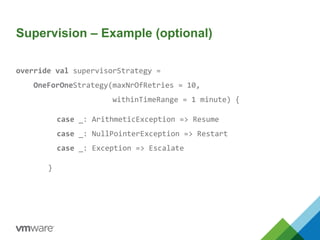
override val supervisorStrategy = 
OneForOneStrategy(maxNrOfRetries = 10, 
withinTimeRange = 1 minute) { 
case _: ArithmeticException => Resume 
case _: NullPointerException => Restart 
case _: Exception => Escalate 
}
Akka Distributable by Design 
• Superior model for detecting and recovering from errors 
• Location transparent - scale UP and OUT for free 
• Adaptive load-balancing, cluster rebalancing & actor 
migration 
• Build extremely loosely coupled and dynamic systems 
that can change and adapt at runtime
Under the hood
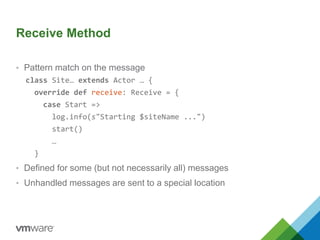
Receive Method 
• Pattern match on the message 
class Site… extends Actor … { 
override def receive: Receive = { 
case Start => 
log.info(s"Starting $siteName ...") 
start() 
… 
} 
• Defined for some (but not necessarily all) messages 
• Unhandled messages are sent to a special location
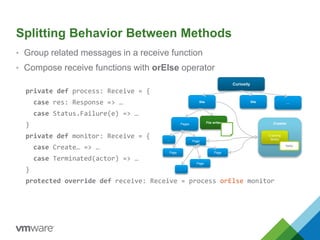
Splitting Behavior Between Methods 
• Group related messages in a receive function 
• Compose receive functions with orElse operator 
private def process: Receive = { 
case res: Response => … 
case Status.Failure(e) => … 
} 
private def monitor: Receive = { 
case Create… => … 
case Terminated(actor) => … 
Curiosity 
Site … 
Crawler 
Crawling 
library 
} 
protected override def receive: Receive = process orElse monitor 
Netty 
Pages 
Page 
Page 
Page 
… 
Page 
File writer 
Site 
…
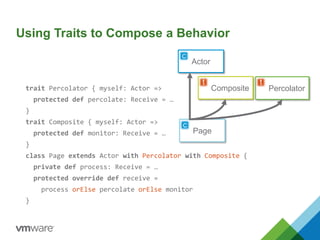
Using Traits to Compose a Behavior 
trait Percolator { myself: Actor => 
protected def percolate: Receive = … 
} 
trait Composite { myself: Actor => 
protected def monitor: Receive = … 
} 
class Page extends Actor with Percolator with Composite { 
private def process: Receive = … 
protected override def receive = 
process orElse percolate orElse monitor 
} 
Composite Percolator 
Actor 
Page 
c 
t t 
c
Web Scraping Actors Design 
Curiosity 
Dispatch 
Crawling 
library 
Netty 
Site … 
Pages 
Level1 Level1 
Level2 
… 
Level2 
File 
writer 
Site 
…
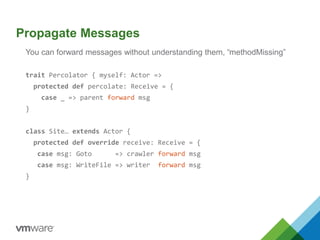
Propagate Messages 
You can forward messages without understanding them, “methodMissing” 
trait Percolator { myself: Actor => 
protected def percolate: Receive = { 
case _ => parent forward msg 
} 
class Site… extends Actor { 
protected def override receive: Receive = { 
case msg: Goto => crawler forward msg 
case msg: WriteFile => writer forward msg 
}
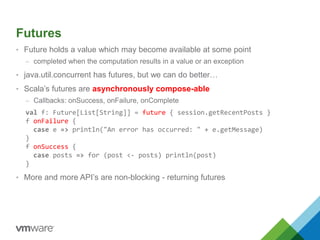
Futures 
• Future holds a value which may become available at some point 
– completed when the computation results in a value or an exception 
• java.util.concurrent has futures, but we can do better… 
• Scala’s futures are asynchronously compose-able 
– Callbacks: onSuccess, onFailure, onComplete 
val f: Future[List[String]] = future { session.getRecentPosts } 
f onFailure { 
case e => println("An error has occurred: " + e.getMessage) 
} 
f onSuccess { 
case posts => for (post <- posts) println(post) 
} 
• More and more API’s are non-blocking - returning futures
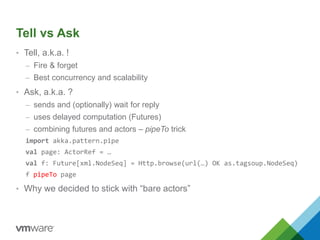
Tell vs Ask 
• Tell, a.k.a. ! 
– Fire & forget 
– Best concurrency and scalability 
• Ask, a.k.a. ? 
– sends and (optionally) wait for reply 
– uses delayed computation (Futures) 
– combining futures and actors – pipeTo trick 
import akka.pattern.pipe 
val page: ActorRef = … 
val f: Future[xml.NodeSeq] = Http.browse(url(…) OK as.tagsoup.NodeSeq) 
f pipeTo page 
• Why we decided to stick with “bare actors”
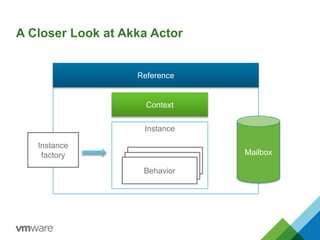
A Closer Look at Akka Actor 
Reference 
Instance 
Instance 
factory 
Context 
Mailbox 
Receive function 
Receive function 
Behavior
Actor State 
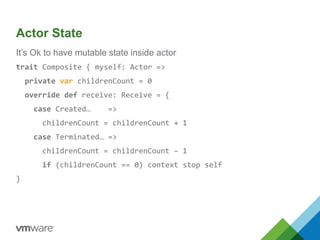
It’s Ok to have mutable state inside actor 
trait Composite { myself: Actor => 
private var childrenCount = 0 
override def receive: Receive = { 
case Created… => 
childrenCount = childrenCount + 1 
case Terminated… => 
childrenCount = childrenCount – 1 
if (childrenCount == 0) context stop self 
}
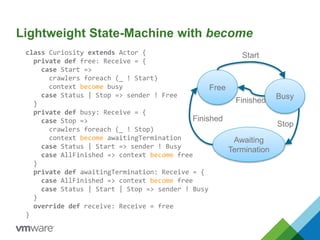
Lightweight State-Machine with become 
class Curiosity extends Actor { 
private def free: Receive = { 
case Start => 
crawlers foreach (_ ! Start) 
context become busy 
case Status | Stop => sender ! Free 
} 
private def busy: Receive = { 
case Stop => 
crawlers foreach (_ ! Stop) 
context become awaitingTermination 
case Status | Start => sender ! Busy 
case AllFinished => context become free 
} 
private def awaitingTermination: Receive = { 
case AllFinished => context become free 
case Status | Start | Stop => sender ! Busy 
} 
override def receive: Receive = free 
} 
Free 
Busy 
Start 
Awaiting 
Termination 
Stop 
Finished 
Finished
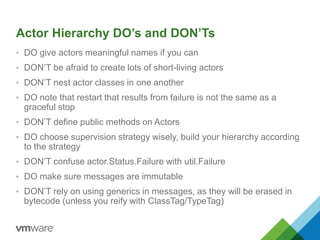
Actor Hierarchy DO’s and DON’Ts 
• DO give actors meaningful names if you can 
• DON’T be afraid to create lots of short-living actors 
• DON’T nest actor classes in one another 
• DO note that restart that results from failure is not the same as a 
graceful stop 
• DON’T define public methods on Actors 
• DO choose supervision strategy wisely, build your hierarchy according 
to the strategy 
• DON’T confuse actor.Status.Failure with util.Failure 
• DO make sure messages are immutable 
• DON’T rely on using generics in messages, as they will be erased in 
bytecode (unless you reify with ClassTag/TypeTag)
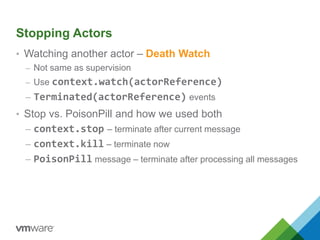
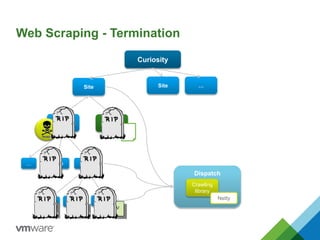
Stopping Actors 
• Watching another actor – Death Watch 
– Not same as supervision 
– Use context.watch(actorReference) 
– Terminated(actorReference) events 
• Stop vs. PoisonPill and how we used both 
– context.stop – terminate after current message 
– context.kill – terminate now 
– PoisonPill message – terminate after processing all messages
Web Scraping - Termination 
Curiosity 
Dispatch 
Crawling 
library 
Netty 
Site … 
Pages 
Page Page 
Page 
… 
Page 
File 
writer 
Site 
… 
k/v k/v k/v
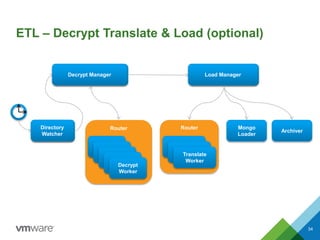
ETL – Decrypt Translate & Load (optional) 
34 
Decrypt Load Router Router 
Load Manager 
Decrypt 
Worker 
Translate 
Worker 
Archiver 
Mongo 
Loader 
Decrypt Manager 
Translate 
WTorarknesrlate 
Worker 
Decrypt 
WDorekcerrypt 
Worker 
Directory 
Watcher 
Decrypt 
WDorekcerrypt 
Worker 
Directory 
Watcher
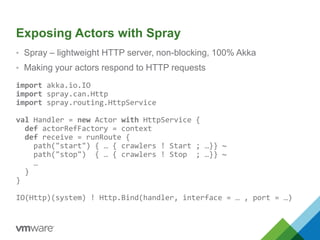
Exposing Actors with Spray 
• Spray – lightweight HTTP server, non-blocking, 100% Akka 
• Making your actors respond to HTTP requests 
import akka.io.IO 
import spray.can.Http 
import spray.routing.HttpService 
val Handler = new Actor with HttpService { 
def actorRefFactory = context 
def receive = runRoute { 
path("start") { … { crawlers ! Start ; …}} ~ 
path("stop") { … { crawlers ! Stop ; …}} ~ 
… 
} 
} 
IO(Http)(system) ! Http.Bind(handler, interface = … , port = …)
Testing Akka 
• ScalaTest – BDD (Given-When-Then) 
• ScalaMock & Mockito 
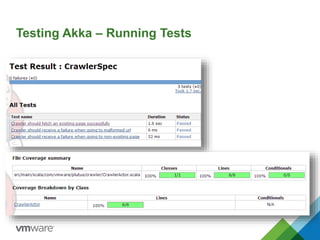
• Measuring Scala code coverage with sbt (scct + cobertura + some 
tricks) 
• Using Akka TestKit + Spray 
• ScalaCheck
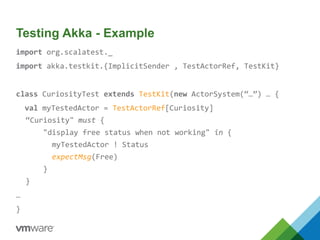
Testing Akka - Example 
import org.scalatest._ 
import akka.testkit.{ImplicitSender , TestActorRef, TestKit} 
class CuriosityTest extends TestKit(new ActorSystem(“…”) … { 
val myTestedActor = TestActorRef[Curiosity] 
“Curiosity" must { 
"display free status when not working" in { 
myTestedActor ! Status 
expectMsg(Free) 
} 
} 
… 
}
Testing Akka – Running Tests
Debugging Akka 
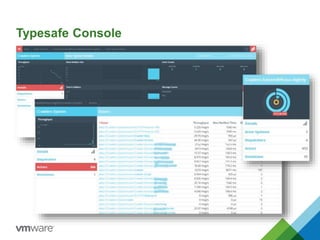
• Typesafe console 
• Logs, watching for DeadLetter 
• Using Scala clone of Yammer Metrics
Typesafe Console
Q&A
Our Amazing Team 
If you want to join, find us at http://vmware.jobs/
Thank You!