Download as PDF, PPTX
![WHY I mean it
and others do...
Scala has a reputation to be accessible
It eases the maths (mostly [matrix] algebra)
The CS world is changing (fast)
It shifts from the cloud to analysis
That is, from IT needs to Market
opportunities](https://image.slidesharecdn.com/scala-and-fp-in-big-data-140710154753-phpapp02/75/Scala-and-fp-in-big-data-3-2048.jpg)
![Reused
knowledgeFact: syntax close to Java, C#, Ruby, ...
Cause: Object Oriented
case class Person( name:String,
first:String,
age:Double,
gender:Gender,
father:Option[Person],
mother:Option[Person],
children:List[Child]=Nil
) {
def incAge(n:Int):Person = copy(age = age+n)
def newSon(child:Person):(Person, Person) = {
val newChild = this.gender match {
case Male => child.copy(father = Some(this))
case Female => child.copy(mother = Some(this))
}
(newChild, this.copy(children = newChild :: children)
}
}
val _Noah = Person("Petrella", "Noah",
age=4, Male,
mother=Some(Sandrine)
father=None)
val boringNoootsab = Person("Petrella", "Andy",
32, Male,
father=Some(Arcangelo),
mother=Some(Nadine))
val (Noah, happyNoootsab) = boringNoootsab.newSon(_Noah)](https://image.slidesharecdn.com/scala-and-fp-in-big-data-140710154753-phpapp02/75/Scala-and-fp-in-big-data-4-2048.jpg)
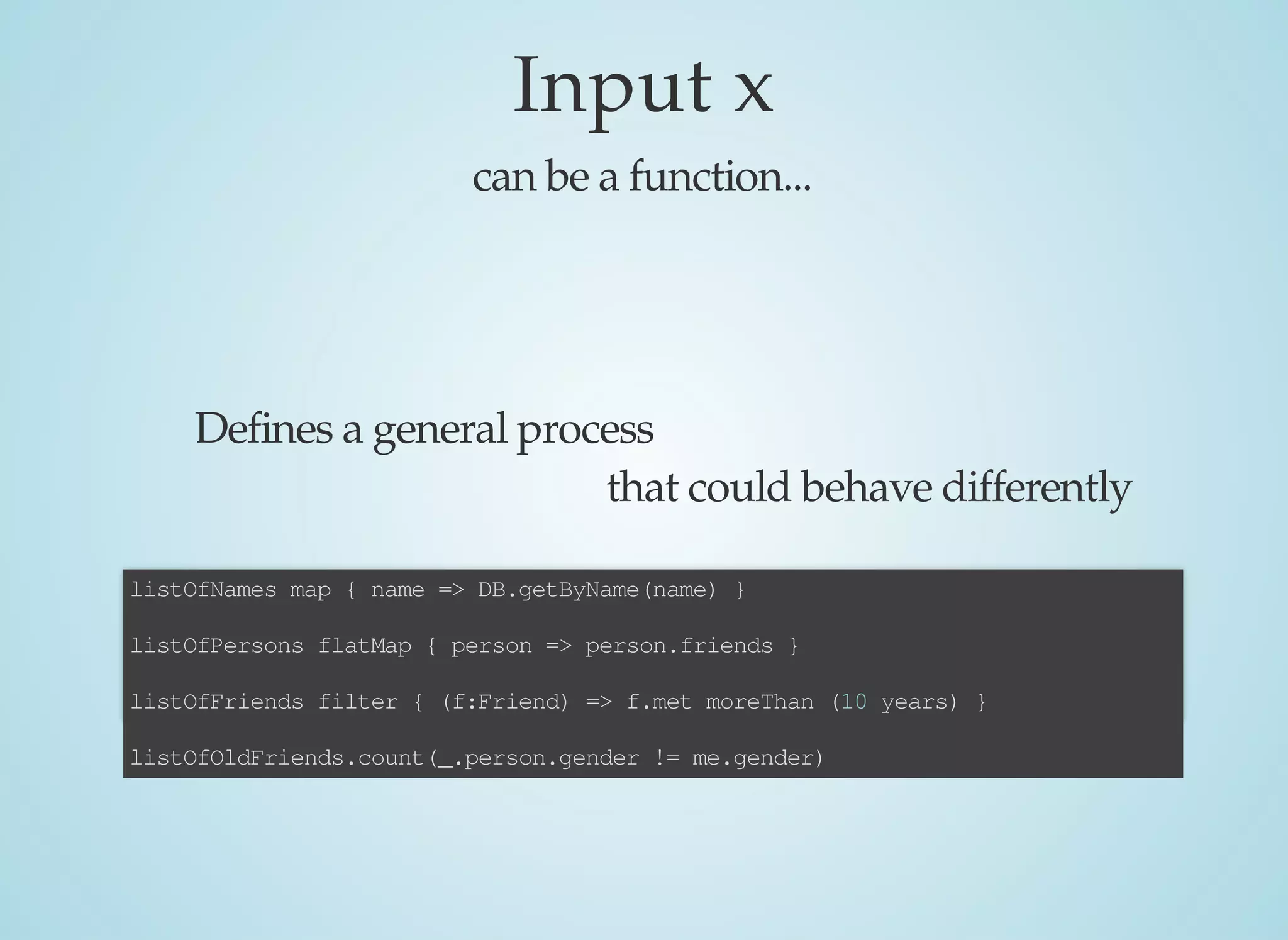
![Output x
bah... can be a function as well...
Prepares a process
that will be available for later usage
def authentication(manager:SecurityManager): User=>Authentication
def source(url:String): Authentication=>DataRepo=>Data
//[...]
val authenticate = authentication(FakeSecurityManager)
val settings = source("/settings")
def request = {
val user = //...
val auth = authenticate(user)
val settingsFetcher = settings(auth)
// and so on
}](https://image.slidesharecdn.com/scala-and-fp-in-big-data-140710154753-phpapp02/75/Scala-and-fp-in-big-data-13-2048.jpg)
![Show me
def lm(x:List[Double], y:List[Double]):((Double, Double), Double=>Double) = {
val n = x.size
val ẍ = x.sum.toDouble / n
val ÿ = y.sum.toDouble / n
val Sp = ((x ·- ẍ) ·* (y ·- ÿ) sum) / (n-1)
val Sx2 = ((x ·- ẍ) ·^ 2 sum) / (n-1)
val ß1 = Sp / Sx2
val ß0 = ÿ - ß1 * ẍ
val coefs = (ß0, ß1)
val predict = (d:Double) => ß0 + ß1 * d
(coefs, predict)
}
def test(ß0:Double = 18.1d, ß1:Double = 6d, error:Int=>List[Double]) = {
val n = 10000
val x:List[Double] = -n.toDouble to n by 1 toList
val e = error(2*n+1)
val y:List[Double] = ß0 ·+: (ß1 ·*: x) ·+: e
lm(x, y)
}
val error = rnorm(mean=0, sigma=5) // gen gaussian nbs
val model = test(103, 7, error)
on
github](https://image.slidesharecdn.com/scala-and-fp-in-big-data-140710154753-phpapp02/75/Scala-and-fp-in-big-data-14-2048.jpg)
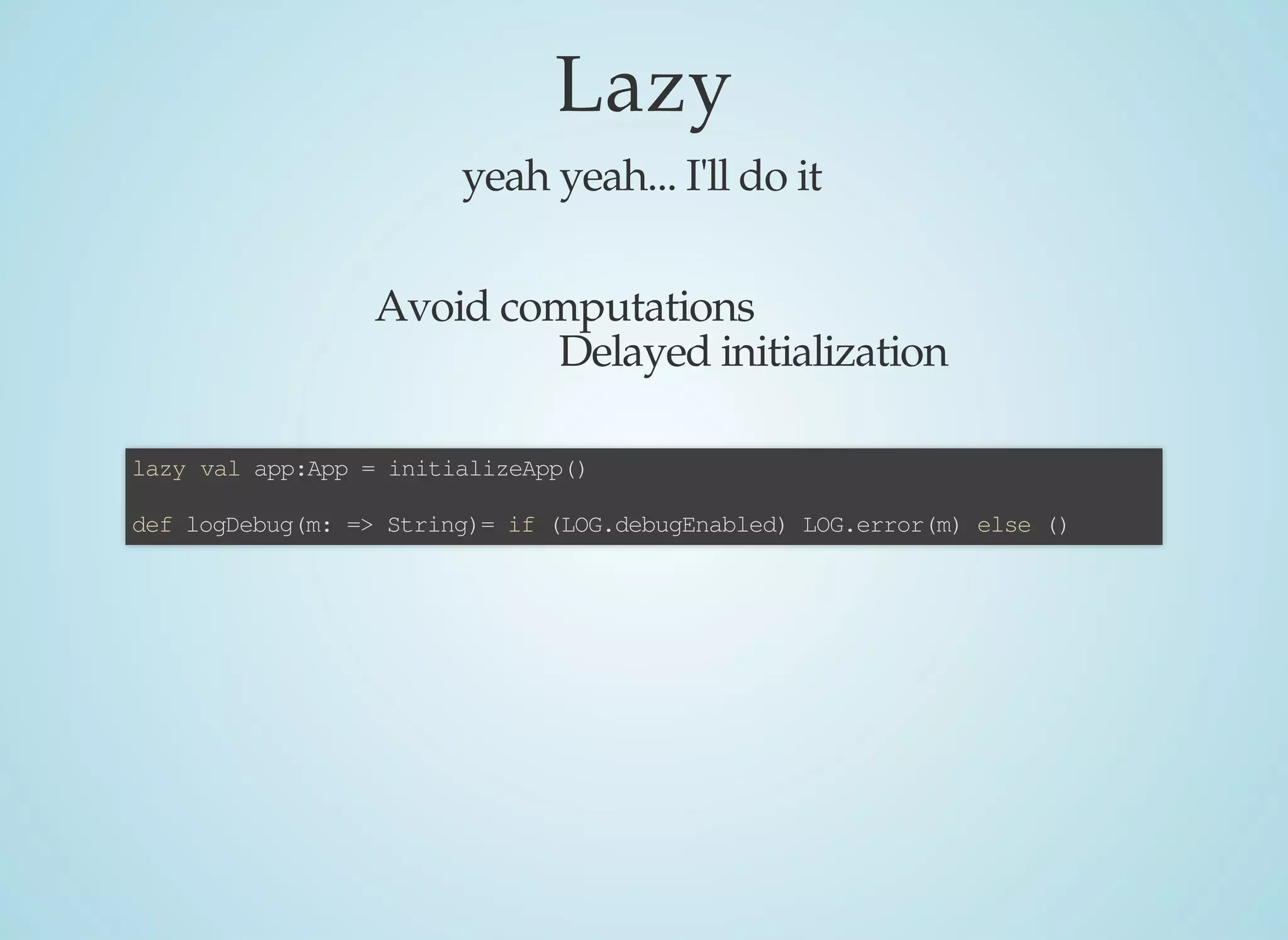
![Sooo laaazy
Come back... in a potential future
TL; DW
val app:Future[App] = initializeApp()
val http:Future[HttpClient] = app.map( _.http.client )
def isOk(url:String):Future[Boolean] =
http.flatMap(client => client.get(url) )
.map( _.code )
.filter( _ == 200 )
.recoverWith {
case x:CommunicationException => isOk(url)
}.recover {
case e: Throwable => false
}](https://image.slidesharecdn.com/scala-and-fp-in-big-data-140710154753-phpapp02/75/Scala-and-fp-in-big-data-16-2048.jpg)
 extends Lazy[A] {
val head = Some(a)
lazy val tail = t
}
def fetch(file:String):Lazy[Future[String]] = {
val texts = io.Source.fromFile(new java.io.File(file)).getLines
def readLine(texts:Iterator[String]):Lazy[Future[String]] = //...
readLine(texts)
}
for the fun →
val fibs:Stream[Int] = 0 #:: 1 #:: ((fibs zip fibs.drop(1)) map ((_:Int) + (_:Int)).tupled)
on
github](https://image.slidesharecdn.com/scala-and-fp-in-big-data-140710154753-phpapp02/75/Scala-and-fp-in-big-data-17-2048.jpg)
![Funky code
trait Data {
def dependent:List[Double]
def observed:Matrix
def bootstrap(proportion:Double):Future[Data]
}
trait Model {
type Coefs
def apply(data:Data):Future[(Coefs, List[Double]=>Future[Double])]
}
def bagging(model:Model)(agg:Aggregation[model.Coefs], n:Int)(data:Data):Future[model.Coef
def exec:Future[model.Coefs] = for {
sample <- data.bootstrap(0.6)
(coefs, _) <- model(sample)
} yield coefs
val execs:List[Future[model.Coefs]] = List.fill(n)(exec)
val coefsList:Future[List[model.Coefs]] = Future.sequence(execs)
val result:Future[model.Coefs] = coefsList map agg
result
}
on
github](https://image.slidesharecdn.com/scala-and-fp-in-big-data-140710154753-phpapp02/75/Scala-and-fp-in-big-data-20-2048.jpg)

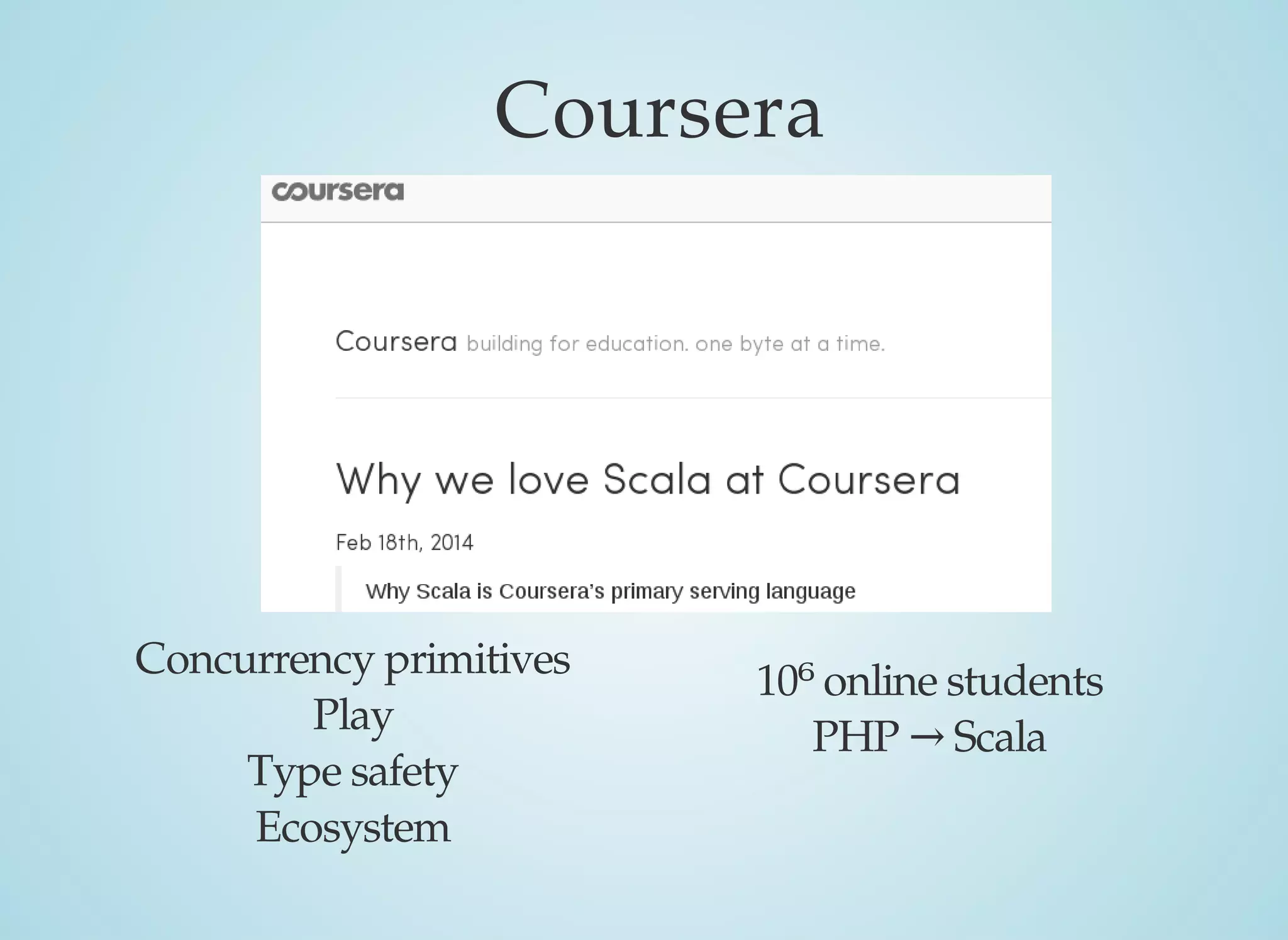
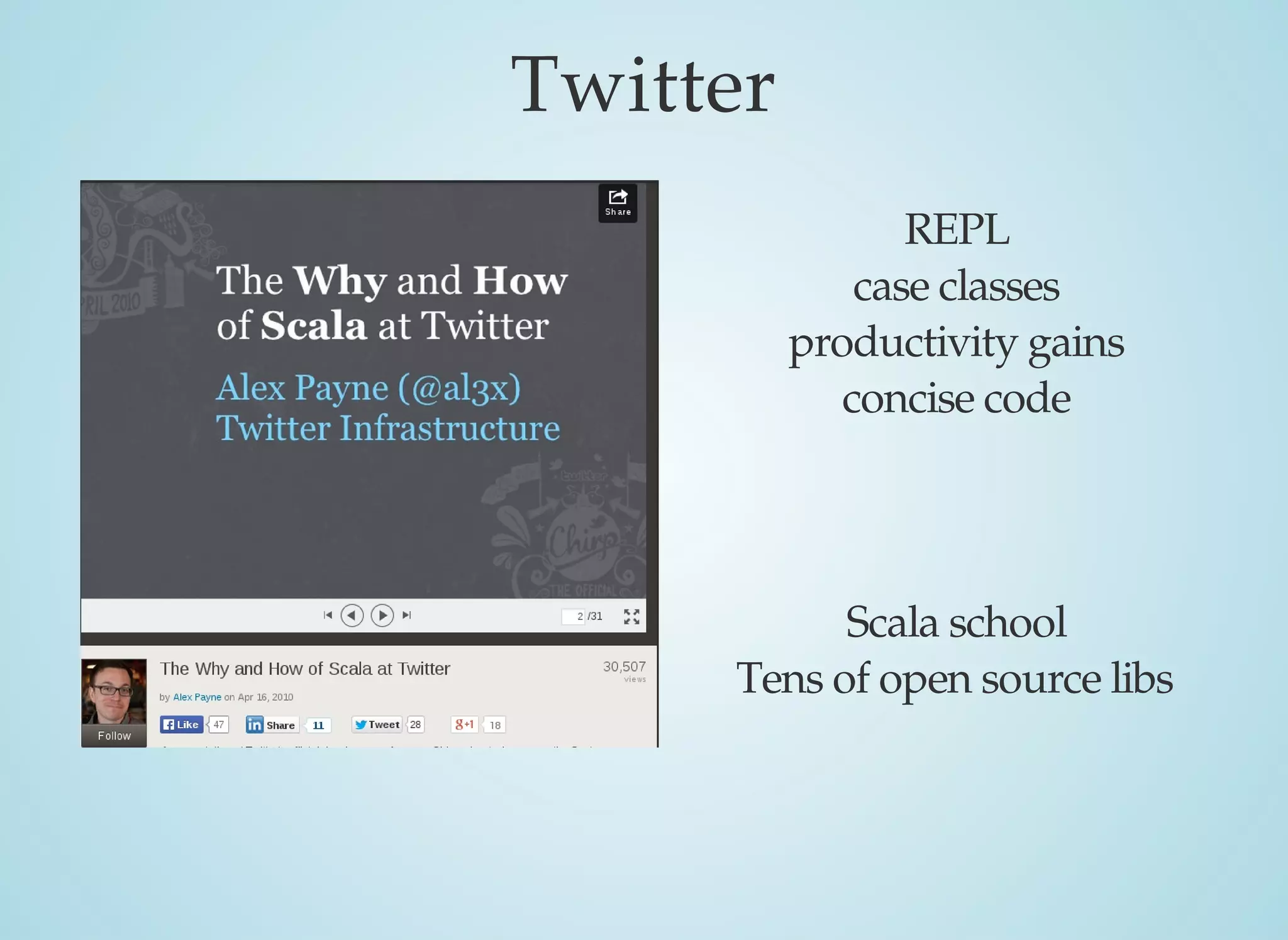
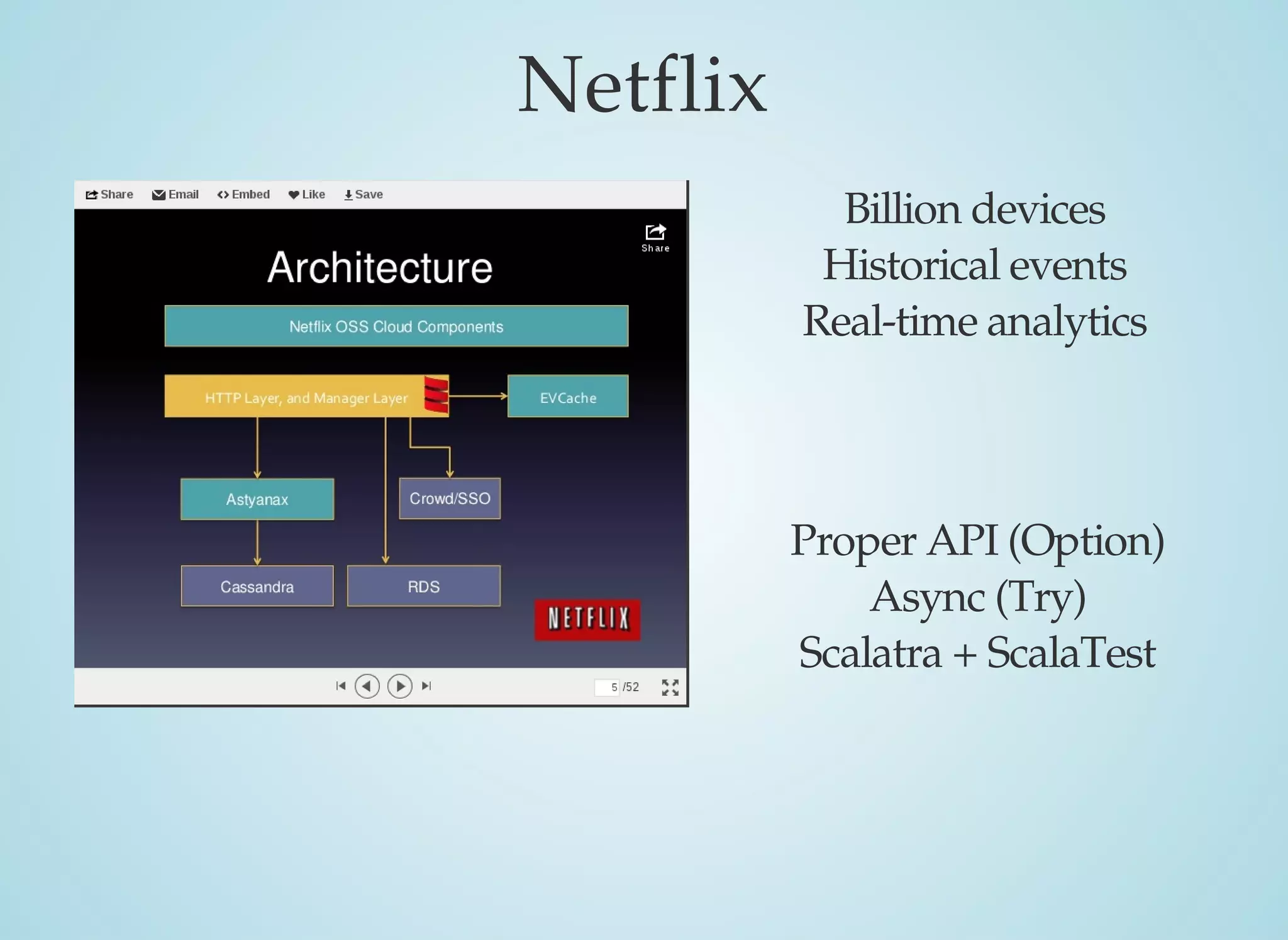
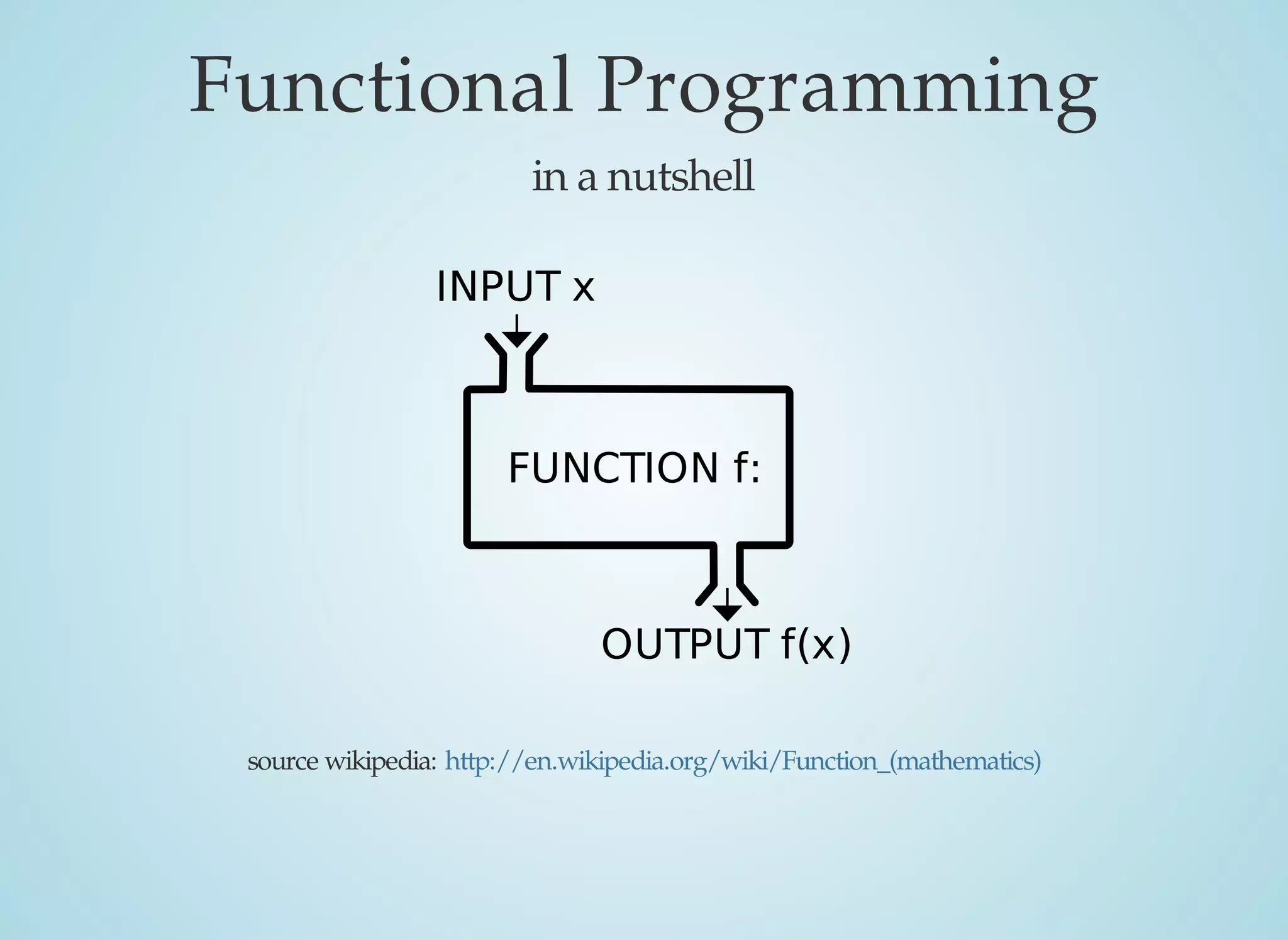
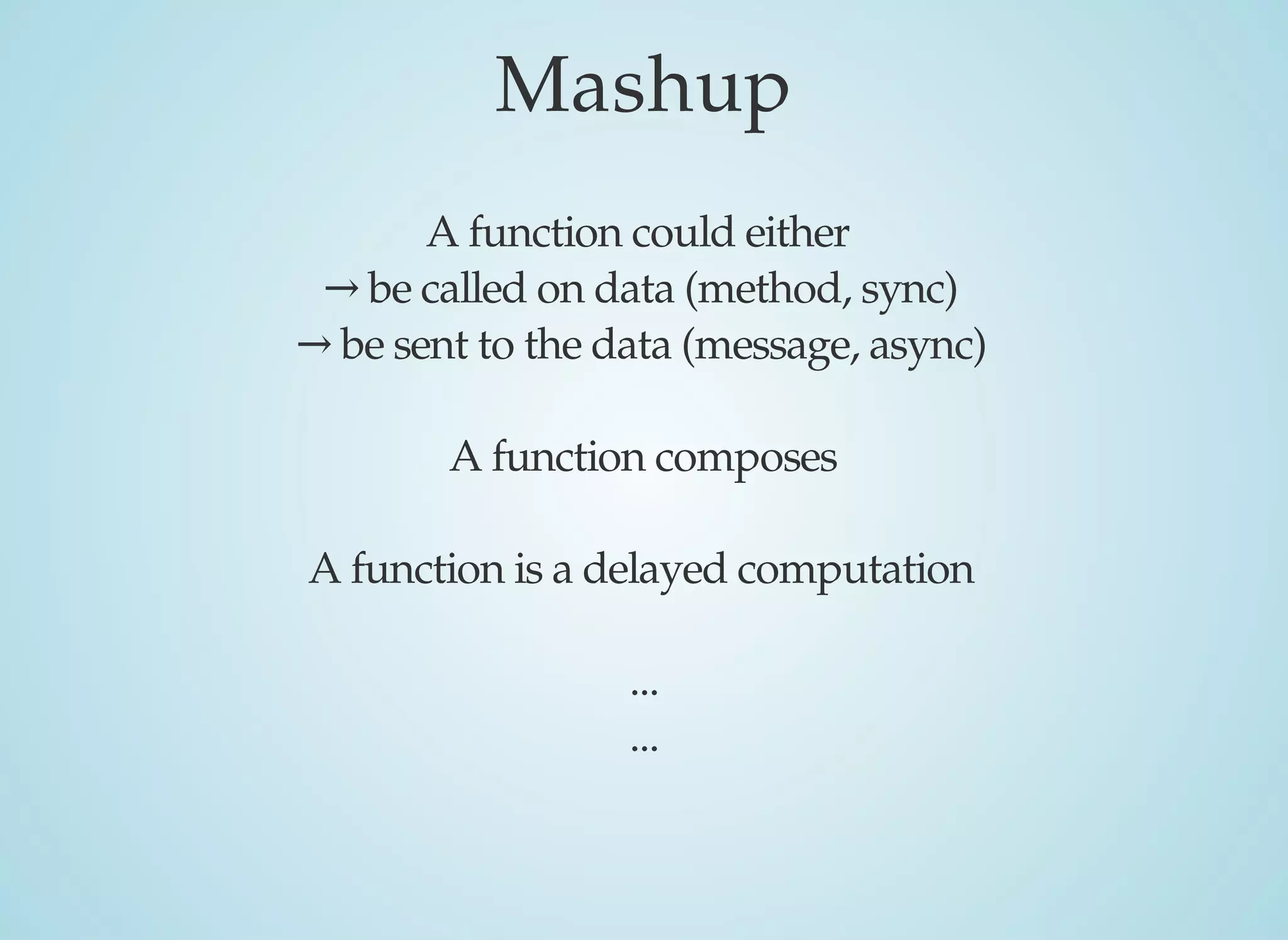
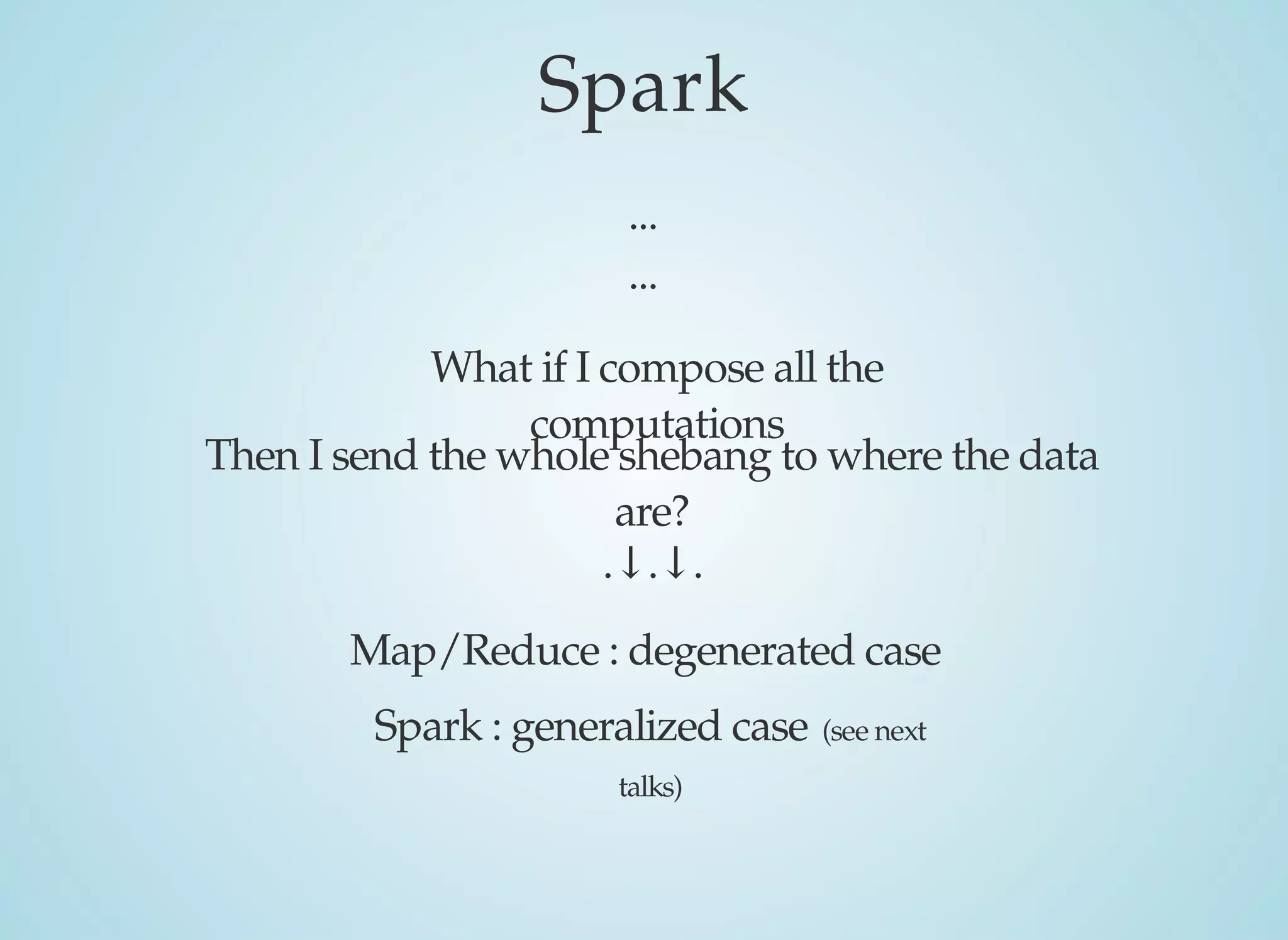
The document discusses Scala and functional programming. It notes that Scala has a reputation for being accessible and easing math concepts like matrix algebra. It has shifted from IT needs to market opportunities. The document discusses how Scala is used by companies like Coursera, Twitter, Netflix, and others for applications involving big data, real-time analytics, and more. It provides examples of functional programming concepts in Scala like mapping, filtering, and lazy evaluation. It also discusses how Spark generalizes the MapReduce model for distributed computing.


![Vibe Coding vs. Spec-Driven Development [Free Meetup]](https://cdn.slidesharecdn.com/ss_thumbnails/vibecodingvsspecdrivendevelopment-251209105622-43f455e7-thumbnail.jpg?width=640&height=640&fit=bounds)


![Coded Agents – with UiPath SDK + LangGraph [Virtual Hands-on Workshop]](https://cdn.slidesharecdn.com/ss_thumbnails/codedagentsdeck-251215155422-5497c599-thumbnail.jpg?width=640&height=640&fit=bounds)


