
SCAFFOLDING INNOVATION THROUGH
                HUMAN-CENTRED DESIGN
                By Jacqueline Wechsler
                University of Technology Sydney, Australia
                Jax@jaxinteractive.com


Wednesday, 17 April 13
Post-graduate Research


                 Masters of Information Technology (Research)
                 University of Technology Sydney, Australia.


                                                                http://www.flickr.com/photos/remeya/1671158725/
Wednesday, 17 April 13
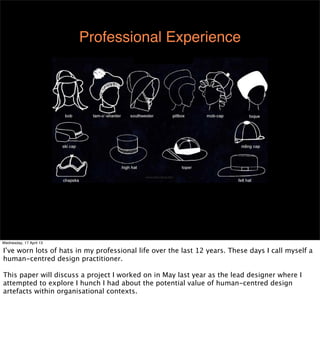
Professional Experience


Wednesday, 17 April 13
HCD & Artefacts


               •    Human-centred Design used by : service designers, UX designers, ‘design
                    thinkers’, strategic designers, interaction designers etc.
               •    Artefact Examples : proto-types, personas, journey maps, process-flows,
                    wire-frames, service blue-prints, conceptual designs etc.


                                                   http://www.flickr.com/photos/7317295@N04/6868882248/sizes/k/in/photostream/
Wednesday, 17 April 13
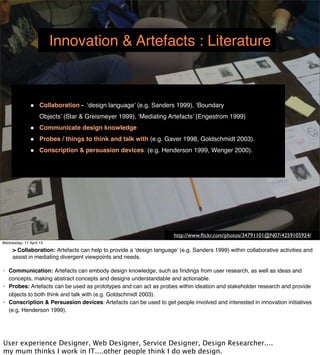
Innovation & Artefacts : Literature


               •    Collaboration - ‘design language’ (e.g. Sanders 1999), ‘Boundary
                    Objects’ (Star & Greismeyer 1999), ‘Mediating Artefacts’ (Engestrom 1999)
               •    Communicate design knowledge
               •    Probes / things to think and talk with (e.g. Gaver 1998, Goldschmidt 2003).
               •    Conscription & persuasion devices: (e.g. Henderson 1999, Wenger 2000).


                                                                   http://www.flickr.com/photos/34791101@N07/4259105924/
Wednesday, 17 April 13
Innovation Work is Social


                         Innovation requires collaboration & advocacy from multiple
                         actors within the organisation across different organisational
                         boundaries (e.g. Fagerberg, Mowery & Nelson 2005).


                                      Fagerberg, J., Mowery, D.C., & Nelson, R.R (eds.) (2005), The Oxford Handbook of
                                                                        Innovation, Oxford University Press, Oxford, UK.
Wednesday, 17 April 13
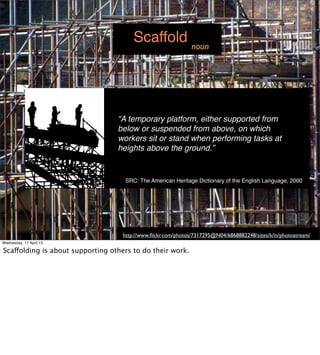
Scaffold noun


                         “A temporary platform, either supported from
                         below or suspended from above, on which
                         workers sit or stand when performing tasks at
                         heights above the ground.”


                           SRC: The American Heritage Dictionary of the English Language, 2000


                          http://www.flickr.com/photos/7317295@N04/6868882248/sizes/k/in/photostream/
Wednesday, 17 April 13
Innovation


                         Radical                 “a change of frame (‘doing what we did not do before’)”


                             vs.

                     Incremental                    “improvements within a given frame of solutions”


                              Norman, D. A., & Verganti, R. 2012, "Incremental and Radical Innovation: Design Research Versus
                                                   Technology and Meaning Change” http://precipice-design.intuitwebsites.com/
                                                      Norman___Verganti__Design_Research___Innovation-18_Mar_2012.pdf
Wednesday, 17 April 13
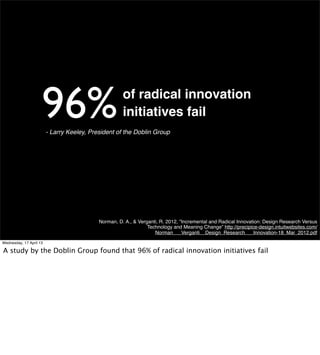
96%                              of radical innovation
                                                      initiatives fail
                         - Larry Keeley, President of the Doblin Group


                                            Norman, D. A., & Verganti, R. 2012, "Incremental and Radical Innovation: Design Research Versus
                                                                 Technology and Meaning Change” http://precipice-design.intuitwebsites.com/
                                                                    Norman___Verganti__Design_Research___Innovation-18_Mar_2012.pdf
Wednesday, 17 April 13
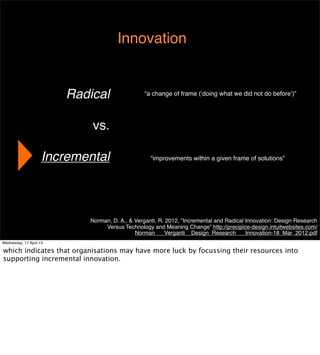
Innovation


                         Radical                “a change of frame (‘doing what we did not do before’)”


                             vs.

                     Incremental                   “improvements within a given frame of solutions”


                            Norman, D. A., & Verganti, R. 2012, "Incremental and Radical Innovation: Design Research
                                 Versus Technology and Meaning Change” http://precipice-design.intuitwebsites.com/
                                             Norman___Verganti__Design_Research___Innovation-18_Mar_2012.pdf
Wednesday, 17 April 13
Design-led Innovation


                                          In 2011 the European Commission launched the European Design
                                          Innovation Initiative (EDII) stated:

                                           ““by 2020, design is a fully acknowledged, well-known,
                                           well-recognised element of innovation policy across Europe”


                          Peter Droll, European Commission, speaking at the SEE conference, 29 March 2011
                                                              http://www.flickr.com/photos/toasty/1540997910/
Wednesday, 17 April 13
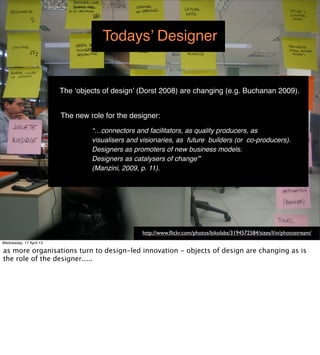
Todays’ Designer


                         The ‘objects of design’ (Dorst 2008) are changing (e.g. Buchanan 2009).


                         The new role for the designer:
                                  “…connectors and facilitators, as quality producers, as
                                  visualisers and visionaries, as future builders (or co-producers).
                                  Designers as promoters of new business models.
                                  Designers as catalysers of change”
                                  (Manzini, 2009, p. 11).


                                                  http://www.flickr.com/photos/bikolabs/3194572584/sizes/l/in/photostream/
Wednesday, 17 April 13
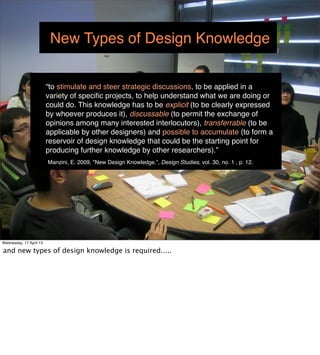
New Types of Design Knowledge


                         “to stimulate and steer strategic discussions, to be applied in a
                         variety of specific projects, to help understand what we are doing or
                         could do. This knowledge has to be explicit (to be clearly expressed
                         by whoever produces it), discussable (to permit the exchange of
                         opinions among many interested interlocutors), transferrable (to be
                         applicable by other designers) and possible to accumulate (to form a
                         reservoir of design knowledge that could be the starting point for
                         producing further knowledge by other researchers).”
                         Manzini, E. 2009, "New Design Knowledge.”, Design Studies, vol. 30, no. 1 , p. 12.


Wednesday, 17 April 13
Design Practice


Wednesday, 17 April 13
Design Practice
                                   is social


                          e.g. Bucciarelli, L.L. (1994), Designing Engineers, MIT Press Cambridge MA, USA

Wednesday, 17 April 13
Design Practice
                         requires the production of artefacts


Wednesday, 17 April 13
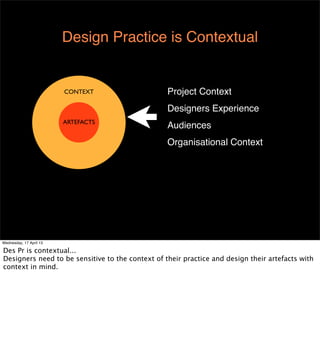
Design Practice is Contextual


                         CONTEXT        Project Context
                                        Designers Experience
                         ARTEFACTS
                          CONTECT
                                        Audiences
                                        Organisational Context


Wednesday, 17 April 13
An Opportunity?


                           Can designers help to scaffold innovation
                          within organisations through the delivery of
                          consciously crafted design representations
                         which can be used by staff members to enable
                         and facilitate service improvement initiatives?


Wednesday, 17 April 13
Key Considerations


                         •   Considering the context surrounding innovation initiatives

                         •   Making deliverables use-ful for others


Wednesday, 17 April 13
The Case-Study Project


                  Project Brief:    Improve the ordering capabilities for a group of B2B customers
                                    through the online channel using human-centred design approaches.


                 Organisation:      •   Large Australian organisation with 40,000 staff
                                    •   Strategic drive to be more customer-centred
                                    •   Heavily silo-ed with distributed work-force


                         My Role:   Lead designer on project on a 6 month contract


Wednesday, 17 April 13
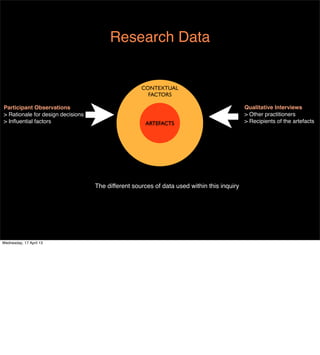
Research Data


                                                    CONTEXTUAL
                                                      FACTORS

Participant Observations                                                                    Qualitative Interviews
> Rationale for design decisions                                                            > Other practitioners
> Influential factors                                 ARTEFACTS                              > Recipients of the artefacts


                                   The different sources of data used within this inquiry


Wednesday, 17 April 13
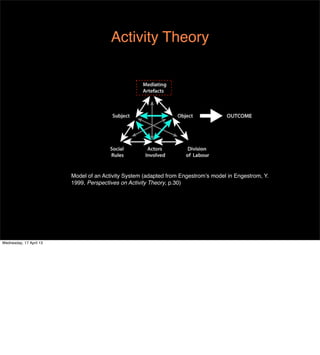
Activity Theory


                         Model of an Activity System (adapted from Engestrom’s model in Engestrom, Y.
                         1999, Perspectives on Activity Theory, p.30)


Wednesday, 17 April 13
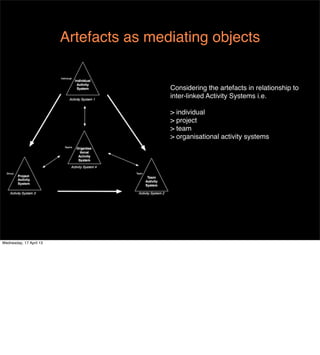
Artefacts as mediating objects


                                         Considering the artefacts in relationship to
                                         inter-linked Activity Systems i.e.

                                         > individual
                                         > project
                                         > team
                                         > organisational activity systems


Wednesday, 17 April 13
Artefact Examples (www)


                                                                                                                                                                                                                         Video Prototype
                   Research Videos                                                                           Customer Journey Maps
                                                                                                                                                                                                                      (Animated wire-frames)


                                                                        Christian                        [ Strategic IT Partner ]                   PRODUCT TYPE

                                                                        “As IT partners we need different processes to                              simplex (traditional)                         complex (data)
                                                                        traditional dealers...there is money in data solutions.”
                                                                                                                                                    SPECIFIC PRODUCTS
                                                                          Age: 32                                                                   TIPT, TID, Next IP, T-Suite, Video Conferencing, MDN,
                                                                          Role: Data Sales Specialist at Futureproof IT                             NCS, Cloud
                                                                          Residence: Westend, Brisbane.                                             TELSTRA SYSTEMS
                                                                          Family Status: Single no kids (lives with girl-friend)                    eForm, DTP, Retail Live, Netcracker, All4Biz., CustData


                                  “Customers [via AEs] come to us           Goals                                                               Pain-points
                                  with a problem...we design and            + Increase sales (and increased commissions)                        + Ordering process is too manual and time-consuming
                                  implement a solution to solve it.””       + Growth of his own client portfolios                               + Inefficient pre-sales support
                                                                            + Provide value and expertise for his clients                       + Manual management of opportunities (lack of a CRM )
                                  “We have excellent technical              + Awareness of new IT/comms technologies/products                   + Payment of commissions is poor
                                  knowledge...we train Telstra more                                                                             + Lack of access to customer information
                                  than they train us.”                      Needs:                                                              + Getting blamed by Telstra for issues when it is their fault
                                                                            + Information, training and collatoral about Telstra products
                                                                                                                                                + Passwords to Retail Live expire every 30 days
                                  “ICT channel managers really hold         + Streamlined ordering and provisioning of products
                                  things together as there is a real        + Visibility of order related information (tracking, status etc.)
                                  lack of support from within Telstra.”     + A way to easily manage commissions                                Work Responsibilities
                                                                            + Better pre-sales support / CRM capabilities                       + Recommend and sell data solutions
                                  “The majority of my sales leads           + Easy collaboration with Telstra and other vendors to manage       + Technical design of data solutions
                                  come from Telstra...We see Telstra        projects                                                            + Management of integration of multiple products from
                                  as a partner not as a competitor.”                                                                            multiple vendors utilising Telstra infrastructure
                                                                            Telstra Touch Points                                                + Stay up to date about new products
                                                                            + Telstra AEs and Project Managers                                  + Keep up to date with trends in IT business solutions
                                Employer: Futureproof IT                    + ICT Channel Manager
                                                                            + Distributors (utilsed for provisioning)
                                Futureproof are a strategic IT partner                                                                          How Telstra Can Support Him Better
                                                                            + Telstra Technical Communication Consultants (TCC)
                                based in Brisbane. They partner with                                                                            + Marketing collateral and training for new products pro-
                                                                            + Retail Live
                                Cisco, Mircrosoft and Dell. They offer                                                         @                vided before or at time of product launch
                                clients integrated cloud based busi-        Touch-points                                                        + CRM tool to help him manage Telstra sales leads
                                ness solutions providing network,                                                                               (customer information, the associated AE, TB /TEG? etc.)
                                infrastructre and IT design expertise.      PRE-SALES                    X      X             X      X          + More streamlined and less manual ordering processes
                                Their primary sales leads come from         SALES                        X      X      X      X                 + Improved commission processes / faster payment
                                Microsoft and Telstra and their clients
                                are mainly assigned medium to en-
                                                                            ORDERING                     X      X      X      X                 + Tracking capability for orders
                                                                                                                                                + Make it easy to for him to collaborate & manage de-
                                terprise business customers.
                                                                            PROVISIONING                               X      X                 pendencies with Telstra and other vendors for his orders
                                                                            COMMISSIONS                         X      X      X


                                                                                          Personas                                                                                                                 Info-graphics
Wednesday, 17 April 13
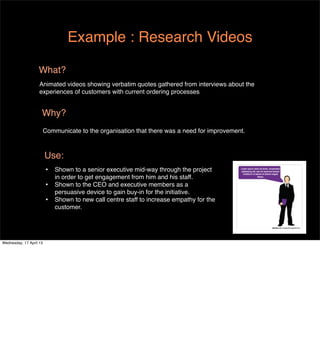
Example : Research Videos

                   What?
                    Animated videos showing verbatim quotes gathered from interviews about the
                    experiences of customers with current ordering processes


                     Why?
                         Communicate to the organisation that there was a need for improvement.


                         Use:
                         •   Shown to a senior executive mid-way through the project
                             in order to get engagement from him and his staff.
                         •   Shown to the CEO and executive members as a
                             persuasive device to gain buy-in for the initiative.
                         •   Shown to new call centre staff to increase empathy for the
                             customer.


Wednesday, 17 April 13
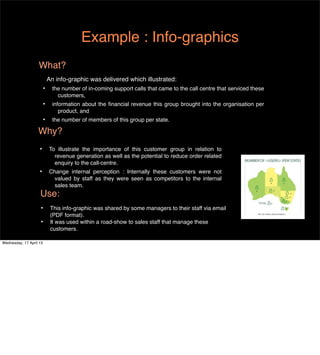
Example : Info-graphics
                   What?
                             An info-graphic was delivered which illustrated:
                         •     the number of in-coming support calls that came to the call centre that serviced these
                                 customers,
                         •     information about the financial revenue this group brought into the organisation per
                                  product, and
                         •     the number of members of this group per state.

                   Why?
                    •        To illustrate the importance of this customer group in relation to
                               revenue generation as well as the potential to reduce order related
                               enquiry to the call-centre.
                    •        Change internal perception : Internally these customers were not
                              valued by staff as they were seen as competitors to the internal
                              sales team.
                    Use:
                    •         This info-graphic was shared by some managers to their staff via email
                              (PDF format).
                    •         It was used within a road-show to sales staff that manage these
                              customers.

Wednesday, 17 April 13
The artefacts were described as:                Re: [i.e. videos & info-graphic]
        “succinct”, “visually memorable”, “fresh    “It’s almost viral in a sense because you
       and accessible” and can be “used by any       have a snack sized asset you can pass
               stakeholder at any level”           around to people. So in terms of changing
                                                   the culture that’s a very nice way to do it.”


                         ARTEFACTS : STAFF PERCEPTION

                                                     “they help to bring not only awareness but
                                                        to create interest and it may help to
       ! “Using these kinds of artefects and          influence stakeholders in the right way.”
       frameworks could possibly help keep the
       customers and the users front of mind…”


Wednesday, 17 April 13
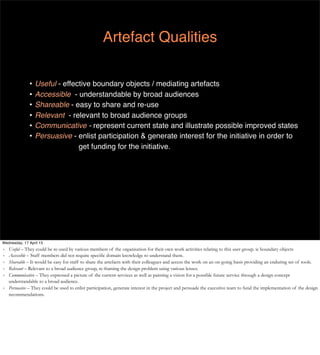
Artefact Qualities

              • Useful - effective boundary objects / mediating artefacts
              • Accessible - understandable by broad audiences
              • Shareable - easy to share and re-use
              • Relevant - relevant to broad audience groups
              • Communicative - represent current state and illustrate possible improved states
              • Persuasive - enlist participation & generate interest for the initiative in order to
                             get funding for the initiative.


Wednesday, 17 April 13
Scaffolding Innovation


                         It can be advantageous to consider design artefacts as
                         mediating objects that can inform innovation initiatives in various ways.


Wednesday, 17 April 13
Scaffolding Innovation


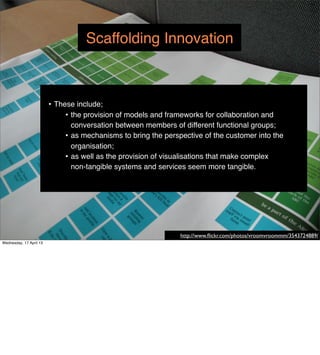
                         • These include;
                              • the provision of models and frameworks for collaboration and
                                conversation between members of different functional groups;
                              • as mechanisms to bring the perspective of the customer into the
                                organisation;
                              • as well as the provision of visualisations that make complex
                                non-tangible systems and services seem more tangible.


                                                                http://www.flickr.com/photos/vroomvroommm/3543724889/
Wednesday, 17 April 13
Scaffolding Innovation


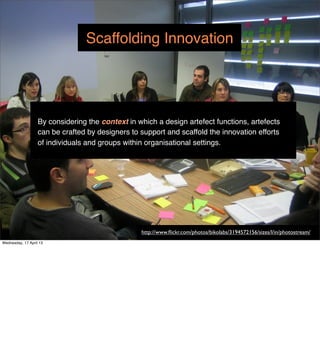
                   By considering the context in which a design artefect functions, artefects
                   can be crafted by designers to support and scaffold the innovation efforts
                   of individuals and groups within organisational settings.


                                                  http://www.flickr.com/photos/bikolabs/3194572156/sizes/l/in/photostream/
Wednesday, 17 April 13
The Opportunity


                         A real opportunity exists for designers to help facilitate and support
                         innovation within organisational contexts through the delivery of
                         consciously crafted design artefects.


                                                            http://www.flickr.com/photos/alveart/6346803873/in/photostream/
Wednesday, 17 April 13
QUESTIONS?


                 jax@jaxinteractive.com
                                                          http://jaxinteractive.com
                 twitter: @jacwex                         http://cocreatingchange.com
                au.linkedin.com/in/jacquelinewechsler/

Wednesday, 17 April 13
References
             Bucciarelli, L.L. (1994), Designing Engineers, MIT Press Cambridge MA, USA.
             Dorst, C H. (2008), “Design Research: A Revolution-Waiting-To-Happen", Design Studies, Vol. 29, No. 1, pp. 4-11
             Droll, P. (2011), European Commission, speaking at the SEE conference, Retrieved 03 29 2011, from http://
               www.seeplatform.eu/
             Engeström, Y. (1999), “Innovative learning in work teams: analysing cycles of knowledge creation in practice”, in
               Enegström, Y., Miettinen, R., Punamäki, R.L., (eds.), Perspectives on Activity Theory, Cambridge University Press,
               Cambridge, USA, pp. 377-406.
             European Commission (2009), Challenges for EU support to innovation in services - Fostering new markets and jobs
               through innovation, Commission Staff Working Document, SEC(2009)1195,
             Fagerberg, J., Mowery, D.C., & Nelson, R.R (eds.) (2005), The Oxford Handbook of Innovation, Oxford University Press,
               Oxford, UK.
             Houghton Mifflin Company (2000), Fourth Edition, The American Heritage Dictionary of the English Language, Houghton
               Mifflin Company. Updated in 2009. 
             Manzini, E. (2009), "New Design Knowledge.”, Design Studies, Vol. 30, No. 1 , pp.4-12.
             Margolin V. (2002). The Politics of the Artificial: Essays on Design and Design Studies, University of Chicago Press,
               Chicago, USA.
             Norman, D. A., & Verganti, R. (2012), "Incremental and Radical Innovation: Design Research Versus Technology and
               Meaning Change”, Retrieved 05 03 2012, from http://precipice-design.intuitwebsites.com/
               Norman___Verganti__Design_Research___Innovation-18_Mar_2012.pdf
             Sanders, E.B.N. (1999), “Design for Experiencing: New Tools” in Overbeeke, C.J. and Hekkert, P. (Eds.), in Proceedings of
               the First International Conference on Design and Emotion, TU Delft.
             Sanders, E B N. (2006), "Design Research in 2006." Design Research Quarterly, Vol.1, No. 1, pp 1-8.
             Star, S.L., and James R Griesemer, J.R., (1989), "Institutional Ecology, 'Translations' and Boundary Objects: Amateurs and
               Professionals in Berkeley's Museum of Vertebrate Zoology”, Social Studies of Science, vol. 19, no. 3, pp 1907-39.


Wednesday, 17 April 13

Scaffolding Innovation Through Human-Centred Design

  • 1.
    SCAFFOLDING INNOVATION THROUGH HUMAN-CENTRED DESIGN By Jacqueline Wechsler University of Technology Sydney, Australia Jax@jaxinteractive.com Wednesday, 17 April 13
  • 2.
    Post-graduate Research Masters of Information Technology (Research) University of Technology Sydney, Australia. http://www.flickr.com/photos/remeya/1671158725/ Wednesday, 17 April 13
  • 3.
  • 4.
    HCD & Artefacts • Human-centred Design used by : service designers, UX designers, ‘design thinkers’, strategic designers, interaction designers etc. • Artefact Examples : proto-types, personas, journey maps, process-flows, wire-frames, service blue-prints, conceptual designs etc. http://www.flickr.com/photos/7317295@N04/6868882248/sizes/k/in/photostream/ Wednesday, 17 April 13
  • 5.
    Innovation & Artefacts: Literature • Collaboration - ‘design language’ (e.g. Sanders 1999), ‘Boundary Objects’ (Star & Greismeyer 1999), ‘Mediating Artefacts’ (Engestrom 1999) • Communicate design knowledge • Probes / things to think and talk with (e.g. Gaver 1998, Goldschmidt 2003). • Conscription & persuasion devices: (e.g. Henderson 1999, Wenger 2000). http://www.flickr.com/photos/34791101@N07/4259105924/ Wednesday, 17 April 13
  • 6.
    Innovation Work isSocial Innovation requires collaboration & advocacy from multiple actors within the organisation across different organisational boundaries (e.g. Fagerberg, Mowery & Nelson 2005). Fagerberg, J., Mowery, D.C., & Nelson, R.R (eds.) (2005), The Oxford Handbook of Innovation, Oxford University Press, Oxford, UK. Wednesday, 17 April 13
  • 7.
    Scaffold noun “A temporary platform, either supported from below or suspended from above, on which workers sit or stand when performing tasks at heights above the ground.” SRC: The American Heritage Dictionary of the English Language, 2000 http://www.flickr.com/photos/7317295@N04/6868882248/sizes/k/in/photostream/ Wednesday, 17 April 13
  • 8.
    Innovation Radical “a change of frame (‘doing what we did not do before’)” vs. Incremental “improvements within a given frame of solutions” Norman, D. A., & Verganti, R. 2012, "Incremental and Radical Innovation: Design Research Versus Technology and Meaning Change” http://precipice-design.intuitwebsites.com/ Norman___Verganti__Design_Research___Innovation-18_Mar_2012.pdf Wednesday, 17 April 13
  • 9.
    96% of radical innovation initiatives fail - Larry Keeley, President of the Doblin Group Norman, D. A., & Verganti, R. 2012, "Incremental and Radical Innovation: Design Research Versus Technology and Meaning Change” http://precipice-design.intuitwebsites.com/ Norman___Verganti__Design_Research___Innovation-18_Mar_2012.pdf Wednesday, 17 April 13
  • 10.
    Innovation Radical “a change of frame (‘doing what we did not do before’)” vs. Incremental “improvements within a given frame of solutions” Norman, D. A., & Verganti, R. 2012, "Incremental and Radical Innovation: Design Research Versus Technology and Meaning Change” http://precipice-design.intuitwebsites.com/ Norman___Verganti__Design_Research___Innovation-18_Mar_2012.pdf Wednesday, 17 April 13
  • 11.
    Design-led Innovation In 2011 the European Commission launched the European Design Innovation Initiative (EDII) stated: ““by 2020, design is a fully acknowledged, well-known, well-recognised element of innovation policy across Europe” Peter Droll, European Commission, speaking at the SEE conference, 29 March 2011 http://www.flickr.com/photos/toasty/1540997910/ Wednesday, 17 April 13
  • 12.
    Todays’ Designer The ‘objects of design’ (Dorst 2008) are changing (e.g. Buchanan 2009). The new role for the designer: “…connectors and facilitators, as quality producers, as visualisers and visionaries, as future builders (or co-producers). Designers as promoters of new business models. Designers as catalysers of change” (Manzini, 2009, p. 11). http://www.flickr.com/photos/bikolabs/3194572584/sizes/l/in/photostream/ Wednesday, 17 April 13
  • 13.
    New Types ofDesign Knowledge “to stimulate and steer strategic discussions, to be applied in a variety of specific projects, to help understand what we are doing or could do. This knowledge has to be explicit (to be clearly expressed by whoever produces it), discussable (to permit the exchange of opinions among many interested interlocutors), transferrable (to be applicable by other designers) and possible to accumulate (to form a reservoir of design knowledge that could be the starting point for producing further knowledge by other researchers).” Manzini, E. 2009, "New Design Knowledge.”, Design Studies, vol. 30, no. 1 , p. 12. Wednesday, 17 April 13
  • 14.
  • 15.
    Design Practice is social e.g. Bucciarelli, L.L. (1994), Designing Engineers, MIT Press Cambridge MA, USA Wednesday, 17 April 13
  • 16.
    Design Practice requires the production of artefacts Wednesday, 17 April 13
  • 17.
    Design Practice isContextual CONTEXT Project Context Designers Experience ARTEFACTS CONTECT Audiences Organisational Context Wednesday, 17 April 13
  • 18.
    An Opportunity? Can designers help to scaffold innovation within organisations through the delivery of consciously crafted design representations which can be used by staff members to enable and facilitate service improvement initiatives? Wednesday, 17 April 13
  • 19.
    Key Considerations • Considering the context surrounding innovation initiatives • Making deliverables use-ful for others Wednesday, 17 April 13
  • 20.
    The Case-Study Project Project Brief: Improve the ordering capabilities for a group of B2B customers through the online channel using human-centred design approaches. Organisation: • Large Australian organisation with 40,000 staff • Strategic drive to be more customer-centred • Heavily silo-ed with distributed work-force My Role: Lead designer on project on a 6 month contract Wednesday, 17 April 13
  • 21.
    Research Data CONTEXTUAL FACTORS Participant Observations Qualitative Interviews > Rationale for design decisions > Other practitioners > Influential factors ARTEFACTS > Recipients of the artefacts The different sources of data used within this inquiry Wednesday, 17 April 13
  • 22.
    Activity Theory Model of an Activity System (adapted from Engestrom’s model in Engestrom, Y. 1999, Perspectives on Activity Theory, p.30) Wednesday, 17 April 13
  • 23.
    Artefacts as mediatingobjects Considering the artefacts in relationship to inter-linked Activity Systems i.e. > individual > project > team > organisational activity systems Wednesday, 17 April 13
  • 24.
    Artefact Examples (www) Video Prototype Research Videos Customer Journey Maps (Animated wire-frames) Christian [ Strategic IT Partner ] PRODUCT TYPE “As IT partners we need different processes to simplex (traditional) complex (data) traditional dealers...there is money in data solutions.” SPECIFIC PRODUCTS Age: 32 TIPT, TID, Next IP, T-Suite, Video Conferencing, MDN, Role: Data Sales Specialist at Futureproof IT NCS, Cloud Residence: Westend, Brisbane. TELSTRA SYSTEMS Family Status: Single no kids (lives with girl-friend) eForm, DTP, Retail Live, Netcracker, All4Biz., CustData “Customers [via AEs] come to us Goals Pain-points with a problem...we design and + Increase sales (and increased commissions) + Ordering process is too manual and time-consuming implement a solution to solve it.”” + Growth of his own client portfolios + Inefficient pre-sales support + Provide value and expertise for his clients + Manual management of opportunities (lack of a CRM ) “We have excellent technical + Awareness of new IT/comms technologies/products + Payment of commissions is poor knowledge...we train Telstra more + Lack of access to customer information than they train us.” Needs: + Getting blamed by Telstra for issues when it is their fault + Information, training and collatoral about Telstra products + Passwords to Retail Live expire every 30 days “ICT channel managers really hold + Streamlined ordering and provisioning of products things together as there is a real + Visibility of order related information (tracking, status etc.) lack of support from within Telstra.” + A way to easily manage commissions Work Responsibilities + Better pre-sales support / CRM capabilities + Recommend and sell data solutions “The majority of my sales leads + Easy collaboration with Telstra and other vendors to manage + Technical design of data solutions come from Telstra...We see Telstra projects + Management of integration of multiple products from as a partner not as a competitor.” multiple vendors utilising Telstra infrastructure Telstra Touch Points + Stay up to date about new products + Telstra AEs and Project Managers + Keep up to date with trends in IT business solutions Employer: Futureproof IT + ICT Channel Manager + Distributors (utilsed for provisioning) Futureproof are a strategic IT partner How Telstra Can Support Him Better + Telstra Technical Communication Consultants (TCC) based in Brisbane. They partner with + Marketing collateral and training for new products pro- + Retail Live Cisco, Mircrosoft and Dell. They offer @ vided before or at time of product launch clients integrated cloud based busi- Touch-points + CRM tool to help him manage Telstra sales leads ness solutions providing network, (customer information, the associated AE, TB /TEG? etc.) infrastructre and IT design expertise. PRE-SALES X X X X + More streamlined and less manual ordering processes Their primary sales leads come from SALES X X X X + Improved commission processes / faster payment Microsoft and Telstra and their clients are mainly assigned medium to en- ORDERING X X X X + Tracking capability for orders + Make it easy to for him to collaborate & manage de- terprise business customers. PROVISIONING X X pendencies with Telstra and other vendors for his orders COMMISSIONS X X X Personas Info-graphics Wednesday, 17 April 13
  • 25.
    Example : ResearchVideos What? Animated videos showing verbatim quotes gathered from interviews about the experiences of customers with current ordering processes Why? Communicate to the organisation that there was a need for improvement. Use: • Shown to a senior executive mid-way through the project in order to get engagement from him and his staff. • Shown to the CEO and executive members as a persuasive device to gain buy-in for the initiative. • Shown to new call centre staff to increase empathy for the customer. Wednesday, 17 April 13
  • 26.
    Example : Info-graphics What? An info-graphic was delivered which illustrated: • the number of in-coming support calls that came to the call centre that serviced these customers, • information about the financial revenue this group brought into the organisation per product, and • the number of members of this group per state. Why? • To illustrate the importance of this customer group in relation to revenue generation as well as the potential to reduce order related enquiry to the call-centre. • Change internal perception : Internally these customers were not valued by staff as they were seen as competitors to the internal sales team. Use: • This info-graphic was shared by some managers to their staff via email (PDF format). • It was used within a road-show to sales staff that manage these customers. Wednesday, 17 April 13
  • 27.
    The artefacts weredescribed as: Re: [i.e. videos & info-graphic] “succinct”, “visually memorable”, “fresh “It’s almost viral in a sense because you and accessible” and can be “used by any have a snack sized asset you can pass stakeholder at any level” around to people. So in terms of changing the culture that’s a very nice way to do it.” ARTEFACTS : STAFF PERCEPTION “they help to bring not only awareness but to create interest and it may help to ! “Using these kinds of artefects and influence stakeholders in the right way.” frameworks could possibly help keep the customers and the users front of mind…” Wednesday, 17 April 13
  • 28.
    Artefact Qualities • Useful - effective boundary objects / mediating artefacts • Accessible - understandable by broad audiences • Shareable - easy to share and re-use • Relevant - relevant to broad audience groups • Communicative - represent current state and illustrate possible improved states • Persuasive - enlist participation & generate interest for the initiative in order to get funding for the initiative. Wednesday, 17 April 13
  • 29.
    Scaffolding Innovation It can be advantageous to consider design artefacts as mediating objects that can inform innovation initiatives in various ways. Wednesday, 17 April 13
  • 30.
    Scaffolding Innovation • These include; • the provision of models and frameworks for collaboration and conversation between members of different functional groups; • as mechanisms to bring the perspective of the customer into the organisation; • as well as the provision of visualisations that make complex non-tangible systems and services seem more tangible. http://www.flickr.com/photos/vroomvroommm/3543724889/ Wednesday, 17 April 13
  • 31.
    Scaffolding Innovation By considering the context in which a design artefect functions, artefects can be crafted by designers to support and scaffold the innovation efforts of individuals and groups within organisational settings. http://www.flickr.com/photos/bikolabs/3194572156/sizes/l/in/photostream/ Wednesday, 17 April 13
  • 32.
    The Opportunity A real opportunity exists for designers to help facilitate and support innovation within organisational contexts through the delivery of consciously crafted design artefects. http://www.flickr.com/photos/alveart/6346803873/in/photostream/ Wednesday, 17 April 13
  • 33.
    QUESTIONS? jax@jaxinteractive.com http://jaxinteractive.com twitter: @jacwex http://cocreatingchange.com au.linkedin.com/in/jacquelinewechsler/ Wednesday, 17 April 13
  • 34.
    References Bucciarelli, L.L. (1994), Designing Engineers, MIT Press Cambridge MA, USA. Dorst, C H. (2008), “Design Research: A Revolution-Waiting-To-Happen", Design Studies, Vol. 29, No. 1, pp. 4-11 Droll, P. (2011), European Commission, speaking at the SEE conference, Retrieved 03 29 2011, from http:// www.seeplatform.eu/ Engeström, Y. (1999), “Innovative learning in work teams: analysing cycles of knowledge creation in practice”, in Enegström, Y., Miettinen, R., Punamäki, R.L., (eds.), Perspectives on Activity Theory, Cambridge University Press, Cambridge, USA, pp. 377-406. European Commission (2009), Challenges for EU support to innovation in services - Fostering new markets and jobs through innovation, Commission Staff Working Document, SEC(2009)1195, Fagerberg, J., Mowery, D.C., & Nelson, R.R (eds.) (2005), The Oxford Handbook of Innovation, Oxford University Press, Oxford, UK. Houghton Mifflin Company (2000), Fourth Edition, The American Heritage Dictionary of the English Language, Houghton Mifflin Company. Updated in 2009.  Manzini, E. (2009), "New Design Knowledge.”, Design Studies, Vol. 30, No. 1 , pp.4-12. Margolin V. (2002). The Politics of the Artificial: Essays on Design and Design Studies, University of Chicago Press, Chicago, USA. Norman, D. A., & Verganti, R. (2012), "Incremental and Radical Innovation: Design Research Versus Technology and Meaning Change”, Retrieved 05 03 2012, from http://precipice-design.intuitwebsites.com/ Norman___Verganti__Design_Research___Innovation-18_Mar_2012.pdf Sanders, E.B.N. (1999), “Design for Experiencing: New Tools” in Overbeeke, C.J. and Hekkert, P. (Eds.), in Proceedings of the First International Conference on Design and Emotion, TU Delft. Sanders, E B N. (2006), "Design Research in 2006." Design Research Quarterly, Vol.1, No. 1, pp 1-8. Star, S.L., and James R Griesemer, J.R., (1989), "Institutional Ecology, 'Translations' and Boundary Objects: Amateurs and Professionals in Berkeley's Museum of Vertebrate Zoology”, Social Studies of Science, vol. 19, no. 3, pp 1907-39. Wednesday, 17 April 13