Communicating with Those Who Know More Than They Can Say An Introduction to   Supported Conversation for Adults with Aphasia (SCA™)
Welcome to SCA TM  Self-Directed Learning Module This self-directed learning module (SDLM) includes a combination of:  Content in text form Videos Discussion questions Prompts for reflection Role plays
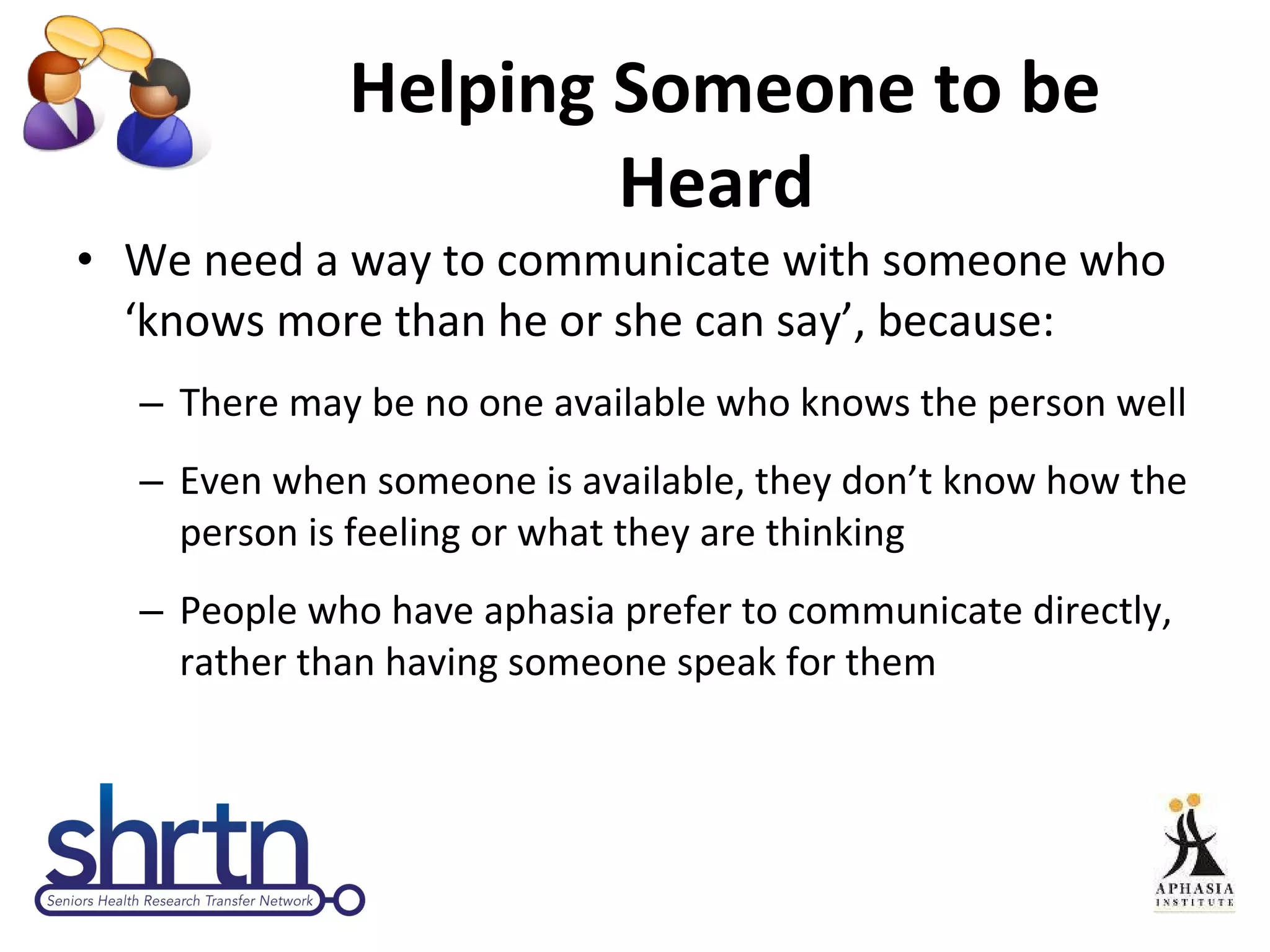
Welcome to SCA TM  Self-Directed Learning Module In order to help you move your knowledge into practice, we encourage you to complete this SDLM in pairs (you may find it tricky to role play with one) You will find the ‘talking heads’ icon (see upper left corner) when you are asked to discuss something with your partner.
Welcome to SCA TM  Self-Directed Learning Module If at any point you have questions or technical difficulties, please contact our Knowledge Broker,  Terry Kirkpatrick, at  [email_address] Let’s get started!
What is Supported Conversation for Adults with Aphasia? (SCA™)
What is SCA™? SCA™ is: a  communication method  that allows you to have a  conversation  with an  individual  who has  difficulty expressing  themselves or  understanding  your verbal messages. SCA™ is useful for addressing a range of communication disabilities, including aphasia.
What is Aphasia? Aphasia  is a  language  problem, caused most often by stroke.  People with aphasia have difficulty expressing themselves  understanding what others say reading and writing  People with aphasia remain  competent
Other Communication Disorders SCA™ is useful for interacting with individuals who have aphasia, and other communication challenges, including: Hearing Loss Poor literacy (pre-stroke) Limited fluency in English, (or other primary language) Physical, cognitive, or mental health conditions that interfere with communication
Discussion #1 You are a healthcare professional.  Your patient, Judy has aphasia.  She appears to understand you when you speak, but when she tries to respond, she says the word “OK” and a few non-word syllables,  over and over.  You need  to know if she is in pain, and where it hurts.  Discuss how you would handle this situation with your partner.
Helping Someone to be Heard  We need a way to communicate with someone who ‘knows more than he or she can say’, because: There may be no one available who knows the person well Even when someone is available, they don’t know how the person is feeling or what they are thinking People who have aphasia prefer to communicate directly, rather than having someone speak for them
Discussion #2 You have aphasia.  You are visiting with a healthcare provider who is asking you questions and… You are intelligent but can’t understand what he/she is  saying  You know what you think but can’t express your thoughts The care provider is avoiding discussing complex issues with you, e.g. your health, your situation, and how you feel. Discuss how you feel with your partner
How Does it Feel? People who have aphasia, or other communication challenges, are often treated as though they are not competent. The experience of aphasia is similar to being in a country where you do not speak the language.  You know what you want to say, but cannot make yourself understood.
What is Communicative Access? Meaningful participation in healthcare activities requires: Finding and understanding verbal information  Engaging in conversation with health care providers
“ Communicative Access and Aphasia” Often we refer to “communicative access and aphasia”.  We use this phrase because aphasia reduces an individual’s ability to engage in routine communication tasks, which are essential to participation in and access to health care.
Discussion #3 The individual with a communication disorder is often not included in health care conversations as their competence is questioned, based on their inability understand and express themselves easily. What barriers do you think a person with aphasia faces when they are in our health care system?
Did you think of these barriers? Professionals that do not know how to communicate with the person Inability to read consent forms, prescriptions, information about medical conditions, etc. Inability to read signage and directions Exclusion from case conferences or care planning Necessity of having a support person to advocate
Providing Communicative Access through SCA TM We provide physical access to healthcare services by altering the physical environment, adding wheelchair ramps, automatic doors, and other improvements. We can provide communicative access by changing the way we interact. SCA™ is a ‘communication ramp’ for someone with aphasia, or other communication disorder.
What does Communicative Accessibility look like? The elements of a  communicatively accessible environment  include:  Trained service providers who use  special communication skills (e.g. SCA™) Health care information that is  translated into a pictographic format  that is more easily understood Ensuring that the  individual is included in important decision-making events , such as case conferences
A Communication Ramp SCA™ is a set of techniques that includes: spoken and written keywords gesture and body language hand drawings sophisticated pictographs designed to support conversation on complex topics.
A Communication Ramp The SCA ™  method has been developed by the Aphasia Institute, over many years of direct service and validated through research.  It has been taught to thousands of health care workers from a variety of professional backgrounds.  Feedback from those who have learned the method and used it in their daily practice has indicated that both the service provider and the patient benefit.
A Communication Ramp SCA ™ u sers say: They view their treatment as more successful. They interact more confidently with patients who they may have avoided in the past.  They are often surprised by the interactive changes possible by using a few basic techniques.
Role Play #1 If you are in a pair, you two will be engaging in role play exercise in which one of you will play the Health Care Professional  and the other will play The Person with Aphasia. The Person with Aphasia should choose an important personal message to try and convey to the Health Care Professional in 5 minutes – with the constraints listed on the next page.
Role Play #1 Person with Aphasia Cannot speak Cannot write Cannot use right hand Health Care Professional Notices that the person is upset Must figure out the problem
Role Play #1 If you are not in a pair,  consider a time when you attempted to communicate with someone who ‘knows more than he/she can say’ without success.  Recall the scene – allow it to play over in your head again and think about as many details as possible. (make notes if necessary)
Role Play #1 Now take a few minutes (both pairs and individuals) to reflect on your experience. How did each of you feel as you tried to exchange information? What communication strategies did you use? What strategies or materials would have helped you to be more effective?
Video: Healthcare Conversation Part 1 Now you will engage in an observation exercise by viewing video #1 While viewing this video consider the following questions:  Does the doctor treat the person as a competent? Does the doctor make his own messages clear? Does the doctor give the person a way to answer or ask questions? Does the doctor check to make sure that he has understood the person correctly?
SCA  ™ – A Framework for Conversation The  SCA TM  framework is an approach that prompts the care provider to: Acknowledge Competence:  Help the person feel as though they are being treated respectfully Reveal Competence:  Get and to give accurate information via: In  – communicate your message to the person Out  – receive information from the person Verify  – ensure your understanding is accurate
Acknowledging Competence Are you treating the person respectfully? Some ways to help you acknowledge competence include: Speak naturally (with normal loudness), using an adult tone of voice and a conversational style Acknowledge the person’s frustrations and fears of being thought of as stupid  e.g. “I know you know”
Acknowledging Competence Deal openly with situations in which you have to communicate with a partner to obtain or give information Explicitly attribute breakdowns to your own limitations as a communicator (humour) Can you and your partner think of at least one more technique?
Video:  Acknowledging Competence  The following videos demonstrate how to acknowledge competence Acknowledging fears and frustrations:  clips #2 and #3 Explaining the need to obtain information from someone else:  clip #4
Revealing Competence  Are you  getting  and  giving accurate information? Revealing Competence has three components: In:  Is your message clear? Out:  Does the person have a way to answer you or ask questions? Verify:  Have you checked to make sure  you  have understood?
Revealing Competence: IN  Is your message clear? You help reveal competence and ensure that your message is getting ‘in’ when you: Use short, simple sentences and expressive voice As you are talking: Use gestures that the patient/client can easily understand Write key words/main idea  e.g. ‘pain’  in large bold print Use pictographic materials – focus on one at a time
Revealing Competence: IN  Eliminate as much distraction as possible  (noises, other people, too much material)  Observe the patient/client to assess comprehension (facial expression/eye gaze, body posture, gestures Use a hierarchy of techniques to support talking including talking PLUS: Gesture Writing Pictures/objects Drawing
Video:  Revealing Competence: IN View the following short video clips that demonstrate the tips for  getting the message “in”: Using gestures:  clips #5 and #6 Using pictographic resources:  clips #7 and #8 Reducing distractions:  clips #9 and #10 Using drawing, key words and pictographic resources:  clip #11 While you view these videos, look for gestures, writing key words, the use of pictographic materials, the type of environment used for communication, and signs of the care provider observing the person
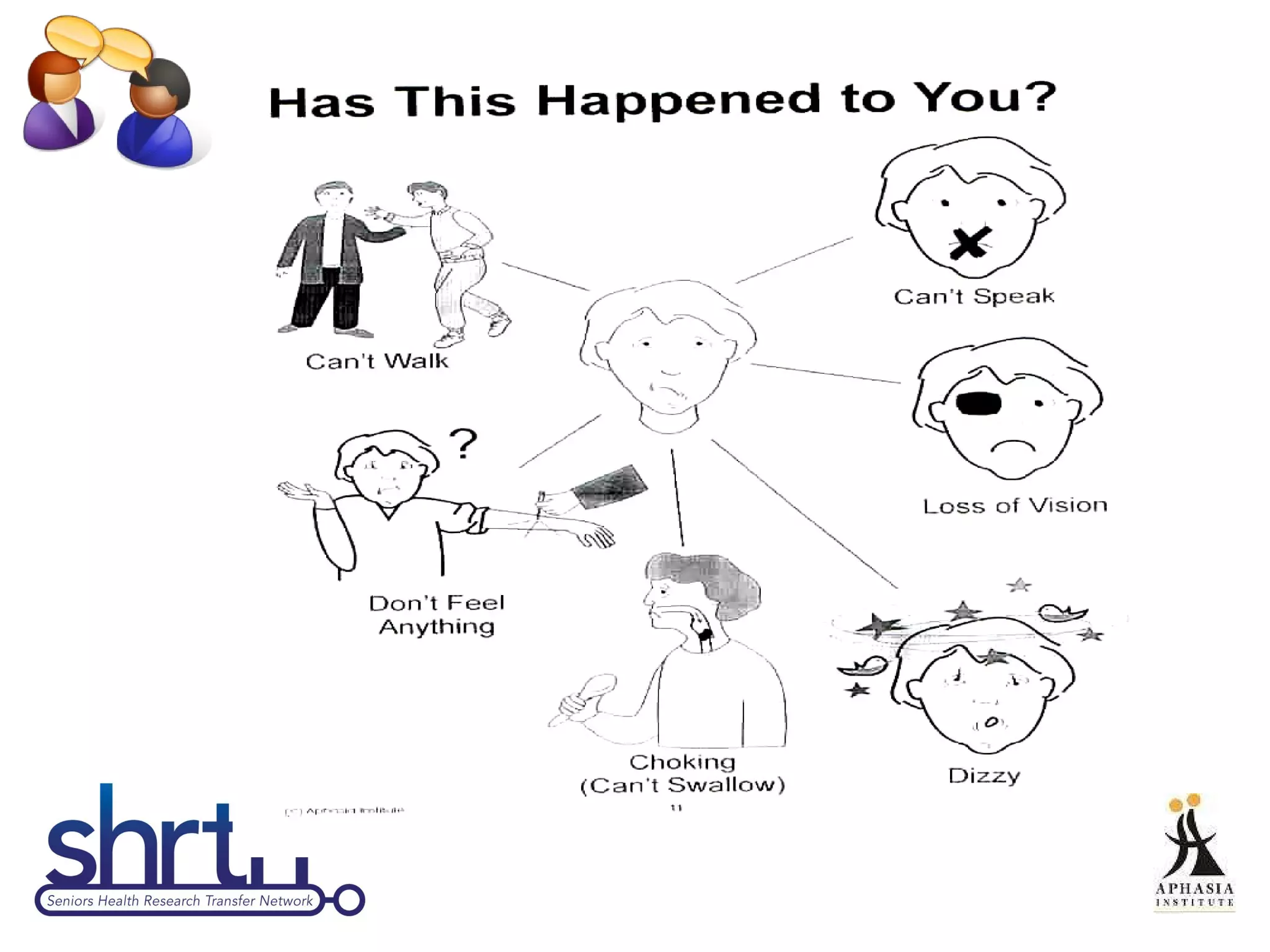
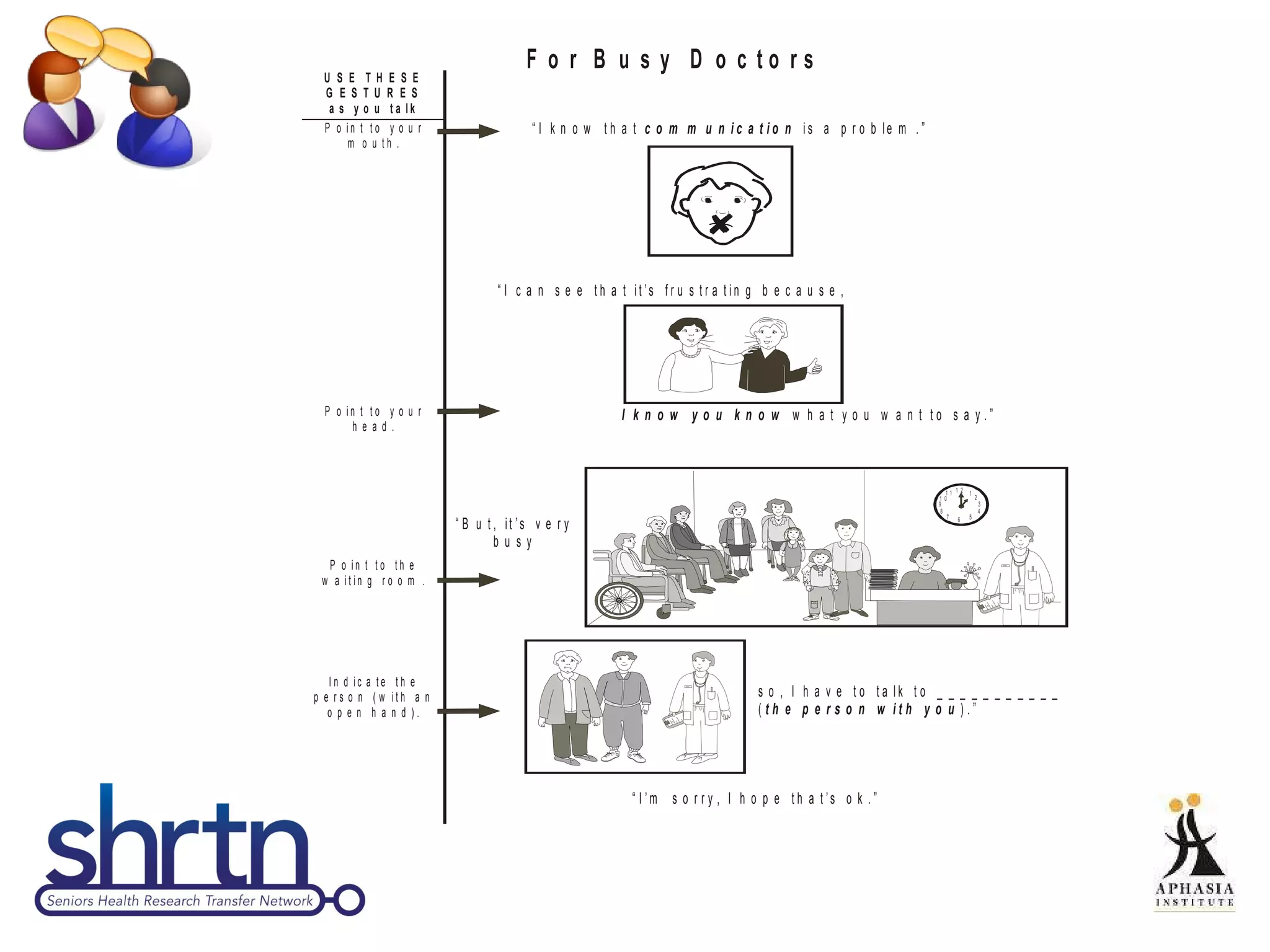
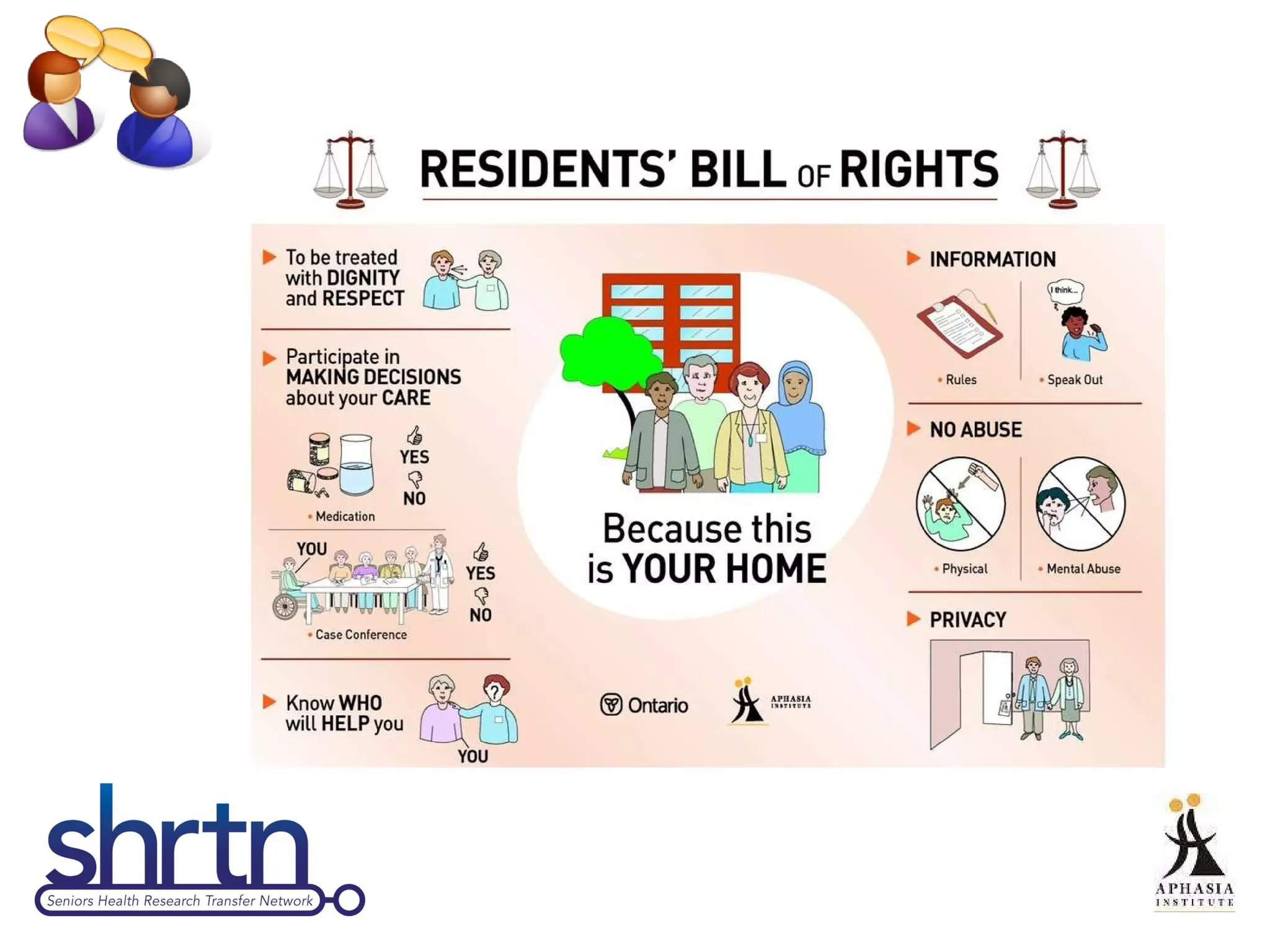
Revealing Competence: IN  Pictographic Materials The Aphasia Institute has developed a large library of pictographic images that depict complex adult topics in a nonverbal format.  For a health care provider who is using adapted communication skills, this type of pictographic support can make all the difference in the success of an interaction.  The following  3 slides show examples of pictographic materials


Revealing Competence: OUT Does the person have a way to answer you or ask questions? Tips for ensuring the person has a way to get information ‘out’ include: Ask “yes/no” questions and make sure that the patient/client has a way to respond Ask one thing at a time
Revealing Competence: OUT Ask the person to give clues by gesturing, or pointing to objects, pictures and written key words (e.g.  “can you show me…?”) Give the person time to respond Multiple choice formats are preferable to “yes/no” questions when you have a list of potential answers Phrase “yes/no” questions in a logical sequence (general to specific)
Video:  Revealing Competence: OUT View the following short video clips illustrating the tips for revealing competence “out”: Using yes/no questions and key words:  clips #12 and #13 Using pictographic resources and writing:  clip #14 Using a multiple choice format:  clips #15 and #16 Using gesture:  clip #17 While you watch these clips, look for yes/no questions or  multiple choice questions, time provided to respond, logical sequence of questioning, and asking for clues
Revealing Competence: VERIFY Have you checked to make sure  you  understood?  The following tips will help you to  verify  that  you  have understood what the person is trying to tell you: Reflect:  repeat the patient/client’s message  Expand:  add what you think the patient/client may be trying to say
Revealing Competence: VERIFY Summarize:  pull things together at the end of a longer discussion; summarize slowly and clearly what you think the patient/client is trying to say, e.g. … “so let me make sure I understand. …”. Add gesture or written key words, if necessary. Reflect – Expand – Summarize
Video: Revealing Competence: VERIFY View the following short video clips illustrating the tips for verification: Summarize:  clip #12 Reflect and Expand; Summarize:  clip #18 Note: here the health care professional is not able to fully understand the message, but the interaction is successful as she acknowledges competence throughout
Video: Healthcare Conversation Part 2 Watch video clip #19 This clip involves the same care provider as ‘Health Care Conversation Part 1’.  He is talking with Gerry after completing SCA TM  training.  Look for the differences in his approach and consider the SCA TM  Framework for Conversation Review and discuss the following questions with your partner (next slide)
Video: Healthcare Conversation Part 2 Acknowledge Competence:  Did the doctor treat the patient as a competent person? Reveal Competence:  Did the doctor help the person reveal what was on his mind? IN:  Did the doctor make the message clear? OUT:  Did the doctor give the patient a way to answer or ask questions? VERIFY:  Did the doctor check to make sure that he has understood correctly?
Summary Communication is an essential element in health care delivery: Health care providers routinely talk with patients in order to make diagnoses and provide treatment Patients are more likely to participate actively in health care interventions if they are involved in discussions with providers
Summary Communicative Access depends upon:  Health care providers using specialized communication strategies, such as Supported Conversation for Adults with Aphasia™ (SCA) Health care organizations facilitating communicative access through policies, education, and organizational culture
Thank you and we wish you successful conversations! Elyse Shumway and Terry Kirkpatrick Communicative Access and Aphasia CoP
Want to learn more about SCA TM ? The Aphasia Institute provides ‘hands-on’ and intensive training courses in SCA™ and has a vast array of pictographic resources to facilitate your conversations.   www.aphasia.ca  Tel: 416-226-3636 Fax: 416-226-3706 Email: aphasia@aphasia.ca 73 Scarsdale Road Toronto, ON M3B 2R2, Canada
Join the CoP! Are you a member of the Communicative Access and Aphasia Community of Practice?  Check us out at  www.shrtn.on.ca  and get involved!

Supported Conversation for Adults with Aphasia (SCA)

  • 1.
    Communicating with ThoseWho Know More Than They Can Say An Introduction to Supported Conversation for Adults with Aphasia (SCA™)
  • 2.
    Welcome to SCATM Self-Directed Learning Module This self-directed learning module (SDLM) includes a combination of: Content in text form Videos Discussion questions Prompts for reflection Role plays
  • 3.
    Welcome to SCATM Self-Directed Learning Module In order to help you move your knowledge into practice, we encourage you to complete this SDLM in pairs (you may find it tricky to role play with one) You will find the ‘talking heads’ icon (see upper left corner) when you are asked to discuss something with your partner.
  • 4.
    Welcome to SCATM Self-Directed Learning Module If at any point you have questions or technical difficulties, please contact our Knowledge Broker, Terry Kirkpatrick, at [email_address] Let’s get started!
  • 5.
    What is SupportedConversation for Adults with Aphasia? (SCA™)
  • 6.
    What is SCA™?SCA™ is: a communication method that allows you to have a conversation with an individual who has difficulty expressing themselves or understanding your verbal messages. SCA™ is useful for addressing a range of communication disabilities, including aphasia.
  • 7.
    What is Aphasia?Aphasia is a language problem, caused most often by stroke. People with aphasia have difficulty expressing themselves understanding what others say reading and writing People with aphasia remain competent
  • 8.
    Other Communication DisordersSCA™ is useful for interacting with individuals who have aphasia, and other communication challenges, including: Hearing Loss Poor literacy (pre-stroke) Limited fluency in English, (or other primary language) Physical, cognitive, or mental health conditions that interfere with communication
  • 9.
    Discussion #1 Youare a healthcare professional. Your patient, Judy has aphasia. She appears to understand you when you speak, but when she tries to respond, she says the word “OK” and a few non-word syllables, over and over. You need to know if she is in pain, and where it hurts. Discuss how you would handle this situation with your partner.
  • 10.
    Helping Someone tobe Heard We need a way to communicate with someone who ‘knows more than he or she can say’, because: There may be no one available who knows the person well Even when someone is available, they don’t know how the person is feeling or what they are thinking People who have aphasia prefer to communicate directly, rather than having someone speak for them
  • 11.
    Discussion #2 Youhave aphasia. You are visiting with a healthcare provider who is asking you questions and… You are intelligent but can’t understand what he/she is saying You know what you think but can’t express your thoughts The care provider is avoiding discussing complex issues with you, e.g. your health, your situation, and how you feel. Discuss how you feel with your partner
  • 12.
    How Does itFeel? People who have aphasia, or other communication challenges, are often treated as though they are not competent. The experience of aphasia is similar to being in a country where you do not speak the language. You know what you want to say, but cannot make yourself understood.
  • 13.
    What is CommunicativeAccess? Meaningful participation in healthcare activities requires: Finding and understanding verbal information Engaging in conversation with health care providers
  • 14.
    “ Communicative Accessand Aphasia” Often we refer to “communicative access and aphasia”. We use this phrase because aphasia reduces an individual’s ability to engage in routine communication tasks, which are essential to participation in and access to health care.
  • 15.
    Discussion #3 Theindividual with a communication disorder is often not included in health care conversations as their competence is questioned, based on their inability understand and express themselves easily. What barriers do you think a person with aphasia faces when they are in our health care system?
  • 16.
    Did you thinkof these barriers? Professionals that do not know how to communicate with the person Inability to read consent forms, prescriptions, information about medical conditions, etc. Inability to read signage and directions Exclusion from case conferences or care planning Necessity of having a support person to advocate
  • 17.
    Providing Communicative Accessthrough SCA TM We provide physical access to healthcare services by altering the physical environment, adding wheelchair ramps, automatic doors, and other improvements. We can provide communicative access by changing the way we interact. SCA™ is a ‘communication ramp’ for someone with aphasia, or other communication disorder.
  • 18.
    What does CommunicativeAccessibility look like? The elements of a communicatively accessible environment include: Trained service providers who use special communication skills (e.g. SCA™) Health care information that is translated into a pictographic format that is more easily understood Ensuring that the individual is included in important decision-making events , such as case conferences
  • 19.
    A Communication RampSCA™ is a set of techniques that includes: spoken and written keywords gesture and body language hand drawings sophisticated pictographs designed to support conversation on complex topics.
  • 20.
    A Communication RampThe SCA ™ method has been developed by the Aphasia Institute, over many years of direct service and validated through research. It has been taught to thousands of health care workers from a variety of professional backgrounds. Feedback from those who have learned the method and used it in their daily practice has indicated that both the service provider and the patient benefit.
  • 21.
    A Communication RampSCA ™ u sers say: They view their treatment as more successful. They interact more confidently with patients who they may have avoided in the past. They are often surprised by the interactive changes possible by using a few basic techniques.
  • 22.
    Role Play #1If you are in a pair, you two will be engaging in role play exercise in which one of you will play the Health Care Professional and the other will play The Person with Aphasia. The Person with Aphasia should choose an important personal message to try and convey to the Health Care Professional in 5 minutes – with the constraints listed on the next page.
  • 23.
    Role Play #1Person with Aphasia Cannot speak Cannot write Cannot use right hand Health Care Professional Notices that the person is upset Must figure out the problem
  • 24.
    Role Play #1If you are not in a pair, consider a time when you attempted to communicate with someone who ‘knows more than he/she can say’ without success. Recall the scene – allow it to play over in your head again and think about as many details as possible. (make notes if necessary)
  • 25.
    Role Play #1Now take a few minutes (both pairs and individuals) to reflect on your experience. How did each of you feel as you tried to exchange information? What communication strategies did you use? What strategies or materials would have helped you to be more effective?
  • 26.
    Video: Healthcare ConversationPart 1 Now you will engage in an observation exercise by viewing video #1 While viewing this video consider the following questions: Does the doctor treat the person as a competent? Does the doctor make his own messages clear? Does the doctor give the person a way to answer or ask questions? Does the doctor check to make sure that he has understood the person correctly?
  • 27.
    SCA ™– A Framework for Conversation The SCA TM framework is an approach that prompts the care provider to: Acknowledge Competence: Help the person feel as though they are being treated respectfully Reveal Competence: Get and to give accurate information via: In – communicate your message to the person Out – receive information from the person Verify – ensure your understanding is accurate
  • 28.
    Acknowledging Competence Areyou treating the person respectfully? Some ways to help you acknowledge competence include: Speak naturally (with normal loudness), using an adult tone of voice and a conversational style Acknowledge the person’s frustrations and fears of being thought of as stupid e.g. “I know you know”
  • 29.
    Acknowledging Competence Dealopenly with situations in which you have to communicate with a partner to obtain or give information Explicitly attribute breakdowns to your own limitations as a communicator (humour) Can you and your partner think of at least one more technique?
  • 30.
    Video: AcknowledgingCompetence The following videos demonstrate how to acknowledge competence Acknowledging fears and frustrations: clips #2 and #3 Explaining the need to obtain information from someone else: clip #4
  • 31.
    Revealing Competence Are you getting and giving accurate information? Revealing Competence has three components: In: Is your message clear? Out: Does the person have a way to answer you or ask questions? Verify: Have you checked to make sure you have understood?
  • 32.
    Revealing Competence: IN Is your message clear? You help reveal competence and ensure that your message is getting ‘in’ when you: Use short, simple sentences and expressive voice As you are talking: Use gestures that the patient/client can easily understand Write key words/main idea e.g. ‘pain’ in large bold print Use pictographic materials – focus on one at a time
  • 33.
    Revealing Competence: IN Eliminate as much distraction as possible (noises, other people, too much material) Observe the patient/client to assess comprehension (facial expression/eye gaze, body posture, gestures Use a hierarchy of techniques to support talking including talking PLUS: Gesture Writing Pictures/objects Drawing
  • 34.
    Video: RevealingCompetence: IN View the following short video clips that demonstrate the tips for getting the message “in”: Using gestures: clips #5 and #6 Using pictographic resources: clips #7 and #8 Reducing distractions: clips #9 and #10 Using drawing, key words and pictographic resources: clip #11 While you view these videos, look for gestures, writing key words, the use of pictographic materials, the type of environment used for communication, and signs of the care provider observing the person
  • 35.
    Revealing Competence: IN Pictographic Materials The Aphasia Institute has developed a large library of pictographic images that depict complex adult topics in a nonverbal format. For a health care provider who is using adapted communication skills, this type of pictographic support can make all the difference in the success of an interaction. The following 3 slides show examples of pictographic materials
  • 36.
  • 37.
  • 38.
  • 39.
    Revealing Competence: OUTDoes the person have a way to answer you or ask questions? Tips for ensuring the person has a way to get information ‘out’ include: Ask “yes/no” questions and make sure that the patient/client has a way to respond Ask one thing at a time
  • 40.
    Revealing Competence: OUTAsk the person to give clues by gesturing, or pointing to objects, pictures and written key words (e.g. “can you show me…?”) Give the person time to respond Multiple choice formats are preferable to “yes/no” questions when you have a list of potential answers Phrase “yes/no” questions in a logical sequence (general to specific)
  • 41.
    Video: RevealingCompetence: OUT View the following short video clips illustrating the tips for revealing competence “out”: Using yes/no questions and key words: clips #12 and #13 Using pictographic resources and writing: clip #14 Using a multiple choice format: clips #15 and #16 Using gesture: clip #17 While you watch these clips, look for yes/no questions or multiple choice questions, time provided to respond, logical sequence of questioning, and asking for clues
  • 42.
    Revealing Competence: VERIFYHave you checked to make sure you understood? The following tips will help you to verify that you have understood what the person is trying to tell you: Reflect: repeat the patient/client’s message Expand: add what you think the patient/client may be trying to say
  • 43.
    Revealing Competence: VERIFYSummarize: pull things together at the end of a longer discussion; summarize slowly and clearly what you think the patient/client is trying to say, e.g. … “so let me make sure I understand. …”. Add gesture or written key words, if necessary. Reflect – Expand – Summarize
  • 44.
    Video: Revealing Competence:VERIFY View the following short video clips illustrating the tips for verification: Summarize: clip #12 Reflect and Expand; Summarize: clip #18 Note: here the health care professional is not able to fully understand the message, but the interaction is successful as she acknowledges competence throughout
  • 45.
    Video: Healthcare ConversationPart 2 Watch video clip #19 This clip involves the same care provider as ‘Health Care Conversation Part 1’. He is talking with Gerry after completing SCA TM training. Look for the differences in his approach and consider the SCA TM Framework for Conversation Review and discuss the following questions with your partner (next slide)
  • 46.
    Video: Healthcare ConversationPart 2 Acknowledge Competence: Did the doctor treat the patient as a competent person? Reveal Competence: Did the doctor help the person reveal what was on his mind? IN: Did the doctor make the message clear? OUT: Did the doctor give the patient a way to answer or ask questions? VERIFY: Did the doctor check to make sure that he has understood correctly?
  • 47.
    Summary Communication isan essential element in health care delivery: Health care providers routinely talk with patients in order to make diagnoses and provide treatment Patients are more likely to participate actively in health care interventions if they are involved in discussions with providers
  • 48.
    Summary Communicative Accessdepends upon: Health care providers using specialized communication strategies, such as Supported Conversation for Adults with Aphasia™ (SCA) Health care organizations facilitating communicative access through policies, education, and organizational culture
  • 49.
    Thank you andwe wish you successful conversations! Elyse Shumway and Terry Kirkpatrick Communicative Access and Aphasia CoP
  • 50.
    Want to learnmore about SCA TM ? The Aphasia Institute provides ‘hands-on’ and intensive training courses in SCA™ and has a vast array of pictographic resources to facilitate your conversations. www.aphasia.ca Tel: 416-226-3636 Fax: 416-226-3706 Email: aphasia@aphasia.ca 73 Scarsdale Road Toronto, ON M3B 2R2, Canada
  • 51.
    Join the CoP!Are you a member of the Communicative Access and Aphasia Community of Practice? Check us out at www.shrtn.on.ca and get involved!

Editor's Notes

  • #2 Introduce yourself and, depending on nature and size of group, allow participants to introduce themselves Give very brief background to development of Modules by the Aphasia Institute in Toronto, Canada. “ This program has been developed by the Aphasia Institute of Toronto. The Aphasia Institute has been providing programs for people with aphasia and their caregivers for over twenty-five years. The Aphasia Institute has become a leader in research, training and education in the area of aphasia.” Acknowledge support from the Ontario Ministry of Health and Long Term Care, including the Ontario Stroke Strategy, and the Heart & Stroke Foundation of Ontario “ Many of you have probably experienced the frustration of trying to talk to patients/clients with communication problems – by the end of today’s session, you will have some tools and resources to help you”
  • #8 Go through slide. “ For example, 20 -30%...” ‘ Just to review the basics, aphasia is…. . The key point to remember is that even though there are problems in talking etc., individuals with aphasia know what is going on – they are inherently competent “ We are going to use APHASIA as an example, but remember that Supported Conversation is a useful tool for ANYONE WHO KNOWS MORE THAN HE/SHE CAN SAY e.g. people who do not speak English You might want to explain why we use aphasia as the example for teaching purposes (as opposed to other communication difficulties): We use aphasia because it involves ALL modalities – speaking, understanding, reading and writing in contrast to some other communication problems which would only need some of the techniques. For example, when interacting with someone with a motor speech impairment, he or she may be able to read easily and point to key words, so pictographic materials or drawing would not be as necessary. Working with aphasia in all four modalities requires the full ‘toolbox’, and so is useful for teaching purposes. TIP: Avoid getting into too much technical information about aphasia
  • #10 Communication problems can interfere with the efficiency and effectiveness of your service e.g. No-one else but the person him/herself can accurately describe the nature or extent of pain e.g. As above with emotions
  • #11 Communication problems can interfere with the efficiency and effectiveness of your service e.g. No-one else but the person him/herself can accurately describe the nature or extent of pain e.g. As above with emotions
  • #12 Communication problems can interfere with the efficiency and effectiveness of your service e.g. No-one else but the person him/herself can accurately describe the nature or extent of pain e.g. As above with emotions
  • #14 Communication problems can interfere with the efficiency and effectiveness of your service e.g. No-one else but the person him/herself can accurately describe the nature or extent of pain e.g. As above with emotions
  • #16 Communication problems can interfere with the efficiency and effectiveness of your service e.g. No-one else but the person him/herself can accurately describe the nature or extent of pain e.g. As above with emotions
  • #18 You can hand out reading lists or print extracts for your participants, depending on their needs or backgrounds Reading list is included in this manual.
  • #20 This method has been developed over many years of direct service and validated through research. It has been taught to thousands of health care workers from a variety of professional backgrounds. While these skills are all useful for patients with aphasia, selected techniques are also useful for patients with hearing loss, motor speech difficulties and for individuals who are not fluent in the dominant language of a given setting. You may want to look at the above text and other similar texts so that you can draw on examples of the importance of communication in healthcare You can hand out reading lists or print extracts for your participants, depending on their needs or backgrounds Reading list is included in this manual.
  • #21 You may want to look at the above text and other similar texts so that you can draw on examples of the importance of communication in healthcare You can hand out reading lists or print extracts for your participants, depending on their needs or backgrounds Reading list is included in this manual.
  • #22 You may want to look at the above text and other similar texts so that you can draw on examples of the importance of communication in healthcare You can hand out reading lists or print extracts for your participants, depending on their needs or backgrounds Reading list is included in this manual.
  • #23 Let’s see what it’s like to have aphasia. You have already been divided up into pairs – one of you is A, the other is B. You each have a small white envelope – DON’T OPEN IT YET. For the first role play, person A has aphasia – (read through restrictions on slide) – person B – just be yourself. B, You have a question to ask – your partner has the answer on their piece of paper - you can do whatever you like to find out except read their notes. Your job is to find out every single detail. Person A – your job is to give every single detail - but remember, no talking! OPEN YOUR ENVELOPES AND TAKE OUT THE GREEN SHEETS – TAKE A MINUTE TO READ AND THEN PERSON B – GET STARTED WITH YOUR QUESTION Keep the pressure on – I minute to go, ½ minute etc. Put papers away – don’t discuss yet ---------------- Reverse – B is now the person with aphasia TELL THEM TO TAKE OUT THE ORANGE SHEETS Identical instructions __________________ First role-play, get B’s to tell you what they found out – then get an A to read the script. They should listen for what they missed and what they got that was wrong. Reverse for second role play Discuss how they felt. When they were the ones with aphasia, what did they wish their partner would do to help? DISCUSS THE DIFFERENCE THE PARTNER MAKES
  • #28 So the partner makes a difference, but what exactly can the partner do? Today we’re going to look at how we can use the methods and resources of Supported Conversation to make a difference. When you use SCA, it is easier for patients/clients to understand you, answer your questions, and ask their own questions. You will learn to make it clear that YOU KNOW THAT YOUR PATIENT/CLIENT IS INHERENTLY COMPETENT “I know you know”. People with aphasia tell us that one of their biggest fears is being thought of as stupid. SCA focuses on TWO MAIN AREAS: AC RC
  • #29 This is all about acknowledging the competence of your patients or clients Mention that based on experience, many of us forget how to talk naturally when we’re too focused on the challenge of communicating with someone who has a language problem Notes for Clip 1 - see next page Notes for Clip 2 - see next page
  • #32 So we have discussed the first main category of Supported Conversation – Acknowledging Competence. This is not the end of the story though – you also need to do something to Reveal or ‘unmask’ inherent competence You must make sure that that the topic is clear – that the person knows what you are talking about – we call this getting the message IN You must make sure that the person with aphasia has a way to answer your questions or initiate their own comments or questions – this is getting the message OUT Finally, you need to check that YOU have understood the person with aphasia correctly – VERIFYING Let’s look at each one of these separately
  • #33 Demonstrate gestures e.g. communication is hard; what’s the time now?; what do you think – yes/no? Notice that I am using gesture AS I SPEAK – then demo what happens when timing is wrong – just use one or two gestures to make your point – don’t overdo. Points to make re Video clips….. Show flashcard with key-word. It’s a good idea to write down the main topic in one or two words – you should write clearly – about this size (demonstrate) . Even when people with aphasia let you know that reading is difficult (they may think they can’t read at all) – in our experience, using written key words together with talk, gesture and pictures, makes a big difference. Points to make re Video clips….. Demonstrate use of pictographic material – participants should ideally have their own resource material related to their own area of practice. Points to make re Video clips….. N.B. ALL ABOVE TECHNIQUES USED TO GET THE MESSAGE IN ARE EQUALLY USEFUL TO HELP PERSON WITH APHASIA TO GET HIS/HER MESSAGE OUT – GIVE THEM EXAMPLES e.g. using pictures/words – makes topic clearer but person with aphasia can point to indicate what they are thinking or to ask a question
  • #34 Give examples related to hierarchy (point 3) e.g. camera/ ‘it’s late’ – gesture is easiest Sailing – line drawing easier than gesture i.e. use common sense with hierarchy This is a good time to go into a bit more detail about pictographic resources. Talk about what is available in relation to SCA e.g. show the packages of profession-specific resources and the What is Aphasia? Resource. Talk about how these can be photocopied and used to create material for specific individuals or re-occurring topics in your setting. Tell participants that the pictographic materials in their practice scenarios come from these resources and have them available for people to look through after the presentation. You can refer anyone who is interested in more information to the Aphasia Institute
  • #36 In the last slide, we talked about two main areas - and now two goals: Increase communicative access: Any of us involved in healthcare have an obligation to make sure that services are accessible to all citizens. Most of us take physical access for granted - e.g. if people can’t walk, we give them walkers or wheelchairs, and we provide wheelchair ramps. As we discussed at the beginning, we are now trying to do the same thing for people with language problems - when you provide supported conversation, you create a communication ramp that is equivalent to the wheelchair ramp. At the same time, research shows that improved communication leads to more efficient and effective service
  • #37 This for example, is a pictographic representation of the warning signs of stroke or a TIA – important for secondary prevention – you can ask questions pointing to one picture at a time, or patients might be able to point to pictures themselves Let them know about the extensive pictographic resource material that is available Go through the package of resource books designed for various members of the healthcare team
  • #38 This is an example to illustrate how you can be upfront with patients/clients while treating them as competent adults. You may not be a doctor, but just look at the principle involved We know that doctors and other healthcare professionals are under enormous pressure and don’t always have the time they would like to spend with patients. Sometimes, it’s easiest to just ask the family member for information – not ideal, but if you do have to do it, at least Acknowledge Competences… This only takes a minute or two of your time - let’s look at what you might do (Go through the pictures and illustrate with appropriate gesture)
  • #40 Discuss the fact that healthcare professionals are often trained NOT to ask YES/NO questions. Acknowledge difficulty in switching mindset. Suggest that they always start off with an open-ended question and move to YES/NO if patient/client is having difficulty Demonstrate with someone in the audience – they can’t talk at all “ I can see you’re pointing to your head – what happened – pause to let them try and answer “Was it a fall or a stroke?” Then repeat with first question – as soon as clear person can’t answer, ask yes/no questions e.g.” Are you talking about a headache?” Show them different ways of answering yes/no (- can also demonstrate fixed choice with way for person to answer e.g. having written key words or pictures) Points to make re Video clips…..
  • #42 DEMONSTRATION e.g. Patient not taking medication: Fine to start off with an open-ended question e.g You’re not taking your medication – can you tell me more about this? If can’t answer, move to closed ended (fixed choice may be most appropriate here) – write out choices e.g. FORGET? FEEL SICK? DOES NOT HELP or use pictures as appropriate YES/NO – Disadvantage is that it takes more time, but often do need to use it ADVANTAGE: Don’t need resources other than a written YES/NO/OTHER card If using YES/NO – do not start off too specific – you will never get there – go for intermediate categories – the equivalent of a continent or country rather than a city. Do role-play with group as a whole: Your patient is upset – think about the broader categories – where would you start your YES/NO? (Health? Family? Money? Transportation? The future? Other….
  • #43 So far, we have talked about making the topic clear (IN) and giving the patient/client a way to express him/herself – now comes a critical step You need to check and make sure that YOU have understood correctly Again, you use the same techniques – rephrasing, using gestures, written key words, resources or drawing Points to make re Video clips…..
  • #45 When you summarize, it’s a good idea to write down the key words for the patient/client to keep ‘ Expanding’ on what the person with aphasia gives you really helps to move from the superficial to a more complex and satisfying conversation Talk about the importance of giving something written to the patient/client – discuss issue of not being able to refer back/ask questions if there is a language barrier e.g. you as the patient/client decide NOT to pursue treatment, but then change your mind
  • #46 Time for another video – this time, we’re going to watch the doctor after he’s had some training – similar to what I have been doing with you Look at the difference these methods and resources make
  • #51 This brings us to the end of Module 1. In Module 2, you’ll have the opportunity to practice some of what we have talked about and then I will give you a few more techniques that you may find useful Thank You BREAK if sessions are following one after the other