SC2218: Anthropology and the Human Condition Lecture 2: “Strangers Abroad” Origins of the Anthropological Perspective Eric C. Thompson Semester 1, 2011/2012
Where Are We Going? Part 1: What is Anthropology? Strangers Abroad Race Culture Part 2: What do Anthropologists Study? Kinship, Gender, Economy, Community Part 3: Current Debates and Trends Representing Others The Poetry of Culture World Anthropologies YOU ARE HERE
Today’s Lecture Why are anthropologists “strangers abroad”? What is the relationship between anthropology and colonialism? Who was Franz Boas? What were his contributions to Anthropology? What is cultural relativism?
Origins of Modern Anthropology Why are anthropologists “Strangers Abroad”? Early Modern Anthropologists American Cultural Anthropology British Social Anthropology Understanding difference and diversity…… from RACE to CULTURE.
Strangers, Others, & the Anthropological Perspective Ibn Batt ú ta Travels in Asia and Africa, 1325-1354 Ma Huan Survey of the Ocean’s Shores, 1433 Franz Boas Expedition to Baffin Island, 1883-1884 Ibn Batt úta’s Route Admiral Zheng He Ibn  Battúta *Follow the hyperlinks for additional information.
Survey of the Ocean’s Shores (1433) Zheng He’s voyages, Early Ming Dynasty Ma Huan was Zheng He’s chronicler; making a record of peoples and places
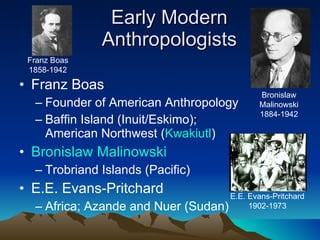
Early Modern Anthropologists Franz Boas Founder of American Anthropology Baffin Island (Inuit/Eskimo); American Northwest ( Kwakiutl ) Bronislaw Malinowski Trobriand Islands (Pacific) E.E. Evans-Pritchard Africa; Azande and Nuer (Sudan) E.E. Evans-Pritchard 1902-1973 Bronislaw Malinowski 1884-1942 Franz Boas 1858-1942
Richard B. Lee: Anthropology in the mid-20 th  century PhD UC-Berkeley, 1965: “Subsistence Ecology of !Kung Bushmen” Man the Hunter  (1968) – Evolutionary perspective. See Appendix for revised view.
Context of Modern Anthropology 19 th  – 21 st  centuries European & American Colonialism Scientific approaches to studying people, society and culture. Decline of colonialism, national liberation movements, “native anthropologists”
Why are People Different? Geography (“Environmental Determinism”) 19 th  century idea; uncommon now Race (“Biological Determinism”) 19 th  century idea; still common Culture (“Cultural Relativism”) 19 th  to 20 th  century idea; popular now
Cultural Evolution 19 th  C. European Idea All societies progress through stages Europeans = most advanced Justification of European Colonial Rule (The “white man’s burden”) Lower Savagery Middle Savagery Upper Savagery Lower Barbarism Middle Barbarism Upper Barbarism Civilization Lewis Henry Morgan’s Scheme of Social Evolution L.H. Morgan
The White Man’s Burden (Kipling 1899) Take up the White man’s burden, Send forth the best ye breed. Go bind your sons to exile, To serve your captives’ need. To wait in heavy harness, On fluttered folk and wild. Your new caught, sullen peoples, Half-devil and half-child. Kipling’s poem echoes three European ideas about “natives”: “ Wild” – Non-human, animals (e.g. debate over whether native Americans had ‘souls’) “ Half-devil” – Heathens “ Half-child” – Lower stage of development
INTERMISSION…
Course Wiki Sign Up! Contribute! Anthropology and the Human Condition http://sc2218.wetpaint.com/
“ The Shackles of Tradition” Who was  Franz Boas ? What was his role in shaping modern anthropology? What did Boas think about “Savages”? How did the idea of CULTURE influence his views? How does Boas compare with other Strangers Abroad?
Boas’ Career Born in 1856 to Jewish parents in Germany (Westphalia) PhD in Physics (1881) Post-graduate work in Geography 1883-4 Baffin Island Research (Inuit/Eskimo) Founding of Department of Anthropology, Columbia University (New York) and American Anthropological Association, c.1896-1902 1901 onward – trained dozens of PhD students, who went on to found anthropology departments elsewhere. Department of Anthropology, University of Washington founded in 1920s by Leslie Spier and Melville Jacobs, both students of Franz Boas 1942 – Collapsed at a faculty dinner and died in the arms of Claude Levi-Strauss (French Anthropologist)
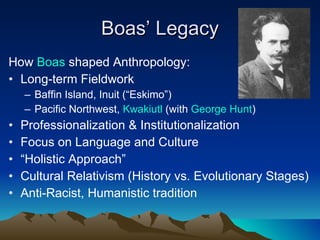
Boas’ Legacy How  Boas  shaped Anthropology: Long-term Fieldwork Baffin Island, Inuit (“Eskimo”) Pacific Northwest,  Kwakiutl  (with  George Hunt ) Professionalization & Institutionalization Focus on Language and Culture “ Holistic Approach” Cultural Relativism (History vs. Evolutionary Stages) Anti-Racist, Humanistic tradition
Culture as  Cultivation “ If this trip has … a valuable experience, it lies in the strengthening of the viewpoint of the  relativity  of all  cultivation . And that the evil as well as the value of a person lies in the  cultivation  of the heart, which I find or do not find here just as much as amongst us. ”   –  Franz Boas 1883-1884
Cultural Relativism, Anti-Racism, Humanism Prior to Boas, the dominant paradigm of anthropology was  unilinear  evolution. Savagery Barbarism Civilization Lewis Henry Morgan Boas rejected evolutionary approaches in favor of  cultural relativism . Cultures are not “better” or “worse”; more or less advanced, etc. Cultures must be understood  on their own terms , not in relationship to other cultures.
Cultural Relativism is a value that teaches respect for others. “ Each culture has its own theoreticians whose contributions deserve the same attention as that which the anthropologist gives to colleagues.” Claude Levi-Strauss,  Structural Anthropology , 1963 [1958], pg. 282
Anthropology’s Ethical Dilemma: Cultural & Moral Relativism Does “cultural relativism” imply “moral relativism”? Are there limits to cultural or moral relativism? Is cultural relativism necessary for anthropological research?
Colonial Anthropology (mid-19 th  C. to mid-20 th  C.) American “Cultural” Anthropology Focus on Native American cultures British “Social” Anthropology Focus on Natives of the British Empire The “Savage Slot” Methodological  Alterity
Post-Colonial Anthropology American “Area Studies” (Cold War) Soviet Anthropology (USSR, China, Vietnam) Japanese Anthropology Rejection of Anthropology (We are not “Primitive”) National Anthropologies (e.g.  Thailand , Korea) Methodological Nationalism “ World Anthropologies” Globalization (e.g.  Anthropology of YouTube )
Boas’ Basic Questions for Anthropology: “ Why are the tribes and the nations of the world different and how have the present differences developed?” Anthropology , 1907 We will be addressing this question over the coming weeks.
Summing Up… Anthropologists as “Strangers Abroad” Throughout history many people have explained ‘other people’ to ‘their own people’ Anthropology is part of this tradition Anthropology’s Relationship to Colonialism Modern European/American Anthropology Anthropology’s Relationship to Anti-Racism The struggle to overcome biased and racist views of “primitive” and other peoples.

Sc2218 lecture 2 (2011)

  • 1.
    SC2218: Anthropology andthe Human Condition Lecture 2: “Strangers Abroad” Origins of the Anthropological Perspective Eric C. Thompson Semester 1, 2011/2012
  • 2.
    Where Are WeGoing? Part 1: What is Anthropology? Strangers Abroad Race Culture Part 2: What do Anthropologists Study? Kinship, Gender, Economy, Community Part 3: Current Debates and Trends Representing Others The Poetry of Culture World Anthropologies YOU ARE HERE
  • 3.
    Today’s Lecture Whyare anthropologists “strangers abroad”? What is the relationship between anthropology and colonialism? Who was Franz Boas? What were his contributions to Anthropology? What is cultural relativism?
  • 4.
    Origins of ModernAnthropology Why are anthropologists “Strangers Abroad”? Early Modern Anthropologists American Cultural Anthropology British Social Anthropology Understanding difference and diversity…… from RACE to CULTURE.
  • 5.
    Strangers, Others, &the Anthropological Perspective Ibn Batt ú ta Travels in Asia and Africa, 1325-1354 Ma Huan Survey of the Ocean’s Shores, 1433 Franz Boas Expedition to Baffin Island, 1883-1884 Ibn Batt úta’s Route Admiral Zheng He Ibn Battúta *Follow the hyperlinks for additional information.
  • 6.
    Survey of theOcean’s Shores (1433) Zheng He’s voyages, Early Ming Dynasty Ma Huan was Zheng He’s chronicler; making a record of peoples and places
  • 7.
    Early Modern AnthropologistsFranz Boas Founder of American Anthropology Baffin Island (Inuit/Eskimo); American Northwest ( Kwakiutl ) Bronislaw Malinowski Trobriand Islands (Pacific) E.E. Evans-Pritchard Africa; Azande and Nuer (Sudan) E.E. Evans-Pritchard 1902-1973 Bronislaw Malinowski 1884-1942 Franz Boas 1858-1942
  • 8.
    Richard B. Lee:Anthropology in the mid-20 th century PhD UC-Berkeley, 1965: “Subsistence Ecology of !Kung Bushmen” Man the Hunter (1968) – Evolutionary perspective. See Appendix for revised view.
  • 9.
    Context of ModernAnthropology 19 th – 21 st centuries European & American Colonialism Scientific approaches to studying people, society and culture. Decline of colonialism, national liberation movements, “native anthropologists”
  • 10.
    Why are PeopleDifferent? Geography (“Environmental Determinism”) 19 th century idea; uncommon now Race (“Biological Determinism”) 19 th century idea; still common Culture (“Cultural Relativism”) 19 th to 20 th century idea; popular now
  • 11.
    Cultural Evolution 19th C. European Idea All societies progress through stages Europeans = most advanced Justification of European Colonial Rule (The “white man’s burden”) Lower Savagery Middle Savagery Upper Savagery Lower Barbarism Middle Barbarism Upper Barbarism Civilization Lewis Henry Morgan’s Scheme of Social Evolution L.H. Morgan
  • 12.
    The White Man’sBurden (Kipling 1899) Take up the White man’s burden, Send forth the best ye breed. Go bind your sons to exile, To serve your captives’ need. To wait in heavy harness, On fluttered folk and wild. Your new caught, sullen peoples, Half-devil and half-child. Kipling’s poem echoes three European ideas about “natives”: “ Wild” – Non-human, animals (e.g. debate over whether native Americans had ‘souls’) “ Half-devil” – Heathens “ Half-child” – Lower stage of development
  • 13.
  • 14.
    Course Wiki SignUp! Contribute! Anthropology and the Human Condition http://sc2218.wetpaint.com/
  • 15.
    “ The Shacklesof Tradition” Who was Franz Boas ? What was his role in shaping modern anthropology? What did Boas think about “Savages”? How did the idea of CULTURE influence his views? How does Boas compare with other Strangers Abroad?
  • 16.
    Boas’ Career Bornin 1856 to Jewish parents in Germany (Westphalia) PhD in Physics (1881) Post-graduate work in Geography 1883-4 Baffin Island Research (Inuit/Eskimo) Founding of Department of Anthropology, Columbia University (New York) and American Anthropological Association, c.1896-1902 1901 onward – trained dozens of PhD students, who went on to found anthropology departments elsewhere. Department of Anthropology, University of Washington founded in 1920s by Leslie Spier and Melville Jacobs, both students of Franz Boas 1942 – Collapsed at a faculty dinner and died in the arms of Claude Levi-Strauss (French Anthropologist)
  • 17.
    Boas’ Legacy How Boas shaped Anthropology: Long-term Fieldwork Baffin Island, Inuit (“Eskimo”) Pacific Northwest, Kwakiutl (with George Hunt ) Professionalization & Institutionalization Focus on Language and Culture “ Holistic Approach” Cultural Relativism (History vs. Evolutionary Stages) Anti-Racist, Humanistic tradition
  • 18.
    Culture as Cultivation “ If this trip has … a valuable experience, it lies in the strengthening of the viewpoint of the relativity of all cultivation . And that the evil as well as the value of a person lies in the cultivation of the heart, which I find or do not find here just as much as amongst us. ” – Franz Boas 1883-1884
  • 19.
    Cultural Relativism, Anti-Racism,Humanism Prior to Boas, the dominant paradigm of anthropology was unilinear evolution. Savagery Barbarism Civilization Lewis Henry Morgan Boas rejected evolutionary approaches in favor of cultural relativism . Cultures are not “better” or “worse”; more or less advanced, etc. Cultures must be understood on their own terms , not in relationship to other cultures.
  • 20.
    Cultural Relativism isa value that teaches respect for others. “ Each culture has its own theoreticians whose contributions deserve the same attention as that which the anthropologist gives to colleagues.” Claude Levi-Strauss, Structural Anthropology , 1963 [1958], pg. 282
  • 21.
    Anthropology’s Ethical Dilemma:Cultural & Moral Relativism Does “cultural relativism” imply “moral relativism”? Are there limits to cultural or moral relativism? Is cultural relativism necessary for anthropological research?
  • 22.
    Colonial Anthropology (mid-19th C. to mid-20 th C.) American “Cultural” Anthropology Focus on Native American cultures British “Social” Anthropology Focus on Natives of the British Empire The “Savage Slot” Methodological Alterity
  • 23.
    Post-Colonial Anthropology American“Area Studies” (Cold War) Soviet Anthropology (USSR, China, Vietnam) Japanese Anthropology Rejection of Anthropology (We are not “Primitive”) National Anthropologies (e.g. Thailand , Korea) Methodological Nationalism “ World Anthropologies” Globalization (e.g. Anthropology of YouTube )
  • 24.
    Boas’ Basic Questionsfor Anthropology: “ Why are the tribes and the nations of the world different and how have the present differences developed?” Anthropology , 1907 We will be addressing this question over the coming weeks.
  • 25.
    Summing Up… Anthropologistsas “Strangers Abroad” Throughout history many people have explained ‘other people’ to ‘their own people’ Anthropology is part of this tradition Anthropology’s Relationship to Colonialism Modern European/American Anthropology Anthropology’s Relationship to Anti-Racism The struggle to overcome biased and racist views of “primitive” and other peoples.