 Presented by : Sanjay A. Dharaiya
 Paper no.8 : ( Cultural studies)
 Topic : Five types of Cultural Studies
 Course Sem : 2
 Roll no. : 25
 Email id : Dharaiy9@gmail.com
 Submitted to : S.B.Gardi Department of English MKB
University
 Cultural studies is an innovative interdisciplinary field of
research and teaching that investigates the ways in which
“culture” creates and transforms individual experiences,
everyday life, social relations and power.
 Cultural Studies traces the relationships among aesthetic,
anthropological, and political economic aspects of cultural
production and reproduction.
 Cultural Studies relies on interdisciplinary research on the
formation of knowledge, power, and difference.
 Cultural Studies scholars and practitioners explore
constructions of race, class, ability, citizenship, gender, and
sexuality in their effort to understand the structures and
practices of domination and resistance that shape
contemporary societies.
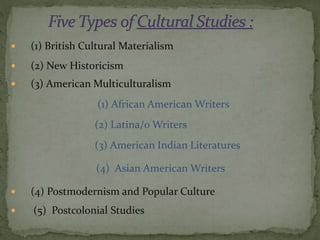
 (1) British Cultural Materialism
 (2) New Historicism
 (3) American Multiculturalism
(1) African American Writers
(2) Latina/o Writers
(3) American Indian Literatures
(4) Asian American Writers
 (4) Postmodernism and Popular Culture
 (5) Postcolonial Studies
 Cultural studies referred to as “cultural Materialism” in Britain and
it has a long tradition.
 Matthew Arnold redefined the ‘givens’ of British culture.
Britain has two trajectories for culture :
(1) First leads to past culture preserver
(2) Second leads to future Althussar insisted
“ Culture or civilization, taken in its widest ethnographic sense, is a
complex whole which include knowledge, beliefs, art, morals, law,
and any other capabilities and habits by man as a member of
society”
 That ideology was ultimately in control of the people that the main
function of ideology was to produce the society’s existing relations
of production and that function is even carried out in literary texts.
 New historicism is a school of literary theory, first developed
in 1980.
 The term ‘new historicism’ was created by the American critic
Stephen Greenbelts.
“The text is historical, and history textual”
Michael Warner phrases “History is always historicized”
 New historicism focuses on the marginalization of subjects
such as those identified as withes, the insane, heretics,
vagabonds, and political prisoners.
 Laputa ''the where ''what did Jonathan swift mean when he
gave that name to the flying island in the third voyage of
Gulliver’s Travels? It is a question that has political reality of
the British Empire upon which the sun never set an ideology
left over from the previous century.
(3) American Multiculturalism :
 As a philosophy, multiculturalism began as part of the pragmatism
movement at the end of the 19th century in Europe and United
States. American multiculturalism was come into existence in 1964
with the passing civil right Act.
(1) African American Writers
(2) Latina/o Writers
(3) American Indian Literatures
(4) Asian American Writers
(1) African American Writers :
 African American writers is widely pursued in American literature
criticism from the recovery of the eighteenth century
 poets such as Phillies wealthy to the experimental novel of Toni
Morison, In Shadow and Act 1964novel Ralph Ellison Argue that
any viable theatre of Negro American culture obligates us to
fashion a more adequate theory of American culture as a what''.
 (2) Latina/o Writers :
Latina/o. Hispanic. Mexican American. Puerto Rican. Nuyorican.
Chicano. or may be Huichol or Maya. Which names to use? the choice
after has political implications.
We will use the term'' Latina/o to indicate a broad sense of Ethnicity
among Spanish speaking ,people n the united states Mexican
American are the largest and most influential of Latina/o Ethnicities
in the united states.
 (3) American Indian Literatures :
In predominantly oral cultures, storytelling passes on religious
beliefs, moral values, political codes and practical lesson of
everyday life.
 For American Indians stories are a source of strength in the face
of centuries of silencing by Euro Americans.
 Asian American literature is written by people of Asian descent in
the United States addressing the experience of living in a society that
views them as alien. Asian immigrants were denied citizenship as
late as the 1950s.
 Edward said has written of Orientals, or the tendency to objectify
and exoticize Asian, and their work has sought to respond to such
stereotyping Asian American writer include Chinese Japanese ,
Korean Filipino, Vietnamese, Asian , Polynesian and many other
peoples of Asia, the Indian subcontinent , and pacific.
 Multiculturalism, in the context of the “American mosaic,” celebrates
the unique cultural heritage of racial and ethnic groups, some of
whom seek to preserve their native languages and lifestyles.
 In a sense, individuals can be Americans and at the same time claim
other identities, including those based on racial and ethnic heritage,
gender, and sexual preference.
 The term ‘postmodernism’ first entered the philosophical
lexicon in 1979, with the publication of The Postmodern
Condition by Jean-Francois Lyotard.
 Postmodernism question everything rationalist European
philosophy held to be true. Postmodernism possesses several
element which are necessary which given by Jean Baudrillard.
 Postmodernism like poststructuralist and deconstruction is a
critique of aesthetic of the preceding age, but besides more
critique post modernism celebrates the very act of
dismembering tradition.
 The idea of the postmodern gained momentum through to the
1950s before dominating literature, art and the intellectual
scene of the 1960s.
 Postmodernism's origins are generally accepted as having been
conceived in art around the end of the nineteenth century.
 Four main types of Popular Culture
(1) Production analysis
(2) Textual analysis.
(3) Audience analysis.
(4) Historical analysis
 Popular culture is the media, products, and attitudes considered to be
part of the mainstream of a given culture and the everyday life of
common people.
 Studying media culture is not only to focus on the ‘cultural aspects’ of
any media but also paying attention to the economics of media.
 This term as it is also known as Pop Culture so The term ‘Popular
Culture' was coined in the 19th century or earlier.
 Traditionally, the term has denoted the education and general
“culturedness” of the lower classes, as opposed to the “official culture”
and higher education emanated by the dominant class.
 The stress in the distinction from “official culture” became more
pronounced towards the end of the 19th century
 Post colonialism refers to a historical phase undergone by third
world countries after the decline of colonialism.
 Post colonial literary theorists study the English language
within this politicized context, especially those writings that
developed at the colonial front such as works by Rudyard
Kipling, E.M. Forster, Jean Rhys or Jamaica Kincaid.
 Homi. K. Bhabha’s post colonial theory involves analysis of
nationality, ethnicity and politics with poststructuralist ideas
of identity and indeterminacy, defining post colonial identities
as shifting, hybrid constructions.
 We can see some powerful conflicts arising from the colonial
past in Rushdie’s Midnight’s Children, for example which
deconstructs the history of modern India.
 Cultural studies we can find five types of cultural studies.
Which were helps to recognize the different cultures with the
different communities and histories.
 These Cultural Studies exists with particular ideas which
shows particular cultural world. Sometimes popular culture
can so overtake and repackage a literary work that it is
impossible to read the original text without reference to the
many layers of popular culture that have developed around it.
Five types of c.s

Five types of c.s

  • 1.
     Presented by: Sanjay A. Dharaiya  Paper no.8 : ( Cultural studies)  Topic : Five types of Cultural Studies  Course Sem : 2  Roll no. : 25  Email id : Dharaiy9@gmail.com  Submitted to : S.B.Gardi Department of English MKB University
  • 2.
     Cultural studiesis an innovative interdisciplinary field of research and teaching that investigates the ways in which “culture” creates and transforms individual experiences, everyday life, social relations and power.  Cultural Studies traces the relationships among aesthetic, anthropological, and political economic aspects of cultural production and reproduction.  Cultural Studies relies on interdisciplinary research on the formation of knowledge, power, and difference.  Cultural Studies scholars and practitioners explore constructions of race, class, ability, citizenship, gender, and sexuality in their effort to understand the structures and practices of domination and resistance that shape contemporary societies.
  • 3.
     (1) BritishCultural Materialism  (2) New Historicism  (3) American Multiculturalism (1) African American Writers (2) Latina/o Writers (3) American Indian Literatures (4) Asian American Writers  (4) Postmodernism and Popular Culture  (5) Postcolonial Studies
  • 4.
     Cultural studiesreferred to as “cultural Materialism” in Britain and it has a long tradition.  Matthew Arnold redefined the ‘givens’ of British culture. Britain has two trajectories for culture : (1) First leads to past culture preserver (2) Second leads to future Althussar insisted “ Culture or civilization, taken in its widest ethnographic sense, is a complex whole which include knowledge, beliefs, art, morals, law, and any other capabilities and habits by man as a member of society”  That ideology was ultimately in control of the people that the main function of ideology was to produce the society’s existing relations of production and that function is even carried out in literary texts.
  • 5.
     New historicismis a school of literary theory, first developed in 1980.  The term ‘new historicism’ was created by the American critic Stephen Greenbelts. “The text is historical, and history textual” Michael Warner phrases “History is always historicized”  New historicism focuses on the marginalization of subjects such as those identified as withes, the insane, heretics, vagabonds, and political prisoners.  Laputa ''the where ''what did Jonathan swift mean when he gave that name to the flying island in the third voyage of Gulliver’s Travels? It is a question that has political reality of the British Empire upon which the sun never set an ideology left over from the previous century.
  • 6.
    (3) American Multiculturalism:  As a philosophy, multiculturalism began as part of the pragmatism movement at the end of the 19th century in Europe and United States. American multiculturalism was come into existence in 1964 with the passing civil right Act. (1) African American Writers (2) Latina/o Writers (3) American Indian Literatures (4) Asian American Writers (1) African American Writers :  African American writers is widely pursued in American literature criticism from the recovery of the eighteenth century  poets such as Phillies wealthy to the experimental novel of Toni Morison, In Shadow and Act 1964novel Ralph Ellison Argue that any viable theatre of Negro American culture obligates us to fashion a more adequate theory of American culture as a what''.
  • 7.
     (2) Latina/oWriters : Latina/o. Hispanic. Mexican American. Puerto Rican. Nuyorican. Chicano. or may be Huichol or Maya. Which names to use? the choice after has political implications. We will use the term'' Latina/o to indicate a broad sense of Ethnicity among Spanish speaking ,people n the united states Mexican American are the largest and most influential of Latina/o Ethnicities in the united states.  (3) American Indian Literatures : In predominantly oral cultures, storytelling passes on religious beliefs, moral values, political codes and practical lesson of everyday life.  For American Indians stories are a source of strength in the face of centuries of silencing by Euro Americans.
  • 8.
     Asian Americanliterature is written by people of Asian descent in the United States addressing the experience of living in a society that views them as alien. Asian immigrants were denied citizenship as late as the 1950s.  Edward said has written of Orientals, or the tendency to objectify and exoticize Asian, and their work has sought to respond to such stereotyping Asian American writer include Chinese Japanese , Korean Filipino, Vietnamese, Asian , Polynesian and many other peoples of Asia, the Indian subcontinent , and pacific.  Multiculturalism, in the context of the “American mosaic,” celebrates the unique cultural heritage of racial and ethnic groups, some of whom seek to preserve their native languages and lifestyles.  In a sense, individuals can be Americans and at the same time claim other identities, including those based on racial and ethnic heritage, gender, and sexual preference.
  • 9.
     The term‘postmodernism’ first entered the philosophical lexicon in 1979, with the publication of The Postmodern Condition by Jean-Francois Lyotard.  Postmodernism question everything rationalist European philosophy held to be true. Postmodernism possesses several element which are necessary which given by Jean Baudrillard.  Postmodernism like poststructuralist and deconstruction is a critique of aesthetic of the preceding age, but besides more critique post modernism celebrates the very act of dismembering tradition.  The idea of the postmodern gained momentum through to the 1950s before dominating literature, art and the intellectual scene of the 1960s.  Postmodernism's origins are generally accepted as having been conceived in art around the end of the nineteenth century.
  • 10.
     Four maintypes of Popular Culture (1) Production analysis (2) Textual analysis. (3) Audience analysis. (4) Historical analysis  Popular culture is the media, products, and attitudes considered to be part of the mainstream of a given culture and the everyday life of common people.  Studying media culture is not only to focus on the ‘cultural aspects’ of any media but also paying attention to the economics of media.  This term as it is also known as Pop Culture so The term ‘Popular Culture' was coined in the 19th century or earlier.  Traditionally, the term has denoted the education and general “culturedness” of the lower classes, as opposed to the “official culture” and higher education emanated by the dominant class.  The stress in the distinction from “official culture” became more pronounced towards the end of the 19th century
  • 11.
     Post colonialismrefers to a historical phase undergone by third world countries after the decline of colonialism.  Post colonial literary theorists study the English language within this politicized context, especially those writings that developed at the colonial front such as works by Rudyard Kipling, E.M. Forster, Jean Rhys or Jamaica Kincaid.  Homi. K. Bhabha’s post colonial theory involves analysis of nationality, ethnicity and politics with poststructuralist ideas of identity and indeterminacy, defining post colonial identities as shifting, hybrid constructions.  We can see some powerful conflicts arising from the colonial past in Rushdie’s Midnight’s Children, for example which deconstructs the history of modern India.
  • 12.
     Cultural studieswe can find five types of cultural studies. Which were helps to recognize the different cultures with the different communities and histories.  These Cultural Studies exists with particular ideas which shows particular cultural world. Sometimes popular culture can so overtake and repackage a literary work that it is impossible to read the original text without reference to the many layers of popular culture that have developed around it.