Long
form of
periodic
table
Class 11 Chemistry
ART INTEGRATED PROJECT
SWEKIT PATEL
CLASS 11
PUNE INTERNATIONAL SCHOOL
Introduction
It is based on the Bohr-Bury electronic configuration concept and
atomic number.
This model is proposed by Rang and Werner.
It is also called as 'Bohr, Bury, Rang, and Werner Periodic table'
This periodic table has 7 periods and 18 groups.
According to IUPAC 18 vertical vertical columns are named as 1st
and 18th group.
Elements belonging to same group have same number of electron
in the outermost shell so their properties are similar.
The physical and chemical properties of elements are the periodic
function of their atommic number.
Modern periodic law
Period
A period in the periodic table is a row of chemical elements.
All elements in a row have the same number of electron shells.
Group
A group is a column of elements in the periodic table of the
chemical elements.
Description of period
Period number = outermost shell
Number of element in a period = Number of electron in a period subshell
P
Description of group
Alkali metals (IA) 1st group
Alkaline earth metals (IIA) 2nd group
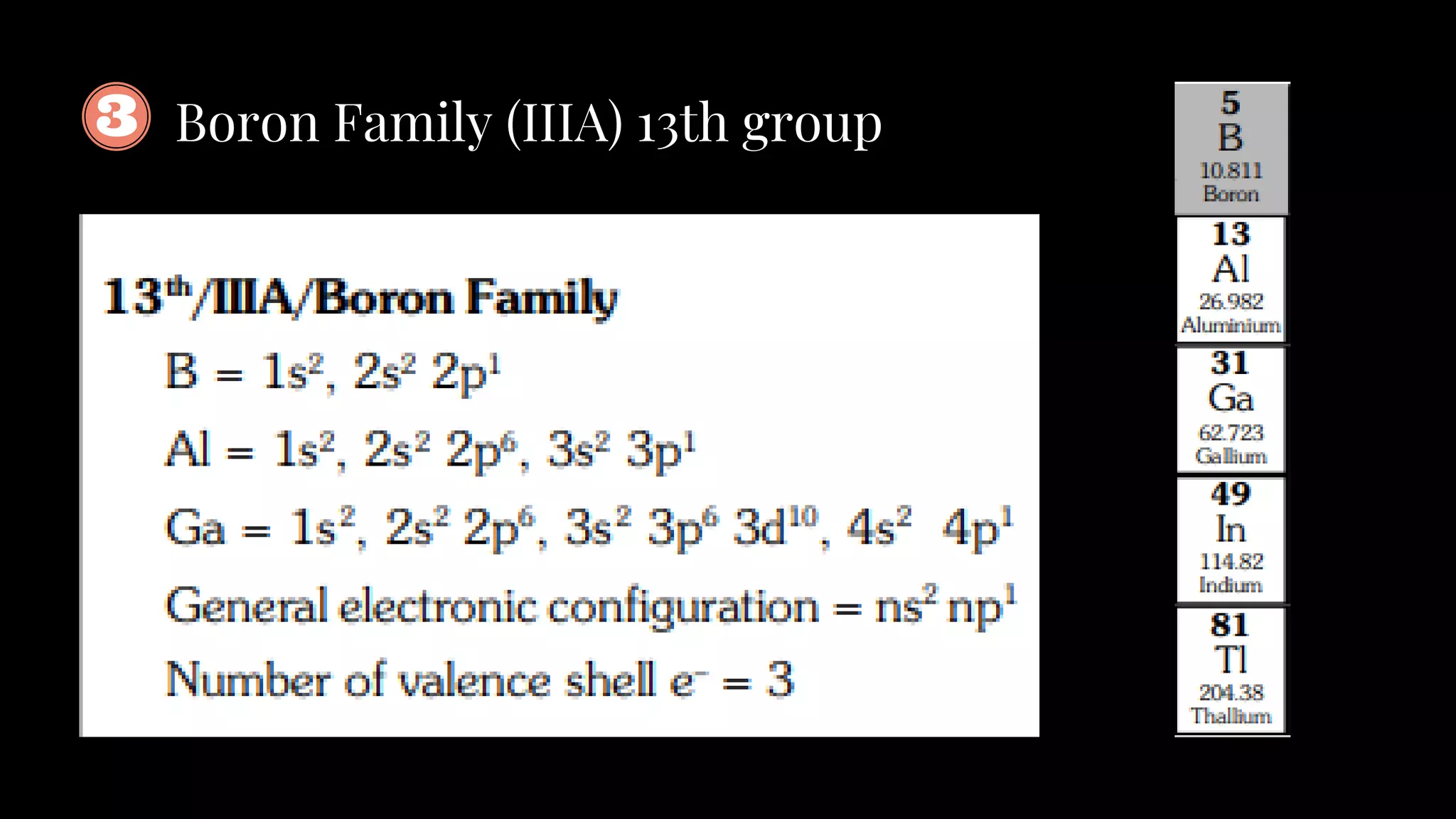
Boron Family (IIIA) 13th group
Carbon family (IVA) 14th group
Nitrogen family / Picogen (VA) 15th group
Oxygen Family / Chalcogen (VIA) 16th group
Fluorine Family / Halogens (VIIA) 17th group
Inert gas/ Noble gas/ Zero group 18th group
Nomenclature of elements
IUPAC gave names to elements above atomic number 100 as follows
In all the elements suffix is ium
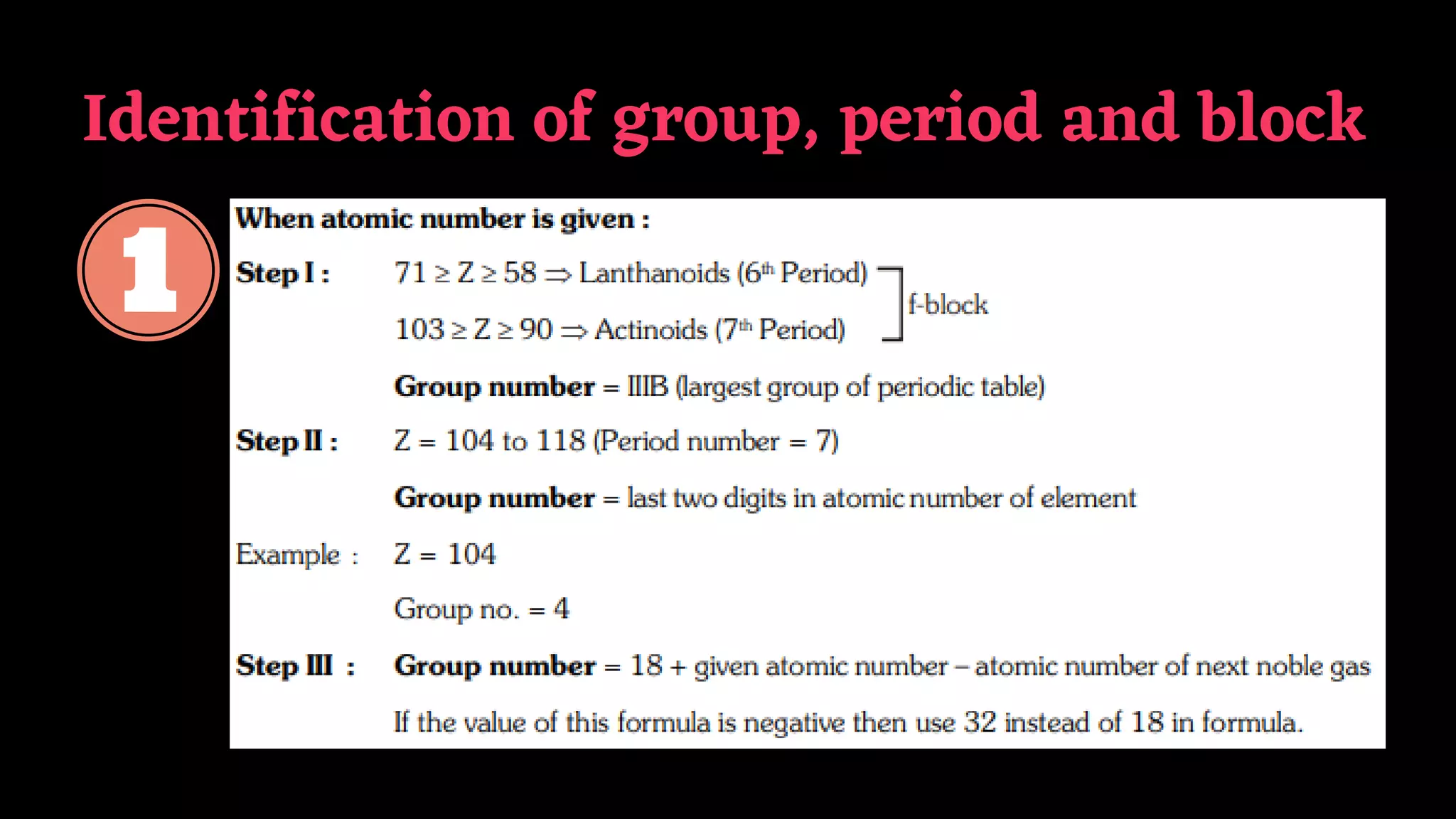
Identification of group, period and block
Some important points
2nd period elements Li, Be, B shows diagonal relationship with 3rd
period elements Mg, Al, Si. Because of same ionic potential value
they show similarity in properties.
3rd period elements Na, Mg, Al, Si, P, S, Cl except inert gases are
called typical elements because they represent the properties of
other elements of their repesctive group.
Transuranic elements are those elements which have atomic
number more than 92.
Transuranic elements are artificial and radioactive.
First man made element Tc - Technetium
First man made lanthanoid Pm - Promethium
Most electropositive elements - GROUP IA
Most electronegative elements - GROUP VIIA
Number of gases - 11
Number of liquid - 6
Number of solid - 95
Bromine only liquid non metal
Elements with 0 valency - GROUP ZERO
THANK
THANK
YOU
YOU

Class 11 chemistry Art integrated Project Periodic Table

  • 1.
    Long form of periodic table Class 11Chemistry ART INTEGRATED PROJECT
  • 2.
    SWEKIT PATEL CLASS 11 PUNEINTERNATIONAL SCHOOL
  • 4.
    Introduction It is basedon the Bohr-Bury electronic configuration concept and atomic number. This model is proposed by Rang and Werner. It is also called as 'Bohr, Bury, Rang, and Werner Periodic table' This periodic table has 7 periods and 18 groups. According to IUPAC 18 vertical vertical columns are named as 1st and 18th group. Elements belonging to same group have same number of electron in the outermost shell so their properties are similar.
  • 5.
    The physical andchemical properties of elements are the periodic function of their atommic number. Modern periodic law Period A period in the periodic table is a row of chemical elements. All elements in a row have the same number of electron shells. Group A group is a column of elements in the periodic table of the chemical elements.
  • 6.
    Description of period Periodnumber = outermost shell Number of element in a period = Number of electron in a period subshell P
  • 7.
    Description of group Alkalimetals (IA) 1st group
  • 8.
    Alkaline earth metals(IIA) 2nd group
  • 9.
  • 10.
  • 11.
    Nitrogen family /Picogen (VA) 15th group
  • 12.
    Oxygen Family /Chalcogen (VIA) 16th group
  • 13.
    Fluorine Family /Halogens (VIIA) 17th group
  • 14.
    Inert gas/ Noblegas/ Zero group 18th group
  • 15.
    Nomenclature of elements IUPACgave names to elements above atomic number 100 as follows In all the elements suffix is ium
  • 16.
    Identification of group,period and block
  • 18.
    Some important points 2ndperiod elements Li, Be, B shows diagonal relationship with 3rd period elements Mg, Al, Si. Because of same ionic potential value they show similarity in properties. 3rd period elements Na, Mg, Al, Si, P, S, Cl except inert gases are called typical elements because they represent the properties of other elements of their repesctive group.
  • 19.
    Transuranic elements arethose elements which have atomic number more than 92. Transuranic elements are artificial and radioactive. First man made element Tc - Technetium First man made lanthanoid Pm - Promethium Most electropositive elements - GROUP IA Most electronegative elements - GROUP VIIA Number of gases - 11 Number of liquid - 6 Number of solid - 95 Bromine only liquid non metal Elements with 0 valency - GROUP ZERO
  • 20.