CHAPTER 17
Liquidity Risk
Copyright © 2011 by The McGraw-Hill Companies, Inc. All Rights Reserved.
McGraw-Hill/Irwin
17-2
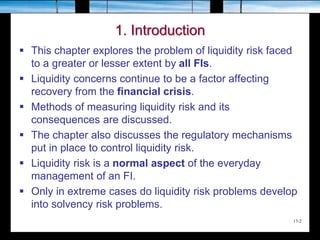
1. Introduction
 This chapter explores the problem of liquidity risk faced
to a greater or lesser extent by all FIs.
 Liquidity concerns continue to be a factor affecting
recovery from the financial crisis.
 Methods of measuring liquidity risk and its
consequences are discussed.
 The chapter also discusses the regulatory mechanisms
put in place to control liquidity risk.
 Liquidity risk is a normal aspect of the everyday
management of an FI.
 Only in extreme cases do liquidity risk problems develop
into solvency risk problems.
17-3
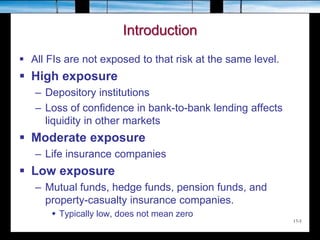
Introduction
 All FIs are not exposed to that risk at the same level.
 High exposure
– Depository institutions
– Loss of confidence in bank-to-bank lending affects
liquidity in other markets
 Moderate exposure
– Life insurance companies
 Low exposure
– Mutual funds, hedge funds, pension funds, and
property-casualty insurance companies.
 Typically low, does not mean zero
17-4
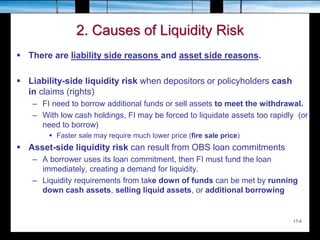
2. Causes of Liquidity Risk
 There are liability side reasons and asset side reasons.
 Liability-side liquidity risk when depositors or policyholders cash
in claims (rights)
– FI need to borrow additional funds or sell assets to meet the withdrawal.
– With low cash holdings, FI may be forced to liquidate assets too rapidly (or
need to borrow)
 Faster sale may require much lower price (fire sale price)
 Asset-side liquidity risk can result from OBS loan commitments
– A borrower uses its loan commitment, then FI must fund the loan
immediately, creating a demand for liquidity.
– Liquidity requirements from take down of funds can be met by running
down cash assets, selling liquid assets, or additional borrowing
17-5
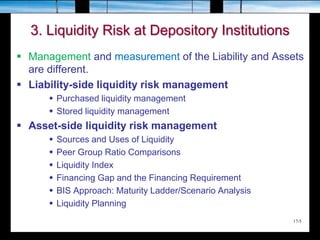
3. Liquidity Risk at Depository Institutions
 Management and measurement of the Liability and Assets
are different.
 Liability-side liquidity risk management
 Purchased liquidity management
 Stored liquidity management
 Asset-side liquidity risk management
 Sources and Uses of Liquidity
 Peer Group Ratio Comparisons
 Liquidity Index
 Financing Gap and the Financing Requirement
 BIS Approach: Maturity Ladder/Scenario Analysis
 Liquidity Planning
17-6
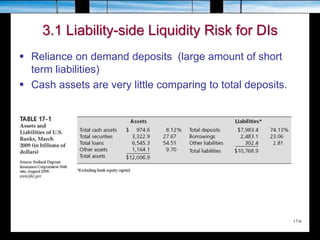
3.1 Liability-side Liquidity Risk for DIs
 Reliance on demand deposits (large amount of short
term liabilities)
 Cash assets are very little comparing to total deposits.
17-7
Liability-side Liquidity Risk for DIs
– Core deposits is the key (with a long term funding source)
– Depository institutions need to be able to predict the distribution
of net deposit drains (the difference between deposit
withdrawals and deposit additions) on a given day.
 Seasonality effects in net withdrawal patterns
 Large inflows of funds can be problem sometime: Early
2000s problem with low rates: Finding suitable investment
opportunities for the large inflows
– Managed by:
 Purchased liquidity management
 Stored liquidity management (traditionally relied on)
17-8
Purchased Liquidity Management
– Federal funds market or repurchase agreement market are the
markets to purchase liquidity.
– Managing the liability side preserves asset side of balance
sheet
– Borrowed funds will likely be at higher rates than interest paid
on deposits (an expensive solution as you have to pay market
rates for low interest bearing deposits, that is unattractive)
– Deposits are insured but borrowed funds not necessarily
protected (for high risk FI availability might be a problem)
– Regulatory concerns:
 During financial crisis, wholesale funds were difficult and sometimes
impossible to obtain
17-9
Purchased Liquidity Management
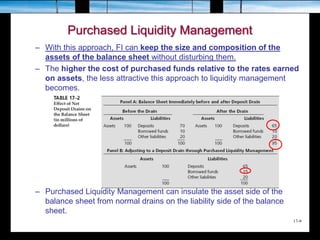
– With this approach, FI can keep the size and composition of the
assets of the balance sheet without disturbing them.
– The higher the cost of purchased funds relative to the rates earned
on assets, the less attractive this approach to liquidity management
becomes.
– Purchased Liquidity Management can insulate the asset side of the
balance sheet from normal drains on the liability side of the balance
sheet.
17-10
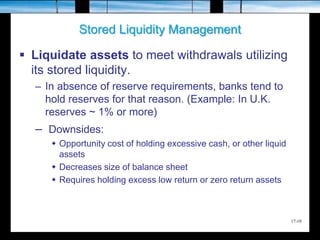
Stored Liquidity Management
 Liquidate assets to meet withdrawals utilizing
its stored liquidity.
– In absence of reserve requirements, banks tend to
hold reserves for that reason. (Example: In U.K.
reserves ~ 1% or more)
– Downsides:
 Opportunity cost of holding excessive cash, or other liquid
assets
 Decreases size of balance sheet
 Requires holding excess low return or zero return assets
17-11
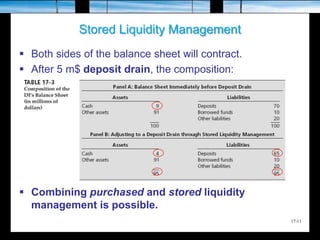
Stored Liquidity Management
 Both sides of the balance sheet will contract.
 After 5 m$ deposit drain, the composition:
 Combining purchased and stored liquidity
management is possible.
17-12
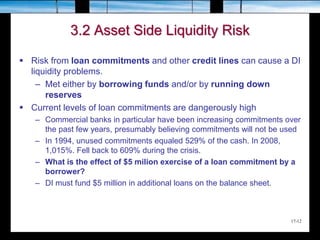
3.2 Asset Side Liquidity Risk
 Risk from loan commitments and other credit lines can cause a DI
liquidity problems.
– Met either by borrowing funds and/or by running down
reserves
 Current levels of loan commitments are dangerously high
– Commercial banks in particular have been increasing commitments over
the past few years, presumably believing commitments will not be used
– In 1994, unused commitments equaled 529% of the cash. In 2008,
1,015%. Fell back to 609% during the crisis.
– What is the effect of $5 milion exercise of a loan commitment by a
borrower?
– DI must fund $5 million in additional loans on the balance sheet.
17-13
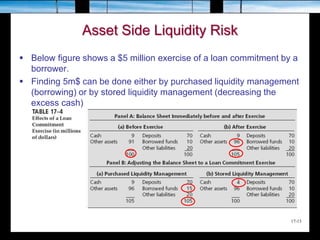
Asset Side Liquidity Risk
 Below figure shows a $5 million exercise of a loan commitment by a
borrower.
 Finding 5m$ can be done either by purchased liquidity management
(borrowing) or by stored liquidity management (decreasing the
excess cash)
17-14
Asset Side Liquidity Risk
 Liquidity risk can be affected from several issues:
 Interest rate risk and market risk of the investment
portfolio can cause values to fluctuate
 Arguments that technological improvements have
increased liquidity in financial markets.
– Some argue that “herd” behavior may actually reduce liquidity
 During the sell off, liquidity dries up and investment
securities can be sold only at fire sale prices.
17-15
Asset Side Liquidity Risk
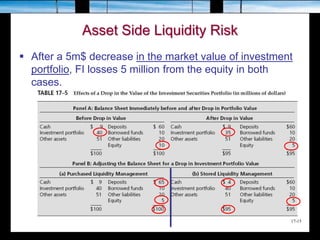
 After a 5m$ decrease in the market value of investment
portfolio, FI losses 5 million from the equity in both
cases.
17-16
3.3 Measuring Liquidity Exposure
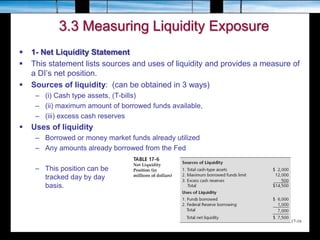
 1- Net Liquidity Statement
 This statement lists sources and uses of liquidity and provides a measure of
a DI’s net position.
 Sources of liquidity: (can be obtained in 3 ways)
– (i) Cash type assets, (T-bills)
– (ii) maximum amount of borrowed funds available,
– (iii) excess cash reserves
 Uses of liquidity
– Borrowed or money market funds already utilized
– Any amounts already borrowed from the Fed
– This position can be
tracked day by day
basis.
17-17
Measuring Liquidity Exposure
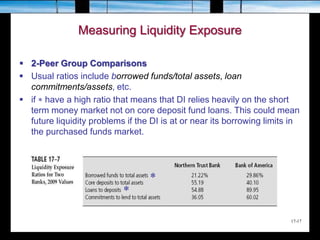
 2-Peer Group Comparisons
 Usual ratios include borrowed funds/total assets, loan
commitments/assets, etc.
 if  have a high ratio that means that DI relies heavily on the short
term money market not on core deposit fund loans. This could mean
future liquidity problems if the DI is at or near its borrowing limits in
the purchased funds market.


17-18
Measuring Liquidity Exposure
 3-Liquidity Index
 Developed by Jim Pierce at Fed, this index measure the potential
losses an FI could suffer from a sudden or fire sale disposal of
assets compared with the amount it would receive at a fair market
value under normal market sale conditions.
 Weighted sum of “fire sale price” P, to fair market price, P*, where
the portfolio weights are the percent of the portfolio value formed by
the individual assets
 I = S wi(Pi /Pi*)
 It will always between 0 and 1. This index can be calculated for a
peer group of similar DIs.
 The greater the differences between immediate fire sale asset prices
(Pi) and fair market Prices (P*i) the less liquid is the DI’s portfolio of
assets.
17-19
Measuring Liquidity Exposure
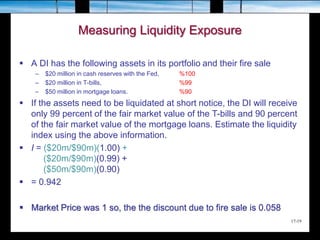
 A DI has the following assets in its portfolio and their fire sale
– $20 million in cash reserves with the Fed, %100
– $20 million in T-bills, %99
– $50 million in mortgage loans. %90
 If the assets need to be liquidated at short notice, the DI will receive
only 99 percent of the fair market value of the T-bills and 90 percent
of the fair market value of the mortgage loans. Estimate the liquidity
index using the above information.
 I = ($20m/$90m)(1.00) +
($20m/$90m)(0.99) +
($50m/$90m)(0.90)
 = 0.942
 Market Price was 1 so, the the discount due to fire sale is 0.058
17-20
Measuring Liquidity Exposure
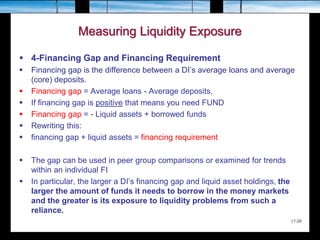
 4-Financing Gap and Financing Requirement
 Financing gap is the difference between a DI’s average loans and average
(core) deposits.
 Financing gap = Average loans - Average deposits,
 If financing gap is positive that means you need FUND
 Financing gap = - Liquid assets + borrowed funds
 Rewriting this:
 financing gap + liquid assets = financing requirement
 The gap can be used in peer group comparisons or examined for trends
within an individual FI
 In particular, the larger a DI’s financing gap and liquid asset holdings, the
larger the amount of funds it needs to borrow in the money markets
and the greater is its exposure to liquidity problems from such a
reliance.
17-21
Measuring Liquidity Exposure
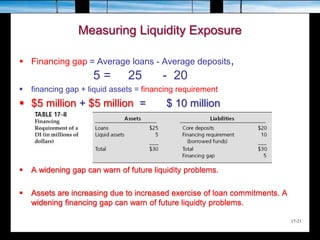
 Financing gap = Average loans - Average deposits,
5 = 25 - 20
 financing gap + liquid assets = financing requirement
 $5 million + $5 million = $ 10 million
 A widening gap can warn of future liquidity problems.
 Assets are increasing due to increased exercise of loan commitments. A
widening financing gap can warn of future liquidty problems.
17-22
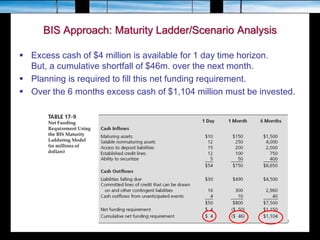
5-BIS Approach: Maturity Ladder/Scenario Analysis
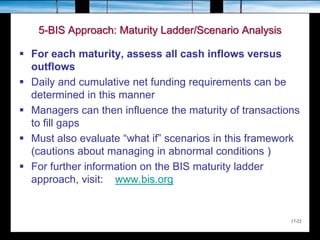
 For each maturity, assess all cash inflows versus
outflows
 Daily and cumulative net funding requirements can be
determined in this manner
 Managers can then influence the maturity of transactions
to fill gaps
 Must also evaluate “what if” scenarios in this framework
(cautions about managing in abnormal conditions )
 For further information on the BIS maturity ladder
approach, visit: www.bis.org
17-23
BIS Approach: Maturity Ladder/Scenario Analysis
 Excess cash of $4 million is available for 1 day time horizon.
But, a cumulative shortfall of $46m. over the next month.
 Planning is required to fill this net funding requirement.
 Over the 6 months excess cash of $1,104 million must be invested.
17-24
BIS Approach: Maturity Ladder/Scenario Analysis
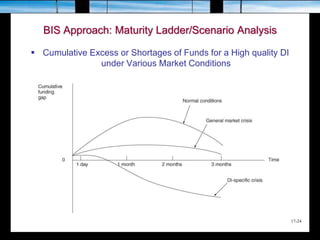
 Cumulative Excess or Shortages of Funds for a High quality DI
under Various Market Conditions
17-25
Liquidity Planning
 Make funding decisions before liquidity problems arise:
Therefore;
– Lower the cost of funds by planning an optimal funding mix
– Minimize the need for reserve holdings
 There are some components of a liquidity plan. They
are:
– Delineate (describe) managerial responsibilities
– Detailed list of funds providers,
– Identify size of potential deposit and fund withdrawals over
various future time horizons
– Set internal limits on subsidiaries’ and branches’ borrowings and
limits on risk premiums for funding sources
– Plan the sequence of asset disposal to meet liquidity needs
17-26
3.4 Liquidity Risk, Unexpected Deposit Drains,
Bank Runs
 Anticipated needs are not unexpected deposit drains.
(summer, christmast, seasonal effects etc.)
 Any sudden and unexpected surges in net deposit witdrawals
risk triggering a bank run that could eventually force a bank
into solvency.
 Major liquidity problems can arise if deposit drains are
abnormally large and unexpected due to concern about:
– Bank solvency
– Failure of a related FI
– Sudden changes in investor preferences
 Demand deposits are first come, first served
 Bank panic: Systemic or contagious bank run [a sudden and
unexpected increase in deposit withdrawels from a DI]
17-27
Alleviating(Reducing) Bank Runs
 Regulatory mechanisms/measures to reduce likelihood
of bank runs are in effect.
 Discount window
– FDIC (or Deposit Insurance)
– Direct actions such as Troubled Asset Relief Program (TARP)
(2008-2009)
– Fed lending to investment banks in the crisis. First time in its
history. (not only depository FIs but also investment banks)
 Reducing bank risk is okay but not without economic
costs
– Protections can encourage DIs to increase liquidity risk
17-28
4. Liquidity Risk for Life Insurance Cos.
 Concerns about the solvency of an insurer can
result in a run, new premium income dries up and
existing policyholders seek to cancel their policies by
cashing them in early.
 The early cancellation of an insurance policy results
in the insurer’s having to pay the insured the
surrender value of that policy.
 Insurance companies need to cash some assets if the
premium income is not sufficiant.
 Life insurance hold reserves such as government
bonds as a buffer to offset policy cancellations.
17-29
5. Liquidity Risk for Property Casualty Insurers
 PC Insurers sell policies insuring against certain contingencies
impacting either real property or individuals.
 Claims are not predictable so that they should have relatively short
term assets and more than those of life insurers.
 As a result, problem is less severe for PC insurers since assets tend
to be shorter term and more liquid
 However, large unexpected claims can be problematic
 Hurricane Andrew and Hurricane Katrina precipitated severe liquidity
crises for many insurers
 Near failure of giant insurer, AIG (2008)
− Credit default swaps / Restructuring and government bailout
17-30
6. Investment Funds
 Investment funds (mutual funds hedge funds) sell shares as liabilities to
investors and invest the proceeds in assets such as bonds and equities.
 It depends if an investment fund is closed end or open end fund.
 In the case of a liquidity crisis in DIs and insurance firms, there are incentives for
depositors and policyholders to withdraw their money or cash in their policies as
early as possible.
 Latecomers will be penalized because the financial institution may be out of liquid
assets. They will have to wait until the institution sells its assets at fire-sale prices,
resulting in a lower payout.
 In the case of investment funds, the net asset value for all shareholders is
lowered or raised as the market value of assets change, so that everybody will
receive the same price if they decide to withdraw their funds. Hence, the
incentive to engage in a run is minimized.
 Closed-end funds are traded directly on stock exchanges, and therefore little
liquidity risk exists since any fund owner can sell the shares on the exchange.
 An open-end fund is exposed to more risk since those shares are sold back to
the fund which must provide cash to the seller.
17-31
Investment Funds
 The mutual fund shareholder knows that their loss of asset value on a pro rata
bases. (proportional)
17-32
Summary
– Liquidity risk is a common problem faced by FI
managers.
– Very large withdrawals can cause asset liquidity
problems that can be compounded by incentives for
liability claim holders to engage in runs.
– Insolvencies have costs to society as well as to
private shareholders.
– Regulators have developed mechanisms such as
deposit insurance and the discount window to
alleviate liquidity problems.
– These will be discussed in another chapter.

3-_chap017-edited04 (1).ppt

  • 1.
    CHAPTER 17 Liquidity Risk Copyright© 2011 by The McGraw-Hill Companies, Inc. All Rights Reserved. McGraw-Hill/Irwin
  • 2.
    17-2 1. Introduction  Thischapter explores the problem of liquidity risk faced to a greater or lesser extent by all FIs.  Liquidity concerns continue to be a factor affecting recovery from the financial crisis.  Methods of measuring liquidity risk and its consequences are discussed.  The chapter also discusses the regulatory mechanisms put in place to control liquidity risk.  Liquidity risk is a normal aspect of the everyday management of an FI.  Only in extreme cases do liquidity risk problems develop into solvency risk problems.
  • 3.
    17-3 Introduction  All FIsare not exposed to that risk at the same level.  High exposure – Depository institutions – Loss of confidence in bank-to-bank lending affects liquidity in other markets  Moderate exposure – Life insurance companies  Low exposure – Mutual funds, hedge funds, pension funds, and property-casualty insurance companies.  Typically low, does not mean zero
  • 4.
    17-4 2. Causes ofLiquidity Risk  There are liability side reasons and asset side reasons.  Liability-side liquidity risk when depositors or policyholders cash in claims (rights) – FI need to borrow additional funds or sell assets to meet the withdrawal. – With low cash holdings, FI may be forced to liquidate assets too rapidly (or need to borrow)  Faster sale may require much lower price (fire sale price)  Asset-side liquidity risk can result from OBS loan commitments – A borrower uses its loan commitment, then FI must fund the loan immediately, creating a demand for liquidity. – Liquidity requirements from take down of funds can be met by running down cash assets, selling liquid assets, or additional borrowing
  • 5.
    17-5 3. Liquidity Riskat Depository Institutions  Management and measurement of the Liability and Assets are different.  Liability-side liquidity risk management  Purchased liquidity management  Stored liquidity management  Asset-side liquidity risk management  Sources and Uses of Liquidity  Peer Group Ratio Comparisons  Liquidity Index  Financing Gap and the Financing Requirement  BIS Approach: Maturity Ladder/Scenario Analysis  Liquidity Planning
  • 6.
    17-6 3.1 Liability-side LiquidityRisk for DIs  Reliance on demand deposits (large amount of short term liabilities)  Cash assets are very little comparing to total deposits.
  • 7.
    17-7 Liability-side Liquidity Riskfor DIs – Core deposits is the key (with a long term funding source) – Depository institutions need to be able to predict the distribution of net deposit drains (the difference between deposit withdrawals and deposit additions) on a given day.  Seasonality effects in net withdrawal patterns  Large inflows of funds can be problem sometime: Early 2000s problem with low rates: Finding suitable investment opportunities for the large inflows – Managed by:  Purchased liquidity management  Stored liquidity management (traditionally relied on)
  • 8.
    17-8 Purchased Liquidity Management –Federal funds market or repurchase agreement market are the markets to purchase liquidity. – Managing the liability side preserves asset side of balance sheet – Borrowed funds will likely be at higher rates than interest paid on deposits (an expensive solution as you have to pay market rates for low interest bearing deposits, that is unattractive) – Deposits are insured but borrowed funds not necessarily protected (for high risk FI availability might be a problem) – Regulatory concerns:  During financial crisis, wholesale funds were difficult and sometimes impossible to obtain
  • 9.
    17-9 Purchased Liquidity Management –With this approach, FI can keep the size and composition of the assets of the balance sheet without disturbing them. – The higher the cost of purchased funds relative to the rates earned on assets, the less attractive this approach to liquidity management becomes. – Purchased Liquidity Management can insulate the asset side of the balance sheet from normal drains on the liability side of the balance sheet.
  • 10.
    17-10 Stored Liquidity Management Liquidate assets to meet withdrawals utilizing its stored liquidity. – In absence of reserve requirements, banks tend to hold reserves for that reason. (Example: In U.K. reserves ~ 1% or more) – Downsides:  Opportunity cost of holding excessive cash, or other liquid assets  Decreases size of balance sheet  Requires holding excess low return or zero return assets
  • 11.
    17-11 Stored Liquidity Management Both sides of the balance sheet will contract.  After 5 m$ deposit drain, the composition:  Combining purchased and stored liquidity management is possible.
  • 12.
    17-12 3.2 Asset SideLiquidity Risk  Risk from loan commitments and other credit lines can cause a DI liquidity problems. – Met either by borrowing funds and/or by running down reserves  Current levels of loan commitments are dangerously high – Commercial banks in particular have been increasing commitments over the past few years, presumably believing commitments will not be used – In 1994, unused commitments equaled 529% of the cash. In 2008, 1,015%. Fell back to 609% during the crisis. – What is the effect of $5 milion exercise of a loan commitment by a borrower? – DI must fund $5 million in additional loans on the balance sheet.
  • 13.
    17-13 Asset Side LiquidityRisk  Below figure shows a $5 million exercise of a loan commitment by a borrower.  Finding 5m$ can be done either by purchased liquidity management (borrowing) or by stored liquidity management (decreasing the excess cash)
  • 14.
    17-14 Asset Side LiquidityRisk  Liquidity risk can be affected from several issues:  Interest rate risk and market risk of the investment portfolio can cause values to fluctuate  Arguments that technological improvements have increased liquidity in financial markets. – Some argue that “herd” behavior may actually reduce liquidity  During the sell off, liquidity dries up and investment securities can be sold only at fire sale prices.
  • 15.
    17-15 Asset Side LiquidityRisk  After a 5m$ decrease in the market value of investment portfolio, FI losses 5 million from the equity in both cases.
  • 16.
    17-16 3.3 Measuring LiquidityExposure  1- Net Liquidity Statement  This statement lists sources and uses of liquidity and provides a measure of a DI’s net position.  Sources of liquidity: (can be obtained in 3 ways) – (i) Cash type assets, (T-bills) – (ii) maximum amount of borrowed funds available, – (iii) excess cash reserves  Uses of liquidity – Borrowed or money market funds already utilized – Any amounts already borrowed from the Fed – This position can be tracked day by day basis.
  • 17.
    17-17 Measuring Liquidity Exposure 2-Peer Group Comparisons  Usual ratios include borrowed funds/total assets, loan commitments/assets, etc.  if  have a high ratio that means that DI relies heavily on the short term money market not on core deposit fund loans. This could mean future liquidity problems if the DI is at or near its borrowing limits in the purchased funds market.  
  • 18.
    17-18 Measuring Liquidity Exposure 3-Liquidity Index  Developed by Jim Pierce at Fed, this index measure the potential losses an FI could suffer from a sudden or fire sale disposal of assets compared with the amount it would receive at a fair market value under normal market sale conditions.  Weighted sum of “fire sale price” P, to fair market price, P*, where the portfolio weights are the percent of the portfolio value formed by the individual assets  I = S wi(Pi /Pi*)  It will always between 0 and 1. This index can be calculated for a peer group of similar DIs.  The greater the differences between immediate fire sale asset prices (Pi) and fair market Prices (P*i) the less liquid is the DI’s portfolio of assets.
  • 19.
    17-19 Measuring Liquidity Exposure A DI has the following assets in its portfolio and their fire sale – $20 million in cash reserves with the Fed, %100 – $20 million in T-bills, %99 – $50 million in mortgage loans. %90  If the assets need to be liquidated at short notice, the DI will receive only 99 percent of the fair market value of the T-bills and 90 percent of the fair market value of the mortgage loans. Estimate the liquidity index using the above information.  I = ($20m/$90m)(1.00) + ($20m/$90m)(0.99) + ($50m/$90m)(0.90)  = 0.942  Market Price was 1 so, the the discount due to fire sale is 0.058
  • 20.
    17-20 Measuring Liquidity Exposure 4-Financing Gap and Financing Requirement  Financing gap is the difference between a DI’s average loans and average (core) deposits.  Financing gap = Average loans - Average deposits,  If financing gap is positive that means you need FUND  Financing gap = - Liquid assets + borrowed funds  Rewriting this:  financing gap + liquid assets = financing requirement  The gap can be used in peer group comparisons or examined for trends within an individual FI  In particular, the larger a DI’s financing gap and liquid asset holdings, the larger the amount of funds it needs to borrow in the money markets and the greater is its exposure to liquidity problems from such a reliance.
  • 21.
    17-21 Measuring Liquidity Exposure Financing gap = Average loans - Average deposits, 5 = 25 - 20  financing gap + liquid assets = financing requirement  $5 million + $5 million = $ 10 million  A widening gap can warn of future liquidity problems.  Assets are increasing due to increased exercise of loan commitments. A widening financing gap can warn of future liquidty problems.
  • 22.
    17-22 5-BIS Approach: MaturityLadder/Scenario Analysis  For each maturity, assess all cash inflows versus outflows  Daily and cumulative net funding requirements can be determined in this manner  Managers can then influence the maturity of transactions to fill gaps  Must also evaluate “what if” scenarios in this framework (cautions about managing in abnormal conditions )  For further information on the BIS maturity ladder approach, visit: www.bis.org
  • 23.
    17-23 BIS Approach: MaturityLadder/Scenario Analysis  Excess cash of $4 million is available for 1 day time horizon. But, a cumulative shortfall of $46m. over the next month.  Planning is required to fill this net funding requirement.  Over the 6 months excess cash of $1,104 million must be invested.
  • 24.
    17-24 BIS Approach: MaturityLadder/Scenario Analysis  Cumulative Excess or Shortages of Funds for a High quality DI under Various Market Conditions
  • 25.
    17-25 Liquidity Planning  Makefunding decisions before liquidity problems arise: Therefore; – Lower the cost of funds by planning an optimal funding mix – Minimize the need for reserve holdings  There are some components of a liquidity plan. They are: – Delineate (describe) managerial responsibilities – Detailed list of funds providers, – Identify size of potential deposit and fund withdrawals over various future time horizons – Set internal limits on subsidiaries’ and branches’ borrowings and limits on risk premiums for funding sources – Plan the sequence of asset disposal to meet liquidity needs
  • 26.
    17-26 3.4 Liquidity Risk,Unexpected Deposit Drains, Bank Runs  Anticipated needs are not unexpected deposit drains. (summer, christmast, seasonal effects etc.)  Any sudden and unexpected surges in net deposit witdrawals risk triggering a bank run that could eventually force a bank into solvency.  Major liquidity problems can arise if deposit drains are abnormally large and unexpected due to concern about: – Bank solvency – Failure of a related FI – Sudden changes in investor preferences  Demand deposits are first come, first served  Bank panic: Systemic or contagious bank run [a sudden and unexpected increase in deposit withdrawels from a DI]
  • 27.
    17-27 Alleviating(Reducing) Bank Runs Regulatory mechanisms/measures to reduce likelihood of bank runs are in effect.  Discount window – FDIC (or Deposit Insurance) – Direct actions such as Troubled Asset Relief Program (TARP) (2008-2009) – Fed lending to investment banks in the crisis. First time in its history. (not only depository FIs but also investment banks)  Reducing bank risk is okay but not without economic costs – Protections can encourage DIs to increase liquidity risk
  • 28.
    17-28 4. Liquidity Riskfor Life Insurance Cos.  Concerns about the solvency of an insurer can result in a run, new premium income dries up and existing policyholders seek to cancel their policies by cashing them in early.  The early cancellation of an insurance policy results in the insurer’s having to pay the insured the surrender value of that policy.  Insurance companies need to cash some assets if the premium income is not sufficiant.  Life insurance hold reserves such as government bonds as a buffer to offset policy cancellations.
  • 29.
    17-29 5. Liquidity Riskfor Property Casualty Insurers  PC Insurers sell policies insuring against certain contingencies impacting either real property or individuals.  Claims are not predictable so that they should have relatively short term assets and more than those of life insurers.  As a result, problem is less severe for PC insurers since assets tend to be shorter term and more liquid  However, large unexpected claims can be problematic  Hurricane Andrew and Hurricane Katrina precipitated severe liquidity crises for many insurers  Near failure of giant insurer, AIG (2008) − Credit default swaps / Restructuring and government bailout
  • 30.
    17-30 6. Investment Funds Investment funds (mutual funds hedge funds) sell shares as liabilities to investors and invest the proceeds in assets such as bonds and equities.  It depends if an investment fund is closed end or open end fund.  In the case of a liquidity crisis in DIs and insurance firms, there are incentives for depositors and policyholders to withdraw their money or cash in their policies as early as possible.  Latecomers will be penalized because the financial institution may be out of liquid assets. They will have to wait until the institution sells its assets at fire-sale prices, resulting in a lower payout.  In the case of investment funds, the net asset value for all shareholders is lowered or raised as the market value of assets change, so that everybody will receive the same price if they decide to withdraw their funds. Hence, the incentive to engage in a run is minimized.  Closed-end funds are traded directly on stock exchanges, and therefore little liquidity risk exists since any fund owner can sell the shares on the exchange.  An open-end fund is exposed to more risk since those shares are sold back to the fund which must provide cash to the seller.
  • 31.
    17-31 Investment Funds  Themutual fund shareholder knows that their loss of asset value on a pro rata bases. (proportional)
  • 32.
    17-32 Summary – Liquidity riskis a common problem faced by FI managers. – Very large withdrawals can cause asset liquidity problems that can be compounded by incentives for liability claim holders to engage in runs. – Insolvencies have costs to society as well as to private shareholders. – Regulators have developed mechanisms such as deposit insurance and the discount window to alleviate liquidity problems. – These will be discussed in another chapter.