International Journal of Trend in Scientific Research and Development (IJTSRD)
Volume 4 Issue 5, July-August 2020 Available Online: www.ijtsrd.com e-ISSN: 2456 – 6470
@ IJTSRD | Unique Paper ID – IJTSRD32912 | Volume – 4 | Issue – 5 | July-August 2020 Page 651
Satellite and Land Cover Image
Classification using Deep Learning
Roshni Rajendran1, Liji Samuel2
1M Tech Student, 2Assistant Professor,
1,2Department of Computer Science and Engineering,
1,2Sree Buddha College of Engineering, Padanilam, Kerala, India
ABSTRACT
Satellite imagery is very significant for many applications including disaster
response, law enforcement and environmental monitoring.Theseapplications
require the manual identification of objects and facilities in the imagery.
Because the geographic area to be covered are greatand the analystsavailable
to conduct the searchesare few, automation is required. Thetraditionalobject
detection and classification algorithms are too inaccurate, takes a lot of time
and unreliable to solve the problem. Deep learning is a family of machine
learning algorithms that can be used for the automation of such tasks. It has
achieved success in image classification by using convolutional neural
networks. The problem of objectand facility classification in satellite imagery
is considered. The system is developed by using various facilities like Tensor
Flow, XAMPP, FLASK and other various deep learning libraries.
KEYWORDS: Deep Learning, Convolutional neural network, VGG, GPU, Tensor
Flow, Random forest algorithm
How to cite this paper: Roshni Rajendran
| Liji Samuel "Satellite and Land Cover
Image Classification usingDeepLearning"
Published in
International Journal
of Trend in Scientific
Research and
Development(ijtsrd),
ISSN: 2456-6470,
Volume-4 | Issue-5,
August 2020, pp.651-
655, URL:
www.ijtsrd.com/papers/ijtsrd32912.pdf
Copyright © 2020 by author(s) and
International Journal of TrendinScientific
Research and Development Journal. This
is an Open Access article distributed
under the terms of
the Creative
Commons Attribution
License (CC BY 4.0)
(http://creativecommons.org/licenses/by
/4.0)
INTRODUCTION
Deep learning is a class of machine learning models that
represent data at different levels of abstraction by means of
multiple processing layers. It has achieved astonishing
success in object detection and classification by combining
large neural network models, called CNN withpowerfulGPU.
A CNN isa deep learningalgorithmwhich can takeinaninput
image, assign importance (learnable weights and biases) to
various aspects/objects in the image and be able to
differentiateone from the other. The pre-processingrequired
in a CNN is much lower as compared to other classification
algorithms. While in primitive methods filters are hand-
engineered, with enough training, CNN have the ability to
learn these filters/characteristics.
The architecture of a CNN is analogous to that of the
connectivity pattern ofNeuronsinthe HumanBrainandwas
inspired by the organization of the Visual Cortex. Individual
neurons respond to stimuli only in a restricted region of the
visualfield knownas theReceptiveField. Acollection of such
fields overlaps to cover the entire visual area.
CNN-based algorithms have dominatedtheannualImageNet
Large Scale Visual Recognition Challenge for detecting and
classifying objectsin photographs.This success hascauseda
revolution in image understanding, and the major
technology companies, including Google, Microsoft and
Facebook, have already deployed CNN-based products and
services.
A CNN consists of a series of processing layers as shown in
Fig. 1. Each layer isa family of convolution filters that detect
image features.Near the end of the series, the CNNcombines
the detector outputs in fully connected “dense” layers,finally
producing a set of predicted probabilities, one for eachclass.
The objective of the convolution operation is to extract the
high-level features suchas edges,from the input image. CNN
need not be limited to only one Convolutional Layer.
Conventionally, thefirstCNN is responsibleforcapturingthe
Low-Levelfeaturessuchasedges, color, gradientorientation,
etc [3]. With added layers, the architecture adapts to the
High-Level features as well, giving us a network, which has
the wholesome understanding of images in the dataset,
similar tohow wewould. Unlike older methods like SIFTand
HOG, CNNs do not require the algorithm designer to
engineer feature detectors. The network itself learns which
features to detect, and how to detect them, as it trains.
Figure 1 System model
IJTSRD32912
International Journal of Trend in Scientific Research and Development (IJTSRD) @ www.ijtsrd.com eISSN: 2456-6470
@ IJTSRD | Unique Paper ID – IJTSRD32912 | Volume – 4 | Issue – 5 | July-August 2020 Page 652
Such large CNNs require computational power, which is
provided by advanced GPUs. Open source deep learning
software libraries suchas Tensor Flow and Keras,alongwith
fast GPUs, have helped fuel continuing advances in deep
learning.
RELATED WORK
Liang Zhang et al. [4] says that in the field of aerospace
measurement and control field, optical equipmentgenerates
a large amount of data as image. Thus, it has great research
value for how to process a huge number of image data
quickly and effectively. With the development of deep
learning, great progress has been made in the task of image
classification. The task images are generated by optical
measurement equipment are classified using the deep
learning method. Firstly, based on residual network, a
general deep learning image classification framework, a
binary image classification network namely rocket image
and other image is built. Secondly, on the basis of the binary
cross entropy loss function, the modified loss function is
used to achieves a better generalization effect on those
images difficult to classify. Then, the visible image data
downloaded from optical equipment is randomly divided
into training set, validation set and test set. The data
augmentation method is used to train the binary
classification model on a relatively small training set. The
optimal model weight is selected according to the loss value
on the validation set. This method has certain value for
exploring the application of deep learning method in the
intelligent and rapid processing of optical equipment task
image in aerospace measurement and control field.
T. Postadjiana et al. [5] proposes that supervised
classification is the basic taskfor landcover mapgeneration.
From semantic segmentation to speech recognition deep
neural networks has outperformed the state-of-the-art
classifiers in many machine learning challenges. Such
strategies are now commonly employed in the literature for
the purpose of land-cover mapping. The systemdevelopsthe
strategy for the use of deep networks to label very high-
resolution satellite images, with the perspective of mapping
regions at country scale. Therefore, a super pixel-based
method is introduced in order to (i) ensure correct
delineation of objects and (ii) perform the classification in a
dense way but with decent computing times.
Chaomin Shen et al. [6] discuss that the percentage of cloud
cover is one of the key indices for satellite imagery analysis.
To date, cloud cover assessment has performed manually in
most ground stations. To facilitate the process, a deep
learning approach for cloud cover assessment in quick look
satellite images is proposed. Same as the manual operation,
given a quick look image, the algorithm returns 8 labels
ranging from A to E and *, indicating the cloud percentages
in different areas of the image. This is achieved by
constructing 8improved VGG-16models, where parameters
such as the loss function, learning rate and dropout are
tailored for better performance. The procedure of manual
assessment can be summarized as follows. First, determine
whether there is cloud cover in the scene by visual
inspection. Some prior knowledge, e.g., shape, color and
shadow, may be used. Second, estimate the percentage of
cloud presence. Although in reality, the labels are often
determined as follows. If there is no cloud, then A; If a very
small amount of clouds exist, then B; C and D are given to
escalating levels of clouds; and E is given when the whole
part is almost covered by clouds. There is also a label * for
no-data. This mostly happens when the sensor switches,
causing no data for several seconds. The disadvantages of
manual assessment are obvious. First of all, it is tedious
work. Second, results may be inaccurate due to subjective
judgement.
Qingshan Liu et al. [7] discuss about a multiscale deep
feature learning method for high-resolution satellite image
scene classification. However, satellite images with high
spatial resolution pose many challenging issues in image
classification. First, the enhanced resolution brings more
details; thus, simple lowlevel features (e.g., intensity and
textures) widely used in the case of low-resolution images
are insufficient in capturing efficiently discriminative
information. Second, objects in the same type of scene might
have different scales and orientations. Besides, high
resolution satellite images often consist of many different
semantic classes, which makes further classification more
difficult. Taking the commercial scene comprises roads,
buildings, trees, parking lots, and so on. Thus, developing
effective feature representations is critical for solving these
issues.
METHODOLOGY
The proposed system is a deep learning system that
classifies objects and facilities in high-resolution multi-
spectral satellite imagery.
Figure 2 System Architecture
The system consists of an ensemble of CNNs with post-
processing neural networks that combine the predictions
from the CNNs with satellite metadata. Combined with a
detection component, the system couldsearchlargeamounts
of satellite imagery for objects or facilities of interest.
The proposed system mainly consists of four modules:
 Image Preparation
 CNN
 Training
 Classification
A. Image Preparation
The first step that has to be performed is image preparation.
This is a most important step because any small changes
from this step can cause a vital change to overall output.
Initially, images in the dataset may contain different sizes
and resolution. Therefore, images had to be resized before
training [2]. Because every image has to be considered
International Journal of Trend in Scientific Research and Development (IJTSRD) @ www.ijtsrd.com eISSN: 2456-6470
@ IJTSRD | Unique Paper ID – IJTSRD32912 | Volume – 4 | Issue – 5 | July-August 2020 Page 653
within a common frame. And also, for the easiness of
processing the imagesin the dataset itmusthavesamerange
of resolution. Then only the training phase will become
accurate. For that a bounding box is required. These images
in the dataset have to be preprocessed for extracting the
features from it. Each and every image is considered using
this bounding box, so the feature extraction from these
images will become more precise.
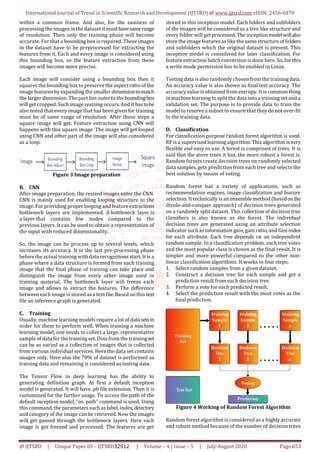
Each image will consider using a bounding box then it
squares the bounding box to preserve the aspect ratio of the
image features by expanding the smaller dimensiontomatch
the larger dimension. The part lies outer to theboundingbox
will get cropped. Such image resizing occurs. And it hastobe
also noted that every image that has been given for training
must be of same range of resolution. After these steps a
square image will get. Feature extraction using CNN will
happens with this square image. The image will get looped
using CNN and other part of the image will also considered
as a loop.
Figure 3 Image preparation
B. CNN
After image preparation, the resized images enter the CNN.
CNN is mainly used for enabling looping structure to the
image. For providing proper looping and feature extractions
bottleneck layers are implemented. A bottleneck layer is
a layer that contains few nodes compared to the
previous layers. It can be used to obtain a representation of
the input with reduced dimensionality.
So, the image can be process up to several levels, which
increases its accuracy. It is the last pre-processing phase
before the actual trainingwith data recognitions start. It isa
phase where a data structure is formed from each training
image that the final phase of training can take place and
distinguish the image from every other image used in
training material. The bottleneck layer will freeze each
image and allows to extract the features. The difference
between each image is stored asa text file. Based on this text
file an inference graph is generated.
C. Training
Usually, machine learning models require a lot of datasetsin
order for them to perform well. When training a machine
learning model, one needs to collect a large, representative
sample of data for the training set. Data from the trainingset
can be as varied as a collection of images that is collected
from various individual services. Here the data set contains
images only. Here also the 70% of dataset is performed as
training data and remaining is considered as testing data.
The Tensor Flow in deep learning has the ability to
generating definition graph. At first a default inception
model is generated. It will have .pb file extension. Then it is
customized for the further usage. To access the path of the
default inception model, “os. path” command is used. Using
this command, the parameters such aslabel, index,directory
and category of the image can be retrieved. Now the images
will get passed through the bottleneck layers. Here each
image is got freezed and processed. The features are get
stored in this inception model. Each folders and subfolders
of the images will be considered as a tree like structure and
every folder will get processed. The inceptionmodelwillalso
store the image features as like the same structure of folders
and subfolders which the original dataset is present. This
inception model is considered for later classification. For
feature extraction batchconversion is done here. So, for this
a write mode permission has to be enabled in Linux.
Testing data isalso randomly chosen from the training data.
An accuracy value is also shown as final test accuracy. The
accuracy value is obtained from entropy. It is common thing
in machine learning to split the data into a training set and a
validation set. The purpose is to provide data to train the
model to reserve a subset to ensure that they do not over-fit
to the training data.
D. Classification
For classification purpose random forest algorithm is used.
RF isa supervised learningalgorithm. This algorithm is very
flexible and easy to use. A forest is comprised of trees. It is
said that the more trees it has, the more robust a forest is.
Random forests create decision trees on randomly selected
data samples, gets prediction from each tree and selects the
best solution by means of voting.
Random forest has a variety of applications, such as
recommendation engines, image classification and feature
selection. It technically is an ensemble method (basedonthe
divide-and-conquer approach) of decision trees generated
on a randomly split dataset. This collection of decision tree
classifiers is also known as the forest. The individual
decision trees are generated using an attribute selection
indicator suchasinformation gain, gain ratio, and Gini index
for each attribute. Each tree depends on an independent
random sample. In a classification problem, each tree votes
and the most popular class is chosen as the final result. It is
simpler and more powerful compared to the other non-
linear classification algorithms. It works in four steps:
1. Select random samples from a given dataset.
2. Construct a decision tree for each sample and get a
prediction result from each decision tree.
3. Perform a vote for each predicted result.
4. Select the prediction result with the most votes as the
final prediction.
Figure 4 Working of Random Forest Algorithm
Random forest algorithm is considered as a highly accurate
and robust method because of the number of decision trees
International Journal of Trend in Scientific Research and Development (IJTSRD) @ www.ijtsrd.com eISSN: 2456-6470
@ IJTSRD | Unique Paper ID – IJTSRD32912 | Volume – 4 | Issue – 5 | July-August 2020 Page 654
participating in the process. It does not suffer from the over
fitting problem. The main reason is that it takes the average
of all the predictions, which cancels out the biases. Random
forests can also handle missing values. There are two ways
to handle these: using median values to replace continuous
variables, andcomputing the proximity-weightedaverageof
missing values [15]. The relative feature importancewillalso
get, which helps in selecting the most contributing features
for the classifier.
The inception model will contain the features of the image.
When an input image is got, the features of this input image
is alsogot extracted. These features are gotmatchedwiththe
features of images that has been stored as the dataset. For
that imagewhich have the higher probability value with this
input image, then the corresponding label of the image or
root_node_label from the inception model will be returned.
There will be a single phase that allows interface with the
user. That is the area to login and provide an input image to
check. From there itself the information regarding theimage
will be provided. The login is usually provided to admin.
Because this system doesn’t require many users. But if any
application wants then there is no problem for providing it.
The accuracy ofthe system ismore depend uponthetraining
dataset. As much as the dataset is accurate then the output
will also show that property. So, the training dataset must
contain clear and also a large number of images in a folder
itself. Because in deep learning as the number of accurate
images in a class increases the accuracy of the output also
increases.
Experimental Results
This section discusses the experimental results of the
proposed system. The system that uses the Linux operating
system and visual studio as platform. The proposed system
uses aerial images for results assessment.
Figure 5 Image classified with high accuracy
Figure 6 Image classified with low accuracy
This system uses Tensor Flow for training the dataset. After
the training, the results will be stored as inception model
that is pb file. The user is able to upload an aerial image for
identifying the content of the image. The web page which
actsas user interface iswritten using php and also to enable
it in python XAMPP is used. From there the image that the
user uploaded, the pb file and the label file which contains
the category ofimages from dataset is loaded to the memory
of Tensor Flow. Actually, the path of the uploaded imagewill
be loaded to Tensor Flow. The algorithm is applied in this
phase. The classification is done using RF algorithm. The
algorithm is implemented using scikit learn.
In RF algorithm, multiple trees are constructed. The number
of trees constructed will be depend upon the number of
categories in the trained dataset. The most probable value
will present at the root node of each category. So, eachtreeis
considered to find the most probable one. For that each
probability value is considered. For each tree, the labels are
also numbered from label 0 to n. The values of each root
nodes will be sent to an array ordered from 0 to n (as same
as the labels numbered). Then this array is subjected for
sorting. After sorting the highest element from the arraycan
be taken. This will be matched to the category, where the
label itself of the category is the result. Also, the correctness
of the output also has to be displayed to user. Because the
applications of the proposed system have a major
importance in the accuracy of the result. So, the probability
value is used to displayas percentage to the user asaccuracy
of the result. The output must have to be passed to the web
page. Because the output has to be displayed to the user. For
that a framework of python called FLASK is used. It is used
for the construction and maintenance ofweb applicationsin
python.
Conclusion
The proposed method shows a deep learning system that
classifies objects and facilities in high resolution multi-
spectral satellite imagery. The system consists of an
ensemble of CNNs with deep learning libraries that combine
the predictions from the RF algorithm with satellite
metadata. Combined witha detectioncomponent,thesystem
could search large amounts of satellite imageryforobjectsor
facilities of interest. In this way it could solve the problems
in various fields.
By proper monitoring of satellite imagery, it could help law
enforcement officers to detect unlicensed miningoperations
or illegal fishing vessels, assist natural disaster response
teams with the proper mapping of mud slides and enable
investors to monitor crop growth or oil well development
more effectively.
Future work
This proposed work uses images that have been already
taken by any satellite. So, the images may be taken before a
long time can challenge the security. For that to enable
accuracy and security live streaming from satellite can be
enabled by using high quality cameras. Theproposedworkis
based on images, but it can also extend for videos taken by
satellite by using efficient streaming equipment.
Acknowledgment
I undersigned hereby declare that the project “Satellite and
Land Cover Image Classification Using Deep Learning”,
submitted for partial fulfillment of the requirements for the
award of degree of Master of Technology of the APJ Abdul
Kalam Technological University, Kerala is a bonafide work
done by me under supervision of Ms. Liji Samuel. This
submission represents my ideas in my own words and
where ideas or words ofothers have been included,Ihavean
adequately and accurately cited and referenced the original
sources. I also declare that I have adhered to ethics of
academic honesty and integrityandhavenotmisrepresented
or fabricated any data or idea or fact or source in my
submission.
International Journal of Trend in Scientific Research and Development (IJTSRD) @ www.ijtsrd.com eISSN: 2456-6470
@ IJTSRD | Unique Paper ID – IJTSRD32912 | Volume – 4 | Issue – 5 | July-August 2020 Page 655
References
[1] Roshni Rajendran, Liji Samuel, “Satellite Image
Classification with Deep Learning:Survey”Publishedin
International Journal of Trend in Scientific Researchand
Development (IJTSRD), ISSN: 2456-6470, Volume-4,
Issue-2, February 2020, pp.583-587.
[2] Roshni Rajendran, Liji Samuel, “Satellite and Land
Cover Image Classification with Deep Learning”,
International Journal of Innovative Research in Science,
Engineering and Technology (IJIRSET), e-ISSN: 2319-
8753, p-ISSN: 2320-6710, Volume 9, Issue 7, July2020.
[3] M. Pritt and G. Chern, "Satellite Image Classification
with Deep Learning," 2017 IEEE Applied Imagery
Pattern Recognition Workshop (AIPR), Washington,DC,
2017, pp. 1-7.
[4] L. Zhang, Z. Chen, J. Wang and Z. Huang, "Rocket Image
Classification Based on Deep Convolutional Neural
Network," 2018 10th International Conference on
Communications, Circuits and Systems (ICCCAS),
Chengdu, China, 2018, pp. 383-386.
[5] T. Postadjian, A. L. Bris, C. Mallet and H. Sahbi,
"Superpixel Partitioning of Very High Resolution
Satellite Images for Large-Scale Classification
Perspectives with Deep Convolutional Neural
Networks," IGARSS 2018 - 2018 IEEE International
Geoscience and Remote Sensing Symposium, Valencia,
2018, pp. 1328-1331.
[6] C. Shen, C. Zhao, M. Yu and Y. Peng, "Cloud Cover
Assessment in Satellite Images Via Deep Ordinal
Classification," IGARSS 2018 - 2018 IEEE International
Geoscience and Remote Sensing Symposium, Valencia,
2018, pp. 3509-3512.
[7] Q. Liu, R. Hang, H. Song and Z. Li, "Learning Multiscale
Deep Features for High-Resolution Satellite Image
Scene Classification," in IEEE Transactions on
Geoscience and Remote Sensing, vol. 56, no. 1, pp. 117-
126, Jan. 2018.
[8] P. Helber, B. Bischke, A. Dengel and D. Borth,
"Introducing Eurosat: A Novel Dataset and Deep
Learning Benchmark for Land Use and Land Cover
Classification," IGARSS 2018 - 2018 IEEE International
Geoscience and Remote Sensing Symposium, Valencia,
2018, pp. 204-207.
[9] K. Cai and H. Wang, "Cloud classification of satellite
image based on convolutional neural networks," 2017
8th IEEE International Conference on Software
Engineering and Service Science (ICSESS),Beijing,2017,
pp. 874-877.
[10] A. O. B. Özdemir, B. E. Gedik and C. Y. Y. Çetin,
"Hyperspectral classification using stacked
autoencoders with deep learning," 2014 6th Workshop
on Hyperspectral Image and Signal Processing:
Evolution in Remote Sensing (WHISPERS), Lausanne,
2014, pp. 1-4.
[11] M. Lavreniuk, N. Kussuland A. Novikov,"DeepLearning
Crop Classification Approach Based on Sparse Coding
of Time Series of Satellite Data," IGARSS 2018 - 2018
IEEE International Geoscience and Remote Sensing
Symposium, Valencia, 2018, pp. 4812-4815.
[12] L. Bragilevsky and I. V. Bajić, "Deep learning for
Amazon satellite image analysis," 2017IEEEPacificRim
Conference on Communications, Computers and Signal
Processing (PACRIM), Victoria, BC, 2017, pp. 1-5.
[13] R. F. Berriel, A. T. Lopes, A. F. de Souza and T. Oliveira-
Santos, "Deep Learning-Based Large-Scale Automatic
Satellite Crosswalk Classification," in IEEE Geoscience
and Remote Sensing Letters, vol. 14, no. 9, pp. 1513-
1517, Sept. 2017.
[14] https://www.academia.edu/12916130/A_Comparativ
e_Study_of_SVM_RF_and_CART_Algorithms_for_Image_
Classification
[15] https://www.datacamp.com/community/tutorials/ran
dom-forests-classifier-python

Satellite and Land Cover Image Classification using Deep Learning

  • 1.
    International Journal ofTrend in Scientific Research and Development (IJTSRD) Volume 4 Issue 5, July-August 2020 Available Online: www.ijtsrd.com e-ISSN: 2456 – 6470 @ IJTSRD | Unique Paper ID – IJTSRD32912 | Volume – 4 | Issue – 5 | July-August 2020 Page 651 Satellite and Land Cover Image Classification using Deep Learning Roshni Rajendran1, Liji Samuel2 1M Tech Student, 2Assistant Professor, 1,2Department of Computer Science and Engineering, 1,2Sree Buddha College of Engineering, Padanilam, Kerala, India ABSTRACT Satellite imagery is very significant for many applications including disaster response, law enforcement and environmental monitoring.Theseapplications require the manual identification of objects and facilities in the imagery. Because the geographic area to be covered are greatand the analystsavailable to conduct the searchesare few, automation is required. Thetraditionalobject detection and classification algorithms are too inaccurate, takes a lot of time and unreliable to solve the problem. Deep learning is a family of machine learning algorithms that can be used for the automation of such tasks. It has achieved success in image classification by using convolutional neural networks. The problem of objectand facility classification in satellite imagery is considered. The system is developed by using various facilities like Tensor Flow, XAMPP, FLASK and other various deep learning libraries. KEYWORDS: Deep Learning, Convolutional neural network, VGG, GPU, Tensor Flow, Random forest algorithm How to cite this paper: Roshni Rajendran | Liji Samuel "Satellite and Land Cover Image Classification usingDeepLearning" Published in International Journal of Trend in Scientific Research and Development(ijtsrd), ISSN: 2456-6470, Volume-4 | Issue-5, August 2020, pp.651- 655, URL: www.ijtsrd.com/papers/ijtsrd32912.pdf Copyright © 2020 by author(s) and International Journal of TrendinScientific Research and Development Journal. This is an Open Access article distributed under the terms of the Creative Commons Attribution License (CC BY 4.0) (http://creativecommons.org/licenses/by /4.0) INTRODUCTION Deep learning is a class of machine learning models that represent data at different levels of abstraction by means of multiple processing layers. It has achieved astonishing success in object detection and classification by combining large neural network models, called CNN withpowerfulGPU. A CNN isa deep learningalgorithmwhich can takeinaninput image, assign importance (learnable weights and biases) to various aspects/objects in the image and be able to differentiateone from the other. The pre-processingrequired in a CNN is much lower as compared to other classification algorithms. While in primitive methods filters are hand- engineered, with enough training, CNN have the ability to learn these filters/characteristics. The architecture of a CNN is analogous to that of the connectivity pattern ofNeuronsinthe HumanBrainandwas inspired by the organization of the Visual Cortex. Individual neurons respond to stimuli only in a restricted region of the visualfield knownas theReceptiveField. Acollection of such fields overlaps to cover the entire visual area. CNN-based algorithms have dominatedtheannualImageNet Large Scale Visual Recognition Challenge for detecting and classifying objectsin photographs.This success hascauseda revolution in image understanding, and the major technology companies, including Google, Microsoft and Facebook, have already deployed CNN-based products and services. A CNN consists of a series of processing layers as shown in Fig. 1. Each layer isa family of convolution filters that detect image features.Near the end of the series, the CNNcombines the detector outputs in fully connected “dense” layers,finally producing a set of predicted probabilities, one for eachclass. The objective of the convolution operation is to extract the high-level features suchas edges,from the input image. CNN need not be limited to only one Convolutional Layer. Conventionally, thefirstCNN is responsibleforcapturingthe Low-Levelfeaturessuchasedges, color, gradientorientation, etc [3]. With added layers, the architecture adapts to the High-Level features as well, giving us a network, which has the wholesome understanding of images in the dataset, similar tohow wewould. Unlike older methods like SIFTand HOG, CNNs do not require the algorithm designer to engineer feature detectors. The network itself learns which features to detect, and how to detect them, as it trains. Figure 1 System model IJTSRD32912
  • 2.
    International Journal ofTrend in Scientific Research and Development (IJTSRD) @ www.ijtsrd.com eISSN: 2456-6470 @ IJTSRD | Unique Paper ID – IJTSRD32912 | Volume – 4 | Issue – 5 | July-August 2020 Page 652 Such large CNNs require computational power, which is provided by advanced GPUs. Open source deep learning software libraries suchas Tensor Flow and Keras,alongwith fast GPUs, have helped fuel continuing advances in deep learning. RELATED WORK Liang Zhang et al. [4] says that in the field of aerospace measurement and control field, optical equipmentgenerates a large amount of data as image. Thus, it has great research value for how to process a huge number of image data quickly and effectively. With the development of deep learning, great progress has been made in the task of image classification. The task images are generated by optical measurement equipment are classified using the deep learning method. Firstly, based on residual network, a general deep learning image classification framework, a binary image classification network namely rocket image and other image is built. Secondly, on the basis of the binary cross entropy loss function, the modified loss function is used to achieves a better generalization effect on those images difficult to classify. Then, the visible image data downloaded from optical equipment is randomly divided into training set, validation set and test set. The data augmentation method is used to train the binary classification model on a relatively small training set. The optimal model weight is selected according to the loss value on the validation set. This method has certain value for exploring the application of deep learning method in the intelligent and rapid processing of optical equipment task image in aerospace measurement and control field. T. Postadjiana et al. [5] proposes that supervised classification is the basic taskfor landcover mapgeneration. From semantic segmentation to speech recognition deep neural networks has outperformed the state-of-the-art classifiers in many machine learning challenges. Such strategies are now commonly employed in the literature for the purpose of land-cover mapping. The systemdevelopsthe strategy for the use of deep networks to label very high- resolution satellite images, with the perspective of mapping regions at country scale. Therefore, a super pixel-based method is introduced in order to (i) ensure correct delineation of objects and (ii) perform the classification in a dense way but with decent computing times. Chaomin Shen et al. [6] discuss that the percentage of cloud cover is one of the key indices for satellite imagery analysis. To date, cloud cover assessment has performed manually in most ground stations. To facilitate the process, a deep learning approach for cloud cover assessment in quick look satellite images is proposed. Same as the manual operation, given a quick look image, the algorithm returns 8 labels ranging from A to E and *, indicating the cloud percentages in different areas of the image. This is achieved by constructing 8improved VGG-16models, where parameters such as the loss function, learning rate and dropout are tailored for better performance. The procedure of manual assessment can be summarized as follows. First, determine whether there is cloud cover in the scene by visual inspection. Some prior knowledge, e.g., shape, color and shadow, may be used. Second, estimate the percentage of cloud presence. Although in reality, the labels are often determined as follows. If there is no cloud, then A; If a very small amount of clouds exist, then B; C and D are given to escalating levels of clouds; and E is given when the whole part is almost covered by clouds. There is also a label * for no-data. This mostly happens when the sensor switches, causing no data for several seconds. The disadvantages of manual assessment are obvious. First of all, it is tedious work. Second, results may be inaccurate due to subjective judgement. Qingshan Liu et al. [7] discuss about a multiscale deep feature learning method for high-resolution satellite image scene classification. However, satellite images with high spatial resolution pose many challenging issues in image classification. First, the enhanced resolution brings more details; thus, simple lowlevel features (e.g., intensity and textures) widely used in the case of low-resolution images are insufficient in capturing efficiently discriminative information. Second, objects in the same type of scene might have different scales and orientations. Besides, high resolution satellite images often consist of many different semantic classes, which makes further classification more difficult. Taking the commercial scene comprises roads, buildings, trees, parking lots, and so on. Thus, developing effective feature representations is critical for solving these issues. METHODOLOGY The proposed system is a deep learning system that classifies objects and facilities in high-resolution multi- spectral satellite imagery. Figure 2 System Architecture The system consists of an ensemble of CNNs with post- processing neural networks that combine the predictions from the CNNs with satellite metadata. Combined with a detection component, the system couldsearchlargeamounts of satellite imagery for objects or facilities of interest. The proposed system mainly consists of four modules:  Image Preparation  CNN  Training  Classification A. Image Preparation The first step that has to be performed is image preparation. This is a most important step because any small changes from this step can cause a vital change to overall output. Initially, images in the dataset may contain different sizes and resolution. Therefore, images had to be resized before training [2]. Because every image has to be considered
  • 3.
    International Journal ofTrend in Scientific Research and Development (IJTSRD) @ www.ijtsrd.com eISSN: 2456-6470 @ IJTSRD | Unique Paper ID – IJTSRD32912 | Volume – 4 | Issue – 5 | July-August 2020 Page 653 within a common frame. And also, for the easiness of processing the imagesin the dataset itmusthavesamerange of resolution. Then only the training phase will become accurate. For that a bounding box is required. These images in the dataset have to be preprocessed for extracting the features from it. Each and every image is considered using this bounding box, so the feature extraction from these images will become more precise. Each image will consider using a bounding box then it squares the bounding box to preserve the aspect ratio of the image features by expanding the smaller dimensiontomatch the larger dimension. The part lies outer to theboundingbox will get cropped. Such image resizing occurs. And it hastobe also noted that every image that has been given for training must be of same range of resolution. After these steps a square image will get. Feature extraction using CNN will happens with this square image. The image will get looped using CNN and other part of the image will also considered as a loop. Figure 3 Image preparation B. CNN After image preparation, the resized images enter the CNN. CNN is mainly used for enabling looping structure to the image. For providing proper looping and feature extractions bottleneck layers are implemented. A bottleneck layer is a layer that contains few nodes compared to the previous layers. It can be used to obtain a representation of the input with reduced dimensionality. So, the image can be process up to several levels, which increases its accuracy. It is the last pre-processing phase before the actual trainingwith data recognitions start. It isa phase where a data structure is formed from each training image that the final phase of training can take place and distinguish the image from every other image used in training material. The bottleneck layer will freeze each image and allows to extract the features. The difference between each image is stored asa text file. Based on this text file an inference graph is generated. C. Training Usually, machine learning models require a lot of datasetsin order for them to perform well. When training a machine learning model, one needs to collect a large, representative sample of data for the training set. Data from the trainingset can be as varied as a collection of images that is collected from various individual services. Here the data set contains images only. Here also the 70% of dataset is performed as training data and remaining is considered as testing data. The Tensor Flow in deep learning has the ability to generating definition graph. At first a default inception model is generated. It will have .pb file extension. Then it is customized for the further usage. To access the path of the default inception model, “os. path” command is used. Using this command, the parameters such aslabel, index,directory and category of the image can be retrieved. Now the images will get passed through the bottleneck layers. Here each image is got freezed and processed. The features are get stored in this inception model. Each folders and subfolders of the images will be considered as a tree like structure and every folder will get processed. The inceptionmodelwillalso store the image features as like the same structure of folders and subfolders which the original dataset is present. This inception model is considered for later classification. For feature extraction batchconversion is done here. So, for this a write mode permission has to be enabled in Linux. Testing data isalso randomly chosen from the training data. An accuracy value is also shown as final test accuracy. The accuracy value is obtained from entropy. It is common thing in machine learning to split the data into a training set and a validation set. The purpose is to provide data to train the model to reserve a subset to ensure that they do not over-fit to the training data. D. Classification For classification purpose random forest algorithm is used. RF isa supervised learningalgorithm. This algorithm is very flexible and easy to use. A forest is comprised of trees. It is said that the more trees it has, the more robust a forest is. Random forests create decision trees on randomly selected data samples, gets prediction from each tree and selects the best solution by means of voting. Random forest has a variety of applications, such as recommendation engines, image classification and feature selection. It technically is an ensemble method (basedonthe divide-and-conquer approach) of decision trees generated on a randomly split dataset. This collection of decision tree classifiers is also known as the forest. The individual decision trees are generated using an attribute selection indicator suchasinformation gain, gain ratio, and Gini index for each attribute. Each tree depends on an independent random sample. In a classification problem, each tree votes and the most popular class is chosen as the final result. It is simpler and more powerful compared to the other non- linear classification algorithms. It works in four steps: 1. Select random samples from a given dataset. 2. Construct a decision tree for each sample and get a prediction result from each decision tree. 3. Perform a vote for each predicted result. 4. Select the prediction result with the most votes as the final prediction. Figure 4 Working of Random Forest Algorithm Random forest algorithm is considered as a highly accurate and robust method because of the number of decision trees
  • 4.
    International Journal ofTrend in Scientific Research and Development (IJTSRD) @ www.ijtsrd.com eISSN: 2456-6470 @ IJTSRD | Unique Paper ID – IJTSRD32912 | Volume – 4 | Issue – 5 | July-August 2020 Page 654 participating in the process. It does not suffer from the over fitting problem. The main reason is that it takes the average of all the predictions, which cancels out the biases. Random forests can also handle missing values. There are two ways to handle these: using median values to replace continuous variables, andcomputing the proximity-weightedaverageof missing values [15]. The relative feature importancewillalso get, which helps in selecting the most contributing features for the classifier. The inception model will contain the features of the image. When an input image is got, the features of this input image is alsogot extracted. These features are gotmatchedwiththe features of images that has been stored as the dataset. For that imagewhich have the higher probability value with this input image, then the corresponding label of the image or root_node_label from the inception model will be returned. There will be a single phase that allows interface with the user. That is the area to login and provide an input image to check. From there itself the information regarding theimage will be provided. The login is usually provided to admin. Because this system doesn’t require many users. But if any application wants then there is no problem for providing it. The accuracy ofthe system ismore depend uponthetraining dataset. As much as the dataset is accurate then the output will also show that property. So, the training dataset must contain clear and also a large number of images in a folder itself. Because in deep learning as the number of accurate images in a class increases the accuracy of the output also increases. Experimental Results This section discusses the experimental results of the proposed system. The system that uses the Linux operating system and visual studio as platform. The proposed system uses aerial images for results assessment. Figure 5 Image classified with high accuracy Figure 6 Image classified with low accuracy This system uses Tensor Flow for training the dataset. After the training, the results will be stored as inception model that is pb file. The user is able to upload an aerial image for identifying the content of the image. The web page which actsas user interface iswritten using php and also to enable it in python XAMPP is used. From there the image that the user uploaded, the pb file and the label file which contains the category ofimages from dataset is loaded to the memory of Tensor Flow. Actually, the path of the uploaded imagewill be loaded to Tensor Flow. The algorithm is applied in this phase. The classification is done using RF algorithm. The algorithm is implemented using scikit learn. In RF algorithm, multiple trees are constructed. The number of trees constructed will be depend upon the number of categories in the trained dataset. The most probable value will present at the root node of each category. So, eachtreeis considered to find the most probable one. For that each probability value is considered. For each tree, the labels are also numbered from label 0 to n. The values of each root nodes will be sent to an array ordered from 0 to n (as same as the labels numbered). Then this array is subjected for sorting. After sorting the highest element from the arraycan be taken. This will be matched to the category, where the label itself of the category is the result. Also, the correctness of the output also has to be displayed to user. Because the applications of the proposed system have a major importance in the accuracy of the result. So, the probability value is used to displayas percentage to the user asaccuracy of the result. The output must have to be passed to the web page. Because the output has to be displayed to the user. For that a framework of python called FLASK is used. It is used for the construction and maintenance ofweb applicationsin python. Conclusion The proposed method shows a deep learning system that classifies objects and facilities in high resolution multi- spectral satellite imagery. The system consists of an ensemble of CNNs with deep learning libraries that combine the predictions from the RF algorithm with satellite metadata. Combined witha detectioncomponent,thesystem could search large amounts of satellite imageryforobjectsor facilities of interest. In this way it could solve the problems in various fields. By proper monitoring of satellite imagery, it could help law enforcement officers to detect unlicensed miningoperations or illegal fishing vessels, assist natural disaster response teams with the proper mapping of mud slides and enable investors to monitor crop growth or oil well development more effectively. Future work This proposed work uses images that have been already taken by any satellite. So, the images may be taken before a long time can challenge the security. For that to enable accuracy and security live streaming from satellite can be enabled by using high quality cameras. Theproposedworkis based on images, but it can also extend for videos taken by satellite by using efficient streaming equipment. Acknowledgment I undersigned hereby declare that the project “Satellite and Land Cover Image Classification Using Deep Learning”, submitted for partial fulfillment of the requirements for the award of degree of Master of Technology of the APJ Abdul Kalam Technological University, Kerala is a bonafide work done by me under supervision of Ms. Liji Samuel. This submission represents my ideas in my own words and where ideas or words ofothers have been included,Ihavean adequately and accurately cited and referenced the original sources. I also declare that I have adhered to ethics of academic honesty and integrityandhavenotmisrepresented or fabricated any data or idea or fact or source in my submission.
  • 5.
    International Journal ofTrend in Scientific Research and Development (IJTSRD) @ www.ijtsrd.com eISSN: 2456-6470 @ IJTSRD | Unique Paper ID – IJTSRD32912 | Volume – 4 | Issue – 5 | July-August 2020 Page 655 References [1] Roshni Rajendran, Liji Samuel, “Satellite Image Classification with Deep Learning:Survey”Publishedin International Journal of Trend in Scientific Researchand Development (IJTSRD), ISSN: 2456-6470, Volume-4, Issue-2, February 2020, pp.583-587. [2] Roshni Rajendran, Liji Samuel, “Satellite and Land Cover Image Classification with Deep Learning”, International Journal of Innovative Research in Science, Engineering and Technology (IJIRSET), e-ISSN: 2319- 8753, p-ISSN: 2320-6710, Volume 9, Issue 7, July2020. [3] M. Pritt and G. Chern, "Satellite Image Classification with Deep Learning," 2017 IEEE Applied Imagery Pattern Recognition Workshop (AIPR), Washington,DC, 2017, pp. 1-7. [4] L. Zhang, Z. Chen, J. Wang and Z. Huang, "Rocket Image Classification Based on Deep Convolutional Neural Network," 2018 10th International Conference on Communications, Circuits and Systems (ICCCAS), Chengdu, China, 2018, pp. 383-386. [5] T. Postadjian, A. L. Bris, C. Mallet and H. Sahbi, "Superpixel Partitioning of Very High Resolution Satellite Images for Large-Scale Classification Perspectives with Deep Convolutional Neural Networks," IGARSS 2018 - 2018 IEEE International Geoscience and Remote Sensing Symposium, Valencia, 2018, pp. 1328-1331. [6] C. Shen, C. Zhao, M. Yu and Y. Peng, "Cloud Cover Assessment in Satellite Images Via Deep Ordinal Classification," IGARSS 2018 - 2018 IEEE International Geoscience and Remote Sensing Symposium, Valencia, 2018, pp. 3509-3512. [7] Q. Liu, R. Hang, H. Song and Z. Li, "Learning Multiscale Deep Features for High-Resolution Satellite Image Scene Classification," in IEEE Transactions on Geoscience and Remote Sensing, vol. 56, no. 1, pp. 117- 126, Jan. 2018. [8] P. Helber, B. Bischke, A. Dengel and D. Borth, "Introducing Eurosat: A Novel Dataset and Deep Learning Benchmark for Land Use and Land Cover Classification," IGARSS 2018 - 2018 IEEE International Geoscience and Remote Sensing Symposium, Valencia, 2018, pp. 204-207. [9] K. Cai and H. Wang, "Cloud classification of satellite image based on convolutional neural networks," 2017 8th IEEE International Conference on Software Engineering and Service Science (ICSESS),Beijing,2017, pp. 874-877. [10] A. O. B. Özdemir, B. E. Gedik and C. Y. Y. Çetin, "Hyperspectral classification using stacked autoencoders with deep learning," 2014 6th Workshop on Hyperspectral Image and Signal Processing: Evolution in Remote Sensing (WHISPERS), Lausanne, 2014, pp. 1-4. [11] M. Lavreniuk, N. Kussuland A. Novikov,"DeepLearning Crop Classification Approach Based on Sparse Coding of Time Series of Satellite Data," IGARSS 2018 - 2018 IEEE International Geoscience and Remote Sensing Symposium, Valencia, 2018, pp. 4812-4815. [12] L. Bragilevsky and I. V. Bajić, "Deep learning for Amazon satellite image analysis," 2017IEEEPacificRim Conference on Communications, Computers and Signal Processing (PACRIM), Victoria, BC, 2017, pp. 1-5. [13] R. F. Berriel, A. T. Lopes, A. F. de Souza and T. Oliveira- Santos, "Deep Learning-Based Large-Scale Automatic Satellite Crosswalk Classification," in IEEE Geoscience and Remote Sensing Letters, vol. 14, no. 9, pp. 1513- 1517, Sept. 2017. [14] https://www.academia.edu/12916130/A_Comparativ e_Study_of_SVM_RF_and_CART_Algorithms_for_Image_ Classification [15] https://www.datacamp.com/community/tutorials/ran dom-forests-classifier-python