SAT PREP
Agenda
• Sign up at the door with your email to receive
electronic copy of full package
• Intro
• SATs: the basics
• Overview of the three sections
• Study Tips
OVERVIEW
SEE HANDOUT
WRITING
Part 1: Essay
• Weight: 33% of writing section
• 25 minutes total

• Always the first section of exam
Suggested Time Strategy
• 3 minutes to think about topic
• Write for 20 minutes

• Use 2 minutes at the end to check over
everything (if you don’t have time to check
everything over, check the first and last
sentences)
Suggested Writing Strategy
• Decide how many paragraphs you are able to write within
time
• Clearly develop position in first paragraph (“thesis”)

• Use at least 1 personal example (e.g. personal experience)
and 1 general example (e.g. in the news, a book, etc.)
• There is no “point proof explanation”, as long as it flows
and makes sense holistically
• Use humour, be creative, etc. (just don’t be racist…)
Always link your supporting arguments back to the question
Tips for the conclusion
• DON’T BE REDUNDANT
• BE CREATIVE

• DON’T INTRODUCE NEW IDEAS
Sample question

(from October 2012 test)

You are given a box with text that is supposed to “lead
you in the right direction”. You can take ideas from this
text but you can also choose to ignore it:
“The idea of caring about only the people of one's own
country seems outdated. Some people still defend this
attitude, claiming that if we are going to expend
resources to help people, we should help those of our
own country first. But national boundaries are
meaningless lines that shift over time. There is no
reason why a citizen of one country should not feel just
as responsible for the well-being of people in other
countries as for the well-being of those in his or her own
country.”
Sample question

(from October 2012 test)

What your essay should focus on is answering
the question that comes after the text:
“ASSIGNMENT: Should we care just as much
about people in other countries as we do about
people in our own country?”
Sample question

(from October 2012 test)

The sentence that follows the question is the
same for EVERY TEST & EVERY QUESTION.
Remember what these words say and don’t
waste time on the test reading it:
“Plan and write an essay in which you develop
your point of view on this issue. Support your
position with reasoning and examples taken
from your reading, studies, experience, or
observations.”
You try!
The idea of caring about only the people of one's own
country seems outdated. Some people still defend this
attitude, claiming that if we are going to expend
resources to help people, we should help those of our
own country first. But national boundaries are
meaningless lines that shift over time. There is no
reason why a citizen of one country should not feel just
as responsible for the well-being of people in other
countries as for the well-being of those in his or her own
country.

ASSIGNMENT: Should we care just as much about people
in other countries as we do about people in our own
country?
NOTE
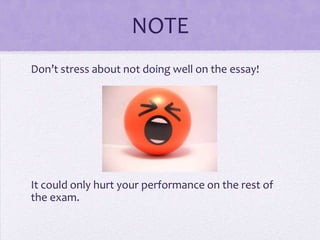
Don’t stress about not doing well on the essay!

It could only hurt your performance on the rest of
the exam.
Part 2: Multiple Choice
2 sections:
• 25 minutes
• 10 minutes (always the last section)
3 types:
• Identify sentence errors

• Sentence correction (improving sentences)
• Editing in context (improving paragraphs)
Identifying Sentence Errors
• Reread the sentence
• There are many sentences with NO errors
(option E), so don’t overthink it
• You must circle one of the underlined words or
phrases, or circle “No Error”
Sentence Corrections
• Option A is “no change”, i.e. the sentence should
be kept the way it is
• Option B,C,D,E give you alternate sentences
• ALWAYS GO WITH THE MOST SIMPLE ONE
• The most complicated ones are usually wrong
• THE ENTIRE PHRASE HAS TO BE UNDERLINED TO
BE ‘WRONG’
• ALWAYS AVOID PASSIVE TENSE
Paragraph Correction
• You will be given a paragraph to read, and
questions will ask you to correct sentences in
the paragraph

• (Same as Sentence Correction)
• Be wary of context
Common Mistakes
ME vs. I
• Abby and I went to the store. CORRECT
• Abby and me went to the store. INCORRECT

• He came with Abby and me to the store. CORRECT
• He came with Abby and I to the store. INCORRECT

^ In these cases, take out the name and see if the sentence makes
sense with just “I” or “me” in it  if it does, then it is correct
Common Mistakes
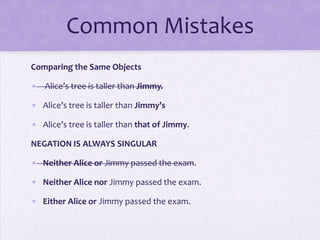
Comparing the Same Objects
• Alice’s tree is taller than Jimmy.
• Alice’s tree is taller than Jimmy’s

• Alice’s tree is taller than that of Jimmy.
NEGATION IS ALWAYS SINGULAR
• Neither Alice or Jimmy passed the exam.
• Neither Alice nor Jimmy passed the exam.
• Either Alice or Jimmy passed the exam.
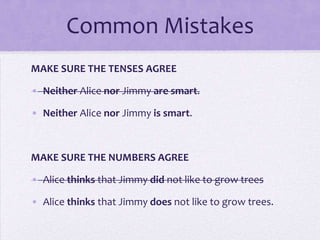
Common Mistakes
MAKE SURE THE TENSES AGREE
• Neither Alice nor Jimmy are smart.
• Neither Alice nor Jimmy is smart.

MAKE SURE THE NUMBERS AGREE

• Alice thinks that Jimmy did not like to grow trees
• Alice thinks that Jimmy does not like to grow trees.
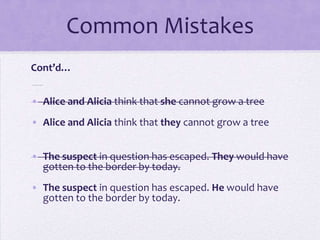
Common Mistakes
Cont’d…
• Alice and Alicia think that she cannot grow a tree

• Alice and Alicia think that they cannot grow a tree
• The suspect in question has escaped. They would have
gotten to the border by today.
• The suspect in question has escaped. He would have
gotten to the border by today.
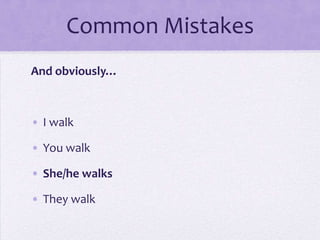
Common Mistakes
And obviously…

• I walk
• You walk
• She/he walks
• They walk
You try!
• (pdf)
• Sentence correction: pg. 45 (5 min)

• Identifying Errors: pg. 22 (5 min)
CRITICAL READING
Part 1: Sentence Completion
3 sections:
• 25 minutes

• 25 minutes
• 20 minutes

Fill-in-the-blanks
Part 1: Sentence Completion
• You will need extensive vocabulary for this
(flashcards)
• The only way you’re going to get a good score
in this section is if you know what the words
mean
• CollegeBoard likes to use words that have
somewhat similar meanings so guessing will
be difficult
Part 1: Sentence Completion
Strategy
• Determine if the word in the blank is POSITIVE or
NEGATIVE

E.g. “Alice was so _____ that she slapped Jimmy”;
“happy” or “pleased” can obviously be eliminated)
• For double blanks, BOTH words must fit
Decide whether the two words are similar or
opposite
Part 2: Reading
Comprehension
4 types:
• 1 short passage + 1 short passage

• 2 short passages combined
• 1 long passage
• 2 long passages combined
Part 2: Reading
Comprehension
• In-text analysis: avoid extreme statements
• Only choose when text EXPLICITLY makes this
statement
• Most of the time, statements that can
QUALIFY and allow FLEXIBILITY are safer
Part 2: Reading
Comprehension
For double passages:
• Read the first passage then answer the first
few questions  then continue to second
passage
• When comparing two passages…
• Option must contain correct facts about both
passages
Part 2: Reading
Comprehension
For all passages:
• UNDERLINE important words or phrases (i.e.
the ones that reflect the main character’s
personality, actions, etc.)
FUN FACT
If you get a text analysis question about a racial minority
(or any race at all), the answer will be something positive
because CollegeBoard doesn’t want to offend anyone.
• E.g. Passage 1 depicts Asians as:
• a) hardworking
• b) unnecessarily overstressed

• c) anal and uptight
…you can be sure that the answer will be a) without
even looking at the text
You try!
• (Pdf)
• Sentence completion pg. 15

• Reading comprehension  pg. 16
STUDY TIPS
GOOD LUCK!

Sat prep presentation

  • 1.
  • 2.
    Agenda • Sign upat the door with your email to receive electronic copy of full package • Intro • SATs: the basics • Overview of the three sections • Study Tips
  • 3.
  • 4.
  • 5.
    Part 1: Essay •Weight: 33% of writing section • 25 minutes total • Always the first section of exam
  • 6.
    Suggested Time Strategy •3 minutes to think about topic • Write for 20 minutes • Use 2 minutes at the end to check over everything (if you don’t have time to check everything over, check the first and last sentences)
  • 7.
    Suggested Writing Strategy •Decide how many paragraphs you are able to write within time • Clearly develop position in first paragraph (“thesis”) • Use at least 1 personal example (e.g. personal experience) and 1 general example (e.g. in the news, a book, etc.) • There is no “point proof explanation”, as long as it flows and makes sense holistically • Use humour, be creative, etc. (just don’t be racist…) Always link your supporting arguments back to the question
  • 8.
    Tips for theconclusion • DON’T BE REDUNDANT • BE CREATIVE • DON’T INTRODUCE NEW IDEAS
  • 9.
    Sample question (from October2012 test) You are given a box with text that is supposed to “lead you in the right direction”. You can take ideas from this text but you can also choose to ignore it: “The idea of caring about only the people of one's own country seems outdated. Some people still defend this attitude, claiming that if we are going to expend resources to help people, we should help those of our own country first. But national boundaries are meaningless lines that shift over time. There is no reason why a citizen of one country should not feel just as responsible for the well-being of people in other countries as for the well-being of those in his or her own country.”
  • 10.
    Sample question (from October2012 test) What your essay should focus on is answering the question that comes after the text: “ASSIGNMENT: Should we care just as much about people in other countries as we do about people in our own country?”
  • 11.
    Sample question (from October2012 test) The sentence that follows the question is the same for EVERY TEST & EVERY QUESTION. Remember what these words say and don’t waste time on the test reading it: “Plan and write an essay in which you develop your point of view on this issue. Support your position with reasoning and examples taken from your reading, studies, experience, or observations.”
  • 12.
    You try! The ideaof caring about only the people of one's own country seems outdated. Some people still defend this attitude, claiming that if we are going to expend resources to help people, we should help those of our own country first. But national boundaries are meaningless lines that shift over time. There is no reason why a citizen of one country should not feel just as responsible for the well-being of people in other countries as for the well-being of those in his or her own country. ASSIGNMENT: Should we care just as much about people in other countries as we do about people in our own country?
  • 13.
    NOTE Don’t stress aboutnot doing well on the essay! It could only hurt your performance on the rest of the exam.
  • 14.
    Part 2: MultipleChoice 2 sections: • 25 minutes • 10 minutes (always the last section) 3 types: • Identify sentence errors • Sentence correction (improving sentences) • Editing in context (improving paragraphs)
  • 15.
    Identifying Sentence Errors •Reread the sentence • There are many sentences with NO errors (option E), so don’t overthink it • You must circle one of the underlined words or phrases, or circle “No Error”
  • 16.
    Sentence Corrections • OptionA is “no change”, i.e. the sentence should be kept the way it is • Option B,C,D,E give you alternate sentences • ALWAYS GO WITH THE MOST SIMPLE ONE • The most complicated ones are usually wrong • THE ENTIRE PHRASE HAS TO BE UNDERLINED TO BE ‘WRONG’ • ALWAYS AVOID PASSIVE TENSE
  • 17.
    Paragraph Correction • Youwill be given a paragraph to read, and questions will ask you to correct sentences in the paragraph • (Same as Sentence Correction) • Be wary of context
  • 18.
    Common Mistakes ME vs.I • Abby and I went to the store. CORRECT • Abby and me went to the store. INCORRECT • He came with Abby and me to the store. CORRECT • He came with Abby and I to the store. INCORRECT ^ In these cases, take out the name and see if the sentence makes sense with just “I” or “me” in it  if it does, then it is correct
  • 19.
    Common Mistakes Comparing theSame Objects • Alice’s tree is taller than Jimmy. • Alice’s tree is taller than Jimmy’s • Alice’s tree is taller than that of Jimmy. NEGATION IS ALWAYS SINGULAR • Neither Alice or Jimmy passed the exam. • Neither Alice nor Jimmy passed the exam. • Either Alice or Jimmy passed the exam.
  • 20.
    Common Mistakes MAKE SURETHE TENSES AGREE • Neither Alice nor Jimmy are smart. • Neither Alice nor Jimmy is smart. MAKE SURE THE NUMBERS AGREE • Alice thinks that Jimmy did not like to grow trees • Alice thinks that Jimmy does not like to grow trees.
  • 21.
    Common Mistakes Cont’d… • Aliceand Alicia think that she cannot grow a tree • Alice and Alicia think that they cannot grow a tree • The suspect in question has escaped. They would have gotten to the border by today. • The suspect in question has escaped. He would have gotten to the border by today.
  • 22.
    Common Mistakes And obviously… •I walk • You walk • She/he walks • They walk
  • 23.
    You try! • (pdf) •Sentence correction: pg. 45 (5 min) • Identifying Errors: pg. 22 (5 min)
  • 24.
  • 25.
    Part 1: SentenceCompletion 3 sections: • 25 minutes • 25 minutes • 20 minutes Fill-in-the-blanks
  • 26.
    Part 1: SentenceCompletion • You will need extensive vocabulary for this (flashcards) • The only way you’re going to get a good score in this section is if you know what the words mean • CollegeBoard likes to use words that have somewhat similar meanings so guessing will be difficult
  • 27.
    Part 1: SentenceCompletion Strategy • Determine if the word in the blank is POSITIVE or NEGATIVE E.g. “Alice was so _____ that she slapped Jimmy”; “happy” or “pleased” can obviously be eliminated) • For double blanks, BOTH words must fit Decide whether the two words are similar or opposite
  • 28.
    Part 2: Reading Comprehension 4types: • 1 short passage + 1 short passage • 2 short passages combined • 1 long passage • 2 long passages combined
  • 29.
    Part 2: Reading Comprehension •In-text analysis: avoid extreme statements • Only choose when text EXPLICITLY makes this statement • Most of the time, statements that can QUALIFY and allow FLEXIBILITY are safer
  • 30.
    Part 2: Reading Comprehension Fordouble passages: • Read the first passage then answer the first few questions  then continue to second passage • When comparing two passages… • Option must contain correct facts about both passages
  • 31.
    Part 2: Reading Comprehension Forall passages: • UNDERLINE important words or phrases (i.e. the ones that reflect the main character’s personality, actions, etc.)
  • 32.
    FUN FACT If youget a text analysis question about a racial minority (or any race at all), the answer will be something positive because CollegeBoard doesn’t want to offend anyone. • E.g. Passage 1 depicts Asians as: • a) hardworking • b) unnecessarily overstressed • c) anal and uptight …you can be sure that the answer will be a) without even looking at the text
  • 33.
    You try! • (Pdf) •Sentence completion pg. 15 • Reading comprehension  pg. 16
  • 34.
  • 35.

Editor's Notes

  • #13 5 minutes Write introduction OR write introduction and list out arguments