TECHNIQUES HOW TO
ATTEMPT PAPERS/TESTS IN
ENGLISH.
Mrs. Samreen Shabbir
TGT, FGPS No.1(Girls) Bwp.
What are examinations ?
• Examinations (or exams for short) are tests
which aim to determine the ability of a
student. Exams are usually written tests,
although some may be practical or have
practical components, and vary greatly in
structure, content and difficulty depending
on the subject, the age group of the tested
persons and the profession.
HOW TO ATTEMPT EXAM
PAPER
GENERAL INSTRUCTIONS
• Get Ready
• Get Set
• Get Started with time Management
SPECIFIC INSTRUCTIONS
• How to attempt MCQ’s
• How to attempt Short Answer Questions
• How to attempt Long Questions
GENERAL INSTRUCTIONS
I. GET READY
• Find out what kind of test you are getting (MCQ’s ,
SAQ’s or LAQ’s)
• Avoid cramming.
• Set up your study schedule to review everything well
a day before .
• Use planner to keep on track.
• Write out likely the test questions and answer them.
Dos
• Get enough rest a night before
• Wear comfortable clothing.
• Have proper breakfast.
• Take all necessary tools; Pen, pencil, eraser,
calculator, markers and geometry box, etc.
• Get your Roll. No. Slip.
• Be confident and calm.
Don'ts
• Do not borrow writing items, it creates stress & disturbance.
• Do not use scotch tape.
• Do not be over confident.
• Do not get panic.
• Do not start writing as soon as you get the paper.
• Tip
• When you are well prepared you experience less stress.
II. GET SET
When you get the paper;
• Fill the information required on answer sheet, i.e.
Roll. No. ,etc.
• First read the instructions carefully.
• Then skim the paper to make sure you have it all.
• Highlight the key words like, solve, compare,
expand, factorize, evaluate , etc.
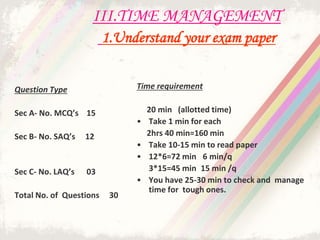
III.TIME MANAGEMENT
1.Understand your exam paper
Question Type
Sec A- No. MCQ’s 15
Sec B- No. SAQ’s 12
Sec C- No. LAQ’s 03
Total No. of Questions 30
Time requirement
20 min (allotted time)
• Take 1 min for each
2hrs 40 min=160 min
• Take 10-15 min to read paper
• 12*6=72 min 6 min/q
3*15=45 min 15 min /q
• You have 25-30 min to check and manage
time for tough ones.
2.Use 10-15 minutes effectively.
* Read the paper carefully
* Mark the questions into categories
a) Easy
b) Manageable
c) Tough or challenging
To make overall idea or rough plan for
solving the paper.
3.Don’t worry about the tough ones
• The questions appear to be tough ,but when
you start working on them you find them
easy.
• So be calm for the easy ones.
• Don’t get unduly worried about the tougher
part.
4. Prioritize your attempt
• Always attempt easy questions first
• Then move on to manageable ones
• This will ensure you that you are not leaving
any question & your confidence will grow
• Now you will be mentally ready to take on
more challenging questions.
5. Keep an eye on your watch
• It is not to increase your stress.
• It is to see that you are adhering to time
allocation discussed in the beginning
• Note A minor variation is not a reason to
worry.
6. Avoid thinking too much about a
question
• It is essential to think about the question , but not
to such an extent that it wastes time on one
question.
• Avoid to write too lengthy answer just because
you know it well.
• Just give answer to the point as required.
• Note : you must practice the habit of finishing
sample papers in 140 – 150 min
• This will help you stimulate and exercise
examination pressures better
GUIDELINES FOR ATTEMPTING
THE ENGLISH PAPER
Time Management
is very crucial in English paper.
Hence cater to the word limit
and divide the sections of the
paper into three hours
allotted to you.
SPECIFIC INSTRUCTIONS
1. How to attempt MCQ’s
• Read the statement carefully and write the correct option in
the box.
• Before looking at the answer ,try to form the answer in your
mind and then match with the given options.
• Draw a column in the last page of booklet for the working if
required.
• Do not over write .
• Do not use pencil.
• Try to avoid eraser, whitener ,etc.
2. How to attempt SAQ’S
• Draw margin line and column for rough work(for
subjects like math physics etc.) at the right side
of the page with suitable width.
• Write the numbers of questions and parts , in the
margin.
• Do not waste time on writing the Long question
statements.
• Draw the horizontal line after finishing the
answer of a question for clarity.
Answer the Comprehension Questions very
briefly. Pick up the answer from the question
itself. Don’t add your own views if not asked
for. Comprehension Passage
• There’s no need to write the entire
paragraph or copying exactly
• Never write answers in incomplete
sentences or beginning with ‘Because’ and
letting the sentence incomplete.
• All the answers should be to the point,
precise, concise and within the word limit
Comprehension:
LETTERS
• LEARN THE BEGINNINS AND THE ENDINGS OF EACH TYPE OF
LETTER.
• Today we write everything on the left side in any kind of
letter. The first paragraphs should be topical expanding the
subject. The second paragraph should discuss the problem dealt
with and the third one should have solutions. The fourth one

must be conclusive. Date must be written in this format: April 18,
2017
• Never and ever write your address or other address that can
be mistaken as your own address. Write a common one like: The
Examination Hall etc.
• Usually letters to the editor are common these days. So you
must be in the practice of reading the ‘Letters to the Editor’
column of a national newspapers.
• Yours is correct; Your’s is not
Summary
• Summary should be condensed in a
paragraph only
• It is better not to go beyond specified
word limit in a summary.
• Irrelevant details must not form part of
your summary
Composition/Essay
• • A grasping, suitable and catchy
heading is always a boon
• • Try beginning with some quote
or saying or just simple good and
attractive ideas
• • Three to four short paragraphs
are sufficient that should not
contain very long sentences
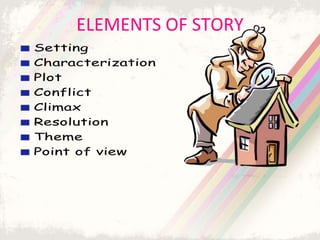
ELEMENTS OF STORY
VOCABULARY OF STORY
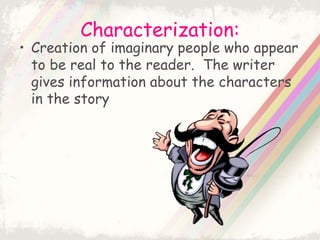
Characterization:
• Creation of imaginary people who appear
to be real to the reader. The writer
gives information about the characters
in the story
Plot:
• Plot: A series of events through which
the writer reveals what is happening, to
whom, and why.
Conflict:
Is a problem in the story that needs to be
resolved
Climax:
• When the action comes to its highest
point of conflict.
Resolution:
• The story’s action after the climax until
the end of the story. The “conclusion”
of the story.
How it all ends.
• The problem is solved.
• What type of ending?
• Happy? Sad?
Theme:
• The story’s main ideas. The “message”
the writer intends to communicate by
telling the story.
Point of view:
• The position of the narrator of the
story and what the writer sees from
that vantage point
A STORY
• Once there were two friend lived near the forest village. They
were fast friends. They promise to each other if any difficult
time will come they will help each other and never leave
alone. One day they were going city to bring some house use
products.
• When they were passing through forest they saw a bear
coming toward him. One friend knows how to climb the tree
so he suddenly climbed up the tree and leave the other friend
alone. Now his friend alone and no one there who can save
him from bear.
• He heard, the bear does not eat dead body. He lay down on
the ground and did the act like he is dead. When bear came
to near him and smell him to his ear and went in the forest to
leave there as consider dead.
• When bear gone his friend ask him what bear said to his ear.
He
• answer his friend the bear said, do not trust a false and selfish
friend.
Points to be noted:
• Poor handwriting can cost points if the examiner cannot read
your response.
• Brevity and clarity will help both the candidate and the
examiner.
• Fancy work i.e. underlining, highlighting, coloring etc can wait
for those last spare moments.
• Get the paper tied up10 min before the time ends.
• Do not attempt extra questions.
THANK YOU!!
Activity: Write a paragraph of 10 to 15 sentences on anyone
of the following topic.
1. Future of Information Technology
2. Pakistani Women
3. Protecting the Environment
4. Terrorism
5. Drug Addiction
6.Our Examination System.

Techniques how to attempt papers tests in english.

  • 2.
    TECHNIQUES HOW TO ATTEMPTPAPERS/TESTS IN ENGLISH. Mrs. Samreen Shabbir TGT, FGPS No.1(Girls) Bwp.
  • 3.
    What are examinations? • Examinations (or exams for short) are tests which aim to determine the ability of a student. Exams are usually written tests, although some may be practical or have practical components, and vary greatly in structure, content and difficulty depending on the subject, the age group of the tested persons and the profession.
  • 4.
    HOW TO ATTEMPTEXAM PAPER
  • 5.
    GENERAL INSTRUCTIONS • GetReady • Get Set • Get Started with time Management
  • 6.
    SPECIFIC INSTRUCTIONS • Howto attempt MCQ’s • How to attempt Short Answer Questions • How to attempt Long Questions
  • 7.
    GENERAL INSTRUCTIONS I. GETREADY • Find out what kind of test you are getting (MCQ’s , SAQ’s or LAQ’s) • Avoid cramming. • Set up your study schedule to review everything well a day before . • Use planner to keep on track. • Write out likely the test questions and answer them.
  • 8.
    Dos • Get enoughrest a night before • Wear comfortable clothing. • Have proper breakfast. • Take all necessary tools; Pen, pencil, eraser, calculator, markers and geometry box, etc. • Get your Roll. No. Slip. • Be confident and calm.
  • 9.
    Don'ts • Do notborrow writing items, it creates stress & disturbance. • Do not use scotch tape. • Do not be over confident. • Do not get panic. • Do not start writing as soon as you get the paper. • Tip • When you are well prepared you experience less stress.
  • 10.
    II. GET SET Whenyou get the paper; • Fill the information required on answer sheet, i.e. Roll. No. ,etc. • First read the instructions carefully. • Then skim the paper to make sure you have it all. • Highlight the key words like, solve, compare, expand, factorize, evaluate , etc.
  • 11.
    III.TIME MANAGEMENT 1.Understand yourexam paper Question Type Sec A- No. MCQ’s 15 Sec B- No. SAQ’s 12 Sec C- No. LAQ’s 03 Total No. of Questions 30 Time requirement 20 min (allotted time) • Take 1 min for each 2hrs 40 min=160 min • Take 10-15 min to read paper • 12*6=72 min 6 min/q 3*15=45 min 15 min /q • You have 25-30 min to check and manage time for tough ones.
  • 12.
    2.Use 10-15 minuteseffectively. * Read the paper carefully * Mark the questions into categories a) Easy b) Manageable c) Tough or challenging To make overall idea or rough plan for solving the paper.
  • 13.
    3.Don’t worry aboutthe tough ones • The questions appear to be tough ,but when you start working on them you find them easy. • So be calm for the easy ones. • Don’t get unduly worried about the tougher part.
  • 14.
    4. Prioritize yourattempt • Always attempt easy questions first • Then move on to manageable ones • This will ensure you that you are not leaving any question & your confidence will grow • Now you will be mentally ready to take on more challenging questions.
  • 15.
    5. Keep aneye on your watch • It is not to increase your stress. • It is to see that you are adhering to time allocation discussed in the beginning • Note A minor variation is not a reason to worry.
  • 16.
    6. Avoid thinkingtoo much about a question • It is essential to think about the question , but not to such an extent that it wastes time on one question. • Avoid to write too lengthy answer just because you know it well. • Just give answer to the point as required. • Note : you must practice the habit of finishing sample papers in 140 – 150 min • This will help you stimulate and exercise examination pressures better
  • 17.
  • 18.
    Time Management is verycrucial in English paper. Hence cater to the word limit and divide the sections of the paper into three hours allotted to you.
  • 19.
    SPECIFIC INSTRUCTIONS 1. Howto attempt MCQ’s • Read the statement carefully and write the correct option in the box. • Before looking at the answer ,try to form the answer in your mind and then match with the given options. • Draw a column in the last page of booklet for the working if required. • Do not over write . • Do not use pencil. • Try to avoid eraser, whitener ,etc.
  • 20.
    2. How toattempt SAQ’S • Draw margin line and column for rough work(for subjects like math physics etc.) at the right side of the page with suitable width. • Write the numbers of questions and parts , in the margin. • Do not waste time on writing the Long question statements. • Draw the horizontal line after finishing the answer of a question for clarity.
  • 21.
    Answer the ComprehensionQuestions very briefly. Pick up the answer from the question itself. Don’t add your own views if not asked for. Comprehension Passage • There’s no need to write the entire paragraph or copying exactly • Never write answers in incomplete sentences or beginning with ‘Because’ and letting the sentence incomplete. • All the answers should be to the point, precise, concise and within the word limit Comprehension:
  • 22.
    LETTERS • LEARN THEBEGINNINS AND THE ENDINGS OF EACH TYPE OF LETTER. • Today we write everything on the left side in any kind of letter. The first paragraphs should be topical expanding the subject. The second paragraph should discuss the problem dealt with and the third one should have solutions. The fourth one must be conclusive. Date must be written in this format: April 18, 2017 • Never and ever write your address or other address that can be mistaken as your own address. Write a common one like: The Examination Hall etc. • Usually letters to the editor are common these days. So you must be in the practice of reading the ‘Letters to the Editor’ column of a national newspapers. • Yours is correct; Your’s is not
  • 23.
    Summary • Summary shouldbe condensed in a paragraph only • It is better not to go beyond specified word limit in a summary. • Irrelevant details must not form part of your summary
  • 24.
    Composition/Essay • • Agrasping, suitable and catchy heading is always a boon • • Try beginning with some quote or saying or just simple good and attractive ideas • • Three to four short paragraphs are sufficient that should not contain very long sentences
  • 25.
  • 26.
  • 27.
    Characterization: • Creation ofimaginary people who appear to be real to the reader. The writer gives information about the characters in the story
  • 28.
    Plot: • Plot: Aseries of events through which the writer reveals what is happening, to whom, and why.
  • 29.
    Conflict: Is a problemin the story that needs to be resolved
  • 30.
    Climax: • When theaction comes to its highest point of conflict.
  • 31.
    Resolution: • The story’saction after the climax until the end of the story. The “conclusion” of the story.
  • 32.
    How it allends. • The problem is solved. • What type of ending? • Happy? Sad?
  • 33.
    Theme: • The story’smain ideas. The “message” the writer intends to communicate by telling the story.
  • 34.
    Point of view: •The position of the narrator of the story and what the writer sees from that vantage point
  • 35.
    A STORY • Oncethere were two friend lived near the forest village. They were fast friends. They promise to each other if any difficult time will come they will help each other and never leave alone. One day they were going city to bring some house use products. • When they were passing through forest they saw a bear coming toward him. One friend knows how to climb the tree so he suddenly climbed up the tree and leave the other friend alone. Now his friend alone and no one there who can save him from bear. • He heard, the bear does not eat dead body. He lay down on the ground and did the act like he is dead. When bear came to near him and smell him to his ear and went in the forest to leave there as consider dead. • When bear gone his friend ask him what bear said to his ear. He • answer his friend the bear said, do not trust a false and selfish friend.
  • 36.
    Points to benoted: • Poor handwriting can cost points if the examiner cannot read your response. • Brevity and clarity will help both the candidate and the examiner. • Fancy work i.e. underlining, highlighting, coloring etc can wait for those last spare moments. • Get the paper tied up10 min before the time ends. • Do not attempt extra questions.
  • 37.
  • 38.
    Activity: Write aparagraph of 10 to 15 sentences on anyone of the following topic. 1. Future of Information Technology 2. Pakistani Women 3. Protecting the Environment 4. Terrorism 5. Drug Addiction 6.Our Examination System.