Ms. Thuy Huong Luu
thuyhuongluu84@yahoo.com
1
TOPIC
SENTENCE
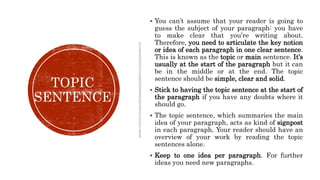
 You can’t assume that your reader is going to
guess the subject of your paragraph: you have
to make clear that you’re writing about.
Therefore, you need to articulate the key notion
or idea of each paragraph in one clear sentence.
This is known as the topic or main sentence. It’s
usually at the start of the paragraph but it can
be in the middle or at the end. The topic
sentence should be simple, clear and solid.
 Stick to having the topic sentence at the start of
the paragraph if you have any doubts where it
should go.
 The topic sentence, which summaries the main
idea of your paragraph, acts as kind of signpost
in each paragraph. Your reader should have an
overview of your work by reading the topic
sentences alone.
 Keep to one idea per paragraph. For further
ideas you need new paragraphs.
2
 Many children have had their
opportunities curbed at a relatively
young age as a result of the loaded
cultural references. Even where the
vocabulary is wide and numerical
skills can be shown, some of the
ways that questions are worded
make them inaccessible.
 Tests for intelligence are
controversial because they can have
far-reaching consequences. Many
children have had their
opportunities curbed at a relatively
young age as a result of the loaded
cultural references. Even where the
vocabulary is wide and numerical
skills can be shown, some of the
ways that questions are worded
make them inaccessible.
3
4
Which paragraph makes
more sense?
Can you see how helpful the
topic sentence is, and how it
improves the writing?
While your topic sentence sets the scene, the rest of the sentences in the paragraph
expand and develop the idea of the topic sentence, using evidence and exemplars.
You present explanations, elaborations, examples and evidence, and you show details
that support your topic sentence. You state what you mean more fully in a range of
different ways such as by:
Discussing the words in the topic sentence in detail, perhaps giving definitions.
Drawing comparisons or explaining cause and effect.
Giving your opinion or view of the topic (you must always accompany this with
other evidence or facts)
Illustrating the topic sentence with details.
Outlining the history or background of the topic.
Presenting statistics or figures
Providing examples of the topic. 5
REMEM
BER
In your topic sentence and the
supporting sentences, you
should discuss the same issue,
first introducing it and then
breaking it down and
analyzing it. Don’t confuse the
reader by introducing new
ideas in the same paragraph.
6
Writing short sentences
 Don’t overuse short
sentences. A series of
short sentences produces
a staccato effect and can
be unpleasant to read.
 Sometimes, having too
many short sentences
leads to repetition of the
keywords because you
have to introduce
concepts again.
Writing long sentences
 You can easily lose the
meaning when sentences
are too long and
complicated.
 Avoid using too many
simple conjunctions such
as “and”, “so”, “but” and
“because”.
 In order to make long
sentences easier to
follow, you should place
the main point/ key idea
at the start or the end.
7
You should always proofread
your essay and check your
spelling carefully but you
should not be too reliant on
your spellchecker because it
may not be able to
distinguish between similar
words but it will identify
most errors so you can
rectify them but you do need
a dictionary as well and
check words yourself so you
can be sure your spelling is
accurate.
Although you should always
proofread your essay and check
your spelling carefully, you
should not be too reliant on your
spellchecker because it may not
be able to distinguish between
similar word. Nevertheless, it
will identify most errors so you
can rectify them. You do,
however, need a dictionary as
well in order to check words
yourself. In this way you can be
sure your spelling is accurate.
8
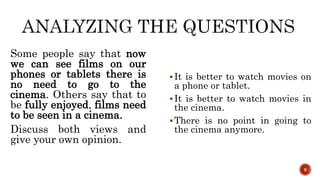
Some people say that now
we can see films on our
phones or tablets there is
no need to go to the
cinema. Others say that to
be fully enjoyed, films need
to be seen in a cinema.
Discuss both views and
give your own opinion.
It is better to watch movies on
a phone or tablet.
It is better to watch movies in
the cinema.
There is no point in going to
the cinema anymore.
9
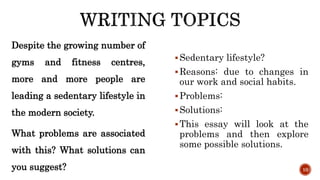
Despite the growing number of
gyms and fitness centres,
more and more people are
leading a sedentary lifestyle in
the modern society.
What problems are associated
with this? What solutions can
you suggest?
Sedentary lifestyle?
Reasons: due to changes in
our work and social habits.
Problems:
Solutions:
This essay will look at the
problems and then explore
some possible solutions.
10
 As most people spend a major part of their adult life at work, job satisfaction is
an important element of individual wellbeing.
What factors contribute to job satisfaction?
How realistic is the expectation of job satisfaction for all workers?
 It is generally believed that some people are born with certain talents, for
instance for sport or music, and others are not. However, it is sometimes
claimed that any child can be taught to become a good sports person or
musician.
11
 Some people think that universities should provide graduates with the
knowledge and skills needed in the workplace. Others think that the true
function of a university should be to give access to knowledge for its own sake,
regardless of whether the course is useful to an employer.
What, in your opinion, should be the main function of a university?
 Some people believe that there should be fixed punishments for each type of
crime. Others, however, argue that the circumstances of an individual crime,
and the motivation for committing it, should always be taken into account
when deciding on the punishment.
Discuss both these views and give your own opinion. 12
 In some countries young people are encouraged to work or travel for a year
between finishing high school and starting university studies.
Discuss the advantages and disadvantages for young people who decide to
do this.
 Some people think that a sense of competition in children should be
encouraged. Others believe that children who are taught to co-operate rather
than compete become more useful adults.
Discuss both these views and give your own opinion.
13
 Research indicates that the characteristics we are born with have much
more influence on our personality and development than any
experiences we may have in our life.
Which do you consider to be the major influence?
 Universities should accept equal numbers of male and female students
in every subject.
To what extent do you agree or disagree?
14
 Creative artists should always be given the freedom to express their
own ideas (in words, pictures, music or film) in whichever way they
wish. There should be no government restrictions on what they do.
To what extent do you agree or disagree with this opinion?
 In many countries schools have severe problems with student behaviour.
What do you think are the causes of this?
What solutions can you suggest?
15
 “Fatherhood ought to be emphasised as much as motherhood. The
idea that women are solely responsible for deciding whether or not to
have babies leads on to the idea that they are also responsible for
bringing the children up.”
To what extent do you agree or disagree?
 “Prevention is better than cure.”
Out of a country’s health budget, a large proportion should be
diverted from treatment to spending on health education and
preventative measures.
To what extent do you agree or disagree with this statement?
16
 Without capital punishment (the death penalty) our lives are less secure and crimes
of violence increase. Capital punishment is essential to control violence in society.
To what extent do you agree or disagree with this opinion?
 The position of women in society has changed markedly in the last twenty years.
Many of the problems young people now experience, such as juvenile delinquency,
arise from the fact that many married women now work and are not at home to
care for their children.
To what extent do you agree or disagree with this opinion?
17

Academic Writing.pptx

  • 1.
    Ms. Thuy HuongLuu thuyhuongluu84@yahoo.com 1
  • 2.
    TOPIC SENTENCE  You can’tassume that your reader is going to guess the subject of your paragraph: you have to make clear that you’re writing about. Therefore, you need to articulate the key notion or idea of each paragraph in one clear sentence. This is known as the topic or main sentence. It’s usually at the start of the paragraph but it can be in the middle or at the end. The topic sentence should be simple, clear and solid.  Stick to having the topic sentence at the start of the paragraph if you have any doubts where it should go.  The topic sentence, which summaries the main idea of your paragraph, acts as kind of signpost in each paragraph. Your reader should have an overview of your work by reading the topic sentences alone.  Keep to one idea per paragraph. For further ideas you need new paragraphs. 2
  • 3.
     Many childrenhave had their opportunities curbed at a relatively young age as a result of the loaded cultural references. Even where the vocabulary is wide and numerical skills can be shown, some of the ways that questions are worded make them inaccessible.  Tests for intelligence are controversial because they can have far-reaching consequences. Many children have had their opportunities curbed at a relatively young age as a result of the loaded cultural references. Even where the vocabulary is wide and numerical skills can be shown, some of the ways that questions are worded make them inaccessible. 3
  • 4.
    4 Which paragraph makes moresense? Can you see how helpful the topic sentence is, and how it improves the writing?
  • 5.
    While your topicsentence sets the scene, the rest of the sentences in the paragraph expand and develop the idea of the topic sentence, using evidence and exemplars. You present explanations, elaborations, examples and evidence, and you show details that support your topic sentence. You state what you mean more fully in a range of different ways such as by: Discussing the words in the topic sentence in detail, perhaps giving definitions. Drawing comparisons or explaining cause and effect. Giving your opinion or view of the topic (you must always accompany this with other evidence or facts) Illustrating the topic sentence with details. Outlining the history or background of the topic. Presenting statistics or figures Providing examples of the topic. 5
  • 6.
    REMEM BER In your topicsentence and the supporting sentences, you should discuss the same issue, first introducing it and then breaking it down and analyzing it. Don’t confuse the reader by introducing new ideas in the same paragraph. 6
  • 7.
    Writing short sentences Don’t overuse short sentences. A series of short sentences produces a staccato effect and can be unpleasant to read.  Sometimes, having too many short sentences leads to repetition of the keywords because you have to introduce concepts again. Writing long sentences  You can easily lose the meaning when sentences are too long and complicated.  Avoid using too many simple conjunctions such as “and”, “so”, “but” and “because”.  In order to make long sentences easier to follow, you should place the main point/ key idea at the start or the end. 7
  • 8.
    You should alwaysproofread your essay and check your spelling carefully but you should not be too reliant on your spellchecker because it may not be able to distinguish between similar words but it will identify most errors so you can rectify them but you do need a dictionary as well and check words yourself so you can be sure your spelling is accurate. Although you should always proofread your essay and check your spelling carefully, you should not be too reliant on your spellchecker because it may not be able to distinguish between similar word. Nevertheless, it will identify most errors so you can rectify them. You do, however, need a dictionary as well in order to check words yourself. In this way you can be sure your spelling is accurate. 8
  • 9.
    Some people saythat now we can see films on our phones or tablets there is no need to go to the cinema. Others say that to be fully enjoyed, films need to be seen in a cinema. Discuss both views and give your own opinion. It is better to watch movies on a phone or tablet. It is better to watch movies in the cinema. There is no point in going to the cinema anymore. 9
  • 10.
    Despite the growingnumber of gyms and fitness centres, more and more people are leading a sedentary lifestyle in the modern society. What problems are associated with this? What solutions can you suggest? Sedentary lifestyle? Reasons: due to changes in our work and social habits. Problems: Solutions: This essay will look at the problems and then explore some possible solutions. 10
  • 11.
     As mostpeople spend a major part of their adult life at work, job satisfaction is an important element of individual wellbeing. What factors contribute to job satisfaction? How realistic is the expectation of job satisfaction for all workers?  It is generally believed that some people are born with certain talents, for instance for sport or music, and others are not. However, it is sometimes claimed that any child can be taught to become a good sports person or musician. 11
  • 12.
     Some peoplethink that universities should provide graduates with the knowledge and skills needed in the workplace. Others think that the true function of a university should be to give access to knowledge for its own sake, regardless of whether the course is useful to an employer. What, in your opinion, should be the main function of a university?  Some people believe that there should be fixed punishments for each type of crime. Others, however, argue that the circumstances of an individual crime, and the motivation for committing it, should always be taken into account when deciding on the punishment. Discuss both these views and give your own opinion. 12
  • 13.
     In somecountries young people are encouraged to work or travel for a year between finishing high school and starting university studies. Discuss the advantages and disadvantages for young people who decide to do this.  Some people think that a sense of competition in children should be encouraged. Others believe that children who are taught to co-operate rather than compete become more useful adults. Discuss both these views and give your own opinion. 13
  • 14.
     Research indicatesthat the characteristics we are born with have much more influence on our personality and development than any experiences we may have in our life. Which do you consider to be the major influence?  Universities should accept equal numbers of male and female students in every subject. To what extent do you agree or disagree? 14
  • 15.
     Creative artistsshould always be given the freedom to express their own ideas (in words, pictures, music or film) in whichever way they wish. There should be no government restrictions on what they do. To what extent do you agree or disagree with this opinion?  In many countries schools have severe problems with student behaviour. What do you think are the causes of this? What solutions can you suggest? 15
  • 16.
     “Fatherhood oughtto be emphasised as much as motherhood. The idea that women are solely responsible for deciding whether or not to have babies leads on to the idea that they are also responsible for bringing the children up.” To what extent do you agree or disagree?  “Prevention is better than cure.” Out of a country’s health budget, a large proportion should be diverted from treatment to spending on health education and preventative measures. To what extent do you agree or disagree with this statement? 16
  • 17.
     Without capitalpunishment (the death penalty) our lives are less secure and crimes of violence increase. Capital punishment is essential to control violence in society. To what extent do you agree or disagree with this opinion?  The position of women in society has changed markedly in the last twenty years. Many of the problems young people now experience, such as juvenile delinquency, arise from the fact that many married women now work and are not at home to care for their children. To what extent do you agree or disagree with this opinion? 17