PRESENTED BY:
SARJEET
13101017
DEFINATION OF CAREER
 Career is a sequence of attitudes and behaviours
associated with the series of job and work related
activities over a person’s life time.
 Succession of related jobs , arranged in hierarchical
order, through which a person moves in an
organization.
DEFINATION OF CAREER PLANNING
 Career planning is an ongoing process that can help
you manage your learning and development. You can
use the four steps:-
 Step 1: knowing yourself
 Step 2: Reality check
 Step 3: making decisions
 Step 4: taking action
OBJECTIVES OF CAREER
DEVELOPMENT
 To attract and retain persons in an organization
 To utilize human resources optimally
 To improve morale and motivation level of employees
 To reduce employee turnover
 To make employees adaptable to changes
 To maintain harmonious industrial relation
What Factors Influence In Career
Planning/Development Process
 · Lack of training
· Lack of Good trainer services
· No sufficient knowledge about industry
· No contacts with relevant professionals
· Hesitations to talk with senior
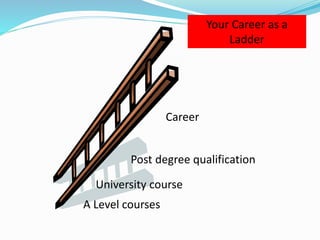
Career
Post degree qualification
University course
A Level courses
Your Career as a
Ladder
What Is Career Management?
 Career management is the process through which
employees:
 Become aware of their own interests, values, strengths,
and weaknesses
 Obtain information about job opportunities within the
company
 Identify career goals
 Establish action plans to achieve career goals
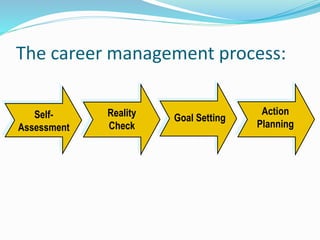
The career management process:
Self-
Assessment
Reality
Check
Goal Setting
Action
Planning
Design factors of Effective Career
Management Systems: (1 of 2)
1. System is positioned as a response to a business need
or supports a business strategy
2. Employees and managers participate in development of
the system
3. Employees are encouraged to take active roles in
career management
4. Evaluation is ongoing and used to improve the system
5. Business units can customize the system for their own
purposes
Design factors of Effective Career
Management Systems: (2 of 2)
6. Employees need access to career information sources
7. Senior management supports the career system
8. Career management is linked to other human resource
practices such as training, recruiting systems, and
performance management
9. System creates a large, diverse talent pool
10. Information about career plans and talent is accessible
to all managers
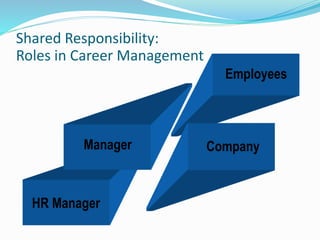
Shared Responsibility:
Roles in Career Management
Manager
Employees
Company
HR Manager
Evaluating Career Management Systems
 Career management systems need to be evaluated to
ensure that they are meeting the needs of employees
and the business
 Two types of outcomes can be used to evaluate:
 Reactions of the employees and managers who use the
career management system
 Results of the career management system
 Evaluation of a career management system should be
based on its objectives
Sarjeet ppt

Sarjeet ppt

  • 1.
  • 2.
    DEFINATION OF CAREER Career is a sequence of attitudes and behaviours associated with the series of job and work related activities over a person’s life time.  Succession of related jobs , arranged in hierarchical order, through which a person moves in an organization.
  • 3.
    DEFINATION OF CAREERPLANNING  Career planning is an ongoing process that can help you manage your learning and development. You can use the four steps:-  Step 1: knowing yourself  Step 2: Reality check  Step 3: making decisions  Step 4: taking action
  • 4.
    OBJECTIVES OF CAREER DEVELOPMENT To attract and retain persons in an organization  To utilize human resources optimally  To improve morale and motivation level of employees  To reduce employee turnover  To make employees adaptable to changes  To maintain harmonious industrial relation
  • 5.
    What Factors InfluenceIn Career Planning/Development Process  · Lack of training · Lack of Good trainer services · No sufficient knowledge about industry · No contacts with relevant professionals · Hesitations to talk with senior
  • 6.
    Career Post degree qualification Universitycourse A Level courses Your Career as a Ladder
  • 7.
    What Is CareerManagement?  Career management is the process through which employees:  Become aware of their own interests, values, strengths, and weaknesses  Obtain information about job opportunities within the company  Identify career goals  Establish action plans to achieve career goals
  • 8.
    The career managementprocess: Self- Assessment Reality Check Goal Setting Action Planning
  • 9.
    Design factors ofEffective Career Management Systems: (1 of 2) 1. System is positioned as a response to a business need or supports a business strategy 2. Employees and managers participate in development of the system 3. Employees are encouraged to take active roles in career management 4. Evaluation is ongoing and used to improve the system 5. Business units can customize the system for their own purposes
  • 10.
    Design factors ofEffective Career Management Systems: (2 of 2) 6. Employees need access to career information sources 7. Senior management supports the career system 8. Career management is linked to other human resource practices such as training, recruiting systems, and performance management 9. System creates a large, diverse talent pool 10. Information about career plans and talent is accessible to all managers
  • 11.
    Shared Responsibility: Roles inCareer Management Manager Employees Company HR Manager
  • 12.
    Evaluating Career ManagementSystems  Career management systems need to be evaluated to ensure that they are meeting the needs of employees and the business  Two types of outcomes can be used to evaluate:  Reactions of the employees and managers who use the career management system  Results of the career management system  Evaluation of a career management system should be based on its objectives