INSTITUTE –University School of
Business
DEPARTMENT -Management
M.B.A
People Management: 21BAT621
Faculty Name : Dr. Apoorva Singh
(Assistant Professor)
UNIT-2; Chapter-6
Introduction to Career
Planning and
Succession Planning
DISCOVER . LEARN . EMPOWER
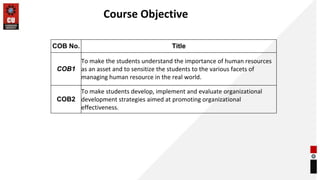
Course Objective
COB No. Title
COB1
To make the students understand the importance of human resources
as an asset and to sensitize the students to the various facets of
managing human resource in the real world.
COB2
To make students develop, implement and evaluate organizational
development strategies aimed at promoting organizational
effectiveness.
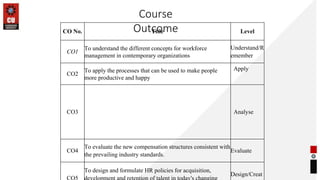
Course
Outcome
CO No. Title Level
CO1
To understand the different concepts for workforce
management in contemporary organizations
Understand/R
emember
CO2
To apply the processes that can be used to make people
more productive and happy
Apply
CO3 Analyse
CO4
To evaluate the new compensation structures consistent with
the prevailing industry standards.
Evaluate
To design and formulate HR policies for acquisition,
Design/Creat
Introduction to Career Planning
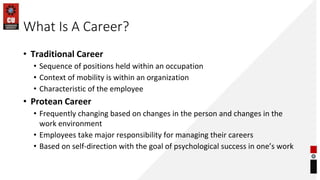
What Is A Career?
• Traditional Career
• Sequence of positions held within an occupation
• Context of mobility is within an organization
• Characteristic of the employee
• Protean Career
• Frequently changing based on changes in the person and changes in the
work environment
• Employees take major responsibility for managing their careers
• Based on self-direction with the goal of psychological success in one’s work
A Model of Career Development
• Career development is the process by which employees progress
through a series of stages
• Each stage is characterized by a different set of developmental tasks,
activities, and relationships
• There are four career stages:
• Exploration
• Establishment
• Maintenance
• Disengagement
A Model of Career Development (continued)
Exploration Establishment Maintenance Disengagement
Developmental
tasks
Identify interests,
skills, fit between
self and work
Advancement,
growth, security,
develop life style
Hold on to
accomplishments,
update skills
Retirement
planning, change
balance between
work and non-
work
Activities Helping
Learning
Following
directions
Making
independent
contributions
Training
Sponsoring
Policy making
Phasing out of
work
Relationships to
other
employees
Apprentice Colleague Mentor Sponsor
Typical age Less than 30 30 – 45 45 – 60 61+
Years on job Less than 2 years 2 – 10 years More than 10 years More than 10
years
The career management process:
Self-
Assessment
Reality
Check
Goal Setting
Action
Planning
Components of the Career Management Process: (1 of 2)
• Self-Assessment
• Use of information by employees to determine their career interests, values,
aptitudes, and behavioral tendencies
• Often involves psychological tests
• Reality Check
• Information employees receive about how the company evaluates their skills
and knowledge and where they fit into company plans
Components of the Career Management Process: (2 of 2)
• Goal Setting
• The process of employees developing short- and long-term career objectives
• Usually discussed with the manager and written into a development plan
• Action Planning
• Employees determining how they will achieve their short- and long-term
career goals
Design factors of Effective Career Management Systems:
(1 of 2)
1. System is positioned as a response to a business need
or supports a business strategy
2. Employees and managers participate in development of
the system
3. Employees are encouraged to take active roles in career
management
4. Evaluation is ongoing and used to improve the system
5. Business units can customize the system for their own
purposes
Design factors of Effective Career Management Systems:
(2 of 2)
6. Employees need access to career information sources
7. Senior management supports the career system
8. Career management is linked to other human resource
practices such as training, recruiting systems, and
performance management
9. System creates a large, diverse talent pool
10. Information about career plans and talent is accessible
to all managers
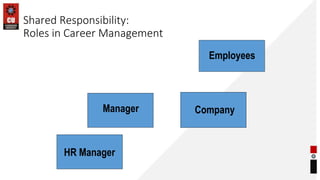
Shared Responsibility:
Roles in Career Management
Manager
Employees
Company
HR Manager
Employees’ Role in Career Management
• Take the initiative to ask for feedback from managers and peers
regarding their skill strengths and weaknesses
• Identify their stage of career development and development needs
• Seek challenges by gaining exposure to a range of learning
opportunities
• Interact with employees from different work groups inside and
outside the company
• Create visibility through good performance
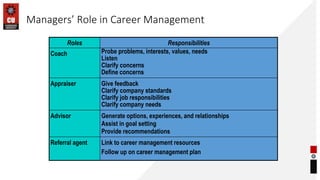
Managers’ Role in Career Management
Roles Responsibilities
Coach Probe problems, interests, values, needs
Listen
Clarify concerns
Define concerns
Appraiser Give feedback
Clarify company standards
Clarify job responsibilities
Clarify company needs
Advisor Generate options, experiences, and relationships
Assist in goal setting
Provide recommendations
Referral agent Link to career management resources
Follow up on career management plan
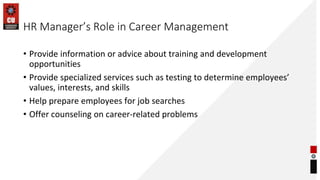
HR Manager’s Role in Career Management
• Provide information or advice about training and development
opportunities
• Provide specialized services such as testing to determine employees’
values, interests, and skills
• Help prepare employees for job searches
• Offer counseling on career-related problems
Company’s Role in Career Management
• Companies are responsible for providing employees with the
resources needed to be successful in career planning:
• Career workshops
• Information on career and job opportunities
• Career planning workbooks
• Career counseling
• Career paths
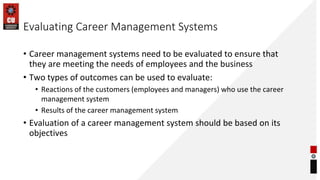
Evaluating Career Management Systems
• Career management systems need to be evaluated to ensure that
they are meeting the needs of employees and the business
• Two types of outcomes can be used to evaluate:
• Reactions of the customers (employees and managers) who use the career
management system
• Results of the career management system
• Evaluation of a career management system should be based on its
objectives
Summary
• The importance of career planning can’t be
overemphasized. Having a career plan is crucial for every
person aspiring to become successful in life. It is a multi-
stage process that needs to be thoroughly planned and
executed to reap the desired benefits.
REFERENCES
Text Books
▪Dessler, G.2013. Human Resource Management. 15th Edition, Prentice-Hall, India, ISBN:9780134235455.
Online Articles
•https://hbr.org/2011/12/get-ready-for-your-next-assignment
•https://80000hours.org/articles/career-planning/
20
Assessment Pattern
Components HT-1 HT-2 Assignment Surprise Test Business Quiz GD Forum Attendance Scaled
Marks
Max. Marks 10 10 6 4 4 4 2 40
THANK YOU
For queries you can reach me on
Email:
apoorva.e8931@cumail.in

Lecture 17.pptx

  • 1.
    INSTITUTE –University Schoolof Business DEPARTMENT -Management M.B.A People Management: 21BAT621 Faculty Name : Dr. Apoorva Singh (Assistant Professor) UNIT-2; Chapter-6 Introduction to Career Planning and Succession Planning DISCOVER . LEARN . EMPOWER
  • 2.
    Course Objective COB No.Title COB1 To make the students understand the importance of human resources as an asset and to sensitize the students to the various facets of managing human resource in the real world. COB2 To make students develop, implement and evaluate organizational development strategies aimed at promoting organizational effectiveness.
  • 3.
    Course Outcome CO No. TitleLevel CO1 To understand the different concepts for workforce management in contemporary organizations Understand/R emember CO2 To apply the processes that can be used to make people more productive and happy Apply CO3 Analyse CO4 To evaluate the new compensation structures consistent with the prevailing industry standards. Evaluate To design and formulate HR policies for acquisition, Design/Creat
  • 4.
  • 5.
    What Is ACareer? • Traditional Career • Sequence of positions held within an occupation • Context of mobility is within an organization • Characteristic of the employee • Protean Career • Frequently changing based on changes in the person and changes in the work environment • Employees take major responsibility for managing their careers • Based on self-direction with the goal of psychological success in one’s work
  • 6.
    A Model ofCareer Development • Career development is the process by which employees progress through a series of stages • Each stage is characterized by a different set of developmental tasks, activities, and relationships • There are four career stages: • Exploration • Establishment • Maintenance • Disengagement
  • 7.
    A Model ofCareer Development (continued) Exploration Establishment Maintenance Disengagement Developmental tasks Identify interests, skills, fit between self and work Advancement, growth, security, develop life style Hold on to accomplishments, update skills Retirement planning, change balance between work and non- work Activities Helping Learning Following directions Making independent contributions Training Sponsoring Policy making Phasing out of work Relationships to other employees Apprentice Colleague Mentor Sponsor Typical age Less than 30 30 – 45 45 – 60 61+ Years on job Less than 2 years 2 – 10 years More than 10 years More than 10 years
  • 8.
    The career managementprocess: Self- Assessment Reality Check Goal Setting Action Planning
  • 9.
    Components of theCareer Management Process: (1 of 2) • Self-Assessment • Use of information by employees to determine their career interests, values, aptitudes, and behavioral tendencies • Often involves psychological tests • Reality Check • Information employees receive about how the company evaluates their skills and knowledge and where they fit into company plans
  • 10.
    Components of theCareer Management Process: (2 of 2) • Goal Setting • The process of employees developing short- and long-term career objectives • Usually discussed with the manager and written into a development plan • Action Planning • Employees determining how they will achieve their short- and long-term career goals
  • 11.
    Design factors ofEffective Career Management Systems: (1 of 2) 1. System is positioned as a response to a business need or supports a business strategy 2. Employees and managers participate in development of the system 3. Employees are encouraged to take active roles in career management 4. Evaluation is ongoing and used to improve the system 5. Business units can customize the system for their own purposes
  • 12.
    Design factors ofEffective Career Management Systems: (2 of 2) 6. Employees need access to career information sources 7. Senior management supports the career system 8. Career management is linked to other human resource practices such as training, recruiting systems, and performance management 9. System creates a large, diverse talent pool 10. Information about career plans and talent is accessible to all managers
  • 13.
    Shared Responsibility: Roles inCareer Management Manager Employees Company HR Manager
  • 14.
    Employees’ Role inCareer Management • Take the initiative to ask for feedback from managers and peers regarding their skill strengths and weaknesses • Identify their stage of career development and development needs • Seek challenges by gaining exposure to a range of learning opportunities • Interact with employees from different work groups inside and outside the company • Create visibility through good performance
  • 15.
    Managers’ Role inCareer Management Roles Responsibilities Coach Probe problems, interests, values, needs Listen Clarify concerns Define concerns Appraiser Give feedback Clarify company standards Clarify job responsibilities Clarify company needs Advisor Generate options, experiences, and relationships Assist in goal setting Provide recommendations Referral agent Link to career management resources Follow up on career management plan
  • 16.
    HR Manager’s Rolein Career Management • Provide information or advice about training and development opportunities • Provide specialized services such as testing to determine employees’ values, interests, and skills • Help prepare employees for job searches • Offer counseling on career-related problems
  • 17.
    Company’s Role inCareer Management • Companies are responsible for providing employees with the resources needed to be successful in career planning: • Career workshops • Information on career and job opportunities • Career planning workbooks • Career counseling • Career paths
  • 18.
    Evaluating Career ManagementSystems • Career management systems need to be evaluated to ensure that they are meeting the needs of employees and the business • Two types of outcomes can be used to evaluate: • Reactions of the customers (employees and managers) who use the career management system • Results of the career management system • Evaluation of a career management system should be based on its objectives
  • 19.
    Summary • The importanceof career planning can’t be overemphasized. Having a career plan is crucial for every person aspiring to become successful in life. It is a multi- stage process that needs to be thoroughly planned and executed to reap the desired benefits.
  • 20.
    REFERENCES Text Books ▪Dessler, G.2013.Human Resource Management. 15th Edition, Prentice-Hall, India, ISBN:9780134235455. Online Articles •https://hbr.org/2011/12/get-ready-for-your-next-assignment •https://80000hours.org/articles/career-planning/ 20
  • 21.
    Assessment Pattern Components HT-1HT-2 Assignment Surprise Test Business Quiz GD Forum Attendance Scaled Marks Max. Marks 10 10 6 4 4 4 2 40
  • 22.
    THANK YOU For queriesyou can reach me on Email: apoorva.e8931@cumail.in