The UW Libraries as a
Catalyst for Your Research
Lauren Pressley
Director, UW Tacoma Library
Associate Dean, UW Libraries
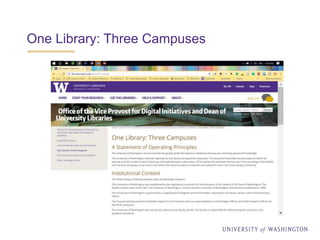
One Library: Three Campuses
Getting Resources
Getting Resources: What does this mean?
> Subject librarians use knowledge of literature in
subject area to build collections
> Work with UW Libraries to contribute to a world
class collection
> Work with the Orbis Cascade Alliance and others to
increase collections campus can access
> At times, provide access to specialized resources to
support specific research projects
Getting Resources: Why do we do it?
> Core library service
> Fiscal stewardship through partnerships with UW
Libraries and others
Getting Resources: What can we do for you?
> Provide materials from a number of libraries to
support your research
> Occasionally can get special access to resources
you need to complete a research project
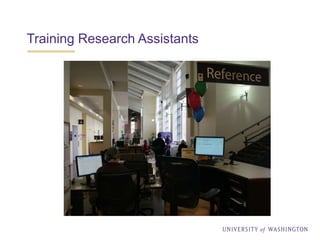
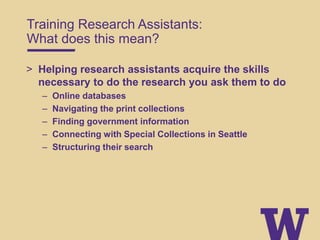
Training Research Assistants
Training Research Assistants:
What does this mean?
> Helping research assistants acquire the skills
necessary to do the research you ask them to do
– Online databases
– Navigating the print collections
– Finding government information
– Connecting with Special Collections in Seattle
– Structuring their search
Training Research Assistants:
Why do we do it?
> Connected to our teaching mission to help our
students gain skills in information literacy
> Indirectly supports faculty research
Getting Resources: What can we do for you?
> Offer workshops for Research Assistants
> Work one-on-one with Research Assistants as
available
> Connect Research Assistants to librarians in Seattle
as appropriate
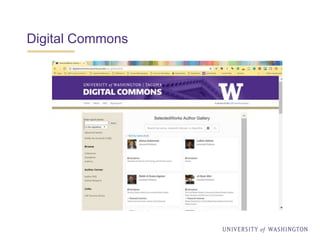
Digital Commons
Digital Commons: What is it?
> An Institutional Repository
> SelectedWorks Profiles
> Campus Journals
Digital Commons: Why do we do it?
> Preserve the scholarly record of UW Tacoma
> Make campus research more findable on the internet
> Extend the impact of campus research
> Help faculty (and students) showcase their research
What can we do for you?
> Create a SelectedWorks profile
> Help determine the copyright status of your
publications
> Host open access versions of your publications
– Add metadata to make them more findable
> Help find interdisciplinary collaborators through
SelectedWorks profiles
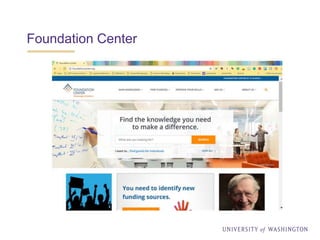
Foundation Center
Foundation Center: What is it?
> The Foundation Center is an independent nonprofit
information clearinghouse established in 1956. The
Center's mission is to foster public understanding of the
foundation field by collecting, organizing, analyzing, and
disseminating information on foundations, corporate
giving programs, and related topics. It is the nation’s
leading authority on philanthropy and strives to easily
connect non-profits with grantmakers.
Why do we do it?
> Help faculty, staff, students, and community locate
potential sources of funding
> A service for the community as part of an Urban
Serving University
> A tool to support finding funding for education in
support of UW Tacoma’s access mission
What can we do for you?
> Provide access to the Foundation Directory Online,
the Foundation Maps, and Foundation Grants to
Individuals (in-library access only)
> Consult and train in the use of Foundation Center
tools
> Offer workshops on the Foundation Center Tools as
requested
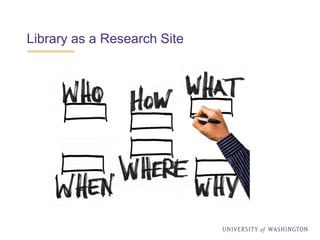
Library as a Research Site
Library as a Research Site: What is it?
> Several classes have used the library as a research
site: usability, user experience, etc.
Library as a Research Site: Why do we do it?
> We learn from your research and can improve based
on your findings!
> If you’re working with students, it’s an easy location
for them to find and you will know that we have
experience working with students
Library as a Research Site:
What can we do for you?
> Identify potential projects to meet your outcome
> Share context and background information that
would be relevant to the design of the project
> Work with students as they gather data
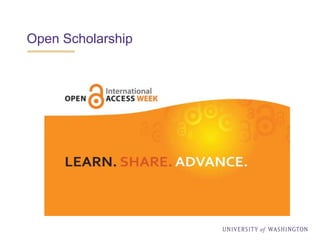
Open Scholarship
Open Scholarship: What is it?
> Open Access (OA) publishing
– Rights retention
– Navigating different publication models
– Meet mandated policies for federal grant requirements
> Open Data
– Meet mandated policies for federal grant requirements
> Open Educational Resources (OER)
– Finding and evaluating Open Textbooks and other OER
objects
– Creation of OER
Open Scholarship: Why do we do it?
> Scholarly journal inflation rate has outpaced budget
inflation across the academy for decades
> A belief that information should be available without
belonging to an elite institution
> UW Tacoma is an Urban Serving University that has
an emphasis on publically engaged scholarship
Open Scholarship: What can we do for you?
> Navigate your rights and requirements as an author
> Offer or coordinate workshops and training on open
scholarship issues
> Host your work through Digital Commons
> Consult about different publications and publishing
models
> Locate open datasets, open educational resources,
or other open sources to support your work
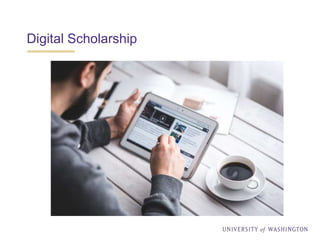
Digital Scholarship
Digital Scholarship: What is it?
> “Digital Scholarship” is defined as any scholarly activity
that makes extensive use of one or more of the new
possibilities for teaching and research opened up by the
unique affordances of digital media. These include, but
are not limited to, new forms of collaboration, new forms
of publication, and new methods for visualizing and
analyzing data. - Demystifying the Digital Humanities,
University of Washington
Digital Scholarship: Why do we do it?
> Our aim is to support faculty research, regardless of
type or format
> Librarians and library staff have a professional
obligation to remain knowledgeable about the
evolving information and research environment
Digital Scholarship: What can we do for you?
> Consult on possible avenues for digital scholarship
work and publication
> Coordinate or offer workshops and training
> Connect you to librarians within the larger UW
Libraries that have expertise in the area you are
working in
> Help make sense of the current state of Alt-Metrics
for evaluating the impact of your scholarship
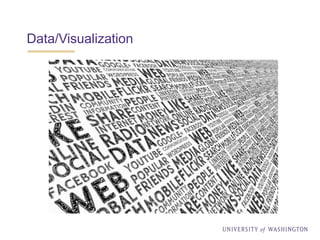
Data/Visualization
Data/Visualization: What is it?
> Research Data Services facilitates the integration of
data into the intellectual discovery process across
disciplinary and organizational boundaries to support the
research data management needs of faculty and
students at the University of Washington. This includes
support for finding and accessing data, data
management planning, data organization, reuse of data,
data sharing and storage, data citation and more.
Data/Visualization: Why do we do it?
> Increasingly grant requests ask for data
management plans
> Data literacy is becoming more important as “Big
Data” becomes a theme across academic domains
> Many disciplines use GIS data in their research
> With new ways of disseminating information, more
faculty look to producing visualizations to
communicate their point quickly and effectively
Data/Visualization: What can we do for you?
> Consult and collaborate with other librarians to
support data management plan requirements
> Coordinate or offer workshops and training
> Connect you to librarians within the larger UW
Libraries that have expertise in the area you are
working in
> Help navigate tools that support data analysis and
visualization
Workflows
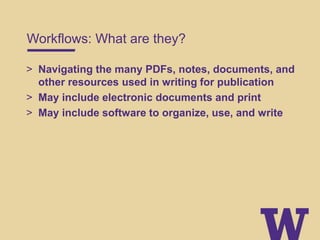
Workflows: What are they?
> Navigating the many PDFs, notes, documents, and
other resources used in writing for publication
> May include electronic documents and print
> May include software to organize, use, and write
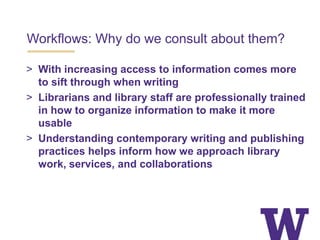
Workflows: Why do we consult about them?
> With increasing access to information comes more
to sift through when writing
> Librarians and library staff are professionally trained
in how to organize information to make it more
usable
> Understanding contemporary writing and publishing
practices helps inform how we approach library
work, services, and collaborations
Workflows: What can we do for you?
> Consult with you about the challenges you’re trying
to solve
> Offer workshops and training on ways to think about
constructing workflows and tools that may be of
interest
> Connect you to people within the library who have a
deep understanding of tools that may help with your
challenge
> Consult about possible ways to integrate these tools
One more thing
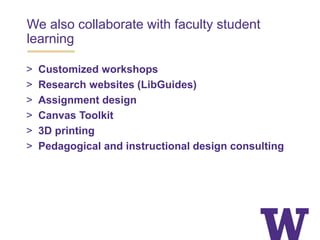
We also collaborate with faculty student
learning
> Customized workshops
> Research websites (LibGuides)
> Assignment design
> Canvas Toolkit
> 3D printing
> Pedagogical and instructional design consulting

The UW Libraries as a Catalyst for your Research

  • 1.
    The UW Librariesas a Catalyst for Your Research Lauren Pressley Director, UW Tacoma Library Associate Dean, UW Libraries
  • 2.
  • 3.
  • 4.
    Getting Resources: Whatdoes this mean? > Subject librarians use knowledge of literature in subject area to build collections > Work with UW Libraries to contribute to a world class collection > Work with the Orbis Cascade Alliance and others to increase collections campus can access > At times, provide access to specialized resources to support specific research projects
  • 5.
    Getting Resources: Whydo we do it? > Core library service > Fiscal stewardship through partnerships with UW Libraries and others
  • 6.
    Getting Resources: Whatcan we do for you? > Provide materials from a number of libraries to support your research > Occasionally can get special access to resources you need to complete a research project
  • 7.
  • 8.
    Training Research Assistants: Whatdoes this mean? > Helping research assistants acquire the skills necessary to do the research you ask them to do – Online databases – Navigating the print collections – Finding government information – Connecting with Special Collections in Seattle – Structuring their search
  • 9.
    Training Research Assistants: Whydo we do it? > Connected to our teaching mission to help our students gain skills in information literacy > Indirectly supports faculty research
  • 10.
    Getting Resources: Whatcan we do for you? > Offer workshops for Research Assistants > Work one-on-one with Research Assistants as available > Connect Research Assistants to librarians in Seattle as appropriate
  • 11.
  • 12.
    Digital Commons: Whatis it? > An Institutional Repository > SelectedWorks Profiles > Campus Journals
  • 13.
    Digital Commons: Whydo we do it? > Preserve the scholarly record of UW Tacoma > Make campus research more findable on the internet > Extend the impact of campus research > Help faculty (and students) showcase their research
  • 14.
    What can wedo for you? > Create a SelectedWorks profile > Help determine the copyright status of your publications > Host open access versions of your publications – Add metadata to make them more findable > Help find interdisciplinary collaborators through SelectedWorks profiles
  • 15.
  • 16.
    Foundation Center: Whatis it? > The Foundation Center is an independent nonprofit information clearinghouse established in 1956. The Center's mission is to foster public understanding of the foundation field by collecting, organizing, analyzing, and disseminating information on foundations, corporate giving programs, and related topics. It is the nation’s leading authority on philanthropy and strives to easily connect non-profits with grantmakers.
  • 17.
    Why do wedo it? > Help faculty, staff, students, and community locate potential sources of funding > A service for the community as part of an Urban Serving University > A tool to support finding funding for education in support of UW Tacoma’s access mission
  • 18.
    What can wedo for you? > Provide access to the Foundation Directory Online, the Foundation Maps, and Foundation Grants to Individuals (in-library access only) > Consult and train in the use of Foundation Center tools > Offer workshops on the Foundation Center Tools as requested
  • 19.
    Library as aResearch Site
  • 20.
    Library as aResearch Site: What is it? > Several classes have used the library as a research site: usability, user experience, etc.
  • 21.
    Library as aResearch Site: Why do we do it? > We learn from your research and can improve based on your findings! > If you’re working with students, it’s an easy location for them to find and you will know that we have experience working with students
  • 22.
    Library as aResearch Site: What can we do for you? > Identify potential projects to meet your outcome > Share context and background information that would be relevant to the design of the project > Work with students as they gather data
  • 23.
  • 24.
    Open Scholarship: Whatis it? > Open Access (OA) publishing – Rights retention – Navigating different publication models – Meet mandated policies for federal grant requirements > Open Data – Meet mandated policies for federal grant requirements > Open Educational Resources (OER) – Finding and evaluating Open Textbooks and other OER objects – Creation of OER
  • 25.
    Open Scholarship: Whydo we do it? > Scholarly journal inflation rate has outpaced budget inflation across the academy for decades > A belief that information should be available without belonging to an elite institution > UW Tacoma is an Urban Serving University that has an emphasis on publically engaged scholarship
  • 26.
    Open Scholarship: Whatcan we do for you? > Navigate your rights and requirements as an author > Offer or coordinate workshops and training on open scholarship issues > Host your work through Digital Commons > Consult about different publications and publishing models > Locate open datasets, open educational resources, or other open sources to support your work
  • 27.
  • 28.
    Digital Scholarship: Whatis it? > “Digital Scholarship” is defined as any scholarly activity that makes extensive use of one or more of the new possibilities for teaching and research opened up by the unique affordances of digital media. These include, but are not limited to, new forms of collaboration, new forms of publication, and new methods for visualizing and analyzing data. - Demystifying the Digital Humanities, University of Washington
  • 29.
    Digital Scholarship: Whydo we do it? > Our aim is to support faculty research, regardless of type or format > Librarians and library staff have a professional obligation to remain knowledgeable about the evolving information and research environment
  • 30.
    Digital Scholarship: Whatcan we do for you? > Consult on possible avenues for digital scholarship work and publication > Coordinate or offer workshops and training > Connect you to librarians within the larger UW Libraries that have expertise in the area you are working in > Help make sense of the current state of Alt-Metrics for evaluating the impact of your scholarship
  • 31.
  • 32.
    Data/Visualization: What isit? > Research Data Services facilitates the integration of data into the intellectual discovery process across disciplinary and organizational boundaries to support the research data management needs of faculty and students at the University of Washington. This includes support for finding and accessing data, data management planning, data organization, reuse of data, data sharing and storage, data citation and more.
  • 33.
    Data/Visualization: Why dowe do it? > Increasingly grant requests ask for data management plans > Data literacy is becoming more important as “Big Data” becomes a theme across academic domains > Many disciplines use GIS data in their research > With new ways of disseminating information, more faculty look to producing visualizations to communicate their point quickly and effectively
  • 34.
    Data/Visualization: What canwe do for you? > Consult and collaborate with other librarians to support data management plan requirements > Coordinate or offer workshops and training > Connect you to librarians within the larger UW Libraries that have expertise in the area you are working in > Help navigate tools that support data analysis and visualization
  • 35.
  • 36.
    Workflows: What arethey? > Navigating the many PDFs, notes, documents, and other resources used in writing for publication > May include electronic documents and print > May include software to organize, use, and write
  • 37.
    Workflows: Why dowe consult about them? > With increasing access to information comes more to sift through when writing > Librarians and library staff are professionally trained in how to organize information to make it more usable > Understanding contemporary writing and publishing practices helps inform how we approach library work, services, and collaborations
  • 38.
    Workflows: What canwe do for you? > Consult with you about the challenges you’re trying to solve > Offer workshops and training on ways to think about constructing workflows and tools that may be of interest > Connect you to people within the library who have a deep understanding of tools that may help with your challenge > Consult about possible ways to integrate these tools
  • 39.
  • 40.
    We also collaboratewith faculty student learning > Customized workshops > Research websites (LibGuides) > Assignment design > Canvas Toolkit > 3D printing > Pedagogical and instructional design consulting

Editor's Notes

  • #2 Hello, thank you, who I am A bit of history (limited scope of services, strategic planning efforts) Moving more into supporting faculty research (academic library best practice, campus size/growth) Not staffed to full capacity at this point, but trying to free up some space to do this type of work
  • #3 Administrative model Quality collections “Hidden” nature of library—interact when using Google Scholar
  • #5 Explain subject librarians build collection
  • #9 Explain subject librarians build collection
  • #13 Define IR
  • #29 Note Digital Humanites