
















Sampling
Techniques
CAPSTONE RESEARCH
Objectives
➢To differentiate the various methods of
sampling and
➢To formulate the criteria for choosing
respondents or subjects
➢To determine the sample population of a
target population
Malls
SM City
Robinsons
Landmark
Trinoma
S & R
Fastfood
Jollibee
McDo
Chowking
KFC
State
Universities
University of the Philippines
Polytechnic University of the Philippines
Bulacan State University
Social Media
Apps
Facebook
Tiktok
Youtube
Instagram
Twitter
Important Terms
SAMPLING TECHNIQUES
Population
Composed of persons or objects that
possess some common characteristics
that are of interest to the researcher.
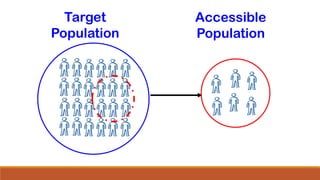
Target (Theoretical) Population
The entire group of people or objects to
which the findings of the study generally
apply.
Accessible (Study) population
The specific population in a study.
Target
Population
Accessible
Population
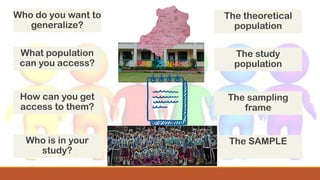
Who do you want to
generalize?
What population
can you access?
How can you get
access to them?
Who is in your
study?
The theoretical
population
The study
population
The sampling
frame
The SAMPLE
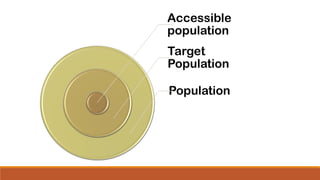
Accessible
population
Target
Population
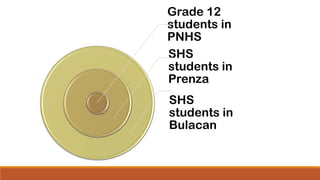
Population
Grade 12
students in
PNHS
SHS
students in
Prenza
SHS
students in
Bulacan
Parameter
A numeric characteristic of a population.
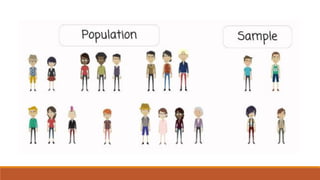
Sample
A subset of the entire population or a
group of individuals that represents the
population and serves as the
respondents of the study.
Statistic
A numeric characteristic of a sample.
Element
A single member of the sample.
Ways to determine the sample
size
➢Homegeneity of the population
➢Degree of precision desired by the
researcher
➢Types of sampling procedure
➢The use of formulas: 1. Slovin. 2. Calmorin
Ways to determine the sample
size
➢Other considerations
➢Shot (1990) – as small as 30
➢Equal to or less than 100 population will serve as
sample size (universal sampling)
➢Acceptable for different types of research (Gay, 1976)
➢Descriptive – 10% - 20% may be required
➢Correlational – 30 subjects or respondents
➢Comparative – 15 subjects/group
➢Experimental – 15-30 subjects/group
Kinds of
Sampling
SAMPLING TECHNIQUES
Probability Sampling
A sampling procedure that gives every
element of the population a (known) nonzero
chance of being selected in the sample is
called probability sampling.
Non-Probability Sampling
a process of selecting respondents in which
the members of the entire population do not
have an equal chance of being selected as
samples.
There are cases in which a sample is given
priority instead of other members. Also
called non-scientific sampling.
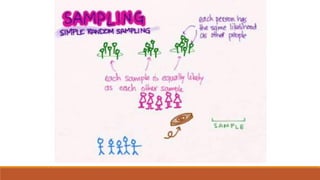
Simple Random
All the members of the population are given
an equal chance to be selected as
respondents.
An unbiased way of selection as samples
drawn by chance
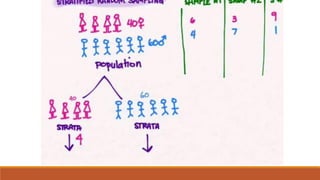
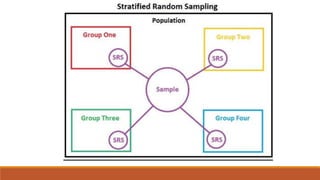
Stratified Random
The population is first divided into different
strata then the sampling follows.
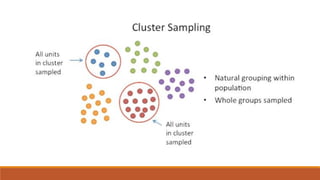
Cluster
Used in large-scale studies in which the
population is geographically spread out
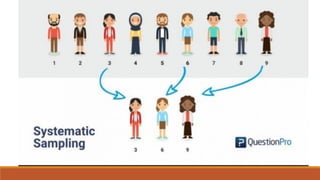
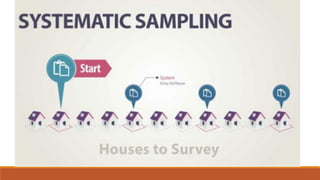
Systematic
A method of selecting every nth element of
the population. After the size of the sample
has been determined, the selection of the
sample follows.
Non-Probability Sampling
a process of selecting respondents in which
the members of the entire population do not
have an equal chance of being selected as
samples.
There are cases in which a sample is given
priority instead of other members. Also
called non-scientific sampling.
Convenience
Also called accidental or incidental sampling.
Samples are readily available.
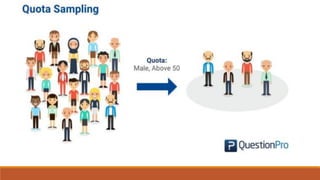
Quota
Similar to stratified sampling.
The proportions of the various sub-groups in
the population are determined and the
sample is drawn to have the same percentage
of it.
Purposive Sampling
Also called judgmental sampling.
Samples are handpicked based on the
researcher’s judgment
Always find your
happy thought to
fuel your day! ☺
Bibliography
Cristobal, Amadeo Jr. P and dela-Cruz-Cristobal, Maura C. (2017). Practical
Researh 2 for Senior High School. C & E. Publishing, Inc.: Quezon City
https://stats.stackexchange.com/questions/87401/to-know-clearly-about-the-
population

sampling techniques.pdf