SAMPLING
DESIGNS
Two Types of
Sampling Design
Probability
Non-Probability
Probability Sampling
A probability sampling method is any
method of sampling that utilizes
some form of random selection.
Types of Probability Sampling
Simple random sampling
Stratified random sampling
Systematic random sampling
Cluster random sampling
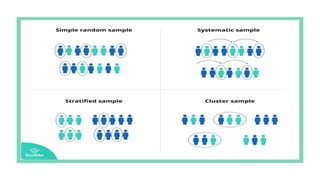
In a simple random sample,
every member of the
population
has an equal chance of
being selected. Your
sampling frame should
include the whole
population.
Simple random
sampling
Stratified
random sampling
Stratified sampling involves
dividing the population into
subpopulations that may differ
in important ways.
It allows you draw more precise
conclusions by
ensuring that every subgroup is
properly represented in the
sample.
Systematic random
sampling
Systematic sampling is similar to
simple random sampling, but it is
usually slightly easier to conduct.
Every member of the population
is listed with a number, but
instead of randomly generating
numbers, individuals are chosen
at regular intervals.
Cluster random
sampling
Cluster sampling also
involves dividing the
population into subgroups,
but each subgroup should
have similar characteristics
to the whole sample.
Instead of sampling
individuals from each
subgroup, you randomly
select entire subgroups.
Non-probability sampling
In a non-probability sample, individuals are
selected based on non-random criteria, and
not every individual
has a chance of being included.
Types of Non-Probability Sampling
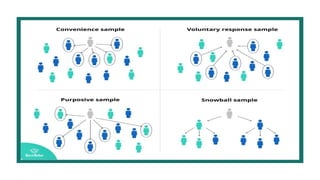
Convenience sample
Voluntary response sample
Purposive sample
Snowball sample
Convenience
sampling
A convenience
sample simply
includes the
individuals who
happen to be most
accessible to the
researcher.
Voluntary response
sampling
Similar to a convenience
sample, a voluntary response
sample is
mainly based on ease of
access. Instead of the
researcher choosing
participants and directly
contacting them, people
volunteer themselves
(e.g. by responding to a public
online survey).
Purposive
sampling
This type of sampling
involves the researcher
using their judgment to
select a sample that is
most useful to the
purposes of the
research.
Snowball sampling
If the population is hard to
access, snowball sampling
can be used to recruit
participants via other
participants. The number of
people you have access to
“snowballs” as you
get in contact with
more people.
Thanks!

Sampling designs.pptx

  • 1.
  • 2.
    Two Types of SamplingDesign Probability Non-Probability
  • 3.
    Probability Sampling A probabilitysampling method is any method of sampling that utilizes some form of random selection.
  • 4.
    Types of ProbabilitySampling Simple random sampling Stratified random sampling Systematic random sampling Cluster random sampling
  • 5.
    In a simplerandom sample, every member of the population has an equal chance of being selected. Your sampling frame should include the whole population. Simple random sampling
  • 6.
    Stratified random sampling Stratified samplinginvolves dividing the population into subpopulations that may differ in important ways. It allows you draw more precise conclusions by ensuring that every subgroup is properly represented in the sample.
  • 7.
    Systematic random sampling Systematic samplingis similar to simple random sampling, but it is usually slightly easier to conduct. Every member of the population is listed with a number, but instead of randomly generating numbers, individuals are chosen at regular intervals.
  • 8.
    Cluster random sampling Cluster samplingalso involves dividing the population into subgroups, but each subgroup should have similar characteristics to the whole sample. Instead of sampling individuals from each subgroup, you randomly select entire subgroups.
  • 10.
    Non-probability sampling In anon-probability sample, individuals are selected based on non-random criteria, and not every individual has a chance of being included.
  • 11.
    Types of Non-ProbabilitySampling Convenience sample Voluntary response sample Purposive sample Snowball sample
  • 12.
    Convenience sampling A convenience sample simply includesthe individuals who happen to be most accessible to the researcher.
  • 13.
    Voluntary response sampling Similar toa convenience sample, a voluntary response sample is mainly based on ease of access. Instead of the researcher choosing participants and directly contacting them, people volunteer themselves (e.g. by responding to a public online survey).
  • 14.
    Purposive sampling This type ofsampling involves the researcher using their judgment to select a sample that is most useful to the purposes of the research.
  • 15.
    Snowball sampling If thepopulation is hard to access, snowball sampling can be used to recruit participants via other participants. The number of people you have access to “snowballs” as you get in contact with more people.
  • 17.