Download to read offline

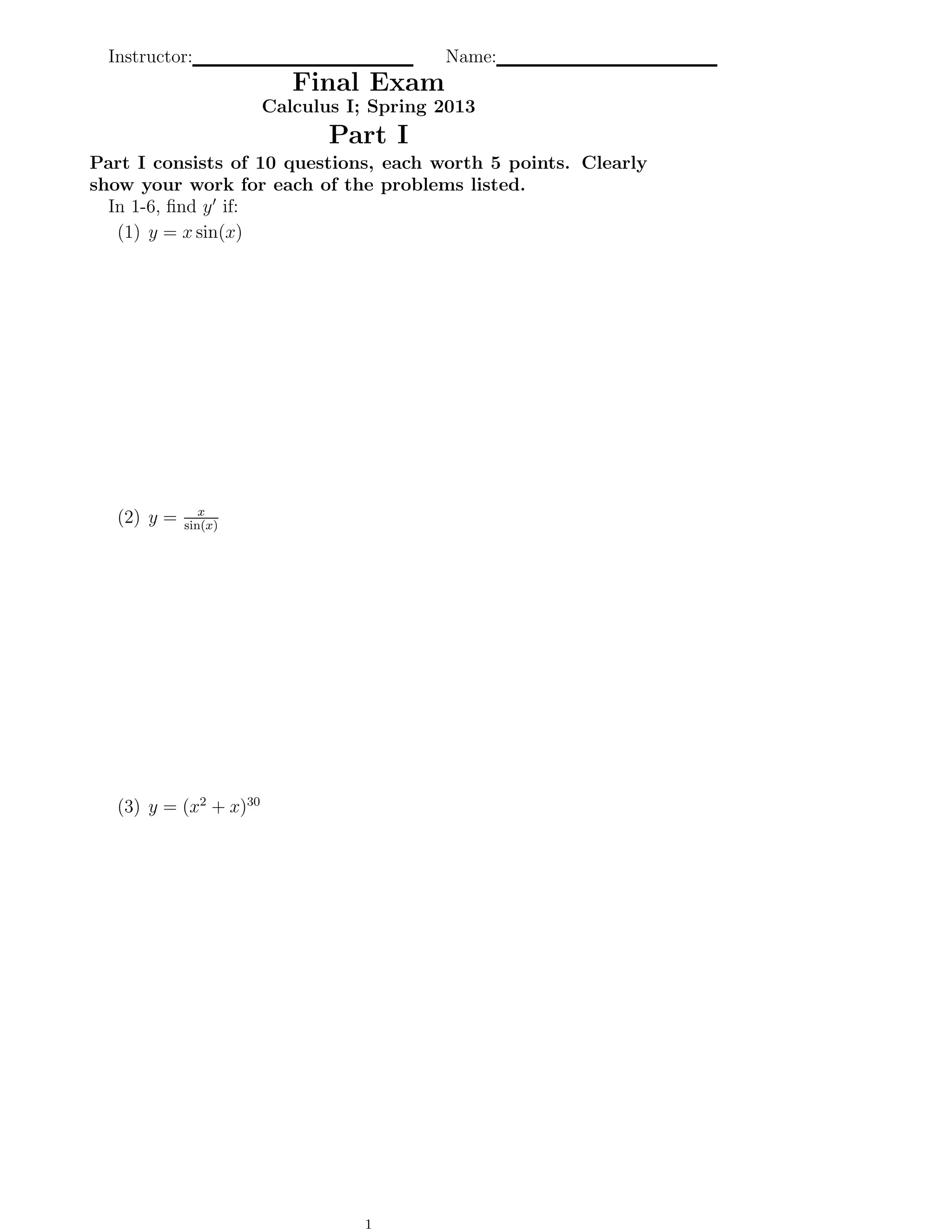
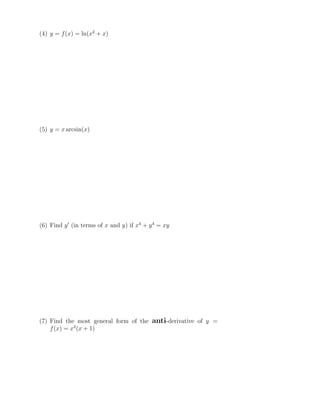
![(8) Find the the critical number(s) of the function y = f(x) = xe−x
(9) Evaluate lim
x→∞
x2
e−x
(10) Find the absolute maximum and minimum of the function y =
f(x) = (x + 1)2
(x − 1)2
on [−1, 2]. Provide both the x and y
values.](https://image.slidesharecdn.com/1-13s-f-140816220910-phpapp01/85/1-13s-f-3-320.jpg)
![Part II
Part II consists of 6 problems; the number of points for each
part are indicated by [x pts]. You must show the relevant
steps and justify your answer to earn credit. Simplify your
answer when possible.
(1) [10 pts] Use implicit differentiation to find the derivative y′
if
x2
+ y2
= sin(xy)
(2) [5 pts] Find the linearization of the function y = f(x) =
√
x
at a = 2.](https://image.slidesharecdn.com/1-13s-f-140816220910-phpapp01/85/1-13s-f-4-320.jpg)
![(3) [3 pts] Use the linearization in problem 2 to estimate
√
9.1
(4) Given the function y = f(x) = x−1
x2
(a) [2 pts] Find the domain and the x and y intercepts of the
function.
(b) [3 pts] Find the vertical and horizontal asymptotes of the
function.
(c) [2 pts] Find the open intervals where f(x) is increasing
and the open intervals where f(x) is decreasing.](https://image.slidesharecdn.com/1-13s-f-140816220910-phpapp01/85/1-13s-f-5-320.jpg)
![(d) [2 pts] Find the local maximum and local minimum values
of f(x). (Be sure to give the x and y coordinate of each of
them). State absolute max/min if any.
(e) [2 pts] Find all open intervals where the graph of f(x)
is concave up and all open intervals where the graph is
concave down.
(f) [1 pts] Find all points of inflection (be sure to give the x
and y coordinate of each point when possible).
(g) [5 pts] Use the above information to graph the function
below. Indicate all relevant information in the graph; in
particular any x,y-intercepts, local/absolute maxima, min-
ima and point(s) of inflection.](https://image.slidesharecdn.com/1-13s-f-140816220910-phpapp01/85/1-13s-f-6-320.jpg)
![(5) [5 pts] If y = xe−x
find the absolute max and min on the
interval −1 ≤ x ≤ 3. (Include the appropriate y values of the
maximum and minimum.)](https://image.slidesharecdn.com/1-13s-f-140816220910-phpapp01/85/1-13s-f-7-320.jpg)
![(6) [10 pts] A 2 m tall person walks toward a street light at a speed
of 1 m/s. If the street light is 5 m tall, how fast is the tip of his
shadow moving when he is 2m from the light post?](https://image.slidesharecdn.com/1-13s-f-140816220910-phpapp01/85/1-13s-f-8-320.jpg)


This document contains the instructions for a Calculus I final exam consisting of two parts. Part I has 10 multiple choice questions worth 5 points each involving derivatives, anti-derivatives, limits, and finding absolute maxima and minima. Part II has 6 longer form problems worth between 1-10 points each involving implicit differentiation, linearization, graphing functions, finding absolute extrema, and a word problem about the speed of a shadow. Students are instructed to show their work and simplify answers where possible to earn full credit.


![5 min[1][1].touroftheworld](https://cdn.slidesharecdn.com/ss_thumbnails/5min11-150530114749-lva1-app6891-thumbnail.jpg?width=640&height=640&fit=bounds)


