How to prepare and deliver a
presentation
Roberto Cipolla
Department of Engineering
http://www.eng.cam.ac.uk/~cipolla
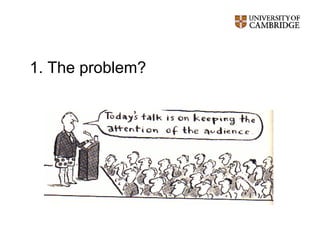
1. The problem?
Effective Communication
What do you want to achieve?
• Educate and inform
• Inspire/interest and persuade
• Entertain
• Must grab and hold attention
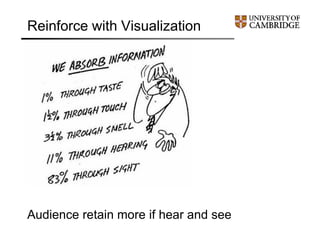
Reinforce with Visualization
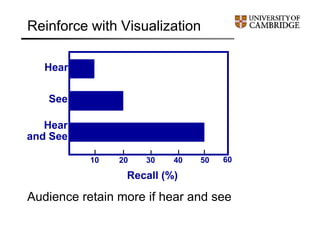
Audience retain more if hear and see
Reinforce with Visualization
Audience retain more if hear and see
Recall (%)
Hear
and See
10 20 30 40 50 60
See
Hear
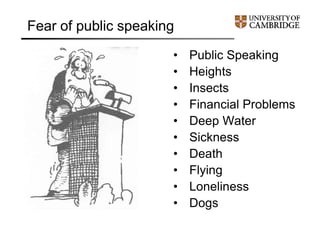
Fear of public speaking
• Public Speaking
• Heights
• Insects
• Financial Problems
• Deep Water
• Sickness
• Death
• Flying
• Loneliness
• Dogs
Outline
• Preparation
• Structure of the presentation
• Visual aids and slides
• Practice and delivery
2. Planning and Preparation
Planning
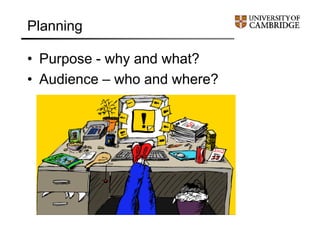
• Purpose - why and what?
• Audience – who and where?
Planning
• Know your subject
• Develop a theme
• List the key concepts and points to convey
• Begin to think about ways of illustrating the
key points
• Max of 1 slide per minute, 4 key points in
45 minute presentation
3. Structure of presentation
The Structure
• Opening –
Tell them what you are going to tell them
• Body –
Tell them
• Summary –
Tell them what you told them
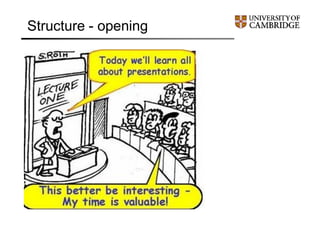
Structure - opening
Structure - opening
• Need a strong beginning
• Few seconds to convince audience:
– I will not waste your time
– I am well organized
– I know who you are
– I know my subject
Structure - opening
• Introduce problem to be addressed and
context
• State purpose, scope and main
message
• Give outline of presentation
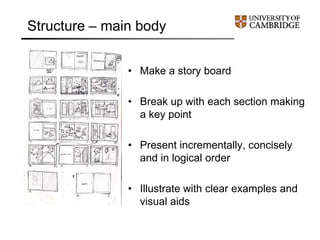
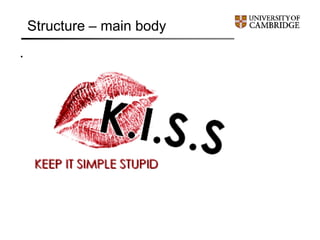
Structure – main body
• Make a story board
• Break up with each section making
a key point
• Present incrementally, concisely
and in logical order
• Illustrate with clear examples and
visual aids
Structure – main body
.
Structure - closing
• Must have a clear end to talk
• Brief and simple summary of main points
• Reinforce the main message
• Put in context of the “big picture”
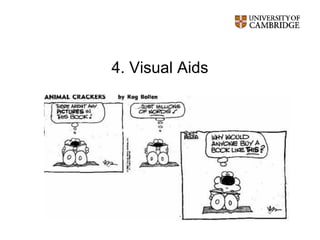
4. Visual Aids
Slides
• Header – headline for main point
• Body
- one point, keep it simple
- don’t overcrowd with bullets and details
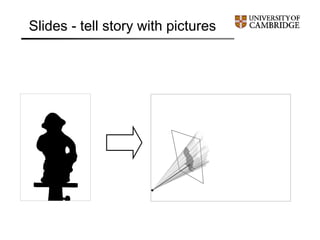
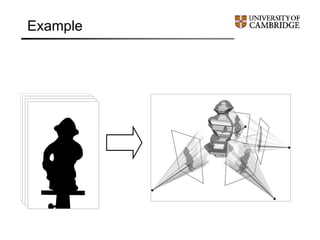
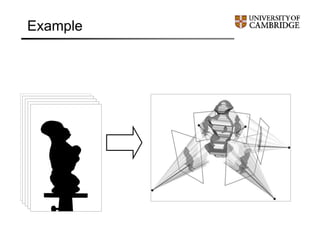
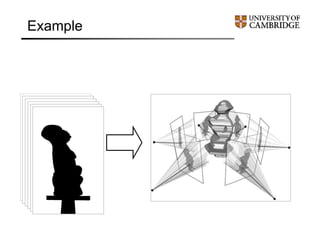
Slides - tell story with pictures
•Illustrate with images and animations to explain difficult
points and generate interest.
Slides - tell story with pictures
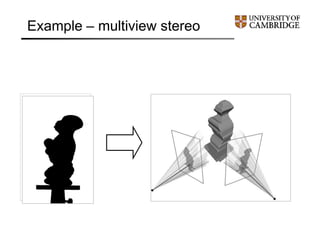
Example – multiview stereo
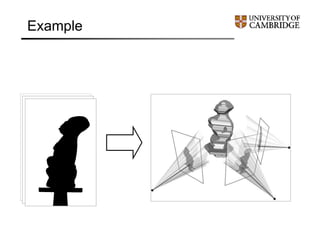
Example
Example
Example
Example
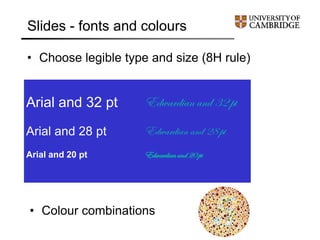
Slides - fonts and colours
• Choose legible type and size (8H rule)
Arial and 32 pt
Arial and 28 pt
Arial and 20 pt
Edwardian and 32 pt
Edwardian and 28 pt
Edwardianand 20 pt
• Colour combinations
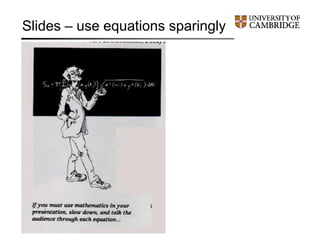
Slides – use equations sparingly
5 Practice and Delivery
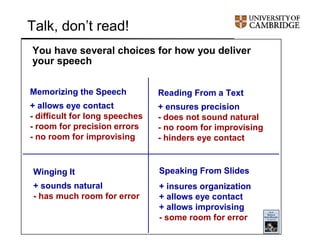
Talk, don’t read!
You have several choices for how you deliver
your speech
Memorizing the Speech
+ allows eye contact
- difficult for long speeches
- room for precision errors
- no room for improvising
Reading From a Text
+ ensures precision
- does not sound natural
- no room for improvising
- hinders eye contact
Winging It
+ sounds natural
- has much room for error
Speaking From Slides
+ insures organization
+ allows eye contact
+ allows improvising
- some room for error
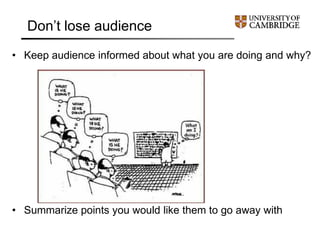
Don’t lose audience
• Keep audience informed about what you are doing and why?
• Summarize points you would like them to go away with
Dealing with nervousness
• All accomplished public speakers feel nervous
before talks – adrenalin helps!
• Be well-prepared:
– Rehearse with friends
– Make sure presentation is well structured
– Arrive and set up early
• During presentation:
– Memorize opening
– Smile, breath deeply, slow down and pause
Thou shalt not be neat
Thou shalt not waste space
Thou shalt not covet brevity
Thou shalt cover thy naked slides
Thou shalt not write large
Thou shalt not use color
Thou shalt not illustrate
Thou shalt not make eye contact
Thou shalt not skip slides in a long talk
Thou shalt not practice
How to give a bad talk
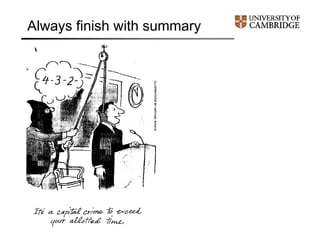
Always finish with summary
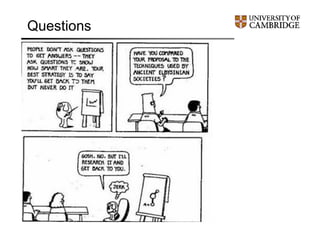
Questions
6. Summary
Summary
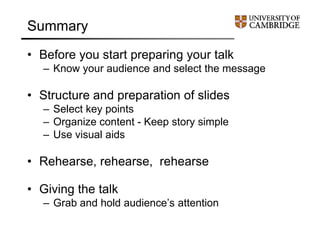
• Before you start preparing your talk
– Know your audience and select the message
• Structure and preparation of slides
– Select key points
– Organize content - Keep story simple
– Use visual aids
• Rehearse, rehearse, rehearse
• Giving the talk
– Grab and hold audience’s attention
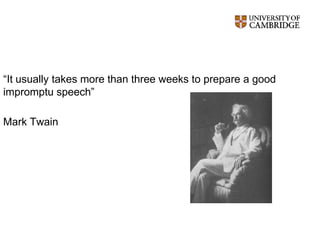
“It usually takes more than three weeks to prepare a good
impromptu speech”
Mark Twain
References
• Good talks motivate audience to investigate
further. Give links to more information.
• http://www.canberra.edu/studyskills/
• Simon Peyton-Jones

Sample title

  • 1.
    How to prepareand deliver a presentation Roberto Cipolla Department of Engineering http://www.eng.cam.ac.uk/~cipolla
  • 2.
  • 3.
    Effective Communication What doyou want to achieve? • Educate and inform • Inspire/interest and persuade • Entertain • Must grab and hold attention
  • 4.
    Reinforce with Visualization Audienceretain more if hear and see
  • 5.
    Reinforce with Visualization Audienceretain more if hear and see Recall (%) Hear and See 10 20 30 40 50 60 See Hear
  • 6.
    Fear of publicspeaking • Public Speaking • Heights • Insects • Financial Problems • Deep Water • Sickness • Death • Flying • Loneliness • Dogs
  • 7.
    Outline • Preparation • Structureof the presentation • Visual aids and slides • Practice and delivery
  • 8.
    2. Planning andPreparation
  • 9.
    Planning • Purpose -why and what? • Audience – who and where?
  • 10.
    Planning • Know yoursubject • Develop a theme • List the key concepts and points to convey • Begin to think about ways of illustrating the key points • Max of 1 slide per minute, 4 key points in 45 minute presentation
  • 11.
    3. Structure ofpresentation
  • 12.
    The Structure • Opening– Tell them what you are going to tell them • Body – Tell them • Summary – Tell them what you told them
  • 13.
  • 14.
    Structure - opening •Need a strong beginning • Few seconds to convince audience: – I will not waste your time – I am well organized – I know who you are – I know my subject
  • 15.
    Structure - opening •Introduce problem to be addressed and context • State purpose, scope and main message • Give outline of presentation
  • 16.
    Structure – mainbody • Make a story board • Break up with each section making a key point • Present incrementally, concisely and in logical order • Illustrate with clear examples and visual aids
  • 17.
  • 18.
    Structure - closing •Must have a clear end to talk • Brief and simple summary of main points • Reinforce the main message • Put in context of the “big picture”
  • 19.
  • 20.
    Slides • Header –headline for main point • Body - one point, keep it simple - don’t overcrowd with bullets and details
  • 21.
    Slides - tellstory with pictures •Illustrate with images and animations to explain difficult points and generate interest.
  • 22.
    Slides - tellstory with pictures
  • 23.
  • 24.
  • 25.
  • 26.
  • 27.
  • 28.
    Slides - fontsand colours • Choose legible type and size (8H rule) Arial and 32 pt Arial and 28 pt Arial and 20 pt Edwardian and 32 pt Edwardian and 28 pt Edwardianand 20 pt • Colour combinations
  • 29.
    Slides – useequations sparingly
  • 30.
  • 31.
    Talk, don’t read! Youhave several choices for how you deliver your speech Memorizing the Speech + allows eye contact - difficult for long speeches - room for precision errors - no room for improvising Reading From a Text + ensures precision - does not sound natural - no room for improvising - hinders eye contact Winging It + sounds natural - has much room for error Speaking From Slides + insures organization + allows eye contact + allows improvising - some room for error
  • 32.
    Don’t lose audience •Keep audience informed about what you are doing and why? • Summarize points you would like them to go away with
  • 33.
    Dealing with nervousness •All accomplished public speakers feel nervous before talks – adrenalin helps! • Be well-prepared: – Rehearse with friends – Make sure presentation is well structured – Arrive and set up early • During presentation: – Memorize opening – Smile, breath deeply, slow down and pause
  • 34.
    Thou shalt notbe neat Thou shalt not waste space Thou shalt not covet brevity Thou shalt cover thy naked slides Thou shalt not write large Thou shalt not use color Thou shalt not illustrate Thou shalt not make eye contact Thou shalt not skip slides in a long talk Thou shalt not practice How to give a bad talk
  • 35.
  • 36.
  • 37.
  • 38.
    Summary • Before youstart preparing your talk – Know your audience and select the message • Structure and preparation of slides – Select key points – Organize content - Keep story simple – Use visual aids • Rehearse, rehearse, rehearse • Giving the talk – Grab and hold audience’s attention
  • 39.
    “It usually takesmore than three weeks to prepare a good impromptu speech” Mark Twain
  • 40.
    References • Good talksmotivate audience to investigate further. Give links to more information. • http://www.canberra.edu/studyskills/ • Simon Peyton-Jones