Sample Size Determination
12/17/2023 1
Research Methodology
Sample Size Determination
• In planning any investigation, we must decide how many people need to be
studied in order to answer the study objectives.
• If too large
 Unnecessary waste of the limited resources
Data collection, analysis
• If too small
 Cannot assure sufficient power for the detection of meaningful estimate
12/17/2023 2
Research Methodology
Con’t…
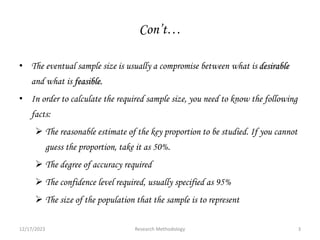
• The eventual sample size is usually a compromise between what is desirable
and what is feasible.
• In order to calculate the required sample size, you need to know the following
facts:
 The reasonable estimate of the key proportion to be studied. If you cannot
guess the proportion, take it as 50%.
 The degree of accuracy required
 The confidence level required, usually specified as 95%
 The size of the population that the sample is to represent
12/17/2023 3
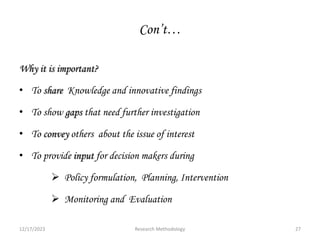
Research Methodology
Con’t…
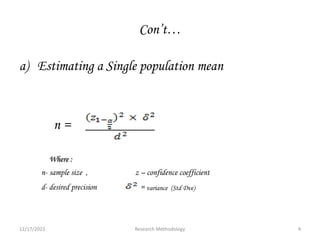
a) Estimating a Single population mean
n =
Where :
n- sample size , z – confidence coefficient
d- desired precision = variance (Std Dve)
12/17/2023 4
Research Methodology
Con’t…
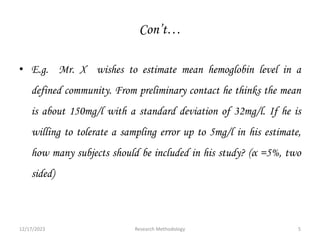
• E.g. Mr. X wishes to estimate mean hemoglobin level in a
defined community. From preliminary contact he thinks the mean
is about 150mg/l with a standard deviation of 32mg/l. If he is
willing to tolerate a sampling error up to 5mg/l in his estimate,
how many subjects should be included in his study? (α =5%, two
sided)
12/17/2023 5
Research Methodology
Con’t…
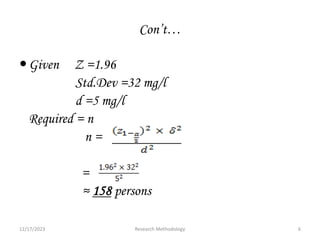
Given Z =1.96
Std.Dev =32 mg/l
d =5 mg/l
Required = n
n =
=
≈ 158 persons
12/17/2023 6
Research Methodology
Con’t…
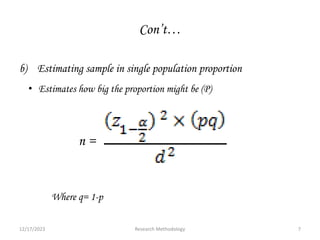
b) Estimating sample in single population proportion
• Estimates how big the proportion might be (P)
n =
Where q= 1-p
12/17/2023 7
Research Methodology
Con’t…
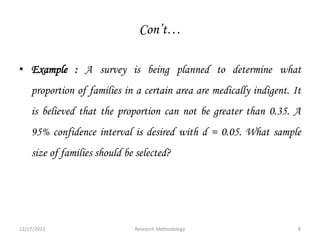
• Example : A survey is being planned to determine what
proportion of families in a certain area are medically indigent. It
is believed that the proportion can not be greater than 0.35. A
95% confidence interval is desired with d = 0.05. What sample
size of families should be selected?
12/17/2023 8
Research Methodology
Con’t…
• Given n = ?
p = 0.35 , q = 0.65
z = 1.96
d = 0.5
n =
=
≈ 350
12/17/2023 9
Research Methodology
Con’t…
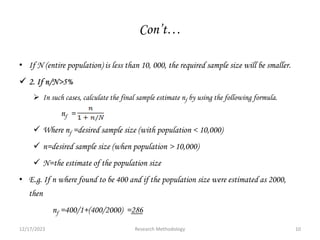
• If N (entire population) is less than 10, 000, the required sample size will be smaller.
 2. If n/N>5%
 In such cases, calculate the final sample estimate nf by using the following formula.
nf =
 Where nf =desired sample size (with population < 10,000)
 n=desired sample size (when population > 10,000)
 N=the estimate of the population size
• E.g. If n where found to be 400 and if the population size were estimated as 2000,
then
nf =400/1+(400/2000) =286
12/17/2023 10
Research Methodology
Health Research Ethics
12/17/2023 11
Research Methodology
Historical Perspectives
• Scientific research has no doubt contributed a lot to the development of
our world.
 Health research has played a significant role in minimizing the burden of
various diseases.
• At the same time it has also raised ethical questions.
• Public attention was drawn to ethical questions by reported abuses of
human participants in biomedical experiments especially during the
Second World War.
 Since then ethics has become an evolving issue which has drawn global
attention.
12/17/2023 12
Research Methodology
Con’t…
 Nazi War Crimes
• Prior to and during the World War II (1940s), Nazi physicians and
scientists conducted experiments on concentration camp prisoners
without their consent.
• Many of these experiments involved exposing subjects to extreme
suffering for observational purposes such as:
To determine the time to death for individuals submerged in freezing
water
To determine the ability of subjects to risist high altitude conditions
by forcing them into low-pressure chambers
12/17/2023 13
Research Methodology
Con’t…
• The Nazi experiment involved sterilization of subjects & exposing
them to malaria, poisons, typhus, untested drugs & operations
usually without any form of anesthesia.
• The Nazi experiments violated numerous rights of human research
subjects :
The selection of study subjects was racially based
demonstrating unfair selection process
The subjects has no opportunity to refuse participation –
prisoners
12/17/2023 14
Research Methodology
Con’t…
• During the Nuremberg Military tribunals/court of justice at the end of
World War II,
the scientists who conducted these experiments were held
accountable for their actions
 The Nuremberg Code (1947)
• The 10 principles outlined in Nuremberg Code were among the 1st rules
for experimentation involving human subjects
 The first and most famous principle from this historic code states “the
voluntary consent of the human subject is absolutely essential”
12/17/2023 15
Research Methodology
Con’t…
 The Tuskegee Syphilis Study
• In 1932 the U.S Public Health Service (PHS) began a study of the
natural course of untreated syphilis among rural black males in Macon
Country, Alabama
• About 400 men with syphilis and 200 uninfected controls were enrolled
in the study
• Informed consent was not obtained from study participants
• Study procedures such as spinal taps were represented as “free
treatment”
12/17/2023 16
Research Methodology
Con’t…
• This study was halted in 1972 when national press reports prompted public
outrage
 This was the longest non-therapeutic experiment on human beings in
medical history
By the time the study was stopped
Dozens of the participants had died of syphilis
Many of their wives had been infected
Many of their children had been born with congenital syphilis
12/17/2023 17
Research Methodology
Con’t…
 The Belmont Report
• In 1972, the public became aware of the Tuskegee study
 As a result, in 1974 the National Commission for the Protection of
Human Subjects of Biomedical and Behavioral Research was established.
• In 1978, the commission submitted its report titled, ‘The Belmont
Report’
 Ethical Principles and Guidelines for the Protection of Human Subjects of
Research.
12/17/2023 18
Research Methodology
Con’t…
 Willow brook study
• An institution for mentally retarded at willow brook conducted a
research on hepatitis on children from mid 1950s to early 1970s
• The subjects, all children, were deliberately infected with hepatitis virus
• To gain their child’s admission to institution, parents were forced to
give permission for the child to be a subject in the study
12/17/2023 19
Research Methodology
Con’t…
 The declaration of Helsinki (1964)
• Was adopted by the World Medical Association in 1964 to guide application
of the ethical principles for clinical research.
 Other international guidelines
A) International Guidelines for Biomedical Research Involving Human
Subjects
B) B) International Conference on Harmonization (ICH)
C) International Guidelines for the Ethical Review of Epidemiologic Studies
12/17/2023 20
Research Methodology
Ethical principles
• Before you embark on research with human subjects, you are likely to
require ethical approval.
 Autonomy- we ought to respect the right to self-determination
• Autonomy is protected by ensuring that any consent to participate in
the study is informed or real.
There must be no coercion of any sort.
 Non-Maleficence- we ought to ‘do no harm’
• This principle states that we may not inflict harm on or expose people to
unnecessary risk as a result of our research project.
This is particularly important if our subjects may not be competent
in some way
12/17/2023 21
Research Methodology
Con’t…
 Beneficence – we ought to further others’ legitimate interests
• The principle is to maximize benefits and minimize harms and wrongs
Making efforts to secure the well-being of research participants
Justice-we ought to ensure fair entitlement to resources
• People should be treated equally in every way
12/17/2023 22
Research Methodology
Con’t…
 Veracity
• All subjects in any research project should always be told the truth.
There is no justification for lying
 Privacy
• When subjects enroll in a research study, they grant access to
themselves
Includes viewing, touch or having information about them
12/17/2023 23
Research Methodology
Con’t…
 Confidentiality
• No information obtained with the subject’s permission from their
medical records should be disclosed to any third person without that
individual’s consent.
 Fidelity
• Keeping our promises and avoiding negligence with information.
12/17/2023 24
Research Methodology
Research Report Writing
12/17/2023 25
Research Methodology
Research Report
• A written document or oral presentation of the
evidence and the findings in such a detail and form as
to be readily understood and accessed by the reader
and as to enable him to verify the validity of the
conclusions.
12/17/2023 26
Research Methodology
Con’t…
Why it is important?
• To share Knowledge and innovative findings
• To show gaps that need further investigation
• To convey others about the issue of interest
• To provide input for decision makers during
 Policy formulation, Planning, Intervention
 Monitoring and Evaluation
12/17/2023 27
Research Methodology
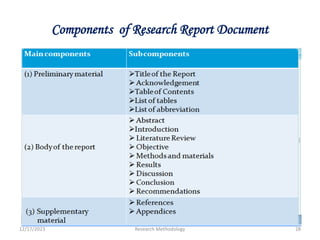
Components of Research Report Document
12/17/2023 28
Research Methodology
Preliminary parts
 Title
• Indicate study subjects, study design, study area, objective of the study
and study period
 Identify the main issue of the paper
 Begin with the subject of the paper
 Not more than 20 words
 It should not contain abbreviations
12/17/2023 29
Research Methodology
Con’t…
 Acknowledgement
• We should acknowledge individuals, communities and organization such
as study participants, funding agents, advisors, data sources and others
accordingly
• It usually placed right after the title page or at the end of the report,
before the references
• Acknowledgement shouldn’t exceed 100 words
• Acknowledge in the order of General to Specific (community to individual)
12/17/2023 30
Research Methodology
Body of the report
 Abstract
• It should contain
Avery brief description of the problem (WHAT)
The main objectives (WHY)
The place of study (WHERE)
The type of study and methods used (HOW)
Major findings and conclusions
• Word length on average 150-250
• Generally written in the past tense and should not contain
abbreviations or acronyms unless standard or very well
known.
12/17/2023 31
Research Methodology
Con’t…
 Introduction
• It tells the reader that
What the topic of the paper is
Why the topic is important
What to expect in the paper
It should funnel from general ideas to the specific topic of the paper
In 3-4 paragraphs
12/17/2023 32
Research Methodology
Con’t…
 Statement of the problem
Try to briefly discuss what is known in the area and the gap that
should be filled by your research.
It describes the context of the study and identify the general
analysis approach of study
12/17/2023 33
Research Methodology
Con’t…
• We have to address the following issues when we write this section
Size and distribution of the problem
Major factors that influence the problem
Solutions that have been tried in the past
How well the solutions worked
Why further research is needed
12/17/2023 34
Research Methodology
Con’t…
 Literature review
• Search widely which are most relevant and recent literatures
• Put reference for all reviewed literature
• Include information directly relevant to your study
• There should be logical sequence in writing literature review
• Put in the order of global to local context of the condition in precise
manner
12/17/2023 35
Research Methodology
Con’t…
 Significance of the study
• It indicate how your research will affect existing knowledge in the area
under investigation.
• Talk about implications, how results of the study may affect scholarly
research, theory, practice, educational interventions, curricula,
counseling and policy.
12/17/2023 36
Research Methodology
Con’t…
 Objective
• State both the general and specific objectives clearly
• General objective: aim of the study in general terms
• Specific objectives: measurable statements on the specific questions to be
answered
12/17/2023 37
Research Methodology
Con’t…
 Method
• Study design
 Clearly states (qualitative, quantitative, or both)
 Which specific type from each design should be stated
• Study period and area
Indicate location of the study area, socio demographic information,
the health care system
Brief description of the socio-economic & cultural characteristics.
12/17/2023 38
Research Methodology
Con’t…
• Source and study population
Define the source population where you haven taken study
population
State the parameters for inclusion and exclusion
Reflection on adequacy and strength of sample and variables for
generalizing to the target population
12/17/2023 39
Research Methodology
Con’t…
• Data collection methods
Consider both qualitative and quantitative data collection
techniques based on your design and objective.
Describe about data collectors, procedures, number of
days, data collection tools and technique.
• Ethical consideration
State about the respective reviewing ethical board
committees, consent from local authority and the way to
assure informed consent of study participant.
12/17/2023 40
Research Methodology
Con’t…
 Data processing and analysis
It is essential that the statistical methods to be used in the
investigation are outlined in detail.
The techniques that will be used to test your hypotheses or
research questions
Manipulations of the variables or data
It is not sufficient to merely state the names of the tests
to be used;
You should describe the rationale for your choice of statistical
software package.
12/17/2023 41
Research Methodology
Con’t…
 Quality assurance
 Mentioning the way of quality assuring means such as training
of data collector, pretesting, ongoing supervision of data
collector, cross checking etc.
 Operational definitions
Define the variables to be observed in the context of your
research
 Plan for Dissemination and Utilization of the findings
 State the way of communication to the respective audience and
the way for utilization of the findings
12/17/2023 42
Research Methodology
Con’t…
 Result
• The results section chronicles the findings of the
statistical analyses and assesses whether your
expectations (hypotheses) were correct.
• Statements about new discoveries or surprises encountered in
the analyses
12/17/2023 43
Research Methodology
Con’t…
 Discussion
• You should summarize the most salient points of your
research (tell the reader what you found out about your
topic).
• Discuss the general significance of your topic and
findings.

• Discuss things future researchers should investigate about
your topic.
• The discussion may include findings from other related
studies that support or contradict your own.
12/17/2023 44
Research Methodology
Con’t…
 Limitation of the Study
• State the limitation of your study and other problems that encountered during your study
 Conclusions
• Should follow logically from the discussion of the findings.
 Recommendations
• The recommendations may be summarized according to the groups towards which they are directed, for
example:
 Policy-makers,
 Health and health-related staff who could implement the activities,
 Potential clients, and
 The community at large
12/17/2023 45
Research Methodology
Supplementary material
 Citation of References
• References are useful to illustrate facts
 Appendix
• Biographical data of the principal investigator
• The study questionnaire if you have it
• The consent form
• Map of the study area
• Analysis output tables and others
• A copy of the approval from the Review Board & if available from
ethical clearing bodies
12/17/2023 46
Research Methodology

Sample Size Determination through out the pharmacy education .pptx

  • 1.
  • 2.
    Sample Size Determination •In planning any investigation, we must decide how many people need to be studied in order to answer the study objectives. • If too large  Unnecessary waste of the limited resources Data collection, analysis • If too small  Cannot assure sufficient power for the detection of meaningful estimate 12/17/2023 2 Research Methodology
  • 3.
    Con’t… • The eventualsample size is usually a compromise between what is desirable and what is feasible. • In order to calculate the required sample size, you need to know the following facts:  The reasonable estimate of the key proportion to be studied. If you cannot guess the proportion, take it as 50%.  The degree of accuracy required  The confidence level required, usually specified as 95%  The size of the population that the sample is to represent 12/17/2023 3 Research Methodology
  • 4.
    Con’t… a) Estimating aSingle population mean n = Where : n- sample size , z – confidence coefficient d- desired precision = variance (Std Dve) 12/17/2023 4 Research Methodology
  • 5.
    Con’t… • E.g. Mr.X wishes to estimate mean hemoglobin level in a defined community. From preliminary contact he thinks the mean is about 150mg/l with a standard deviation of 32mg/l. If he is willing to tolerate a sampling error up to 5mg/l in his estimate, how many subjects should be included in his study? (α =5%, two sided) 12/17/2023 5 Research Methodology
  • 6.
    Con’t… Given Z =1.96 Std.Dev=32 mg/l d =5 mg/l Required = n n = = ≈ 158 persons 12/17/2023 6 Research Methodology
  • 7.
    Con’t… b) Estimating samplein single population proportion • Estimates how big the proportion might be (P) n = Where q= 1-p 12/17/2023 7 Research Methodology
  • 8.
    Con’t… • Example :A survey is being planned to determine what proportion of families in a certain area are medically indigent. It is believed that the proportion can not be greater than 0.35. A 95% confidence interval is desired with d = 0.05. What sample size of families should be selected? 12/17/2023 8 Research Methodology
  • 9.
    Con’t… • Given n= ? p = 0.35 , q = 0.65 z = 1.96 d = 0.5 n = = ≈ 350 12/17/2023 9 Research Methodology
  • 10.
    Con’t… • If N(entire population) is less than 10, 000, the required sample size will be smaller.  2. If n/N>5%  In such cases, calculate the final sample estimate nf by using the following formula. nf =  Where nf =desired sample size (with population < 10,000)  n=desired sample size (when population > 10,000)  N=the estimate of the population size • E.g. If n where found to be 400 and if the population size were estimated as 2000, then nf =400/1+(400/2000) =286 12/17/2023 10 Research Methodology
  • 11.
    Health Research Ethics 12/17/202311 Research Methodology
  • 12.
    Historical Perspectives • Scientificresearch has no doubt contributed a lot to the development of our world.  Health research has played a significant role in minimizing the burden of various diseases. • At the same time it has also raised ethical questions. • Public attention was drawn to ethical questions by reported abuses of human participants in biomedical experiments especially during the Second World War.  Since then ethics has become an evolving issue which has drawn global attention. 12/17/2023 12 Research Methodology
  • 13.
    Con’t…  Nazi WarCrimes • Prior to and during the World War II (1940s), Nazi physicians and scientists conducted experiments on concentration camp prisoners without their consent. • Many of these experiments involved exposing subjects to extreme suffering for observational purposes such as: To determine the time to death for individuals submerged in freezing water To determine the ability of subjects to risist high altitude conditions by forcing them into low-pressure chambers 12/17/2023 13 Research Methodology
  • 14.
    Con’t… • The Naziexperiment involved sterilization of subjects & exposing them to malaria, poisons, typhus, untested drugs & operations usually without any form of anesthesia. • The Nazi experiments violated numerous rights of human research subjects : The selection of study subjects was racially based demonstrating unfair selection process The subjects has no opportunity to refuse participation – prisoners 12/17/2023 14 Research Methodology
  • 15.
    Con’t… • During theNuremberg Military tribunals/court of justice at the end of World War II, the scientists who conducted these experiments were held accountable for their actions  The Nuremberg Code (1947) • The 10 principles outlined in Nuremberg Code were among the 1st rules for experimentation involving human subjects  The first and most famous principle from this historic code states “the voluntary consent of the human subject is absolutely essential” 12/17/2023 15 Research Methodology
  • 16.
    Con’t…  The TuskegeeSyphilis Study • In 1932 the U.S Public Health Service (PHS) began a study of the natural course of untreated syphilis among rural black males in Macon Country, Alabama • About 400 men with syphilis and 200 uninfected controls were enrolled in the study • Informed consent was not obtained from study participants • Study procedures such as spinal taps were represented as “free treatment” 12/17/2023 16 Research Methodology
  • 17.
    Con’t… • This studywas halted in 1972 when national press reports prompted public outrage  This was the longest non-therapeutic experiment on human beings in medical history By the time the study was stopped Dozens of the participants had died of syphilis Many of their wives had been infected Many of their children had been born with congenital syphilis 12/17/2023 17 Research Methodology
  • 18.
    Con’t…  The BelmontReport • In 1972, the public became aware of the Tuskegee study  As a result, in 1974 the National Commission for the Protection of Human Subjects of Biomedical and Behavioral Research was established. • In 1978, the commission submitted its report titled, ‘The Belmont Report’  Ethical Principles and Guidelines for the Protection of Human Subjects of Research. 12/17/2023 18 Research Methodology
  • 19.
    Con’t…  Willow brookstudy • An institution for mentally retarded at willow brook conducted a research on hepatitis on children from mid 1950s to early 1970s • The subjects, all children, were deliberately infected with hepatitis virus • To gain their child’s admission to institution, parents were forced to give permission for the child to be a subject in the study 12/17/2023 19 Research Methodology
  • 20.
    Con’t…  The declarationof Helsinki (1964) • Was adopted by the World Medical Association in 1964 to guide application of the ethical principles for clinical research.  Other international guidelines A) International Guidelines for Biomedical Research Involving Human Subjects B) B) International Conference on Harmonization (ICH) C) International Guidelines for the Ethical Review of Epidemiologic Studies 12/17/2023 20 Research Methodology
  • 21.
    Ethical principles • Beforeyou embark on research with human subjects, you are likely to require ethical approval.  Autonomy- we ought to respect the right to self-determination • Autonomy is protected by ensuring that any consent to participate in the study is informed or real. There must be no coercion of any sort.  Non-Maleficence- we ought to ‘do no harm’ • This principle states that we may not inflict harm on or expose people to unnecessary risk as a result of our research project. This is particularly important if our subjects may not be competent in some way 12/17/2023 21 Research Methodology
  • 22.
    Con’t…  Beneficence –we ought to further others’ legitimate interests • The principle is to maximize benefits and minimize harms and wrongs Making efforts to secure the well-being of research participants Justice-we ought to ensure fair entitlement to resources • People should be treated equally in every way 12/17/2023 22 Research Methodology
  • 23.
    Con’t…  Veracity • Allsubjects in any research project should always be told the truth. There is no justification for lying  Privacy • When subjects enroll in a research study, they grant access to themselves Includes viewing, touch or having information about them 12/17/2023 23 Research Methodology
  • 24.
    Con’t…  Confidentiality • Noinformation obtained with the subject’s permission from their medical records should be disclosed to any third person without that individual’s consent.  Fidelity • Keeping our promises and avoiding negligence with information. 12/17/2023 24 Research Methodology
  • 25.
    Research Report Writing 12/17/202325 Research Methodology
  • 26.
    Research Report • Awritten document or oral presentation of the evidence and the findings in such a detail and form as to be readily understood and accessed by the reader and as to enable him to verify the validity of the conclusions. 12/17/2023 26 Research Methodology
  • 27.
    Con’t… Why it isimportant? • To share Knowledge and innovative findings • To show gaps that need further investigation • To convey others about the issue of interest • To provide input for decision makers during  Policy formulation, Planning, Intervention  Monitoring and Evaluation 12/17/2023 27 Research Methodology
  • 28.
    Components of ResearchReport Document 12/17/2023 28 Research Methodology
  • 29.
    Preliminary parts  Title •Indicate study subjects, study design, study area, objective of the study and study period  Identify the main issue of the paper  Begin with the subject of the paper  Not more than 20 words  It should not contain abbreviations 12/17/2023 29 Research Methodology
  • 30.
    Con’t…  Acknowledgement • Weshould acknowledge individuals, communities and organization such as study participants, funding agents, advisors, data sources and others accordingly • It usually placed right after the title page or at the end of the report, before the references • Acknowledgement shouldn’t exceed 100 words • Acknowledge in the order of General to Specific (community to individual) 12/17/2023 30 Research Methodology
  • 31.
    Body of thereport  Abstract • It should contain Avery brief description of the problem (WHAT) The main objectives (WHY) The place of study (WHERE) The type of study and methods used (HOW) Major findings and conclusions • Word length on average 150-250 • Generally written in the past tense and should not contain abbreviations or acronyms unless standard or very well known. 12/17/2023 31 Research Methodology
  • 32.
    Con’t…  Introduction • Ittells the reader that What the topic of the paper is Why the topic is important What to expect in the paper It should funnel from general ideas to the specific topic of the paper In 3-4 paragraphs 12/17/2023 32 Research Methodology
  • 33.
    Con’t…  Statement ofthe problem Try to briefly discuss what is known in the area and the gap that should be filled by your research. It describes the context of the study and identify the general analysis approach of study 12/17/2023 33 Research Methodology
  • 34.
    Con’t… • We haveto address the following issues when we write this section Size and distribution of the problem Major factors that influence the problem Solutions that have been tried in the past How well the solutions worked Why further research is needed 12/17/2023 34 Research Methodology
  • 35.
    Con’t…  Literature review •Search widely which are most relevant and recent literatures • Put reference for all reviewed literature • Include information directly relevant to your study • There should be logical sequence in writing literature review • Put in the order of global to local context of the condition in precise manner 12/17/2023 35 Research Methodology
  • 36.
    Con’t…  Significance ofthe study • It indicate how your research will affect existing knowledge in the area under investigation. • Talk about implications, how results of the study may affect scholarly research, theory, practice, educational interventions, curricula, counseling and policy. 12/17/2023 36 Research Methodology
  • 37.
    Con’t…  Objective • Stateboth the general and specific objectives clearly • General objective: aim of the study in general terms • Specific objectives: measurable statements on the specific questions to be answered 12/17/2023 37 Research Methodology
  • 38.
    Con’t…  Method • Studydesign  Clearly states (qualitative, quantitative, or both)  Which specific type from each design should be stated • Study period and area Indicate location of the study area, socio demographic information, the health care system Brief description of the socio-economic & cultural characteristics. 12/17/2023 38 Research Methodology
  • 39.
    Con’t… • Source andstudy population Define the source population where you haven taken study population State the parameters for inclusion and exclusion Reflection on adequacy and strength of sample and variables for generalizing to the target population 12/17/2023 39 Research Methodology
  • 40.
    Con’t… • Data collectionmethods Consider both qualitative and quantitative data collection techniques based on your design and objective. Describe about data collectors, procedures, number of days, data collection tools and technique. • Ethical consideration State about the respective reviewing ethical board committees, consent from local authority and the way to assure informed consent of study participant. 12/17/2023 40 Research Methodology
  • 41.
    Con’t…  Data processingand analysis It is essential that the statistical methods to be used in the investigation are outlined in detail. The techniques that will be used to test your hypotheses or research questions Manipulations of the variables or data It is not sufficient to merely state the names of the tests to be used; You should describe the rationale for your choice of statistical software package. 12/17/2023 41 Research Methodology
  • 42.
    Con’t…  Quality assurance Mentioning the way of quality assuring means such as training of data collector, pretesting, ongoing supervision of data collector, cross checking etc.  Operational definitions Define the variables to be observed in the context of your research  Plan for Dissemination and Utilization of the findings  State the way of communication to the respective audience and the way for utilization of the findings 12/17/2023 42 Research Methodology
  • 43.
    Con’t…  Result • Theresults section chronicles the findings of the statistical analyses and assesses whether your expectations (hypotheses) were correct. • Statements about new discoveries or surprises encountered in the analyses 12/17/2023 43 Research Methodology
  • 44.
    Con’t…  Discussion • Youshould summarize the most salient points of your research (tell the reader what you found out about your topic). • Discuss the general significance of your topic and findings. • Discuss things future researchers should investigate about your topic. • The discussion may include findings from other related studies that support or contradict your own. 12/17/2023 44 Research Methodology

  • 45.
    Con’t…  Limitation ofthe Study • State the limitation of your study and other problems that encountered during your study  Conclusions • Should follow logically from the discussion of the findings.  Recommendations • The recommendations may be summarized according to the groups towards which they are directed, for example:  Policy-makers,  Health and health-related staff who could implement the activities,  Potential clients, and  The community at large 12/17/2023 45 Research Methodology

  • 46.
    Supplementary material  Citationof References • References are useful to illustrate facts  Appendix • Biographical data of the principal investigator • The study questionnaire if you have it • The consent form • Map of the study area • Analysis output tables and others • A copy of the approval from the Review Board & if available from ethical clearing bodies 12/17/2023 46 Research Methodology