(Enclosure No. 4 to DepEd Memorandum No. 044, s. 2023)
Republic of the Philippines
Department of Education
National Educators Academy of the Philippines
Detailed Professional Development Program Design Form
INSTRUCTIONS: Provide the details in the designated spaces as required. Indicate N/A if not applicable. DO NOT ABBREVIATE.
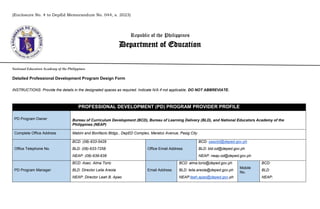
PROFESSIONAL DEVELOPMENT (PD) PROGRAM PROVIDER PROFILE
PD Program Owner Bureau of Curriculum Development (BCD), Bureau of Learning Delivery (BLD), and National Educators Academy of the
Philippines (NEAP)
Complete Office Address Mabini and Bonifacio Bldgs., DepED Complex, Meralco Avenue, Pasig City
Office Telephone No.
BCD: (08)-633-5429
BLD: (08)-633-7258
NEAP: (08)-638-638
Office Email Address
BCD: oasctct@deped.gov.ph
BLD: bld.od@deped.gov.ph
NEAP: neap.od@deped.gov.ph
PD Program Manager
BCD: Asec. Alma Torio
BLD: Director Leila Areola
NEAP: Director Leah B. Apao
Email Address
BCD: alma.torio@deped.gov.ph
BLD: leila.areola@deped.gov.ph
NEAP:leah.apao@deped.gov.ph
Mobile
No.
BCD:
BLD:
NEAP:
2
PD PROGRAM PROFILE
Title Training on the MATATAG Curriculum for Kindergarten, Grades 1, 4, and 7 (K147) School Leaders and Teachers
Rationale
Republic Act No. 10533 or the “The Enhanced K to 12 Basic Education Program” is a significant educational reform in the country that presented
ways to improve the delivery of Philippine basic education. Its primary goal was to equip Filipino learners with the necessary skills and competence to
prepare them to take on the challenges of the 21st century. K-12 geared towards the basic education system in the Philippines to be at par with
international standards by ensuring that it was appropriate, responsive, and relevant to the learners and to national and global realities (DepEd, 2019).
The implementation of the K to 12 Program revealed no improvement on academic performance of Filipino learners as gleaned in the standardized
national and international assessment (Schleicher, 2018; Mullis, Martin, Foy, Kelly, & Fishbein, 2020; UNICEF (United Nations Children Fund) & SEAMEO,
2020). To address this “learning poverty”, the Department of Education (DepEd) pursued its education reform MATATAG agenda which sets the new
direction of the agency in resolving basic education challenges. It spells out four critical components: MAke the curriculum relevant to produce competent
and job-ready, active, and responsible citizens; TAke steps to accelerate delivery of basic education facilities and services; TAke good care of learners by
promoting learner well-being, inclusive education, and a positive learning environment; and Give support to teachers to teach better.
DepEd recently launched the MATATAG curriculum to address challenges faced by the current K to 12 curriculum such as congested content,
misplaced prerequisite learning competencies, and cognitive demand imbalance. MATATAG Curriculum also puts premium on foundational skills,
embedding peace competencies, and strengthening inclusive education programs.
With this, it is imperative that the teachers and school leaders have an in-depth and consistent understanding of the revised curriculum and be
equipped with the knowledge, skills, attitudes, and values, anchored on Philippine professional standards for teachers, school heads, and supervisors,
necessary to effectively implement and support the curriculum.
Furthermore, for teachers to be effective and efficient in implementing the curriculum, school leaders, i.e. officials in the public school system who
perform managerial and supervisory roles in their respective levels of governance, such as head teachers, department heads, principals and assistant
principals, schools district supervisors, education program supervisors and chief education supervisors at the schools division and regional offices, schools
division superintendents, regional directors and assistant regional directors, and their equivalent positions in the private school system as defined under
RA No. 11713, must step up to effectively provide purposive instructional supervision. Instructional Supervision is a professional continuous and
cooperative process for the improvement of instruction (Basic Education Sector Reform Agenda Teacher Education and Development – TWG).
Finally, all the initiatives related with the MATATAG agenda are congruent with DepEd Order No. 24, s. 2022 or the Adoption of the Basic Education
Development Plan 2030 (BEDP 2030) that outlines the priorities of the department in addressing the immediate and long-term concerns confronting basic
education: access, equity, quality, and resiliency. Quality is designed to address the quality of education through various strategic means such as
upskilling and reskilling of teachers and school leaders. Training teachers and school leaders on the MATATAG curriculum is essential to enhance their
3
readiness, competency, and understanding, ultimately benefiting the students’ learning experience.
Program
Description
The Training on MATATAG Curriculum for teachers and school leaders shall be delivered at various governance levels including National Core Trainer
Orientation (ONCT), National Training of School Leaders (NTSL), Regional Training of School Leaders (RTSL), Division Training of School Leaders
(DTSL), and School-Based Management Training Program (SBMTP).
The ONCT is implemented by a team of experienced educators and experts in curriculum development, learning delivery, and assessment, particularly for
Kindergarten, Grade 1, Grade 4, and Grade 7. They are responsible for providing the necessary training and guidance to the core trainers who will
disseminate the curriculum and appropriate pedagogical approaches to educators nationwide. This team ensures that the core trainers have a thorough
understanding of the curriculum and are equipped with the knowledge and skills to effectively implement training in their respective regions, school
divisions, and schools.
The NTSLs shall be conducted by the National Core of Trainers. The Regional Team of Trainer-School Leaders shall be participated by Regional CLMD,
HRDD, QAD, Division CID and SGOD chiefs, Regional and Division Education Program Supervisors, Public Schools District Supervisors, NEAP-R Focal
and Specialists, SGOD HRD and Specialists, Division M&E SEPS and EPS II. The NTSLs builds the capability of school leaders, equipping them with the
necessary skills and knowledge aligned with the overarching educational priorities and goals set by the MATATAG Curriculum, likewise, it also aims to
provide school leaders across regions and divisions during the Regional Training of School Leaders and Division Training of School Leaders.
The training rollout of the MATATAG Curriculum using the SBMTP to be implemented by the school heads is more effective, efficient, and responsive to
the needs of teachers. Through their quality leadership and management, the Department of Education (DepEd) will upskill and reskill quality teachers and
“holistic learners who are steeped in values, equipped with 21st-century skills, and able to propel the country to development and progress” (DepEd Order
No. 42, s. 2017). This is consonant with the DepEd’s vision of producing “Filipinos who passionately love their country and whose values and
competencies enable them to realize their full potential and contribute meaningfully to building the nation” (DO No. 36, s. 2013) along with the MATATAG
Agenda.
By conducting national training on the MATATAG curriculum according to the levels of governance, school leaders and the education system can foster
effective leadership, encourage collaboration and networking, and ensure that school leaders are competent to enable the teachers to move forward to
bring about positive change and eventually improve learning outcomes.
PROGRAM OBJECTIVES
Results
Objective
Ensure improved student learning through effective implementation of the Curriculum by teachers, master teachers, and school leaders (school
heads, SEPSs, PSDSs, Chiefs)
4
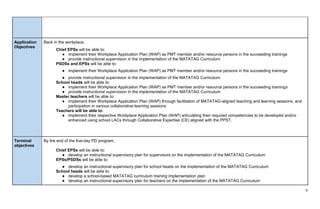
Application
Objectives
Back in the workplace,
Chief EPSs will be able to:
● implement their Workplace Application Plan (WAP) as PMT member and/or resource persons in the succeeding trainings
● provide instructional supervision in the implementation of the MATATAG Curriculum
PSDSs and EPSs will be able to:
● implement their Workplace Application Plan (WAP) as PMT member and/or resource persons in the succeeding trainings
● provide instructional supervision in the implementation of the MATATAG Curriculum
School heads will be able to:
● implement their Workplace Application Plan (WAP) as PMT member and/or resource persons in the succeeding trainings
● provide instructional supervision in the implementation of the MATATAG Curriculum
Master teachers will be able to:
● implement their Workplace Application Plan (WAP) through facilitation of MATATAG-aligned teaching and learning sessions, and
participation in various collaborative learning sessions
Teachers will be able to:
● implement their respective Workplace Application Plan (WAP) articulating their required competencies to be developed and/or
enhanced using school LACs through Collaborative Expertise (CE) aligned with the PPST.
Terminal
objectives
By the end of the five-day PD program,
Chief EPSs will be able to:
● develop an instructional supervisory plan for supervisors on the implementation of the MATATAG Curriculum
EPSs/PSDSs will be able to:
● develop an instructional supervisory plan for school heads on the implementation of the MATATAG Curriculum
School heads will be able to:
● develop a school-based MATATAG curriculum training implementation plan
● develop an instructional supervisory plan for teachers on the implementation of the MATATAG Curriculum
5
Master teachers will be able:
● develop a lesson plan and instructional supervisory plan that show understanding of the connections among instructional elements
(standards, instruction, assessment, and evaluation and feedback) of the MATATAG curriculum
Teachers will be able:
● develop a lesson plan that shows understanding of the connections among instructional elements (standards, instruction,
assessment, and evaluation and feedback) of the MATATAG curriculum
Enabling
objectives
Specifically, the participants [teachers, master teachers, school leaders (Chiefs, EPSs, PSDSDs, and School Heads) will be able to:
1. identify the overall structure and salient features of the general shaping paper and learning area curriculum guide
2. demonstrate knowledge and skills on unpacking/merging/clustering competencies per grade level and learning area.
3. discuss the key principles of the Matatag Curriculum Instructional Design Framework
4. design a classroom-based assessment tool for an identified learning competency within the MATATAG Curriculum, ensuring alignment
with instructional objectives and diverse assessment methods.
5. integrate 21st century skills, inclusion principles and brain-based learning theories in teaching and learning processes
6. apply pedagogical approaches and assessment per learning area for effective lesson planning
7. develop a lesson plan for Q1 and Q2 of the MATATAG Curriculum for demonstration teaching
8. simulate collaborative learning expertise
9. facilitate and give feedback to a teaching-learning session using the co-developed lesson plan
10. exhibit positive /inclusive attitude towards the implementation of the MATATAG curriculum
11. discuss the key steps and strategies in organizing and managing school-based training programs.
12. discuss the principles for an effective learning session facilitation
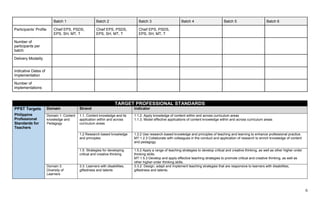
TARGET PARTICIPANTS
Total number of
target participants:
Number of batches
per implementation
(if applicable):
6
Batch 1 Batch 2 Batch 3 Batch 4 Batch 5 Batch 6
Participants’ Profile Chief EPS, PSDS,
EPS, SH, MT, T
Chief EPS, PSDS,
EPS, SH, MT, T
Chief EPS, PSDS,
EPS, SH, MT, T
Number of
participants per
batch:
Delivery Modality
Indicative Dates of
Implementation
Number of
implementations:
TARGET PROFESSIONAL STANDARDS
PPST Targets
Philippine
Professional
Standards for
Teachers
Domain Strand Indicator
Domain 1: Content
knowledge and
Pedagogy
1.1. Content knowledge and its
application within and across
curriculum areas
1.1.2. Apply knowledge of content within and across curriculum areas
1.1.3. Model effective applications of content knowledge within and across curriculum areas
1.2 Research-based knowledge
and principles
1.2.2 Use research-based knowledge and principles of teaching and learning to enhance professional practice.
MT:1.2.3 Collaborate with colleagues in the conduct and application of research to enrich knowledge of content
and pedagogy
1.5. Strategies for developing
critical and creative thinking
1.5.2 Apply a range of teaching strategies to develop critical and creative thinking, as well as other higher-order
thinking skills.
MT:1.5.3 Develop and apply effective teaching strategies to promote critical and creative thinking, as well as
other higher-order thinking skills.
Domain 3.
Diversity of
Learners
3.3. Learners with disabilities,
giftedness and talents
3.3.2. Design, adapt and implement teaching strategies that are responsive to learners with disabilities,
giftedness and talents.
7
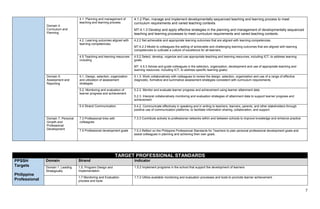
Domain 4.
Curriculum and
Planning
4.1. Planning and management of
teaching and learning process
4.1.2 Plan, manage and implement developmentally sequenced teaching and learning process to meet
curriculum requirements and varied teaching contexts.
MT:4.1.3 Develop and apply effective strategies in the planning and management of developmentally sequenced
teaching and learning processes to meet curriculum requirements and varied teaching contexts.
4.2. Learning outcomes aligned with
learning competencies;
4.2.2 Set achievable and appropriate learning outcomes that are aligned with learning competencies.
MT:4.2.3 Model to colleagues the setting of achievable and challenging learning outcomes that are aligned with learning
competencies to cultivate a culture of excellence for all learners.
4.5 Teaching and learning resources
including
4.5.2 Select, develop, organize and use appropriate teaching and learning resources, including ICT, to address learning
goals.
MT: 4.5.3 Advise and guide colleagues in the selection, organization, development and use of appropriate teaching and
learning resources, including ICT, to address specific learning goals)
Domain 5:
Assessment and
Reporting
5.1. Design, selection, organization
and utilization of assessment
strategies
5.1.3. Work collaboratively with colleagues to review the design, selection, organization and use of a range of effective
diagnostic, formative and summative assessment strategies consistent with curriculum requirements.
5.2. Monitoring and evaluation of
learner progress and achievement
5.2.2. Monitor and evaluate learner progress and achievement using learner attainment data
5.2.3. Interpret collaboratively monitoring and evaluation strategies of attainment data to support learner progress and
achievement
5.4 Strand Communication 5.4.2. Communicate effectively in speaking and in writing to teachers, learners, parents, and other stakeholders through
positive use of communication platforms, to facilitate information sharing, collaboration, and support.
Domain 7. Personal
Growth and
Professional
Development
7.3 Professional links with
colleagues
7.3.3 Contribute actively to professional networks within and between schools to improve knowledge and enhance practice
7.5 Professional development goals 7.5.3 Reflect on the Philippine Professional Standards for Teachers to plan personal professional development goals and
assist colleagues in planning and achieving their own goals.
TARGET PROFESSIONAL STANDARDS
PPSSH
Targets
Philippine
Professional
Domain Strand Indicator
Domain 1. Leading
Strategically
1.5. Program Design and
Implementation
1.5.2 Implement programs in the school that support the development of learners
1.7 Monitoring and Evaluation
process and tools
1.7.2 Utilize available monitoring and evaluation processes and tools to promote learner achievement.
8
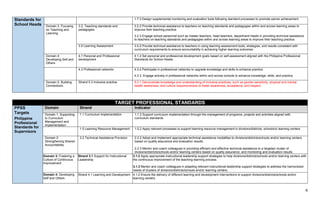
Standards for
School Heads
1.7.3 Design supplemental monitoring and evaluation tools following standard processes to promote earner achievement.
Domain 3. Focusing
on Teaching and
Learning
3.2. Teaching standards and
pedagogies
3.2.2 Provide technical assistance to teachers on teaching standards and pedagogies within and across learning areas to
improve their teaching practice.
3.2.3 Engage school personnel such as master teachers, head teachers, department heads in providing technical assistance
to teachers on teaching standards and pedagogies within and across learning areas to improve their teaching practice.
3.5 Learning Assessment 3.5.2 Provide technical assistance to teachers in using learning assessment tools, strategies, and results consistent with
curriculum requirements to ensure accountability in achieving higher learning outcomes.
Domain 4:
Developing Self and
Others
4.1 Personal and Professional
development
4.1.2 Set personal and professional development goals based on self-assessment aligned with the Philippine Professional
Standards for School Heads.
4.3 Professional networks 4.3.2 Participate in professional networks to upgrade knowledge and skills to enhance practice.
4.3.3. Engage actively in professional networks within and across schools to advance knowledge, skills, and practice.
Domain 5. Building
Connections
Strand 5.3 Inclusive practice 5.3.1 Demonstrate knowledge and understanding of inclusive practices, such as gender sensitivity, physical and mental
health awareness, and culture responsiveness to foster awareness, acceptance, and respect.
TARGET PROFESSIONAL STANDARDS
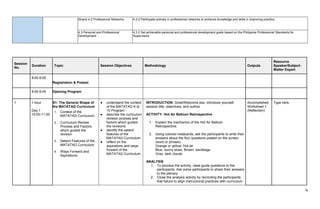
PPSS
Targets
Philippine
Professional
Standards for
Supervisors
Domain Strand Indicator
Domain 1. Supporting
to Curriculum
Management and
Implementation
1.1 Curriculum Implementation 1.1.2 Support curriculum implementation through the management of programs, projects and activities aligned with
curriculum standards.
1.5 Learning Resource Management 1.5.2 Apply relevant processes to support learning resource management in divisions/districts, schools/or learning centers
Domain 2:
Strengthening Shared
Accountability
2.2 Technical Assistance Provision 2.2.2 Adopt and implement appropriate technical assistance modalities to divisions/districts/schools and/or learning centers
based on quality assurance and evaluation results.
2.2.3 Mentor and coach colleagues in providing efficient and effective technical assistance to a targeted cluster of
divisions/districts/schools and/or learning centers based on quality assurance, and monitoring and evaluation results.
Domain 3: Fostering a
Culture of Continuous
Improvement
Strand 3.1 Support for Instructional
Leadership
3.1.2 Apply appropriate instructional leadership support strategies to help divisions/districts/schools and/or learning centers with
the continuous improvement of the teaching-learning process.
3.1.3 Mentor and coach colleagues in adapting relevant instructional leadership support strategies to address the harmonized
needs of clusters of divisions/districts/schools and/or learning centers.
Domain 4: Developing
Self and Others
Strand 4.1 Learning and Development 4.1.2 Ensure the delivery of different learning and development interventions to support divisions/districts/schools and/or
learning centers.
9
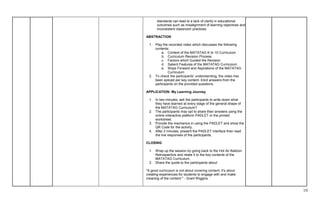
Strand 4.2 Professional Networks 4.2.2 Participate actively in professional networks to enhance knowledge and skills in improving practice.
4.3 Personal and Professional
Development
4.3.2 Set achievable personal and professional development goals based on the Philippine Professional Standards for
Supervisors.
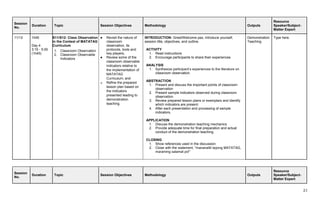
Session
No.
Duration Topic Session Objectives Methodology Outputs
Resource
Speaker/Subject-
Matter Expert
8:00-9:00
Registration & Pretest
9:00-9:45 Opening Program
1 1 hour
Day 1
10:00-11:00
S1: The General Shape of
the MATATAG Curriculum
1. Context of the
MATATAG Curriculum,
2. Curriculum Review
Process and Factors
which guided the
revision
3. Salient Features of the
MATATAG Curriculum
4. Ways Forward and
Aspirations
● understand the context
of the MATATAG K to
10 Program
● describe the curriculum
revision process and
factors which guided
the revisions
● identify the salient
features of the
MATATAG Curriculum
● reflect on the
aspirations and ways
forward of the
MATATAG Curriculum
INTRODUCTION: Greet/Welcome pax, introduce yourself,
session title, objectives, and outline.
ACTIVITY: Hot Air Balloon Retrospective
1. Explain the mechanics of the Hot Air Balloon
Retrospective.
2. Using colored metacards, ask the participants to write their
answers about the four questions posted on the screen
(word or phrase)
Orange or yellow: Hot air
Blue: sunny skies, Brown: sandbags
Gray: dark clouds
ANALYSIS
1. To process the activity, raise guide questions to the
participants. Ask some participants to share their answers
to the plenary.
2. Close the analysis activity by reminding the participants
that failure to align instructional practices with curriculum
Accomplished
Worksheet 1
(Reflection)
Type here.
10
standards can lead to a lack of clarity in educational
outcomes such as misalignment of learning objectives and
inconsistent classroom practices.
ABSTRACTION
1. Play the recorded video which discusses the following
contents:
a. Context of the MATATAG K to 10 Curriculum
b. Curriculum Revision Process
c. Factors which Guided the Revision
d. Salient Features of the MATATAG Curriculum
e. Ways Forward and Aspirations of the MATATAG
Curriculum
2. To check the participants’ understanding, the video has
been spliced per key content. Elicit answers from the
participants on the provided questions.
APPLICATION: My Learning Journey
1. In two minutes, ask the participants to write down what
they have learned at every stage of the general shape of
the MATATAG Curriculum?
2. The participants may opt to share their answers using the
online interactive platform PADLET or the printed
worksheet.
3. Provide the mechanics in using the PADLET and show the
QR Code for the activity.
4. After 2 minutes, present the PADLET interface then read
the live responses of the participants.
CLOSING
1. Wrap up the session by going back to the Hot Air Balloon
Retrospective and relate it to the key contents of the
MATATAG Curriculum.
2. Share the quote to the participants about
“A good curriculum is not about covering content; it's about
creating experiences for students to engage with and make
meaning of the content." - Grant Wiggins
11
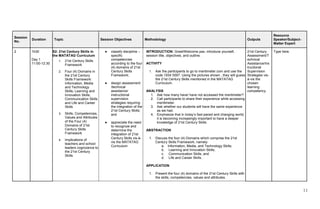
Session
No.
Duration Topic Session Objectives Methodology Outputs
Resource
Speaker/Subject-
Matter Expert
2 1h30
Day 1
11:00-12:30
S2: 21st Century Skills in
the MATATAG Curriculum
1. 21st Century Skills
Framework
2. Four (4) Domains in
the 21st Century
Skills Framework:
Information, Media
and Technology
Skills; Learning and
Innovation Skills;
Communication Skills
and Life and Career
Skills
3. Skills, Competencies,
Values and Attributes
of the Four (4)
Domains of 21st
Century Skills
Framework
4. Implications of
teachers and school
leaders cognizance to
the 21st Century
Skills
● classify discipline –
specific
competencies
according to the four
(4) domains of 21st
Century Skills
Framework;
● design assessment
/technical
assistance/
instructional
supervision
strategies requiring
the integration of the
21st Century Skills;
and
● appreciate the need
to recognize and
determine the
integration of 21st
Century Skills vis-à-
vis the MATATAG
Curriculum
INTRODUCTION: Greet/Welcome pax, introduce yourself,
session title, objectives, and outline.
ACTIVITY
1. Ask the participants to go to mentimeter.com and use the
code 1934 5597. Using the pictures shown , they will guess
the 21st Century Skills mentioned in the MATATAG
Curriculum.
ANALYSIS
1. Ask how many have/ have not accessed the mentimeter?
2. Call participants to share their experience while accessing
mentimeter.
3. Ask whether our students will have the same experience
as we had.
4. Emphasize that in today’s fast-paced and changing world,
it is becoming increasingly important to have a deeper
knowledge of 21st Century Skills.
ABSTRACTION
1. Discuss the four (4) Domains which comprise the 21st
Century Skills Framework, namely:
a. Information, Media, and Technology Skills;
b. Learning and Innovation Skills;
c. Communication Skills, and
d. Life and Career Skills.
APPLICATION
1. Present the four (4) domains of the 21st Century Skills with
the skills, competencies, values and attributes.
21st Century
Assessment/T
echnical
Assistance/Ins
tructional
Supervision
Strategies vis-
à-vis the
chosen
learning
competency
Type here.
12
2. Project a specific competency taken from the subject-
specific Curriculum Guides.
3. Let them determine the domain of the projected
competency.
4. Call participants to share their thoughts, learnings,
realizations and or insights regarding 21st Century Skills.
CLOSING
1. Wrap up the session by presenting key ideas about the
topic and by asking them if the objectives set were met.
2. Let them watch a video titled Lessons From Geese
Session
No.
Duration Topic Session Objectives Methodology Outputs
Resource
Speaker/Subject-
Matter Expert
Refer to
Grade
Level-/
Learning
Area-
specific
PD
Design
2h15
Day 1
1:30-2:30
(1h)
2:45-4:00
(1h15)
Walkthrough of [Learning
Area] Shaping Paper
● Explain the Salient Features
of the Learning Area Shaping
Paper
● Share one’s appreciation on
the importance of the
Shaping Paper to the
teaching and learning
process.
Refer to Grade Level-/ Learning Area-specific PD Design Accomplished
Reflection
Paper
Type here.
Refer to
Grade
Level-/
Learning
Area-
specific
PD
Design
3h15
Day 2
8:30 - 10:00
10:15 -
11:00
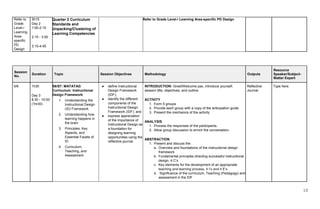
Quarter 1 Curriculum
Standards and
Unpacking/ Clustering of
Learning Competencies
Refer to Grade Level-/ Learning Area-specific PD Design
13
Refer to
Grade
Level-/
Learning
Area-
specific
PD
Design
3h15
Day 2
1:00-2:15
2:15 - 3:00
3:15-4:45
Quarter 2 Curriculum
Standards and
Unpacking/Clustering of
Learning Competencies
Refer to Grade Level-/ Learning Area-specific PD Design
Session
No.
Duration Topic Session Objectives Methodology Outputs
Resource
Speaker/Subject-
Matter Expert
5/6 1h30
Day 3
8:30 - 10:00
(1hr30)
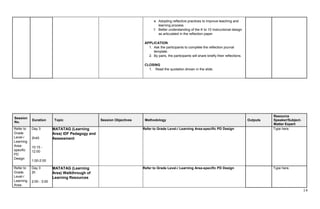
S6/S7: MATATAG
Curriculum: Instructional
Design Framework
1. Understanding the
Instructional Design
(ID) Framework
2. Understanding how
learning happens in
the brain
3. Principles, Key
Aspects, and
Essential Facets of
ID
4. Curriculum,
Teaching, and
Assessment
● define Instructional
Design Framework
(IDF);
● identify the different
components of the
Instructional Design
Framework (IDF); and
● express appreciation
of the importance of
Instructional Design as
a foundation for
designing learning
opportunities using the
reflective journal.
INTRODUCTION: Greet/Welcome pax, introduce yourself,
session title, objectives, and outline.
ACTIVITY
1. Form 5 groups
2. Provide each group with a copy of the anticipation guide
3. Present the mechanics of the activity
ANALYSIS
1. Process the responses of the participants.
2. Allow group discussion to enrich the conversation.
ABSTRACTION
1. Present and discuss the:
a. Overview and foundations of the instructional design
framework
b. Fundamental principles directing successful instructional
design, 4 C’s
c. Key elements for the development of an appropriate
teaching and learning process, 4 I’s and 4 E’s
d. Significance of the curriculum, Teaching (Pedagogy) and
assessment in the IDF
Reflective
Journal
Type here.
14
e. Adopting reflective practices to improve teaching and
learning process
f. Better understanding of the K to 10 Instructional design
as articulated in the reflection paper
APPLICATION
1. Ask the participants to complete the reflection journal
template.
2. By pairs, the participants will share briefly their reflections.
CLOSING
1. Read the quotation shown in the slide.
Session
No.
Duration Topic Session Objectives Methodology Outputs
Resource
Speaker/Subject-
Matter Expert
Refer to
Grade
Level-/
Learning
Area-
specific
PD
Design
Day 3
2h45
10:15 -
12:00
1:00-2:00
MATATAG (Learning
Area) IDF Pedagogy and
Assessment
Refer to Grade Level-/ Learning Area-specific PD Design Type here.
Refer to
Grade
Level-/
Learning
Area-
Day 3
2h
2:00 - 3:00
MATATAG (Learning
Area) Walkthrough of
Learning Resources
Refer to Grade Level-/ Learning Area-specific PD Design Type here.
15
specific
PD
Design
3:15 - 4:15
Session
No.
Duration Topic Session Objectives Methodology Outputs
Resource
Speaker/Subject-
Matter Expert
8/9 1h45
Day 4
8:30 - 10:15
(1h45)
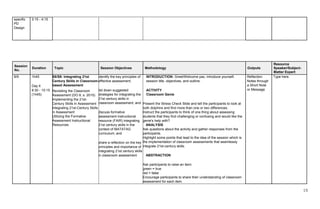
S8/S9: Integrating 21st
Century Skills in Classroom-
based Assessment
13. Revisiting the Classroom
Assessment (DO 8, s. 2015)
14. Implementing the 21st-
Century Skills in Assessment
15. Integrating 21st-Century Skills
in Assessment
16. Utilizing the Formative
Assessment Instructional
Resources
● identify the key principles of
effective assessment;
● list down suggested
strategies for integrating the
21st century skills in
classroom assessment; and
● discuss formative
assessment instructional
resource (FAIR) integrating
21st century skills in the
context of MATATAG
curriculum; and
● share a reflection on the key
principles and importance of
integrating 21st century skills
in classroom assessment
INTRODUCTION: Greet/Welcome pax, introduce yourself,
session title, objectives, and outline.
ACTIVITY
Classroom Genie
17. Present the Stress Check Slide and tell the participants to look at
both dolphins and find more than one or two differences.
18. Instruct the participants to think of one thing about assessing
students that they find challenging or confusing and would like the
genie's help with?
ANALYSIS
19. Ask questions about the activity and gather responses from the
participants.
20. Highlight some points that lead to the idea of the session which is
the implementation of classroom assessments that seamlessly
integrate 21st-century skills.
ABSTRACTION
21. Ask participants to raise an item:
g. green = true
h. red = false
22. Encourage participants to share their understanding of classroom
assessment for each item.
Reflection
Notes through
a Short Note
or Message
Type here.
16
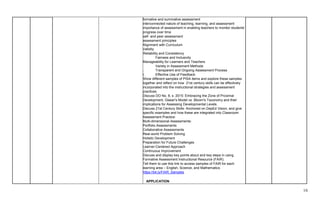
i. formative and summative assessment
j. interconnected nature of teaching, learning, and assessment
k. importance of assessment in enabling teachers to monitor students'
progress over time
l. self- and peer assessment
m. assessment principles
i. Alignment with Curriculum
ii. Validity
iii.Reliability and Consistency
iv. Fairness and Inclusivity
v.Manageability for Learners and Teachers
vi. Variety in Assessment Methods
vii. Transparent and Ongoing Assessment Process
viii. Effective Use of Feedback
23. Show different samples of PISA items and explore these samples
together and reflect on how 21st century skills can be effectively
incorporated into the instructional strategies and assessment
practices.
24. Discuss DO No. 8, s. 2015: Embracing the Zone of Proximal
Development, Glaser's Model vs. Bloom's Taxonomy and their
implications for Assessing Developmental Levels.
25. Discuss 21st Century Skills: Anchored on DepEd Vision, and give
specific examples and how these are integrated into Classroom
Assessment Practice:
n. Multi-dimensional Assessments:
o. Portfolio Assessments
p. Collaborative Assessments
q. Real-world Problem Solving
r. Holistic Development
s. Preparation for Future Challenges
t. Learner-Centered Approach
u. Continuous Improvement
26. Discuss and display key points about and key steps in using
Formative Assessment Instructional Resource (FAIR).
27. Tell them to use this link to access samples of FAIR for each
learning area – English, Science, and Mathematics:
https://bit.ly/FAIR_Samples
APPLICATION
17
28. Ask participants to revisit their outputs from the sessions on
unpacking learning competencies, formulating learning objectives,
determining 21st-century skills, and understanding pedagogy and
assessment.
29. Ask them to analyze their learning objectives and teaching
strategies to identify which 21st-century skills can be targeted within
the context of their subject area.
30. Ask them to review their previously identified assessment methods.
With reference to the identified 21st-century skills, they will modify
their assessment strategies.
31. Participants will use the provided worksheet template to document
their analysis and modifications.
32. Ask them that they will share their insights and key takeaways from
the activity.
CLOSING
33. Ask them to write a short note or message to the Classroom Genie,
summarizing what you gained from the session and expressing
your gratitude.
34. Show quote from Carol Ann Tomlinson and thank them.
Session
No.
Duration Topic Session Objectives Methodology Outputs
Resource
Speaker/Subject
- Matter Expert
9/10 1h30
Day 4
S9/S10: Classroom
Practices to Promote
Inclusion for Special
Needs Education Learners
(SNED)
Differentiate
inclusion, inclusive
education, types of
disability and how
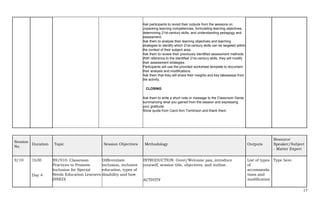
INTRODUCTION: Greet/Welcome pax, introduce
yourself, session title, objectives, and outline.
ACTIVITY
List of types
of
accommoda
tions and
modification
Type here.
18
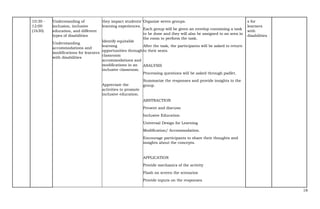
10:30 -
12:00
(1h30)
Understanding of
inclusion, inclusive
education, and different
types of disabilities
Understanding
accommodations and
modifications for learners
with disabilities
they impact students’
learning experiences.
Identify equitable
learning
opportunities through
classroom
accommodations and
modifications in an
inclusive classroom.
Appreciate the
activities to promote
inclusive education.
Organize seven groups.
Each group will be given an envelop containing a task
to be done and they will also be assigned to an area in
the room to perform the task.
After the task, the participants will be asked to return
to their seats.
ANALYSIS
Processing questions will be asked through padlet.
Summarize the responses and provide insights to the
group.
ABSTRACTION
Present and discuss:
Inclusive Education
Universal Design for Learning
Modification/ Accommodation.
Encourage participants to share their thoughts and
insights about the concepts.
APPLICATION
Provide mechanics of the activity
Flash on screen the scenarios
Provide inputs on the responses
s for
learners
with
disabilities
19
CLOSING
Provide a synthesis of the session
Flash on screen the quote, “Inclusion is not just about
changing the education system: It’s about changing
attitudes, attitudes, values, teaching strategies and
perceptions towards diversity.”
Session
No.
Duration Topic Session Objectives Methodology Outputs
Resource
Speaker/Subject-
Matter Expert
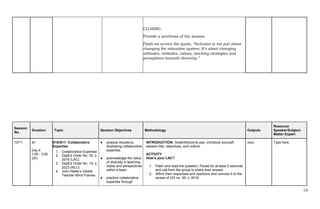
10/11 2h
Day 4
1:00 - 3:00
(2h)
S10/S11: Collaborative
Expertise
1. Collaborative Expertise
2. DepEd Order No. 35, s.
2016 (LAC)
3. DepEd Order No. 14, s.
2023 (NLC)
4. John Hattie’s Visible
Teacher Mind Frames
● analyze situations
illustrating collaborative
expertise.
● acknowledge the value
of diversity in teaching
styles and perspectives
within a team.
● practice collaborative
expertise through
INTRODUCTION: Greet/Welcome pax, introduce yourself,
session title, objectives, and outline.
ACTIVITY
How’s your LAC?
1. Flash and read the question. Pause for at least 5 seconds
and call from the group to share their answer.
2. Affirm their responses and reactions and connect it to the
review of DO no. 35, s. 2016
xxxx Type here.
20
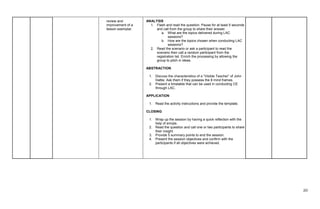
review and
improvement of a
lesson exemplar.
ANALYSIS
1. Flash and read the question. Pause for at least 5 seconds
and call from the group to share their answer.
a. What are the topics delivered during LAC
sessions?
b. How are the topics chosen when conducting LAC
sessions?
2. Read the scenario or ask a participant to read the
scenario then call a random participant from the
registration list. Enrich the processing by allowing the
group to pitch in ideas.
ABSTRACTION
1. Discuss the characteristics of a “Visible Teacher” of John
Hattie. Ask them if they possess the 8 mind frames.
2. Present a timetable that can be used in conducting CE
through LAC.
APPLICATION
1. Read the activity instructions and provide the template.
CLOSING
1. Wrap up the session by having a quick reflection with the
help of emojis.
2. Read the question and call one or two participants to share
their insight.
3. Provide 5 summary points to end the session.
4. Present the session objectives and confirm with the
participants if all objectives were achieved.
21
Session
No.
Duration Topic Session Objectives Methodology Outputs
Resource
Speaker/Subject-
Matter Expert
11/12 1h45
Day 4
3:15 - 5:00
(1h45)
S11/S12: Class Observation
in the Context of MATATAG
Curriculum
1. Classroom Observation
2. Classroom Observable
Indicators
● Revisit the nature of
classroom
observation, its
protocols, tools and
key players;
● Review some of the
classroom observable
indicators relative to
the implementation of
MATATAG
Curriculum; and
 Refine the prepared
lesson plan based on
the indicators
presented leading to
demonstration
teaching.
INTRODUCTION: Greet/Welcome pax, introduce yourself,
session title, objectives, and outline.
ACTIVITY
1. Read instructions
2. Encourage participants to share their experiences
ANALYSIS
1. Synthesize participant’s experiences to the literature on
classroom observation.
ABSTRACTION
1. Present and discuss the important points of classroom
observation
2. Present sample indicators observed during classroom
observation.
3. Review prepared lesson plans or exemplars and identify
which indicators are present.
4. After each presentation and processing of sample
indicators,
APPLICATION
1. Discuss the demonstration teaching mechanics
2. Provide adequate time for final preparation and actual
conduct of the demonstration teaching.
CLOSING
1. Show references used in the discussion
2. Close with the statement, “mananatili tayong MATATAG,
maraming salamat po!”
Demonstration
Teaching
Type here.
Session
No.
Duration Topic Session Objectives Methodology Outputs
Resource
Speaker/Subject-
Matter Expert
22
12/13 1h30
Day 5
8:30-10:00
(1h30)
S12/S13: Management of
School-based Professional
Development Programs
1. Roles and
Responsibilities of
School Heads in the
Management of
School-based
Professional
Development
Programs
2. Effect Size and Why
Does It Matter
3. Learners’ Overall
Performance in the
NATG10 and
NATG12
4. Whole-School
Approach
5. School-Based PD
Programs
● INSET
● LAC
● TPDC
Framework
6. Implementation
Strategies for the
Conduct of School-
Based Training on the
MATATAG
Curriculum
7. Work Application Plan
(WAP)
● discuss the significant
roles of school leaders
in leading and
managing School-
Based Professional
Development Programs
to improve teacher
practice;
● integrate the concept
and elements of the
whole-school approach
to curriculum planning
and its link to teachers’
ongoing professional
learning, articulating the
effect size and its
impact on learning
outcomes;
● discuss the
Implementation
Strategies for the
Conduct of School-
Based Training on the
MATATAG Curriculum;
● develop a WAP
capturing the general
concepts of MATATAG
Curriculum articulating
a doable school-based
professional
development plan for
teachers on the
MATATAG Curriculum;
and
● display willingness to
implement the WAP to
improve learning
outcomes.
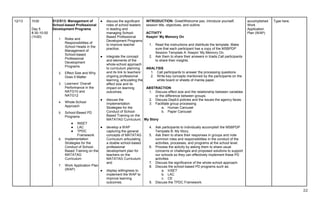
INTRODUCTION: Greet/Welcome pax, introduce yourself,
session title, objectives, and outline.
ACTIVITY
Keepin’ My Memory On
1. Read the instructions and distribute the template. Make
sure that each participant has a copy of the MSBPDP
Session Template A: Keepin’ My Memory On.
2. Ask them to share their answers in triads.Call participants
to share their insights.
ANALYSIS
1. Call participants to answer the processing questions.
2. Write key concepts mentioned by the participants on the
white board or sheets of manila paper.
ABSTRACTION
1. Discuss effect size and the relationship between variables
or the difference between groups.
2. Discuss DepEd policies and the issues the agency faces.
3. Facilitate group processing
a. Human Carousel
b. Paper Carousel
My Story
4. Ask participants to individually accomplish the MSBPDP
Template B: My Story.
5. Ask them to share their responses in groups and note
common roles and responsibilities in the conduct of the
activities, processes, and programs at the school level.
6. Process the activity by asking them to share usual
concerns or challenges and proposed solutions to support
our schools so they can effectively implement these PD
activities
7. Discuss the significance of the whole-school approach
8. Discuss the school-based PD programs such as:
a. InSET
b. LAC
c. CE
9. Discuss the TPDC Framework.
accomplished
Work
Application
Plan (WAP)
Type here.
23
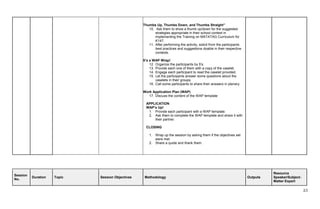
Thumbs Up, Thumbs Down, and Thumbs Straight”
10. Ask them to show a thumb up/down for the suggested
strategies appropriate in their school context in
implementing the Training on MATATAG Curriculum for
K147.
11. After performing the activity, solicit from the participants
best practices and suggestions doable in their respective
contexts.
It’s a WAP Wrap!
12. Organize the participants by 5's.
13. Provide each one of them with a copy of the caselet.
14. Engage each participant to read the caselet provided.
15. Let the participants answer some questions about the
caselets in their groups.
16. Call some participants to share their answers in plenary.
Work Application Plan (WAP)
17. Discuss the content of the WAP template
APPLICATION
WAP’s Up!
1. Provide each participant with a WAP template.
2. Ask them to complete the WAP template and share it with
their partner.
CLOSING
1. Wrap up the session by asking them if the objectives set
were met.
2. Share a quote and thank them.
Session
No.
Duration Topic Session Objectives Methodology Outputs
Resource
Speaker/Subject-
Matter Expert
24
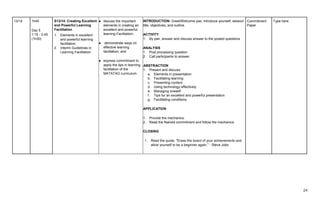
13/14 1h45
Day 5
1:15 - 2:45
(1h30)
S13/14: Creating Excellent
and Powerful Learning
Facilitation
1. Elements in excellent
and powerful learning
facilitation
2. Interim Guidelines in
Learning Facilitation
● discuss the important
elements in creating an
excellent and powerful
learning Facilitation;
● demonstrate ways on
effective learning
facilitation; and
● express commitment to
apply the tips in learning
facilitation of the
MATATAG curriculum.
INTRODUCTION: Greet/Welcome pax, introduce yourself, session
title, objectives, and outline.
ACTIVITY
1. By pair, answer and discuss answer to the posted questions
ANALYSIS
1. Post processing question.
2. Call participants to answer.
ABSTRACTION
1. Present and discuss:
a. Elements in presentation
b. Facilitating learning
c. Presenting content
d. Using technology effectively
e. Managing oneself
f. Tips for an excellent and powerful presentation
g. Facilitating conditions
APPLICATION
1. Provide the mechanics.
2. Read the flashed commitment and follow the mechanics
CLOSING
1. Read the quote, “Erase the board of your achievements and
allow yourself to be a beginner again.” - Steve Jobs
Commitment
Paper
Type here.
25
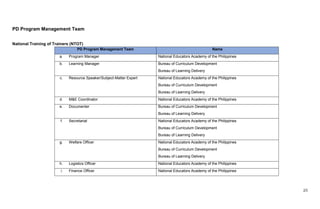
PD Program Management Team
National Training of Trainers (NTOT)
PD Program Management Team Name
a. Program Manager National Educators Academy of the Philippines
b. Learning Manager Bureau of Curriculum Development
Bureau of Learning Delivery
c. Resource Speaker/Subject-Matter Expert National Educators Academy of the Philippines
Bureau of Curriculum Development
Bureau of Learning Delivery
d. M&E Coordinator National Educators Academy of the Philippines
e. Documenter Bureau of Curriculum Development
Bureau of Learning Delivery
f. Secretariat National Educators Academy of the Philippines
Bureau of Curriculum Development
Bureau of Learning Delivery
g. Welfare Officer National Educators Academy of the Philippines
Bureau of Curriculum Development
Bureau of Learning Delivery
h. Logistics Officer National Educators Academy of the Philippines
i. Finance Officer National Educators Academy of the Philippines
26
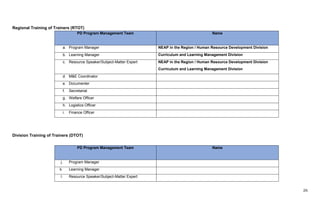
Regional Training of Trainers (RTOT)
PD Program Management Team Name
a. Program Manager NEAP in the Region / Human Resource Development Division
b. Learning Manager Curriculum and Learning Management Division
c. Resource Speaker/Subject-Matter Expert NEAP in the Region / Human Resource Development Division
Curriculum and Learning Management Division
d. M&E Coordinator
e. Documenter
f. Secretariat
g. Welfare Officer
h. Logistics Officer
i. Finance Officer
Division Training of Trainers (DTOT)
PD Program Management Team Name
j. Program Manager
k. Learning Manager
l. Resource Speaker/Subject-Matter Expert
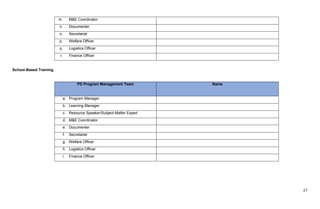
27
m. M&E Coordinator
n. Documenter
o. Secretariat
p. Welfare Officer
q. Logistics Officer
r. Finance Officer
School-Based Training
PD Program Management Team Name
a. Program Manager
b. Learning Manager
c. Resource Speaker/Subject-Matter Expert
d. M&E Coordinator
e. Documenter
f. Secretariat
g. Welfare Officer
h. Logistics Officer
i. Finance Officer
(Enclosure No. 4 to DepEd Memorandum No. 044, s. 2023)
Republic of the Philippines
Department of Education
National Educators Academy of the Philippines
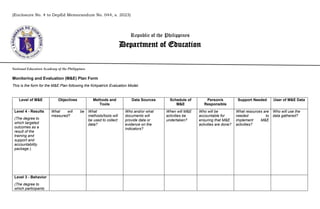
Monitoring and Evaluation (M&E) Plan Form
This is the form for the M&E Plan following the Kirkpatrick Evaluation Model.
Level of M&E Objectives Methods and
Tools
Data Sources Schedule of
M&E
Person/s
Responsible
Support Needed User of M&E Data
Level 4 - Results
(The degree to
which targeted
outcomes as a
result of the
training and
support and
accountability
package.)
What will be
measured?
What
methods/tools will
be used to collect
data?
Who and/or what
documents will
provide data or
evidence on the
indicators?
When will M&E
activities be
undertaken?
Who will be
accountable for
ensuring that M&E
activities are done?
What resources are
needed to
implement M&E
activities?
Who will use the
data gathered?
Level 3 - Behavior
(The degree to
which participants
2
apply what they
learned during
training when they
are back on the
job. This can be
found in the
application
objective.)
Level 2 - Learning
(The degree to
which participants
acquire the
intended
knowledge, skills,
attitude,
confidence, and
commitment based
on their
participation in the
training.)
Level 1 – Reaction
(The degree to
which participants
find the training
favorable,
engaging, and
relevant to their
jobs.)
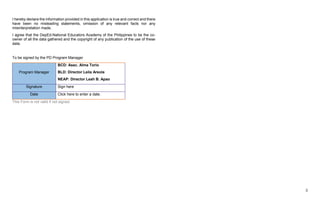
Declaration:
3
I hereby declare the information provided in this application is true and correct and there
have been no misleading statements, omission of any relevant facts nor any
misinterpretation made.
I agree that the DepEd-National Educators Academy of the Philippines to be the co-
owner of all the data gathered and the copyright of any publication of the use of these
data.
To be signed by the PD Program Manager
Program Manager
BCD: Asec. Alma Torio
BLD: Director Leila Areola
NEAP: Director Leah B. Apao
Signature Sign here
Date Click here to enter a date.
This Form is not valid if not signed.

Parent PD Design for Professional Development .docx

  • 1.
    (Enclosure No. 4to DepEd Memorandum No. 044, s. 2023) Republic of the Philippines Department of Education National Educators Academy of the Philippines Detailed Professional Development Program Design Form INSTRUCTIONS: Provide the details in the designated spaces as required. Indicate N/A if not applicable. DO NOT ABBREVIATE. PROFESSIONAL DEVELOPMENT (PD) PROGRAM PROVIDER PROFILE PD Program Owner Bureau of Curriculum Development (BCD), Bureau of Learning Delivery (BLD), and National Educators Academy of the Philippines (NEAP) Complete Office Address Mabini and Bonifacio Bldgs., DepED Complex, Meralco Avenue, Pasig City Office Telephone No. BCD: (08)-633-5429 BLD: (08)-633-7258 NEAP: (08)-638-638 Office Email Address BCD: oasctct@deped.gov.ph BLD: bld.od@deped.gov.ph NEAP: neap.od@deped.gov.ph PD Program Manager BCD: Asec. Alma Torio BLD: Director Leila Areola NEAP: Director Leah B. Apao Email Address BCD: alma.torio@deped.gov.ph BLD: leila.areola@deped.gov.ph NEAP:leah.apao@deped.gov.ph Mobile No. BCD: BLD: NEAP:
  • 2.
    2 PD PROGRAM PROFILE TitleTraining on the MATATAG Curriculum for Kindergarten, Grades 1, 4, and 7 (K147) School Leaders and Teachers Rationale Republic Act No. 10533 or the “The Enhanced K to 12 Basic Education Program” is a significant educational reform in the country that presented ways to improve the delivery of Philippine basic education. Its primary goal was to equip Filipino learners with the necessary skills and competence to prepare them to take on the challenges of the 21st century. K-12 geared towards the basic education system in the Philippines to be at par with international standards by ensuring that it was appropriate, responsive, and relevant to the learners and to national and global realities (DepEd, 2019). The implementation of the K to 12 Program revealed no improvement on academic performance of Filipino learners as gleaned in the standardized national and international assessment (Schleicher, 2018; Mullis, Martin, Foy, Kelly, & Fishbein, 2020; UNICEF (United Nations Children Fund) & SEAMEO, 2020). To address this “learning poverty”, the Department of Education (DepEd) pursued its education reform MATATAG agenda which sets the new direction of the agency in resolving basic education challenges. It spells out four critical components: MAke the curriculum relevant to produce competent and job-ready, active, and responsible citizens; TAke steps to accelerate delivery of basic education facilities and services; TAke good care of learners by promoting learner well-being, inclusive education, and a positive learning environment; and Give support to teachers to teach better. DepEd recently launched the MATATAG curriculum to address challenges faced by the current K to 12 curriculum such as congested content, misplaced prerequisite learning competencies, and cognitive demand imbalance. MATATAG Curriculum also puts premium on foundational skills, embedding peace competencies, and strengthening inclusive education programs. With this, it is imperative that the teachers and school leaders have an in-depth and consistent understanding of the revised curriculum and be equipped with the knowledge, skills, attitudes, and values, anchored on Philippine professional standards for teachers, school heads, and supervisors, necessary to effectively implement and support the curriculum. Furthermore, for teachers to be effective and efficient in implementing the curriculum, school leaders, i.e. officials in the public school system who perform managerial and supervisory roles in their respective levels of governance, such as head teachers, department heads, principals and assistant principals, schools district supervisors, education program supervisors and chief education supervisors at the schools division and regional offices, schools division superintendents, regional directors and assistant regional directors, and their equivalent positions in the private school system as defined under RA No. 11713, must step up to effectively provide purposive instructional supervision. Instructional Supervision is a professional continuous and cooperative process for the improvement of instruction (Basic Education Sector Reform Agenda Teacher Education and Development – TWG). Finally, all the initiatives related with the MATATAG agenda are congruent with DepEd Order No. 24, s. 2022 or the Adoption of the Basic Education Development Plan 2030 (BEDP 2030) that outlines the priorities of the department in addressing the immediate and long-term concerns confronting basic education: access, equity, quality, and resiliency. Quality is designed to address the quality of education through various strategic means such as upskilling and reskilling of teachers and school leaders. Training teachers and school leaders on the MATATAG curriculum is essential to enhance their
  • 3.
    3 readiness, competency, andunderstanding, ultimately benefiting the students’ learning experience. Program Description The Training on MATATAG Curriculum for teachers and school leaders shall be delivered at various governance levels including National Core Trainer Orientation (ONCT), National Training of School Leaders (NTSL), Regional Training of School Leaders (RTSL), Division Training of School Leaders (DTSL), and School-Based Management Training Program (SBMTP). The ONCT is implemented by a team of experienced educators and experts in curriculum development, learning delivery, and assessment, particularly for Kindergarten, Grade 1, Grade 4, and Grade 7. They are responsible for providing the necessary training and guidance to the core trainers who will disseminate the curriculum and appropriate pedagogical approaches to educators nationwide. This team ensures that the core trainers have a thorough understanding of the curriculum and are equipped with the knowledge and skills to effectively implement training in their respective regions, school divisions, and schools. The NTSLs shall be conducted by the National Core of Trainers. The Regional Team of Trainer-School Leaders shall be participated by Regional CLMD, HRDD, QAD, Division CID and SGOD chiefs, Regional and Division Education Program Supervisors, Public Schools District Supervisors, NEAP-R Focal and Specialists, SGOD HRD and Specialists, Division M&E SEPS and EPS II. The NTSLs builds the capability of school leaders, equipping them with the necessary skills and knowledge aligned with the overarching educational priorities and goals set by the MATATAG Curriculum, likewise, it also aims to provide school leaders across regions and divisions during the Regional Training of School Leaders and Division Training of School Leaders. The training rollout of the MATATAG Curriculum using the SBMTP to be implemented by the school heads is more effective, efficient, and responsive to the needs of teachers. Through their quality leadership and management, the Department of Education (DepEd) will upskill and reskill quality teachers and “holistic learners who are steeped in values, equipped with 21st-century skills, and able to propel the country to development and progress” (DepEd Order No. 42, s. 2017). This is consonant with the DepEd’s vision of producing “Filipinos who passionately love their country and whose values and competencies enable them to realize their full potential and contribute meaningfully to building the nation” (DO No. 36, s. 2013) along with the MATATAG Agenda. By conducting national training on the MATATAG curriculum according to the levels of governance, school leaders and the education system can foster effective leadership, encourage collaboration and networking, and ensure that school leaders are competent to enable the teachers to move forward to bring about positive change and eventually improve learning outcomes. PROGRAM OBJECTIVES Results Objective Ensure improved student learning through effective implementation of the Curriculum by teachers, master teachers, and school leaders (school heads, SEPSs, PSDSs, Chiefs)
  • 4.
    4 Application Objectives Back in theworkplace, Chief EPSs will be able to: ● implement their Workplace Application Plan (WAP) as PMT member and/or resource persons in the succeeding trainings ● provide instructional supervision in the implementation of the MATATAG Curriculum PSDSs and EPSs will be able to: ● implement their Workplace Application Plan (WAP) as PMT member and/or resource persons in the succeeding trainings ● provide instructional supervision in the implementation of the MATATAG Curriculum School heads will be able to: ● implement their Workplace Application Plan (WAP) as PMT member and/or resource persons in the succeeding trainings ● provide instructional supervision in the implementation of the MATATAG Curriculum Master teachers will be able to: ● implement their Workplace Application Plan (WAP) through facilitation of MATATAG-aligned teaching and learning sessions, and participation in various collaborative learning sessions Teachers will be able to: ● implement their respective Workplace Application Plan (WAP) articulating their required competencies to be developed and/or enhanced using school LACs through Collaborative Expertise (CE) aligned with the PPST. Terminal objectives By the end of the five-day PD program, Chief EPSs will be able to: ● develop an instructional supervisory plan for supervisors on the implementation of the MATATAG Curriculum EPSs/PSDSs will be able to: ● develop an instructional supervisory plan for school heads on the implementation of the MATATAG Curriculum School heads will be able to: ● develop a school-based MATATAG curriculum training implementation plan ● develop an instructional supervisory plan for teachers on the implementation of the MATATAG Curriculum
  • 5.
    5 Master teachers willbe able: ● develop a lesson plan and instructional supervisory plan that show understanding of the connections among instructional elements (standards, instruction, assessment, and evaluation and feedback) of the MATATAG curriculum Teachers will be able: ● develop a lesson plan that shows understanding of the connections among instructional elements (standards, instruction, assessment, and evaluation and feedback) of the MATATAG curriculum Enabling objectives Specifically, the participants [teachers, master teachers, school leaders (Chiefs, EPSs, PSDSDs, and School Heads) will be able to: 1. identify the overall structure and salient features of the general shaping paper and learning area curriculum guide 2. demonstrate knowledge and skills on unpacking/merging/clustering competencies per grade level and learning area. 3. discuss the key principles of the Matatag Curriculum Instructional Design Framework 4. design a classroom-based assessment tool for an identified learning competency within the MATATAG Curriculum, ensuring alignment with instructional objectives and diverse assessment methods. 5. integrate 21st century skills, inclusion principles and brain-based learning theories in teaching and learning processes 6. apply pedagogical approaches and assessment per learning area for effective lesson planning 7. develop a lesson plan for Q1 and Q2 of the MATATAG Curriculum for demonstration teaching 8. simulate collaborative learning expertise 9. facilitate and give feedback to a teaching-learning session using the co-developed lesson plan 10. exhibit positive /inclusive attitude towards the implementation of the MATATAG curriculum 11. discuss the key steps and strategies in organizing and managing school-based training programs. 12. discuss the principles for an effective learning session facilitation TARGET PARTICIPANTS Total number of target participants: Number of batches per implementation (if applicable):
  • 6.
    6 Batch 1 Batch2 Batch 3 Batch 4 Batch 5 Batch 6 Participants’ Profile Chief EPS, PSDS, EPS, SH, MT, T Chief EPS, PSDS, EPS, SH, MT, T Chief EPS, PSDS, EPS, SH, MT, T Number of participants per batch: Delivery Modality Indicative Dates of Implementation Number of implementations: TARGET PROFESSIONAL STANDARDS PPST Targets Philippine Professional Standards for Teachers Domain Strand Indicator Domain 1: Content knowledge and Pedagogy 1.1. Content knowledge and its application within and across curriculum areas 1.1.2. Apply knowledge of content within and across curriculum areas 1.1.3. Model effective applications of content knowledge within and across curriculum areas 1.2 Research-based knowledge and principles 1.2.2 Use research-based knowledge and principles of teaching and learning to enhance professional practice. MT:1.2.3 Collaborate with colleagues in the conduct and application of research to enrich knowledge of content and pedagogy 1.5. Strategies for developing critical and creative thinking 1.5.2 Apply a range of teaching strategies to develop critical and creative thinking, as well as other higher-order thinking skills. MT:1.5.3 Develop and apply effective teaching strategies to promote critical and creative thinking, as well as other higher-order thinking skills. Domain 3. Diversity of Learners 3.3. Learners with disabilities, giftedness and talents 3.3.2. Design, adapt and implement teaching strategies that are responsive to learners with disabilities, giftedness and talents.
  • 7.
    7 Domain 4. Curriculum and Planning 4.1.Planning and management of teaching and learning process 4.1.2 Plan, manage and implement developmentally sequenced teaching and learning process to meet curriculum requirements and varied teaching contexts. MT:4.1.3 Develop and apply effective strategies in the planning and management of developmentally sequenced teaching and learning processes to meet curriculum requirements and varied teaching contexts. 4.2. Learning outcomes aligned with learning competencies; 4.2.2 Set achievable and appropriate learning outcomes that are aligned with learning competencies. MT:4.2.3 Model to colleagues the setting of achievable and challenging learning outcomes that are aligned with learning competencies to cultivate a culture of excellence for all learners. 4.5 Teaching and learning resources including 4.5.2 Select, develop, organize and use appropriate teaching and learning resources, including ICT, to address learning goals. MT: 4.5.3 Advise and guide colleagues in the selection, organization, development and use of appropriate teaching and learning resources, including ICT, to address specific learning goals) Domain 5: Assessment and Reporting 5.1. Design, selection, organization and utilization of assessment strategies 5.1.3. Work collaboratively with colleagues to review the design, selection, organization and use of a range of effective diagnostic, formative and summative assessment strategies consistent with curriculum requirements. 5.2. Monitoring and evaluation of learner progress and achievement 5.2.2. Monitor and evaluate learner progress and achievement using learner attainment data 5.2.3. Interpret collaboratively monitoring and evaluation strategies of attainment data to support learner progress and achievement 5.4 Strand Communication 5.4.2. Communicate effectively in speaking and in writing to teachers, learners, parents, and other stakeholders through positive use of communication platforms, to facilitate information sharing, collaboration, and support. Domain 7. Personal Growth and Professional Development 7.3 Professional links with colleagues 7.3.3 Contribute actively to professional networks within and between schools to improve knowledge and enhance practice 7.5 Professional development goals 7.5.3 Reflect on the Philippine Professional Standards for Teachers to plan personal professional development goals and assist colleagues in planning and achieving their own goals. TARGET PROFESSIONAL STANDARDS PPSSH Targets Philippine Professional Domain Strand Indicator Domain 1. Leading Strategically 1.5. Program Design and Implementation 1.5.2 Implement programs in the school that support the development of learners 1.7 Monitoring and Evaluation process and tools 1.7.2 Utilize available monitoring and evaluation processes and tools to promote learner achievement.
  • 8.
    8 Standards for School Heads 1.7.3Design supplemental monitoring and evaluation tools following standard processes to promote earner achievement. Domain 3. Focusing on Teaching and Learning 3.2. Teaching standards and pedagogies 3.2.2 Provide technical assistance to teachers on teaching standards and pedagogies within and across learning areas to improve their teaching practice. 3.2.3 Engage school personnel such as master teachers, head teachers, department heads in providing technical assistance to teachers on teaching standards and pedagogies within and across learning areas to improve their teaching practice. 3.5 Learning Assessment 3.5.2 Provide technical assistance to teachers in using learning assessment tools, strategies, and results consistent with curriculum requirements to ensure accountability in achieving higher learning outcomes. Domain 4: Developing Self and Others 4.1 Personal and Professional development 4.1.2 Set personal and professional development goals based on self-assessment aligned with the Philippine Professional Standards for School Heads. 4.3 Professional networks 4.3.2 Participate in professional networks to upgrade knowledge and skills to enhance practice. 4.3.3. Engage actively in professional networks within and across schools to advance knowledge, skills, and practice. Domain 5. Building Connections Strand 5.3 Inclusive practice 5.3.1 Demonstrate knowledge and understanding of inclusive practices, such as gender sensitivity, physical and mental health awareness, and culture responsiveness to foster awareness, acceptance, and respect. TARGET PROFESSIONAL STANDARDS PPSS Targets Philippine Professional Standards for Supervisors Domain Strand Indicator Domain 1. Supporting to Curriculum Management and Implementation 1.1 Curriculum Implementation 1.1.2 Support curriculum implementation through the management of programs, projects and activities aligned with curriculum standards. 1.5 Learning Resource Management 1.5.2 Apply relevant processes to support learning resource management in divisions/districts, schools/or learning centers Domain 2: Strengthening Shared Accountability 2.2 Technical Assistance Provision 2.2.2 Adopt and implement appropriate technical assistance modalities to divisions/districts/schools and/or learning centers based on quality assurance and evaluation results. 2.2.3 Mentor and coach colleagues in providing efficient and effective technical assistance to a targeted cluster of divisions/districts/schools and/or learning centers based on quality assurance, and monitoring and evaluation results. Domain 3: Fostering a Culture of Continuous Improvement Strand 3.1 Support for Instructional Leadership 3.1.2 Apply appropriate instructional leadership support strategies to help divisions/districts/schools and/or learning centers with the continuous improvement of the teaching-learning process. 3.1.3 Mentor and coach colleagues in adapting relevant instructional leadership support strategies to address the harmonized needs of clusters of divisions/districts/schools and/or learning centers. Domain 4: Developing Self and Others Strand 4.1 Learning and Development 4.1.2 Ensure the delivery of different learning and development interventions to support divisions/districts/schools and/or learning centers.
  • 9.
    9 Strand 4.2 ProfessionalNetworks 4.2.2 Participate actively in professional networks to enhance knowledge and skills in improving practice. 4.3 Personal and Professional Development 4.3.2 Set achievable personal and professional development goals based on the Philippine Professional Standards for Supervisors. Session No. Duration Topic Session Objectives Methodology Outputs Resource Speaker/Subject- Matter Expert 8:00-9:00 Registration & Pretest 9:00-9:45 Opening Program 1 1 hour Day 1 10:00-11:00 S1: The General Shape of the MATATAG Curriculum 1. Context of the MATATAG Curriculum, 2. Curriculum Review Process and Factors which guided the revision 3. Salient Features of the MATATAG Curriculum 4. Ways Forward and Aspirations ● understand the context of the MATATAG K to 10 Program ● describe the curriculum revision process and factors which guided the revisions ● identify the salient features of the MATATAG Curriculum ● reflect on the aspirations and ways forward of the MATATAG Curriculum INTRODUCTION: Greet/Welcome pax, introduce yourself, session title, objectives, and outline. ACTIVITY: Hot Air Balloon Retrospective 1. Explain the mechanics of the Hot Air Balloon Retrospective. 2. Using colored metacards, ask the participants to write their answers about the four questions posted on the screen (word or phrase) Orange or yellow: Hot air Blue: sunny skies, Brown: sandbags Gray: dark clouds ANALYSIS 1. To process the activity, raise guide questions to the participants. Ask some participants to share their answers to the plenary. 2. Close the analysis activity by reminding the participants that failure to align instructional practices with curriculum Accomplished Worksheet 1 (Reflection) Type here.
  • 10.
    10 standards can leadto a lack of clarity in educational outcomes such as misalignment of learning objectives and inconsistent classroom practices. ABSTRACTION 1. Play the recorded video which discusses the following contents: a. Context of the MATATAG K to 10 Curriculum b. Curriculum Revision Process c. Factors which Guided the Revision d. Salient Features of the MATATAG Curriculum e. Ways Forward and Aspirations of the MATATAG Curriculum 2. To check the participants’ understanding, the video has been spliced per key content. Elicit answers from the participants on the provided questions. APPLICATION: My Learning Journey 1. In two minutes, ask the participants to write down what they have learned at every stage of the general shape of the MATATAG Curriculum? 2. The participants may opt to share their answers using the online interactive platform PADLET or the printed worksheet. 3. Provide the mechanics in using the PADLET and show the QR Code for the activity. 4. After 2 minutes, present the PADLET interface then read the live responses of the participants. CLOSING 1. Wrap up the session by going back to the Hot Air Balloon Retrospective and relate it to the key contents of the MATATAG Curriculum. 2. Share the quote to the participants about “A good curriculum is not about covering content; it's about creating experiences for students to engage with and make meaning of the content." - Grant Wiggins
  • 11.
    11 Session No. Duration Topic SessionObjectives Methodology Outputs Resource Speaker/Subject- Matter Expert 2 1h30 Day 1 11:00-12:30 S2: 21st Century Skills in the MATATAG Curriculum 1. 21st Century Skills Framework 2. Four (4) Domains in the 21st Century Skills Framework: Information, Media and Technology Skills; Learning and Innovation Skills; Communication Skills and Life and Career Skills 3. Skills, Competencies, Values and Attributes of the Four (4) Domains of 21st Century Skills Framework 4. Implications of teachers and school leaders cognizance to the 21st Century Skills ● classify discipline – specific competencies according to the four (4) domains of 21st Century Skills Framework; ● design assessment /technical assistance/ instructional supervision strategies requiring the integration of the 21st Century Skills; and ● appreciate the need to recognize and determine the integration of 21st Century Skills vis-à- vis the MATATAG Curriculum INTRODUCTION: Greet/Welcome pax, introduce yourself, session title, objectives, and outline. ACTIVITY 1. Ask the participants to go to mentimeter.com and use the code 1934 5597. Using the pictures shown , they will guess the 21st Century Skills mentioned in the MATATAG Curriculum. ANALYSIS 1. Ask how many have/ have not accessed the mentimeter? 2. Call participants to share their experience while accessing mentimeter. 3. Ask whether our students will have the same experience as we had. 4. Emphasize that in today’s fast-paced and changing world, it is becoming increasingly important to have a deeper knowledge of 21st Century Skills. ABSTRACTION 1. Discuss the four (4) Domains which comprise the 21st Century Skills Framework, namely: a. Information, Media, and Technology Skills; b. Learning and Innovation Skills; c. Communication Skills, and d. Life and Career Skills. APPLICATION 1. Present the four (4) domains of the 21st Century Skills with the skills, competencies, values and attributes. 21st Century Assessment/T echnical Assistance/Ins tructional Supervision Strategies vis- à-vis the chosen learning competency Type here.
  • 12.
    12 2. Project aspecific competency taken from the subject- specific Curriculum Guides. 3. Let them determine the domain of the projected competency. 4. Call participants to share their thoughts, learnings, realizations and or insights regarding 21st Century Skills. CLOSING 1. Wrap up the session by presenting key ideas about the topic and by asking them if the objectives set were met. 2. Let them watch a video titled Lessons From Geese Session No. Duration Topic Session Objectives Methodology Outputs Resource Speaker/Subject- Matter Expert Refer to Grade Level-/ Learning Area- specific PD Design 2h15 Day 1 1:30-2:30 (1h) 2:45-4:00 (1h15) Walkthrough of [Learning Area] Shaping Paper ● Explain the Salient Features of the Learning Area Shaping Paper ● Share one’s appreciation on the importance of the Shaping Paper to the teaching and learning process. Refer to Grade Level-/ Learning Area-specific PD Design Accomplished Reflection Paper Type here. Refer to Grade Level-/ Learning Area- specific PD Design 3h15 Day 2 8:30 - 10:00 10:15 - 11:00 Quarter 1 Curriculum Standards and Unpacking/ Clustering of Learning Competencies Refer to Grade Level-/ Learning Area-specific PD Design
  • 13.
    13 Refer to Grade Level-/ Learning Area- specific PD Design 3h15 Day 2 1:00-2:15 2:15- 3:00 3:15-4:45 Quarter 2 Curriculum Standards and Unpacking/Clustering of Learning Competencies Refer to Grade Level-/ Learning Area-specific PD Design Session No. Duration Topic Session Objectives Methodology Outputs Resource Speaker/Subject- Matter Expert 5/6 1h30 Day 3 8:30 - 10:00 (1hr30) S6/S7: MATATAG Curriculum: Instructional Design Framework 1. Understanding the Instructional Design (ID) Framework 2. Understanding how learning happens in the brain 3. Principles, Key Aspects, and Essential Facets of ID 4. Curriculum, Teaching, and Assessment ● define Instructional Design Framework (IDF); ● identify the different components of the Instructional Design Framework (IDF); and ● express appreciation of the importance of Instructional Design as a foundation for designing learning opportunities using the reflective journal. INTRODUCTION: Greet/Welcome pax, introduce yourself, session title, objectives, and outline. ACTIVITY 1. Form 5 groups 2. Provide each group with a copy of the anticipation guide 3. Present the mechanics of the activity ANALYSIS 1. Process the responses of the participants. 2. Allow group discussion to enrich the conversation. ABSTRACTION 1. Present and discuss the: a. Overview and foundations of the instructional design framework b. Fundamental principles directing successful instructional design, 4 C’s c. Key elements for the development of an appropriate teaching and learning process, 4 I’s and 4 E’s d. Significance of the curriculum, Teaching (Pedagogy) and assessment in the IDF Reflective Journal Type here.
  • 14.
    14 e. Adopting reflectivepractices to improve teaching and learning process f. Better understanding of the K to 10 Instructional design as articulated in the reflection paper APPLICATION 1. Ask the participants to complete the reflection journal template. 2. By pairs, the participants will share briefly their reflections. CLOSING 1. Read the quotation shown in the slide. Session No. Duration Topic Session Objectives Methodology Outputs Resource Speaker/Subject- Matter Expert Refer to Grade Level-/ Learning Area- specific PD Design Day 3 2h45 10:15 - 12:00 1:00-2:00 MATATAG (Learning Area) IDF Pedagogy and Assessment Refer to Grade Level-/ Learning Area-specific PD Design Type here. Refer to Grade Level-/ Learning Area- Day 3 2h 2:00 - 3:00 MATATAG (Learning Area) Walkthrough of Learning Resources Refer to Grade Level-/ Learning Area-specific PD Design Type here.
  • 15.
    15 specific PD Design 3:15 - 4:15 Session No. DurationTopic Session Objectives Methodology Outputs Resource Speaker/Subject- Matter Expert 8/9 1h45 Day 4 8:30 - 10:15 (1h45) S8/S9: Integrating 21st Century Skills in Classroom- based Assessment 13. Revisiting the Classroom Assessment (DO 8, s. 2015) 14. Implementing the 21st- Century Skills in Assessment 15. Integrating 21st-Century Skills in Assessment 16. Utilizing the Formative Assessment Instructional Resources ● identify the key principles of effective assessment; ● list down suggested strategies for integrating the 21st century skills in classroom assessment; and ● discuss formative assessment instructional resource (FAIR) integrating 21st century skills in the context of MATATAG curriculum; and ● share a reflection on the key principles and importance of integrating 21st century skills in classroom assessment INTRODUCTION: Greet/Welcome pax, introduce yourself, session title, objectives, and outline. ACTIVITY Classroom Genie 17. Present the Stress Check Slide and tell the participants to look at both dolphins and find more than one or two differences. 18. Instruct the participants to think of one thing about assessing students that they find challenging or confusing and would like the genie's help with? ANALYSIS 19. Ask questions about the activity and gather responses from the participants. 20. Highlight some points that lead to the idea of the session which is the implementation of classroom assessments that seamlessly integrate 21st-century skills. ABSTRACTION 21. Ask participants to raise an item: g. green = true h. red = false 22. Encourage participants to share their understanding of classroom assessment for each item. Reflection Notes through a Short Note or Message Type here.
  • 16.
    16 i. formative andsummative assessment j. interconnected nature of teaching, learning, and assessment k. importance of assessment in enabling teachers to monitor students' progress over time l. self- and peer assessment m. assessment principles i. Alignment with Curriculum ii. Validity iii.Reliability and Consistency iv. Fairness and Inclusivity v.Manageability for Learners and Teachers vi. Variety in Assessment Methods vii. Transparent and Ongoing Assessment Process viii. Effective Use of Feedback 23. Show different samples of PISA items and explore these samples together and reflect on how 21st century skills can be effectively incorporated into the instructional strategies and assessment practices. 24. Discuss DO No. 8, s. 2015: Embracing the Zone of Proximal Development, Glaser's Model vs. Bloom's Taxonomy and their implications for Assessing Developmental Levels. 25. Discuss 21st Century Skills: Anchored on DepEd Vision, and give specific examples and how these are integrated into Classroom Assessment Practice: n. Multi-dimensional Assessments: o. Portfolio Assessments p. Collaborative Assessments q. Real-world Problem Solving r. Holistic Development s. Preparation for Future Challenges t. Learner-Centered Approach u. Continuous Improvement 26. Discuss and display key points about and key steps in using Formative Assessment Instructional Resource (FAIR). 27. Tell them to use this link to access samples of FAIR for each learning area – English, Science, and Mathematics: https://bit.ly/FAIR_Samples APPLICATION
  • 17.
    17 28. Ask participantsto revisit their outputs from the sessions on unpacking learning competencies, formulating learning objectives, determining 21st-century skills, and understanding pedagogy and assessment. 29. Ask them to analyze their learning objectives and teaching strategies to identify which 21st-century skills can be targeted within the context of their subject area. 30. Ask them to review their previously identified assessment methods. With reference to the identified 21st-century skills, they will modify their assessment strategies. 31. Participants will use the provided worksheet template to document their analysis and modifications. 32. Ask them that they will share their insights and key takeaways from the activity. CLOSING 33. Ask them to write a short note or message to the Classroom Genie, summarizing what you gained from the session and expressing your gratitude. 34. Show quote from Carol Ann Tomlinson and thank them. Session No. Duration Topic Session Objectives Methodology Outputs Resource Speaker/Subject - Matter Expert 9/10 1h30 Day 4 S9/S10: Classroom Practices to Promote Inclusion for Special Needs Education Learners (SNED) Differentiate inclusion, inclusive education, types of disability and how INTRODUCTION: Greet/Welcome pax, introduce yourself, session title, objectives, and outline. ACTIVITY List of types of accommoda tions and modification Type here.
  • 18.
    18 10:30 - 12:00 (1h30) Understanding of inclusion,inclusive education, and different types of disabilities Understanding accommodations and modifications for learners with disabilities they impact students’ learning experiences. Identify equitable learning opportunities through classroom accommodations and modifications in an inclusive classroom. Appreciate the activities to promote inclusive education. Organize seven groups. Each group will be given an envelop containing a task to be done and they will also be assigned to an area in the room to perform the task. After the task, the participants will be asked to return to their seats. ANALYSIS Processing questions will be asked through padlet. Summarize the responses and provide insights to the group. ABSTRACTION Present and discuss: Inclusive Education Universal Design for Learning Modification/ Accommodation. Encourage participants to share their thoughts and insights about the concepts. APPLICATION Provide mechanics of the activity Flash on screen the scenarios Provide inputs on the responses s for learners with disabilities
  • 19.
    19 CLOSING Provide a synthesisof the session Flash on screen the quote, “Inclusion is not just about changing the education system: It’s about changing attitudes, attitudes, values, teaching strategies and perceptions towards diversity.” Session No. Duration Topic Session Objectives Methodology Outputs Resource Speaker/Subject- Matter Expert 10/11 2h Day 4 1:00 - 3:00 (2h) S10/S11: Collaborative Expertise 1. Collaborative Expertise 2. DepEd Order No. 35, s. 2016 (LAC) 3. DepEd Order No. 14, s. 2023 (NLC) 4. John Hattie’s Visible Teacher Mind Frames ● analyze situations illustrating collaborative expertise. ● acknowledge the value of diversity in teaching styles and perspectives within a team. ● practice collaborative expertise through INTRODUCTION: Greet/Welcome pax, introduce yourself, session title, objectives, and outline. ACTIVITY How’s your LAC? 1. Flash and read the question. Pause for at least 5 seconds and call from the group to share their answer. 2. Affirm their responses and reactions and connect it to the review of DO no. 35, s. 2016 xxxx Type here.
  • 20.
    20 review and improvement ofa lesson exemplar. ANALYSIS 1. Flash and read the question. Pause for at least 5 seconds and call from the group to share their answer. a. What are the topics delivered during LAC sessions? b. How are the topics chosen when conducting LAC sessions? 2. Read the scenario or ask a participant to read the scenario then call a random participant from the registration list. Enrich the processing by allowing the group to pitch in ideas. ABSTRACTION 1. Discuss the characteristics of a “Visible Teacher” of John Hattie. Ask them if they possess the 8 mind frames. 2. Present a timetable that can be used in conducting CE through LAC. APPLICATION 1. Read the activity instructions and provide the template. CLOSING 1. Wrap up the session by having a quick reflection with the help of emojis. 2. Read the question and call one or two participants to share their insight. 3. Provide 5 summary points to end the session. 4. Present the session objectives and confirm with the participants if all objectives were achieved.
  • 21.
    21 Session No. Duration Topic SessionObjectives Methodology Outputs Resource Speaker/Subject- Matter Expert 11/12 1h45 Day 4 3:15 - 5:00 (1h45) S11/S12: Class Observation in the Context of MATATAG Curriculum 1. Classroom Observation 2. Classroom Observable Indicators ● Revisit the nature of classroom observation, its protocols, tools and key players; ● Review some of the classroom observable indicators relative to the implementation of MATATAG Curriculum; and  Refine the prepared lesson plan based on the indicators presented leading to demonstration teaching. INTRODUCTION: Greet/Welcome pax, introduce yourself, session title, objectives, and outline. ACTIVITY 1. Read instructions 2. Encourage participants to share their experiences ANALYSIS 1. Synthesize participant’s experiences to the literature on classroom observation. ABSTRACTION 1. Present and discuss the important points of classroom observation 2. Present sample indicators observed during classroom observation. 3. Review prepared lesson plans or exemplars and identify which indicators are present. 4. After each presentation and processing of sample indicators, APPLICATION 1. Discuss the demonstration teaching mechanics 2. Provide adequate time for final preparation and actual conduct of the demonstration teaching. CLOSING 1. Show references used in the discussion 2. Close with the statement, “mananatili tayong MATATAG, maraming salamat po!” Demonstration Teaching Type here. Session No. Duration Topic Session Objectives Methodology Outputs Resource Speaker/Subject- Matter Expert
  • 22.
    22 12/13 1h30 Day 5 8:30-10:00 (1h30) S12/S13:Management of School-based Professional Development Programs 1. Roles and Responsibilities of School Heads in the Management of School-based Professional Development Programs 2. Effect Size and Why Does It Matter 3. Learners’ Overall Performance in the NATG10 and NATG12 4. Whole-School Approach 5. School-Based PD Programs ● INSET ● LAC ● TPDC Framework 6. Implementation Strategies for the Conduct of School- Based Training on the MATATAG Curriculum 7. Work Application Plan (WAP) ● discuss the significant roles of school leaders in leading and managing School- Based Professional Development Programs to improve teacher practice; ● integrate the concept and elements of the whole-school approach to curriculum planning and its link to teachers’ ongoing professional learning, articulating the effect size and its impact on learning outcomes; ● discuss the Implementation Strategies for the Conduct of School- Based Training on the MATATAG Curriculum; ● develop a WAP capturing the general concepts of MATATAG Curriculum articulating a doable school-based professional development plan for teachers on the MATATAG Curriculum; and ● display willingness to implement the WAP to improve learning outcomes. INTRODUCTION: Greet/Welcome pax, introduce yourself, session title, objectives, and outline. ACTIVITY Keepin’ My Memory On 1. Read the instructions and distribute the template. Make sure that each participant has a copy of the MSBPDP Session Template A: Keepin’ My Memory On. 2. Ask them to share their answers in triads.Call participants to share their insights. ANALYSIS 1. Call participants to answer the processing questions. 2. Write key concepts mentioned by the participants on the white board or sheets of manila paper. ABSTRACTION 1. Discuss effect size and the relationship between variables or the difference between groups. 2. Discuss DepEd policies and the issues the agency faces. 3. Facilitate group processing a. Human Carousel b. Paper Carousel My Story 4. Ask participants to individually accomplish the MSBPDP Template B: My Story. 5. Ask them to share their responses in groups and note common roles and responsibilities in the conduct of the activities, processes, and programs at the school level. 6. Process the activity by asking them to share usual concerns or challenges and proposed solutions to support our schools so they can effectively implement these PD activities 7. Discuss the significance of the whole-school approach 8. Discuss the school-based PD programs such as: a. InSET b. LAC c. CE 9. Discuss the TPDC Framework. accomplished Work Application Plan (WAP) Type here.
  • 23.
    23 Thumbs Up, ThumbsDown, and Thumbs Straight” 10. Ask them to show a thumb up/down for the suggested strategies appropriate in their school context in implementing the Training on MATATAG Curriculum for K147. 11. After performing the activity, solicit from the participants best practices and suggestions doable in their respective contexts. It’s a WAP Wrap! 12. Organize the participants by 5's. 13. Provide each one of them with a copy of the caselet. 14. Engage each participant to read the caselet provided. 15. Let the participants answer some questions about the caselets in their groups. 16. Call some participants to share their answers in plenary. Work Application Plan (WAP) 17. Discuss the content of the WAP template APPLICATION WAP’s Up! 1. Provide each participant with a WAP template. 2. Ask them to complete the WAP template and share it with their partner. CLOSING 1. Wrap up the session by asking them if the objectives set were met. 2. Share a quote and thank them. Session No. Duration Topic Session Objectives Methodology Outputs Resource Speaker/Subject- Matter Expert
  • 24.
    24 13/14 1h45 Day 5 1:15- 2:45 (1h30) S13/14: Creating Excellent and Powerful Learning Facilitation 1. Elements in excellent and powerful learning facilitation 2. Interim Guidelines in Learning Facilitation ● discuss the important elements in creating an excellent and powerful learning Facilitation; ● demonstrate ways on effective learning facilitation; and ● express commitment to apply the tips in learning facilitation of the MATATAG curriculum. INTRODUCTION: Greet/Welcome pax, introduce yourself, session title, objectives, and outline. ACTIVITY 1. By pair, answer and discuss answer to the posted questions ANALYSIS 1. Post processing question. 2. Call participants to answer. ABSTRACTION 1. Present and discuss: a. Elements in presentation b. Facilitating learning c. Presenting content d. Using technology effectively e. Managing oneself f. Tips for an excellent and powerful presentation g. Facilitating conditions APPLICATION 1. Provide the mechanics. 2. Read the flashed commitment and follow the mechanics CLOSING 1. Read the quote, “Erase the board of your achievements and allow yourself to be a beginner again.” - Steve Jobs Commitment Paper Type here.
  • 25.
    25 PD Program ManagementTeam National Training of Trainers (NTOT) PD Program Management Team Name a. Program Manager National Educators Academy of the Philippines b. Learning Manager Bureau of Curriculum Development Bureau of Learning Delivery c. Resource Speaker/Subject-Matter Expert National Educators Academy of the Philippines Bureau of Curriculum Development Bureau of Learning Delivery d. M&E Coordinator National Educators Academy of the Philippines e. Documenter Bureau of Curriculum Development Bureau of Learning Delivery f. Secretariat National Educators Academy of the Philippines Bureau of Curriculum Development Bureau of Learning Delivery g. Welfare Officer National Educators Academy of the Philippines Bureau of Curriculum Development Bureau of Learning Delivery h. Logistics Officer National Educators Academy of the Philippines i. Finance Officer National Educators Academy of the Philippines
  • 26.
    26 Regional Training ofTrainers (RTOT) PD Program Management Team Name a. Program Manager NEAP in the Region / Human Resource Development Division b. Learning Manager Curriculum and Learning Management Division c. Resource Speaker/Subject-Matter Expert NEAP in the Region / Human Resource Development Division Curriculum and Learning Management Division d. M&E Coordinator e. Documenter f. Secretariat g. Welfare Officer h. Logistics Officer i. Finance Officer Division Training of Trainers (DTOT) PD Program Management Team Name j. Program Manager k. Learning Manager l. Resource Speaker/Subject-Matter Expert
  • 27.
    27 m. M&E Coordinator n.Documenter o. Secretariat p. Welfare Officer q. Logistics Officer r. Finance Officer School-Based Training PD Program Management Team Name a. Program Manager b. Learning Manager c. Resource Speaker/Subject-Matter Expert d. M&E Coordinator e. Documenter f. Secretariat g. Welfare Officer h. Logistics Officer i. Finance Officer
  • 28.
    (Enclosure No. 4to DepEd Memorandum No. 044, s. 2023) Republic of the Philippines Department of Education National Educators Academy of the Philippines Monitoring and Evaluation (M&E) Plan Form This is the form for the M&E Plan following the Kirkpatrick Evaluation Model. Level of M&E Objectives Methods and Tools Data Sources Schedule of M&E Person/s Responsible Support Needed User of M&E Data Level 4 - Results (The degree to which targeted outcomes as a result of the training and support and accountability package.) What will be measured? What methods/tools will be used to collect data? Who and/or what documents will provide data or evidence on the indicators? When will M&E activities be undertaken? Who will be accountable for ensuring that M&E activities are done? What resources are needed to implement M&E activities? Who will use the data gathered? Level 3 - Behavior (The degree to which participants
  • 29.
    2 apply what they learnedduring training when they are back on the job. This can be found in the application objective.) Level 2 - Learning (The degree to which participants acquire the intended knowledge, skills, attitude, confidence, and commitment based on their participation in the training.) Level 1 – Reaction (The degree to which participants find the training favorable, engaging, and relevant to their jobs.) Declaration:
  • 30.
    3 I hereby declarethe information provided in this application is true and correct and there have been no misleading statements, omission of any relevant facts nor any misinterpretation made. I agree that the DepEd-National Educators Academy of the Philippines to be the co- owner of all the data gathered and the copyright of any publication of the use of these data. To be signed by the PD Program Manager Program Manager BCD: Asec. Alma Torio BLD: Director Leila Areola NEAP: Director Leah B. Apao Signature Sign here Date Click here to enter a date. This Form is not valid if not signed.