ASSIGNMENT 
On 
“GLOBAL WARMING” 
Submitted By 
SAMJITHA LS 
Physical Science
INTRODUCTION 
Global warming is defined as an 
increase in the average temperature of the Earth's 
atmosphere, especially a sustained increase great 
enough to cause changes in the global climate. The term 
global warming is synonymous with Enhanced green 
house effect, implying an increase in the amount of 
green house gases in the earth’s atmosphere, leading to 
entrapment of more and more solar radiations, and thus 
increasing the overall temperature of the earth. 
Causes of Global Warming 
Global warming is affecting many parts of the world. 
Due to global warming, the glaciers are melting which 
are causing the rise in the sea level. When the level of 
the sea rises, it causes danger to the people living in the 
low lying areas. So, this cause a big problem for the 
people, plants and animals living on the earth.When the 
level of the sea rises, it covers the plants and causes 
some of them to die. When they die, animals lose their 
main source of food. We, human beings lose our two 
sources of food, plants and animals. It may also force
people to lose their homes. In other words, the whole 
chain will get affected if nothing is done on time to stop 
global warming from spreading its wings. Few of the 
main causes that are contributing their best 
towards global warming are, 
 Pollution : 
Pollution whether it is vehicular, electrical or industrial 
is the main contributor to the global warming. Everyday 
billions of vehicles release various gases into the 
atmosphere. This causes earth to warm up and increase 
its average temperature. Electricity causes pollution in 
many ways. 
Fossil fuels are burnt for example coal is burnt to 
produce electricity. Coal is the major fuel that is burnt 
in these power plants. Coal produces around 1.7 times 
as much carbon dioxide per unit of energy when flamed 
as does natural gas and 1.25 times as much as oil. Over 
75% of the electricity worldwide is produced by 
burning fossil fuels. Many gases are sent into the air 
when fossil fuels are burnt of which main is the carbon 
dioxide gas. 
Industries on the other hand release various gases into 
the water and air. Carbon dioxide, methane, nitrous 
oxides are the major greenhouse gases. Different gases 
have different heat trapping capabilities. Some of them 
trap more heat than carbon dioxide. Methane is much 
more effective then carbon dioxide in entrapping heat in
the atmosphere. By driving cars, using electricity from 
coal fired plants and heating up our homes from natural 
gases, we release carbon dioxide and other heat 
trapping gases in the atmosphere. 
 Deforestation : 
Deforestation is the cutting down of trees and plants to 
make way for any development activity. Carbon dioxide 
is the air that our body lets out when we breathe. Trees 
take in this carbon dioxide and release oxygen that we 
breathe in. With the cutting down of more and more 
trees is leading to greater concentration of carbon 
dioxide in the air. This means that it is very important to 
protect our trees to stop the greenhouse effect, and also 
so we can breathe and live. Deforestation is blamed for 
rise in the greenhouse gases present in the atmosphere 
by cutting or burning them. New development projects, 
requirement of land for homes and factories, 
requirement for wood and also soil erosion are the 
major factors that are causing deforestation, which in 
turn leading to global warming. 
 Landfills : 
When we throw garbage out of our house it goes to 
landfills. Landfills are those big chunks of garbage that 
you must have seen on some expressway, when you go 
out of your city that stink. The garbage is is then used 
by big recycling companies to make some useful 
products out from that garbage.
Most of the time that garbage is burnt which then 
release some toxic gases into the atmosphere. These 
enormous amounts of toxic greenhouse gases when go 
into the atmosphere makes global warming worse. 
 Population : 
Another cause of global warming is population. Since 
Carbon dioxide contributes to global warming, the 
increase in population makes the problem worse 
because we breathe out carbon dioxide. More people 
means more demand for food, more carbon dioxide in 
the atmosphere, more demand for cars, more demand 
for homes and they all in somehow or other lead to 
global warming. 
More demand for food will lead to 
more transportation since movement of goods and 
services is done by transportation sector. More demand 
for cars means more pollution in the air and more traffic 
on the roads which means longer waiting time on the 
traffic lights and will result more burning of fuel. More 
demand for homes means cutting down of trees to make 
way for homes, schools and colleges.
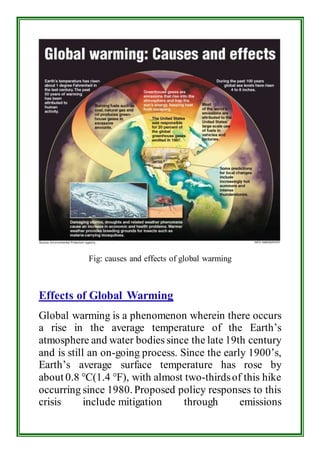
Fig: causes and effects of global warming 
Effects of Global Warming 
Global warming is a phenomenon wherein there occurs 
a rise in the average temperature of the Earth’s 
atmosphere and water bodies since the late 19th century 
and is still an on-going process. Since the early 1900’s, 
Earth’s average surface temperature has rose by 
about 0.8 °C(1.4 °F), with almost two-thirds of this hike 
occurring since 1980. Proposed policy responses to this 
crisis include mitigation through emissions
reduction, adaptation to its effects etc. Most of the 
countries in the world are members of the United 
Nations Framework Convention on Climate 
Change(UNFCCC) whose sole objective is to prevent 
dangerous anthropocentric i.e., human-induced climate 
change. All of the party members have taken an oath to 
adopt a range of policies that work around reducing 
greenhouse gas emissions that are the sole reason for an 
increase in global. Currently efforts as of the early 21st 
century that are mainly directed towards reducing 
emissions seem to be quite inadequate to cope up with 
the UNFCCC’s 2 °C target. Here are some of the 
causes for Global Warming, 
 Increase in temperature 
The intense heat waves and rising temperatures are 
becoming more common as greenhouse gases are 
trapped in the atmosphere. Experts state that this will 
become 100 times more likely to occur over the next 4 
decades. The energy from the sun which is responsible 
for the earth’s weather and climate is radiated back into 
space. While this happens the greenhouse gases (water 
vapor, carbon dioxide, and other gases) trap some of the 
outgoing energy and retaining the heat. This process is 
similar to the mechanism of a glass paneled greenhouse. 
The greenhouse effect thus leads to a rise in 
temperature on, and as it becomes stronger, more heat is 
trapped within the planet. Majority of these greenhouse 
gases come from the process of burning fossil fuels in
order to produce energy, deforestation, industrial 
processes etc. 
 Rising sea levels 
Warm surface temperatures cause glaciers, polar ice shelves 
and other ice bodies to completely destabilize and melt. This 
in turn increases the amount of water in the world’s oceans 
thus contributing to a rise in sea levels. This rise especially 
threatens populations located in low-lying coastal areas 
because of their higher vulnerability to flooding. Scientists 
speculate that the melting ice from Greenland and Antarctica 
is capable of rising the sea level to more than 20 feet by 
2100.This is a dangerous situation especially because most of 
the people live in coastal areas there. At the same time, 
nations such as Maldives, is already considering relocation 
and rehabilitation. 
 Extinction 
Warming temperature of water bodies, desertification 
and deforestation can all contribute to the irreversible 
impact on natural habitat and thus threaten 
endangerment and even extinction of plant and animal. 
Eg: the polar bear is considered to be an endangered 
species whose numbers are falling because of their 
inability to adapt to the volatile temperature changes in 
the Polar Regions. Biodiversity is a crucial phenomenon 
for the existence of human beings and a loss of species 
of flora and fauna would threaten the entire planet. 
Around 30 % of plant and animal species alive today 
risk a chance of getting extinct by 2050 if the average 
temperature rises more than 2 – 11 degrees F.
 Effect on plants and animals 
All plants and animals live in regions with extremely specific 
climate and geological conditions, such as temperature and 
rainfall patterns, that enable them to survive and reproduce. 
Any change in the climate of the specific habitat can affect the 
plants and animals that exist there, as well as the overall 
makeup of the environment. Some species respond to warmer 
climatic conditions by migrating to cooler locations. Eg: 
Some North American animals and plants have moved to the 
farther north of the region or to higher elevations to meet their 
requirements. Climate change is also capable of altering the 
life cycles of plants and animals. For Eg: warmer 
temperatures would imply plants would possibly grow and 
bloom earlier in the spring and survive longer into the fall. 
 Effects on human health 
Research states that more than 1, 50,000 people die from 
climate change-related diseases on a yearly basis. Changes in 
weather conditions can lead to health conditions ranging from 
heat-related heart and respiratory problems to malaria 
.Droughts, floods and warmer temperatures combine in order 
to create an apt habitat for insects and creatures such as 
mosquitoes and other disease-carrying agents. Diseases like 
West Nile virus, cholera, Lyme disease and dengue fever 
which were earlier considered to be confined to tropical areas 
are now spreading worldwide due to the globally rising 
temperatures. The ability of mankind to react or adapt to the 
new conditions is completely dependent upon the magnitude 
and speed of it. The outcome of the scenario will also depend 
on our ability to recognize such epidemics early, restrict their 
spread, and effectively provide appropriate treatment so as to 
effectively cure them and to commit adequate resources, time
and energy to prevention and research of other arising and 
upcoming diseases. 
 Storms 
The phenomenon of Global warming is bound to 
increase the degree of severity in terms of storms. 
Warmer temperatures and warmer ocean waters would 
fuel the intensity of these storms thus leading to a high 
number of devastating hurricanes. On observing the 
pattern of storms in the past decade it can be noted that 
the frequency has literally doubled. Along with floods 
comes loss of lives, damage to property, resources etc. 
 Droughts 
A warmer climate owing to global warming will 
eventually lead to diminishing water supplies and 
pathetic agricultural conditions in turn resulting in crop 
failures If these water shortages are persistent it will 
cause a lot of disruptions in global food production by 
affecting agriculture and is thus paving a way for 
situations such as starvation . Research states that the 
drought conditions are said to increase by at least a 
minimum of 66% by 2020. Almost more than 60% of 
Africa by this time will have to live in a country where 
the continent’s agricultural output is going to drastically 
decrease by 50 % 
 Economic collapse 
The results of climate change have a direct relationship 
with a nation’s economy. Natural disasters such as
hurricanes and floods as an effect of the global warming 
process end up becoming a costly affair for the 
government in terms of clean-up costs, property damage 
and rehabilitation costs. Crisis like this in turn result in 
a hike when it comes to food and energy costs. Looking 
at the pace of things, it has been predicted that global 
warming crises could be labelled with a $20 trillion 
price tag by 2100. Many countries run a huge risk on a 
daily basis because the national income is dependent on 
one particular area such as oil, tourism, plantation, etc. 
and can lose everything with the loss of that single 
particular sector. The presence of globalization can thus 
create a domino effect which means that if a country is 
affected , several other countries are bound to get 
affected too even if they might be on the other end of 
the globe. 
 Ecosystem Failure 
An Increase in greenhouse gases can cause drastic and 
irreversible changes both in the upper atmosphere and 
within the planet thus affecting it’s every component 
including land, water, air etc. and the processes that 
occur at all these levels. If not becoming extinct , 
animals and plants move away to non-native habitats 
when the very ecosystems that they were adapted to for 
survival lose its quality or probably even disappear. 
Similarly , humans will also migrate due to changing 
weather conditions thus leading to a high demand for 
limited resources in a particular place. The effects of a 
climate change on physical and biological systems are
already reflecting through cases like depletion of coral 
reefs, migration of vulnerable plants and animals, 
melting glaciers, formation of acidic water etc. 
 War 
Hostilities and conflicts amongst countries are 
constantly on the rise as nations are competent and 
ruthless when it comes to acquiring resources. An 
important example of this is the genocide in the Darfur 
region situated in Sudan or the Somalian war with roots 
in the reduction of its natural resources due to the sole 
reasons of climate change. It is clearly evident that the 
increasing number of wars that commence on the 
foundation of food and water scarcities may lead to 
uncontrollable levels of aggression, security trouble, 
regional instability, panic etc. We should realize that 
there is a direct relationship between a geological 
condition such as global warming and civil unrest. 
Production of weapons, the oil industry etc. Is often 
considered to be the most common reasons for global 
politics.
Global Warming Prevention Measures 
While humankind has the ability to destroy the planet, 
we can also help protect and sustain it. Global warming 
is too massive a problem for one person to solve, but 
you can create positive change by making 
environmentally-conscious personal choices and 
inspiring others to take collective action. 
Change a light : 
Replace regular bulbs with compact fluorescent light 
(CFL) bulbs. They consume less power then ordinary 
bulbs and have longer lifetime. Some countries have 
completely banned the usage of ordinary bulbs and 
force the common public to use CFL bulbs. 
Drive less : 
By driving less you are not only saving fuel but also 
helping in reducing global warming. Also, look out for 
other possibilities, for eg: car pooling. If you have 
colleagues who live in the same area then you can 
combine trips. If you need to go to a local market then 
either walk or go by cycle. Both of them are great form 
of exercise. 
Recycle more : 
Try to use the disposable products into some other 
form. Just don’t throw them away. You can recycle 
almost anything for e.g.: paper, aluminum foils, cans,
newspapers. By recycling you can help in reducing 
landfills. 
Check your tyres : 
When you drive make sure your tyres are inflated 
properly. If not, then obviously they will consume more 
fuel. Keep your engine properly tuned and drive less 
aggressively. Aggressive driving and frequent applying 
of brakes hampers the engine and can lower the mileage 
of your car. 
Use less hot water : 
Buy energy saving geysers and dishwasher for your 
home. Avoid washing clothes in hot water. Just wash 
them in cold or warm water. Avoid taking frequent 
showers and use less hot water. It will help in saving 
energy require to produce that energy. 
Avoid products with lot of packaging : 
Just don’t buy products with lot of packaging. When 
you buy such products you will end up in throwing the 
waste material in the garbage, which then will help in 
filling landfill sites and pollute the environment. Also, 
discourage others from buying such products. 
Adjust your thermostat : 
Geysers consume lot of electricity. Use the thermostat 
to lower down the temperature. The easiest and most
cost effective advice is simply adjusting your 
thermostat up in the summer and down in the winter. 
Turn off electronic devices : 
Turn off electronic devices when you are moving out 
for a couple of days or more. Unnecessary usage of 
electronic appliances will not only save fuel i.e. coal by 
which we get electricity but also increase the lifetime of 
your gadgets. 
Plant a tree : 
Planting trees can help much in reducing global 
warming then any other method. They not only give 
oxygen but also take in carbon dioxide, during the 
process of photosynthesis, which is the main source of 
global warming. 
Spread the awareness : 
Always try your best to educate people about global 
warming and it’s causes and after affects. Tell them 
how they can contribute their part by saving energy that 
will be good for the environment. Gather opportunities 
and establish programs that will help you to share 
information with friends, relatives and neighbours
Conclusion 
Global warming is the slow rise of the temperature of 
Earth. The conclusion is that global warming has been 
happening. Global warming has an effect on the 
weather with increased droughts, tropical cyclone 
activities and earthquakes. It is the major challenge for 
our global society. If we make small changes now in 
the way we live, we can avoid huge changes in the 
future. Scientists, governments and individuals must 
work together to overcome this threat. 
References 
 Climate Change: Observed impacts on Planet Earth by 
Trevor Lecher 
 The Future of Everything: The Science of Prediction by 
David Orrell 
 Internet (google,Wikipedia)

Samjitha1

  • 1.
    ASSIGNMENT On “GLOBALWARMING” Submitted By SAMJITHA LS Physical Science
  • 2.
    INTRODUCTION Global warmingis defined as an increase in the average temperature of the Earth's atmosphere, especially a sustained increase great enough to cause changes in the global climate. The term global warming is synonymous with Enhanced green house effect, implying an increase in the amount of green house gases in the earth’s atmosphere, leading to entrapment of more and more solar radiations, and thus increasing the overall temperature of the earth. Causes of Global Warming Global warming is affecting many parts of the world. Due to global warming, the glaciers are melting which are causing the rise in the sea level. When the level of the sea rises, it causes danger to the people living in the low lying areas. So, this cause a big problem for the people, plants and animals living on the earth.When the level of the sea rises, it covers the plants and causes some of them to die. When they die, animals lose their main source of food. We, human beings lose our two sources of food, plants and animals. It may also force
  • 3.
    people to losetheir homes. In other words, the whole chain will get affected if nothing is done on time to stop global warming from spreading its wings. Few of the main causes that are contributing their best towards global warming are,  Pollution : Pollution whether it is vehicular, electrical or industrial is the main contributor to the global warming. Everyday billions of vehicles release various gases into the atmosphere. This causes earth to warm up and increase its average temperature. Electricity causes pollution in many ways. Fossil fuels are burnt for example coal is burnt to produce electricity. Coal is the major fuel that is burnt in these power plants. Coal produces around 1.7 times as much carbon dioxide per unit of energy when flamed as does natural gas and 1.25 times as much as oil. Over 75% of the electricity worldwide is produced by burning fossil fuels. Many gases are sent into the air when fossil fuels are burnt of which main is the carbon dioxide gas. Industries on the other hand release various gases into the water and air. Carbon dioxide, methane, nitrous oxides are the major greenhouse gases. Different gases have different heat trapping capabilities. Some of them trap more heat than carbon dioxide. Methane is much more effective then carbon dioxide in entrapping heat in
  • 4.
    the atmosphere. Bydriving cars, using electricity from coal fired plants and heating up our homes from natural gases, we release carbon dioxide and other heat trapping gases in the atmosphere.  Deforestation : Deforestation is the cutting down of trees and plants to make way for any development activity. Carbon dioxide is the air that our body lets out when we breathe. Trees take in this carbon dioxide and release oxygen that we breathe in. With the cutting down of more and more trees is leading to greater concentration of carbon dioxide in the air. This means that it is very important to protect our trees to stop the greenhouse effect, and also so we can breathe and live. Deforestation is blamed for rise in the greenhouse gases present in the atmosphere by cutting or burning them. New development projects, requirement of land for homes and factories, requirement for wood and also soil erosion are the major factors that are causing deforestation, which in turn leading to global warming.  Landfills : When we throw garbage out of our house it goes to landfills. Landfills are those big chunks of garbage that you must have seen on some expressway, when you go out of your city that stink. The garbage is is then used by big recycling companies to make some useful products out from that garbage.
  • 5.
    Most of thetime that garbage is burnt which then release some toxic gases into the atmosphere. These enormous amounts of toxic greenhouse gases when go into the atmosphere makes global warming worse.  Population : Another cause of global warming is population. Since Carbon dioxide contributes to global warming, the increase in population makes the problem worse because we breathe out carbon dioxide. More people means more demand for food, more carbon dioxide in the atmosphere, more demand for cars, more demand for homes and they all in somehow or other lead to global warming. More demand for food will lead to more transportation since movement of goods and services is done by transportation sector. More demand for cars means more pollution in the air and more traffic on the roads which means longer waiting time on the traffic lights and will result more burning of fuel. More demand for homes means cutting down of trees to make way for homes, schools and colleges.
  • 6.
    Fig: causes andeffects of global warming Effects of Global Warming Global warming is a phenomenon wherein there occurs a rise in the average temperature of the Earth’s atmosphere and water bodies since the late 19th century and is still an on-going process. Since the early 1900’s, Earth’s average surface temperature has rose by about 0.8 °C(1.4 °F), with almost two-thirds of this hike occurring since 1980. Proposed policy responses to this crisis include mitigation through emissions
  • 7.
    reduction, adaptation toits effects etc. Most of the countries in the world are members of the United Nations Framework Convention on Climate Change(UNFCCC) whose sole objective is to prevent dangerous anthropocentric i.e., human-induced climate change. All of the party members have taken an oath to adopt a range of policies that work around reducing greenhouse gas emissions that are the sole reason for an increase in global. Currently efforts as of the early 21st century that are mainly directed towards reducing emissions seem to be quite inadequate to cope up with the UNFCCC’s 2 °C target. Here are some of the causes for Global Warming,  Increase in temperature The intense heat waves and rising temperatures are becoming more common as greenhouse gases are trapped in the atmosphere. Experts state that this will become 100 times more likely to occur over the next 4 decades. The energy from the sun which is responsible for the earth’s weather and climate is radiated back into space. While this happens the greenhouse gases (water vapor, carbon dioxide, and other gases) trap some of the outgoing energy and retaining the heat. This process is similar to the mechanism of a glass paneled greenhouse. The greenhouse effect thus leads to a rise in temperature on, and as it becomes stronger, more heat is trapped within the planet. Majority of these greenhouse gases come from the process of burning fossil fuels in
  • 8.
    order to produceenergy, deforestation, industrial processes etc.  Rising sea levels Warm surface temperatures cause glaciers, polar ice shelves and other ice bodies to completely destabilize and melt. This in turn increases the amount of water in the world’s oceans thus contributing to a rise in sea levels. This rise especially threatens populations located in low-lying coastal areas because of their higher vulnerability to flooding. Scientists speculate that the melting ice from Greenland and Antarctica is capable of rising the sea level to more than 20 feet by 2100.This is a dangerous situation especially because most of the people live in coastal areas there. At the same time, nations such as Maldives, is already considering relocation and rehabilitation.  Extinction Warming temperature of water bodies, desertification and deforestation can all contribute to the irreversible impact on natural habitat and thus threaten endangerment and even extinction of plant and animal. Eg: the polar bear is considered to be an endangered species whose numbers are falling because of their inability to adapt to the volatile temperature changes in the Polar Regions. Biodiversity is a crucial phenomenon for the existence of human beings and a loss of species of flora and fauna would threaten the entire planet. Around 30 % of plant and animal species alive today risk a chance of getting extinct by 2050 if the average temperature rises more than 2 – 11 degrees F.
  • 9.
     Effect onplants and animals All plants and animals live in regions with extremely specific climate and geological conditions, such as temperature and rainfall patterns, that enable them to survive and reproduce. Any change in the climate of the specific habitat can affect the plants and animals that exist there, as well as the overall makeup of the environment. Some species respond to warmer climatic conditions by migrating to cooler locations. Eg: Some North American animals and plants have moved to the farther north of the region or to higher elevations to meet their requirements. Climate change is also capable of altering the life cycles of plants and animals. For Eg: warmer temperatures would imply plants would possibly grow and bloom earlier in the spring and survive longer into the fall.  Effects on human health Research states that more than 1, 50,000 people die from climate change-related diseases on a yearly basis. Changes in weather conditions can lead to health conditions ranging from heat-related heart and respiratory problems to malaria .Droughts, floods and warmer temperatures combine in order to create an apt habitat for insects and creatures such as mosquitoes and other disease-carrying agents. Diseases like West Nile virus, cholera, Lyme disease and dengue fever which were earlier considered to be confined to tropical areas are now spreading worldwide due to the globally rising temperatures. The ability of mankind to react or adapt to the new conditions is completely dependent upon the magnitude and speed of it. The outcome of the scenario will also depend on our ability to recognize such epidemics early, restrict their spread, and effectively provide appropriate treatment so as to effectively cure them and to commit adequate resources, time
  • 10.
    and energy toprevention and research of other arising and upcoming diseases.  Storms The phenomenon of Global warming is bound to increase the degree of severity in terms of storms. Warmer temperatures and warmer ocean waters would fuel the intensity of these storms thus leading to a high number of devastating hurricanes. On observing the pattern of storms in the past decade it can be noted that the frequency has literally doubled. Along with floods comes loss of lives, damage to property, resources etc.  Droughts A warmer climate owing to global warming will eventually lead to diminishing water supplies and pathetic agricultural conditions in turn resulting in crop failures If these water shortages are persistent it will cause a lot of disruptions in global food production by affecting agriculture and is thus paving a way for situations such as starvation . Research states that the drought conditions are said to increase by at least a minimum of 66% by 2020. Almost more than 60% of Africa by this time will have to live in a country where the continent’s agricultural output is going to drastically decrease by 50 %  Economic collapse The results of climate change have a direct relationship with a nation’s economy. Natural disasters such as
  • 11.
    hurricanes and floodsas an effect of the global warming process end up becoming a costly affair for the government in terms of clean-up costs, property damage and rehabilitation costs. Crisis like this in turn result in a hike when it comes to food and energy costs. Looking at the pace of things, it has been predicted that global warming crises could be labelled with a $20 trillion price tag by 2100. Many countries run a huge risk on a daily basis because the national income is dependent on one particular area such as oil, tourism, plantation, etc. and can lose everything with the loss of that single particular sector. The presence of globalization can thus create a domino effect which means that if a country is affected , several other countries are bound to get affected too even if they might be on the other end of the globe.  Ecosystem Failure An Increase in greenhouse gases can cause drastic and irreversible changes both in the upper atmosphere and within the planet thus affecting it’s every component including land, water, air etc. and the processes that occur at all these levels. If not becoming extinct , animals and plants move away to non-native habitats when the very ecosystems that they were adapted to for survival lose its quality or probably even disappear. Similarly , humans will also migrate due to changing weather conditions thus leading to a high demand for limited resources in a particular place. The effects of a climate change on physical and biological systems are
  • 12.
    already reflecting throughcases like depletion of coral reefs, migration of vulnerable plants and animals, melting glaciers, formation of acidic water etc.  War Hostilities and conflicts amongst countries are constantly on the rise as nations are competent and ruthless when it comes to acquiring resources. An important example of this is the genocide in the Darfur region situated in Sudan or the Somalian war with roots in the reduction of its natural resources due to the sole reasons of climate change. It is clearly evident that the increasing number of wars that commence on the foundation of food and water scarcities may lead to uncontrollable levels of aggression, security trouble, regional instability, panic etc. We should realize that there is a direct relationship between a geological condition such as global warming and civil unrest. Production of weapons, the oil industry etc. Is often considered to be the most common reasons for global politics.
  • 13.
    Global Warming PreventionMeasures While humankind has the ability to destroy the planet, we can also help protect and sustain it. Global warming is too massive a problem for one person to solve, but you can create positive change by making environmentally-conscious personal choices and inspiring others to take collective action. Change a light : Replace regular bulbs with compact fluorescent light (CFL) bulbs. They consume less power then ordinary bulbs and have longer lifetime. Some countries have completely banned the usage of ordinary bulbs and force the common public to use CFL bulbs. Drive less : By driving less you are not only saving fuel but also helping in reducing global warming. Also, look out for other possibilities, for eg: car pooling. If you have colleagues who live in the same area then you can combine trips. If you need to go to a local market then either walk or go by cycle. Both of them are great form of exercise. Recycle more : Try to use the disposable products into some other form. Just don’t throw them away. You can recycle almost anything for e.g.: paper, aluminum foils, cans,
  • 14.
    newspapers. By recyclingyou can help in reducing landfills. Check your tyres : When you drive make sure your tyres are inflated properly. If not, then obviously they will consume more fuel. Keep your engine properly tuned and drive less aggressively. Aggressive driving and frequent applying of brakes hampers the engine and can lower the mileage of your car. Use less hot water : Buy energy saving geysers and dishwasher for your home. Avoid washing clothes in hot water. Just wash them in cold or warm water. Avoid taking frequent showers and use less hot water. It will help in saving energy require to produce that energy. Avoid products with lot of packaging : Just don’t buy products with lot of packaging. When you buy such products you will end up in throwing the waste material in the garbage, which then will help in filling landfill sites and pollute the environment. Also, discourage others from buying such products. Adjust your thermostat : Geysers consume lot of electricity. Use the thermostat to lower down the temperature. The easiest and most
  • 15.
    cost effective adviceis simply adjusting your thermostat up in the summer and down in the winter. Turn off electronic devices : Turn off electronic devices when you are moving out for a couple of days or more. Unnecessary usage of electronic appliances will not only save fuel i.e. coal by which we get electricity but also increase the lifetime of your gadgets. Plant a tree : Planting trees can help much in reducing global warming then any other method. They not only give oxygen but also take in carbon dioxide, during the process of photosynthesis, which is the main source of global warming. Spread the awareness : Always try your best to educate people about global warming and it’s causes and after affects. Tell them how they can contribute their part by saving energy that will be good for the environment. Gather opportunities and establish programs that will help you to share information with friends, relatives and neighbours
  • 16.
    Conclusion Global warmingis the slow rise of the temperature of Earth. The conclusion is that global warming has been happening. Global warming has an effect on the weather with increased droughts, tropical cyclone activities and earthquakes. It is the major challenge for our global society. If we make small changes now in the way we live, we can avoid huge changes in the future. Scientists, governments and individuals must work together to overcome this threat. References  Climate Change: Observed impacts on Planet Earth by Trevor Lecher  The Future of Everything: The Science of Prediction by David Orrell  Internet (google,Wikipedia)