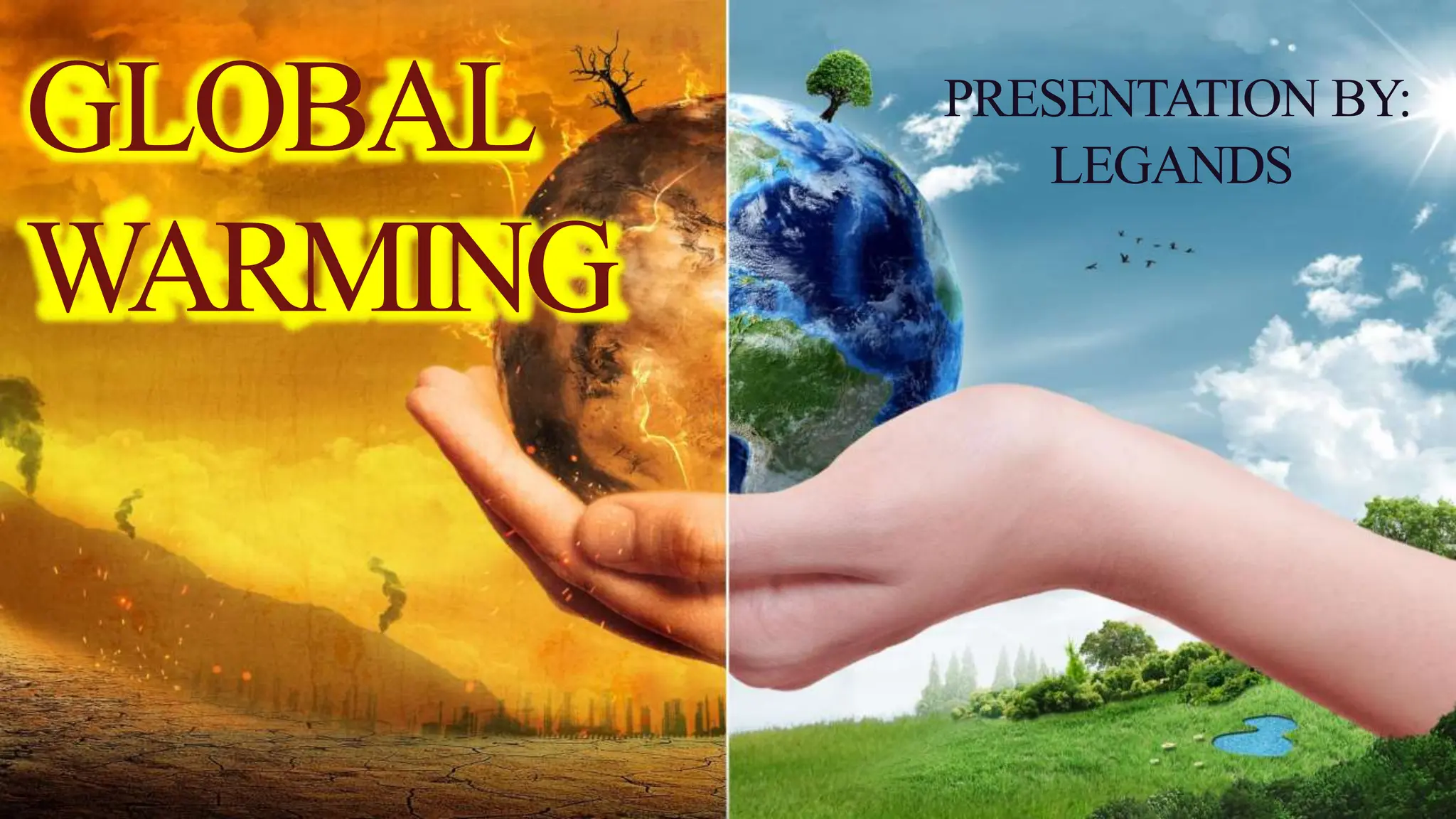
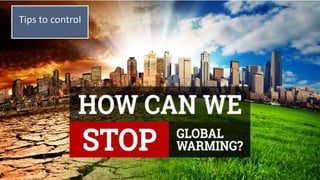
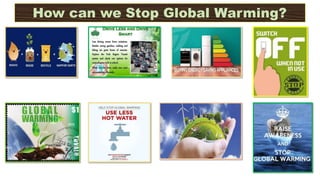
The presentation details global warming as the increase in average world temperatures due to greenhouse gases, primarily from human activities such as fossil fuel burning and deforestation. It outlines the causes, including industrial development and agriculture, and the significant effects like rising temperatures, climate change, and threats to ecosystems. The presentation concludes with tips for managing global warming.
Global warming isthe increase of average world
temperatures as a result of what is known as the
greenhouseeffect. Certain gases in the atmosphere act
like glass in a greenhouse, allowing sunlight through to
heat the earth's surface but trapping the heat as it
radiates back into space. As the greenhouse gases build
up in the atmosphere the Earth gets hotter.This process
is leading to a rapid change in climate, also known as
climate change.
4.
Green House Gases
Greenhousegases (also known as GHGs) are
gases in the earth's atmosphere that trap heat
Greenhouse gases are the gases in the
atmosphere that raise the surface
temperature of planets such as the Earth
5.
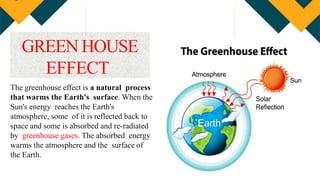
The greenhouse effectis a natural process
that warms the Earth's surface. When the
Sun's energy reaches the Earth's
atmosphere, some of it is reflected back to
space and some is absorbed and re-radiated
by greenhouse gases. The absorbed energy
warms the atmosphere and the surface of
the Earth.
GREEN HOUSE
EFFECT
6.
WHAT IS GLOBAL
WARMING?
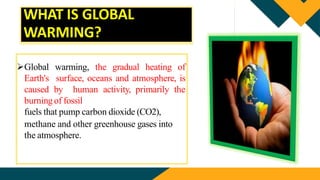
Globalwarming, the gradual heating of
Earth's surface, oceans and atmosphere, is
caused by human activity, primarily the
burning of fossil
fuels that pump carbon dioxide (CO2),
methane and other greenhouse gases into
the atmosphere.
9.
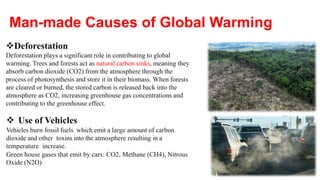
Deforestation
Deforestation plays asignificant role in contributing to global
warming. Trees and forests act as natural carbon sinks, meaning they
absorb carbon dioxide (CO2) from the atmosphere through the
process of photosynthesis and store it in their biomass. When forests
are cleared or burned, the stored carbon is released back into the
atmosphere as CO2, increasing greenhouse gas concentrations and
contributing to the greenhouse effect.
Use of Vehicles
Vehicles burn fossil fuels which emit a large amount of carbon
dioxide and other toxins into the atmosphere resulting in a
temperature increase.
Green house gases that emit by cars: CO2, Methane (CH4), Nitrous
Oxide (N2O)
Man-made Causes of Global Warming
10.
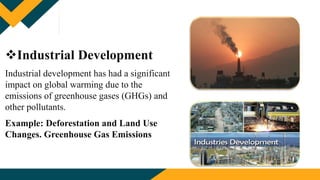
Industrial Development
Industrial developmenthas had a significant
impact on global warming due to the
emissions of greenhouse gases (GHGs) and
other pollutants.
Example: Deforestation and Land Use
Changes. Greenhouse Gas Emissions
11.
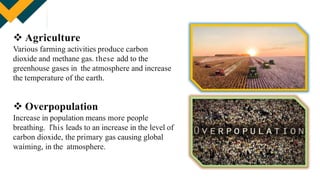
Agriculture
Various farmingactivities produce carbon
dioxide and methane gas. these add to the
greenhouse gases in the atmosphere and increase
the temperature of the earth.
Overpopulation
Increase in population means more people
breathing. ľhis leads to an increase in the level of
carbon dioxide, the primary gas causing global
waíming, in the atmosphere.
12.
Natural Causes ofGlobal Warming
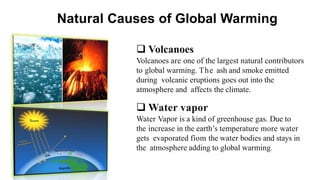
Volcanoes
Volcanoes are one of the largest natural contributors
to global warming. The ash and smoke emitted
during volcanic eruptions goes out into the
atmosphere and affects the climate.
Water vapor
Water Vapor is a kind of greenhouse gas. Due to
the increase in the earth’s temperature more water
gets evaporated fíom the water bodies and stays in
the atmosphere adding to global warming.
13.
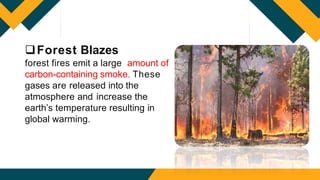
Forest Blazes
forest firesemit a large amount of
carbon-containing smoke. These
gases are released into the
atmosphere and increase the
earth’s temperature resulting in
global warming.
14.
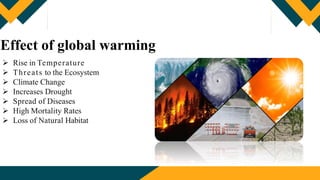
Effect of globalwarming
Rise in Temperature
Threats to the Ecosystem
Climate Change
Increases Drought
Spread of Diseases
High Mortality Rates
Loss of Natural Habitat
15.
Rise inTemperature
Global warming has led to an incredible increase in
earth’s temperature, this has resulted in an
increase in the melting of glaciers, which have led
to an increase in the sea level. this could have
devastating effects on coastal regions.
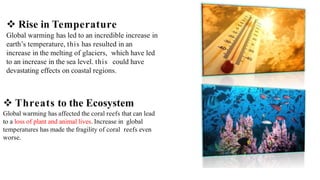
Threats to the Ecosystem
Global warming has affected the coral reefs that can lead
to a loss of plant and animal lives. Increase in global
temperatures has made the fragility of coral reefs even
worse.
16.
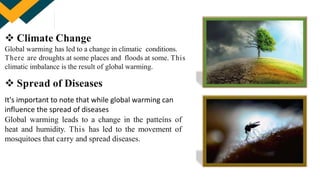
Climate Change
Globalwarming has led to a change in climatic conditions.
There are droughts at some places and floods at some. This
climatic imbalance is the result of global warming.
Spread of Diseases
It's important to note that while global warming can
influence the spread of diseases
Global warming leads to a change in the patteíns of
heat and humidity. This has led to the movement of
mosquitoes that carry and spread diseases.
17.
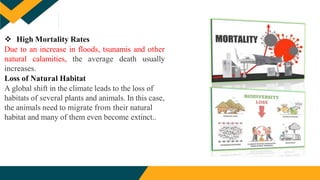
High MortalityRates
Due to an increase in floods, tsunamis and other
natural calamities, the average death usually
increases.
Loss of Natural Habitat
A global shift in the climate leads to the loss of
habitats of several plants and animals. In this case,
the animals need to migrate from their natural
habitat and many of them even become extinct..