MEMBERS: HOSMAN PINEDA TEACHER: MS.MORALES
ELÍAS CALDERÓN ENGLISH
MANUEL LANDAVERDE GLOBAL WARMING
CARLOS DIAZ
We Can(NOT) Stop Global
Warming
INTRODUCTION
• Global warming, which is the increase in the tem
perature of the Earth due tothe use of fossil fuels a
nd other industrial processes that lead to an
accumulation of gases causing the greenhouse e
ffect, atmospheric. Problem that every day is mor
e affecting humanity, intervening gradually in
their living conditions, affecting a progressively e
merging and factors involved
in the development and the balance of beings th
at surround the human being
including the main affected and causative of this
situation, which threatens to
life on the planet in a radical way and without tur
ning back.
WHAT IS GLOBAL WARMING
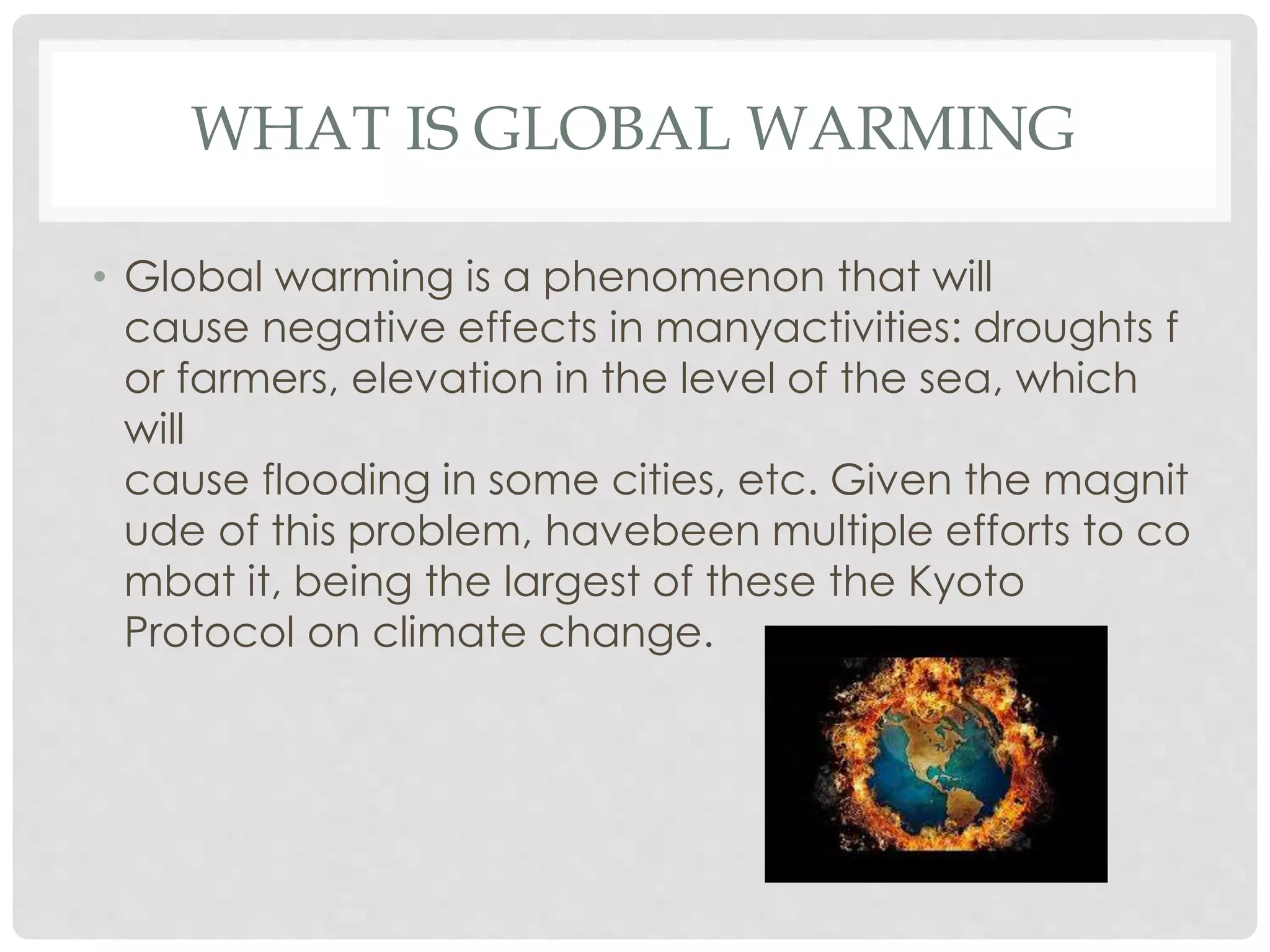
• Global warming is a phenomenon that will
cause negative effects in manyactivities: droughts f
or farmers, elevation in the level of the sea, which
will
cause flooding in some cities, etc. Given the magnit
ude of this problem, havebeen multiple efforts to co
mbat it, being the largest of these the Kyoto
Protocol on climate change.
CAUSES OF PULLUTION
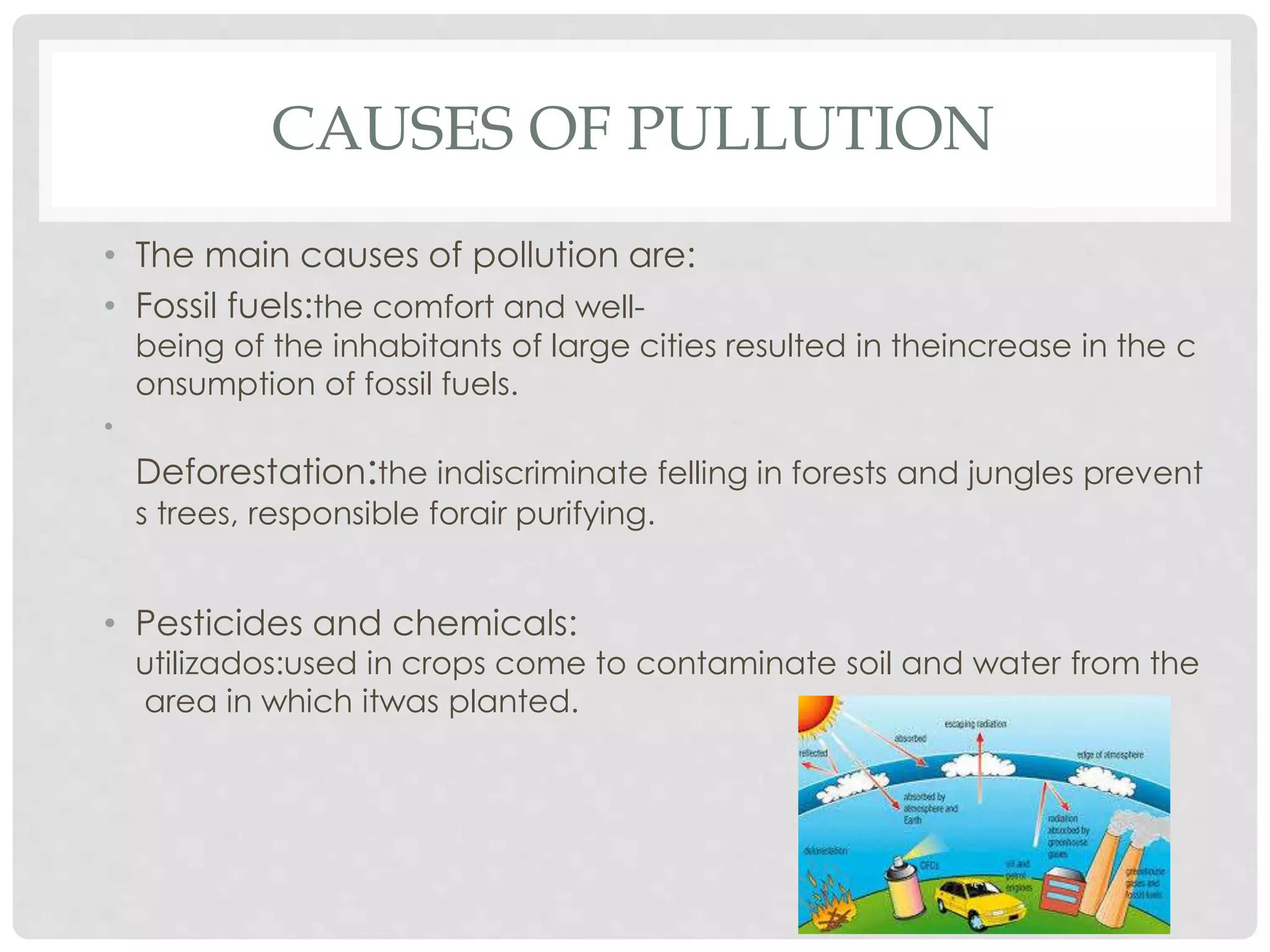
• The main causes of pollution are:
• Fossil fuels:the comfort and well-
being of the inhabitants of large cities resulted in theincrease in the c
onsumption of fossil fuels.
•
Deforestation:the indiscriminate felling in forests and jungles prevent
s trees, responsible forair purifying.
• Pesticides and chemicals:
utilizados:used in crops come to contaminate soil and water from the
area in which itwas planted.
WHAT IS THE SITUATION AROUND THE
WORLD?
AFRICA
Some regions are likely to experience water shortages. Coupled with
increasing demand, this is likely to result in large increases in the number of
people at risk of water scarcity. It is likely to affect livelihoods, the report by
the International Panel on Climate Change says.
Projected reductions in the area suitable for growing crops, and in the
length of the growing season, are likely to produce an increased risk of
hunger. In some countries, yields from rain-fed agriculture could be
reduced by up to 50% by 2020.
Rising sea levels threaten large cities. Degradation of coral reefs and
mangroves is likely, with impacts on local fisheries and tourism.
Rising temperatures, coupled with over-fishing, will decrease the supply of
fish from large lakes, with important impacts on food supplies.
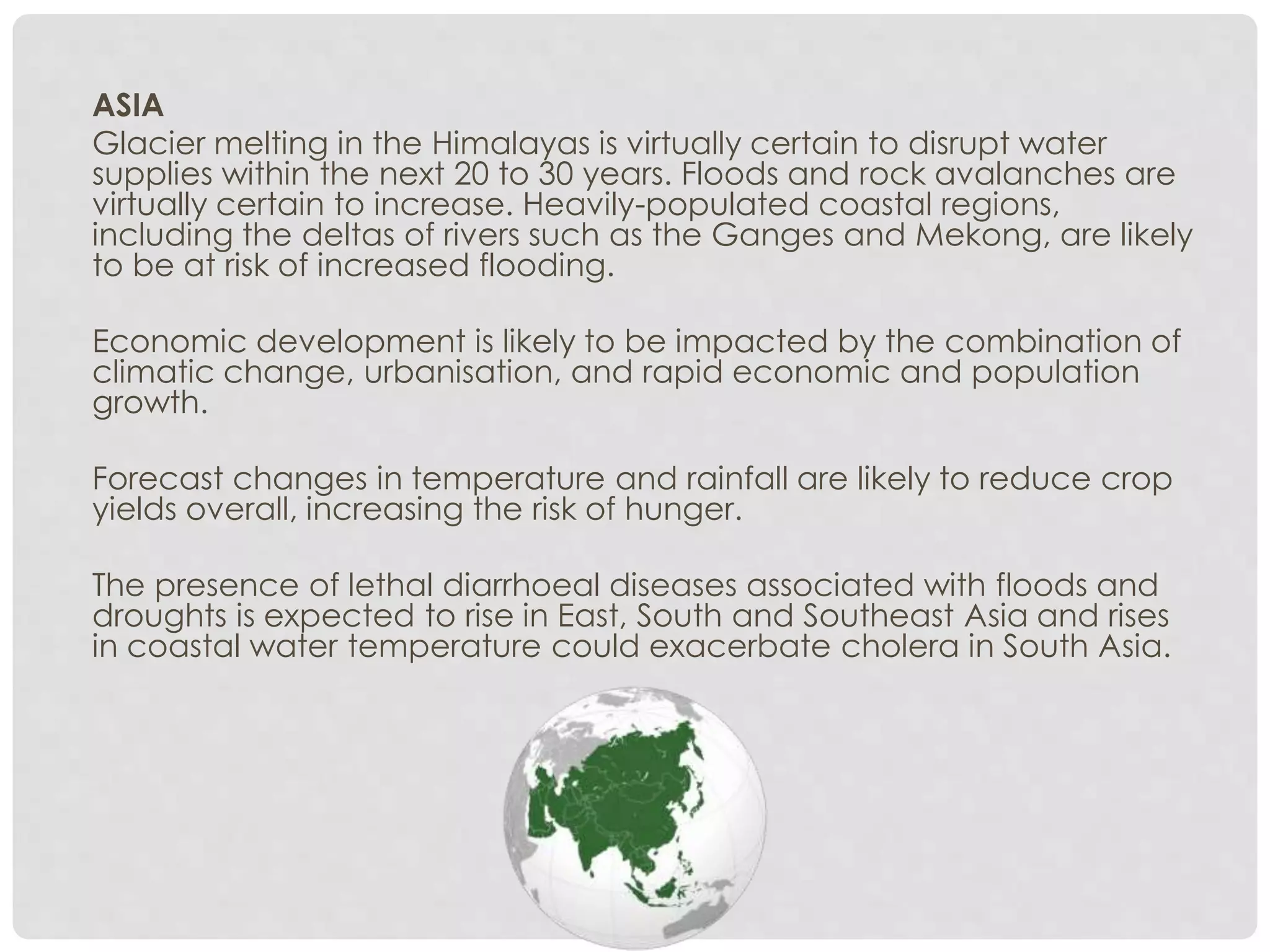
ASIA
Glacier melting in the Himalayas is virtually certain to disrupt water
supplies within the next 20 to 30 years. Floods and rock avalanches are
virtually certain to increase. Heavily-populated coastal regions,
including the deltas of rivers such as the Ganges and Mekong, are likely
to be at risk of increased flooding.
Economic development is likely to be impacted by the combination of
climatic change, urbanisation, and rapid economic and population
growth.
Forecast changes in temperature and rainfall are likely to reduce crop
yields overall, increasing the risk of hunger.
The presence of lethal diarrhoeal diseases associated with floods and
droughts is expected to rise in East, South and Southeast Asia and rises
in coastal water temperature could exacerbate cholera in South Asia.
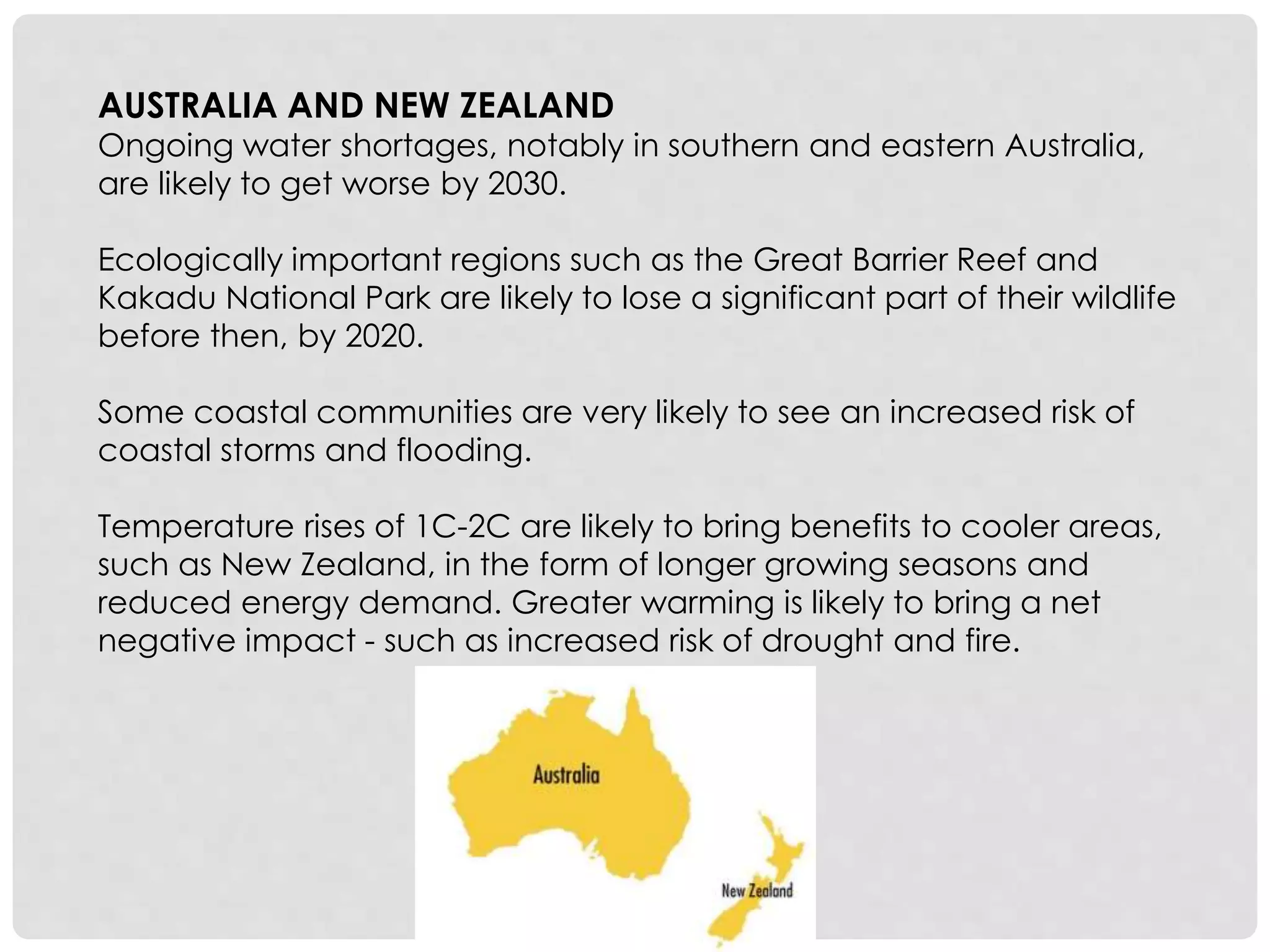
AUSTRALIA AND NEW ZEALAND
Ongoing water shortages, notably in southern and eastern Australia,
are likely to get worse by 2030.
Ecologically important regions such as the Great Barrier Reef and
Kakadu National Park are likely to lose a significant part of their wildlife
before then, by 2020.
Some coastal communities are very likely to see an increased risk of
coastal storms and flooding.
Temperature rises of 1C-2C are likely to bring benefits to cooler areas,
such as New Zealand, in the form of longer growing seasons and
reduced energy demand. Greater warming is likely to bring a net
negative impact - such as increased risk of drought and fire.
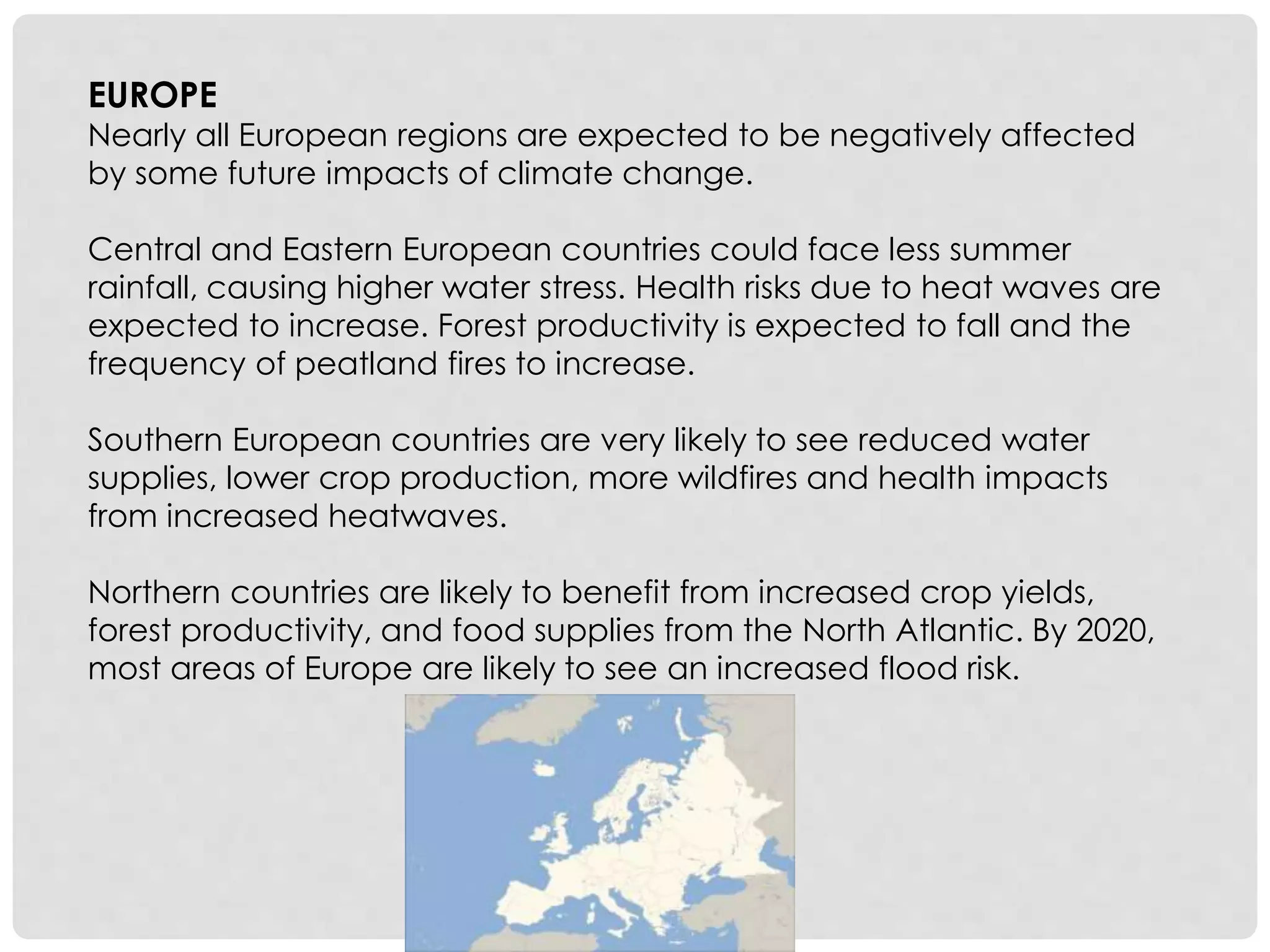
EUROPE
Nearly all European regions are expected to be negatively affected
by some future impacts of climate change.
Central and Eastern European countries could face less summer
rainfall, causing higher water stress. Health risks due to heat waves are
expected to increase. Forest productivity is expected to fall and the
frequency of peatland fires to increase.
Southern European countries are very likely to see reduced water
supplies, lower crop production, more wildfires and health impacts
from increased heatwaves.
Northern countries are likely to benefit from increased crop yields,
forest productivity, and food supplies from the North Atlantic. By 2020,
most areas of Europe are likely to see an increased flood risk.
LATIN AMERICA
Increasing temperatures and decreases in soil water in the eastern
Amazon region would lead to replacement of tropical forest by
savannah. Species extinctions are likely.
Drier areas are likely to see salinization and desertification of agricultural
land, with falling crop yields and livestock productivity reducing food
security. However, soybean yields are likely to increase in temperate
zones.
Sea level rise is very likely to bring flooding to low-lying regions such as
the coast of El Salvador, Guyana and the Rio de la Plata estuary.
Increasing sea temperatures are likely to impact coral reefs and south-
east Pacific fish stocks.
Changes in rainfall patterns and the disappearance of glaciers are
projected to significantly affect water availability for human
consumption, agriculture and energy generation.
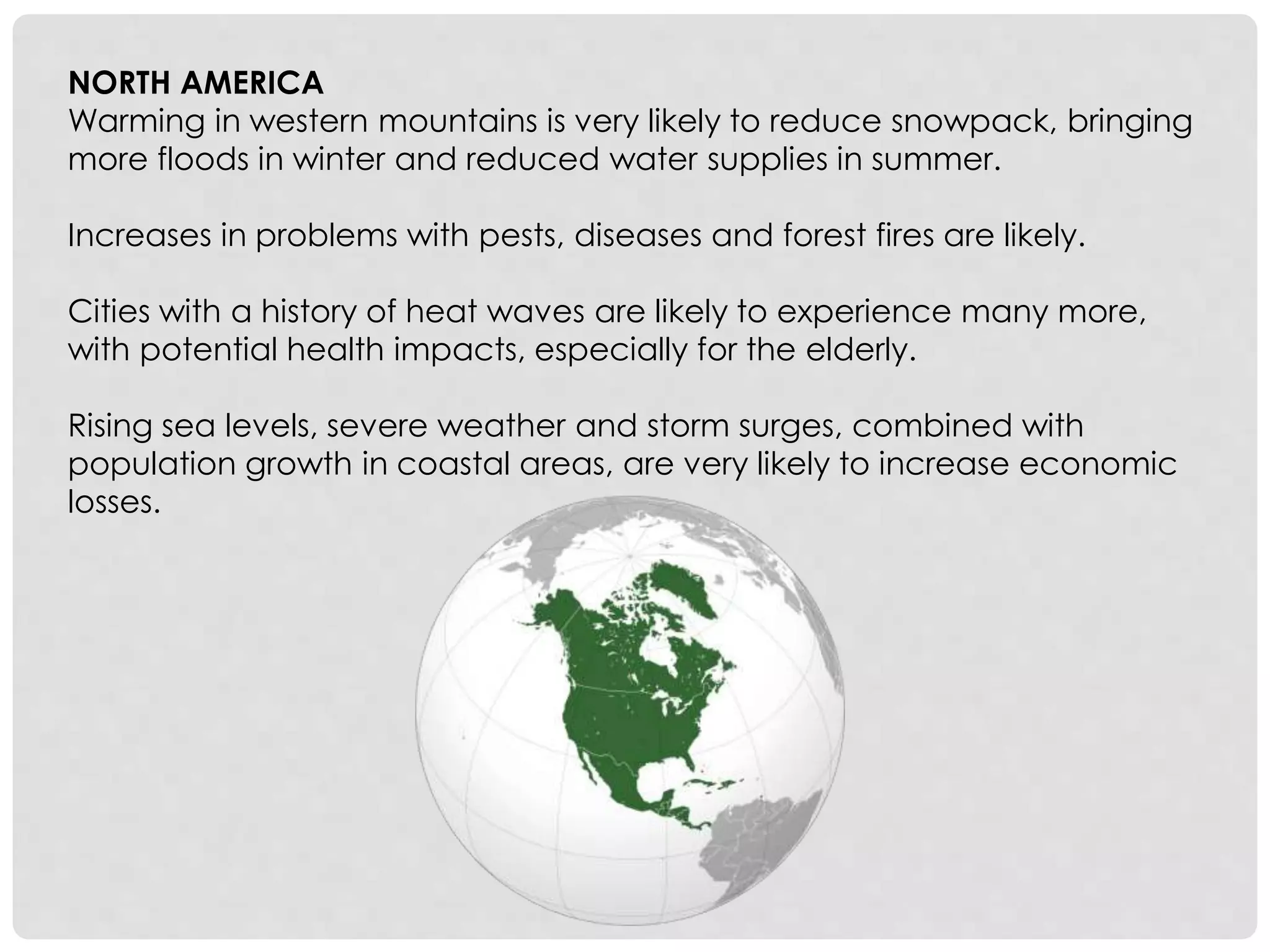
NORTH AMERICA
Warming in western mountains is very likely to reduce snowpack, bringing
more floods in winter and reduced water supplies in summer.
Increases in problems with pests, diseases and forest fires are likely.
Cities with a history of heat waves are likely to experience many more,
with potential health impacts, especially for the elderly.
Rising sea levels, severe weather and storm surges, combined with
population growth in coastal areas, are very likely to increase economic
losses.
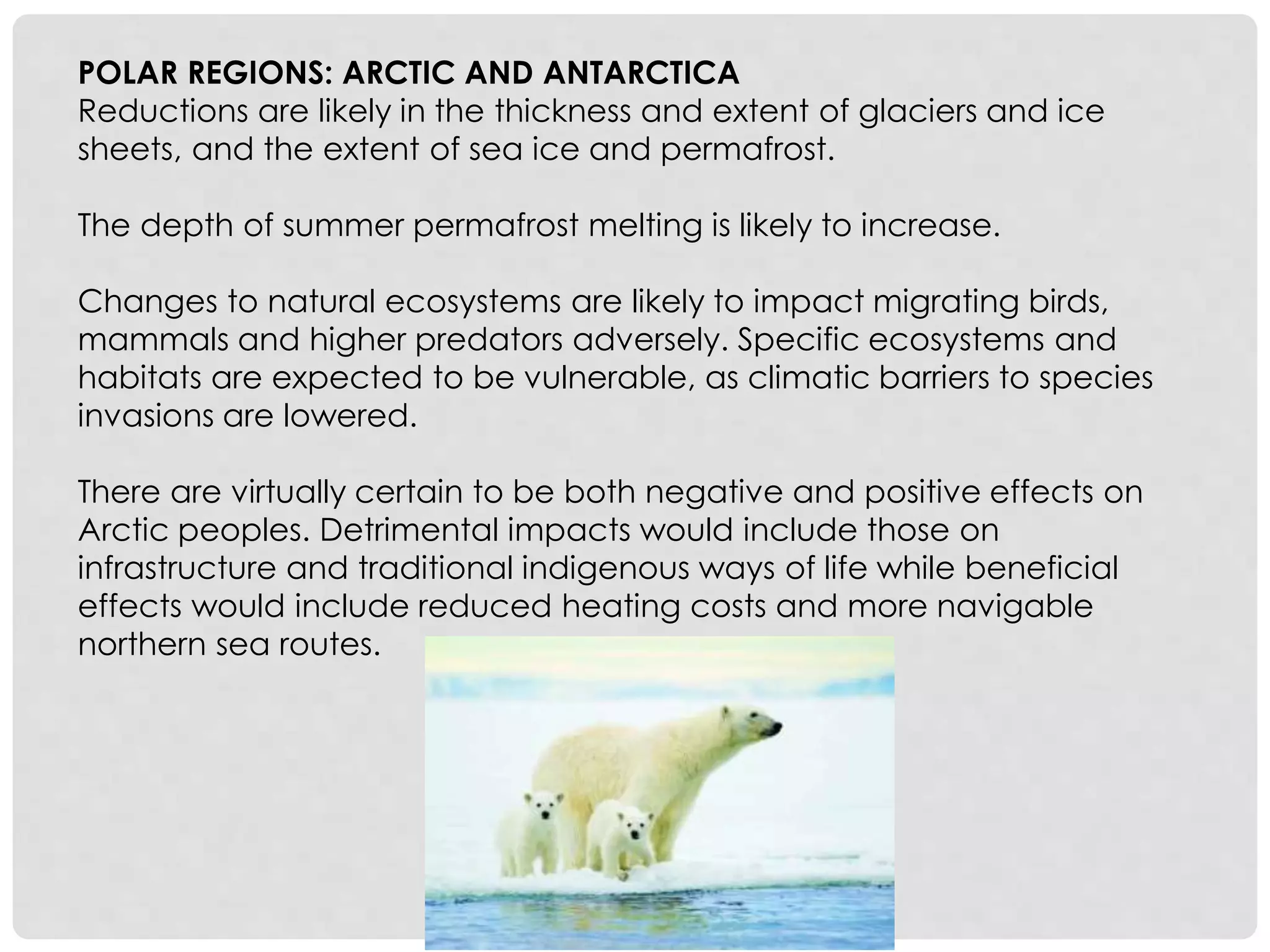
POLAR REGIONS: ARCTIC AND ANTARCTICA
Reductions are likely in the thickness and extent of glaciers and ice
sheets, and the extent of sea ice and permafrost.
The depth of summer permafrost melting is likely to increase.
Changes to natural ecosystems are likely to impact migrating birds,
mammals and higher predators adversely. Specific ecosystems and
habitats are expected to be vulnerable, as climatic barriers to species
invasions are lowered.
There are virtually certain to be both negative and positive effects on
Arctic peoples. Detrimental impacts would include those on
infrastructure and traditional indigenous ways of life while beneficial
effects would include reduced heating costs and more navigable
northern sea routes.
SOLUTIONS TO STOP GLOBAL
WARMING
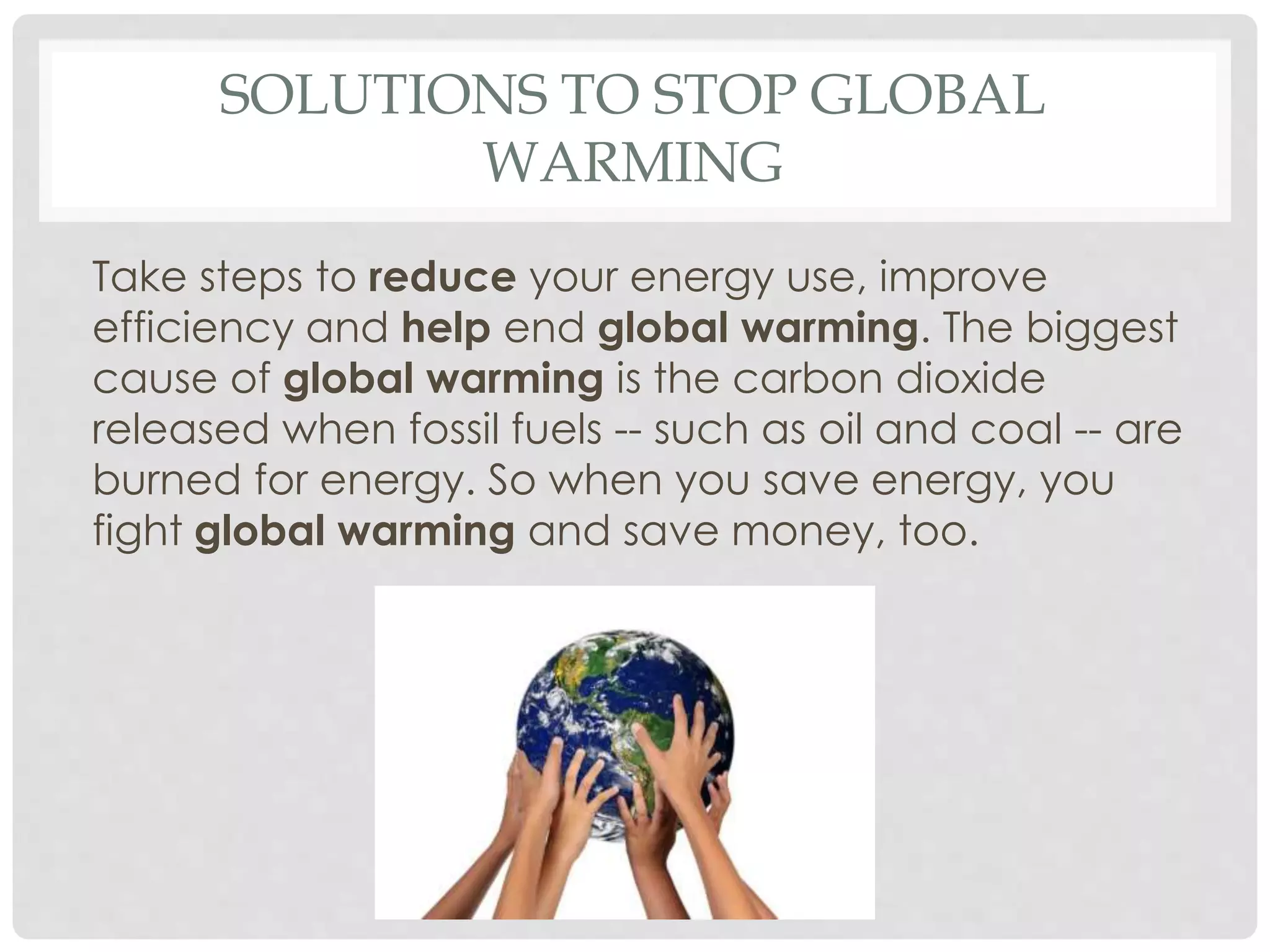
Take steps to reduce your energy use, improve
efficiency and help end global warming. The biggest
cause of global warming is the carbon dioxide
released when fossil fuels -- such as oil and coal -- are
burned for energy. So when you save energy, you
fight global warming and save money, too.
WHAT IS PEOPLE DOING
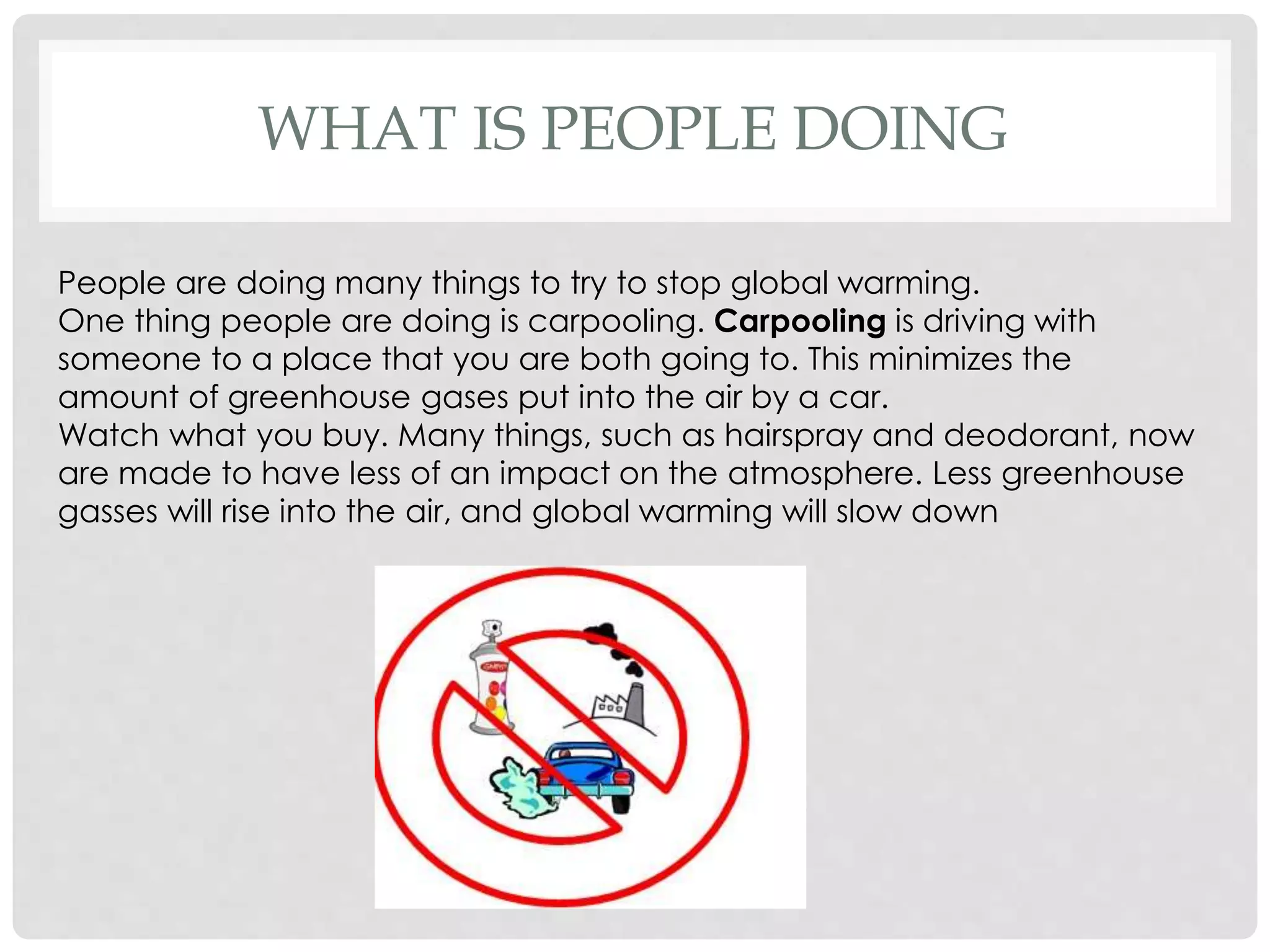
People are doing many things to try to stop global warming.
One thing people are doing is carpooling. Carpooling is driving with
someone to a place that you are both going to. This minimizes the
amount of greenhouse gases put into the air by a car.
Watch what you buy. Many things, such as hairspray and deodorant, now
are made to have less of an impact on the atmosphere. Less greenhouse
gasses will rise into the air, and global warming will slow down
CONCLUSION
Global warming is caused by greenhouse gases, caused by
industrialized societies. When contaminated with the gases from
factories, used aerosols, car gases etc. Human beings used each day,
perhaps without realizing, the destruction of our planet
The reality of global warming is a threat whose effects are already visible
to our society: the accelerated species extinction, rising sea levels, as
well as the progressive melting of the polar ice caps. In the last decade is
seen as the world collapses, as the temperature increases are
experienced, hotter summers and droughts, or else heavy rains that
endanger the lives of people.
Global warming should be treated very seriously in the world, then it is
very serious.

English Midterm Project(?)

  • 1.
    MEMBERS: HOSMAN PINEDATEACHER: MS.MORALES ELÍAS CALDERÓN ENGLISH MANUEL LANDAVERDE GLOBAL WARMING CARLOS DIAZ
  • 2.
    We Can(NOT) StopGlobal Warming
  • 3.
    INTRODUCTION • Global warming,which is the increase in the tem perature of the Earth due tothe use of fossil fuels a nd other industrial processes that lead to an accumulation of gases causing the greenhouse e ffect, atmospheric. Problem that every day is mor e affecting humanity, intervening gradually in their living conditions, affecting a progressively e merging and factors involved in the development and the balance of beings th at surround the human being including the main affected and causative of this situation, which threatens to life on the planet in a radical way and without tur ning back.
  • 4.
    WHAT IS GLOBALWARMING • Global warming is a phenomenon that will cause negative effects in manyactivities: droughts f or farmers, elevation in the level of the sea, which will cause flooding in some cities, etc. Given the magnit ude of this problem, havebeen multiple efforts to co mbat it, being the largest of these the Kyoto Protocol on climate change.
  • 5.
    CAUSES OF PULLUTION •The main causes of pollution are: • Fossil fuels:the comfort and well- being of the inhabitants of large cities resulted in theincrease in the c onsumption of fossil fuels. • Deforestation:the indiscriminate felling in forests and jungles prevent s trees, responsible forair purifying. • Pesticides and chemicals: utilizados:used in crops come to contaminate soil and water from the area in which itwas planted.
  • 6.
    WHAT IS THESITUATION AROUND THE WORLD? AFRICA Some regions are likely to experience water shortages. Coupled with increasing demand, this is likely to result in large increases in the number of people at risk of water scarcity. It is likely to affect livelihoods, the report by the International Panel on Climate Change says. Projected reductions in the area suitable for growing crops, and in the length of the growing season, are likely to produce an increased risk of hunger. In some countries, yields from rain-fed agriculture could be reduced by up to 50% by 2020. Rising sea levels threaten large cities. Degradation of coral reefs and mangroves is likely, with impacts on local fisheries and tourism. Rising temperatures, coupled with over-fishing, will decrease the supply of fish from large lakes, with important impacts on food supplies.
  • 7.
    ASIA Glacier melting inthe Himalayas is virtually certain to disrupt water supplies within the next 20 to 30 years. Floods and rock avalanches are virtually certain to increase. Heavily-populated coastal regions, including the deltas of rivers such as the Ganges and Mekong, are likely to be at risk of increased flooding. Economic development is likely to be impacted by the combination of climatic change, urbanisation, and rapid economic and population growth. Forecast changes in temperature and rainfall are likely to reduce crop yields overall, increasing the risk of hunger. The presence of lethal diarrhoeal diseases associated with floods and droughts is expected to rise in East, South and Southeast Asia and rises in coastal water temperature could exacerbate cholera in South Asia.
  • 8.
    AUSTRALIA AND NEWZEALAND Ongoing water shortages, notably in southern and eastern Australia, are likely to get worse by 2030. Ecologically important regions such as the Great Barrier Reef and Kakadu National Park are likely to lose a significant part of their wildlife before then, by 2020. Some coastal communities are very likely to see an increased risk of coastal storms and flooding. Temperature rises of 1C-2C are likely to bring benefits to cooler areas, such as New Zealand, in the form of longer growing seasons and reduced energy demand. Greater warming is likely to bring a net negative impact - such as increased risk of drought and fire.
  • 9.
    EUROPE Nearly all Europeanregions are expected to be negatively affected by some future impacts of climate change. Central and Eastern European countries could face less summer rainfall, causing higher water stress. Health risks due to heat waves are expected to increase. Forest productivity is expected to fall and the frequency of peatland fires to increase. Southern European countries are very likely to see reduced water supplies, lower crop production, more wildfires and health impacts from increased heatwaves. Northern countries are likely to benefit from increased crop yields, forest productivity, and food supplies from the North Atlantic. By 2020, most areas of Europe are likely to see an increased flood risk.
  • 10.
    LATIN AMERICA Increasing temperaturesand decreases in soil water in the eastern Amazon region would lead to replacement of tropical forest by savannah. Species extinctions are likely. Drier areas are likely to see salinization and desertification of agricultural land, with falling crop yields and livestock productivity reducing food security. However, soybean yields are likely to increase in temperate zones. Sea level rise is very likely to bring flooding to low-lying regions such as the coast of El Salvador, Guyana and the Rio de la Plata estuary. Increasing sea temperatures are likely to impact coral reefs and south- east Pacific fish stocks. Changes in rainfall patterns and the disappearance of glaciers are projected to significantly affect water availability for human consumption, agriculture and energy generation.
  • 11.
    NORTH AMERICA Warming inwestern mountains is very likely to reduce snowpack, bringing more floods in winter and reduced water supplies in summer. Increases in problems with pests, diseases and forest fires are likely. Cities with a history of heat waves are likely to experience many more, with potential health impacts, especially for the elderly. Rising sea levels, severe weather and storm surges, combined with population growth in coastal areas, are very likely to increase economic losses.
  • 12.
    POLAR REGIONS: ARCTICAND ANTARCTICA Reductions are likely in the thickness and extent of glaciers and ice sheets, and the extent of sea ice and permafrost. The depth of summer permafrost melting is likely to increase. Changes to natural ecosystems are likely to impact migrating birds, mammals and higher predators adversely. Specific ecosystems and habitats are expected to be vulnerable, as climatic barriers to species invasions are lowered. There are virtually certain to be both negative and positive effects on Arctic peoples. Detrimental impacts would include those on infrastructure and traditional indigenous ways of life while beneficial effects would include reduced heating costs and more navigable northern sea routes.
  • 13.
    SOLUTIONS TO STOPGLOBAL WARMING Take steps to reduce your energy use, improve efficiency and help end global warming. The biggest cause of global warming is the carbon dioxide released when fossil fuels -- such as oil and coal -- are burned for energy. So when you save energy, you fight global warming and save money, too.
  • 14.
    WHAT IS PEOPLEDOING People are doing many things to try to stop global warming. One thing people are doing is carpooling. Carpooling is driving with someone to a place that you are both going to. This minimizes the amount of greenhouse gases put into the air by a car. Watch what you buy. Many things, such as hairspray and deodorant, now are made to have less of an impact on the atmosphere. Less greenhouse gasses will rise into the air, and global warming will slow down
  • 15.
    CONCLUSION Global warming iscaused by greenhouse gases, caused by industrialized societies. When contaminated with the gases from factories, used aerosols, car gases etc. Human beings used each day, perhaps without realizing, the destruction of our planet The reality of global warming is a threat whose effects are already visible to our society: the accelerated species extinction, rising sea levels, as well as the progressive melting of the polar ice caps. In the last decade is seen as the world collapses, as the temperature increases are experienced, hotter summers and droughts, or else heavy rains that endanger the lives of people. Global warming should be treated very seriously in the world, then it is very serious.