SFC PD DAY
NOVEMBER 2018
AGENDA
CONSTANT JOURNEY OF
IMPROVEMENT
• Retention and achievement on linear
• Gscores with 1-9
• Ofsted
• Progress
**MATHS & NUMBERS
WARNING**
BUT LET’S KICK
OFF WITH A QUIZ!!
• Please get
out your
device and
open up
Kahoot!
2 YEAR A LEVELS AND
RETENTION
• Retention is a measure used by OFSTED to see how
many students have stayed on any given course
between the START and END date
• When A levels were modular retention was measured
over AS, then the measure would start again for the A2
course.
• AS retention for the SFC was typically 89.5%
• A2 retention for the SFC was typically around 95.5%
HOWEVER - FOR LINEAR A
LEVELS…..
• Retention is now calculated over a 2 year period
• “linear retention will simply count the students who
left during the AS year and those who left in the A2
year”
• Is this statement correct? Yes/No
• Achievement is another key measure used by
OFSTED, and it is benchmarked against the national
data
• Achievement takes into account both how many
people PASSED the course and how many people
STAYED ON the course
ACHIEVEMENT IS THE SAME AS
PASS RATE, RIGHT?
SO…
• A typical modular AS course may START with 132
students, and by June of the following year have 120
students still on the course, so RETENTION would be
120/132 = 91%
• of the 120 students who finish the course, 116 might
pass, so the PASS RATE would be 116/120 = 96.6%
• ACHIEVEMENT is calculated as PASS over STARTS,
so 116/132 = 87.8%
BUT WHAT ABOUT LINEAR??
• Let’s extend this over a 2 year journey. Of our 132 starters:
• 120 completed the first year
• 6 didn’t return over summer
• 4 were withdrawn in Y13
• so at the end of Y13 we are left with 110 students
• retention over 2 years is 83%
• we have lost 22 students from the course
…LINEAR ACHIEVEMENT
• of those 110 students who got to the end of Y13, 6
failed, so the pass rate is 94.5%
• Achievement over 2 years would be calculated as
104 students who PASSED over 132 students who
STARTED = 78.7%
WITH THE PEOPLE YOU ARE SITTING
NEXT TO, DISCUSS….
WHAT QUESTIONS DOES THIS
RAISE ABOUT RETENTION AND
ACHIEVEMENT?
• You have the information from
the previous slides to help you -
look on your table!
POTENTIAL QUESTIONS…
• What is happening to all of those students withdrawn from the
subject?
• Is it ok to ‘fail’ almost a quarter of students?
• Is there any more we can be doing to support these students?
• Would we expect this to be the number of students who do not
achieve at the end of a two year A level?
• Is this acceptable?
• What is the norm?
MOVING ON…
• GSCORES
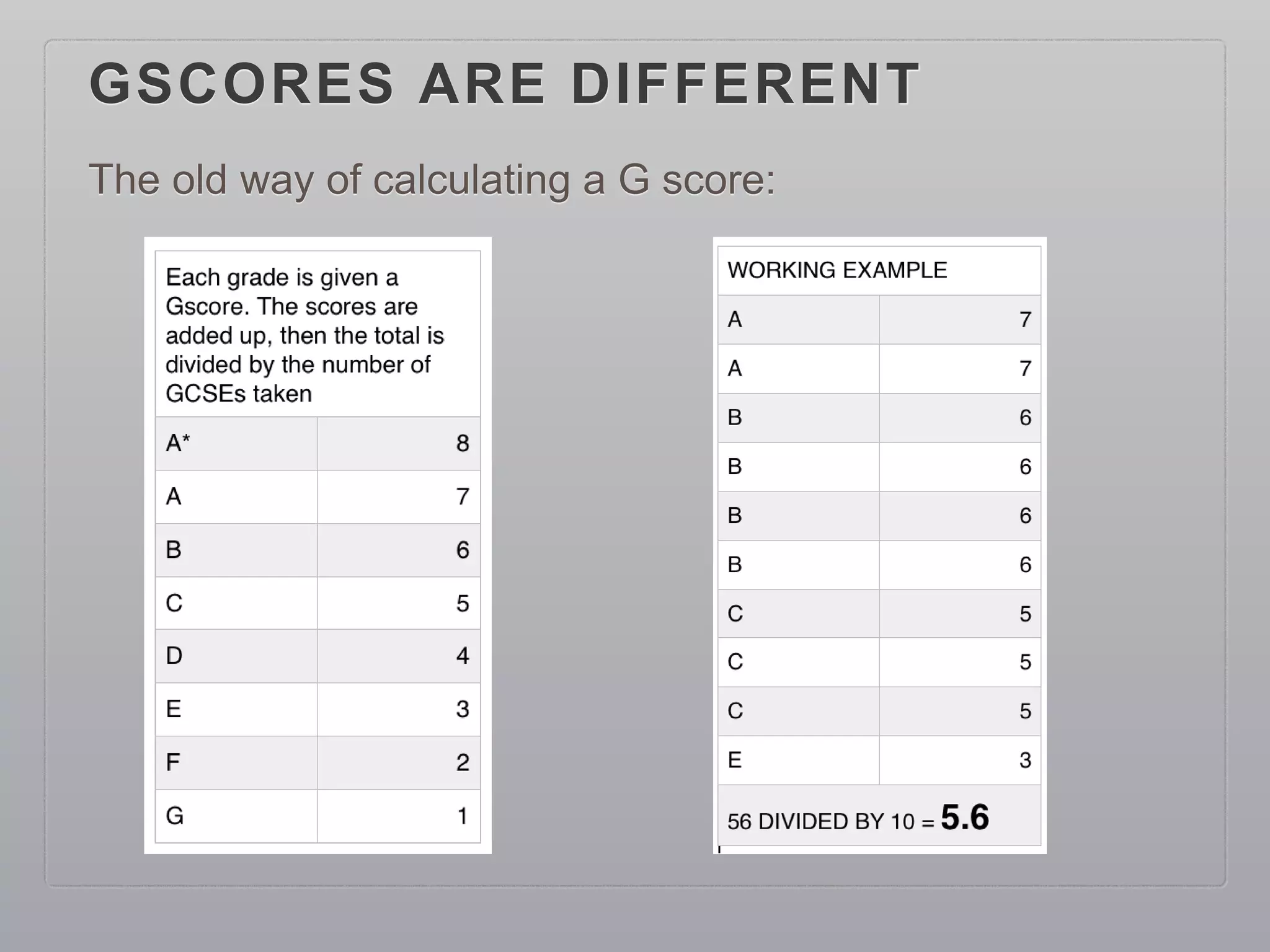
GSCORES ARE DIFFERENT
The old way of calculating a G score:
1-9 GCSES
• With the 1-9 GCSEs
the method used to
calculate the G score
is easier, but the
same principle. You
add up the number
awarded to each
GCSE, then divide by
the total number of
GCSEs taken
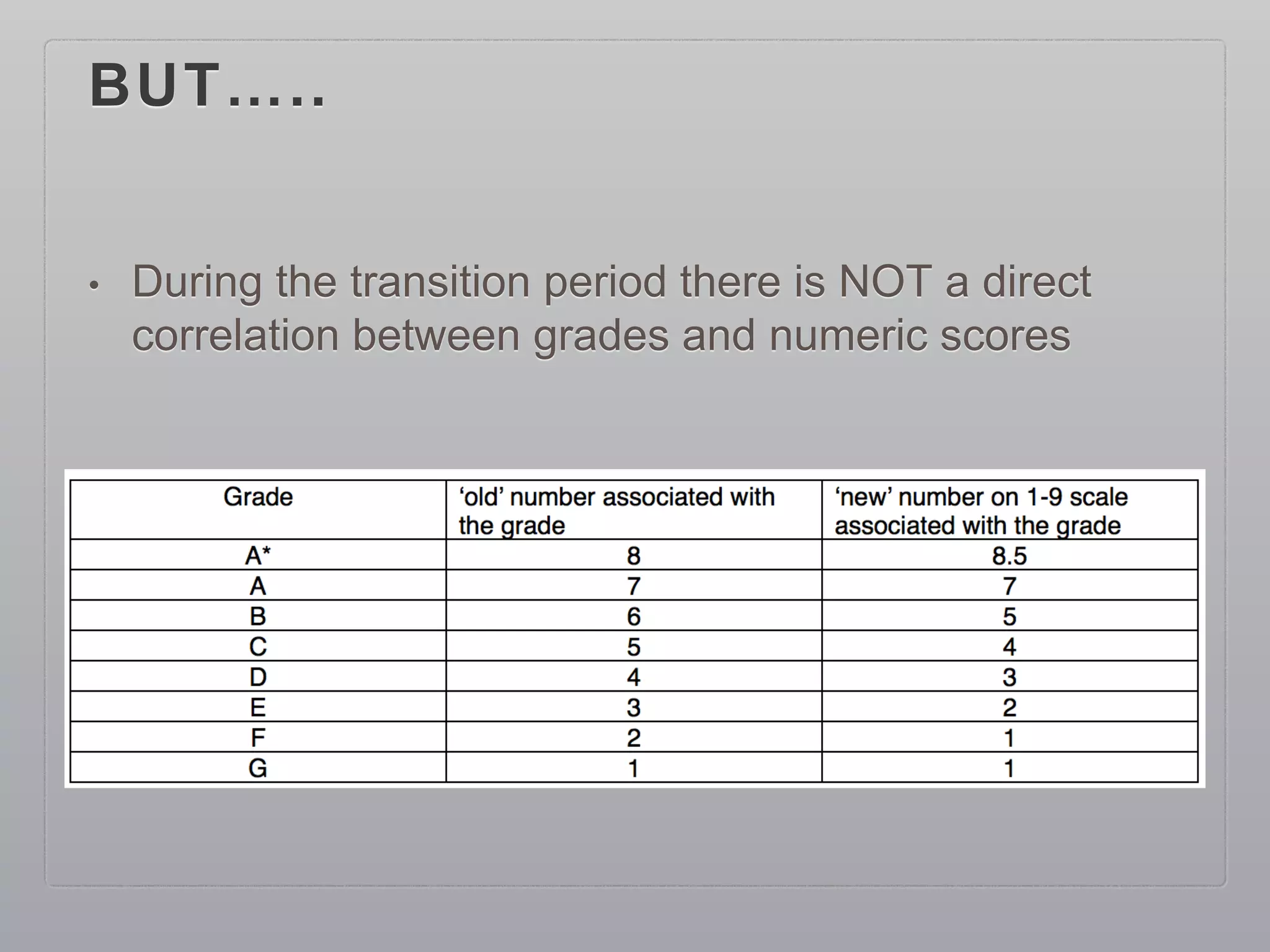
BUT…..
• During the transition period there is NOT a direct
correlation between grades and numeric scores
SO TAKING OUR FIRST
EXAMPLE…
• Using the OLD Scale
• A 7
• A 7
• B 6
• B 6
• B 6
• B 6
• C 5
• C 5
• C 5
• E 3
• = 56 divided by 10 = 5.6
Using the NEW scale
• A 7
• A 7
• B 5
• B 5
• B 5
• B 5
• C 4
• C 4
• C 4
• E 2
• = divided by 10 = 4.8
SO…
• So you can see that because of the way the new and
old GCSE scores have been calculated the
results feel very different
WHAT HAPPENS AT THE VERY
TOP END??
• The OLD calculation:
• A*A*A*AAAAA
• 8 8 8 7 7 7 7 7
• 57 divided by 8 = 7.1
• The NEW calculation:
• A*A*A*AAAAA
• 8.5 8.5 8.5 77777
• 60.5 divided by 8 = 7.6
Note: A* is the only grade that will result in a higher G score
TARGET GRADES
• Will a lower G score result in a lower target grade??
• No - an adjustment has been made so the target
grades will not be any lower than those we are used
to seeing for our cohort
TARGET GRADE REMINDER
• Target grades are benchmarked against national
achievement.
• At CIC we have chosen to benchmark against the ‘70th
percentile’
• this means that if a student achieved their target grade,
they would be in the top 30% highest achieving
students with the same GSCORE nationally
SUBJECT SPECIFIC
TARGET GRADES ARE ALSO SUBJECT
SPECIFIC
• For student with a new G score of 5.8….
MOVING SWIFTLY ON OUR
BUDDIES AT
OFSTED
HANDBOOK 1
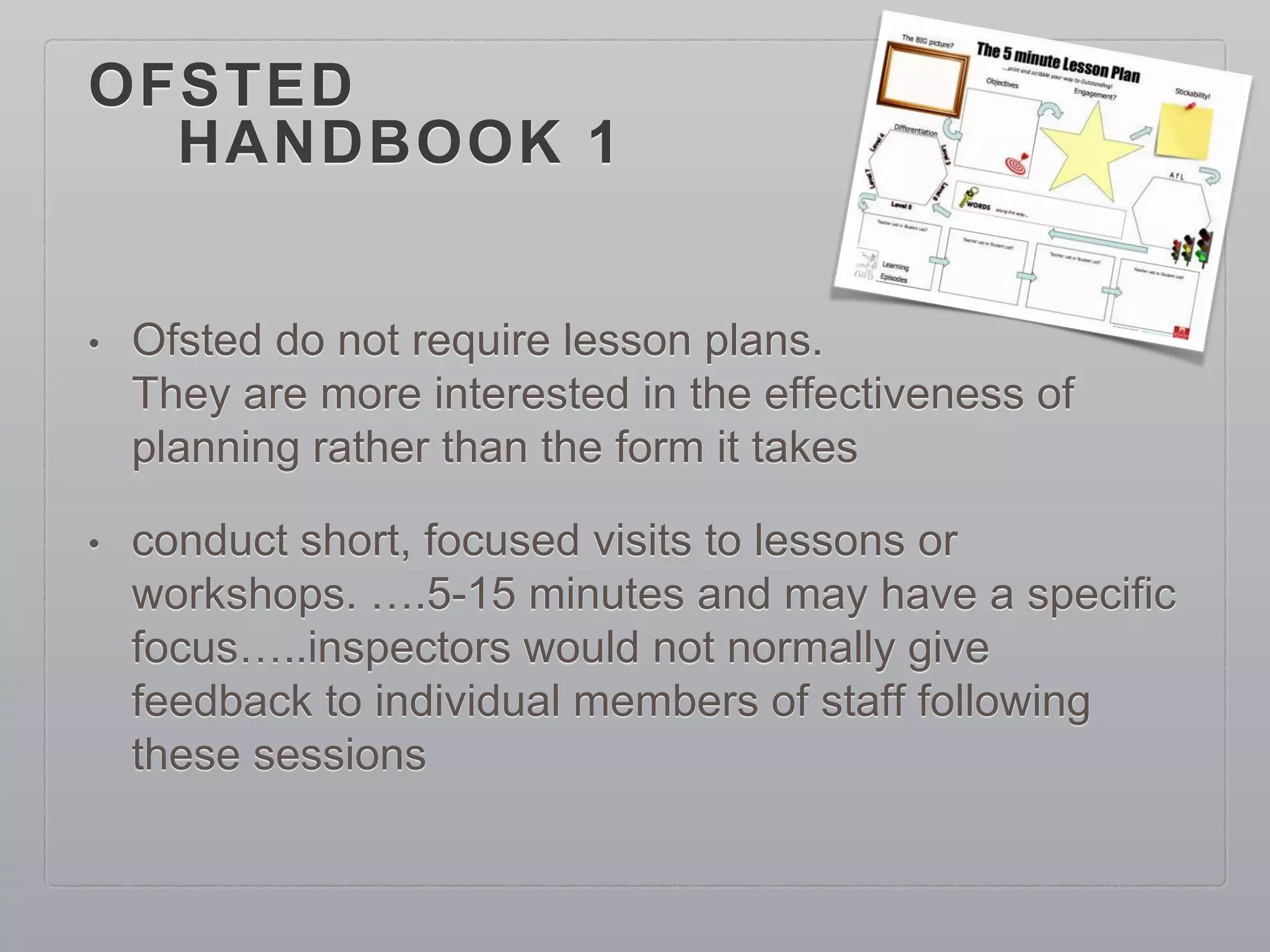
• Ofsted do not require lesson plans.
They are more interested in the effectiveness of
planning rather than the form it takes
• conduct short, focused visits to lessons or
workshops. ….5-15 minutes and may have a specific
focus…..inspectors would not normally give
feedback to individual members of staff following
these sessions
OFSTED
HANDBOOK 2
• Judgements about current learners’ progress
and standards of work carry more weighting than
historic achievement rates
• Inspectors will spend much more time in lessons
judging TLA
• lessons are not graded, teachers do not usually
receive feedback, managers will not receive
feedback on individual teachers or lessons
OFSTED
HANDBOOK 3
• ‘learners’ views are central to inspection’
• ‘discussions with learners and analysis of their work’
• ‘analysis of provider and learner records showing planning for
and monitoring of, learners’ individual progress from their
starting points’
• ‘the main focus will be on evaluating the impact of actions
taken by providers’ staff on learners personal development,
their learning and progress and/or their outcomes’
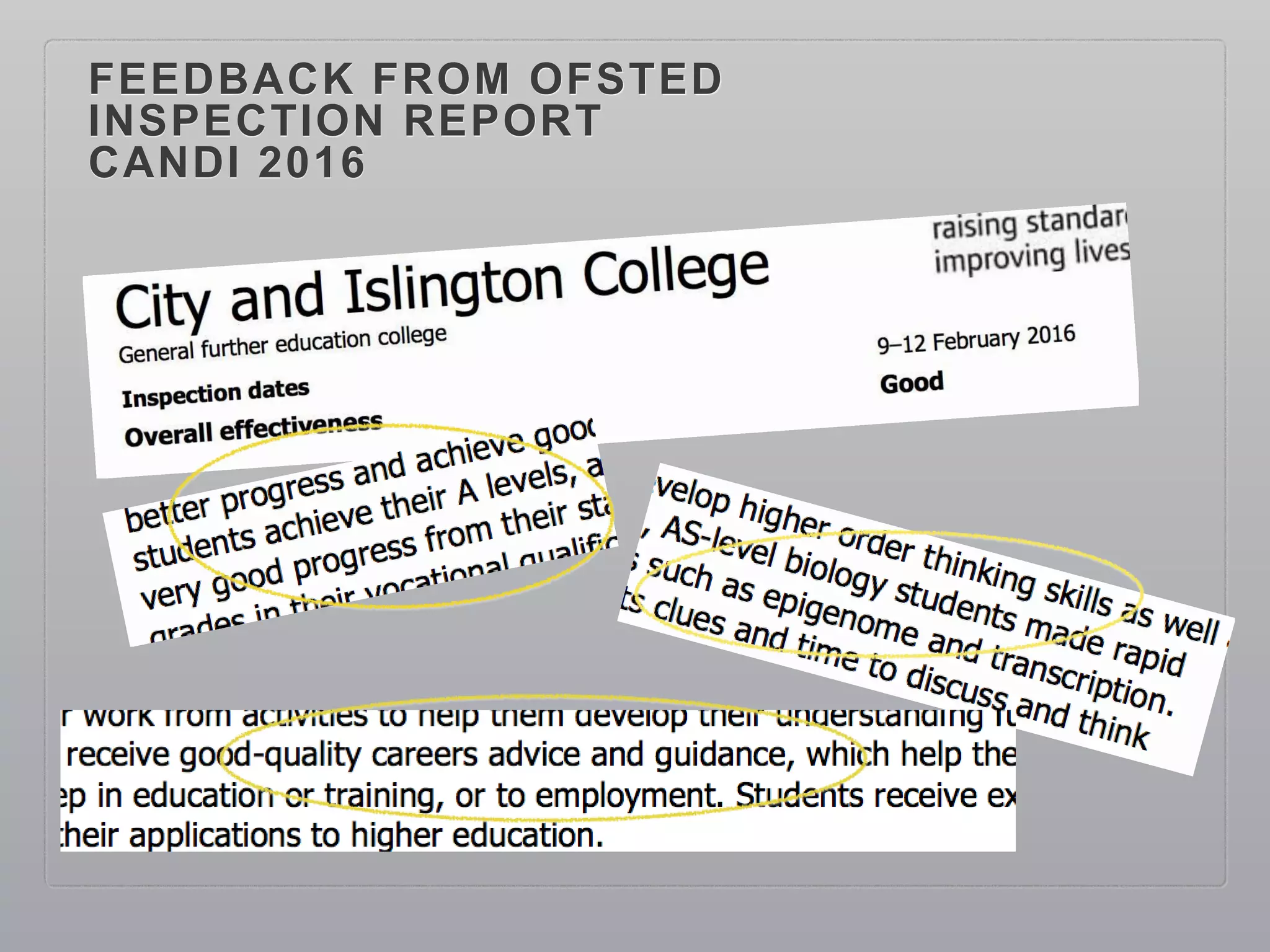
FEEDBACK FROM OFSTED
INSPECTION REPORT
CANDI 2016
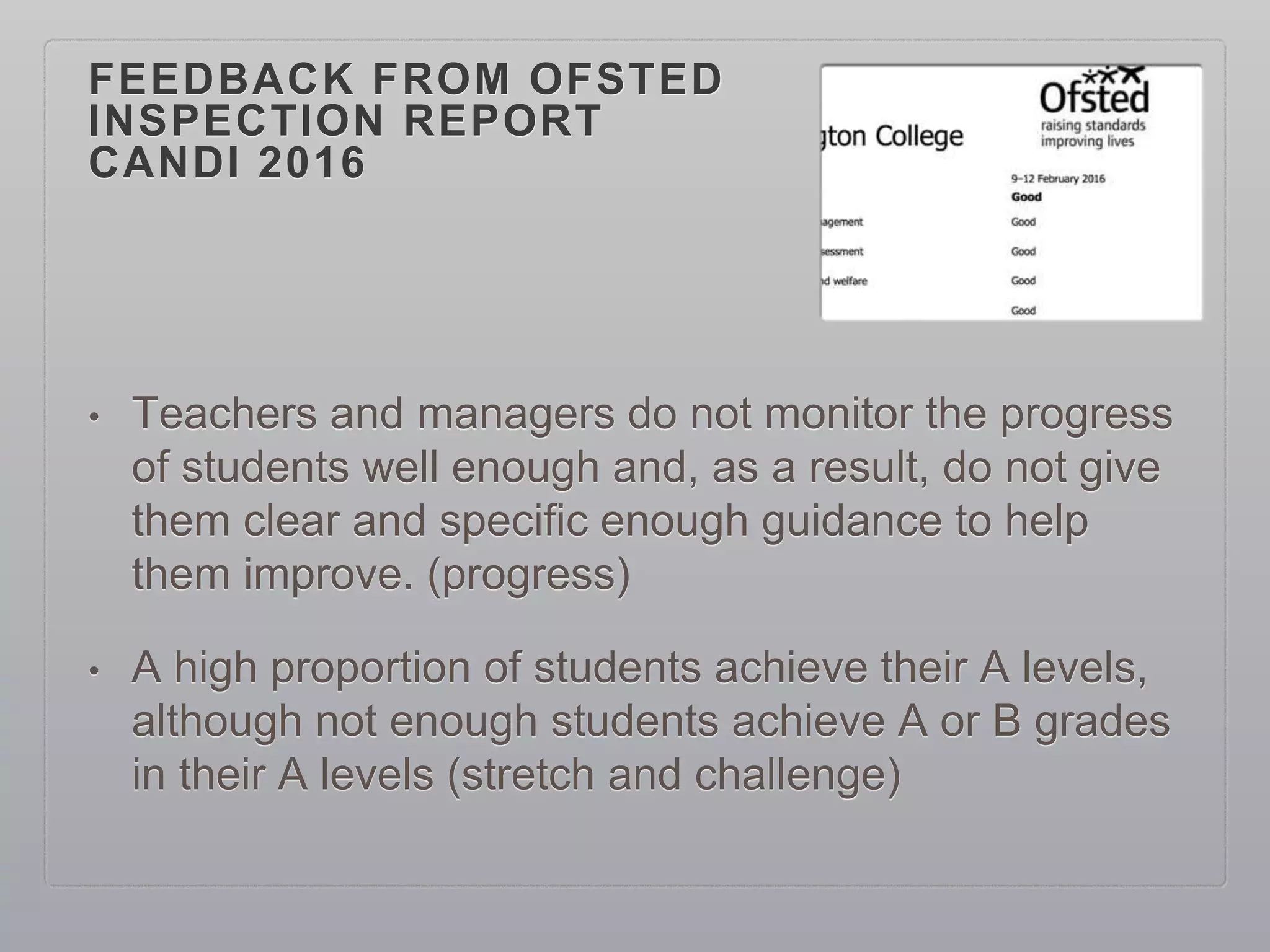
FEEDBACK FROM OFSTED
INSPECTION REPORT
CANDI 2016
• Teachers and managers do not monitor the progress
of students well enough and, as a result, do not give
them clear and specific enough guidance to help
them improve. (progress)
• A high proportion of students achieve their A levels,
although not enough students achieve A or B grades
in their A levels (stretch and challenge)
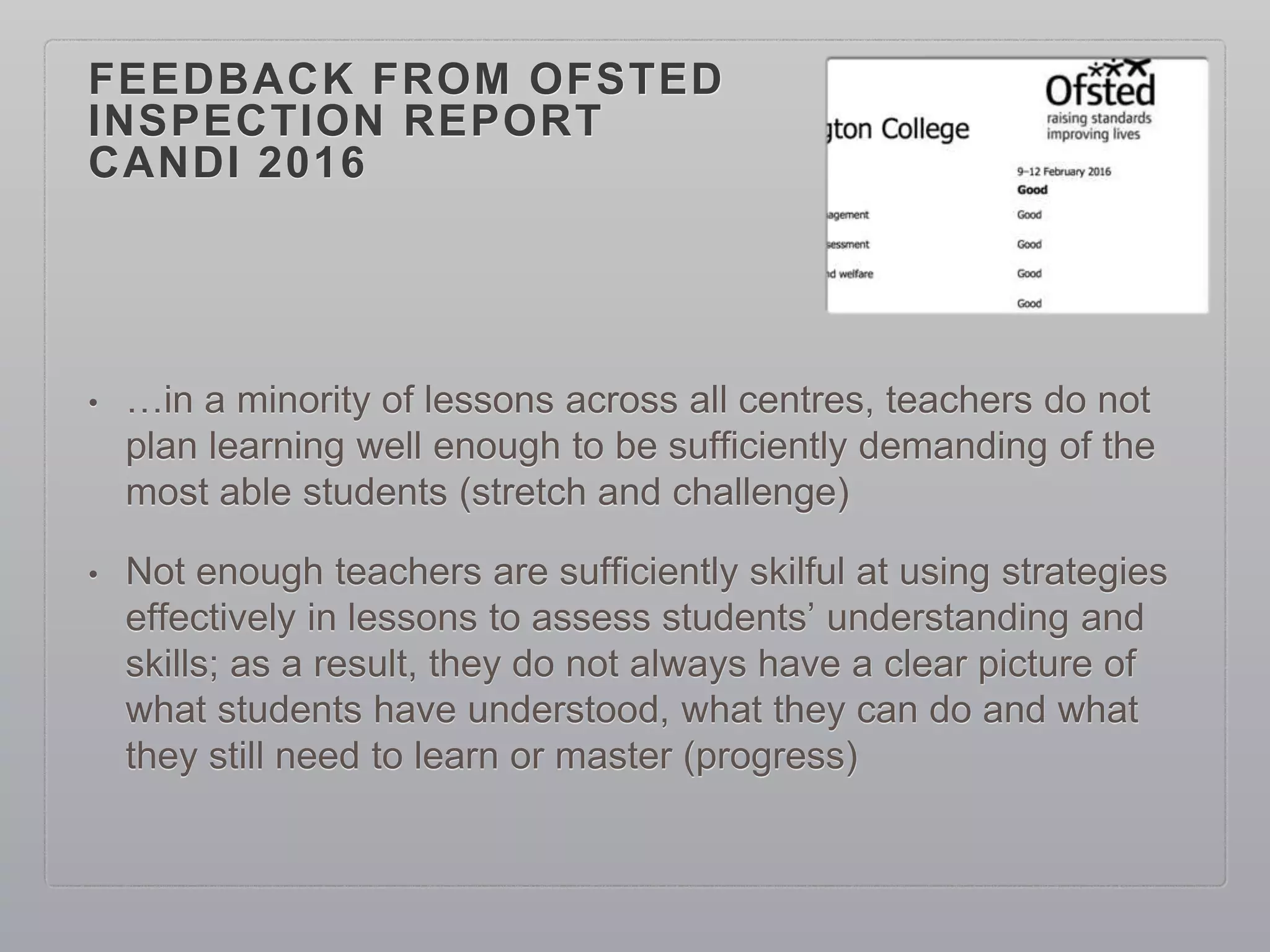
FEEDBACK FROM OFSTED
INSPECTION REPORT
CANDI 2016
• …in a minority of lessons across all centres, teachers do not
plan learning well enough to be sufficiently demanding of the
most able students (stretch and challenge)
• Not enough teachers are sufficiently skilful at using strategies
effectively in lessons to assess students’ understanding and
skills; as a result, they do not always have a clear picture of
what students have understood, what they can do and what
they still need to learn or master (progress)
WHAT INSPECTORS ARE
LOOKING FOR
• learners’ progress has developed over time since the start of their qualification
• learners have a knowledge of their progress grades and where they are
currently
• positive attitudes to learning
• development in leaner’s knowledge which teachers and students can articulate
• impact of teaching strategies on learning and progress
• challenge for the least and most able students
• formative assessment for learning
DISCUSSION TOPIC - PROGRESS
• How do the teachers know the student is learning and making
progress over time/in a lesson?
• What methods can a teacher employ to know a student is learning
and making progress during a lesson?
• How do the students know they are learning and making progress,
and what that progress is, over time?
• How do students know they are making progress during a lesson?
PROGRESS
• Creating opportunities for students to demonstrate what they know,
and talk about their learning
• evidence of dialogue between the teacher and student
• feedback that enables progress and learning is given
• students have time and opportunity to, and expectations that they will,
respond to feedback
• students are engaged and talk enthusiastically about their learning
• purposeful assessment - what do we need to assess and when?
CANDI SFC pdd Nov 2018 ppt

CANDI SFC pdd Nov 2018 ppt

  • 1.
  • 2.
    AGENDA CONSTANT JOURNEY OF IMPROVEMENT •Retention and achievement on linear • Gscores with 1-9 • Ofsted • Progress
  • 3.
  • 4.
    BUT LET’S KICK OFFWITH A QUIZ!! • Please get out your device and open up Kahoot!
  • 5.
    2 YEAR ALEVELS AND RETENTION • Retention is a measure used by OFSTED to see how many students have stayed on any given course between the START and END date • When A levels were modular retention was measured over AS, then the measure would start again for the A2 course. • AS retention for the SFC was typically 89.5% • A2 retention for the SFC was typically around 95.5%
  • 6.
    HOWEVER - FORLINEAR A LEVELS….. • Retention is now calculated over a 2 year period • “linear retention will simply count the students who left during the AS year and those who left in the A2 year” • Is this statement correct? Yes/No
  • 7.
    • Achievement isanother key measure used by OFSTED, and it is benchmarked against the national data • Achievement takes into account both how many people PASSED the course and how many people STAYED ON the course ACHIEVEMENT IS THE SAME AS PASS RATE, RIGHT?
  • 8.
    SO… • A typicalmodular AS course may START with 132 students, and by June of the following year have 120 students still on the course, so RETENTION would be 120/132 = 91% • of the 120 students who finish the course, 116 might pass, so the PASS RATE would be 116/120 = 96.6% • ACHIEVEMENT is calculated as PASS over STARTS, so 116/132 = 87.8%
  • 9.
    BUT WHAT ABOUTLINEAR?? • Let’s extend this over a 2 year journey. Of our 132 starters: • 120 completed the first year • 6 didn’t return over summer • 4 were withdrawn in Y13 • so at the end of Y13 we are left with 110 students • retention over 2 years is 83% • we have lost 22 students from the course
  • 10.
    …LINEAR ACHIEVEMENT • ofthose 110 students who got to the end of Y13, 6 failed, so the pass rate is 94.5% • Achievement over 2 years would be calculated as 104 students who PASSED over 132 students who STARTED = 78.7%
  • 11.
    WITH THE PEOPLEYOU ARE SITTING NEXT TO, DISCUSS…. WHAT QUESTIONS DOES THIS RAISE ABOUT RETENTION AND ACHIEVEMENT? • You have the information from the previous slides to help you - look on your table!
  • 12.
    POTENTIAL QUESTIONS… • Whatis happening to all of those students withdrawn from the subject? • Is it ok to ‘fail’ almost a quarter of students? • Is there any more we can be doing to support these students? • Would we expect this to be the number of students who do not achieve at the end of a two year A level? • Is this acceptable? • What is the norm?
  • 13.
  • 14.
    GSCORES ARE DIFFERENT Theold way of calculating a G score:
  • 15.
    1-9 GCSES • Withthe 1-9 GCSEs the method used to calculate the G score is easier, but the same principle. You add up the number awarded to each GCSE, then divide by the total number of GCSEs taken
  • 16.
    BUT….. • During thetransition period there is NOT a direct correlation between grades and numeric scores
  • 17.
    SO TAKING OURFIRST EXAMPLE… • Using the OLD Scale • A 7 • A 7 • B 6 • B 6 • B 6 • B 6 • C 5 • C 5 • C 5 • E 3 • = 56 divided by 10 = 5.6 Using the NEW scale • A 7 • A 7 • B 5 • B 5 • B 5 • B 5 • C 4 • C 4 • C 4 • E 2 • = divided by 10 = 4.8
  • 18.
    SO… • So youcan see that because of the way the new and old GCSE scores have been calculated the results feel very different
  • 19.
    WHAT HAPPENS ATTHE VERY TOP END?? • The OLD calculation: • A*A*A*AAAAA • 8 8 8 7 7 7 7 7 • 57 divided by 8 = 7.1 • The NEW calculation: • A*A*A*AAAAA • 8.5 8.5 8.5 77777 • 60.5 divided by 8 = 7.6 Note: A* is the only grade that will result in a higher G score
  • 20.
    TARGET GRADES • Willa lower G score result in a lower target grade?? • No - an adjustment has been made so the target grades will not be any lower than those we are used to seeing for our cohort
  • 21.
    TARGET GRADE REMINDER •Target grades are benchmarked against national achievement. • At CIC we have chosen to benchmark against the ‘70th percentile’ • this means that if a student achieved their target grade, they would be in the top 30% highest achieving students with the same GSCORE nationally
  • 22.
    SUBJECT SPECIFIC TARGET GRADESARE ALSO SUBJECT SPECIFIC • For student with a new G score of 5.8….
  • 23.
    MOVING SWIFTLY ONOUR BUDDIES AT
  • 24.
    OFSTED HANDBOOK 1 • Ofsteddo not require lesson plans. They are more interested in the effectiveness of planning rather than the form it takes • conduct short, focused visits to lessons or workshops. ….5-15 minutes and may have a specific focus…..inspectors would not normally give feedback to individual members of staff following these sessions
  • 25.
    OFSTED HANDBOOK 2 • Judgementsabout current learners’ progress and standards of work carry more weighting than historic achievement rates • Inspectors will spend much more time in lessons judging TLA • lessons are not graded, teachers do not usually receive feedback, managers will not receive feedback on individual teachers or lessons
  • 26.
    OFSTED HANDBOOK 3 • ‘learners’views are central to inspection’ • ‘discussions with learners and analysis of their work’ • ‘analysis of provider and learner records showing planning for and monitoring of, learners’ individual progress from their starting points’ • ‘the main focus will be on evaluating the impact of actions taken by providers’ staff on learners personal development, their learning and progress and/or their outcomes’
  • 27.
  • 28.
    FEEDBACK FROM OFSTED INSPECTIONREPORT CANDI 2016 • Teachers and managers do not monitor the progress of students well enough and, as a result, do not give them clear and specific enough guidance to help them improve. (progress) • A high proportion of students achieve their A levels, although not enough students achieve A or B grades in their A levels (stretch and challenge)
  • 29.
    FEEDBACK FROM OFSTED INSPECTIONREPORT CANDI 2016 • …in a minority of lessons across all centres, teachers do not plan learning well enough to be sufficiently demanding of the most able students (stretch and challenge) • Not enough teachers are sufficiently skilful at using strategies effectively in lessons to assess students’ understanding and skills; as a result, they do not always have a clear picture of what students have understood, what they can do and what they still need to learn or master (progress)
  • 30.
    WHAT INSPECTORS ARE LOOKINGFOR • learners’ progress has developed over time since the start of their qualification • learners have a knowledge of their progress grades and where they are currently • positive attitudes to learning • development in leaner’s knowledge which teachers and students can articulate • impact of teaching strategies on learning and progress • challenge for the least and most able students • formative assessment for learning
  • 31.
    DISCUSSION TOPIC -PROGRESS • How do the teachers know the student is learning and making progress over time/in a lesson? • What methods can a teacher employ to know a student is learning and making progress during a lesson? • How do the students know they are learning and making progress, and what that progress is, over time? • How do students know they are making progress during a lesson?
  • 32.
    PROGRESS • Creating opportunitiesfor students to demonstrate what they know, and talk about their learning • evidence of dialogue between the teacher and student • feedback that enables progress and learning is given • students have time and opportunity to, and expectations that they will, respond to feedback • students are engaged and talk enthusiastically about their learning • purposeful assessment - what do we need to assess and when?