
CREATINGAND STARTINGTHE
VENTURE
1
Entrepreneurship
PLANNING AS PARTOFTHEBUSINESSOPERATION
Planning is a process that never ends. In the early stages, the
entrepreneur should prepare a preliminary plan. The plan will
be finalized asthe enterprise develops.
Many different types of plans may be part of any business
operation-financial, marketing, production, and salesplans.
Plans may be short term or long term, or they may be strategic
or operational. All of these plans have one purpose: to provide
guidance and structure to management in a rapidly changing
market environment.
Chapter: Creating and starting the venture
Source: Entrepreneurship by Hisrich, Peters & Shepherd
2
WHAT IS THEBUSINESSPLAN
A business plan is a written document prepared by the entrepreneur
that describes all the relevant external and internal elements involved
in starting anewventure.
It addresses both short- and long -term decision making. The business
plan is like aroad map for the business’development.
TheInternet also provides outlines for businessplanning.
Entrepreneurs can also hire or offer equity to another person to
provide expertise in preparing the business plan. In developing the
business plan the entrepreneur can determine how much money will
be needed from new and existingsources.
Chapter: Creating and starting the venture
Source: Entrepreneurship by Hisrich, Peters & Shepherd
3
WHO SHOULD WRITE THEPLAN
Thebusinessplan should be prepared by the entrepreneur; however,
he or shemayconsult manysources.
Lawyers,accountants, marketing consultants, and engineers are useful
supplemental sources.
Other resources are the Small Business Administration, Service Core of
Retired Executives, Small Business Development Centers, universities,
friends, andrelatives.
To help determine whether to hire a consultant, the entrepreneur
needs to makean objective assessmentof his orher own skills.
Chapter: Creating and starting the venture
Source: Entrepreneurship by Hisrich, Peters & Shepherd
4
SCOPEAND VALUEOFTHEBUSINESS PLAN
WHO READS THEPLAN
Thebusinessplan must be comprehensive enough to addressthe concerns of
employees, investors, bankers, venture capitalists, suppliers, and customers.
Three perspectives need to beconsidered:
1. The entrepreneur understands the new venture better than
anyone.
2.
3.
The marketing perspective considers the venture through the eyes
of the customer.
The investor looks for sound financial projections. The depth of the
business plan depends on the size and scope of the proposed
venture.
Thebusinessplan is valuable to the entrepreneur and investorsbecause: It
helps determine the feasibility of the venture in adesignated market.
Chapter: Creating and starting the venture
Source: Entrepreneurship by Hisrich, Peters & Shepherd
5
Continued………..
Thebusiness plan is valuable to the entrepreneur and investors
because:
1. It helps determine the feasibility of the venture in a
designated market.
2. It gives guidance in organizing planningactivities.
3. It serves as an important tool in obtaining financing.
Potential investors are very particular about what should be
included in the plan. The process of developing a business
plan also provides aself-assessmentof the entrepreneur.
Chapter: Creating and starting the venture
Source: Entrepreneurship by Hisrich, Peters & Shepherd
6
HOW DO POTENTIALLENDERSANDINVESTORS
EVALUATETHE PLAN
Potential suppliers of capital will vary in their needs and
requirements in the business plan. Lenders are primarily
interested in the ability of the new venture to pay back the
debt and focus on the four C’sofcredit:
1. Theentrepreneur’s credit history or character.
2. Their ability to meet debt and interest payments (cash
flow.)
3. Thecollateral or tangible assetsbeing secured.
4. Equity contribution or the amount of personal equity
that hasbeen invested by the entrepreneur.
Chapter: Creating and starting the venture
Source: Entrepreneurship by Hisrich, Peters & Shepherd
7
PRESENTING THEPLAN
It is often necessary for an entrepreneur to orally present the business
plan to investors. Typically the entrepreneur provides a short (10 -20
minutes) presentation of the business plan. The entrepreneur must
sell their business concept in a short time period. A venture capitalist
or angel group may also ask the entrepreneur to present the plan to
their partners before making afinal decision.
1. Toidentify information needsand sourcesfor businessplanning.
2. To enhance awareness of the ability of the Internet as an
information resource and marketingtool
3. Topresent helpful questions for the entrepreneur at eachstageof
the planningprocess.
4. Tounderstand how to monitor the businessplan
Chapter: Creating and starting the venture
Source: Entrepreneurship by Hisrich, Peters & Shepherd
8
INFORMATION NEEDS
Before preparing a business plan, the entrepreneur should do a
quick feasibility study to see if there are possible barriers to
success. The entrepreneur should clearly define the venture’s
goals, which provide a framework for the business plan. The
businessplan must reflect reasonablegoals.
Market Information
It is important to know the market potential for the product or
service.
The first step is to define the market. A well-defined target
market makes it easier to project market size and market goals.
To assess the total market potential, the entrepreneur can use
trade associations, government reports, and publishedstudies.
Chapter: Creating and starting the venture
Source: Entrepreneurship by Hisrich, Peters & Shepherd
9
Continued……
Operations Information Needs
Theentrepreneur may need information on:
•Location
•Manufacturing operations
•Rawmaterials
•Equipment
•Laborskills
•Space
•operating cost
Eachitem may require some research but is needed by those
who will assessthe businessplan.
Chapter: Creating and starting the venture
Source: Entrepreneurship by Hisrich, Peters & Shepherd
10
Continued…….
Financial Information Needs
Before preparing the plan, the entrepreneur must evaluate the
profitability of the venture through the following:
1. Expected salesand expensefigures for the first three years
2. Cashflow figures for the first threeyears
3. Current balance sheets and pro forma balance sheets for
the next three years Determination of expected sales and
expenses is based on the market information gathered
earlier. Estimates of cash flow will consider the ability of the
new venture to meet expenses at designated times. Current
balance sheet figures show the assets, liabilities, and
investments made by the owner.
Chapter: Creating and starting the venture
Source: Entrepreneurship by Hisrich, Peters & Shepherd
11
USING THEINTERNETAS A RESOURCETOOL
Thanks to technology, entrepreneurs are able to access information
efficiently, expediently, and at very little cost.
The Internet can serve as an important source of information in
preparing the businessplan.
Information on industry analysis, competitor analysis, and
measurement of market potential canbelocated.
In addition, the Internet also provides opportunities for actually
marketing the new venture’s products. A web site, or home page,
typically describes a firm’s history, existing products, background of
the founders, and other information tocreate afavorable image.
Chapter: Creating and starting the venture
Source: Entrepreneurship by Hisrich, Peters & Shepherd
12
Continued……..
Theweb site canbe avehicle for advertising or fordirect marketing.
Many new ventures useweb pagesto increase salescontacts and
reach potential customers.
An entrepreneur can also access competitors’ web sites to gain
knowledgeof their strategy in the marketplace.
To gather information anonymously the entrepreneur can also
investigate newsgroups. All that is needed to use these sources is a
small investment in hardware andsoftware.
Chapter: Creating and starting the venture
Source: Entrepreneurship by Hisrich, Peters & Shepherd
13
WRITI NG THEBUSINESSPLAN
The business plan should be comprehensive enough to
give a potential investor a complete understanding of the
venture
Introductory Page
Thetitle pageprovides abrief summary of the business plan’s
contents, and should include:
1. Thename and address of the company
2. Thename of the entrepreneur and atelephonenumber
3. A paragraph describing the company and the nature of the
business
4. Theamount of financing needed
5. Astatement of the confidentiality of the report It also sets out
the basic concept that the entrepreneur is attempting todevelop.Chapter: Creating and starting the venture
Source: Entrepreneurship by Hisrich, Peters & Shepherd
14
Executive Summary
This is prepared after the total plan is written. It should be
one to two pages in length and should highlight the key
points in the businessplan.
The summary should highlight in a concise manner the key
points in the business plan. Issues that should be addressed
include:
1. Brief description of the businessconcept
2. Any data that support the opportunity for the venture.
3. Statement of you this opportunity willbe pursued.
4. Highlight some key financial results that can be
achieved Because of the limited scope of the summary,
the entrepreneur should ascertain what is important to
the audience to whom theplan is directed.
Chapter: Creating and starting the venture
Source: Entrepreneurship by Hisrich, Peters & Shepherd
15
Environmental and IndustryAnalysis
The entrepreneur should first conduct an environmental
analysis to identify trends and changes occurring on a
national and international level that may impact the
new venture. Examplesof environmental factorsare:
Economy Culture Technology Legal concerns All of the
above external factors are generally uncontrollable Next
the entrepreneur should conduct an industry analysis
that focuses on specific industrytrends.
Some examples of industry analysis : SWOT,PEST,STEER,
PORTERfive forces……..
Chapter: Creating and starting the venture
Source: Entrepreneurship by Hisrich, Peters & Shepherd
16
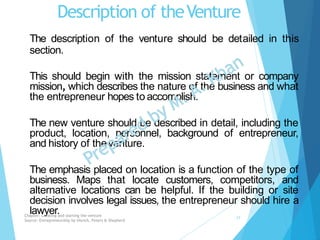
Description of theVenture
The description of the venture should be detailed in this
section.
This should begin with the mission statement or company
mission, which describes the nature of the business and what
the entrepreneur hopes to accomplish.
The new venture should be described in detail, including the
product, location, personnel, background of entrepreneur,
and history of theventure.
The emphasis placed on location is a function of the type of
business. Maps that locate customers, competitors, and
alternative locations can be helpful. If the building or site
decision involves legal issues, the entrepreneur should hire a
lawyer.Chapter: Creating and starting the venture
Source: Entrepreneurship by Hisrich, Peters & Shepherd
17
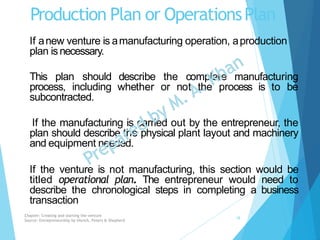
Production Plan or OperationsPlan
If anew venture is amanufacturing operation, aproduction
plan is necessary.
describe the complete manufacturing
whether or not the process is to be
This plan should
process, including
subcontracted.
If the manufacturing is carried out by the entrepreneur, the
plan should describe the physical plant layout and machinery
and equipment needed.
If the venture is not manufacturing, this section would be
titled operational plan. The entrepreneur would need to
describe the chronological steps in completing a business
transaction
Chapter: Creating and starting the venture
Source: Entrepreneurship by Hisrich, Peters & Shepherd
18
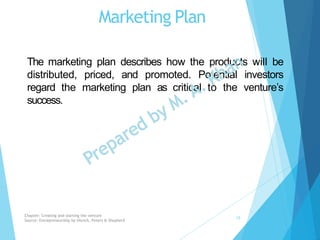
Marketing Plan
The marketing plan describes how the products will be
distributed, priced, and promoted. Potential investors
regard the marketing plan as critical to the venture’s
success.
Chapter: Creating and starting the venture
Source: Entrepreneurship by Hisrich, Peters & Shepherd
19
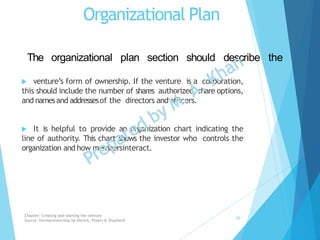
Organizational Plan
 venture’s form of ownership. If the venture is a corporation,
this should include the number of shares authorized, share options,
and namesand addressesof the directors andofficers.
 It is helpful to provide an organization chart indicating the
line of authority. This chart shows the investor who controls the
organization and how membersinteract.
The organizational plan section should describe the
Chapter: Creating and starting the venture
Source: Entrepreneurship by Hisrich, Peters & Shepherd
20
Assessment ofRisk
It is important that the entrepreneur make an assessment of
risk in the following manner: The entrepreneur should
indicate the potential risks to the new venture.
Next should be a discussion of what might happen if these
risks become reality.
Finally the entrepreneur should discuss the strategy to
prevent, minimize, or respond tothese risks.
The entrepreneur should also provide alternative strategies
should these risk factorsoccurChapter: Creating and starting the venture
Source: Entrepreneurship by Hisrich, Peters & Shepherd
21
FinancialPlan
The financial plan determines the investment needed for the
new venture and indicates whether the business plan is
economically feasible. The entrepreneur should summarize
the forecasted sales and expenses for the first three years.
Cash flow figure for three years are needed, with the first
year’s projections provided monthly. The projected balance
sheet shows the financial condition of the business at a
specific time.
Chapter: Creating and starting the venture
Source: Entrepreneurship by Hisrich, Peters & Shepherd
22
USING AND IMPLEMENTING THEBUSINESSPLAN
Thebusinessplan is designed to guide the entrepreneur through the first yearof
operations.
•It should contain control points to ascertain progress.
•Planning should be a part of any business operation. Without good planning the
employees will not understand the company’s goals and how they are expected
to perform theirjobs.
•Bankerssaythat most businessesfail becauseof the entrepreneur’s inability to
plan effectively.
•The entrepreneur can enhance efficient implementation of the plan by
developing aschedule to measure programs and to institute contingencyplans.
Chapter: Creating and starting the venture
Source: Entrepreneurship by Hisrich, Peters & Shepherd
23
Measuring Plan Progress
Plan projections will typically be made on a 12-month schedule, but the
entrepreneur should check keyareasmore frequently.
Inventory control by controlling inventory, the firm can ensure maximum
service to the customer. Production control Compare the cost figures
against day-to-day operatingcosts.
1. Quality control Quality control depends on the type of production
system used.
2. Salescontrol Information on units, dollars, and specific productssold
should be collected.
3. expenditures.
4. Thenew venture should control the amount of money paid out
Chapter: Creating and starting the venture
Source: Entrepreneurship by Hisrich, Peters & Shepherd
24
WHY SOME BUSINESS PLANSFAIL
Apoorly prepared business plan canbe blamed on:
•Goalsset by the entrepreneurs that areunreasonable.
•Goalsthose are not measurable.
Tobesuccessful
•Goalsshould be specific.
•Theyshould also be measurable and should be monitored over time.
The entrepreneur who has not made a total commitment to the business
will not be able to meet the venture’s demands of the venture. Investors
will not be positive about a venture that does not have full-time
commitment. Investors will typically expect the entrepreneur to make
significant financial commitment to the business. Lack of experience will
result in failure unless the entrepreneur can gain knowledge or team up
with someone. The entrepreneur should also document customer needs
before preparing the planChapter: Creating and starting the venture
Source: Entrepreneurship by Hisrich, Peters & Shepherd
25

Creating and starting the venture

  • 1.
  • 2.
    PLANNING AS PARTOFTHEBUSINESSOPERATION Planningis a process that never ends. In the early stages, the entrepreneur should prepare a preliminary plan. The plan will be finalized asthe enterprise develops. Many different types of plans may be part of any business operation-financial, marketing, production, and salesplans. Plans may be short term or long term, or they may be strategic or operational. All of these plans have one purpose: to provide guidance and structure to management in a rapidly changing market environment. Chapter: Creating and starting the venture Source: Entrepreneurship by Hisrich, Peters & Shepherd 2
  • 3.
    WHAT IS THEBUSINESSPLAN Abusiness plan is a written document prepared by the entrepreneur that describes all the relevant external and internal elements involved in starting anewventure. It addresses both short- and long -term decision making. The business plan is like aroad map for the business’development. TheInternet also provides outlines for businessplanning. Entrepreneurs can also hire or offer equity to another person to provide expertise in preparing the business plan. In developing the business plan the entrepreneur can determine how much money will be needed from new and existingsources. Chapter: Creating and starting the venture Source: Entrepreneurship by Hisrich, Peters & Shepherd 3
  • 4.
    WHO SHOULD WRITETHEPLAN Thebusinessplan should be prepared by the entrepreneur; however, he or shemayconsult manysources. Lawyers,accountants, marketing consultants, and engineers are useful supplemental sources. Other resources are the Small Business Administration, Service Core of Retired Executives, Small Business Development Centers, universities, friends, andrelatives. To help determine whether to hire a consultant, the entrepreneur needs to makean objective assessmentof his orher own skills. Chapter: Creating and starting the venture Source: Entrepreneurship by Hisrich, Peters & Shepherd 4
  • 5.
    SCOPEAND VALUEOFTHEBUSINESS PLAN WHOREADS THEPLAN Thebusinessplan must be comprehensive enough to addressthe concerns of employees, investors, bankers, venture capitalists, suppliers, and customers. Three perspectives need to beconsidered: 1. The entrepreneur understands the new venture better than anyone. 2. 3. The marketing perspective considers the venture through the eyes of the customer. The investor looks for sound financial projections. The depth of the business plan depends on the size and scope of the proposed venture. Thebusinessplan is valuable to the entrepreneur and investorsbecause: It helps determine the feasibility of the venture in adesignated market. Chapter: Creating and starting the venture Source: Entrepreneurship by Hisrich, Peters & Shepherd 5
  • 6.
    Continued……….. Thebusiness plan isvaluable to the entrepreneur and investors because: 1. It helps determine the feasibility of the venture in a designated market. 2. It gives guidance in organizing planningactivities. 3. It serves as an important tool in obtaining financing. Potential investors are very particular about what should be included in the plan. The process of developing a business plan also provides aself-assessmentof the entrepreneur. Chapter: Creating and starting the venture Source: Entrepreneurship by Hisrich, Peters & Shepherd 6
  • 7.
    HOW DO POTENTIALLENDERSANDINVESTORS EVALUATETHEPLAN Potential suppliers of capital will vary in their needs and requirements in the business plan. Lenders are primarily interested in the ability of the new venture to pay back the debt and focus on the four C’sofcredit: 1. Theentrepreneur’s credit history or character. 2. Their ability to meet debt and interest payments (cash flow.) 3. Thecollateral or tangible assetsbeing secured. 4. Equity contribution or the amount of personal equity that hasbeen invested by the entrepreneur. Chapter: Creating and starting the venture Source: Entrepreneurship by Hisrich, Peters & Shepherd 7
  • 8.
    PRESENTING THEPLAN It isoften necessary for an entrepreneur to orally present the business plan to investors. Typically the entrepreneur provides a short (10 -20 minutes) presentation of the business plan. The entrepreneur must sell their business concept in a short time period. A venture capitalist or angel group may also ask the entrepreneur to present the plan to their partners before making afinal decision. 1. Toidentify information needsand sourcesfor businessplanning. 2. To enhance awareness of the ability of the Internet as an information resource and marketingtool 3. Topresent helpful questions for the entrepreneur at eachstageof the planningprocess. 4. Tounderstand how to monitor the businessplan Chapter: Creating and starting the venture Source: Entrepreneurship by Hisrich, Peters & Shepherd 8
  • 9.
    INFORMATION NEEDS Before preparinga business plan, the entrepreneur should do a quick feasibility study to see if there are possible barriers to success. The entrepreneur should clearly define the venture’s goals, which provide a framework for the business plan. The businessplan must reflect reasonablegoals. Market Information It is important to know the market potential for the product or service. The first step is to define the market. A well-defined target market makes it easier to project market size and market goals. To assess the total market potential, the entrepreneur can use trade associations, government reports, and publishedstudies. Chapter: Creating and starting the venture Source: Entrepreneurship by Hisrich, Peters & Shepherd 9
  • 10.
    Continued…… Operations Information Needs Theentrepreneurmay need information on: •Location •Manufacturing operations •Rawmaterials •Equipment •Laborskills •Space •operating cost Eachitem may require some research but is needed by those who will assessthe businessplan. Chapter: Creating and starting the venture Source: Entrepreneurship by Hisrich, Peters & Shepherd 10
  • 11.
    Continued……. Financial Information Needs Beforepreparing the plan, the entrepreneur must evaluate the profitability of the venture through the following: 1. Expected salesand expensefigures for the first three years 2. Cashflow figures for the first threeyears 3. Current balance sheets and pro forma balance sheets for the next three years Determination of expected sales and expenses is based on the market information gathered earlier. Estimates of cash flow will consider the ability of the new venture to meet expenses at designated times. Current balance sheet figures show the assets, liabilities, and investments made by the owner. Chapter: Creating and starting the venture Source: Entrepreneurship by Hisrich, Peters & Shepherd 11
  • 12.
    USING THEINTERNETAS ARESOURCETOOL Thanks to technology, entrepreneurs are able to access information efficiently, expediently, and at very little cost. The Internet can serve as an important source of information in preparing the businessplan. Information on industry analysis, competitor analysis, and measurement of market potential canbelocated. In addition, the Internet also provides opportunities for actually marketing the new venture’s products. A web site, or home page, typically describes a firm’s history, existing products, background of the founders, and other information tocreate afavorable image. Chapter: Creating and starting the venture Source: Entrepreneurship by Hisrich, Peters & Shepherd 12
  • 13.
    Continued…….. Theweb site canbeavehicle for advertising or fordirect marketing. Many new ventures useweb pagesto increase salescontacts and reach potential customers. An entrepreneur can also access competitors’ web sites to gain knowledgeof their strategy in the marketplace. To gather information anonymously the entrepreneur can also investigate newsgroups. All that is needed to use these sources is a small investment in hardware andsoftware. Chapter: Creating and starting the venture Source: Entrepreneurship by Hisrich, Peters & Shepherd 13
  • 14.
    WRITI NG THEBUSINESSPLAN Thebusiness plan should be comprehensive enough to give a potential investor a complete understanding of the venture Introductory Page Thetitle pageprovides abrief summary of the business plan’s contents, and should include: 1. Thename and address of the company 2. Thename of the entrepreneur and atelephonenumber 3. A paragraph describing the company and the nature of the business 4. Theamount of financing needed 5. Astatement of the confidentiality of the report It also sets out the basic concept that the entrepreneur is attempting todevelop.Chapter: Creating and starting the venture Source: Entrepreneurship by Hisrich, Peters & Shepherd 14
  • 15.
    Executive Summary This isprepared after the total plan is written. It should be one to two pages in length and should highlight the key points in the businessplan. The summary should highlight in a concise manner the key points in the business plan. Issues that should be addressed include: 1. Brief description of the businessconcept 2. Any data that support the opportunity for the venture. 3. Statement of you this opportunity willbe pursued. 4. Highlight some key financial results that can be achieved Because of the limited scope of the summary, the entrepreneur should ascertain what is important to the audience to whom theplan is directed. Chapter: Creating and starting the venture Source: Entrepreneurship by Hisrich, Peters & Shepherd 15
  • 16.
    Environmental and IndustryAnalysis Theentrepreneur should first conduct an environmental analysis to identify trends and changes occurring on a national and international level that may impact the new venture. Examplesof environmental factorsare: Economy Culture Technology Legal concerns All of the above external factors are generally uncontrollable Next the entrepreneur should conduct an industry analysis that focuses on specific industrytrends. Some examples of industry analysis : SWOT,PEST,STEER, PORTERfive forces…….. Chapter: Creating and starting the venture Source: Entrepreneurship by Hisrich, Peters & Shepherd 16
  • 17.
    Description of theVenture Thedescription of the venture should be detailed in this section. This should begin with the mission statement or company mission, which describes the nature of the business and what the entrepreneur hopes to accomplish. The new venture should be described in detail, including the product, location, personnel, background of entrepreneur, and history of theventure. The emphasis placed on location is a function of the type of business. Maps that locate customers, competitors, and alternative locations can be helpful. If the building or site decision involves legal issues, the entrepreneur should hire a lawyer.Chapter: Creating and starting the venture Source: Entrepreneurship by Hisrich, Peters & Shepherd 17
  • 18.
    Production Plan orOperationsPlan If anew venture is amanufacturing operation, aproduction plan is necessary. describe the complete manufacturing whether or not the process is to be This plan should process, including subcontracted. If the manufacturing is carried out by the entrepreneur, the plan should describe the physical plant layout and machinery and equipment needed. If the venture is not manufacturing, this section would be titled operational plan. The entrepreneur would need to describe the chronological steps in completing a business transaction Chapter: Creating and starting the venture Source: Entrepreneurship by Hisrich, Peters & Shepherd 18
  • 19.
    Marketing Plan The marketingplan describes how the products will be distributed, priced, and promoted. Potential investors regard the marketing plan as critical to the venture’s success. Chapter: Creating and starting the venture Source: Entrepreneurship by Hisrich, Peters & Shepherd 19
  • 20.
    Organizational Plan  venture’sform of ownership. If the venture is a corporation, this should include the number of shares authorized, share options, and namesand addressesof the directors andofficers.  It is helpful to provide an organization chart indicating the line of authority. This chart shows the investor who controls the organization and how membersinteract. The organizational plan section should describe the Chapter: Creating and starting the venture Source: Entrepreneurship by Hisrich, Peters & Shepherd 20
  • 21.
    Assessment ofRisk It isimportant that the entrepreneur make an assessment of risk in the following manner: The entrepreneur should indicate the potential risks to the new venture. Next should be a discussion of what might happen if these risks become reality. Finally the entrepreneur should discuss the strategy to prevent, minimize, or respond tothese risks. The entrepreneur should also provide alternative strategies should these risk factorsoccurChapter: Creating and starting the venture Source: Entrepreneurship by Hisrich, Peters & Shepherd 21
  • 22.
    FinancialPlan The financial plandetermines the investment needed for the new venture and indicates whether the business plan is economically feasible. The entrepreneur should summarize the forecasted sales and expenses for the first three years. Cash flow figure for three years are needed, with the first year’s projections provided monthly. The projected balance sheet shows the financial condition of the business at a specific time. Chapter: Creating and starting the venture Source: Entrepreneurship by Hisrich, Peters & Shepherd 22
  • 23.
    USING AND IMPLEMENTINGTHEBUSINESSPLAN Thebusinessplan is designed to guide the entrepreneur through the first yearof operations. •It should contain control points to ascertain progress. •Planning should be a part of any business operation. Without good planning the employees will not understand the company’s goals and how they are expected to perform theirjobs. •Bankerssaythat most businessesfail becauseof the entrepreneur’s inability to plan effectively. •The entrepreneur can enhance efficient implementation of the plan by developing aschedule to measure programs and to institute contingencyplans. Chapter: Creating and starting the venture Source: Entrepreneurship by Hisrich, Peters & Shepherd 23
  • 24.
    Measuring Plan Progress Planprojections will typically be made on a 12-month schedule, but the entrepreneur should check keyareasmore frequently. Inventory control by controlling inventory, the firm can ensure maximum service to the customer. Production control Compare the cost figures against day-to-day operatingcosts. 1. Quality control Quality control depends on the type of production system used. 2. Salescontrol Information on units, dollars, and specific productssold should be collected. 3. expenditures. 4. Thenew venture should control the amount of money paid out Chapter: Creating and starting the venture Source: Entrepreneurship by Hisrich, Peters & Shepherd 24
  • 25.
    WHY SOME BUSINESSPLANSFAIL Apoorly prepared business plan canbe blamed on: •Goalsset by the entrepreneurs that areunreasonable. •Goalsthose are not measurable. Tobesuccessful •Goalsshould be specific. •Theyshould also be measurable and should be monitored over time. The entrepreneur who has not made a total commitment to the business will not be able to meet the venture’s demands of the venture. Investors will not be positive about a venture that does not have full-time commitment. Investors will typically expect the entrepreneur to make significant financial commitment to the business. Lack of experience will result in failure unless the entrepreneur can gain knowledge or team up with someone. The entrepreneur should also document customer needs before preparing the planChapter: Creating and starting the venture Source: Entrepreneurship by Hisrich, Peters & Shepherd 25