Salsa Music:
The music of the people
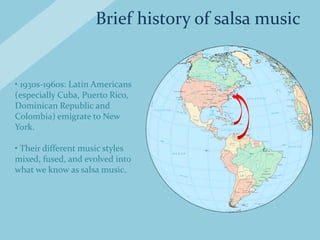
Brief history of salsa music
• 1930s-1960s: Latin Americans
(especially Cuba, Puerto Rico,
Dominican Republic and
Colombia) emigrate to New
York.
• Their different music styles
mixed, fused, and evolved into
what we know as salsa music.
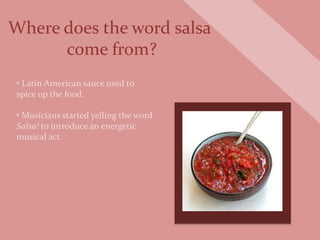
Where does the word salsa
come from?
• Latin American sauce used to
spice up the food.
• Musicians started yelling the word
Salsa! to introduce an energetic
musical act.
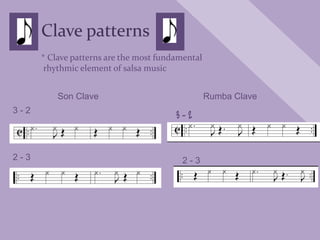
Clave patterns
* Clave patterns are the most fundamental
rhythmic element of salsa music
Son Clave Rumba Clave
3 - 2
2 - 3 2 - 3
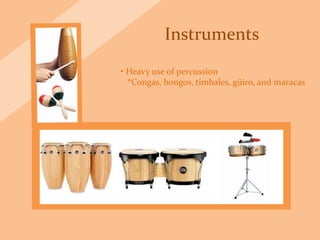
Instruments
• Heavy use of percussion
*Congas, bongos, timbales, güiro, and maracas
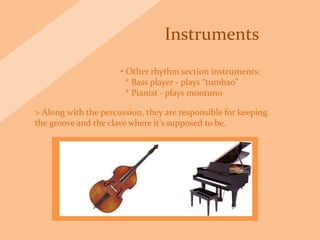
Instruments
• Other rhythm section instruments:
* Bass player - plays “tumbao”
* Pianist - plays montuno
> Along with the percussion, they are responsible for keeping
the groove and the clave where it’s supposed to be.
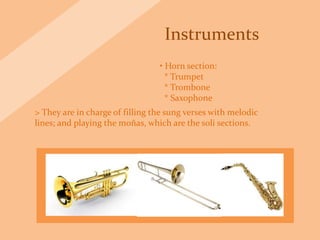
Instruments
• Horn section:
* Trumpet
* Trombone
* Saxophone
> They are in charge of filling the sung verses with melodic
lines; and playing the moñas, which are the soli sections.
Instruments
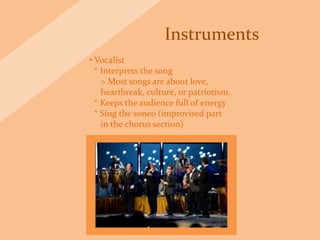
• Vocalist
* Interprets the song
> Most songs are about love,
heartbreak, culture, or patriotism.
* Keeps the audience full of energy
* Sing the soneo (improvised part
in the chorus section)
Instruments
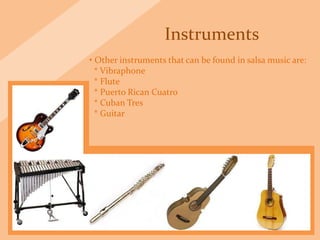
• Other instruments that can be found in salsa music are:
* Vibraphone
* Flute
* Puerto Rican Cuatro
* Cuban Tres
* Guitar
Music structure
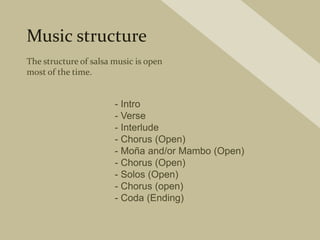
The structure of salsa music is open
most of the time.
- Intro
- Verse
- Interlude
- Chorus (Open)
- Moña and/or Mambo (Open)
- Chorus (Open)
- Solos (Open)
- Chorus (open)
- Coda (Ending)
Music structure
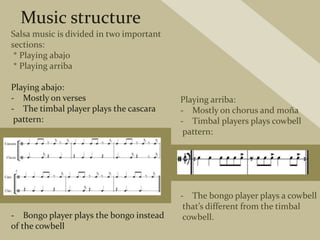
Salsa music is divided in two important
sections:
* Playing abajo
* Playing arriba
Playing abajo:
- Mostly on verses
- The timbal player plays the cascara
pattern:
- Bongo player plays the bongo instead
of the cowbell
Playing arriba:
- Mostly on chorus and moña
- Timbal players plays cowbell
pattern:
- The bongo player plays a cowbell
that’s different from the timbal
cowbell.
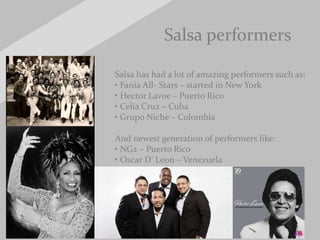
Salsa performers
Salsa has had a lot of amazing performers such as:
• Fania All- Stars – started in New York
• Hector Lavoe – Puerto Rico
• Celia Cruz – Cuba
• Grupo Niche – Colombia
And newest generation of performers like:
• NG2 – Puerto Rico
• Oscar D’ Leon – Venezuela
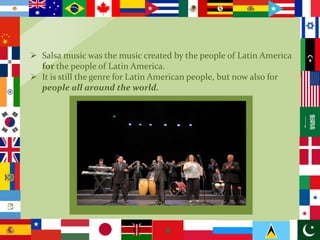
 Salsa music was the music created by the people of Latin America
for the people of Latin America.
 It is still the genre for Latin American people, but now also for
people all around the world.

Salsa music

  • 1.
  • 2.
    Brief history ofsalsa music • 1930s-1960s: Latin Americans (especially Cuba, Puerto Rico, Dominican Republic and Colombia) emigrate to New York. • Their different music styles mixed, fused, and evolved into what we know as salsa music.
  • 3.
    Where does theword salsa come from? • Latin American sauce used to spice up the food. • Musicians started yelling the word Salsa! to introduce an energetic musical act.
  • 4.
    Clave patterns * Clavepatterns are the most fundamental rhythmic element of salsa music Son Clave Rumba Clave 3 - 2 2 - 3 2 - 3
  • 5.
    Instruments • Heavy useof percussion *Congas, bongos, timbales, güiro, and maracas
  • 6.
    Instruments • Other rhythmsection instruments: * Bass player - plays “tumbao” * Pianist - plays montuno > Along with the percussion, they are responsible for keeping the groove and the clave where it’s supposed to be.
  • 7.
    Instruments • Horn section: *Trumpet * Trombone * Saxophone > They are in charge of filling the sung verses with melodic lines; and playing the moñas, which are the soli sections.
  • 8.
    Instruments • Vocalist * Interpretsthe song > Most songs are about love, heartbreak, culture, or patriotism. * Keeps the audience full of energy * Sing the soneo (improvised part in the chorus section)
  • 9.
    Instruments • Other instrumentsthat can be found in salsa music are: * Vibraphone * Flute * Puerto Rican Cuatro * Cuban Tres * Guitar
  • 10.
    Music structure The structureof salsa music is open most of the time. - Intro - Verse - Interlude - Chorus (Open) - Moña and/or Mambo (Open) - Chorus (Open) - Solos (Open) - Chorus (open) - Coda (Ending)
  • 11.
    Music structure Salsa musicis divided in two important sections: * Playing abajo * Playing arriba Playing abajo: - Mostly on verses - The timbal player plays the cascara pattern: - Bongo player plays the bongo instead of the cowbell Playing arriba: - Mostly on chorus and moña - Timbal players plays cowbell pattern: - The bongo player plays a cowbell that’s different from the timbal cowbell.
  • 12.
    Salsa performers Salsa hashad a lot of amazing performers such as: • Fania All- Stars – started in New York • Hector Lavoe – Puerto Rico • Celia Cruz – Cuba • Grupo Niche – Colombia And newest generation of performers like: • NG2 – Puerto Rico • Oscar D’ Leon – Venezuela
  • 13.
     Salsa musicwas the music created by the people of Latin America for the people of Latin America.  It is still the genre for Latin American people, but now also for people all around the world.