Stakeholder Relationships,
Social Responsibility, and
Corporate Governance
C H A P T E R 2
Relationships and Business
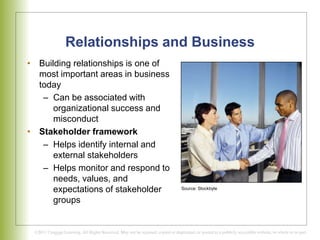
• Building relationships is one of
most important areas in business
today
– Can be associated with
organizational success and
misconduct
• Stakeholder framework
– Helps identify internal and
external stakeholders
– Helps monitor and respond to
needs, values, and
expectations of stakeholder
groups
Source: Stockbyte
What Is a Stakeholder?
• Stakeholders are those who have a stake or claim in
some aspect of a company’s products, operations,
markets, industry and outcomes
– Customers – Investors
– Employees – Suppliers
– Government agencies – Communities
• Stakeholders can influence and are influenced by
businesses
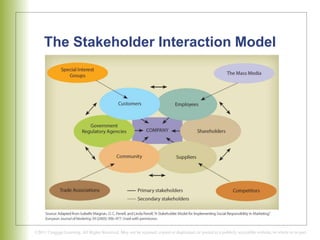
Primary vs. Secondary Stakeholders
• Primary stakeholders: Those whose continued
association is necessary for a firm’s survival
– Employees, customers, investors, governments
and communities
• Secondary stakeholders: Are not essential to a
company’s survival
– Media, trade associations, and special interest
groups
The Stakeholder Interaction Model
Stakeholder Orientation
• The degree to which a firm understands and
addresses stakeholder demands
• Three activities:
– Generation of data about
stakeholder groups
– Distribution of the information
throughout the firm
– Organization’s responsiveness
to this intelligence
Source: Digital Vision
Social Responsibility
• Is an organization’s obligation to maximize its positive
impact on stakeholders and minimize its negative
impact
• Four levels of social responsibility:
– Economic
– Legal
– Ethical
– Philanthropic
Source: Nancy Ney
Social Responsibility and the
Importance of Stakeholder Orientation
• From a social responsibility perspective, business
ethics embodies standards, norms, and expectations
that reflect concerns of major stakeholders
• Social responsibility is associated with:
– Increased profits
– Increased employee commitment
– Greater customer loyalty
Best and Worst Companies for Social
Responsibility
Social Responsibility and Ethics
• Social responsibility can be viewed as a contract
with society
• Business ethics involves carefully thought-out
rules (heuristics) of conduct that guide decision
making
The Steps of Social Responsibility
Corporate Citizenship
• The extent to which businesses strategically meet
their economic, legal, ethical, and philanthropic
responsibilities
• Four interrelated dimensions:
– Strong sustained economic performance
– Rigorous compliance
– Ethical actions beyond what is required by the law
– Voluntary contributions that advance reputation
and stakeholder commitment
Reputation
• Reputation is one of an organization’s
greatest intangible assets with tangible value
– Difficult to quantify,
but very important
Source: Digital Vision
The World’s Most Ethical Companies
Corporate Governance
• Formal systems of accountability, oversight, and
control
• Accountability
– Refers to how closely workplace decisions are
aligned with a firm’s stated strategic direction
• Oversight
– Provides a system of checks and balances that
limits employees and minimizes opportunities for
misconduct
• Control
– The process of auditing and improving
organizational decisions and actions
Common Corporate Governance
Issues
Corporate Governance Models
• Shareholder model
– Founded in classic economic precepts
– The maximization of wealth for investors and
owners
• Stakeholder model
– A broader view of the purpose of business
– Includes satisfying concerns of a variety of
stakeholders
Boards of Directors
• Hold final responsibility for their firms’
success, failure, and ethicality of actions
• Increased demands for accountability/
transparency
• Trend toward “outside directors” chosen for
expertise, competence, and strategic decision
making
• Executive compensation a large and growing
concern
Executive Compensation
• Many boards spend more time discussing
compensation than ensuring integrity of
financial reporting systems
– How closely linked is executive compensation to
company performance?
– Does performance-linked compensation
encourage executives to focus on short-term
performance at the expense of long-term growth?
Percentage of U.S. Workforce Who Feel
Executive Compensation Is Appropriate,
Based on Ethics Cultural Strength
Source: 2009 National Business Ethics Survey, Ethics Resource Center, p. 27
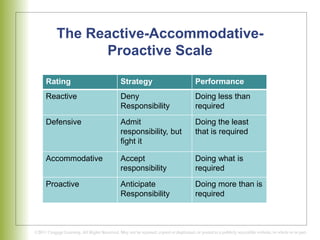
The Reactive-Accommodative-
Proactive Scale
Rating Strategy Performance
Reactive Deny
Responsibility
Doing less than
required
Defensive Admit
responsibility, but
fight it
Doing the least
that is required
Accommodative Accept
responsibility
Doing what is
required
Proactive Anticipate
Responsibility
Doing more than is
required
Implementing a Stakeholder
Perspective
1. Assessing the corporate culture
2. Identifying stakeholder groups
3. Identifying stakeholder issues
4. Assessing organizational commitment to
social responsibility
5. Identifying resources and determining
urgency
6. Gaining stakeholder feedback

etika-bisnis-2.ppt

  • 1.
    Stakeholder Relationships, Social Responsibility,and Corporate Governance C H A P T E R 2
  • 2.
    Relationships and Business •Building relationships is one of most important areas in business today – Can be associated with organizational success and misconduct • Stakeholder framework – Helps identify internal and external stakeholders – Helps monitor and respond to needs, values, and expectations of stakeholder groups Source: Stockbyte
  • 3.
    What Is aStakeholder? • Stakeholders are those who have a stake or claim in some aspect of a company’s products, operations, markets, industry and outcomes – Customers – Investors – Employees – Suppliers – Government agencies – Communities • Stakeholders can influence and are influenced by businesses
  • 4.
    Primary vs. SecondaryStakeholders • Primary stakeholders: Those whose continued association is necessary for a firm’s survival – Employees, customers, investors, governments and communities • Secondary stakeholders: Are not essential to a company’s survival – Media, trade associations, and special interest groups
  • 5.
  • 6.
    Stakeholder Orientation • Thedegree to which a firm understands and addresses stakeholder demands • Three activities: – Generation of data about stakeholder groups – Distribution of the information throughout the firm – Organization’s responsiveness to this intelligence Source: Digital Vision
  • 7.
    Social Responsibility • Isan organization’s obligation to maximize its positive impact on stakeholders and minimize its negative impact • Four levels of social responsibility: – Economic – Legal – Ethical – Philanthropic Source: Nancy Ney
  • 8.
    Social Responsibility andthe Importance of Stakeholder Orientation • From a social responsibility perspective, business ethics embodies standards, norms, and expectations that reflect concerns of major stakeholders • Social responsibility is associated with: – Increased profits – Increased employee commitment – Greater customer loyalty
  • 9.
    Best and WorstCompanies for Social Responsibility
  • 10.
    Social Responsibility andEthics • Social responsibility can be viewed as a contract with society • Business ethics involves carefully thought-out rules (heuristics) of conduct that guide decision making
  • 11.
    The Steps ofSocial Responsibility
  • 12.
    Corporate Citizenship • Theextent to which businesses strategically meet their economic, legal, ethical, and philanthropic responsibilities • Four interrelated dimensions: – Strong sustained economic performance – Rigorous compliance – Ethical actions beyond what is required by the law – Voluntary contributions that advance reputation and stakeholder commitment
  • 13.
    Reputation • Reputation isone of an organization’s greatest intangible assets with tangible value – Difficult to quantify, but very important Source: Digital Vision
  • 14.
    The World’s MostEthical Companies
  • 15.
    Corporate Governance • Formalsystems of accountability, oversight, and control • Accountability – Refers to how closely workplace decisions are aligned with a firm’s stated strategic direction • Oversight – Provides a system of checks and balances that limits employees and minimizes opportunities for misconduct • Control – The process of auditing and improving organizational decisions and actions
  • 16.
  • 17.
    Corporate Governance Models •Shareholder model – Founded in classic economic precepts – The maximization of wealth for investors and owners • Stakeholder model – A broader view of the purpose of business – Includes satisfying concerns of a variety of stakeholders
  • 18.
    Boards of Directors •Hold final responsibility for their firms’ success, failure, and ethicality of actions • Increased demands for accountability/ transparency • Trend toward “outside directors” chosen for expertise, competence, and strategic decision making • Executive compensation a large and growing concern
  • 19.
    Executive Compensation • Manyboards spend more time discussing compensation than ensuring integrity of financial reporting systems – How closely linked is executive compensation to company performance? – Does performance-linked compensation encourage executives to focus on short-term performance at the expense of long-term growth?
  • 20.
    Percentage of U.S.Workforce Who Feel Executive Compensation Is Appropriate, Based on Ethics Cultural Strength Source: 2009 National Business Ethics Survey, Ethics Resource Center, p. 27
  • 21.
    The Reactive-Accommodative- Proactive Scale RatingStrategy Performance Reactive Deny Responsibility Doing less than required Defensive Admit responsibility, but fight it Doing the least that is required Accommodative Accept responsibility Doing what is required Proactive Anticipate Responsibility Doing more than is required
  • 22.
    Implementing a Stakeholder Perspective 1.Assessing the corporate culture 2. Identifying stakeholder groups 3. Identifying stakeholder issues 4. Assessing organizational commitment to social responsibility 5. Identifying resources and determining urgency 6. Gaining stakeholder feedback

Editor's Notes

  • #21 It is clear from this figure that employee satisfaction over executive pay greatly improves as the strength of ethical culture improves. This is perhaps because incidences of ethical misconduct decrease in corporations with strong ethical cultures, making employees more satisfied and secure in their jobs.
  • #22 This model provides a method for assessing a company’s strategy and performance with each stakeholder group.