
Entrepreneur’s Toolkit :  www.marsdd.com/entrepreneurs-toolkit.html  HR Workbook 1: Building an A-Team HR Workbook 2: Compensation HR Workbook 3: HR at Work Creating an HR plan: Butteriss on human resources Building HR processes, policies and procedures Compensating employees Hiring your friends: Is it such a good idea? Video: Human Capital: Building high performance teams Video: Human Resources Management
Best Practices HR Series Finding, Managing and Compensating Your Sales Team Effectively
Agenda Why must companies pay attention to the sales function? Focus on the impact to the business. Tips on hiring and managing sales. Sales DNA; knowing what you need and then finding it. Tips on managing sales teams for effective results. Sales Compensation Strategy  Design  Implementation  Evaluation War stories and lessons learned. Sharing real stories from the field - what worked, what didn’t.
Why companies need to pay attention to the sales function…. One assumption: Your business needs to make money! If so, then this topic is of critical importance.
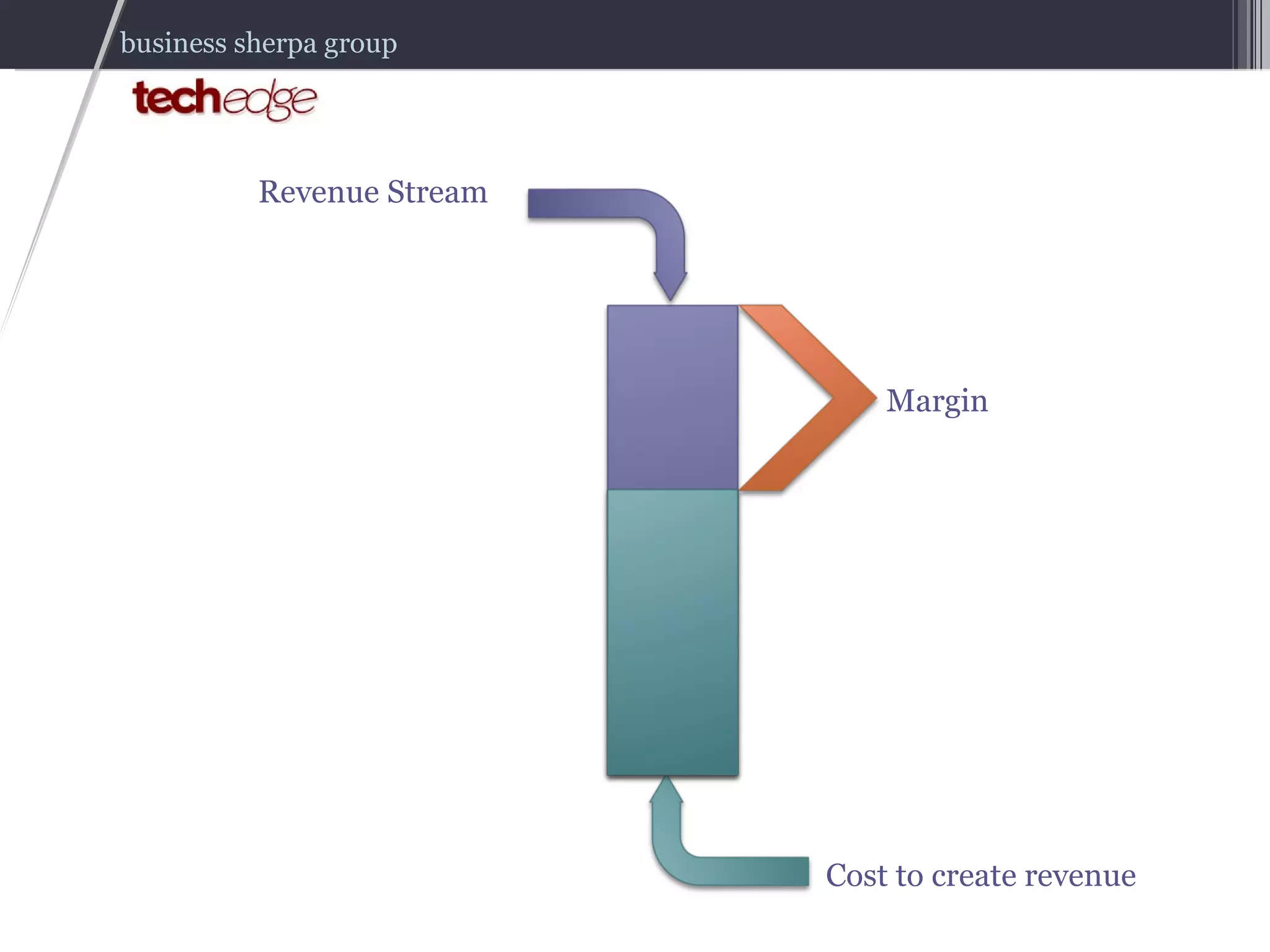
Revenue Stream Cost to create revenue Margin
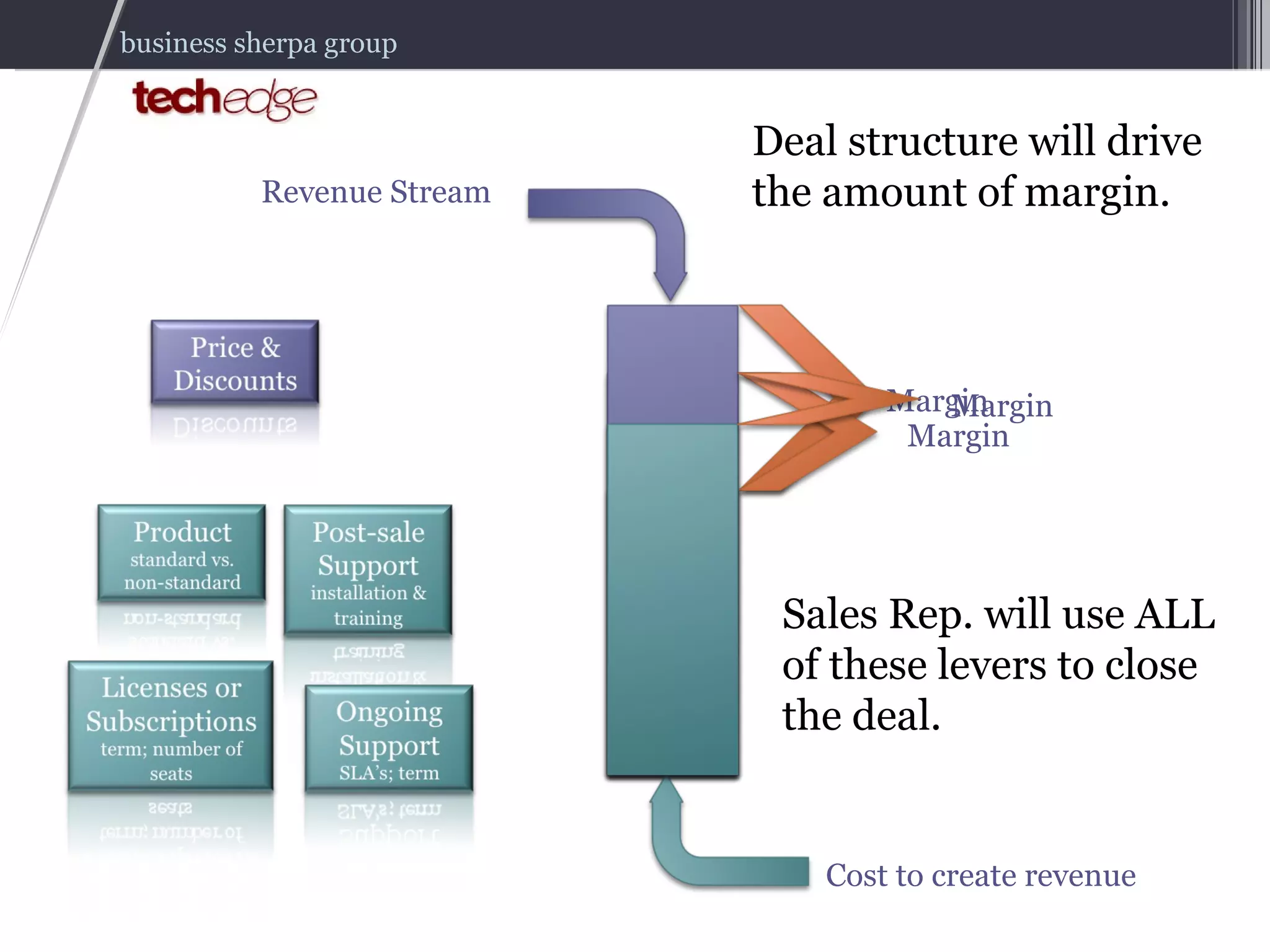
Revenue Stream Cost to create revenue Margin Deal structure will drive the amount of margin. Margin Margin Sales Rep. will use ALL of these levers to close the deal.
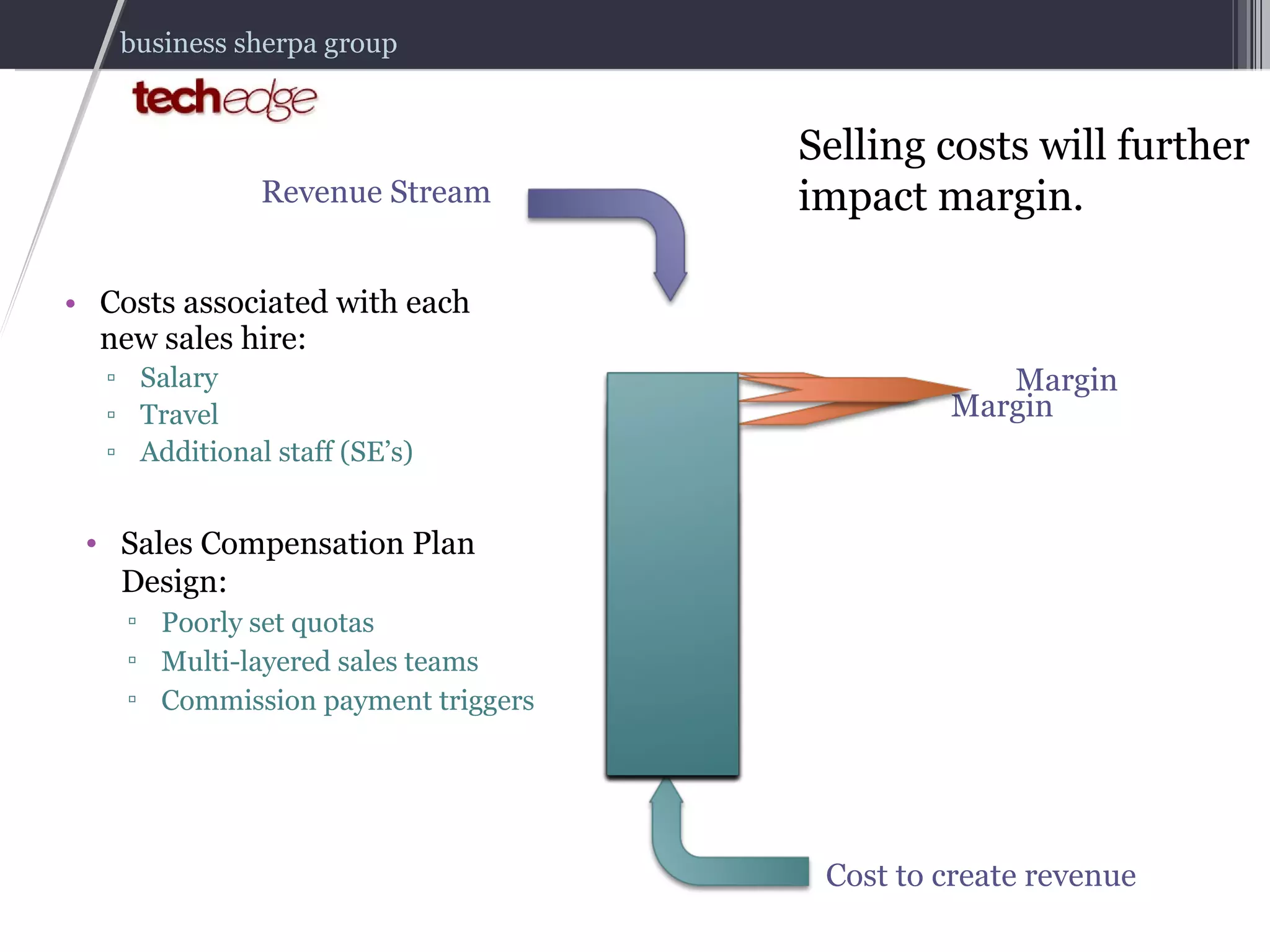
Costs associated with each new sales hire: Salary Travel Additional staff (SE’s) Revenue Stream Cost to create revenue Margin Selling costs will further impact margin. Margin Sales Compensation Plan Design: Poorly set quotas Multi-layered sales teams Commission payment triggers
Sales DNA Hunter Will sell what product you have now Will sell what is easiest Will drive to close deals Will use and overuse every lever available Will continually hunt out new business So will not focus on post-sales activities Will place lots of demands on your team to respond to customers wants/needs Compensation Features Higher ‘at risk’ pay Incentive based on quotas Revenue targets, or margin targets
Farmer Will milk additional sales from existing accounts Will not seek new accounts Will use levers to drive repeated sales Will operate more autonomously Will have more focus on post-sales support Values ongoing customer relationship Compensation Features Lower ‘at risk’ pay Incentive based on quotas Revenue targets, or margin targets More support/service revenues targets Sales DNA
Business Development Focus on early engagement & evangelizing Usually has a more technical background, or extensive sector experience Focused on building relationships; influencing strategic decisions Selling product and ideas at multiple levels Not driven to close a deal Relationship focused Usually after a target list of customers or partners May focus more on the ‘big fish’ Not uncovering every stone for new accounts Compensation Features May have no incentive, or low ‘at risk’ pay Incentive based on pre-sales milestones MOU’s Trials Partnering agreements Sales DNA
Channel Management Focus on developing sales through 3 rd  party channels Not focused on direct sales Compensation Features May have no incentive, or low ‘at risk’ pay Incentives based on revenue quotas achieved through channel partners Layered commission - $$ to channel manager & to channel partner Sales DNA
Very difficult to find one individual with multiple Sales DNA styles HOWEVER – as company’s needs change – you may need different sales DNA  Very expensive to have the wrong sales person in place Not just $$$, but highly distracting to the business and the team Must be prepared to make changes as necessary Sales DNA Challenges
How to hire the RIGHT sales person…. STEP 1 Know what you need to (or can) accomplish – the  GOAL Amount and timing of revenues required in your business plan (has it changed!)? Do you have something to sell…is the product ready? Is there a loss leader product? To drive adoption; create footprint; establish relationships Do you need partnerships or sales or both? STEP 2 Understand the  SELLING ECOSYSTEM Is it a complicated sale? Are there multiple influencers involved? Can have organizations that create demand but will not buy your product Can have organizations that will influence demand through technical standards,  regulatory environment, etc. Can have organizations that will buy your product, BUT will not buy directly from you and will only buy through partners or resellers
How to hire the RIGHT sales person…. STEP 3 Match the  SALES DNA  to the  GOAL  and the  SELLING ECOSYSTEM This will also help in designing an effective sales compensation plan STEP 4 Consider where the sales function should be located? Close to the customer Close to a regional hub Close to HQ STEP 5 Create a description that reflects all of the above Review session on Recruiting your A-team for tips on sourcing candidates
Tips on successfully interviewing for Sales What to find out about the candidate: Building a pipeline Success in closing deals Post-sales focus (or not) Sales team support needed Quota results Types of deals (size of deals, number of customers, types of customers) Hitting quotas Remember that these are sales professionals – very adept at convincing you they can achieve anything Must validate their claims Understand their personal drivers Key to determining a good match Will also help in designing an appropriate compensation plan Doing a 2 nd  interview is key; the candidate shifts from selling mode to asking mode Validate everything through references
Managing Sales Teams Effectively Requires a lot of maintenance!! Set and monitor clear targets Quotas – revenues; margins; etc. Milestones – must have meaningful value to the company Continually monitor results & pipeline – test credibility and assign appropriate probabilities Size of funnel 3:1 (depends on sector) When results don’t happen – understand why Wrong DNA for type of selling needed Market adoption of the product Availability of GA product Support to sales Changes in technology, regulatory environment, standards, competitive landscape, etc. Remember it is difficult to get different sales DNA in one person
Sales Compensation Linking the sales compensation plan to your business strategy Establishing the design team Assessing the existing plan (if required) Designing the new plan Implementing the new plan Evaluating results
Linking the Sales Compensation Plan to your Business Strategy Drive Desired Results: Sales objectives which support business plan Building customer faith Supporting revenue generation and profitability Incenting achievement of short term and long term goals
Understanding the Strategy Who?- Customers/Dealers What? - Specific Products & Services When?- Sales Cycle Where? - Competitive Environment Why? - Profitability, market share How? - By Customer? By Territory? by Product?
Balancing Business Objectives In-year objectives Sales volume goals Sales channel development profit targets % revenue growth specific customers specific products or services penetration of new markets keep salespeople focused Long term objectives Increasing shareholder value sustained profitability strategic customer or dealer base, customer loyalty improved market share product evolution retention of salespeople
Balance Revenue and Profit Margins - requirements and flexibility Meeting commitments to shareholders Affordability of incentive plan
2. Establishing the Design Team Sales & Marketing Finance HR Legal Possibly IT
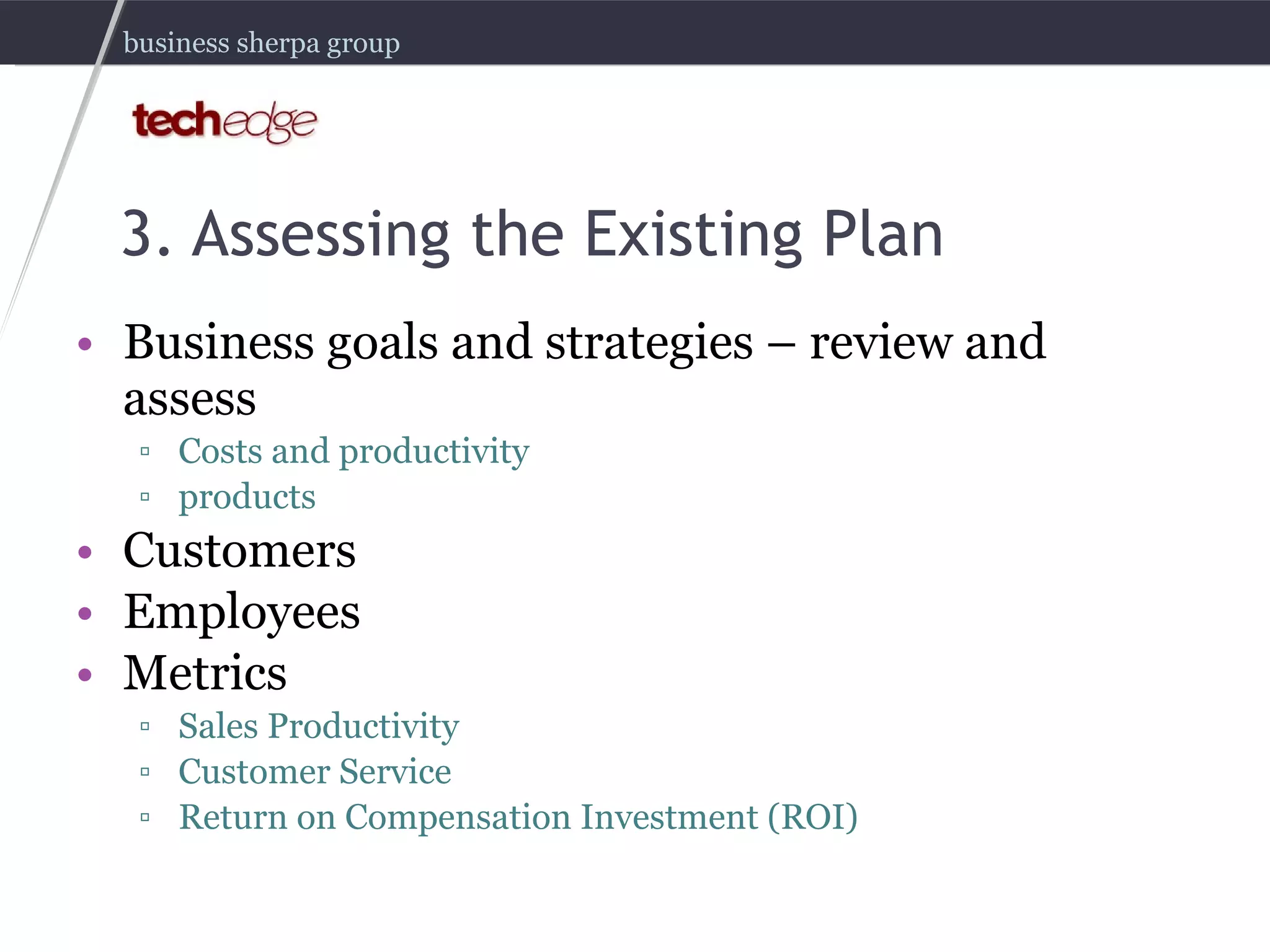
3. Assessing the Existing Plan Business goals and strategies – review and assess Costs and productivity products Customers Employees Metrics Sales Productivity Customer Service Return on Compensation Investment (ROI)
Design Elements Eligibility Mix/Leverage Total Target Compensation Performance Measures Incentive Formulas Formula features
Eligibility Sales vs Non-sales focus Technical, Administrative staff etc. Team vs Individual Bonus Senior management Executive or Sales Compensation?
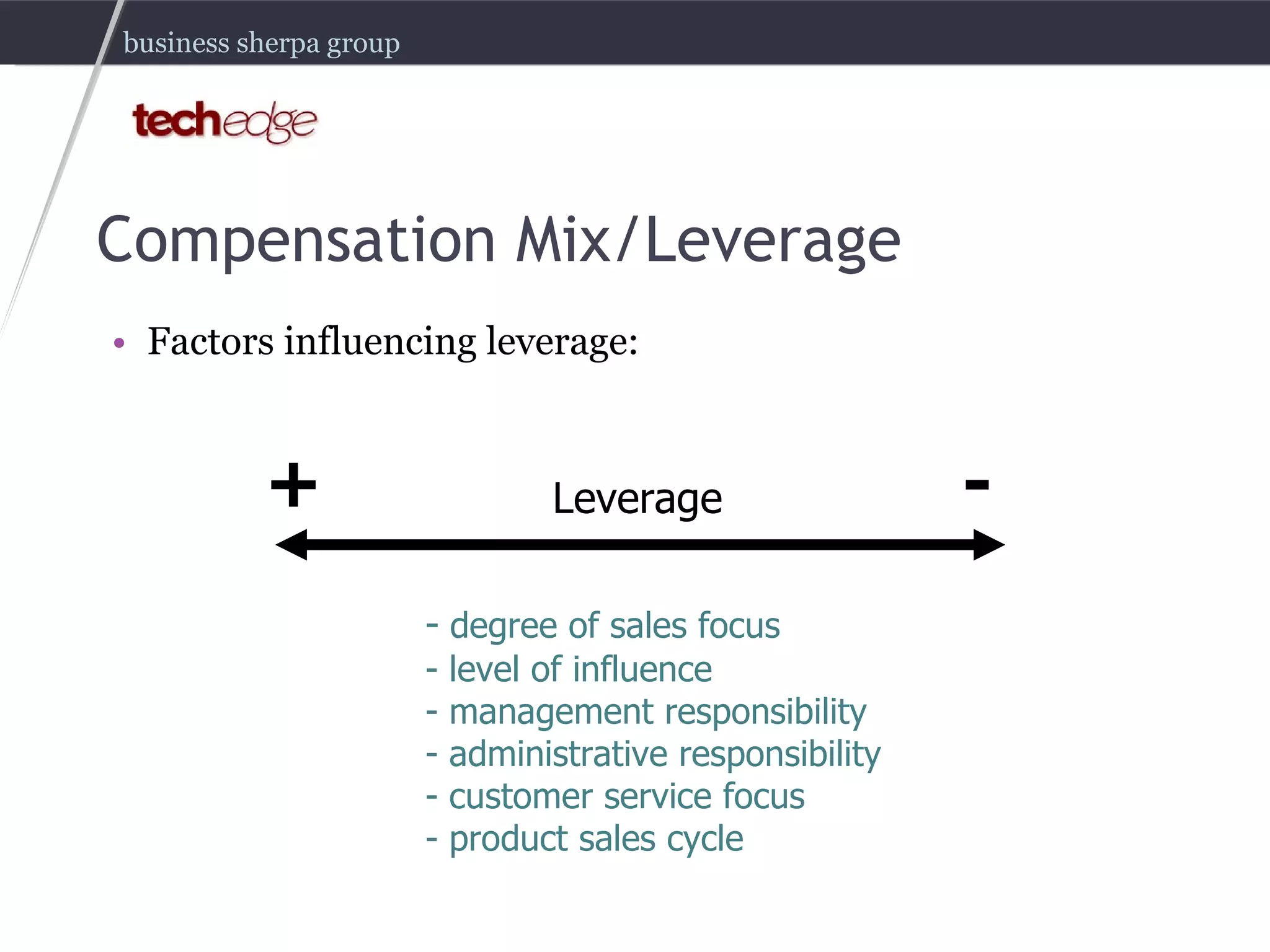
Compensation Mix/Leverage Factors influencing leverage: Leverage degree of sales focus level of influence management responsibility administrative responsibility customer service focus product sales cycle + -
Total Target Compensation Determine Organization’s compensation strategy Define job design and org structure  Slot employees into jobs Collect  relevant market data Focus on Total target compensation Create individual plans
Performance Measures Performance Measures – Sales staff Volume  Profitability Strategic Objectives – MBO
Incentive Formulas and Features Tie market data to the target incentive Determine incentive payout Performance measures by job level  Weightings by job level Accelerators by job level
Affordability - Cost Modeling Use financial ratios (profit margins by product, cost of sales etc) to determine affordability of plan design Finalize Accelerators, Performance measures and weightings
Terms and Conditions Eligibility Transfers Terminations Split credits House accounts Territory or  accounts changes Foreign currencies Pricing Adjustments to payments “ Out Clause”
Implementation Communication Plan Explain any new or revised changes to plans Updates on forecasting models, product, customer, employee changes Individual meetings Makes changes as required Administration Finance reports and payouts Quarterly updates
Evaluation Back to step # 3 “Assessing the existing plan” Performance Measures – Sales Plan Business goals and strategies – review and assess Costs and productivity products Customers Employees Metrics Sales Productivity Customer Service Return on Compensation Investment (ROI)
Driving Behaviour – Keys to Effective Sales Compensation Setting pre-revenue sales targets – must be milestones that create significant value in the eyes of board/investors Paying out incentives at end of year for more strategic roles:  gives more opportunity to build revenue stream and ‘afford’ the incentive payout allows time for success to be measured  For BD roles – make payment of incentive conditional upon closing a financing round  aligns to the goals of the whole team/company Higher ‘at risk’ pay plan design
Trends Cont’d Move to growth focus,  Move to more value-add solutions sales - not box products Sales staff want access to plan details and performance/incentive - not 3 months for statement. 3 or less performance measures - less is more HR and Finance working more closely - critical for evaluation of plan Improved modeling and testing
War Stories and Lessons Learned Lesson 1 Hiring pedigree over substance. Lesson 2 The Asian footprint – tread carefully. Lesson 3 Multi-layered sales teams – who really makes the deal happen?
War Stories and Lessons Learned Lesson 4 Think global – act local… Lesson 5 Quota nightmares – adjustments, windfalls, turnover… Lesson 6 Late Sales Contracts – meet your deadlines or…
Thank You! Questions?

Strategies for Managing Sales Teams: How to find, select and compensate these critical hires

  • 1.
  • 2.
    Entrepreneur’s Toolkit : www.marsdd.com/entrepreneurs-toolkit.html HR Workbook 1: Building an A-Team HR Workbook 2: Compensation HR Workbook 3: HR at Work Creating an HR plan: Butteriss on human resources Building HR processes, policies and procedures Compensating employees Hiring your friends: Is it such a good idea? Video: Human Capital: Building high performance teams Video: Human Resources Management
  • 3.
    Best Practices HRSeries Finding, Managing and Compensating Your Sales Team Effectively
  • 4.
    Agenda Why mustcompanies pay attention to the sales function? Focus on the impact to the business. Tips on hiring and managing sales. Sales DNA; knowing what you need and then finding it. Tips on managing sales teams for effective results. Sales Compensation Strategy Design Implementation Evaluation War stories and lessons learned. Sharing real stories from the field - what worked, what didn’t.
  • 5.
    Why companies needto pay attention to the sales function…. One assumption: Your business needs to make money! If so, then this topic is of critical importance.
  • 6.
    Revenue Stream Costto create revenue Margin
  • 7.
    Revenue Stream Costto create revenue Margin Deal structure will drive the amount of margin. Margin Margin Sales Rep. will use ALL of these levers to close the deal.
  • 8.
    Costs associated witheach new sales hire: Salary Travel Additional staff (SE’s) Revenue Stream Cost to create revenue Margin Selling costs will further impact margin. Margin Sales Compensation Plan Design: Poorly set quotas Multi-layered sales teams Commission payment triggers
  • 9.
    Sales DNA HunterWill sell what product you have now Will sell what is easiest Will drive to close deals Will use and overuse every lever available Will continually hunt out new business So will not focus on post-sales activities Will place lots of demands on your team to respond to customers wants/needs Compensation Features Higher ‘at risk’ pay Incentive based on quotas Revenue targets, or margin targets
  • 10.
    Farmer Will milkadditional sales from existing accounts Will not seek new accounts Will use levers to drive repeated sales Will operate more autonomously Will have more focus on post-sales support Values ongoing customer relationship Compensation Features Lower ‘at risk’ pay Incentive based on quotas Revenue targets, or margin targets More support/service revenues targets Sales DNA
  • 11.
    Business Development Focuson early engagement & evangelizing Usually has a more technical background, or extensive sector experience Focused on building relationships; influencing strategic decisions Selling product and ideas at multiple levels Not driven to close a deal Relationship focused Usually after a target list of customers or partners May focus more on the ‘big fish’ Not uncovering every stone for new accounts Compensation Features May have no incentive, or low ‘at risk’ pay Incentive based on pre-sales milestones MOU’s Trials Partnering agreements Sales DNA
  • 12.
    Channel Management Focuson developing sales through 3 rd party channels Not focused on direct sales Compensation Features May have no incentive, or low ‘at risk’ pay Incentives based on revenue quotas achieved through channel partners Layered commission - $$ to channel manager & to channel partner Sales DNA
  • 13.
    Very difficult tofind one individual with multiple Sales DNA styles HOWEVER – as company’s needs change – you may need different sales DNA Very expensive to have the wrong sales person in place Not just $$$, but highly distracting to the business and the team Must be prepared to make changes as necessary Sales DNA Challenges
  • 14.
    How to hirethe RIGHT sales person…. STEP 1 Know what you need to (or can) accomplish – the GOAL Amount and timing of revenues required in your business plan (has it changed!)? Do you have something to sell…is the product ready? Is there a loss leader product? To drive adoption; create footprint; establish relationships Do you need partnerships or sales or both? STEP 2 Understand the SELLING ECOSYSTEM Is it a complicated sale? Are there multiple influencers involved? Can have organizations that create demand but will not buy your product Can have organizations that will influence demand through technical standards, regulatory environment, etc. Can have organizations that will buy your product, BUT will not buy directly from you and will only buy through partners or resellers
  • 15.
    How to hirethe RIGHT sales person…. STEP 3 Match the SALES DNA to the GOAL and the SELLING ECOSYSTEM This will also help in designing an effective sales compensation plan STEP 4 Consider where the sales function should be located? Close to the customer Close to a regional hub Close to HQ STEP 5 Create a description that reflects all of the above Review session on Recruiting your A-team for tips on sourcing candidates
  • 16.
    Tips on successfullyinterviewing for Sales What to find out about the candidate: Building a pipeline Success in closing deals Post-sales focus (or not) Sales team support needed Quota results Types of deals (size of deals, number of customers, types of customers) Hitting quotas Remember that these are sales professionals – very adept at convincing you they can achieve anything Must validate their claims Understand their personal drivers Key to determining a good match Will also help in designing an appropriate compensation plan Doing a 2 nd interview is key; the candidate shifts from selling mode to asking mode Validate everything through references
  • 17.
    Managing Sales TeamsEffectively Requires a lot of maintenance!! Set and monitor clear targets Quotas – revenues; margins; etc. Milestones – must have meaningful value to the company Continually monitor results & pipeline – test credibility and assign appropriate probabilities Size of funnel 3:1 (depends on sector) When results don’t happen – understand why Wrong DNA for type of selling needed Market adoption of the product Availability of GA product Support to sales Changes in technology, regulatory environment, standards, competitive landscape, etc. Remember it is difficult to get different sales DNA in one person
  • 18.
    Sales Compensation Linkingthe sales compensation plan to your business strategy Establishing the design team Assessing the existing plan (if required) Designing the new plan Implementing the new plan Evaluating results
  • 19.
    Linking the SalesCompensation Plan to your Business Strategy Drive Desired Results: Sales objectives which support business plan Building customer faith Supporting revenue generation and profitability Incenting achievement of short term and long term goals
  • 20.
    Understanding the StrategyWho?- Customers/Dealers What? - Specific Products & Services When?- Sales Cycle Where? - Competitive Environment Why? - Profitability, market share How? - By Customer? By Territory? by Product?
  • 21.
    Balancing Business ObjectivesIn-year objectives Sales volume goals Sales channel development profit targets % revenue growth specific customers specific products or services penetration of new markets keep salespeople focused Long term objectives Increasing shareholder value sustained profitability strategic customer or dealer base, customer loyalty improved market share product evolution retention of salespeople
  • 22.
    Balance Revenue andProfit Margins - requirements and flexibility Meeting commitments to shareholders Affordability of incentive plan
  • 23.
    2. Establishing theDesign Team Sales & Marketing Finance HR Legal Possibly IT
  • 24.
    3. Assessing theExisting Plan Business goals and strategies – review and assess Costs and productivity products Customers Employees Metrics Sales Productivity Customer Service Return on Compensation Investment (ROI)
  • 25.
    Design Elements EligibilityMix/Leverage Total Target Compensation Performance Measures Incentive Formulas Formula features
  • 26.
    Eligibility Sales vsNon-sales focus Technical, Administrative staff etc. Team vs Individual Bonus Senior management Executive or Sales Compensation?
  • 27.
    Compensation Mix/Leverage Factorsinfluencing leverage: Leverage degree of sales focus level of influence management responsibility administrative responsibility customer service focus product sales cycle + -
  • 28.
    Total Target CompensationDetermine Organization’s compensation strategy Define job design and org structure Slot employees into jobs Collect relevant market data Focus on Total target compensation Create individual plans
  • 29.
    Performance Measures PerformanceMeasures – Sales staff Volume Profitability Strategic Objectives – MBO
  • 30.
    Incentive Formulas andFeatures Tie market data to the target incentive Determine incentive payout Performance measures by job level Weightings by job level Accelerators by job level
  • 31.
    Affordability - CostModeling Use financial ratios (profit margins by product, cost of sales etc) to determine affordability of plan design Finalize Accelerators, Performance measures and weightings
  • 32.
    Terms and ConditionsEligibility Transfers Terminations Split credits House accounts Territory or accounts changes Foreign currencies Pricing Adjustments to payments “ Out Clause”
  • 33.
    Implementation Communication PlanExplain any new or revised changes to plans Updates on forecasting models, product, customer, employee changes Individual meetings Makes changes as required Administration Finance reports and payouts Quarterly updates
  • 34.
    Evaluation Back tostep # 3 “Assessing the existing plan” Performance Measures – Sales Plan Business goals and strategies – review and assess Costs and productivity products Customers Employees Metrics Sales Productivity Customer Service Return on Compensation Investment (ROI)
  • 35.
    Driving Behaviour –Keys to Effective Sales Compensation Setting pre-revenue sales targets – must be milestones that create significant value in the eyes of board/investors Paying out incentives at end of year for more strategic roles: gives more opportunity to build revenue stream and ‘afford’ the incentive payout allows time for success to be measured For BD roles – make payment of incentive conditional upon closing a financing round aligns to the goals of the whole team/company Higher ‘at risk’ pay plan design
  • 36.
    Trends Cont’d Moveto growth focus, Move to more value-add solutions sales - not box products Sales staff want access to plan details and performance/incentive - not 3 months for statement. 3 or less performance measures - less is more HR and Finance working more closely - critical for evaluation of plan Improved modeling and testing
  • 37.
    War Stories andLessons Learned Lesson 1 Hiring pedigree over substance. Lesson 2 The Asian footprint – tread carefully. Lesson 3 Multi-layered sales teams – who really makes the deal happen?
  • 38.
    War Stories andLessons Learned Lesson 4 Think global – act local… Lesson 5 Quota nightmares – adjustments, windfalls, turnover… Lesson 6 Late Sales Contracts – meet your deadlines or…
  • 39.

Editor's Notes

  • #20 This is the number one reason why we would caution you against using “off the shelf” plan, or the plan that your Sales VP had at his/her last company. These are some of the key elements that have to be considered in designing any Sales Compensation Plan. You have to incent the right things. A good salesperson will do what they are incented to do. This can be a very positive thing, or not, depending on how well your plan is designed for your company. You need to be sure you’re are balancing all of the important factors in your plan design, because many counter each other. Example: You have an existing product that has a proven track record, established client base, and customers are comfortable with it. You are now basing your 5 year plan on replacing this old equipment with a new wireless product, complete with more features, more convenience, less downtime….. However, it will be a tougher sell, because people aren’t comfortable with the new technology, they are afraid of brain tumours, they don’t want to spend additional money on replacing their whole system, when they can put a bandaid on the old one for much less. If you have a simple volume sales plan, the salesperson will sell the old stuff - it’s faster, easier and more lucrative - that’s what you’re paying them to do. This would be a serious hindrance to the success of your new product, on which your future is riding.
  • #21 Who are your customers now? Who do you want them to be? Are you growing an existing client base, or turning to a whole new market segment? Will you sell through dealers? Do you have sales agreements already in place? What are you selling this year? Are they existing or new products? How expensive is the product? Is it a commonly accepted product in the marketplace, or leading edge? How long is the sales cycle? Is the product or service “boxed” or highly customized? - does it take 2 months or 2 years to finalize a sale? Where are you selling the product/service? Is it a growing market? A flat market? On a downward turn? How’s the economy generally? Do you have a time lead on a new product or technology? Who else has similar products, and who has the edge? Why? Why - self explanatory How will you sell the product? Through dealers or directly to the end user? Will salespeople have control over margins? Will you divide the objectives by region? By product? By customer? (job design)? How will you ensure that you don’t have 2 of your salespeople bidding against each other?
  • #22 You should always start with your long term business objectives and define your in-year objectives in support of these long term goals. Your in-year objectives should then drive your compensation plan design. We all know that both long and short term objectives change periodically, and this is why an off the shelf or inflexible plan design is often not an optimal solution. Your in-year objectives should always support your long term objectives Your Sales Comp Plan should support your in-year objectives.
  • #23 Always keep an eye on both revenue and profitability - make sure there are parameters around margin flexibility if there is any. Keep your eyes on how much the company is paying to bring in revenue - consider immediate and long term costs. Consider direct and indirect costs. Make sure your plan continues to provide value for money. Your plan needs to be affordable, while providing salespeople with market competitive pay levels. - Make sure it’s an investment, not an expense!
  • #24 Sales & Marketing management - to define the business goals and priorities Finance - guidance on financial issues - costing, what-if’s, ROI, affordability, payment process, tracking and monitoring, administration HR - market value of skills, driving behaviours, job/ organizational design, hiring plan Legal - ensure legality of plan design across regions Possibly IT - to implement or adapt specialized software if applicable.
  • #25 Is the plan doing what you want it to?