



A guide for people inspiring TDMs and
BDMs on the value of Microsoft solutions for
the business
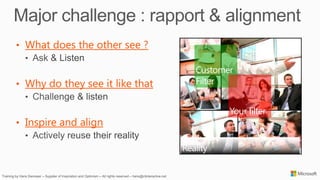
• What does the other see ?


• Why do they see it like that


• Inspire and align
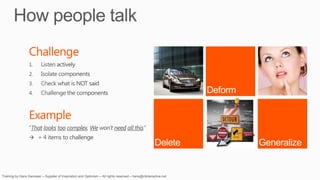
Listen
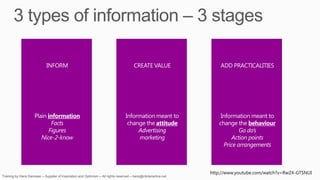
http://www.youtube.com/watch?v=RwZ4-GTSNUI
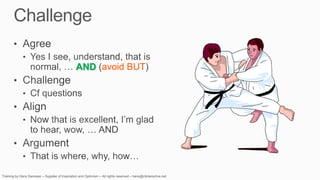
Challenge


Example
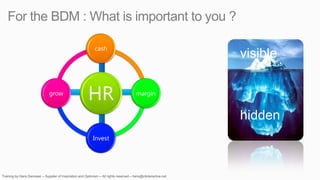
For the BDM : What is important to you ?

               cash
                                           visible

       grow
              HR       margin


                                           hidden
              Invest
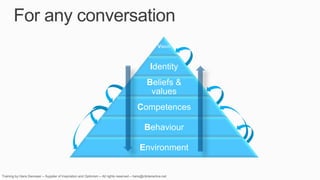
For any conversation
                   Vision


                 Identity
                Beliefs &
                 values
               Competences

                Behaviour

               Environment
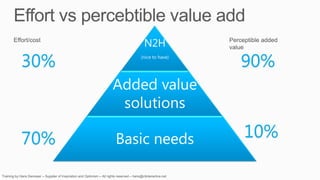
N2H
30%      (nice to have)
                          90%
      Added value
       solutions

70%   Basic needs         10%
AND avoid BUT
Sales training (focus on telesales)

Sales training (focus on telesales)

Editor's Notes

  • #3 When we talktopeople we talk about the oneand the samereality (IT in this case). Thisreality is seento different glassesbyeach of us. WE :We often approach itfrom a technical point of view. We followed training sessionsandknowwhat the solution candeliver in the future. We needto make a living out of selling the solutionsCUSTOMERS :Theydon’treally care about IT andifthey do, they look at itfrom a cost or value point of view. Theydidnot follow sessionsand do notknow the possibilities of IT.They are notinterested in what the solution can do forthem, but in whattheycan do with the solution. They do not have to make a living byselling IT. They have tospend money toacquireandoftenneed extra support fromustounderstandhowitwill help themto make a living more efficiently.
  • #12 It plays on all levelsPreviously : youhiredpeoplefortheiridentityandtheircompetencesandyoucould force themintobehaving the way the organizationprescribed in the delimited environment.Today : it is increasingly the environment and the subsequentbehaviour (beliefs) of the company that have toadaptto the competencesand the identities of the recruits (Y-gen)