Business Skills For
The 21st Century
© LenFoster.Com 2014 All rights reserved
len@lenfoster.co.uk
The 7 Stages of The Sales Process
Prospecting
Stage 1
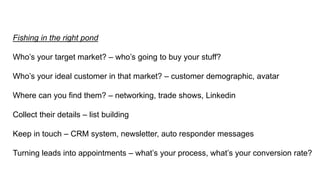
Fishing in the right pond
Who’s your target market? – who’s going to buy your stuff?
Who’s your ideal customer in that market? – customer demographic, avatar
Where can you find them? – networking, trade shows, Linkedin
Collect their details – list building
Keep in touch – CRM system, newsletter, auto responder messages
Turning leads into appointments – what’s your process, what’s your conversion rate?
Preparation
Stage 2
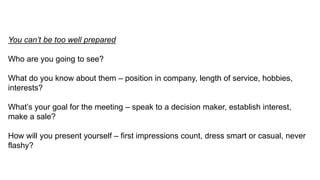
You can’t be too well prepared
Who are you going to see?
What do you know about them – position in company, length of service, hobbies,
interests?
What’s your goal for the meeting – speak to a decision maker, establish interest,
make a sale?
How will you present yourself – first impressions count, dress smart or casual, never
flashy?
Rapport
Stage 3
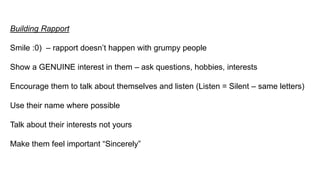
Building Rapport
Smile :0) – rapport doesn’t happen with grumpy people
Show a GENUINE interest in them – ask questions, hobbies, interests
Encourage them to talk about themselves and listen (Listen = Silent – same letters)
Use their name where possible
Talk about their interests not yours
Make them feel important “Sincerely”
Qualification
Stage 4
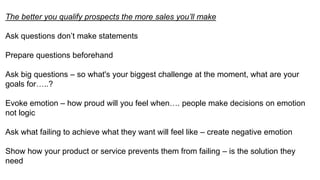
The better you qualify prospects the more sales you’ll make
Ask questions don’t make statements
Prepare questions beforehand
Ask big questions – so what's your biggest challenge at the moment, what are your
goals for…..?
Evoke emotion – how proud will you feel when…. people make decisions on emotion
not logic
Ask what failing to achieve what they want will feel like – create negative emotion
Show how your product or service prevents them from failing – is the solution they
need
Presentation
Stage 5
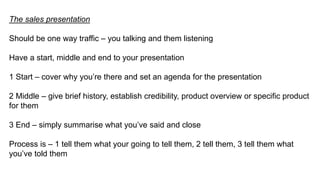
The sales presentation
Should be one way traffic – you talking and them listening
Have a start, middle and end to your presentation
1 Start – cover why you’re there and set an agenda for the presentation
2 Middle – give brief history, establish credibility, product overview or specific product
for them
3 End – simply summarise what you’ve said and close
Process is – 1 tell them what your going to tell them, 2 tell them, 3 tell them what
you’ve told them
Closing
Stage 6
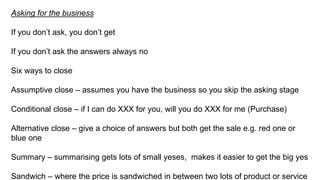
Asking for the business
If you don’t ask, you don’t get
If you don’t ask the answers always no
Six ways to close
Assumptive close – assumes you have the business so you skip the asking stage
Conditional close – if I can do XXX for you, will you do XXX for me (Purchase)
Alternative close – give a choice of answers but both get the sale e.g. red one or
blue one
Summary – summarising gets lots of small yeses, makes it easier to get the big yes
Sandwich – where the price is sandwiched in between two lots of product or service
Objections
Stage 6
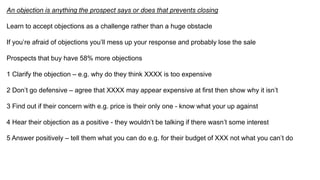
An objection is anything the prospect says or does that prevents closing
Learn to accept objections as a challenge rather than a huge obstacle
If you’re afraid of objections you’ll mess up your response and probably lose the sale
Prospects that buy have 58% more objections
1 Clarify the objection – e.g. why do they think XXXX is too expensive
2 Don’t go defensive – agree that XXXX may appear expensive at first then show why it isn’t
3 Find out if their concern with e.g. price is their only one - know what your up against
4 Hear their objection as a positive - they wouldn’t be talking if there wasn’t some interest
5 Answer positively – tell them what you can do e.g. for their budget of XXX not what you can’t do

Sales stages

  • 1.
    Business Skills For The21st Century © LenFoster.Com 2014 All rights reserved len@lenfoster.co.uk
  • 2.
    The 7 Stagesof The Sales Process
  • 3.
  • 4.
    Fishing in theright pond Who’s your target market? – who’s going to buy your stuff? Who’s your ideal customer in that market? – customer demographic, avatar Where can you find them? – networking, trade shows, Linkedin Collect their details – list building Keep in touch – CRM system, newsletter, auto responder messages Turning leads into appointments – what’s your process, what’s your conversion rate?
  • 5.
  • 6.
    You can’t betoo well prepared Who are you going to see? What do you know about them – position in company, length of service, hobbies, interests? What’s your goal for the meeting – speak to a decision maker, establish interest, make a sale? How will you present yourself – first impressions count, dress smart or casual, never flashy?
  • 7.
  • 8.
    Building Rapport Smile :0)– rapport doesn’t happen with grumpy people Show a GENUINE interest in them – ask questions, hobbies, interests Encourage them to talk about themselves and listen (Listen = Silent – same letters) Use their name where possible Talk about their interests not yours Make them feel important “Sincerely”
  • 9.
  • 10.
    The better youqualify prospects the more sales you’ll make Ask questions don’t make statements Prepare questions beforehand Ask big questions – so what's your biggest challenge at the moment, what are your goals for…..? Evoke emotion – how proud will you feel when…. people make decisions on emotion not logic Ask what failing to achieve what they want will feel like – create negative emotion Show how your product or service prevents them from failing – is the solution they need
  • 11.
  • 12.
    The sales presentation Shouldbe one way traffic – you talking and them listening Have a start, middle and end to your presentation 1 Start – cover why you’re there and set an agenda for the presentation 2 Middle – give brief history, establish credibility, product overview or specific product for them 3 End – simply summarise what you’ve said and close Process is – 1 tell them what your going to tell them, 2 tell them, 3 tell them what you’ve told them
  • 13.
  • 14.
    Asking for thebusiness If you don’t ask, you don’t get If you don’t ask the answers always no Six ways to close Assumptive close – assumes you have the business so you skip the asking stage Conditional close – if I can do XXX for you, will you do XXX for me (Purchase) Alternative close – give a choice of answers but both get the sale e.g. red one or blue one Summary – summarising gets lots of small yeses, makes it easier to get the big yes Sandwich – where the price is sandwiched in between two lots of product or service
  • 15.
  • 16.
    An objection isanything the prospect says or does that prevents closing Learn to accept objections as a challenge rather than a huge obstacle If you’re afraid of objections you’ll mess up your response and probably lose the sale Prospects that buy have 58% more objections 1 Clarify the objection – e.g. why do they think XXXX is too expensive 2 Don’t go defensive – agree that XXXX may appear expensive at first then show why it isn’t 3 Find out if their concern with e.g. price is their only one - know what your up against 4 Hear their objection as a positive - they wouldn’t be talking if there wasn’t some interest 5 Answer positively – tell them what you can do e.g. for their budget of XXX not what you can’t do