Sales Plan
 Executive Summary 
 Mission Statement 
 SWOT Analysis 
 Key Performance Indicators 
 Target Customers – Segmentation 
 Industry Analysis 
 Financial Analysis and Competitors 
 Brand Marketing and Sales Strategy
 For more than a century, they have devoted 
their energy and their competencies solely to 
one business: beauty. They have chosen to 
offer their expertise in the service of women 
and men worldwide, meeting the infinite 
diversity of their beauty desires. They are 
committed to fulfilling this mission ethically 
and responsibly. 
 L'Oréal is the second leading beauty and 
personal care manufacturer in the world, 
L'Oréal is the second leading beauty and 
personal care manufacturer in the world, and 
also the most favorite brand in Vietnam for its 
good quality and reasonable price in Vietnam. 
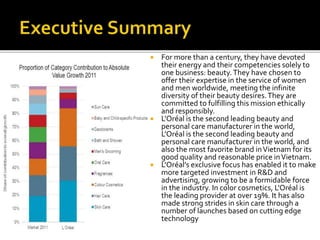
 L'Oréal’s exclusive focus has enabled it to make 
more targeted investment in R&D and 
advertising, growing to be a formidable force 
in the industry. In color cosmetics, L'Oréal is 
the leading provider at over 19%. It has also 
made strong strides in skin care through a 
number of launches based on cutting edge 
technology
 Beauty is a language 
 Beauty is universal 
 Beauty is a science 
 Beauty is a commitment 
 L’Oréal, offering 
beauty for all
STRENGTH 
 Strong brand: 
L’Oréal has a strong brand portfolio. 
It includes Body Shop, Garnier, 
Maybelline,…all are recognized 
globally -> has built a portfolio of 
strong brands through heavy 
advertising expenditure over the 
years. 
 Diversified presence: 
The company currently has 
operations in over 130 countries 
across five continents 
 R&D capability: 
focused on cosmetology and 
dermatology. The company 
registered 569 patents related to 
cosmetics and dermatology in 2006. 
WEAKNES 
 Slow revenue growth 
L’Oréal's long term revenue growth has 
been low. 
Slow revenue growth relative to the 
industry average and the revenues of 
competitors such as Estee Lauder 
indicates a decline in competitiveness 
and lack of revenue driving products. 
 Weak performance in parts of 
Vietnam 
The company is also losing market 
share in the parts of Vietnam to 
Unilever in hair care and skincare 
market. A weak performance in 
such a geographically strategic 
market undermines investor 
confidence, as well as adversely 
affects revenue growth.
OPPORTUNITY 
 Demographic trends in the US: 
Growing beauty consciousness 
especially among the aging baby 
boomers is an important trend for all 
cosmetics companies. 
 Acquisition and alliances: 
The natural personal care products 
market is rapidly growing. Demand for 
natural personal care products is rising 
as consumers shift to products which are 
safer and more eco-friendly. 
 Cosmetics market in emerging 
nations: 
The importance of emerging markets 
such as China, India and Vietnam is on 
the rise for cosmetics companies due to 
increasing popularity of beauty contests 
and increasing disposable incomes. 
THREAT 
Growing popularity of cosmetic 
surgery: 
Beauty consumers are increasingly 
taking refuge in new technologies such 
as advanced dermatology, cosmetic 
surgery, hair and organ transplant and 
other treatments to enhance their 
beauty. Not only are the results from 
these treatments instant, but they are 
also long lasting. This could reduce 
dependence on traditional beauty aids 
which could lead to a fall in demand for 
the skin and hair care products of 
L’Oréal. 
 Counterfeiting: 
Low quality counterfeits also reduce 
consumer confidence in the products of a 
company. More importantly, the 
company's key differentiator, exclusivity, 
is damaged by counterfeiting operations
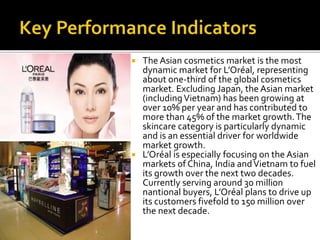
 The Asian cosmetics market is the most 
dynamic market for L’Oréal, representing 
about one-third of the global cosmetics 
market. Excluding Japan, the Asian market 
(including Vietnam) has been growing at 
over 10% per year and has contributed to 
more than 45% of the market growth. The 
skincare category is particularly dynamic 
and is an essential driver for worldwide 
market growth. 
 L’Oréal is especially focusing on the Asian 
markets of China, India and Vietnam to fuel 
its growth over the next two decades. 
Currently serving around 30 million 
nantional buyers, L’Oréal plans to drive up 
its customers fivefold to 150 million over 
the next decade.
 Geographic and Psychographic Segmentation 
Knowing no geographic bounds or social class limitations, L’Oréal's 
main marketing tool is the innate drive to be attractive in men and 
women alike. By using young female models and celebrities of many 
different ethnicities L’Oréal accomplishes an important task. Women 
of all ages and races will see how beautiful women look using L’Oréal 
products. This triggers a personal interest and inferring that L’Oréal 
products make you beautiful. 
 Demographic Segmentation 
Demographically, the largest consumer segment for the entire beauty 
industry is white women aged in their early teens and older. 
Women of different ethnicities can purchase cosmetics from L’Oréal's 
Soft Sheen product line, men, young and old, can hide their gray or 
change their look with L’Oréal's Color Spa for Men hair coloring, and 
all parents can make bathing fun with a brightly colored bottle of 
L’Oréal Shampoo for Kids.
 Benefits-Sought Segmentation 
L’Oréal Paris offers 6 different lines of lip color each 
with 48 different shades. To compare the product 
lines consider the shine, texture, and richness of 
color. This phenomenon is the product of benefits-sought 
segmentation. 
 Situation Segmentation. 
L’Oréal USA has 10 companies for manufacturing 
and 11 companies for distributing. Considering that 
the majority of revenue comes from retail stores, 
the proximity and abundance of distributing firms 
might persuade a retailer to choose L’Oréal.
 Suppliers 
Bargaining Power of suppliers – LOW 
L’Oréal owns most of its suppliers through its different brands (forward integration). 
Very few brands compete with L’Oréal and thus its suppliers are dependent on them. 
The cost of suppliers relative to the cost of its products is actually quite low. 
 Substitute Products 
Potential development of substitute products -MEDIUM to LOW 
Because L’Oréal is a much-diversified company in cosmetic products ranging from 
makeup, crèmes to hair products, it is difficult to find a substitute product that L’Oréal 
is not already selling. 
 Competitors 
Rivalry among competing firms - HIGH to MEDIUM 
The number of competitors in this industry is quite high. Moreover, most of L’Oréal’s 
competitors are specialized in a certain type of cosmetic, giving them an expert image 
advantage over L’Oréal. 
 Buyers 
Bargaining power of consumers/buyers - MEDIUM to LOW 
Consumers have increasing power over companies because of the increased 
accessibility of company information. However, L’Oréal is considered a high-end and 
high-tech leader in its industry that directs demand rather than follows it.
 Entry of New Competitors 
Potential entry of new competitors – LOW 
L’Oréal offers products that are different and benefit from economies of scale 
for its production. In the cosmetic industry, brand identity and product 
differentiation is very high. High capital is required because of the heavy R&D 
needed to create cosmetic products. 
 Internal Environment 
Tangible Resources: The tangible resources of L’Oréal would be first and 
foremost its financial position and capital. 
Intangible Resources: For a cosmetics company like L’Oréal, a majority of its 
resources are intangible. Some of the company’s major intangible assets are 
its technological patents. 
 Resource and Capabilities 
Some of L’Oréal’s main capabilities are its ability to cater products to 
different ethnic backgrounds, as well as its advanced R&D in these skin types. 
For this reason, they are able to venture into untapped markets. L’Oréal’s 
constant innovation and cutting edge technology puts them at the top of the 
market. They have recently conducted the first ever stem cell research for 
makeup purposes.
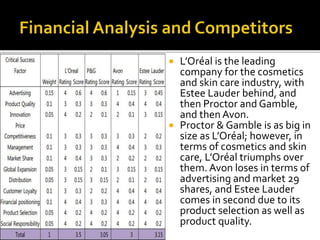
 L’Oréal is the leading 
company for the cosmetics 
and skin care industry, with 
Estee Lauder behind, and 
then Proctor and Gamble, 
and then Avon. 
 Proctor & Gamble is as big in 
size as L’Oréal; however, in 
terms of cosmetics and skin 
care, L’Oréal triumphs over 
them. Avon loses in terms of 
advertising and market 29 
shares, and Estee Lauder 
comes in second due to its 
product selection as well as 
product quality.
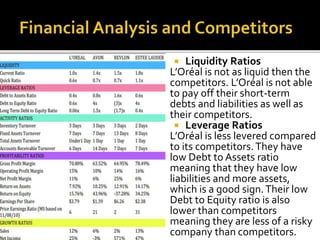
 Liquidity Ratios 
L’Oréal is not as liquid then the 
competitors. L’Oréal is not able 
to pay off their short-term 
debts and liabilities as well as 
their competitors. 
 Leverage Ratios 
L’Oréal is less levered compared 
to its competitors. They have 
low Debt to Assets ratio 
meaning that they have low 
liabilities and more assets, 
which is a good sign. Their low 
Debt to Equity ratio is also 
lower than competitors 
meaning they are less of a risky 
company than competitors.
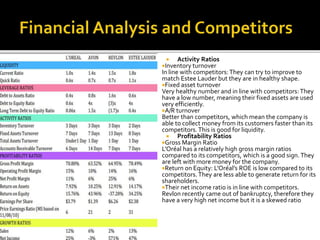
 Activity Ratios 
Inventory turnover 
In line with competitors: They can try to improve to 
match Estee Lauder but they are in healthy shape. 
Fixed asset turnover 
Very healthy number and in line with competitors: They 
have a low number, meaning their fixed assets are used 
very efficiently. 
A/R turnover 
Better than competitors, which mean the company is 
able to collect money from its customers faster than its 
competitors. This is good for liquidity. 
 Profitability Ratios 
Gross Margin Ratio 
L’Oréal has a relatively high gross margin ratios 
compared to its competitors, which is a good sign. They 
are left with more money for the company. 
Return on Equity: L’Oréal’s ROE is low compared to its 
competitors. They are less able to generate return for its 
shareholders. 
Their net income ratio is in line with competitors. 
Revlon recently came out of bankruptcy, therefore they 
have a very high net income but it is a skewed ratio
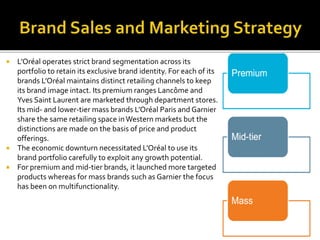
 L’Oréal operates strict brand segmentation across its 
portfolio to retain its exclusive brand identity. For each of its 
brands L’Oréal maintains distinct retailing channels to keep 
its brand image intact. Its premium ranges Lancôme and 
Yves Saint Laurent are marketed through department stores. 
Its mid- and lower-tier mass brands L’Oréal Paris and Garnier 
share the same retailing space in Western markets but the 
distinctions are made on the basis of price and product 
offerings. 
 The economic downturn necessitated L’Oréal to use its 
brand portfolio carefully to exploit any growth potential. 
 For premium and mid-tier brands, it launched more targeted 
products whereas for mass brands such as Garnier the focus 
has been on multifunctionality.
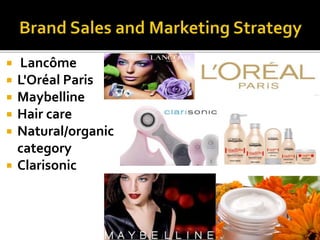
 Lancôme 
 L'Oréal Paris 
 Maybelline 
 Hair care 
 Natural/organic 
category 
 Clarisonic
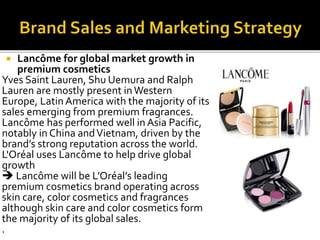
 Lancôme for global market growth in 
premium cosmetics 
Yves Saint Lauren, Shu Uemura and Ralph 
Lauren are mostly present in Western 
Europe, Latin America with the majority of its 
sales emerging from premium fragrances. 
Lancôme has performed well in Asia Pacific, 
notably in China and Vietnam, driven by the 
brand’s strong reputation across the world. 
L'Oréal uses Lancôme to help drive global 
growth 
 Lancôme will be L’Oréal’s leading 
premium cosmetics brand operating across 
skin care, color cosmetics and fragrances 
although skin care and color cosmetics form 
the majority of its global sales. 
.
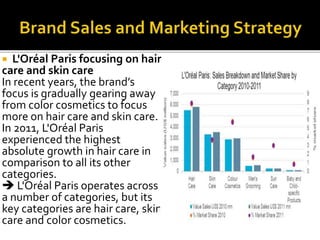
 L'Oréal Paris focusing on hair 
care and skin care 
In recent years, the brand’s 
focus is gradually gearing away 
from color cosmetics to focus 
more on hair care and skin care. 
In 2011, L'Oréal Paris 
experienced the highest 
absolute growth in hair care in 
comparison to all its other 
categories. 
 L'Oréal Paris operates across 
a number of categories, but its 
key categories are hair care, skin 
care and color cosmetics.
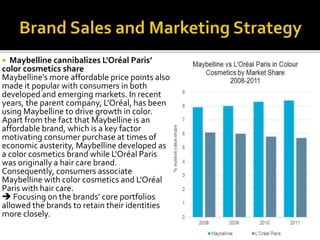
 Maybelline cannibalizes L'Oréal Paris’ 
color cosmetics share 
Maybelline’s more affordable price points also 
made it popular with consumers in both 
developed and emerging markets. In recent 
years, the parent company, L'Oréal, has been 
using Maybelline to drive growth in color. 
Apart from the fact that Maybelline is an 
affordable brand, which is a key factor 
motivating consumer purchase at times of 
economic austerity, Maybelline developed as 
a color cosmetics brand while L'Oréal Paris 
was originally a hair care brand. 
Consequently, consumers associate 
Maybelline with color cosmetics and L'Oréal 
Paris with hair care. 
 Focusing on the brands’ core portfolios 
allowed the brands to retain their identities 
more closely.
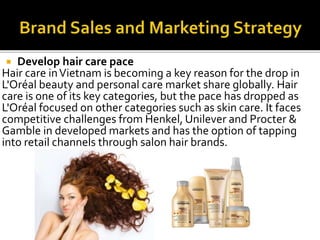
 Develop hair care pace 
Hair care in Vietnam is becoming a key reason for the drop in 
L'Oréal beauty and personal care market share globally. Hair 
care is one of its key categories, but the pace has dropped as 
L'Oréal focused on other categories such as skin care. It faces 
competitive challenges from Henkel, Unilever and Procter & 
Gamble in developed markets and has the option of tapping 
into retail channels through salon hair brands.
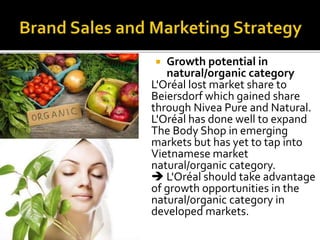
 Growth potential in 
natural/organic category 
L'Oréal lost market share to 
Beiersdorf which gained share 
through Nivea Pure and Natural. 
L'Oréal has done well to expand 
The Body Shop in emerging 
markets but has yet to tap into 
Vietnamese market 
natural/organic category. 
 L'Oréal should take advantage 
of growth opportunities in the 
natural/organic category in 
developed markets.
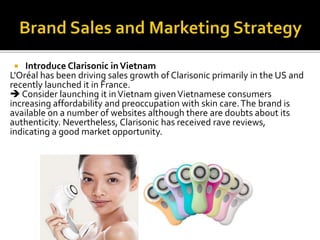
 Introduce Clarisonic in Vietnam 
L'Oréal has been driving sales growth of Clarisonic primarily in the US and 
recently launched it in France. 
 Consider launching it in Vietnam given Vietnamese consumers 
increasing affordability and preoccupation with skin care. The brand is 
available on a number of websites although there are doubts about its 
authenticity. Nevertheless, Clarisonic has received rave reviews, 
indicating a good market opportunity.
Sales & Marketing Management

Sales & Marketing Management

  • 1.
  • 2.
     Executive Summary  Mission Statement  SWOT Analysis  Key Performance Indicators  Target Customers – Segmentation  Industry Analysis  Financial Analysis and Competitors  Brand Marketing and Sales Strategy
  • 3.
     For morethan a century, they have devoted their energy and their competencies solely to one business: beauty. They have chosen to offer their expertise in the service of women and men worldwide, meeting the infinite diversity of their beauty desires. They are committed to fulfilling this mission ethically and responsibly.  L'Oréal is the second leading beauty and personal care manufacturer in the world, L'Oréal is the second leading beauty and personal care manufacturer in the world, and also the most favorite brand in Vietnam for its good quality and reasonable price in Vietnam.  L'Oréal’s exclusive focus has enabled it to make more targeted investment in R&D and advertising, growing to be a formidable force in the industry. In color cosmetics, L'Oréal is the leading provider at over 19%. It has also made strong strides in skin care through a number of launches based on cutting edge technology
  • 4.
     Beauty isa language  Beauty is universal  Beauty is a science  Beauty is a commitment  L’Oréal, offering beauty for all
  • 5.
    STRENGTH  Strongbrand: L’Oréal has a strong brand portfolio. It includes Body Shop, Garnier, Maybelline,…all are recognized globally -> has built a portfolio of strong brands through heavy advertising expenditure over the years.  Diversified presence: The company currently has operations in over 130 countries across five continents  R&D capability: focused on cosmetology and dermatology. The company registered 569 patents related to cosmetics and dermatology in 2006. WEAKNES  Slow revenue growth L’Oréal's long term revenue growth has been low. Slow revenue growth relative to the industry average and the revenues of competitors such as Estee Lauder indicates a decline in competitiveness and lack of revenue driving products.  Weak performance in parts of Vietnam The company is also losing market share in the parts of Vietnam to Unilever in hair care and skincare market. A weak performance in such a geographically strategic market undermines investor confidence, as well as adversely affects revenue growth.
  • 6.
    OPPORTUNITY  Demographictrends in the US: Growing beauty consciousness especially among the aging baby boomers is an important trend for all cosmetics companies.  Acquisition and alliances: The natural personal care products market is rapidly growing. Demand for natural personal care products is rising as consumers shift to products which are safer and more eco-friendly.  Cosmetics market in emerging nations: The importance of emerging markets such as China, India and Vietnam is on the rise for cosmetics companies due to increasing popularity of beauty contests and increasing disposable incomes. THREAT Growing popularity of cosmetic surgery: Beauty consumers are increasingly taking refuge in new technologies such as advanced dermatology, cosmetic surgery, hair and organ transplant and other treatments to enhance their beauty. Not only are the results from these treatments instant, but they are also long lasting. This could reduce dependence on traditional beauty aids which could lead to a fall in demand for the skin and hair care products of L’Oréal.  Counterfeiting: Low quality counterfeits also reduce consumer confidence in the products of a company. More importantly, the company's key differentiator, exclusivity, is damaged by counterfeiting operations
  • 7.
     The Asiancosmetics market is the most dynamic market for L’Oréal, representing about one-third of the global cosmetics market. Excluding Japan, the Asian market (including Vietnam) has been growing at over 10% per year and has contributed to more than 45% of the market growth. The skincare category is particularly dynamic and is an essential driver for worldwide market growth.  L’Oréal is especially focusing on the Asian markets of China, India and Vietnam to fuel its growth over the next two decades. Currently serving around 30 million nantional buyers, L’Oréal plans to drive up its customers fivefold to 150 million over the next decade.
  • 8.
     Geographic andPsychographic Segmentation Knowing no geographic bounds or social class limitations, L’Oréal's main marketing tool is the innate drive to be attractive in men and women alike. By using young female models and celebrities of many different ethnicities L’Oréal accomplishes an important task. Women of all ages and races will see how beautiful women look using L’Oréal products. This triggers a personal interest and inferring that L’Oréal products make you beautiful.  Demographic Segmentation Demographically, the largest consumer segment for the entire beauty industry is white women aged in their early teens and older. Women of different ethnicities can purchase cosmetics from L’Oréal's Soft Sheen product line, men, young and old, can hide their gray or change their look with L’Oréal's Color Spa for Men hair coloring, and all parents can make bathing fun with a brightly colored bottle of L’Oréal Shampoo for Kids.
  • 9.
     Benefits-Sought Segmentation L’Oréal Paris offers 6 different lines of lip color each with 48 different shades. To compare the product lines consider the shine, texture, and richness of color. This phenomenon is the product of benefits-sought segmentation.  Situation Segmentation. L’Oréal USA has 10 companies for manufacturing and 11 companies for distributing. Considering that the majority of revenue comes from retail stores, the proximity and abundance of distributing firms might persuade a retailer to choose L’Oréal.
  • 10.
     Suppliers BargainingPower of suppliers – LOW L’Oréal owns most of its suppliers through its different brands (forward integration). Very few brands compete with L’Oréal and thus its suppliers are dependent on them. The cost of suppliers relative to the cost of its products is actually quite low.  Substitute Products Potential development of substitute products -MEDIUM to LOW Because L’Oréal is a much-diversified company in cosmetic products ranging from makeup, crèmes to hair products, it is difficult to find a substitute product that L’Oréal is not already selling.  Competitors Rivalry among competing firms - HIGH to MEDIUM The number of competitors in this industry is quite high. Moreover, most of L’Oréal’s competitors are specialized in a certain type of cosmetic, giving them an expert image advantage over L’Oréal.  Buyers Bargaining power of consumers/buyers - MEDIUM to LOW Consumers have increasing power over companies because of the increased accessibility of company information. However, L’Oréal is considered a high-end and high-tech leader in its industry that directs demand rather than follows it.
  • 11.
     Entry ofNew Competitors Potential entry of new competitors – LOW L’Oréal offers products that are different and benefit from economies of scale for its production. In the cosmetic industry, brand identity and product differentiation is very high. High capital is required because of the heavy R&D needed to create cosmetic products.  Internal Environment Tangible Resources: The tangible resources of L’Oréal would be first and foremost its financial position and capital. Intangible Resources: For a cosmetics company like L’Oréal, a majority of its resources are intangible. Some of the company’s major intangible assets are its technological patents.  Resource and Capabilities Some of L’Oréal’s main capabilities are its ability to cater products to different ethnic backgrounds, as well as its advanced R&D in these skin types. For this reason, they are able to venture into untapped markets. L’Oréal’s constant innovation and cutting edge technology puts them at the top of the market. They have recently conducted the first ever stem cell research for makeup purposes.
  • 12.
     L’Oréal isthe leading company for the cosmetics and skin care industry, with Estee Lauder behind, and then Proctor and Gamble, and then Avon.  Proctor & Gamble is as big in size as L’Oréal; however, in terms of cosmetics and skin care, L’Oréal triumphs over them. Avon loses in terms of advertising and market 29 shares, and Estee Lauder comes in second due to its product selection as well as product quality.
  • 13.
     Liquidity Ratios L’Oréal is not as liquid then the competitors. L’Oréal is not able to pay off their short-term debts and liabilities as well as their competitors.  Leverage Ratios L’Oréal is less levered compared to its competitors. They have low Debt to Assets ratio meaning that they have low liabilities and more assets, which is a good sign. Their low Debt to Equity ratio is also lower than competitors meaning they are less of a risky company than competitors.
  • 14.
     Activity Ratios Inventory turnover In line with competitors: They can try to improve to match Estee Lauder but they are in healthy shape. Fixed asset turnover Very healthy number and in line with competitors: They have a low number, meaning their fixed assets are used very efficiently. A/R turnover Better than competitors, which mean the company is able to collect money from its customers faster than its competitors. This is good for liquidity.  Profitability Ratios Gross Margin Ratio L’Oréal has a relatively high gross margin ratios compared to its competitors, which is a good sign. They are left with more money for the company. Return on Equity: L’Oréal’s ROE is low compared to its competitors. They are less able to generate return for its shareholders. Their net income ratio is in line with competitors. Revlon recently came out of bankruptcy, therefore they have a very high net income but it is a skewed ratio
  • 15.
     L’Oréal operatesstrict brand segmentation across its portfolio to retain its exclusive brand identity. For each of its brands L’Oréal maintains distinct retailing channels to keep its brand image intact. Its premium ranges Lancôme and Yves Saint Laurent are marketed through department stores. Its mid- and lower-tier mass brands L’Oréal Paris and Garnier share the same retailing space in Western markets but the distinctions are made on the basis of price and product offerings.  The economic downturn necessitated L’Oréal to use its brand portfolio carefully to exploit any growth potential.  For premium and mid-tier brands, it launched more targeted products whereas for mass brands such as Garnier the focus has been on multifunctionality.
  • 16.
     Lancôme L'Oréal Paris  Maybelline  Hair care  Natural/organic category  Clarisonic
  • 17.
     Lancôme forglobal market growth in premium cosmetics Yves Saint Lauren, Shu Uemura and Ralph Lauren are mostly present in Western Europe, Latin America with the majority of its sales emerging from premium fragrances. Lancôme has performed well in Asia Pacific, notably in China and Vietnam, driven by the brand’s strong reputation across the world. L'Oréal uses Lancôme to help drive global growth  Lancôme will be L’Oréal’s leading premium cosmetics brand operating across skin care, color cosmetics and fragrances although skin care and color cosmetics form the majority of its global sales. .
  • 18.
     L'Oréal Parisfocusing on hair care and skin care In recent years, the brand’s focus is gradually gearing away from color cosmetics to focus more on hair care and skin care. In 2011, L'Oréal Paris experienced the highest absolute growth in hair care in comparison to all its other categories.  L'Oréal Paris operates across a number of categories, but its key categories are hair care, skin care and color cosmetics.
  • 19.
     Maybelline cannibalizesL'Oréal Paris’ color cosmetics share Maybelline’s more affordable price points also made it popular with consumers in both developed and emerging markets. In recent years, the parent company, L'Oréal, has been using Maybelline to drive growth in color. Apart from the fact that Maybelline is an affordable brand, which is a key factor motivating consumer purchase at times of economic austerity, Maybelline developed as a color cosmetics brand while L'Oréal Paris was originally a hair care brand. Consequently, consumers associate Maybelline with color cosmetics and L'Oréal Paris with hair care.  Focusing on the brands’ core portfolios allowed the brands to retain their identities more closely.
  • 20.
     Develop haircare pace Hair care in Vietnam is becoming a key reason for the drop in L'Oréal beauty and personal care market share globally. Hair care is one of its key categories, but the pace has dropped as L'Oréal focused on other categories such as skin care. It faces competitive challenges from Henkel, Unilever and Procter & Gamble in developed markets and has the option of tapping into retail channels through salon hair brands.
  • 21.
     Growth potentialin natural/organic category L'Oréal lost market share to Beiersdorf which gained share through Nivea Pure and Natural. L'Oréal has done well to expand The Body Shop in emerging markets but has yet to tap into Vietnamese market natural/organic category.  L'Oréal should take advantage of growth opportunities in the natural/organic category in developed markets.
  • 22.
     Introduce Clarisonicin Vietnam L'Oréal has been driving sales growth of Clarisonic primarily in the US and recently launched it in France.  Consider launching it in Vietnam given Vietnamese consumers increasing affordability and preoccupation with skin care. The brand is available on a number of websites although there are doubts about its authenticity. Nevertheless, Clarisonic has received rave reviews, indicating a good market opportunity.