Though beauty lies in the heart, 
but it does matters to appear on face…
Maslow’s Hierarchy of needs: West and Asia
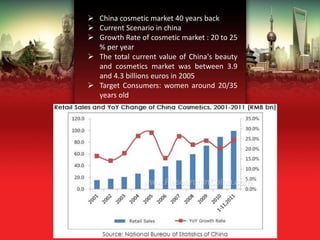
 China cosmetic market 40 years back 
 Current Scenario in china 
 Growth Rate of cosmetic market : 20 to 25 
% per year 
 The total current value of China's beauty 
and cosmetics market was between 3.9 
and 4.3 billions euros in 2005 
 Target Consumers: women around 20/35 
years old
Culture variables of China 
 Private(China) vs Public Circles(West) 
 Language : Subtle and indirect 
 Perception: Symbolic value of products 
 Motivation : Ownership vs Replenishment 
 Learning and Memory: University Special Classes 
 Age: Too Young 
 Self Concept: Japanese Influence 
 Gender roles: soft makeup 
 Attitude towards change: Effective salespersons 
 Purchase: Not so expert advice 
 Country-product image: Label concept
Hofstede’s Cultural Dimension 
France Vs China
Japan’s Scenario 
 In 2003, the cosmetic market in Japan was 17 million 
euros. 
 Japanese companies held 70 percent of the market 
with leading 5 companies like shiseido, pola, kosa, 
koa, kanebo accounting for 49% of the sales.
The cultural variables 
 Space- entering into the private closed circles by the 
European who tend to socialize with larger grouper 
was a challenge. 
 Language-European people tend to direct frank, 
straightforward in their communication, while 
Japanese people generally prefer an indirect, subtle, 
roundabout language.
Influence of Culture 
 Perception-in japan, blue is associated with high 
quality, red with happiness and purple with 
expensive. One of the Japanese girl said “it is better 
to look white.” and “it is more elegant.” 
 Motivation- according to the Japanese girls 
interviewed they said that the make-up helped them 
feel confident about themselves. For them buying 
make up was more about quality than brand.
 Age- In japan- younger women use more make-up 
than older woman. According to her girls start to 
make-up earlier and earlier. 
 Self- concept- Japanese girls used make-up more and 
more because they were afraid of the opinion of the 
people after seeing them without make-up. Japanese 
girls are perceived to have different skins as 
compared to other Asians. 
 Group influence-Due to peer influence more girls 
used make up on daily basis.
 Attitude toward change- Japanese people want 
newer products all the time, the average life cycle of 
a product is 6 months for them. 
 Purchase- Japanese people want a lot of information 
before buying any cosmetic products as they are 
experts in area. 
 Country image of the product- Japanese people 
don’t like products from any other country. Even if 
they are from other Asian countries they reject them 
outright. So L'Oreal japan was introduced.
Hofstede’s Cultural Dimension 
France Vs Japan
Perception: 
• South Korean women preferred very light pink or beige colours. 
• South Korean people prefer descriptive advertisements. 
Age: 
• According to South Korean girls interviewed, young generation 
prefers natural make up which was not the case earlier. 
• Earlier their mother’s used more colours but now make-up is 
more natural and it doesn't have to be more visible. 
Self concept: 
• Korean girls generally think, and are considered, as one of the 
most beautiful girls in Asia. They think they are very special.
Group influence: 
• In Korea, make up is well seen in the society as 
long as it is not too much and looks natural. 
Country product image: 
• Korean people prefer products made in France and US 
because they feel confident worth it. 
• South Korean girls said that they prefer using famous 
brands when they don’t know a product as, 
“South Korea is not popular for brands”.
Hofstede’s Cultural Dimension 
France vs. South Korea
Adaptation Strategy in Asian Markets 
 Product acceptability in particular Asian Market 
 Selling features and brand-name decisions 
 Labeling requirements , packaging and repackaging 
needs 
 Service needs 
 The effect of culture on product decisions 
 Organization of tests and surveys
L'Oréal strategy in China 
 Acquisition of local brands to adapt to local market. 
 Opened R&D facility in Pudong 
 Purchase of two production facilities and Training Development Centre 
 Setting up of Local management and marketing center 
 Tie up with local models as brand ambassador 
 Product- oriented advertisement
L'Oréal strategy in Japan 
 L’Oreal put Sun Protection Factor in its primary cosmetic products to be 
protected from sun. 
 L’Oreal packaged cosmetic products in small, simple, ‘Zen’, light coloured 
 L’Oreal focus on Selective marketing than Mass Marketing 
 L’Oreal trained salesperson because Japanese people are expert in 
cosmetics
L'Oréal strategy in South Korea 
 L’Oreal changed its tagline to ‘You are worth it’ 
 Globalization of business 
 Export of local beauty related phenomenon 
 Focus on skincare products 
 Acquisition of Clarisonic vibrating cleansing device 
 Developed a Pure Mineral Fresh Glow BB Cream for Korean consumers
The influence of culture on purchase aspects 
of the consumer behaviour 
 Language 
 Power distance 
 Uncertainty avoidance 
 Individualism versus collectivism 
 Neutral versus affective 
 Specific versus diffuse
So the elements of culture influence the consumer behavior 
Because : 
1) They change the way of analyzing a situation 
2) Reacting to it 
3) Behaving in general 
That’s why consumer behavior aspects will be analyzed and 
used by the firms in order to create and implement the most 
profitable strategy
Credits: 
KASHYAP SHAH 
K.SRIRAM 
VINITA GOSWAMI 
VRINDA JAIN 
ANUBHUTI GUPTA 
MANISHA NANDAL 
MANTHAN JANI

L'oreal

  • 1.
    Though beauty liesin the heart, but it does matters to appear on face…
  • 3.
    Maslow’s Hierarchy ofneeds: West and Asia
  • 8.
     China cosmeticmarket 40 years back  Current Scenario in china  Growth Rate of cosmetic market : 20 to 25 % per year  The total current value of China's beauty and cosmetics market was between 3.9 and 4.3 billions euros in 2005  Target Consumers: women around 20/35 years old
  • 9.
    Culture variables ofChina  Private(China) vs Public Circles(West)  Language : Subtle and indirect  Perception: Symbolic value of products  Motivation : Ownership vs Replenishment  Learning and Memory: University Special Classes  Age: Too Young  Self Concept: Japanese Influence  Gender roles: soft makeup  Attitude towards change: Effective salespersons  Purchase: Not so expert advice  Country-product image: Label concept
  • 10.
  • 12.
    Japan’s Scenario In 2003, the cosmetic market in Japan was 17 million euros.  Japanese companies held 70 percent of the market with leading 5 companies like shiseido, pola, kosa, koa, kanebo accounting for 49% of the sales.
  • 13.
    The cultural variables  Space- entering into the private closed circles by the European who tend to socialize with larger grouper was a challenge.  Language-European people tend to direct frank, straightforward in their communication, while Japanese people generally prefer an indirect, subtle, roundabout language.
  • 14.
    Influence of Culture  Perception-in japan, blue is associated with high quality, red with happiness and purple with expensive. One of the Japanese girl said “it is better to look white.” and “it is more elegant.”  Motivation- according to the Japanese girls interviewed they said that the make-up helped them feel confident about themselves. For them buying make up was more about quality than brand.
  • 15.
     Age- Injapan- younger women use more make-up than older woman. According to her girls start to make-up earlier and earlier.  Self- concept- Japanese girls used make-up more and more because they were afraid of the opinion of the people after seeing them without make-up. Japanese girls are perceived to have different skins as compared to other Asians.  Group influence-Due to peer influence more girls used make up on daily basis.
  • 16.
     Attitude towardchange- Japanese people want newer products all the time, the average life cycle of a product is 6 months for them.  Purchase- Japanese people want a lot of information before buying any cosmetic products as they are experts in area.  Country image of the product- Japanese people don’t like products from any other country. Even if they are from other Asian countries they reject them outright. So L'Oreal japan was introduced.
  • 17.
  • 19.
    Perception: • SouthKorean women preferred very light pink or beige colours. • South Korean people prefer descriptive advertisements. Age: • According to South Korean girls interviewed, young generation prefers natural make up which was not the case earlier. • Earlier their mother’s used more colours but now make-up is more natural and it doesn't have to be more visible. Self concept: • Korean girls generally think, and are considered, as one of the most beautiful girls in Asia. They think they are very special.
  • 20.
    Group influence: •In Korea, make up is well seen in the society as long as it is not too much and looks natural. Country product image: • Korean people prefer products made in France and US because they feel confident worth it. • South Korean girls said that they prefer using famous brands when they don’t know a product as, “South Korea is not popular for brands”.
  • 21.
    Hofstede’s Cultural Dimension France vs. South Korea
  • 23.
    Adaptation Strategy inAsian Markets  Product acceptability in particular Asian Market  Selling features and brand-name decisions  Labeling requirements , packaging and repackaging needs  Service needs  The effect of culture on product decisions  Organization of tests and surveys
  • 24.
    L'Oréal strategy inChina  Acquisition of local brands to adapt to local market.  Opened R&D facility in Pudong  Purchase of two production facilities and Training Development Centre  Setting up of Local management and marketing center  Tie up with local models as brand ambassador  Product- oriented advertisement
  • 25.
    L'Oréal strategy inJapan  L’Oreal put Sun Protection Factor in its primary cosmetic products to be protected from sun.  L’Oreal packaged cosmetic products in small, simple, ‘Zen’, light coloured  L’Oreal focus on Selective marketing than Mass Marketing  L’Oreal trained salesperson because Japanese people are expert in cosmetics
  • 26.
    L'Oréal strategy inSouth Korea  L’Oreal changed its tagline to ‘You are worth it’  Globalization of business  Export of local beauty related phenomenon  Focus on skincare products  Acquisition of Clarisonic vibrating cleansing device  Developed a Pure Mineral Fresh Glow BB Cream for Korean consumers
  • 27.
    The influence ofculture on purchase aspects of the consumer behaviour  Language  Power distance  Uncertainty avoidance  Individualism versus collectivism  Neutral versus affective  Specific versus diffuse
  • 28.
    So the elementsof culture influence the consumer behavior Because : 1) They change the way of analyzing a situation 2) Reacting to it 3) Behaving in general That’s why consumer behavior aspects will be analyzed and used by the firms in order to create and implement the most profitable strategy
  • 30.
    Credits: KASHYAP SHAH K.SRIRAM VINITA GOSWAMI VRINDA JAIN ANUBHUTI GUPTA MANISHA NANDAL MANTHAN JANI

Editor's Notes

  • #4 The needs of an individual can be classified as a hierarchy from physiological needs (hunger, thirst) at the bottom, to safety needs (security, protection), to social needs (sense of belonging, love), to esteem needs (self-esteem, recognition, status), to selfactualization needs (self-development, actualization) at the top. The needs at the bottom of the hierarchy such as thirst tend to be satisfied first whereas needs at the top of the hierarchy such as realization tend to be satisfied last. Culture can impact on the needs at every level of the hierarchy. However, the higher in the hierarchy, the greater the impact of the culture is. The research is showing that both specific needs and their ranking can vary from culture to culture.
  • #29 L'Oreal's entry into C,SK,J