The History Of the company…
• In 1907, a young French chemist Eugéne Schueller
developed an innovative colour formula;
• In 1909, he registred his own company;
• In 1920, the small company employed 3 chemists;
• In 1912, Eugéne Schueller started to export his
products;
• In 1933, he created and launched Votre Beauté, a
magazine devoted to women;
• In 1953, L‘Oréal won an advertising Oscar.
About the industry
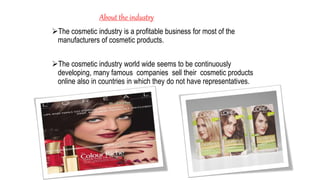
The cosmetic industry is a profitable business for most of the
manufacturers of cosmetic products.
The cosmetic industry world wide seems to be continuously
developing, many famous companies sell their cosmetic products
online also in countries in which they do not have representatives.
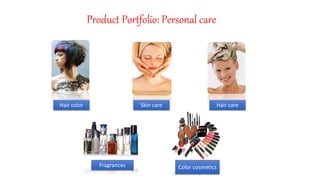
Product Portfolio: Personal care
Hair color Skin care Hair care
Fragrances Color cosmetics
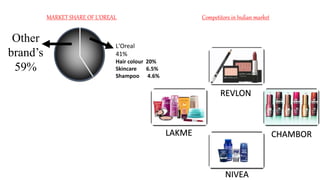
MARKET SHARE OF L’OREAL
Other
brand’s
59%
L'Oreal
41%
Hair colour 20%
Skincare 6.5%
Shampoo 4.6%
LAKME
REVLON
NIVEA
CHAMBOR
Competitors in Indian market
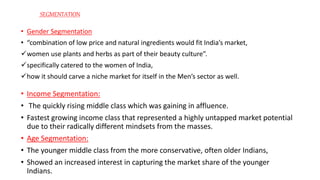
• Gender Segmentation
• “combination of low price and natural ingredients would fit India’s market,
women use plants and herbs as part of their beauty culture”.
specifically catered to the women of India,
how it should carve a niche market for itself in the Men’s sector as well.
• Income Segmentation:
• The quickly rising middle class which was gaining in affluence.
• Fastest growing income class that represented a highly untapped market potential
due to their radically different mindsets from the masses.
• Age Segmentation:
• The younger middle class from the more conservative, often older Indians,
• Showed an increased interest in capturing the market share of the younger
Indians.
SEGMENTATION
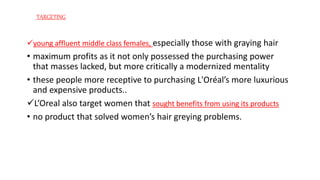
young affluent middle class females, especially those with graying hair
• maximum profits as it not only possessed the purchasing power
that masses lacked, but more critically a modernized mentality
• these people more receptive to purchasing L'Oréal’s more luxurious
and expensive products..
L’Oreal also target women that sought benefits from using its products
• no product that solved women’s hair greying problems.
TARGETING
POSTITIONING
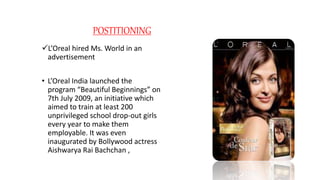
L’Oreal hired Ms. World in an
advertisement
• L’Oreal India launched the
program “Beautiful Beginnings” on
7th July 2009, an initiative which
aimed to train at least 200
unprivileged school drop-out girls
every year to make them
employable. It was even
inaugurated by Bollywood actress
Aishwarya Rai Bachchan ,
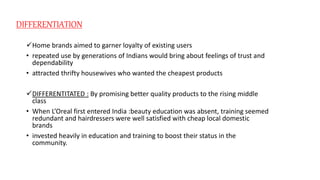
DIFFERENTIATION
Home brands aimed to garner loyalty of existing users
• repeated use by generations of Indians would bring about feelings of trust and
dependability
• attracted thrifty housewives who wanted the cheapest products
DIFFERENTITATED : By promising better quality products to the rising middle
class
• When L’Oreal first entered India :beauty education was absent, training seemed
redundant and hairdressers were well satisfied with cheap local domestic
brands
• invested heavily in education and training to boost their status in the
community.
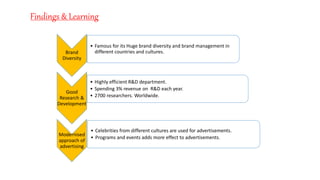
Brand
Diversity
• Famous for its Huge brand diversity and brand management in
different countries and cultures.
Good
Research &
Development
• Highly efficient R&D department.
• Spending 3% revenue on R&D each year.
• 2700 researchers. Worldwide.
Modernised
approach of
advertising
• Celebrities from different cultures are used for advertisements.
• Programs and events adds more effect to advertisements.
Findings & Learning
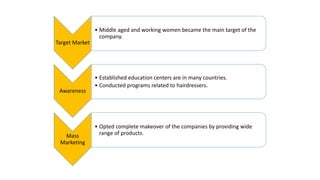
Target Market
• Middle aged and working women became the main target of the
company.
Awareness
• Established education centers are in many countries.
• Conducted programs related to hairdressers.
Mass
Marketing
• Opted complete makeover of the companies by providing wide
range of products.
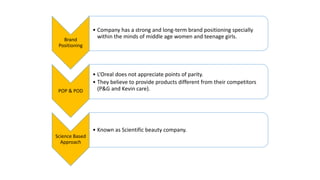
Brand
Positioning
• Company has a strong and long-term brand positioning specially
within the minds of middle age women and teenage girls.
POP & POD
• L’Oreal does not appreciate points of parity.
• They believe to provide products different from their competitors
(P&G and Kevin care).
Science Based
Approach
• Known as Scientific beauty company.
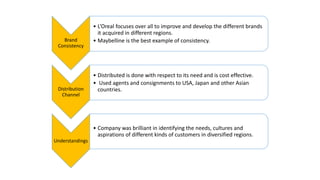
Brand
Consistency
• L’Oreal focuses over all to improve and develop the different brands
it acquired in different regions.
• Maybelline is the best example of consistency.
Distribution
Channel
• Distributed is done with respect to its need and is cost effective.
• Used agents and consignments to USA, Japan and other Asian
countries.
Understandings
• Company was brilliant in identifying the needs, cultures and
aspirations of different kinds of customers in diversified regions.
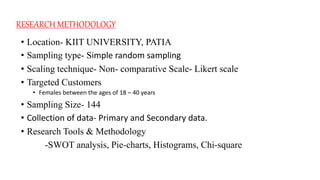
RESEARCH METHODOLOGY
• Location- KIIT UNIVERSITY, PATIA
• Sampling type- Simple random sampling
• Scaling technique- Non- comparative Scale- Likert scale
• Targeted Customers
• Females between the ages of 18 – 40 years
• Sampling Size- 144
• Collection of data- Primary and Secondary data.
• Research Tools & Methodology
-SWOT analysis, Pie-charts, Histograms, Chi-square
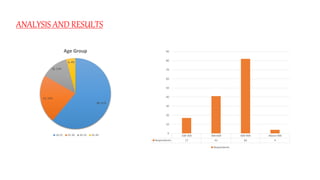
88, 61%
32, 22%
18, 13%
6, 4%
Age Group
18-25 25-30 30-35 35-40 100-300 300-600 600-900 Above 900
Respondents 17 41 82 4
0
10
20
30
40
50
60
70
80
90
Respondents
ANALYSIS AND RESULTS
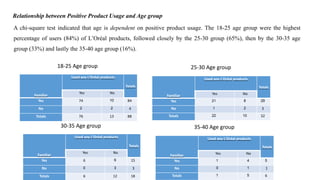
Relationship between Positive Product Usage and Age group
A chi-square test indicated that age is dependent on positive product usage. The 18-25 age group were the highest
percentage of users (84%) of L’Oréal products, followed closely by the 25-30 group (65%), then by the 30-35 age
group (33%) and lastly the 35-40 age group (16%).
Familiar
Used any L'Oréal products
Totals
Yes No
Yes 74 10 84
No 2 2 4
Totals 76 13 88
18-25 Age group
Familiar
Used any L'Oréal products
Totals
Yes No
Yes 21 8 29
No 1 2 3
Totals 22 10 32
25-30 Age group
Familiar
Used any L'Oréal products
Totals
Yes No
Yes 6 9 15
No 0 3 3
Totals 6 12 18
30-35 Age group
Familiar
Used any L'Oréal products
Totals
Yes No
Yes 1 4 5
No 0 1 1
Totals 1 5 6
35-40 Age group
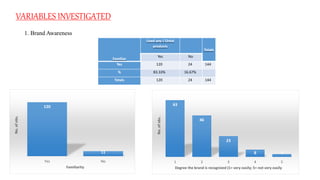
VARIABLES INVESTIGATED
1. Brand Awareness
120
11
Yes No
No.ofobs.
Familiarity
Familiar
Used any L'Oréal
products
Totals
Yes No
Yes 120 24 144
% 83.33% 16.67%
Totals 120 24 144
63
46
23
8 3
1 2 3 4 5
No.ofobs.
Degree the brand is recognized (1= very easily; 5= not very easily
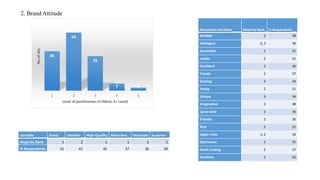
2. Brand Attitude
40
59
35
7 3
1 2 3 4 5
Noofobs
Level of positiveness (1=Most; 5= Least)
Variable Good Likeable High Quality Attractive Desirable Superior
Majority Rank 1 2 1 1 2 2
% Respondents 41 41 45 37 36 39
Personality Attribute Majority Rank % Respondents
Reliable 2 38
Intelligent 2; 3 36
Successful 1 41
Leader 2 41
Confident 2 36
Trendy 2 37
Exciting 2 34
Young 2 31
Unique 3 34
Imaginative 3 48
Up-to-date 1 36
Friendly 2 36
Real 2 31
Upper Class 1; 2 32
Glamorous 1 35
Good Looking 2 37
Feminine 1 50
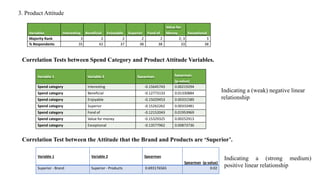
3. Product Attitude
Variables Interesting Beneficial Enjoyable Superior Fond of
Value for
Money Exceptional
Majority Rank 3 2 2 2 2 2; 3 3
% Respondents 35 42 37 38 38 33 38
Correlation Tests between Spend Category and Product Attitude Variables.
Variable 1 Variable 2 Spearman Spearman
(p-value)
Spend category Interesting -0.15645743 0.00219294
Spend category Beneficial -0.12773133 0.01330884
Spend category Enjoyable -0.15029453 0.00331589
Spend category Superior -0.15262262 0.00333481
Spend category Fond of -0.12152043 0.01953969
Spend category Value for money -0.15329325 0.00252913
Spend category Exceptional -0.13577962 0.00873736
Variable 1 Variable 2 Spearman
Spearman (p-value)
Superior - Brand Superior - Products 0.693176565 0.02
Correlation Test between the Attitude that the Brand and Products are ‘Superior’.
Indicating a (strong medium)
positive linear relationship
Indicating a (weak) negative linear
relationship
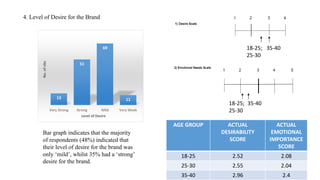
4. Level of Desire for the Brand
13
51
69
11
Very Strong Strong Mild Very Weak
No.ofobs
Level of Desire
Bar graph indicates that the majority
of respondents (48%) indicated that
their level of desire for the brand was
only ‘mild’, whilst 35% had a ‘strong’
desire for the brand.
18-25;
25-30
18-25;
25-30
35-40
35-40
AGE GROUP ACTUAL
DESIRABILITY
SCORE
ACTUAL
EMOTIONAL
IMPORTANCE
SCORE
18-25 2.52 2.08
25-30 2.55 2.04
35-40 2.96 2.4
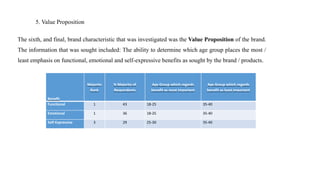
5. Value Proposition
The sixth, and final, brand characteristic that was investigated was the Value Proposition of the brand.
The information that was sought included: The ability to determine which age group places the most /
least emphasis on functional, emotional and self-expressive benefits as sought by the brand / products.
Benefit
Majority
Rank
% Majority of
Respondents
Age Group which regards
benefit as most important
Age Group which regards
benefit as least important
Functional 1 43 18-25 35-40
Emotional 1 36 18-25 35-40
Self-Expressive 3 29 25-30 35-40
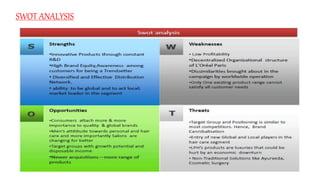
SWOT ANALYSIS
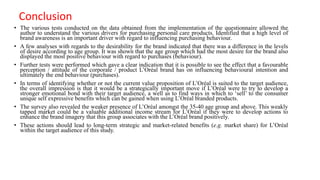
Conclusion
• The various tests conducted on the data obtained from the implementation of the questionnaire allowed the
author to understand the various drivers for purchasing personal care products. Identified that a high level of
brand awareness is an important driver with regard to influencing purchasing behaviour.
• A few analyses with regards to the desirability for the brand indicated that there was a difference in the levels
of desire according to age group. It was shown that the age group which had the most desire for the brand also
displayed the most positive behaviour with regard to purchases (behaviour).
• Further tests were performed which gave a clear indication that it is possible to see the effect that a favourable
perception / attitude of the corporate / product L’Oréal brand has on influencing behavioural intention and
ultimately the end behaviour (purchases).
• In terms of identifying whether or not the current value proposition of L’Oréal is suited to the target audience,
the overall impression is that it would be a strategically important move if L’Oréal were to try to develop a
stronger emotional bond with their target audience, a well as to find ways in which to ‘sell’ to the consumer
unique self expressive benefits which can be gained when using L’Oréal branded products.
• The survey also revealed the weaker presence of L’Oréal amongst the 35-40 age group and above. This weakly
tapped market could be a valuable additional income stream for L’Oréal if they were to develop actions to
enhance the brand imagery that this group associates with the L’Oréal brand positively.
• These actions should lead to long-term strategic and market-related benefits (e.g. market share) for L’Oréal
within the target audience of this study.
Brand Audit on Loreal

Brand Audit on Loreal

  • 2.
    The History Ofthe company… • In 1907, a young French chemist Eugéne Schueller developed an innovative colour formula; • In 1909, he registred his own company; • In 1920, the small company employed 3 chemists; • In 1912, Eugéne Schueller started to export his products; • In 1933, he created and launched Votre Beauté, a magazine devoted to women; • In 1953, L‘Oréal won an advertising Oscar.
  • 3.
    About the industry Thecosmetic industry is a profitable business for most of the manufacturers of cosmetic products. The cosmetic industry world wide seems to be continuously developing, many famous companies sell their cosmetic products online also in countries in which they do not have representatives.
  • 4.
    Product Portfolio: Personalcare Hair color Skin care Hair care Fragrances Color cosmetics
  • 5.
    MARKET SHARE OFL’OREAL Other brand’s 59% L'Oreal 41% Hair colour 20% Skincare 6.5% Shampoo 4.6% LAKME REVLON NIVEA CHAMBOR Competitors in Indian market
  • 6.
    • Gender Segmentation •“combination of low price and natural ingredients would fit India’s market, women use plants and herbs as part of their beauty culture”. specifically catered to the women of India, how it should carve a niche market for itself in the Men’s sector as well. • Income Segmentation: • The quickly rising middle class which was gaining in affluence. • Fastest growing income class that represented a highly untapped market potential due to their radically different mindsets from the masses. • Age Segmentation: • The younger middle class from the more conservative, often older Indians, • Showed an increased interest in capturing the market share of the younger Indians. SEGMENTATION
  • 7.
    young affluent middleclass females, especially those with graying hair • maximum profits as it not only possessed the purchasing power that masses lacked, but more critically a modernized mentality • these people more receptive to purchasing L'Oréal’s more luxurious and expensive products.. L’Oreal also target women that sought benefits from using its products • no product that solved women’s hair greying problems. TARGETING
  • 8.
    POSTITIONING L’Oreal hired Ms.World in an advertisement • L’Oreal India launched the program “Beautiful Beginnings” on 7th July 2009, an initiative which aimed to train at least 200 unprivileged school drop-out girls every year to make them employable. It was even inaugurated by Bollywood actress Aishwarya Rai Bachchan ,
  • 9.
    DIFFERENTIATION Home brands aimedto garner loyalty of existing users • repeated use by generations of Indians would bring about feelings of trust and dependability • attracted thrifty housewives who wanted the cheapest products DIFFERENTITATED : By promising better quality products to the rising middle class • When L’Oreal first entered India :beauty education was absent, training seemed redundant and hairdressers were well satisfied with cheap local domestic brands • invested heavily in education and training to boost their status in the community.
  • 10.
    Brand Diversity • Famous forits Huge brand diversity and brand management in different countries and cultures. Good Research & Development • Highly efficient R&D department. • Spending 3% revenue on R&D each year. • 2700 researchers. Worldwide. Modernised approach of advertising • Celebrities from different cultures are used for advertisements. • Programs and events adds more effect to advertisements. Findings & Learning
  • 11.
    Target Market • Middleaged and working women became the main target of the company. Awareness • Established education centers are in many countries. • Conducted programs related to hairdressers. Mass Marketing • Opted complete makeover of the companies by providing wide range of products.
  • 12.
    Brand Positioning • Company hasa strong and long-term brand positioning specially within the minds of middle age women and teenage girls. POP & POD • L’Oreal does not appreciate points of parity. • They believe to provide products different from their competitors (P&G and Kevin care). Science Based Approach • Known as Scientific beauty company.
  • 13.
    Brand Consistency • L’Oreal focusesover all to improve and develop the different brands it acquired in different regions. • Maybelline is the best example of consistency. Distribution Channel • Distributed is done with respect to its need and is cost effective. • Used agents and consignments to USA, Japan and other Asian countries. Understandings • Company was brilliant in identifying the needs, cultures and aspirations of different kinds of customers in diversified regions.
  • 14.
    RESEARCH METHODOLOGY • Location-KIIT UNIVERSITY, PATIA • Sampling type- Simple random sampling • Scaling technique- Non- comparative Scale- Likert scale • Targeted Customers • Females between the ages of 18 – 40 years • Sampling Size- 144 • Collection of data- Primary and Secondary data. • Research Tools & Methodology -SWOT analysis, Pie-charts, Histograms, Chi-square
  • 15.
    88, 61% 32, 22% 18,13% 6, 4% Age Group 18-25 25-30 30-35 35-40 100-300 300-600 600-900 Above 900 Respondents 17 41 82 4 0 10 20 30 40 50 60 70 80 90 Respondents ANALYSIS AND RESULTS
  • 16.
    Relationship between PositiveProduct Usage and Age group A chi-square test indicated that age is dependent on positive product usage. The 18-25 age group were the highest percentage of users (84%) of L’Oréal products, followed closely by the 25-30 group (65%), then by the 30-35 age group (33%) and lastly the 35-40 age group (16%). Familiar Used any L'Oréal products Totals Yes No Yes 74 10 84 No 2 2 4 Totals 76 13 88 18-25 Age group Familiar Used any L'Oréal products Totals Yes No Yes 21 8 29 No 1 2 3 Totals 22 10 32 25-30 Age group Familiar Used any L'Oréal products Totals Yes No Yes 6 9 15 No 0 3 3 Totals 6 12 18 30-35 Age group Familiar Used any L'Oréal products Totals Yes No Yes 1 4 5 No 0 1 1 Totals 1 5 6 35-40 Age group
  • 17.
    VARIABLES INVESTIGATED 1. BrandAwareness 120 11 Yes No No.ofobs. Familiarity Familiar Used any L'Oréal products Totals Yes No Yes 120 24 144 % 83.33% 16.67% Totals 120 24 144 63 46 23 8 3 1 2 3 4 5 No.ofobs. Degree the brand is recognized (1= very easily; 5= not very easily
  • 18.
    2. Brand Attitude 40 59 35 73 1 2 3 4 5 Noofobs Level of positiveness (1=Most; 5= Least) Variable Good Likeable High Quality Attractive Desirable Superior Majority Rank 1 2 1 1 2 2 % Respondents 41 41 45 37 36 39 Personality Attribute Majority Rank % Respondents Reliable 2 38 Intelligent 2; 3 36 Successful 1 41 Leader 2 41 Confident 2 36 Trendy 2 37 Exciting 2 34 Young 2 31 Unique 3 34 Imaginative 3 48 Up-to-date 1 36 Friendly 2 36 Real 2 31 Upper Class 1; 2 32 Glamorous 1 35 Good Looking 2 37 Feminine 1 50
  • 19.
    3. Product Attitude VariablesInteresting Beneficial Enjoyable Superior Fond of Value for Money Exceptional Majority Rank 3 2 2 2 2 2; 3 3 % Respondents 35 42 37 38 38 33 38 Correlation Tests between Spend Category and Product Attitude Variables. Variable 1 Variable 2 Spearman Spearman (p-value) Spend category Interesting -0.15645743 0.00219294 Spend category Beneficial -0.12773133 0.01330884 Spend category Enjoyable -0.15029453 0.00331589 Spend category Superior -0.15262262 0.00333481 Spend category Fond of -0.12152043 0.01953969 Spend category Value for money -0.15329325 0.00252913 Spend category Exceptional -0.13577962 0.00873736 Variable 1 Variable 2 Spearman Spearman (p-value) Superior - Brand Superior - Products 0.693176565 0.02 Correlation Test between the Attitude that the Brand and Products are ‘Superior’. Indicating a (strong medium) positive linear relationship Indicating a (weak) negative linear relationship
  • 20.
    4. Level ofDesire for the Brand 13 51 69 11 Very Strong Strong Mild Very Weak No.ofobs Level of Desire Bar graph indicates that the majority of respondents (48%) indicated that their level of desire for the brand was only ‘mild’, whilst 35% had a ‘strong’ desire for the brand. 18-25; 25-30 18-25; 25-30 35-40 35-40 AGE GROUP ACTUAL DESIRABILITY SCORE ACTUAL EMOTIONAL IMPORTANCE SCORE 18-25 2.52 2.08 25-30 2.55 2.04 35-40 2.96 2.4
  • 21.
    5. Value Proposition Thesixth, and final, brand characteristic that was investigated was the Value Proposition of the brand. The information that was sought included: The ability to determine which age group places the most / least emphasis on functional, emotional and self-expressive benefits as sought by the brand / products. Benefit Majority Rank % Majority of Respondents Age Group which regards benefit as most important Age Group which regards benefit as least important Functional 1 43 18-25 35-40 Emotional 1 36 18-25 35-40 Self-Expressive 3 29 25-30 35-40
  • 22.
  • 23.
    Conclusion • The varioustests conducted on the data obtained from the implementation of the questionnaire allowed the author to understand the various drivers for purchasing personal care products. Identified that a high level of brand awareness is an important driver with regard to influencing purchasing behaviour. • A few analyses with regards to the desirability for the brand indicated that there was a difference in the levels of desire according to age group. It was shown that the age group which had the most desire for the brand also displayed the most positive behaviour with regard to purchases (behaviour). • Further tests were performed which gave a clear indication that it is possible to see the effect that a favourable perception / attitude of the corporate / product L’Oréal brand has on influencing behavioural intention and ultimately the end behaviour (purchases). • In terms of identifying whether or not the current value proposition of L’Oréal is suited to the target audience, the overall impression is that it would be a strategically important move if L’Oréal were to try to develop a stronger emotional bond with their target audience, a well as to find ways in which to ‘sell’ to the consumer unique self expressive benefits which can be gained when using L’Oréal branded products. • The survey also revealed the weaker presence of L’Oréal amongst the 35-40 age group and above. This weakly tapped market could be a valuable additional income stream for L’Oréal if they were to develop actions to enhance the brand imagery that this group associates with the L’Oréal brand positively. • These actions should lead to long-term strategic and market-related benefits (e.g. market share) for L’Oréal within the target audience of this study.