OTHER FERMENTED
BEVERAGES
SESSION OBJECTIVES
After the end of the session one should be able
to know sake, cider, Perry types, their
production, service.
Contents
 Definition
 Production
 Service & Storage
 Cider
 Perry
 Production
 Storage & Service
 Alcohol free wines
Sake
A sweet golden wine made from fermenting
freshly steamed glutinous rice. Most rice
wines are low in alcohol. The most well
known Japanese rice wines are sake & mirin.
Sake is a Japanese word meaning alcoholic
beverage. Its other name is ‘Nihonshu’.
Sake is widely refer to in English as ‘Rice
wine’. It is served warm in a small cup called
‘Sakazuki’. It has 18% alcohol.
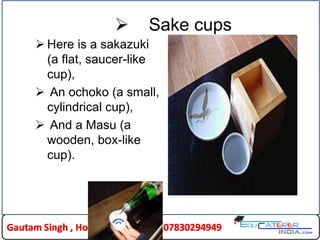
 Sake cups
 Here is a sakazuki
(a flat, saucer-like
cup),
 An ochoko (a small,
cylindrical cup),
 And a Masu (a
wooden, box-like
cup).
Sake cups
sakazuki Masu
Sake
Production of SAKE
 Processing Rice(Polishing).
 Resting
 Milling
 Washed & Steeped/Soaked
 Boiled/Steamed-cooled & Divided
 Inoculated with kōji mold (Aspergillus oryzae)
 Creation of the starter mash (Kōji rice, water,
and yeast) & lactic Acid
 Cultivation of Yeast (Addition of steamed rice
to Mixture for 10 to 15 days).
Production of SAKE
 Main Mash or moromi (Steamed rice, water,
and more kōji are added once a day for three
days, doubling the volume of the mash each
time)
 Fermentation(2 to 6 weeks at a temperature
of 10°C (50°F) or less).
 Sake is pressed to separate the liquid
 Some sake, a small amount of distilled alcohol
is added to extract flavour
 Filtration
 Carbonation & Pasteurization
Production of SAKE
 Maturation
 Diluting by adding Water to decrease alcohol
from 20 to 15%.
 Bottling
Service of Sake
 Served chilled in summer, Warm in Winters
 Served from ceramic flasks called tokkuri. In
a Saucer-like cups called sakazuki
 Another traditional cup is the masu, a box
usually made of hinoki or sugi,
 which was originally used for measuring rice.
 Server may put a glass inside the masu
 Put the masu on a saucer and pour until sake
overflows and fills both containers.
Other sake & brewed
beverages
Storage
 Store in cool & Dark place
 If stored at room temperature will last for few
months
 Should be consumed within 2-3 hrs
 If stored at refrigerated condition will last for
3 days.
Cider
Cider is a natural , liquid beverage that is
obtained from pressing of a finely ground
fruit
such as apples,
under the proper conditions, it undergoes a
natural fermenting process, which yields an
alcoholic juice.
It has 5% alcohol & appears golden yellow &
often cloudy. It is very popular in UK,
Normandy, Ireland & Spain.
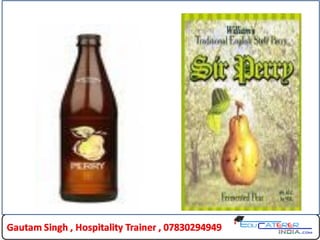
Perry or peer cider is an alcoholic beverage
made of fermented peer juice. It is similar to
cider. It has a similar alcoholic content
around 5% & above.
Real Perry, it is fermented & distilled peer
juice. Like applejack, fermented & distilled
apple juice.
Perry
Perry
Production of CIDER & PERRY
 Selection Apples (Eating, Cooking& Cider
apples)
 Scratting and Pressing
 Fermentation (4–16 °C (40–60 °F) for 3
months.
(Racking, Carbonation & Maturation)
 Blending and bottling
Service of Cider & Perry
 Served in Flute or Pilsner or woodchuck or
any similar glass or long Tapered glass
 Served chilled
 Can be flavoured with botanicals & served
warm
 Can be mixed with Syrups & served chilled.
Storage of CIDER & PERRY
 Mature cider should be stored in full airtight
containers
 It can be bottled or kept in bulk, but air must
be excluded at all times to prevent spoilage
 Stored in a Cool, Dark Place
 Should be away from noise/sound, vibration &
light
Alcohol free wines/
De-alcoholized wines
A category of wine produced by one of the
several special processes that remove the
alcohol, it is known as non- alcoholic wine. It
is legally a non alcoholic product it contains
less than 0.5 % alcohol ( about the same
amount in most freshly squeezed orange
juice. It has less than half the calories of
regular wine. De-alcoholized wines simply
doesn’t have the body & mouth full of real
wine.
Alcohol free wines/
De-alcoholized wines
These wines are made by fermenting grape
juice, later on alcohol is removed by hot
treatment, I.e distillation which may also
removes most of the flavor.
Alcohol free 0.05%, De-alcoholized
0.5%,Low alcohol 1.25%.
Review
Cider(Apple), Perry (Pear), & Sake (Rice) is a
fermented alcoholic beverage.
BIBLIOGRAPHY
 Food & Beverage service, (Danis Lillicrap/ 7th
edition pg 169.
 Google http://en.wikipedia.org/wiki/Cider
http://en.wikipedia.org/wiki/Perry
http://en.wikipedia.org/wiki/Sake
THANK YOU

Sake cider perry

  • 1.
  • 2.
    SESSION OBJECTIVES After theend of the session one should be able to know sake, cider, Perry types, their production, service.
  • 3.
    Contents  Definition  Production Service & Storage  Cider  Perry  Production  Storage & Service  Alcohol free wines
  • 4.
    Sake A sweet goldenwine made from fermenting freshly steamed glutinous rice. Most rice wines are low in alcohol. The most well known Japanese rice wines are sake & mirin. Sake is a Japanese word meaning alcoholic beverage. Its other name is ‘Nihonshu’. Sake is widely refer to in English as ‘Rice wine’. It is served warm in a small cup called ‘Sakazuki’. It has 18% alcohol.
  • 5.
     Sake cups Here is a sakazuki (a flat, saucer-like cup),  An ochoko (a small, cylindrical cup),  And a Masu (a wooden, box-like cup).
  • 6.
  • 7.
  • 8.
    Production of SAKE Processing Rice(Polishing).  Resting  Milling  Washed & Steeped/Soaked  Boiled/Steamed-cooled & Divided  Inoculated with kōji mold (Aspergillus oryzae)  Creation of the starter mash (Kōji rice, water, and yeast) & lactic Acid  Cultivation of Yeast (Addition of steamed rice to Mixture for 10 to 15 days).
  • 9.
    Production of SAKE Main Mash or moromi (Steamed rice, water, and more kōji are added once a day for three days, doubling the volume of the mash each time)  Fermentation(2 to 6 weeks at a temperature of 10°C (50°F) or less).  Sake is pressed to separate the liquid  Some sake, a small amount of distilled alcohol is added to extract flavour  Filtration  Carbonation & Pasteurization
  • 10.
    Production of SAKE Maturation  Diluting by adding Water to decrease alcohol from 20 to 15%.  Bottling
  • 11.
    Service of Sake Served chilled in summer, Warm in Winters  Served from ceramic flasks called tokkuri. In a Saucer-like cups called sakazuki  Another traditional cup is the masu, a box usually made of hinoki or sugi,  which was originally used for measuring rice.  Server may put a glass inside the masu  Put the masu on a saucer and pour until sake overflows and fills both containers.
  • 12.
    Other sake &brewed beverages
  • 13.
    Storage  Store incool & Dark place  If stored at room temperature will last for few months  Should be consumed within 2-3 hrs  If stored at refrigerated condition will last for 3 days.
  • 14.
    Cider Cider is anatural , liquid beverage that is obtained from pressing of a finely ground fruit such as apples, under the proper conditions, it undergoes a natural fermenting process, which yields an alcoholic juice. It has 5% alcohol & appears golden yellow & often cloudy. It is very popular in UK, Normandy, Ireland & Spain.
  • 15.
    Perry or peercider is an alcoholic beverage made of fermented peer juice. It is similar to cider. It has a similar alcoholic content around 5% & above. Real Perry, it is fermented & distilled peer juice. Like applejack, fermented & distilled apple juice. Perry
  • 16.
  • 17.
    Production of CIDER& PERRY  Selection Apples (Eating, Cooking& Cider apples)  Scratting and Pressing  Fermentation (4–16 °C (40–60 °F) for 3 months. (Racking, Carbonation & Maturation)  Blending and bottling
  • 18.
    Service of Cider& Perry  Served in Flute or Pilsner or woodchuck or any similar glass or long Tapered glass  Served chilled  Can be flavoured with botanicals & served warm  Can be mixed with Syrups & served chilled.
  • 19.
    Storage of CIDER& PERRY  Mature cider should be stored in full airtight containers  It can be bottled or kept in bulk, but air must be excluded at all times to prevent spoilage  Stored in a Cool, Dark Place  Should be away from noise/sound, vibration & light
  • 20.
    Alcohol free wines/ De-alcoholizedwines A category of wine produced by one of the several special processes that remove the alcohol, it is known as non- alcoholic wine. It is legally a non alcoholic product it contains less than 0.5 % alcohol ( about the same amount in most freshly squeezed orange juice. It has less than half the calories of regular wine. De-alcoholized wines simply doesn’t have the body & mouth full of real wine.
  • 21.
    Alcohol free wines/ De-alcoholizedwines These wines are made by fermenting grape juice, later on alcohol is removed by hot treatment, I.e distillation which may also removes most of the flavor. Alcohol free 0.05%, De-alcoholized 0.5%,Low alcohol 1.25%.
  • 22.
    Review Cider(Apple), Perry (Pear),& Sake (Rice) is a fermented alcoholic beverage.
  • 23.
    BIBLIOGRAPHY  Food &Beverage service, (Danis Lillicrap/ 7th edition pg 169.  Google http://en.wikipedia.org/wiki/Cider http://en.wikipedia.org/wiki/Perry http://en.wikipedia.org/wiki/Sake
  • 24.