Curbing Sharps associated Infections in ED Dr. Rashidi Ahmad Medical lecturer/Emergentist School of Medical Sciences USM Health Campus [email_address] Occupational Hazard Workshop 4 th  September 2007
“ We need to create a culture of safety in the work environment  to make sure that health care organizations promote and support sharps injury prevention.” —  Julie Gerberding, M.D., M.P.H. CDC Director
Outline Facts & realities Risk assessment of SAIs in ED Injury prevention Suggestions
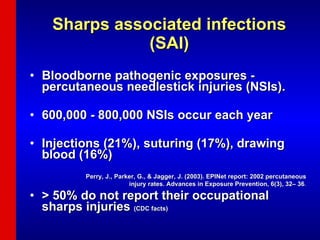
Sharps associated infections (SAI) Bloodborne pathogenic exposures - percutaneous needlestick injuries (NSIs). 600,000 - 800,000 NSIs occur each year Injections (21%), suturing (17%), drawing blood (16%) > 50% do not report their occupational sharps injuries  (CDC facts) Perry, J., Parker, G., & Jagger, J. (2003). EPINet report: 2002 percutaneous injury rates. Advances in Exposure Prevention, 6(3), 32– 36 .
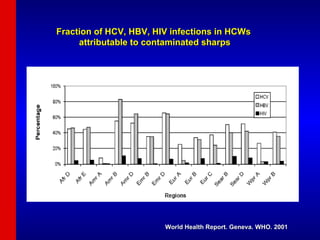
Fraction of HCV, HBV, HIV infections in HCWs  attributable to contaminated sharps World Health Report. Geneva. WHO. 2001
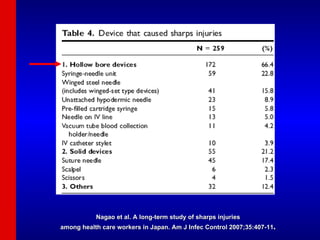
Nagao et al. A long-term study of sharps injuries among health care workers in Japan. Am J Infec Control 2007;35:407-11 .
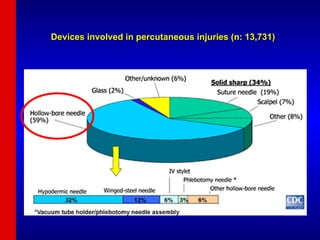
Devices involved in percutaneous injuries (n: 13,731)
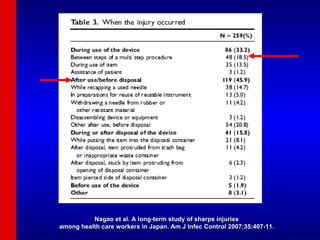
Nagao et al. A long-term study of sharps injuries among health care workers in Japan. Am J Infec Control 2007;35:407-11.
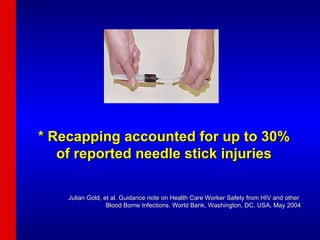
* Recapping accounted for up to 30% of reported needle stick injuries Julian Gold, et al. Guidance note on Health Care Worker Safety from HIV and other  Blood Borne Infections. World Bank, Washington, DC, USA, May 2004
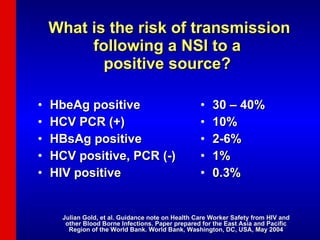
What is the risk of transmission following a NSI to a  positive source?   HbeAg positive HCV PCR (+)  HBsAg positive HCV positive, PCR (-) HIV positive 30 – 40% 10% 2-6% 1% 0.3% Julian Gold, et al. Guidance note on Health Care Worker Safety from HIV and other Blood Borne Infections. Paper prepared for the East Asia and Pacific Region of the World Bank. World Bank, Washington, DC, USA, May 2004
Impact of SRIs The evaluation and treatment of these injuries and subsequent illnesses impose a heavy societal burden in terms of: - economic cost - worker anxiety and distress - future morbidity & mortality
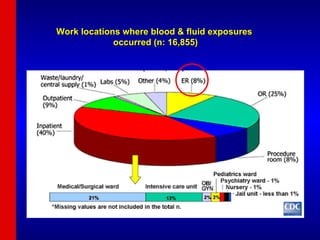
Work locations where blood & fluid exposures  occurred (n: 16,855)
Hazards among EDHCWs  Skin, mucous membranes, RS damages - cleaning, disinfecting, and sterilizing agents  Exposure to radiation.  Sharp objects injuries & infections Musculoskeletal problems -  handling of heavy patients, continuous work while standing  Stress & burnout - shift & ON duty, psychological & organizational factors Sick patients in the ER present a risk of infection from body fluids Violence patients
Why EDHCWs are at risk of sharp-associated infections? Johns Hopkins Hospital in Baltimore (1998) 5% of all adults presenting to the ED were seropositive for HBV, 18% for HCV, and 6% for HIV 24% of ED patients were infected with either HIV, HBV, or HCV.   GD Kelen, GB Green and RH Purcell  et al. , Hepatitis B and hepatitis C in emergency department patients,  N Engl J Med   326  (1992), pp. 1399–1404
Cont… HIV seroprevalence studies of ED patients have found infection rates up to 18% among patients with penetrating trauma in inner-city EDs  In addition, nonemergency health care workers are frequently referred to hospital EDs for immediate treatment of occupational exposures .  J Jui, P Stevens and K Hedberg  et al. , HIV seroprevalence in ED patients: Portland, Oregon, 1988-1991,  Acad Emerg Med   2  (1995), pp. 773–783. GD Kelen, GB Green and RH Purcell  et al. , Hepatitis B and hepatitis C in  ED patients,  N Engl J Med   326  (1992), pp. 1399–1404
Risk of HIV infection among  EDHCWs R Marcus  et al. , Risk of HIV infection among ED workers,  Am J Med  94 (1993), pp. 363–370   8-month study in 3 pairs of inner-city and suburban hospital EDs in high AIDS incidence areas in the United States HIV seroprevalence: - 4.1 to 8.9 per 100 patient visits in the 3 inner-city Eds - 6.1 in 1 suburban ED - 0.2 & 0.7 in other 2 suburban EDs. 69% of HIV patients was unknown to ED staff.
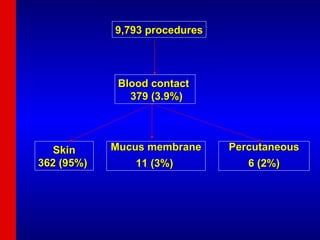
9,793 procedures Blood contact  379 (3.9%) Skin 362 (95%)  Mucus membrane 11 (3%)  Percutaneous 6 (2%)
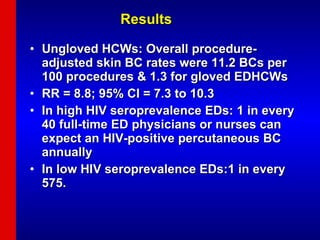
Ungloved HCWs: Overall procedure-adjusted skin BC rates were 11.2 BCs per 100 procedures & 1.3 for gloved EDHCWs RR = 8.8; 95% CI = 7.3 to 10.3 In high HIV seroprevalence EDs: 1 in every 40 full-time ED physicians or nurses can expect an HIV-positive percutaneous BC annually In low HIV seroprevalence EDs:1 in every 575.  Results
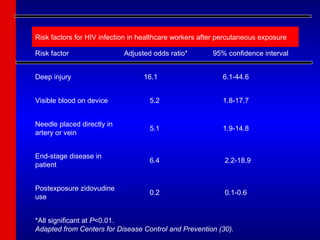
*All significant at  P <0.01.  Adapted from Centers for Disease Control and Prevention (30).   0.1-0.6  0.2  Postexposure zidovudine use  2.2-18.9  6.4  End-stage disease in patient  1.9-14.8  5.1  Needle placed directly in artery or vein  1.8-17.7  5.2  Visible blood on device  6.1-44.6  16.1  Deep injury  95% confidence interval  Adjusted odds ratio*  Risk factor  Risk factors for HIV infection in healthcare workers after percutaneous exposure
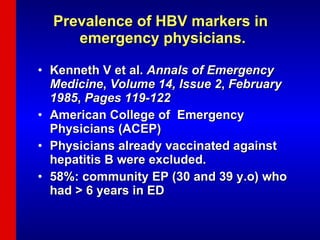
Prevalence of HBV markers in  emergency physicians. Kenneth V et al.  Annals of Emergency Medicine ,  Volume 14, Issue 2 ,  February 1985 ,  Pages 119-122 American College of  Emergency    Physicians (ACEP) Physicians already vaccinated against hepatitis B were excluded.  58%: community EP (30 and 39 y.o) who had > 6 years in ED
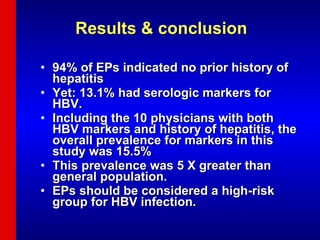
Results & conclusion 94% of EPs indicated no prior history of hepatitis Yet: 13.1% had serologic markers for HBV.  Including the 10 physicians with both HBV markers and history of hepatitis, the overall prevalence for markers in this study was 15.5% This prevalence was 5 X greater than general population. EPs should be considered a high-risk group for HBV infection.
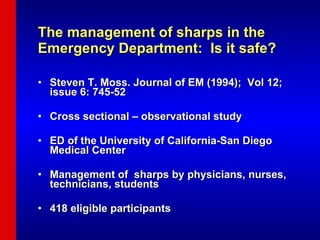
The management of sharps in the    Emergency Department:  Is it safe? Steven T. Moss. Journal of EM (1994);  Vol 12; issue 6: 745-52 Cross sectional – observational study ED of the University of California-San Diego Medical Center Management of  sharps by physicians, nurses, technicians, students 418 eligible participants
Excess risk to the user,  another person, or both [28% of 418] Excess risk to the user [27%]  Excess risk to another person [12%] * Of the 418 observed  sharp utilizations, none resulted in a puncture wound
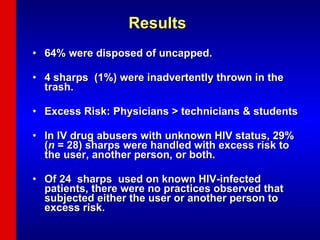
64% were disposed of uncapped. 4 sharps  (1%) were inadvertently thrown in the trash. Excess Risk: Physicians > technicians & students  In IV drug abusers with unknown HIV status, 29% ( n  = 28) sharps were handled with excess risk to the user, another person, or both. Of 24  sharps  used on known HIV-infected patients, there were no practices observed that subjected either the user or another person to excess risk.  Results
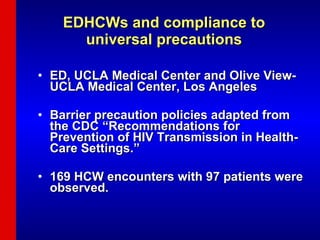
EDHCWs and compliance to universal precautions ED, UCLA Medical Center and Olive View-UCLA Medical Center, Los Angeles  Barrier precaution policies adapted from the CDC “Recommendations for Prevention of HIV Transmission in Health-Care Settings.”  169 HCW encounters with 97 patients were observed.
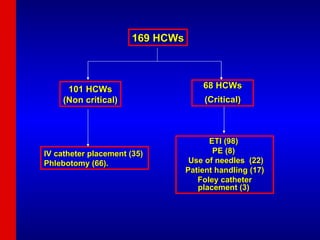
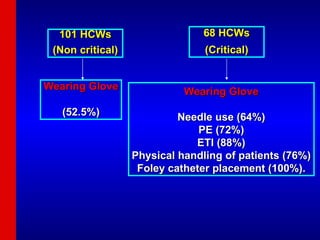
169 HCWs IV catheter placement (35)  Phlebotomy (66). ETI (98)  PE (8)  Use of needles  (22) Patient handling (17) Foley catheter placement (3)  101 HCWs (Non critical) 68 HCWs (Critical)
101 HCWs (Non critical) Wearing Glove (52.5%) Wearing Glove Needle use (64%) PE (72%) ETI (88%) Physical handling of patients (76%) Foley catheter placement (100%). 68 HCWs (Critical)
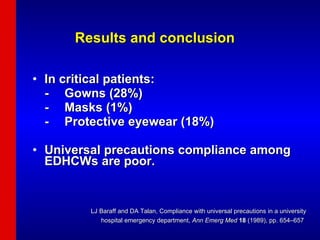
In critical patients: - Gowns (28%) - Masks (1%) - Protective eyewear (18%)  Universal precautions compliance among EDHCWs are poor. LJ Baraff and DA Talan, Compliance with universal precautions in a university hospital emergency department,  Ann Emerg Med   18  (1989), pp. 654–657   Results and conclusion
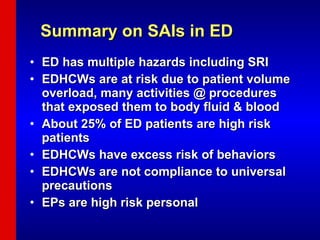
Summary on SAIs in ED ED has multiple hazards including SRI EDHCWs are at risk due to patient volume overload, many activities @ procedures that exposed them to body fluid & blood About 25% of ED patients are high risk patients EDHCWs have excess risk of behaviors EDHCWs are not compliance to universal precautions EPs are high risk personal
Injury Prevention:  The Three E’s Education Enforcement Engineering Christoffel T., and Gallagher S.,  Injury Prevention and Public Health , Gaithers,  Gaithersburg, Maryland: Aspen Publishers, 1999, 30-32,139-200
The Three E’s:  Education Aim is to provide EDHCWs with information on how to avoid SAIs Alter attitudes about risk reduction Modify behaviors by educating EDHCWs about why they must adopt behavior Altering social norms about risk of injury Promoting societal policy change for safer environment
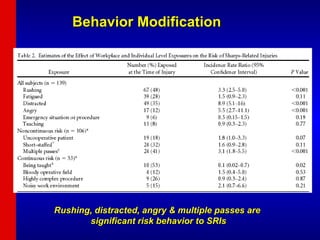
Rushing, distracted, angry & multiple passes are  significant risk behavior to SRIs Behavior Modification
The Three E’s:  Enforcement Enforcement is usually more effective than education Most injury prevention laws at state level Laws can have varied focus: individual behaviors engineering of environment consumer products design
Mandating compliance with UP is more effective than just a guideline 7 months following the introduction of an institutional policy mandating compliance with universal precautions (UPs) 127 HCWs performing 1421 interventions on 155 critically ill and injured patients in an emergency department setting in July 1989. Results were compared with a similar study undertaken exactly 1 year previously when UPs were considered as guidelines only.  Kelen P, et al. Substantial improvement in compliance with universal precautions in an emergency department following institution of policy.(1991)  Archives of Internal Medicine , 151 (10), pp. 2051-2056
Adherence to Ups: intervention of profuse bleeding patients – improved from 19.5% to 55.7%; performance of major procedure – improved from 16.7% to 54.5% Overall adherence to Ups: improved from 44.0% to 72.7%  Compliance for EDHCWs:  improved from 47.9% to 81.0%.   Kelen P, et al. Substantial improvement in compliance with universal precautions in an emergency department following institution of policy.(1991)  Archives of Internal Medicine , 151 (10), pp. 2051-2056 Results
 
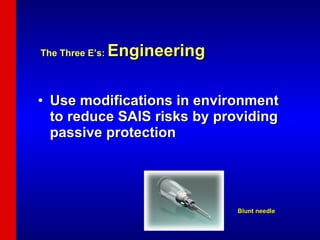
The Three E’s:  Engineering Use modifications in environment to reduce SAIS risks by providing passive protection Blunt needle
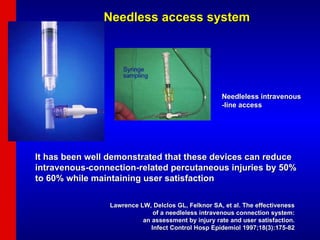
Needleless intravenous -line access  Needless access system It has been well demonstrated that these devices can reduce intravenous-connection-related percutaneous injuries by 50% to 60% while maintaining user satisfaction  Lawrence LW, Delclos GL, Felknor SA, et al. The effectiveness  of a needleless intravenous connection system:  an assessment by injury rate and user satisfaction.  Infect Control Hosp Epidemiol 1997;18(3):175-82
Conclusions Preventive measures Vaccinations Personal protective gear Mandating UPs Education and training Safety devices Supervision Convenience, non stress working environment Policies & procedures
General factors for SAIs prevention Population development factor Social need factor Policy maker factor Economic development factor
Summary SAIs in ED is REAL In ED HUSM context: paramedics are the high risk group not the EPs Unsure of the prevalence of HCV, HBV & HIV at EDHUSM SAIs is a disease; it is not an accident; it is preventable Time for proper Haddon Matrix analysis in ED Strategies: 3E
Thank you Q ?

Sai In Ed

  • 1.
    Curbing Sharps associatedInfections in ED Dr. Rashidi Ahmad Medical lecturer/Emergentist School of Medical Sciences USM Health Campus [email_address] Occupational Hazard Workshop 4 th September 2007
  • 2.
    “ We needto create a culture of safety in the work environment to make sure that health care organizations promote and support sharps injury prevention.” — Julie Gerberding, M.D., M.P.H. CDC Director
  • 3.
    Outline Facts &realities Risk assessment of SAIs in ED Injury prevention Suggestions
  • 4.
    Sharps associated infections(SAI) Bloodborne pathogenic exposures - percutaneous needlestick injuries (NSIs). 600,000 - 800,000 NSIs occur each year Injections (21%), suturing (17%), drawing blood (16%) > 50% do not report their occupational sharps injuries (CDC facts) Perry, J., Parker, G., & Jagger, J. (2003). EPINet report: 2002 percutaneous injury rates. Advances in Exposure Prevention, 6(3), 32– 36 .
  • 5.
    Fraction of HCV,HBV, HIV infections in HCWs attributable to contaminated sharps World Health Report. Geneva. WHO. 2001
  • 6.
    Nagao et al.A long-term study of sharps injuries among health care workers in Japan. Am J Infec Control 2007;35:407-11 .
  • 7.
    Devices involved inpercutaneous injuries (n: 13,731)
  • 8.
    Nagao et al.A long-term study of sharps injuries among health care workers in Japan. Am J Infec Control 2007;35:407-11.
  • 9.
    * Recapping accountedfor up to 30% of reported needle stick injuries Julian Gold, et al. Guidance note on Health Care Worker Safety from HIV and other Blood Borne Infections. World Bank, Washington, DC, USA, May 2004
  • 10.
    What is therisk of transmission following a NSI to a positive source? HbeAg positive HCV PCR (+) HBsAg positive HCV positive, PCR (-) HIV positive 30 – 40% 10% 2-6% 1% 0.3% Julian Gold, et al. Guidance note on Health Care Worker Safety from HIV and other Blood Borne Infections. Paper prepared for the East Asia and Pacific Region of the World Bank. World Bank, Washington, DC, USA, May 2004
  • 11.
    Impact of SRIsThe evaluation and treatment of these injuries and subsequent illnesses impose a heavy societal burden in terms of: - economic cost - worker anxiety and distress - future morbidity & mortality
  • 12.
    Work locations whereblood & fluid exposures occurred (n: 16,855)
  • 13.
    Hazards among EDHCWs Skin, mucous membranes, RS damages - cleaning, disinfecting, and sterilizing agents Exposure to radiation. Sharp objects injuries & infections Musculoskeletal problems - handling of heavy patients, continuous work while standing Stress & burnout - shift & ON duty, psychological & organizational factors Sick patients in the ER present a risk of infection from body fluids Violence patients
  • 14.
    Why EDHCWs areat risk of sharp-associated infections? Johns Hopkins Hospital in Baltimore (1998) 5% of all adults presenting to the ED were seropositive for HBV, 18% for HCV, and 6% for HIV 24% of ED patients were infected with either HIV, HBV, or HCV. GD Kelen, GB Green and RH Purcell et al. , Hepatitis B and hepatitis C in emergency department patients, N Engl J Med 326 (1992), pp. 1399–1404
  • 15.
    Cont… HIV seroprevalencestudies of ED patients have found infection rates up to 18% among patients with penetrating trauma in inner-city EDs In addition, nonemergency health care workers are frequently referred to hospital EDs for immediate treatment of occupational exposures . J Jui, P Stevens and K Hedberg et al. , HIV seroprevalence in ED patients: Portland, Oregon, 1988-1991, Acad Emerg Med 2 (1995), pp. 773–783. GD Kelen, GB Green and RH Purcell et al. , Hepatitis B and hepatitis C in ED patients, N Engl J Med 326 (1992), pp. 1399–1404
  • 16.
    Risk of HIVinfection among EDHCWs R Marcus et al. , Risk of HIV infection among ED workers, Am J Med 94 (1993), pp. 363–370 8-month study in 3 pairs of inner-city and suburban hospital EDs in high AIDS incidence areas in the United States HIV seroprevalence: - 4.1 to 8.9 per 100 patient visits in the 3 inner-city Eds - 6.1 in 1 suburban ED - 0.2 & 0.7 in other 2 suburban EDs. 69% of HIV patients was unknown to ED staff.
  • 17.
    9,793 procedures Bloodcontact 379 (3.9%) Skin 362 (95%) Mucus membrane 11 (3%) Percutaneous 6 (2%)
  • 18.
    Ungloved HCWs: Overallprocedure-adjusted skin BC rates were 11.2 BCs per 100 procedures & 1.3 for gloved EDHCWs RR = 8.8; 95% CI = 7.3 to 10.3 In high HIV seroprevalence EDs: 1 in every 40 full-time ED physicians or nurses can expect an HIV-positive percutaneous BC annually In low HIV seroprevalence EDs:1 in every 575. Results
  • 19.
    *All significant at P <0.01. Adapted from Centers for Disease Control and Prevention (30). 0.1-0.6 0.2 Postexposure zidovudine use 2.2-18.9 6.4 End-stage disease in patient 1.9-14.8 5.1 Needle placed directly in artery or vein 1.8-17.7 5.2 Visible blood on device 6.1-44.6 16.1 Deep injury 95% confidence interval Adjusted odds ratio* Risk factor Risk factors for HIV infection in healthcare workers after percutaneous exposure
  • 20.
    Prevalence of HBVmarkers in emergency physicians. Kenneth V et al. Annals of Emergency Medicine ,  Volume 14, Issue 2 ,  February 1985 ,  Pages 119-122 American College of Emergency Physicians (ACEP) Physicians already vaccinated against hepatitis B were excluded. 58%: community EP (30 and 39 y.o) who had > 6 years in ED
  • 21.
    Results & conclusion94% of EPs indicated no prior history of hepatitis Yet: 13.1% had serologic markers for HBV. Including the 10 physicians with both HBV markers and history of hepatitis, the overall prevalence for markers in this study was 15.5% This prevalence was 5 X greater than general population. EPs should be considered a high-risk group for HBV infection.
  • 22.
    The management ofsharps in the Emergency Department: Is it safe? Steven T. Moss. Journal of EM (1994); Vol 12; issue 6: 745-52 Cross sectional – observational study ED of the University of California-San Diego Medical Center Management of sharps by physicians, nurses, technicians, students 418 eligible participants
  • 23.
    Excess risk tothe user, another person, or both [28% of 418] Excess risk to the user [27%] Excess risk to another person [12%] * Of the 418 observed sharp utilizations, none resulted in a puncture wound
  • 24.
    64% were disposedof uncapped. 4 sharps (1%) were inadvertently thrown in the trash. Excess Risk: Physicians > technicians & students In IV drug abusers with unknown HIV status, 29% ( n = 28) sharps were handled with excess risk to the user, another person, or both. Of 24 sharps used on known HIV-infected patients, there were no practices observed that subjected either the user or another person to excess risk. Results
  • 25.
    EDHCWs and complianceto universal precautions ED, UCLA Medical Center and Olive View-UCLA Medical Center, Los Angeles Barrier precaution policies adapted from the CDC “Recommendations for Prevention of HIV Transmission in Health-Care Settings.” 169 HCW encounters with 97 patients were observed.
  • 26.
    169 HCWs IVcatheter placement (35) Phlebotomy (66). ETI (98) PE (8) Use of needles (22) Patient handling (17) Foley catheter placement (3) 101 HCWs (Non critical) 68 HCWs (Critical)
  • 27.
    101 HCWs (Noncritical) Wearing Glove (52.5%) Wearing Glove Needle use (64%) PE (72%) ETI (88%) Physical handling of patients (76%) Foley catheter placement (100%). 68 HCWs (Critical)
  • 28.
    In critical patients:- Gowns (28%) - Masks (1%) - Protective eyewear (18%) Universal precautions compliance among EDHCWs are poor. LJ Baraff and DA Talan, Compliance with universal precautions in a university hospital emergency department, Ann Emerg Med 18 (1989), pp. 654–657 Results and conclusion
  • 29.
    Summary on SAIsin ED ED has multiple hazards including SRI EDHCWs are at risk due to patient volume overload, many activities @ procedures that exposed them to body fluid & blood About 25% of ED patients are high risk patients EDHCWs have excess risk of behaviors EDHCWs are not compliance to universal precautions EPs are high risk personal
  • 30.
    Injury Prevention: The Three E’s Education Enforcement Engineering Christoffel T., and Gallagher S., Injury Prevention and Public Health , Gaithers, Gaithersburg, Maryland: Aspen Publishers, 1999, 30-32,139-200
  • 31.
    The Three E’s: Education Aim is to provide EDHCWs with information on how to avoid SAIs Alter attitudes about risk reduction Modify behaviors by educating EDHCWs about why they must adopt behavior Altering social norms about risk of injury Promoting societal policy change for safer environment
  • 32.
    Rushing, distracted, angry& multiple passes are significant risk behavior to SRIs Behavior Modification
  • 33.
    The Three E’s: Enforcement Enforcement is usually more effective than education Most injury prevention laws at state level Laws can have varied focus: individual behaviors engineering of environment consumer products design
  • 34.
    Mandating compliance withUP is more effective than just a guideline 7 months following the introduction of an institutional policy mandating compliance with universal precautions (UPs) 127 HCWs performing 1421 interventions on 155 critically ill and injured patients in an emergency department setting in July 1989. Results were compared with a similar study undertaken exactly 1 year previously when UPs were considered as guidelines only. Kelen P, et al. Substantial improvement in compliance with universal precautions in an emergency department following institution of policy.(1991)  Archives of Internal Medicine , 151 (10), pp. 2051-2056
  • 35.
    Adherence to Ups:intervention of profuse bleeding patients – improved from 19.5% to 55.7%; performance of major procedure – improved from 16.7% to 54.5% Overall adherence to Ups: improved from 44.0% to 72.7% Compliance for EDHCWs: improved from 47.9% to 81.0%. Kelen P, et al. Substantial improvement in compliance with universal precautions in an emergency department following institution of policy.(1991)  Archives of Internal Medicine , 151 (10), pp. 2051-2056 Results
  • 36.
  • 37.
    The Three E’s: Engineering Use modifications in environment to reduce SAIS risks by providing passive protection Blunt needle
  • 38.
    Needleless intravenous -lineaccess Needless access system It has been well demonstrated that these devices can reduce intravenous-connection-related percutaneous injuries by 50% to 60% while maintaining user satisfaction Lawrence LW, Delclos GL, Felknor SA, et al. The effectiveness of a needleless intravenous connection system: an assessment by injury rate and user satisfaction. Infect Control Hosp Epidemiol 1997;18(3):175-82
  • 39.
    Conclusions Preventive measuresVaccinations Personal protective gear Mandating UPs Education and training Safety devices Supervision Convenience, non stress working environment Policies & procedures
  • 40.
    General factors forSAIs prevention Population development factor Social need factor Policy maker factor Economic development factor
  • 41.
    Summary SAIs inED is REAL In ED HUSM context: paramedics are the high risk group not the EPs Unsure of the prevalence of HCV, HBV & HIV at EDHUSM SAIs is a disease; it is not an accident; it is preventable Time for proper Haddon Matrix analysis in ED Strategies: 3E
  • 42.

Editor's Notes

  • #31 The three E’s of injury prevention address the three conceptual approaches to injury prevention. The three are complimentary to each other and can be applied synergistically to the same injury problem. Christoffel T., and Gallagher S., Injury Prevention and Public Health , Gaithers, Gaithersburg, Maryland: Aspen Publishers, 1999, 30-32,139-200.
  • #32 The educational approach can be simplified to that if people are given information about the risk of injuries they will avoid those behaviors that will lead to injury. This assumes there is a lack of information about the risk of injuries. This approach is founded on the the rational-empirical strategy (Benne &amp; Chin) that assumes that people are rational and when given information will act to optimize their health. Many public health programs utilize this approach. Examples: “Buckle up”, “Practice Safe Sex” Chin, R and Benne, K. “general strategies for effective change in human systems” In: Warren Bennis et al.(eds.) The Planning of Change , New York: Holt, Rinehart and Winston, Inc. 32-59, 1969.
  • #34 Enforcement strategies can be applies at varying levels. They can regulate the environment to make it less risky or they can regulate behavior. This can be done through statue law or tort law. Both have been used successfully.
  • #38 The environment can be reengineered (or changed) to reduce the risk of injuries. Some of the greatest successes in injury have been because of engineering a change in the environment. These have not only been limited to motor vehicle safety but diverse applications such as child resistant caps, and safety straps on changing tables.