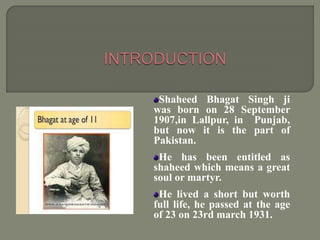

Shaheed Bhagat Singh ji
was born on 28 September
1907,in Lallpur, in Punjab,
but now it is the part of
Pakistan.
He has been entitled as
shaheed which means a great
soul or martyr.
He lived a short but worth
full life, he passed at the age
of 23 on 23rd march 1931.
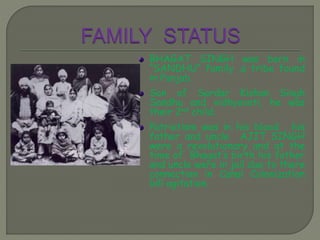
BHAGAT SINGH was born in
“SANDHU” family ,a tribe found
in Punjab.
Son of Sardar Kishan Singh
Sandhu and vidhyavati, he was
their 2nd child.
Patriotism was in his blood , his
father and uncle AJIT SINGH
were a revolutionary and at the
time of Bhagat’s birth his father
and uncle were in jail due to there
connection in Canal Colonization
bill agitation.
He passed his 5th class from his school at village,
then he joined DAV ( Dayanand Anglo-Vedic )
school.
But in the call of Mahatma Gandhi and other
national leaders to boycott government aided
institutions and british goods he gave up his
school and joined National college at Lahore and
tored his all text books published by british govt.
 "The aim of life is no more to control mind, but to
develop it harmoniously, not to achieve salvation here
after, but to make the best use of it here below, and not
to realize truth, beauty and good only in
contemplation, but also in-the actual experience of
daily life; social progress depends not upon the
involvement of the few, but on the enrichment
democracy or universal brotherhood, which can be
achieved only, when there is an equality of
opportunity, of opportunity in the social, political and
individual life”.
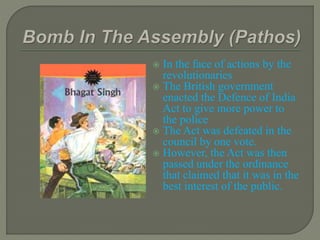
 In the face of actions by the
revolutionaries
 The British government
enacted the Defence of India
Act to give more power to
the police
 The Act was defeated in the
council by one vote.
 However, the Act was then
passed under the ordinance
that claimed that it was in the
best interest of the public.
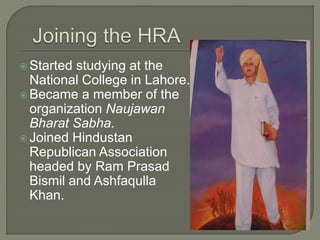
 Started studying at the
National College in Lahore.
 Became a member of the
organization Naujawan
Bharat Sabha.
 Joined Hindustan
Republican Association
headed by Ram Prasad
Bismil and Ashfaqulla
Khan.
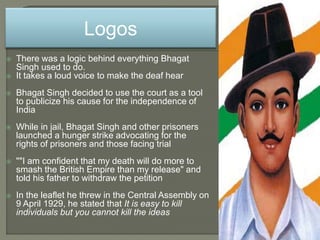
 There was a logic behind everything Bhagat
Singh used to do.
 It takes a loud voice to make the deaf hear
 Bhagat Singh decided to use the court as a tool
to publicize his cause for the independence of
India
 While in jail, Bhagat Singh and other prisoners
launched a hunger strike advocating for the
rights of prisoners and those facing trial
 ""I am confident that my death will do more to
smash the British Empire than my release" and
told his father to withdraw the petition
 In the leaflet he threw in the Central Assembly on
9 April 1929, he stated that It is easy to kill
individuals but you cannot kill the ideas
Logos
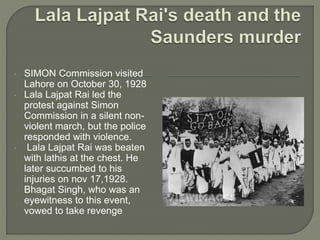
• SIMON Commission visited
Lahore on October 30, 1928
• Lala Lajpat Rai led the
protest against Simon
Commission in a silent non-
violent march, but the police
responded with violence.
• Lala Lajpat Rai was beaten
with lathis at the chest. He
later succumbed to his
injuries on nov 17,1928.
Bhagat Singh, who was an
eyewitness to this event,
vowed to take revenge
Sahid bhagat singh

Sahid bhagat singh

  • 2.
    Shaheed Bhagat Singhji was born on 28 September 1907,in Lallpur, in Punjab, but now it is the part of Pakistan. He has been entitled as shaheed which means a great soul or martyr. He lived a short but worth full life, he passed at the age of 23 on 23rd march 1931.
  • 3.
    BHAGAT SINGH wasborn in “SANDHU” family ,a tribe found in Punjab. Son of Sardar Kishan Singh Sandhu and vidhyavati, he was their 2nd child. Patriotism was in his blood , his father and uncle AJIT SINGH were a revolutionary and at the time of Bhagat’s birth his father and uncle were in jail due to there connection in Canal Colonization bill agitation.
  • 4.
    He passed his5th class from his school at village, then he joined DAV ( Dayanand Anglo-Vedic ) school. But in the call of Mahatma Gandhi and other national leaders to boycott government aided institutions and british goods he gave up his school and joined National college at Lahore and tored his all text books published by british govt.
  • 6.
     "The aimof life is no more to control mind, but to develop it harmoniously, not to achieve salvation here after, but to make the best use of it here below, and not to realize truth, beauty and good only in contemplation, but also in-the actual experience of daily life; social progress depends not upon the involvement of the few, but on the enrichment democracy or universal brotherhood, which can be achieved only, when there is an equality of opportunity, of opportunity in the social, political and individual life”.
  • 7.
     In theface of actions by the revolutionaries  The British government enacted the Defence of India Act to give more power to the police  The Act was defeated in the council by one vote.  However, the Act was then passed under the ordinance that claimed that it was in the best interest of the public.
  • 8.
     Started studyingat the National College in Lahore.  Became a member of the organization Naujawan Bharat Sabha.  Joined Hindustan Republican Association headed by Ram Prasad Bismil and Ashfaqulla Khan.
  • 9.
     There wasa logic behind everything Bhagat Singh used to do.  It takes a loud voice to make the deaf hear  Bhagat Singh decided to use the court as a tool to publicize his cause for the independence of India  While in jail, Bhagat Singh and other prisoners launched a hunger strike advocating for the rights of prisoners and those facing trial  ""I am confident that my death will do more to smash the British Empire than my release" and told his father to withdraw the petition  In the leaflet he threw in the Central Assembly on 9 April 1929, he stated that It is easy to kill individuals but you cannot kill the ideas Logos
  • 10.
    • SIMON Commissionvisited Lahore on October 30, 1928 • Lala Lajpat Rai led the protest against Simon Commission in a silent non- violent march, but the police responded with violence. • Lala Lajpat Rai was beaten with lathis at the chest. He later succumbed to his injuries on nov 17,1928. Bhagat Singh, who was an eyewitness to this event, vowed to take revenge