1MURPHY OIL CORPORATION www.murphyoilcorp.com NYSE: MUR
SAFETY MEETING – October 14
Lifting Equipment and Appliances
2MURPHY OIL CORPORATION www.murphyoilcorp.com NYSE: MUR
SAFETY MEETING – October 14
Subject: Lifting Equipment and Appliances
References: MOC Lifting Operation Manual - MOM-MUR-
10-HS-0015-00-0 Revision 0
BS EN 12079-1, 2 & 3 (2006)
DNV 2.7-1 (2006 & 2013)
DNV 2.7-3 (2011)
UKOOA (2002) – Referenced via MOC LOM
LOLER (1998) – Referenced via MOC LOM
ISO 13628-8 (2002) ROV interfaces on
subsea production systems
3MURPHY OIL CORPORATION www.murphyoilcorp.com NYSE: MUR
SAFETY MEETING – October 14
Offshore Freight Container (DVN 2.7-1 / BS EN ISO 12079-1)
Examples: Cargo Carrying Unit (CCU) Basket, Open Top Container etc
Gas Racks
Tanks
Offshore Service Container (DVN 2.7-1 / BS EN ISO 12079-1)
Examples: Labs / Workshops
Power Plant / Control Stations
Portable Offshore Units (DNV 2.7-3)
Examples: Type A; Coil Units, Skid type Manifolds / Pumps etc
Type B; Skids without a crash frame
Type C; Stand alone vessels, reels, manifolds
Type D; Control cabins, service units (integral strength in skin)
Type E; Falling outside the scope of 2.7-1/2.7-3/12079
4MURPHY OIL CORPORATION www.murphyoilcorp.com NYSE: MUR
SAFETY MEETING – October 14
Question 1:
“ROV Equipment mobilized to MOC Contracted offshore locations
(i.e. Rigs). At the time of demobilization from an offshore rig, how
do we lift equipment from the rig if the ROV equipment is not
considered suitable for offshore lifting?”
Response:
In terms of the specified requirements, as referenced via the MOC
LOM, LOLER, UKOOA etc, if the equipment is not considered
suitable for lifting, the simple answer is that it is not lifted!
Unrealistic but reality in terms of specified requirements.
5MURPHY OIL CORPORATION www.murphyoilcorp.com NYSE: MUR
SAFETY MEETING – October 14
Obviously, the best approach is to have process and practices in place to
ensure that equipment does not get to a condition where it is
unsuitable to lift - NAMELY
In an instance such as this, it would be recommended that a thorough,
documented risk assessment is performed using personnel competent
in lifting equipment, structures and practices to determine if the
equipment is in fact unsuitable to lift or to implement measures that
would mitigate the possible risks involved, at least until the equipment
was back to shore where it could be evaluated further.
6MURPHY OIL CORPORATION www.murphyoilcorp.com NYSE: MUR
SAFETY MEETING – October 14
Question 2:
“Other than a sea container designed and built to DNV 2.7-1
construction rules how do you confirm equipment is suitable for
offshore lifting i.e. EHPU, an A Frame. An Umbilical Winch.”
Response:
In terms of the specified requirements, as referenced via the MOC
LOM or by using the principles used for a sea container, in this
case the use of DNV 2.7-3 could be applied by;
• Design review and verification
• Conformity of fabrication to design requirements
• Conformity of tests and inspections to design requirements
• Maintaining records as evidence of conformance, such as the
7MURPHY OIL CORPORATION www.murphyoilcorp.com NYSE: MUR
SAFETY MEETING – October 14
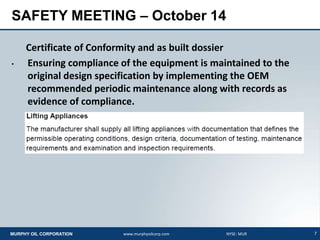
Certificate of Conformity and as built dossier
• Ensuring compliance of the equipment is maintained to the
original design specification by implementing the OEM
recommended periodic maintenance along with records as
evidence of compliance.
8MURPHY OIL CORPORATION www.murphyoilcorp.com NYSE: MUR
SAFETY MEETING – October 14
Question 3:
“Must all equipment be weighed to determine proof of weight?”
Response:
Based on the references quoted, there is a requirement for
weight to be identified.
MOC LOM 6.4.1; “…every lifting appliance shall have an SWL”
(Safe Working Load)
DNV 2.7-1 at 6.3 and BS EN ISO 12079-1 at 9.3 states; “Maximum
gross mass (Kg), Tare mass (Kg) & Payload (Kg).”
DNV 2.7-3 at 6.2 states; “The maximum gross weight (mass) also
if applicable the tare mass and the payload.”
There are a number of ways that the weight can be determined
such as assembly calculations, drawings or the use of a load cell.
9MURPHY OIL CORPORATION www.murphyoilcorp.com NYSE: MUR
SAFETY MEETING – October 14
In place with the MOC Logistics group for the delivery of equipment to
the MOC Supply Base is a cargo transfer checklist where there are two
points that must also be considered for “proof or weight,” for the lifted
equipment and associated lifting accessories, which are;
► Check Safe Working Load (SWL)
► Check loaded item is within the weight limit
This checklist is completed by all Contractors prior to releasing
equipment to the MOC Supply Base and then cross checked by the MOC
Logistics group.
One final point in relation to weight is the distribution of the weight of
any lifted equipment where there are guidance notes, in the case of
CCU’s specified requirements, to ensure the lift is balanced (±50) from
centre) and when suspended, a lift must be level in both axes, <3% of
length/breadth (equivalent to 6” in 20’, 18” in 50’).
10MURPHY OIL CORPORATION www.murphyoilcorp.com NYSE: MUR
SAFETY MEETING – October 14
Question 4:
“Equipment lifted from vessels deployed to seabed through the
water column. If a piece of equipment (Large subsea tool or static
object) is deployed from a boat overboard to the sea, what
criteria must be met and supplied as evidence before the item is
deemed fit for use?”
Response:
Pretty much the same response to question 2 in terms of what is
required.
• Design review and verification
• Conformity of fabrication to design requirements
• Conformity of tests and inspections to design requirements
• Maintaining records as evidence of conformance, such as the
11MURPHY OIL CORPORATION www.murphyoilcorp.com NYSE: MUR
SAFETY MEETING – October 14
Certificate of Conformity and as built dossier
• Ensuring compliance of the equipment is maintained to the original
design specification by implementing the OEM recommended
periodic maintenance along with records as evidence of
compliance.
Specifically ISO 13628-8 (2002) “ROV interfaces on subsea production
systems” may be worth consideration, or at least ISO 13628-1 Annex K.
DNV 2.7-3 also consider subsea design in chapter 3.11.
Summary
In general terms, lifted equipment and accessories are no different from
any other equipment that is used during drilling and completion
operations in that the equipment is designed, manufactured, tested,
inspected, maintained and preserved to defined criteria with
documented evidence of conformance available.
12MURPHY OIL CORPORATION www.murphyoilcorp.com NYSE: MUR
SAFETY MEETING – October 14
Questions???
For further clarification related to any point
from the presentation, please speak with any
of the QA/QC Team after the meeting where we
will try to assist, alternately drop an email to
one of our Lifting Specialists at;
lifting_specialist_moc@hotmail.com
13MURPHY OIL CORPORATION www.murphyoilcorp.com NYSE: MUR
THANKS FOR LISTENING, HOPE IT WAS WORTHWHILE

Safety Meeting - Lifting 6Oct14

  • 1.
    1MURPHY OIL CORPORATIONwww.murphyoilcorp.com NYSE: MUR SAFETY MEETING – October 14 Lifting Equipment and Appliances
  • 2.
    2MURPHY OIL CORPORATIONwww.murphyoilcorp.com NYSE: MUR SAFETY MEETING – October 14 Subject: Lifting Equipment and Appliances References: MOC Lifting Operation Manual - MOM-MUR- 10-HS-0015-00-0 Revision 0 BS EN 12079-1, 2 & 3 (2006) DNV 2.7-1 (2006 & 2013) DNV 2.7-3 (2011) UKOOA (2002) – Referenced via MOC LOM LOLER (1998) – Referenced via MOC LOM ISO 13628-8 (2002) ROV interfaces on subsea production systems
  • 3.
    3MURPHY OIL CORPORATIONwww.murphyoilcorp.com NYSE: MUR SAFETY MEETING – October 14 Offshore Freight Container (DVN 2.7-1 / BS EN ISO 12079-1) Examples: Cargo Carrying Unit (CCU) Basket, Open Top Container etc Gas Racks Tanks Offshore Service Container (DVN 2.7-1 / BS EN ISO 12079-1) Examples: Labs / Workshops Power Plant / Control Stations Portable Offshore Units (DNV 2.7-3) Examples: Type A; Coil Units, Skid type Manifolds / Pumps etc Type B; Skids without a crash frame Type C; Stand alone vessels, reels, manifolds Type D; Control cabins, service units (integral strength in skin) Type E; Falling outside the scope of 2.7-1/2.7-3/12079
  • 4.
    4MURPHY OIL CORPORATIONwww.murphyoilcorp.com NYSE: MUR SAFETY MEETING – October 14 Question 1: “ROV Equipment mobilized to MOC Contracted offshore locations (i.e. Rigs). At the time of demobilization from an offshore rig, how do we lift equipment from the rig if the ROV equipment is not considered suitable for offshore lifting?” Response: In terms of the specified requirements, as referenced via the MOC LOM, LOLER, UKOOA etc, if the equipment is not considered suitable for lifting, the simple answer is that it is not lifted! Unrealistic but reality in terms of specified requirements.
  • 5.
    5MURPHY OIL CORPORATIONwww.murphyoilcorp.com NYSE: MUR SAFETY MEETING – October 14 Obviously, the best approach is to have process and practices in place to ensure that equipment does not get to a condition where it is unsuitable to lift - NAMELY In an instance such as this, it would be recommended that a thorough, documented risk assessment is performed using personnel competent in lifting equipment, structures and practices to determine if the equipment is in fact unsuitable to lift or to implement measures that would mitigate the possible risks involved, at least until the equipment was back to shore where it could be evaluated further.
  • 6.
    6MURPHY OIL CORPORATIONwww.murphyoilcorp.com NYSE: MUR SAFETY MEETING – October 14 Question 2: “Other than a sea container designed and built to DNV 2.7-1 construction rules how do you confirm equipment is suitable for offshore lifting i.e. EHPU, an A Frame. An Umbilical Winch.” Response: In terms of the specified requirements, as referenced via the MOC LOM or by using the principles used for a sea container, in this case the use of DNV 2.7-3 could be applied by; • Design review and verification • Conformity of fabrication to design requirements • Conformity of tests and inspections to design requirements • Maintaining records as evidence of conformance, such as the
  • 7.
    7MURPHY OIL CORPORATIONwww.murphyoilcorp.com NYSE: MUR SAFETY MEETING – October 14 Certificate of Conformity and as built dossier • Ensuring compliance of the equipment is maintained to the original design specification by implementing the OEM recommended periodic maintenance along with records as evidence of compliance.
  • 8.
    8MURPHY OIL CORPORATIONwww.murphyoilcorp.com NYSE: MUR SAFETY MEETING – October 14 Question 3: “Must all equipment be weighed to determine proof of weight?” Response: Based on the references quoted, there is a requirement for weight to be identified. MOC LOM 6.4.1; “…every lifting appliance shall have an SWL” (Safe Working Load) DNV 2.7-1 at 6.3 and BS EN ISO 12079-1 at 9.3 states; “Maximum gross mass (Kg), Tare mass (Kg) & Payload (Kg).” DNV 2.7-3 at 6.2 states; “The maximum gross weight (mass) also if applicable the tare mass and the payload.” There are a number of ways that the weight can be determined such as assembly calculations, drawings or the use of a load cell.
  • 9.
    9MURPHY OIL CORPORATIONwww.murphyoilcorp.com NYSE: MUR SAFETY MEETING – October 14 In place with the MOC Logistics group for the delivery of equipment to the MOC Supply Base is a cargo transfer checklist where there are two points that must also be considered for “proof or weight,” for the lifted equipment and associated lifting accessories, which are; ► Check Safe Working Load (SWL) ► Check loaded item is within the weight limit This checklist is completed by all Contractors prior to releasing equipment to the MOC Supply Base and then cross checked by the MOC Logistics group. One final point in relation to weight is the distribution of the weight of any lifted equipment where there are guidance notes, in the case of CCU’s specified requirements, to ensure the lift is balanced (±50) from centre) and when suspended, a lift must be level in both axes, <3% of length/breadth (equivalent to 6” in 20’, 18” in 50’).
  • 10.
    10MURPHY OIL CORPORATIONwww.murphyoilcorp.com NYSE: MUR SAFETY MEETING – October 14 Question 4: “Equipment lifted from vessels deployed to seabed through the water column. If a piece of equipment (Large subsea tool or static object) is deployed from a boat overboard to the sea, what criteria must be met and supplied as evidence before the item is deemed fit for use?” Response: Pretty much the same response to question 2 in terms of what is required. • Design review and verification • Conformity of fabrication to design requirements • Conformity of tests and inspections to design requirements • Maintaining records as evidence of conformance, such as the
  • 11.
    11MURPHY OIL CORPORATIONwww.murphyoilcorp.com NYSE: MUR SAFETY MEETING – October 14 Certificate of Conformity and as built dossier • Ensuring compliance of the equipment is maintained to the original design specification by implementing the OEM recommended periodic maintenance along with records as evidence of compliance. Specifically ISO 13628-8 (2002) “ROV interfaces on subsea production systems” may be worth consideration, or at least ISO 13628-1 Annex K. DNV 2.7-3 also consider subsea design in chapter 3.11. Summary In general terms, lifted equipment and accessories are no different from any other equipment that is used during drilling and completion operations in that the equipment is designed, manufactured, tested, inspected, maintained and preserved to defined criteria with documented evidence of conformance available.
  • 12.
    12MURPHY OIL CORPORATIONwww.murphyoilcorp.com NYSE: MUR SAFETY MEETING – October 14 Questions??? For further clarification related to any point from the presentation, please speak with any of the QA/QC Team after the meeting where we will try to assist, alternately drop an email to one of our Lifting Specialists at; lifting_specialist_moc@hotmail.com
  • 13.
    13MURPHY OIL CORPORATIONwww.murphyoilcorp.com NYSE: MUR THANKS FOR LISTENING, HOPE IT WAS WORTHWHILE