Offshore and Industrial Services GmbH
GLO Doha Station Office
Forklift Operator Course
By: Mohamed Elazab
Offshore and Industrial Services
Rev.01 Sep 2004
2002-09-03
No. 2
Offshore and Industrial Services
Rev.01 Sep 2004
2002-09-03
No. 3
Offshore and Industrial Services
Rev.01 Sep 2004
2002-09-03
No. 4
ALWAYS READ AND
ALWAYS READ AND
UNDERSTAND THE
UNDERSTAND THE
MANUFACTURER’S
MANUFACTURER’S
OPERATOR’S MANUAL AND
SERVICE NOTICE
SERVICE NOTICE
!
Offshore and Industrial Services
Rev.01 Sep 2004
2002-09-03
No. 5
Lifting Parts of a Fork Lift Truck
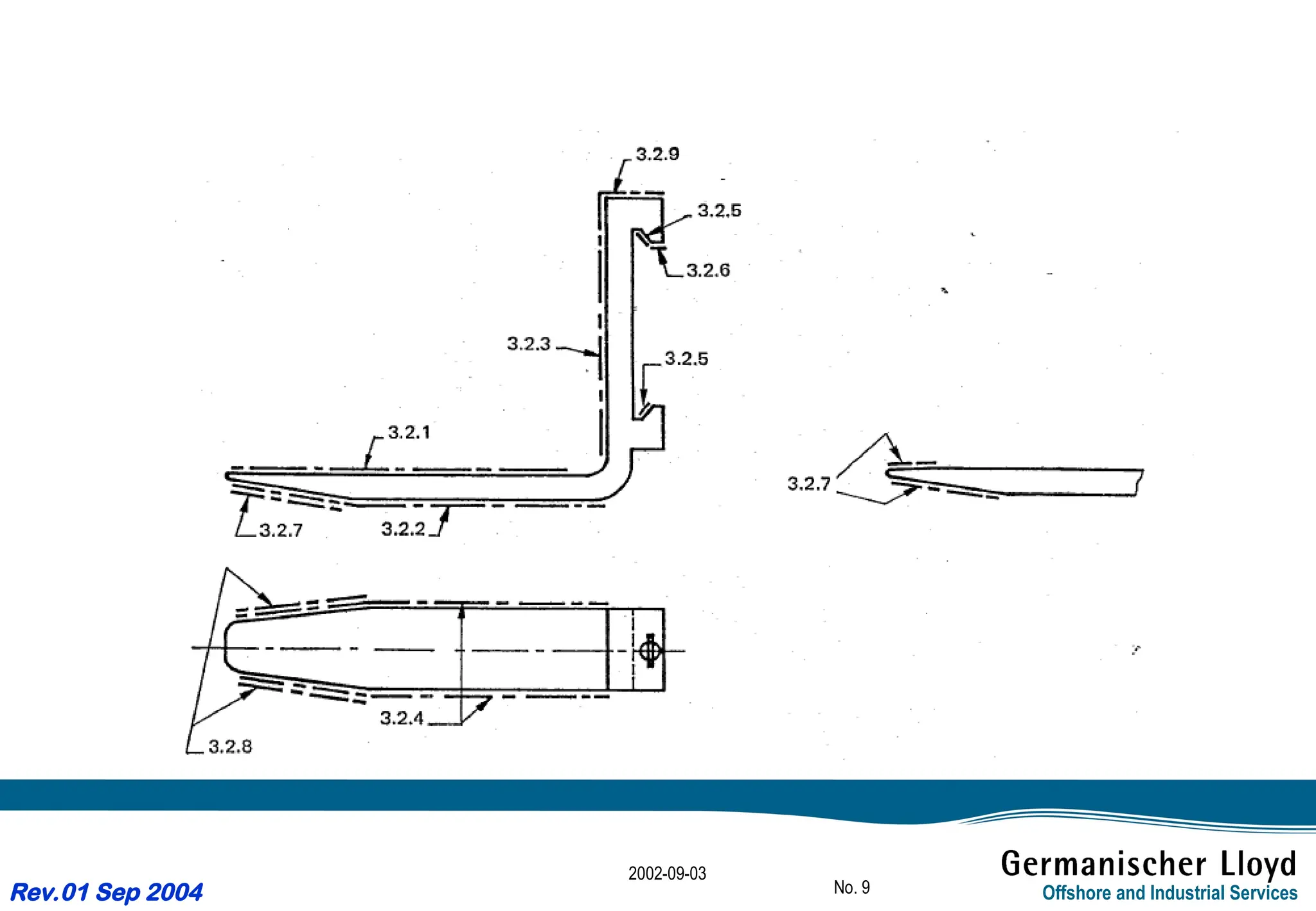
•The Forks adjusted to take equal weight locked into
place by locating pin
•Carriage allow lateral fork adjustment, it is mounted
inside the mast channel.
•Mast Inner mast moves, outer mast is fixed.
•Load Chains take the weight of the forks/ carriage the load.
It is anchored behind the mast.
•Hoist Ram To elevate and lower carriage and forks.
•Tilt Ram Tilts mast/ forks forward or backwards.
•SWL / Plate Identifies the capacity/SWL the truck can lift at
certain load centers.
Offshore and Industrial Services
Rev.01 Sep 2004
2002-09-03
No. 6
Offshore and Industrial Services
Rev.01 Sep 2004
2002-09-03
No. 7
Lifting Parts of a Fork Lift Truck
Offshore and Industrial Services
Rev.01 Sep 2004
2002-09-03
No. 8
Offshore and Industrial Services
Rev.01 Sep 2004
2002-09-03
No. 9
Offshore and Industrial Services
Rev.01 Sep 2004
2002-09-03
No. 10
Offshore and Industrial Services
Rev.01 Sep 2004
2002-09-03
No. 11
Offshore and Industrial Services
Rev.01 Sep 2004
2002-09-03
No. 12
Offshore and Industrial Services
Rev.01 Sep 2004
2002-09-03
No. 13
Lifting Parts of a Fork Lift Truck
Offshore and Industrial Services
Rev.01 Sep 2004
2002-09-03
No. 14
•Load Center is defined as the horizontal distance from the
heel of the forks to the center of the load.
Load Centers
500 mm 20 in
600 mm 24 in
750 mm 30 in
Height Weight that can be lifted
kg
lb
mm
in
Offshore and Industrial Services
Rev.01 Sep 2004
2002-09-03
No. 15
•Load Center is defined as the horizontal distance from the
heel of the forks to the center of the load.
Offshore and Industrial Services
Rev.01 Sep 2004
2002-09-03
No. 16
Side Loading
Lift Truck Large Lift
Truck
Offshore and Industrial Services
Rev.01 Sep 2004
2002-09-03
No. 17
Industrial
Counter balance
Lift Truck
Rough Terrain
Counter balance Lift
Truck
Offshore and Industrial Services
Rev.01 Sep 2004
2002-09-03
No. 18
Industrial Reach Truck
Telescopic
Materials Handler
Offshore and Industrial Services
Rev.01 Sep 2004
2002-09-03
No. 19
Pre-Shift Checks
•Fuel/Oil/Water Battery Top up to correct levels, remember
to wipe up an spillages, check battery terminal posts.
• Visual a good look at the machine, report anything out of the
ordinary.
•Hydraulic Oil Correct level, make sure forks are fully
lowered when checking.
•Forks/Mast Ensure there is no distortion, cracks or excessive
wear.
•Load Chains well lubricated, no bent pins or damage and
anchor points are in good conditions.
•Wheels/Tires Check wheel nuts, Tire pressures and Tire’s
conditions
Offshore and Industrial Services
Rev.01 Sep 2004
2002-09-03
No. 20
Pre-Shift Checks
•Brakes All brakes are working properly.
• Steering Undue tightness or looseness.
•Horn/Lights/ Gauges All good working order.
•Hydraulic Controls Working properly. Always operate
hydraulic control smoothly.
Offshore and Industrial Services
Rev.01 Sep 2004
2002-09-03
No. 21
IMMEDIATELY REPORT ANY
ABNORMALITY TO YOUR SUPERVISOR
•Never Park in front of Fire Fighting equipment,
Emergency Exits, Doorways, Safety Notice boards or
anywhere it would be a nuisance.
•Remember to remove the Keys.
Offshore and Industrial Services
Rev.01 Sep 2004
2002-09-03
No. 22
Chain is not
damaged in
anyway
Check the mast,
Hydraulics and
carriage plate
Ensure Chain Anchor
Points are in good
conditions
Offshore and Industrial Services
Rev.01 Sep 2004
2002-09-03
No. 23
Connect
Charger Plug
Correctly
Coil up
Charger Cable
Properly
Fully Understand
the Charger
Offshore and Industrial Services
Rev.01 Sep 2004
2002-09-03
No. 24
Operate Only in approved areas!
Certain areas such as those containing
hazardous flammable gases, liquid or
other combustibles, should be avoided
Offshore and Industrial Services
Rev.01 Sep 2004
2002-09-03
No. 25
Offshore and Industrial Services
Rev.01 Sep 2004
2002-09-03
No. 26
Offshore and Industrial Services
Rev.01 Sep 2004
2002-09-03
No. 27
Offshore and Industrial Services
Rev.01 Sep 2004
2002-09-03
No. 28
Offshore and Industrial Services
Rev.01 Sep 2004
2002-09-03
No. 29
Offshore and Industrial Services
Rev.01 Sep 2004
2002-09-03
No. 30
Offshore and Industrial Services
Rev.01 Sep 2004
2002-09-03
No. 31
Offshore and Industrial Services
Rev.01 Sep 2004
2002-09-03
No. 32
Offshore and Industrial Services
Rev.01 Sep 2004
2002-09-03
No. 33
Offshore and Industrial Services
Rev.01 Sep 2004
2002-09-03
No. 34
Offshore and Industrial Services
Rev.01 Sep 2004
2002-09-03
No. 35
Offshore and Industrial Services
Rev.01 Sep 2004
2002-09-03
No. 36
Offshore and Industrial Services
Rev.01 Sep 2004
2002-09-03
No. 37
Offshore and Industrial Services
Rev.01 Sep 2004
2002-09-03
No. 38
Offshore and Industrial Services
Rev.01 Sep 2004
2002-09-03
No. 39
Offshore and Industrial Services
Rev.01 Sep 2004
2002-09-03
No. 40
Offshore and Industrial Services
Rev.01 Sep 2004
2002-09-03
No. 41
Offshore and Industrial Services
Rev.01 Sep 2004
2002-09-03
No. 42
Offshore and Industrial Services
Rev.01 Sep 2004
2002-09-03
No. 43
Offshore and Industrial Services
Rev.01 Sep 2004
2002-09-03
No. 44
Offshore and Industrial Services
Rev.01 Sep 2004
2002-09-03
No. 45
Offshore and Industrial Services
Rev.01 Sep 2004
2002-09-03
No. 46
Offshore and Industrial Services
Rev.01 Sep 2004
2002-09-03
No. 47
Offshore and Industrial Services
Rev.01 Sep 2004
2002-09-03
No. 48
Offshore and Industrial Services
Rev.01 Sep 2004
2002-09-03
No. 49
Offshore and Industrial Services
Rev.01 Sep 2004
2002-09-03
No. 50
Offshore and Industrial Services
Rev.01 Sep 2004
2002-09-03
No. 51
Offshore and Industrial Services
Rev.01 Sep 2004
2002-09-03
No. 52
Offshore and Industrial Services
Rev.01 Sep 2004
2002-09-03
No. 53
Offshore and Industrial Services
Rev.01 Sep 2004
2002-09-03
No. 54
Offshore and Industrial Services
Rev.01 Sep 2004
2002-09-03
No. 55
Offshore and Industrial Services
Rev.01 Sep 2004
2002-09-03
No. 56
Offshore and Industrial Services
Rev.01 Sep 2004
2002-09-03
No. 57
Offshore and Industrial Services
Rev.01 Sep 2004
2002-09-03
No. 58
Offshore and Industrial Services
Rev.01 Sep 2004
2002-09-03
No. 59
Offshore and Industrial Services
Rev.01 Sep 2004
2002-09-03
No. 60
Offshore and Industrial Services
Rev.01 Sep 2004
2002-09-03
No. 61
Offshore and Industrial Services
Rev.01 Sep 2004
2002-09-03
No. 62
Offshore and Industrial Services
Rev.01 Sep 2004
2002-09-03
No. 63
Offshore and Industrial Services
Rev.01 Sep 2004
2002-09-03
No. 64
Safe Battery Charging Procedure for
Electrical Fork Lift Trucks
•Batteries are Electrolyte which is highly corrosive, toxic
highly corrosive, toxic
and flammable
and flammable.
•Protective Clothing must be worn, (including Gloves, Safety
shoes, aprons, and safety goggles).
•No Smoking or naked light is allowed near the charging
area.
•Ensure that you are using the correct charger and fully
understand how it works.
•When topping up a battery cell only use distilled water.
Offshore and Industrial Services
Rev.01 Sep 2004
2002-09-03
No. 65
Safe Battery Charging Procedure for Electrical
Fork Lift Trucks
•Check charger plug is connected to the battery plug
correctly.
•Ensure the charger is properly switched off before
disconnecting charger plug.
•Coil up the charger cable properly when finished charging a
fork lift truck
•Avoid Under-charging as this can damage a battery
permanently.
•Clean up any spillage immediately.
Offshore and Industrial Services
Rev.01 Sep 2004
2002-09-03
No. 66
Load Leading
Offshore and Industrial Services
Rev.01 Sep 2004
2002-09-03
No. 67
Load Trailing
Offshore and Industrial Services
Rev.01 Sep 2004
2002-09-03
No. 68
Safe Operation Procedure
•All controls must be operated smoothly.
•4” off the ground at the heel and 6” at the tips of the forks
should be maintained as travel position.
•Good all around observation before moving.
•Operate the truck at a speed consistent with the type of load
and general work conditions.
•Ensure the truck capacity plate is fully understood.
•Avoid pot holes and kerbs in the road. If you have to cross,
cross it diagonally.
•Keep your limbs inside the truck and mount and dismount
properly.
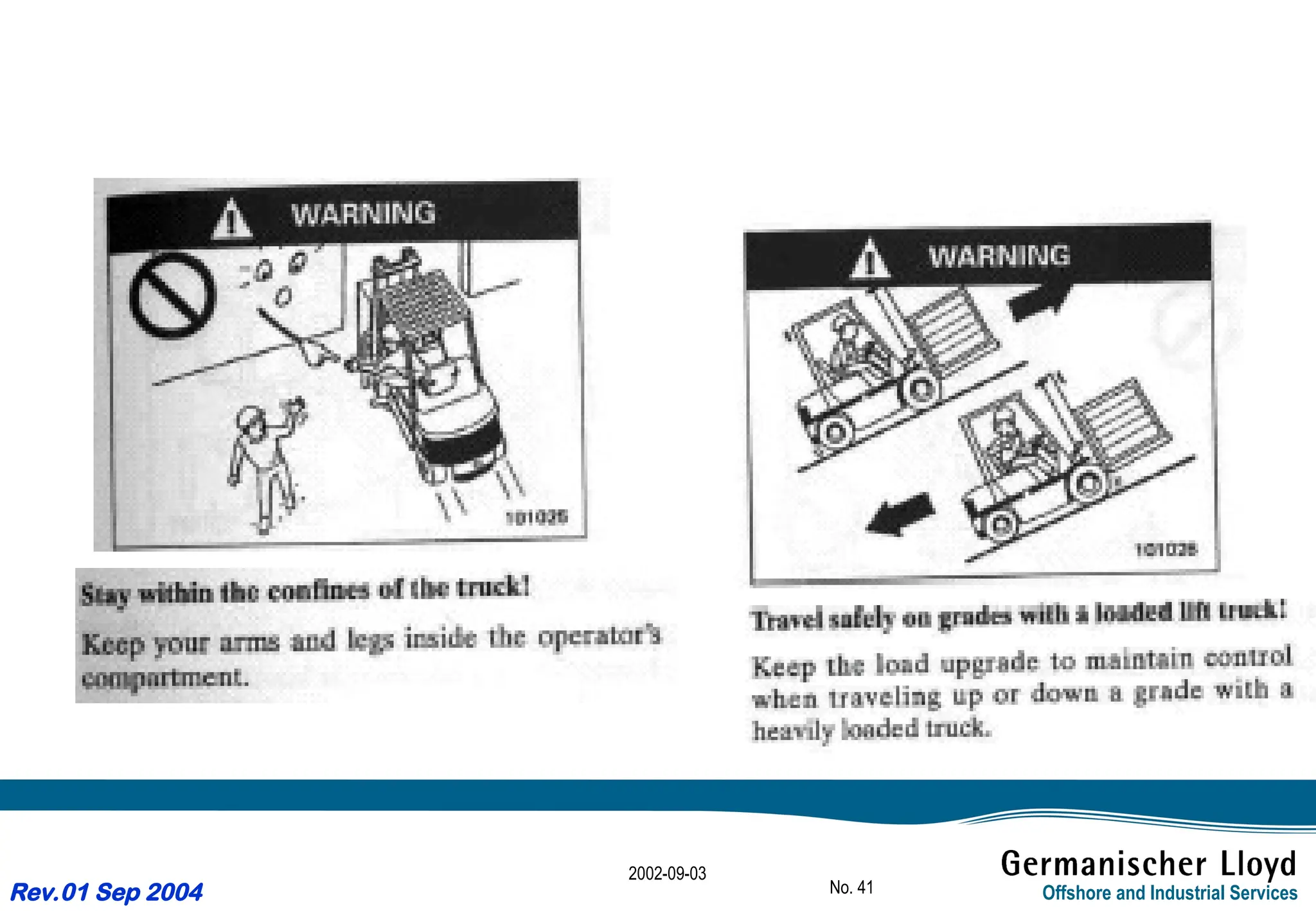
•On ramp or incline always have the load leading going up
and load trailing coming down.
Offshore and Industrial Services
Rev.01 Sep 2004
2002-09-03
No. 69
Safe Operation Procedure
•Never cross an incline
•The forks must be adjusted to take an equal weight on each
fork.
•All loads must be approached squarely with the forks central
under the weight.
•Handbrakes applied, neutral selected before operating the
hydraulic controls.
•Ensure the load within the rated capacity of the truck.
•Passengers must not travels on the truck.
•Loads must be carried out as close as possible to the ground.
Offshore and Industrial Services
Rev.01 Sep 2004
2002-09-03
No. 70
Safe Operation Procedure
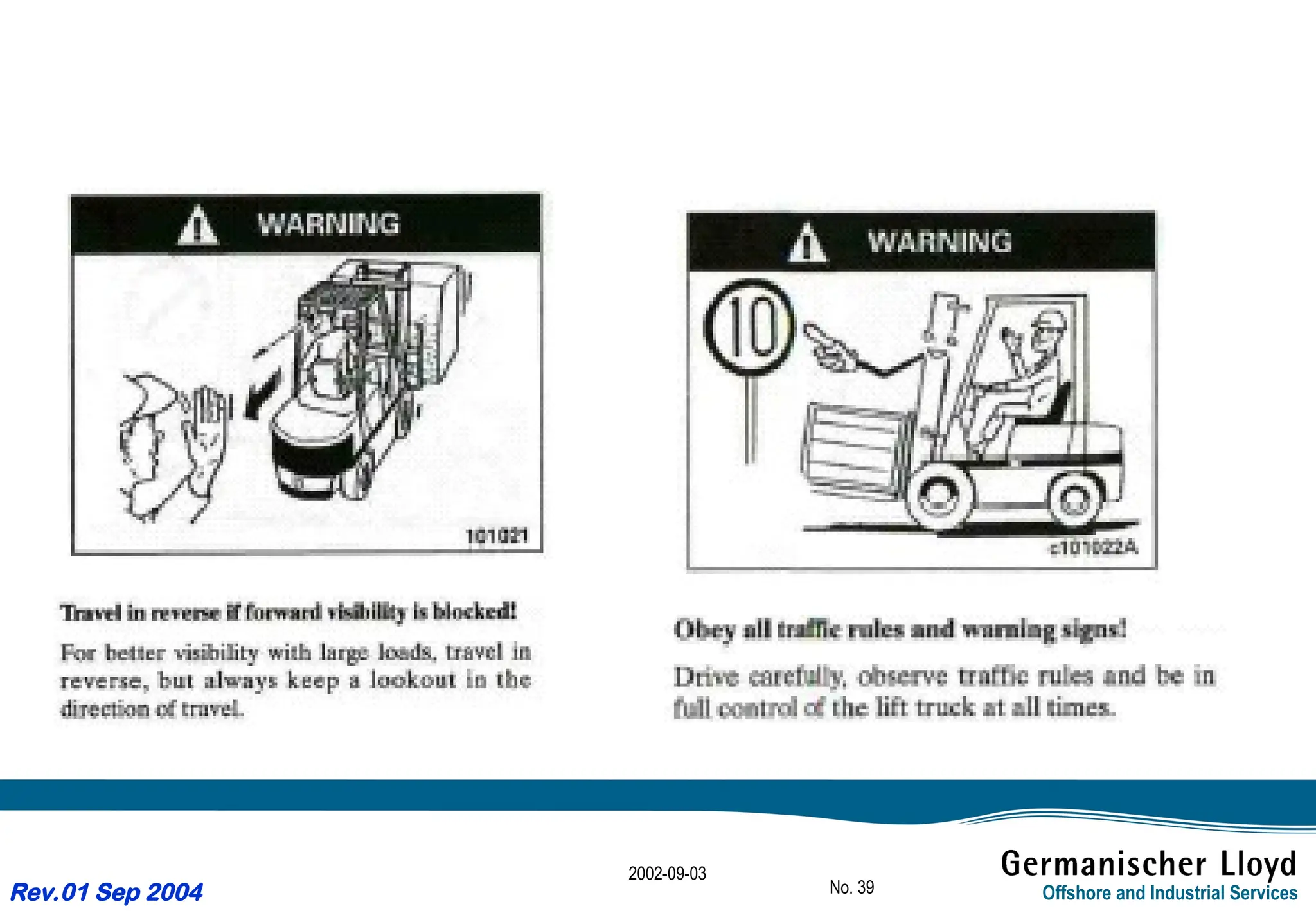
•If the load obscures your view, travel in reverse with the load
trailing.
•Always look in the direction of travel.
•After finish, park the truck safely, and use the proper parking
position of the forks, Mast titled slightly forward, fork tips
touching the ground gently.
Offshore and Industrial Services
Rev.01 Sep 2004
2002-09-03
No. 71
Safe Condition
Stability and Load Centers
Offshore and Industrial Services
Rev.01 Sep 2004
2002-09-03
No. 72
Approaching Danger
Stability and Load Centers
Offshore and Industrial Services
Rev.01 Sep 2004
2002-09-03
No. 73
Accident
Stability and Load Centers
Offshore and Industrial Services
Rev.01 Sep 2004
2002-09-03
No. 74
Offshore and Industrial Services
Rev.01 Sep 2004
2002-09-03
No. 75
Offshore and Industrial Services
Rev.01 Sep 2004
2002-09-03
No. 76
Approach Blind Corners With Care
Offshore and Industrial Services
Rev.01 Sep 2004
2002-09-03
No. 77
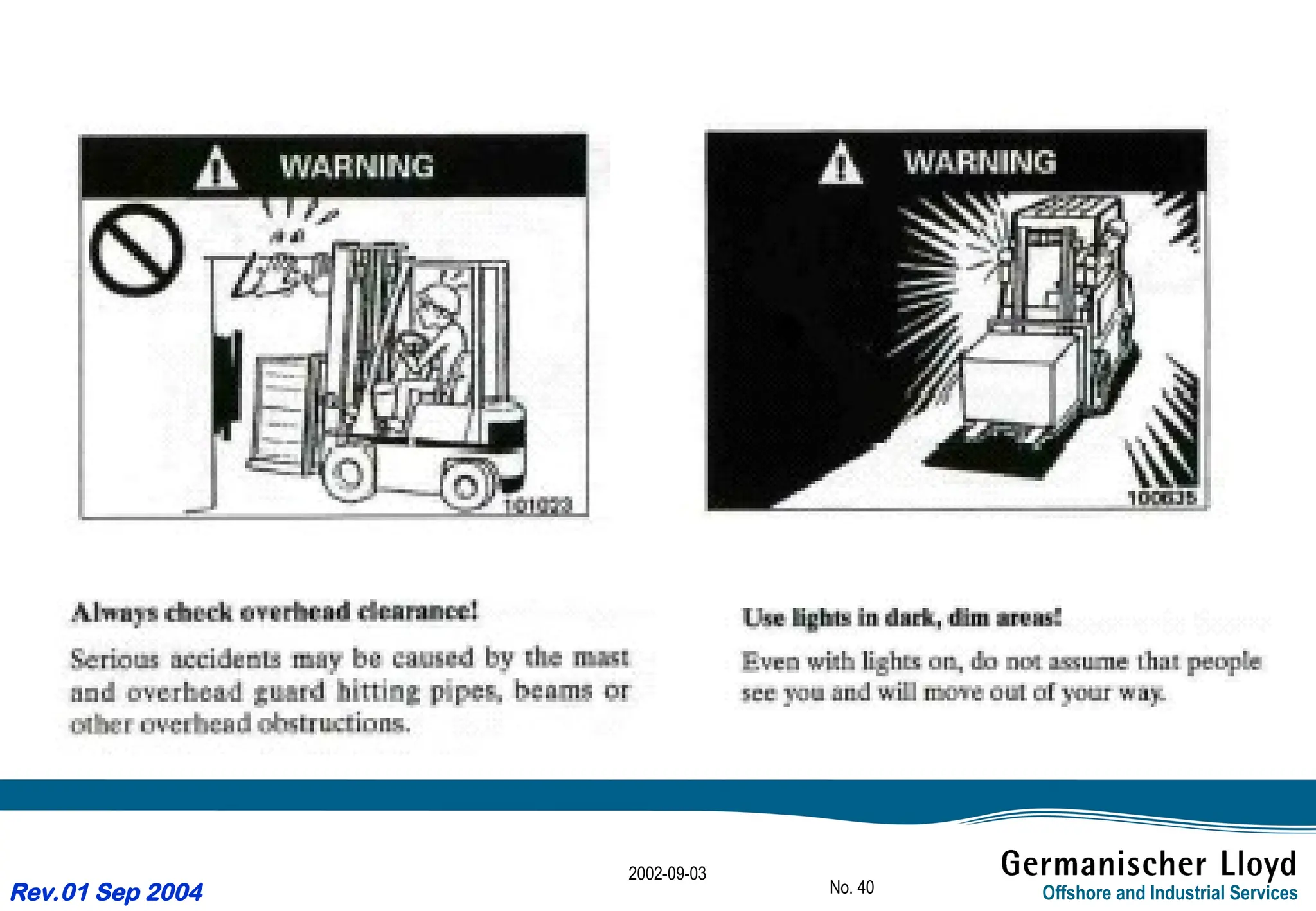
Be Careful Of Over Head Obstructions
Offshore and Industrial Services
Rev.01 Sep 2004
2002-09-03
No. 78
Unsafe Driving
Offshore and Industrial Services
Rev.01 Sep 2004
2002-09-03
No. 79
ASCENDING
UP
Offshore and Industrial Services
Rev.01 Sep 2004
2002-09-03
No. 80
DECENDING
DOWN
Offshore and Industrial Services
Rev.01 Sep 2004
2002-09-03
No. 81
Ground Level Procedures with Pallets/
Loads
•Position the truck so you are approaching the pallet/ load in a
square and central manner.
•Adjust t ensure the forks as necessary to ensure they are
central within the pallet/ load.
•Apply handbrake before operating hydraulic controls.
•Tilt mast to the vertical so the forks do not rub against the
pallet//load on entry or withdrawal.
Offshore and Industrial Services
Rev.01 Sep 2004
2002-09-03
No. 82
Ground Level Procedures with Pallets/
Loads
•Drive slowly while entering a pallet/ load.
•Forks should be fully inserted until heels of the forks are
touching the pallet/ load.
•Apply the handbrake.
•Raise the load clear off the ground. Tilt mast backwards to
cradle the load ( if in a racking system the load will have to be
clear of racking system before being able to cradle load).
•Raise the forks slightly to travel position, release handbrake
and look in the direction of travel.
Offshore and Industrial Services
Rev.01 Sep 2004
2002-09-03
No. 83
Offshore and Industrial Services
Rev.01 Sep 2004
2002-09-03
No. 84
Approach Stack
Correctly
Reduce Tilt Slightly and
Lift to Desired Height
Offshore and Industrial Services
Rev.01 Sep 2004
2002-09-03
No. 85
When the load is over
the stack bring mast to
vertical and drive
forward carefully
Lower load onto stack
gently
Offshore and Industrial Services
Rev.01 Sep 2004
2002-09-03
No. 86
Ensure forks are clear
before withdrawing.
Look in direction of
travel
Proper travel position
Offshore and Industrial Services
Rev.01 Sep 2004
2002-09-03
No. 87
Stacking with Counter Balance Fork Lift
Truck
•Great care must be taken with the personnel working in the
area as well as the goods you are handling.
•Approach the stack in the proper travel position i.e. load as
low as practical and titled backward.
•Approach the stack properly aligned and stop about 8”/20cm
from the face of stack.
•Apply handbrake and reduce the backward tilt slightly.
•Raise the load to the desired height.
Offshore and Industrial Services
Rev.01 Sep 2004
2002-09-03
No. 88
Stacking with Counter Balance Fork Lift
Truck
•When the load is clear of the top of the stack release
handbrake and move foreword carefully.
•When the load is over the stack apply the handbrake. Bring
the mast to the vertical and lower the load onto the stack
gently.
•Ensure the load is securely stacked and your forks are free
before withdrawing.
•Look in the direction of travel.
•When clear of the stack apply handbrake and return to travel
position before moving on the next assignation.
Offshore and Industrial Services
Rev.01 Sep 2004
2002-09-03
No. 89
Approach stack
properly and then
bring mast to the
vertical
Raise forks to desired
height
Offshore and Industrial Services
Rev.01 Sep 2004
2002-09-03
No. 90
Ensure forks enter
cleanly
Raise the load and tilt
mast backwards to
stabilize the load
Offshore and Industrial Services
Rev.01 Sep 2004
2002-09-03
No. 91
Look in direction of travel
and lower load when clear
of stack
Proper travel position
before moving
Offshore and Industrial Services
Rev.01 Sep 2004
2002-09-03
No. 92
Destacking with Counter Balance Fork Lift
Truck
•Ensure you are square with the stack.
•Apply handbrake and bring mast to vertical position.
•Ensure the forks are spread as to take an equal weight.
• Raise forks to a position that allows a good entry in to the
pallet.
•Release handbrake and drive forward slowly ensuring forks
are inserted fully.
•Apply handbrake.
Offshore and Industrial Services
Rev.01 Sep 2004
2002-09-03
No. 93
Destacking with Counter Balance Fork Lift
Truck
•Lift the load clear of the stack and tilt mast backwards enough
to stabilize the load.
•Release the handbrake and check the way is clear before
moving back until the load and forks are clear of the stack.
•Apply the handbrake and lower the load smoothly to the
correct traveling position, applying further tilt to cradle the
load before moving off.
Offshore and Industrial Services
Rev.01 Sep 2004
2002-09-03
No. 94
Telescopic Material
Handler
Offshore and Industrial Services
Rev.01 Sep 2004
2002-09-03
No. 95
The following should be considered:-
•The operator must fully understand the capacity chart and
Safe Load Indicator.
•Safe Load Indicator should be tested at the start of the shift by
pressing a test button on the indicator.
•The closer the load is to truck the more the stability can be
obtained.
•If the Audible alarms ring when lifting a load lower the load
immediately.
•Never exceed the trucks capacity.
•Never disconnect the safe load indicator or tamper with it.
•When lifting a pallet/ load raise the boom and then extend.
• When lowering a pallet/ load retract the boom and then
lower.
Offshore and Industrial Services
Rev.01 Sep 2004
2002-09-03
No. 96
Approach stack squarely, proper
travel position
Raise the boom, move
forward and extend the
boom as necessary
Offshore and Industrial Services
Rev.01 Sep 2004
2002-09-03
No. 97
Remove the tilt and
lower the load
Ensure good all around
check and a clean
withdrawal from the load
Offshore and Industrial Services
Rev.01 Sep 2004
2002-09-03
No. 98
Proper travel position
Offshore and Industrial Services
Rev.01 Sep 2004
2002-09-03
No. 99
Stacking with a Telescopic Materials Handler
•Approach the stack squarely and stop about 24”/600mm form
the stack.
•Apply handbrake.
•Raise the load.
•Release handbrake and move forward as close to stack as
possible, Reapply handbrake.
•Extend the boom until load is directly over the stack (if load
indicator gives a warning retract the boom and start a new
stack).
Offshore and Industrial Services
Rev.01 Sep 2004
2002-09-03
No. 100
Stacking with a Telescopic Materials Handler
•Remove tilt and lower load onto stack retracting boom slightly
if necessary to position load.
•Release handbrake, have a good look in direction of travel.
•Ensure forks are clear and withdraw.
•Apply handbrake.
•Retract boom fully and lower to travel position.
•Good all around observation before moving off.
Offshore and Industrial Services
Rev.01 Sep 2004
2002-09-03
No. 101
Proper travel position,
approach the stack squarely
Raise the boom and then
extend if necessary
Offshore and Industrial Services
Rev.01 Sep 2004
2002-09-03
No. 102
Raise the boom
Adjust tilt and drive
forward slowly
Offshore and Industrial Services
Rev.01 Sep 2004
2002-09-03
No. 103
Raise the boom
Stabilize the load by tilting
the forks backwards slightly
Offshore and Industrial Services
Rev.01 Sep 2004
2002-09-03
No. 104
Good all around observation move
backwards slowly
Proper travel position
Offshore and Industrial Services
Rev.01 Sep 2004
2002-09-03
No. 105
Destacking with a Telescopic Materials
Handler
•Approach the stack squarely and stop about 24”/600mm form
the stack.
•Apply handbrake.
•Raise the boom, extend if necessary and adjust tilt to enable
forks a good clean entry.
•Release handbrake and move forward slowly ensuring forks
insert cleanly and pallet/ load is up against heels of forks.
•Apply handbrake
Offshore and Industrial Services
Rev.01 Sep 2004
2002-09-03
No. 106
•Raise the load and tilt forks sufficient to stabilize the load.
•Retract the boom. (the boom may have to be raised to ensure
the load does not foul the stack when retracting).
•A good all around observation.
•Release handbrake, and move back to clear the stack.
•Apply handbrake, and lower to travel position.
• have a good look in direction of travel and release handbrake
before move.
Destacking with a Telescopic Materials
Handler
Offshore and Industrial Services
Rev.01 Sep 2004
2002-09-03
No. 107
Place load on stack
correctly
Retract boom slightly
Offshore and Industrial Services
Rev.01 Sep 2004
2002-09-03
No. 108
Raise the boom slightly
Retract and raise the boom
carefully until forks are clear
Offshore and Industrial Services
Rev.01 Sep 2004
2002-09-03
No. 109
Handling a Load Using the Boom
It is commonly use while working in a confined space:
•Place the load on the stack using the proper method.
•Apply handbrake.
•Retract the boom slightly.
•Raise the boom slightly and continue retracting and raising
the boom as necessary until forks are completely clear of the
stack.
•The reverse of this procedure would be required in case of
desctacking.
Offshore and Industrial Services
Rev.01 Sep 2004
2002-09-03
No. 110
Approach the stack
properly
Raise the load and
reduce the tilt
slightly
Offshore and Industrial Services
Rev.01 Sep 2004
2002-09-03
No. 111
Reach forward and
bring mast
to the vertical
Lower load Gently
Offshore and Industrial Services
Rev.01 Sep 2004
2002-09-03
No. 112
When load is secure
reach back in and
lower forks
Proper travel position
before moving
Offshore and Industrial Services
Rev.01 Sep 2004
2002-09-03
No. 113
Stacking with Counter Balance Fork Lift
Truck
•Approach the stack in the proper travel position and ensure
the truck is square with the stack.
•Apply handbrake and reduce the backward tilt slightly to
maintain the load stability
•Raise the load to the desired height.
•When the load is clear at the desired height, If necessary,
release handbrake and drive forward to bring truck closer to
the stack.
•Apply handbrake, and reach forward taking care not to
damage or dislodge in adjacent stacks.
Offshore and Industrial Services
Rev.01 Sep 2004
2002-09-03
No. 114
Stacking with Counter Balance Fork Lift
Truck
•Bring mast to the vertical and lower the load onto the stack
gently.
•Ensure the load is securely stacked withdraw the forks from
the load cleanly by reaching in.
•If the fork arms are not fully clear of the stack the truck should
be moved back a short distance making sure the way is clear
before moving back.
•Proper traveling position before moving.
•Forks tilted backwards and lowered until heels are 4” from
ground and tips are 6” from ground same as counter balance
type.
Offshore and Industrial Services
Rev.01 Sep 2004
2002-09-03
No. 115
Approach the stack
correctly
Bring mast to vertical
and raise the forks to
correct height
Offshore and Industrial Services
Rev.01 Sep 2004
2002-09-03
No. 116
Reach forward and insert forks
cleanly
Lift the load and tilt back
slightly to stabilize the load
Offshore and Industrial Services
Rev.01 Sep 2004
2002-09-03
No. 117
Reach back in and lower
the load
Proper traveling position
before moving
Offshore and Industrial Services
Rev.01 Sep 2004
2002-09-03
No. 118
Destacking with a Reach Truck
•Ensure you are square with the stack.
•Apply handbrake and bring mast to vertical position.
•Ensure the forks are spread as to take an equal weight.
• Raise forks to a position that allows a good entry in to the
pallet.
•Release handbrake and drive forward slowly ensuring forks
are inserted fully.
•Apply handbrake.
Offshore and Industrial Services
Rev.01 Sep 2004
2002-09-03
No. 119
Destacking with Counter Balance Fork Lift
Truck
•Lift the load clear of the stack and carefully apply mast
backwards enough to stabilize the load.
•Release the handbrake and check the way is clear before
moving back until the load and forks are clear of the stack.
•Apply the handbrake and lower the load smoothly to the
correct traveling position.
Offshore and Industrial Services
Rev.01 Sep 2004
2002-09-03
No. 120
Always cross ridges & tracks at an angle
Offshore and Industrial Services
Rev.01 Sep 2004
2002-09-03
No. 121
Offshore and Industrial Services
Rev.01 Sep 2004
2002-09-03
No. 122

forklift Germanischer LLOYD LLOYD LLOYD .ppt

  • 1.
    Offshore and IndustrialServices GmbH GLO Doha Station Office Forklift Operator Course By: Mohamed Elazab
  • 2.
    Offshore and IndustrialServices Rev.01 Sep 2004 2002-09-03 No. 2
  • 3.
    Offshore and IndustrialServices Rev.01 Sep 2004 2002-09-03 No. 3
  • 4.
    Offshore and IndustrialServices Rev.01 Sep 2004 2002-09-03 No. 4 ALWAYS READ AND ALWAYS READ AND UNDERSTAND THE UNDERSTAND THE MANUFACTURER’S MANUFACTURER’S OPERATOR’S MANUAL AND OPERATOR’S MANUAL AND SERVICE NOTICE SERVICE NOTICE !
  • 5.
    Offshore and IndustrialServices Rev.01 Sep 2004 2002-09-03 No. 5 Lifting Parts of a Fork Lift Truck •The Forks adjusted to take equal weight locked into place by locating pin •Carriage allow lateral fork adjustment, it is mounted inside the mast channel. •Mast Inner mast moves, outer mast is fixed. •Load Chains take the weight of the forks/ carriage the load. It is anchored behind the mast. •Hoist Ram To elevate and lower carriage and forks. •Tilt Ram Tilts mast/ forks forward or backwards. •SWL / Plate Identifies the capacity/SWL the truck can lift at certain load centers.
  • 6.
    Offshore and IndustrialServices Rev.01 Sep 2004 2002-09-03 No. 6
  • 7.
    Offshore and IndustrialServices Rev.01 Sep 2004 2002-09-03 No. 7 Lifting Parts of a Fork Lift Truck
  • 8.
    Offshore and IndustrialServices Rev.01 Sep 2004 2002-09-03 No. 8
  • 9.
    Offshore and IndustrialServices Rev.01 Sep 2004 2002-09-03 No. 9
  • 10.
    Offshore and IndustrialServices Rev.01 Sep 2004 2002-09-03 No. 10
  • 11.
    Offshore and IndustrialServices Rev.01 Sep 2004 2002-09-03 No. 11
  • 12.
    Offshore and IndustrialServices Rev.01 Sep 2004 2002-09-03 No. 12
  • 13.
    Offshore and IndustrialServices Rev.01 Sep 2004 2002-09-03 No. 13 Lifting Parts of a Fork Lift Truck
  • 14.
    Offshore and IndustrialServices Rev.01 Sep 2004 2002-09-03 No. 14 •Load Center is defined as the horizontal distance from the heel of the forks to the center of the load. Load Centers 500 mm 20 in 600 mm 24 in 750 mm 30 in Height Weight that can be lifted kg lb mm in
  • 15.
    Offshore and IndustrialServices Rev.01 Sep 2004 2002-09-03 No. 15 •Load Center is defined as the horizontal distance from the heel of the forks to the center of the load.
  • 16.
    Offshore and IndustrialServices Rev.01 Sep 2004 2002-09-03 No. 16 Side Loading Lift Truck Large Lift Truck
  • 17.
    Offshore and IndustrialServices Rev.01 Sep 2004 2002-09-03 No. 17 Industrial Counter balance Lift Truck Rough Terrain Counter balance Lift Truck
  • 18.
    Offshore and IndustrialServices Rev.01 Sep 2004 2002-09-03 No. 18 Industrial Reach Truck Telescopic Materials Handler
  • 19.
    Offshore and IndustrialServices Rev.01 Sep 2004 2002-09-03 No. 19 Pre-Shift Checks •Fuel/Oil/Water Battery Top up to correct levels, remember to wipe up an spillages, check battery terminal posts. • Visual a good look at the machine, report anything out of the ordinary. •Hydraulic Oil Correct level, make sure forks are fully lowered when checking. •Forks/Mast Ensure there is no distortion, cracks or excessive wear. •Load Chains well lubricated, no bent pins or damage and anchor points are in good conditions. •Wheels/Tires Check wheel nuts, Tire pressures and Tire’s conditions
  • 20.
    Offshore and IndustrialServices Rev.01 Sep 2004 2002-09-03 No. 20 Pre-Shift Checks •Brakes All brakes are working properly. • Steering Undue tightness or looseness. •Horn/Lights/ Gauges All good working order. •Hydraulic Controls Working properly. Always operate hydraulic control smoothly.
  • 21.
    Offshore and IndustrialServices Rev.01 Sep 2004 2002-09-03 No. 21 IMMEDIATELY REPORT ANY IMMEDIATELY REPORT ANY ABNORMALITY TO YOUR SUPERVISOR ABNORMALITY TO YOUR SUPERVISOR •Never Park in front of Fire Fighting equipment, Emergency Exits, Doorways, Safety Notice boards or anywhere it would be a nuisance. •Remember to remove the Keys.
  • 22.
    Offshore and IndustrialServices Rev.01 Sep 2004 2002-09-03 No. 22 Chain is not damaged in anyway Check the mast, Hydraulics and carriage plate Ensure Chain Anchor Points are in good conditions
  • 23.
    Offshore and IndustrialServices Rev.01 Sep 2004 2002-09-03 No. 23 Connect Charger Plug Correctly Coil up Charger Cable Properly Fully Understand the Charger
  • 24.
    Offshore and IndustrialServices Rev.01 Sep 2004 2002-09-03 No. 24 Operate Only in approved areas! Certain areas such as those containing hazardous flammable gases, liquid or other combustibles, should be avoided
  • 25.
    Offshore and IndustrialServices Rev.01 Sep 2004 2002-09-03 No. 25
  • 26.
    Offshore and IndustrialServices Rev.01 Sep 2004 2002-09-03 No. 26
  • 27.
    Offshore and IndustrialServices Rev.01 Sep 2004 2002-09-03 No. 27
  • 28.
    Offshore and IndustrialServices Rev.01 Sep 2004 2002-09-03 No. 28
  • 29.
    Offshore and IndustrialServices Rev.01 Sep 2004 2002-09-03 No. 29
  • 30.
    Offshore and IndustrialServices Rev.01 Sep 2004 2002-09-03 No. 30
  • 31.
    Offshore and IndustrialServices Rev.01 Sep 2004 2002-09-03 No. 31
  • 32.
    Offshore and IndustrialServices Rev.01 Sep 2004 2002-09-03 No. 32
  • 33.
    Offshore and IndustrialServices Rev.01 Sep 2004 2002-09-03 No. 33
  • 34.
    Offshore and IndustrialServices Rev.01 Sep 2004 2002-09-03 No. 34
  • 35.
    Offshore and IndustrialServices Rev.01 Sep 2004 2002-09-03 No. 35
  • 36.
    Offshore and IndustrialServices Rev.01 Sep 2004 2002-09-03 No. 36
  • 37.
    Offshore and IndustrialServices Rev.01 Sep 2004 2002-09-03 No. 37
  • 38.
    Offshore and IndustrialServices Rev.01 Sep 2004 2002-09-03 No. 38
  • 39.
    Offshore and IndustrialServices Rev.01 Sep 2004 2002-09-03 No. 39
  • 40.
    Offshore and IndustrialServices Rev.01 Sep 2004 2002-09-03 No. 40
  • 41.
    Offshore and IndustrialServices Rev.01 Sep 2004 2002-09-03 No. 41
  • 42.
    Offshore and IndustrialServices Rev.01 Sep 2004 2002-09-03 No. 42
  • 43.
    Offshore and IndustrialServices Rev.01 Sep 2004 2002-09-03 No. 43
  • 44.
    Offshore and IndustrialServices Rev.01 Sep 2004 2002-09-03 No. 44
  • 45.
    Offshore and IndustrialServices Rev.01 Sep 2004 2002-09-03 No. 45
  • 46.
    Offshore and IndustrialServices Rev.01 Sep 2004 2002-09-03 No. 46
  • 47.
    Offshore and IndustrialServices Rev.01 Sep 2004 2002-09-03 No. 47
  • 48.
    Offshore and IndustrialServices Rev.01 Sep 2004 2002-09-03 No. 48
  • 49.
    Offshore and IndustrialServices Rev.01 Sep 2004 2002-09-03 No. 49
  • 50.
    Offshore and IndustrialServices Rev.01 Sep 2004 2002-09-03 No. 50
  • 51.
    Offshore and IndustrialServices Rev.01 Sep 2004 2002-09-03 No. 51
  • 52.
    Offshore and IndustrialServices Rev.01 Sep 2004 2002-09-03 No. 52
  • 53.
    Offshore and IndustrialServices Rev.01 Sep 2004 2002-09-03 No. 53
  • 54.
    Offshore and IndustrialServices Rev.01 Sep 2004 2002-09-03 No. 54
  • 55.
    Offshore and IndustrialServices Rev.01 Sep 2004 2002-09-03 No. 55
  • 56.
    Offshore and IndustrialServices Rev.01 Sep 2004 2002-09-03 No. 56
  • 57.
    Offshore and IndustrialServices Rev.01 Sep 2004 2002-09-03 No. 57
  • 58.
    Offshore and IndustrialServices Rev.01 Sep 2004 2002-09-03 No. 58
  • 59.
    Offshore and IndustrialServices Rev.01 Sep 2004 2002-09-03 No. 59
  • 60.
    Offshore and IndustrialServices Rev.01 Sep 2004 2002-09-03 No. 60
  • 61.
    Offshore and IndustrialServices Rev.01 Sep 2004 2002-09-03 No. 61
  • 62.
    Offshore and IndustrialServices Rev.01 Sep 2004 2002-09-03 No. 62
  • 63.
    Offshore and IndustrialServices Rev.01 Sep 2004 2002-09-03 No. 63
  • 64.
    Offshore and IndustrialServices Rev.01 Sep 2004 2002-09-03 No. 64 Safe Battery Charging Procedure for Electrical Fork Lift Trucks •Batteries are Electrolyte which is highly corrosive, toxic highly corrosive, toxic and flammable and flammable. •Protective Clothing must be worn, (including Gloves, Safety shoes, aprons, and safety goggles). •No Smoking or naked light is allowed near the charging area. •Ensure that you are using the correct charger and fully understand how it works. •When topping up a battery cell only use distilled water.
  • 65.
    Offshore and IndustrialServices Rev.01 Sep 2004 2002-09-03 No. 65 Safe Battery Charging Procedure for Electrical Fork Lift Trucks •Check charger plug is connected to the battery plug correctly. •Ensure the charger is properly switched off before disconnecting charger plug. •Coil up the charger cable properly when finished charging a fork lift truck •Avoid Under-charging as this can damage a battery permanently. •Clean up any spillage immediately.
  • 66.
    Offshore and IndustrialServices Rev.01 Sep 2004 2002-09-03 No. 66 Load Leading
  • 67.
    Offshore and IndustrialServices Rev.01 Sep 2004 2002-09-03 No. 67 Load Trailing
  • 68.
    Offshore and IndustrialServices Rev.01 Sep 2004 2002-09-03 No. 68 Safe Operation Procedure •All controls must be operated smoothly. •4” off the ground at the heel and 6” at the tips of the forks should be maintained as travel position. •Good all around observation before moving. •Operate the truck at a speed consistent with the type of load and general work conditions. •Ensure the truck capacity plate is fully understood. •Avoid pot holes and kerbs in the road. If you have to cross, cross it diagonally. •Keep your limbs inside the truck and mount and dismount properly. •On ramp or incline always have the load leading going up and load trailing coming down.
  • 69.
    Offshore and IndustrialServices Rev.01 Sep 2004 2002-09-03 No. 69 Safe Operation Procedure •Never cross an incline •The forks must be adjusted to take an equal weight on each fork. •All loads must be approached squarely with the forks central under the weight. •Handbrakes applied, neutral selected before operating the hydraulic controls. •Ensure the load within the rated capacity of the truck. •Passengers must not travels on the truck. •Loads must be carried out as close as possible to the ground.
  • 70.
    Offshore and IndustrialServices Rev.01 Sep 2004 2002-09-03 No. 70 Safe Operation Procedure •If the load obscures your view, travel in reverse with the load trailing. •Always look in the direction of travel. •After finish, park the truck safely, and use the proper parking position of the forks, Mast titled slightly forward, fork tips touching the ground gently.
  • 71.
    Offshore and IndustrialServices Rev.01 Sep 2004 2002-09-03 No. 71 Safe Condition Stability and Load Centers
  • 72.
    Offshore and IndustrialServices Rev.01 Sep 2004 2002-09-03 No. 72 Approaching Danger Stability and Load Centers
  • 73.
    Offshore and IndustrialServices Rev.01 Sep 2004 2002-09-03 No. 73 Accident Stability and Load Centers
  • 74.
    Offshore and IndustrialServices Rev.01 Sep 2004 2002-09-03 No. 74
  • 75.
    Offshore and IndustrialServices Rev.01 Sep 2004 2002-09-03 No. 75
  • 76.
    Offshore and IndustrialServices Rev.01 Sep 2004 2002-09-03 No. 76 Approach Blind Corners With Care
  • 77.
    Offshore and IndustrialServices Rev.01 Sep 2004 2002-09-03 No. 77 Be Careful Of Over Head Obstructions
  • 78.
    Offshore and IndustrialServices Rev.01 Sep 2004 2002-09-03 No. 78 Unsafe Driving
  • 79.
    Offshore and IndustrialServices Rev.01 Sep 2004 2002-09-03 No. 79 ASCENDING UP
  • 80.
    Offshore and IndustrialServices Rev.01 Sep 2004 2002-09-03 No. 80 DECENDING DOWN
  • 81.
    Offshore and IndustrialServices Rev.01 Sep 2004 2002-09-03 No. 81 Ground Level Procedures with Pallets/ Loads •Position the truck so you are approaching the pallet/ load in a square and central manner. •Adjust t ensure the forks as necessary to ensure they are central within the pallet/ load. •Apply handbrake before operating hydraulic controls. •Tilt mast to the vertical so the forks do not rub against the pallet//load on entry or withdrawal.
  • 82.
    Offshore and IndustrialServices Rev.01 Sep 2004 2002-09-03 No. 82 Ground Level Procedures with Pallets/ Loads •Drive slowly while entering a pallet/ load. •Forks should be fully inserted until heels of the forks are touching the pallet/ load. •Apply the handbrake. •Raise the load clear off the ground. Tilt mast backwards to cradle the load ( if in a racking system the load will have to be clear of racking system before being able to cradle load). •Raise the forks slightly to travel position, release handbrake and look in the direction of travel.
  • 83.
    Offshore and IndustrialServices Rev.01 Sep 2004 2002-09-03 No. 83
  • 84.
    Offshore and IndustrialServices Rev.01 Sep 2004 2002-09-03 No. 84 Approach Stack Correctly Reduce Tilt Slightly and Lift to Desired Height
  • 85.
    Offshore and IndustrialServices Rev.01 Sep 2004 2002-09-03 No. 85 When the load is over the stack bring mast to vertical and drive forward carefully Lower load onto stack gently
  • 86.
    Offshore and IndustrialServices Rev.01 Sep 2004 2002-09-03 No. 86 Ensure forks are clear before withdrawing. Look in direction of travel Proper travel position
  • 87.
    Offshore and IndustrialServices Rev.01 Sep 2004 2002-09-03 No. 87 Stacking with Counter Balance Fork Lift Truck •Great care must be taken with the personnel working in the area as well as the goods you are handling. •Approach the stack in the proper travel position i.e. load as low as practical and titled backward. •Approach the stack properly aligned and stop about 8”/20cm from the face of stack. •Apply handbrake and reduce the backward tilt slightly. •Raise the load to the desired height.
  • 88.
    Offshore and IndustrialServices Rev.01 Sep 2004 2002-09-03 No. 88 Stacking with Counter Balance Fork Lift Truck •When the load is clear of the top of the stack release handbrake and move foreword carefully. •When the load is over the stack apply the handbrake. Bring the mast to the vertical and lower the load onto the stack gently. •Ensure the load is securely stacked and your forks are free before withdrawing. •Look in the direction of travel. •When clear of the stack apply handbrake and return to travel position before moving on the next assignation.
  • 89.
    Offshore and IndustrialServices Rev.01 Sep 2004 2002-09-03 No. 89 Approach stack properly and then bring mast to the vertical Raise forks to desired height
  • 90.
    Offshore and IndustrialServices Rev.01 Sep 2004 2002-09-03 No. 90 Ensure forks enter cleanly Raise the load and tilt mast backwards to stabilize the load
  • 91.
    Offshore and IndustrialServices Rev.01 Sep 2004 2002-09-03 No. 91 Look in direction of travel and lower load when clear of stack Proper travel position before moving
  • 92.
    Offshore and IndustrialServices Rev.01 Sep 2004 2002-09-03 No. 92 Destacking with Counter Balance Fork Lift Truck •Ensure you are square with the stack. •Apply handbrake and bring mast to vertical position. •Ensure the forks are spread as to take an equal weight. • Raise forks to a position that allows a good entry in to the pallet. •Release handbrake and drive forward slowly ensuring forks are inserted fully. •Apply handbrake.
  • 93.
    Offshore and IndustrialServices Rev.01 Sep 2004 2002-09-03 No. 93 Destacking with Counter Balance Fork Lift Truck •Lift the load clear of the stack and tilt mast backwards enough to stabilize the load. •Release the handbrake and check the way is clear before moving back until the load and forks are clear of the stack. •Apply the handbrake and lower the load smoothly to the correct traveling position, applying further tilt to cradle the load before moving off.
  • 94.
    Offshore and IndustrialServices Rev.01 Sep 2004 2002-09-03 No. 94 Telescopic Material Handler
  • 95.
    Offshore and IndustrialServices Rev.01 Sep 2004 2002-09-03 No. 95 The following should be considered:- •The operator must fully understand the capacity chart and Safe Load Indicator. •Safe Load Indicator should be tested at the start of the shift by pressing a test button on the indicator. •The closer the load is to truck the more the stability can be obtained. •If the Audible alarms ring when lifting a load lower the load immediately. •Never exceed the trucks capacity. •Never disconnect the safe load indicator or tamper with it. •When lifting a pallet/ load raise the boom and then extend. • When lowering a pallet/ load retract the boom and then lower.
  • 96.
    Offshore and IndustrialServices Rev.01 Sep 2004 2002-09-03 No. 96 Approach stack squarely, proper travel position Raise the boom, move forward and extend the boom as necessary
  • 97.
    Offshore and IndustrialServices Rev.01 Sep 2004 2002-09-03 No. 97 Remove the tilt and lower the load Ensure good all around check and a clean withdrawal from the load
  • 98.
    Offshore and IndustrialServices Rev.01 Sep 2004 2002-09-03 No. 98 Proper travel position
  • 99.
    Offshore and IndustrialServices Rev.01 Sep 2004 2002-09-03 No. 99 Stacking with a Telescopic Materials Handler •Approach the stack squarely and stop about 24”/600mm form the stack. •Apply handbrake. •Raise the load. •Release handbrake and move forward as close to stack as possible, Reapply handbrake. •Extend the boom until load is directly over the stack (if load indicator gives a warning retract the boom and start a new stack).
  • 100.
    Offshore and IndustrialServices Rev.01 Sep 2004 2002-09-03 No. 100 Stacking with a Telescopic Materials Handler •Remove tilt and lower load onto stack retracting boom slightly if necessary to position load. •Release handbrake, have a good look in direction of travel. •Ensure forks are clear and withdraw. •Apply handbrake. •Retract boom fully and lower to travel position. •Good all around observation before moving off.
  • 101.
    Offshore and IndustrialServices Rev.01 Sep 2004 2002-09-03 No. 101 Proper travel position, approach the stack squarely Raise the boom and then extend if necessary
  • 102.
    Offshore and IndustrialServices Rev.01 Sep 2004 2002-09-03 No. 102 Raise the boom Adjust tilt and drive forward slowly
  • 103.
    Offshore and IndustrialServices Rev.01 Sep 2004 2002-09-03 No. 103 Raise the boom Stabilize the load by tilting the forks backwards slightly
  • 104.
    Offshore and IndustrialServices Rev.01 Sep 2004 2002-09-03 No. 104 Good all around observation move backwards slowly Proper travel position
  • 105.
    Offshore and IndustrialServices Rev.01 Sep 2004 2002-09-03 No. 105 Destacking with a Telescopic Materials Handler •Approach the stack squarely and stop about 24”/600mm form the stack. •Apply handbrake. •Raise the boom, extend if necessary and adjust tilt to enable forks a good clean entry. •Release handbrake and move forward slowly ensuring forks insert cleanly and pallet/ load is up against heels of forks. •Apply handbrake
  • 106.
    Offshore and IndustrialServices Rev.01 Sep 2004 2002-09-03 No. 106 •Raise the load and tilt forks sufficient to stabilize the load. •Retract the boom. (the boom may have to be raised to ensure the load does not foul the stack when retracting). •A good all around observation. •Release handbrake, and move back to clear the stack. •Apply handbrake, and lower to travel position. • have a good look in direction of travel and release handbrake before move. Destacking with a Telescopic Materials Handler
  • 107.
    Offshore and IndustrialServices Rev.01 Sep 2004 2002-09-03 No. 107 Place load on stack correctly Retract boom slightly
  • 108.
    Offshore and IndustrialServices Rev.01 Sep 2004 2002-09-03 No. 108 Raise the boom slightly Retract and raise the boom carefully until forks are clear
  • 109.
    Offshore and IndustrialServices Rev.01 Sep 2004 2002-09-03 No. 109 Handling a Load Using the Boom It is commonly use while working in a confined space: •Place the load on the stack using the proper method. •Apply handbrake. •Retract the boom slightly. •Raise the boom slightly and continue retracting and raising the boom as necessary until forks are completely clear of the stack. •The reverse of this procedure would be required in case of desctacking.
  • 110.
    Offshore and IndustrialServices Rev.01 Sep 2004 2002-09-03 No. 110 Approach the stack properly Raise the load and reduce the tilt slightly
  • 111.
    Offshore and IndustrialServices Rev.01 Sep 2004 2002-09-03 No. 111 Reach forward and bring mast to the vertical Lower load Gently
  • 112.
    Offshore and IndustrialServices Rev.01 Sep 2004 2002-09-03 No. 112 When load is secure reach back in and lower forks Proper travel position before moving
  • 113.
    Offshore and IndustrialServices Rev.01 Sep 2004 2002-09-03 No. 113 Stacking with Counter Balance Fork Lift Truck •Approach the stack in the proper travel position and ensure the truck is square with the stack. •Apply handbrake and reduce the backward tilt slightly to maintain the load stability •Raise the load to the desired height. •When the load is clear at the desired height, If necessary, release handbrake and drive forward to bring truck closer to the stack. •Apply handbrake, and reach forward taking care not to damage or dislodge in adjacent stacks.
  • 114.
    Offshore and IndustrialServices Rev.01 Sep 2004 2002-09-03 No. 114 Stacking with Counter Balance Fork Lift Truck •Bring mast to the vertical and lower the load onto the stack gently. •Ensure the load is securely stacked withdraw the forks from the load cleanly by reaching in. •If the fork arms are not fully clear of the stack the truck should be moved back a short distance making sure the way is clear before moving back. •Proper traveling position before moving. •Forks tilted backwards and lowered until heels are 4” from ground and tips are 6” from ground same as counter balance type.
  • 115.
    Offshore and IndustrialServices Rev.01 Sep 2004 2002-09-03 No. 115 Approach the stack correctly Bring mast to vertical and raise the forks to correct height
  • 116.
    Offshore and IndustrialServices Rev.01 Sep 2004 2002-09-03 No. 116 Reach forward and insert forks cleanly Lift the load and tilt back slightly to stabilize the load
  • 117.
    Offshore and IndustrialServices Rev.01 Sep 2004 2002-09-03 No. 117 Reach back in and lower the load Proper traveling position before moving
  • 118.
    Offshore and IndustrialServices Rev.01 Sep 2004 2002-09-03 No. 118 Destacking with a Reach Truck •Ensure you are square with the stack. •Apply handbrake and bring mast to vertical position. •Ensure the forks are spread as to take an equal weight. • Raise forks to a position that allows a good entry in to the pallet. •Release handbrake and drive forward slowly ensuring forks are inserted fully. •Apply handbrake.
  • 119.
    Offshore and IndustrialServices Rev.01 Sep 2004 2002-09-03 No. 119 Destacking with Counter Balance Fork Lift Truck •Lift the load clear of the stack and carefully apply mast backwards enough to stabilize the load. •Release the handbrake and check the way is clear before moving back until the load and forks are clear of the stack. •Apply the handbrake and lower the load smoothly to the correct traveling position.
  • 120.
    Offshore and IndustrialServices Rev.01 Sep 2004 2002-09-03 No. 120 Always cross ridges & tracks at an angle
  • 121.
    Offshore and IndustrialServices Rev.01 Sep 2004 2002-09-03 No. 121
  • 122.
    Offshore and IndustrialServices Rev.01 Sep 2004 2002-09-03 No. 122