Lifting Safety and
Rigging Crane
Prepared By: Hussein Hakam
Presented By: Hussein Hakam
Training Outline
•Introduction
•Types of mobile crane
•How to Conduct a Crane Safety Inspection
•Types of Lifting operations
•Lifting plan and Rigging
•Lifting and Rigging hazards
•Lifting and Rigging Precautions
•Emergency response
•Lifting Accidents
•Personal Protective Equipment (PPE)
•Summary
•Questions and Answers
2
Introduction
• Lifting is very common in the construction industry as a method
for material transfer. Through mechanical means such cranes,
lifting equipment and manual handling.
• The risk of injury can be reduced through training and application
of correct lifting & handling techniques.
3
Introduction
• Definitions
• SWL
• WLL
• RCI
• TPI
• Load chart
• Radius
• Outriggers
• Country wight
4
5
Types of mobile crane
1.Outrigger crane
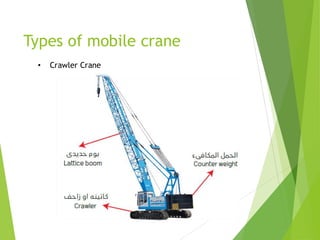
2.Crawler Crane
6
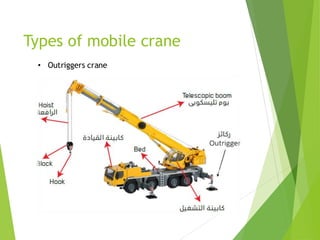
Types of mobile crane
• Outriggers crane
7
Types of mobile crane
• Crawler Crane
8
How to Conduct a Crane Safety
Inspection
•Conduct a Visual Inspection
•Inspect the Hydraulic System
•Inspect the Crane’s Controls
•Check the Tires and Brakes
•Conduct Functional Tests
9
How to Conduct a Crane Safety
Inspection
1
0
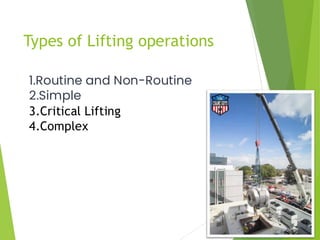
Types of Lifting operations
1.Routine and Non-Routine
2.Simple
3.Critical Lifting
4.Complex
1
1
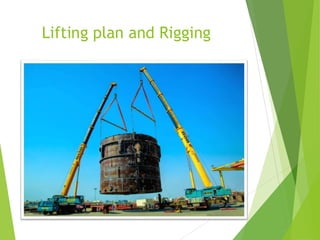
Lifting plan and Rigging
1
2
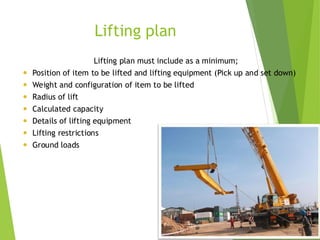
Lifting plan
Lifting plan must include as a minimum;
 Position of item to be lifted and lifting equipment (Pick up and set down)
 Weight and configuration of item to be lifted
 Radius of lift
 Calculated capacity
 Details of lifting equipment
 Lifting restrictions
 Ground loads
1
3
Lifting plan
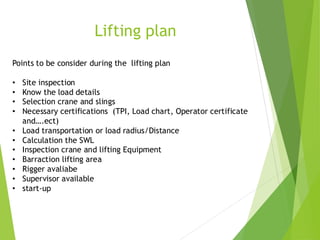
Points to be consider during the lifting plan
• Site inspection
• Know the load details
• Selection crane and slings
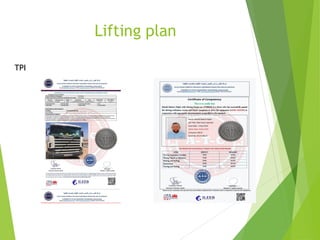
• Necessary certifications (TPI, Load chart, Operator certificate
and….ect)
• Load transportation or load radius/Distance
• Calculation the SWL
• Inspection crane and lifting Equipment
• Barraction lifting area
• Rigger avaliabe
• Supervisor available
• start-up
1
4
Lifting plan
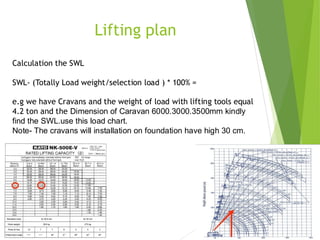
Calculation the SWL
SWL- (Totally Load weight/selection load ) * 100% =
e.g we have Cravans and the weight of load with lifting tools equal
4.2 ton and the Dimension of Caravan 6000.3000.3500mm kindly
find the SWL.use this load chart.
Note- The cravans will installation on foundation have high 30 cm.
1
5
Lifting plan
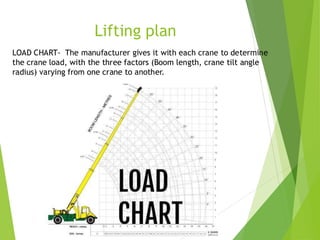
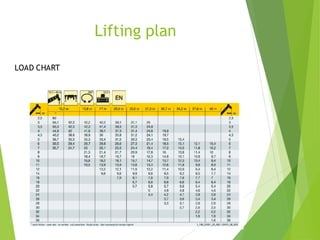
LOAD CHART- The manufacturer gives it with each crane to determine
the crane load, with the three factors (Boom length, crane tilt angle
radius) varying from one crane to another.
1
6
Lifting plan
LOAD CHART
1
7
Lifting plan
TPI
1
8
Rigging
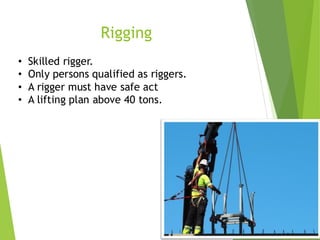
• Skilled rigger.
• Only persons qualified as riggers.
• A rigger must have safe act
• A lifting plan above 40 tons.
1
9
Rigging
Types of slings
➢ There are six main types of Slings
• CHAINS
• WIRE ROPE SLINGS
• FIBER ROPE
• SYNTHETIC WEB SLINGS
• MATAL MESH WIRES
• NAUTRAL FABRIC ROPE
2
0
Rigging
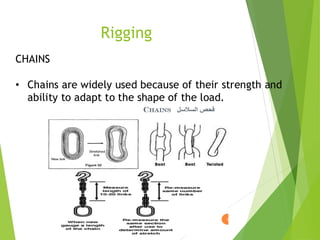
CHAINS
• Chains are widely used because of their strength and
ability to adapt to the shape of the load.
2
1
Rigging
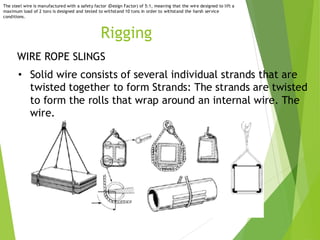
WIRE ROPE SLINGS
• Solid wire consists of several individual strands that are
twisted together to form Strands: The strands are twisted
to form the rolls that wrap around an internal wire. The
wire.
The steel wire is manufactured with a safety factor (Design Factor) of 5:1, meaning that the wire designed to lift a
maximum load of 2 tons is designed and tested to withstand 10 tons in order to withstand the harsh service
conditions.
2
2
Rigging
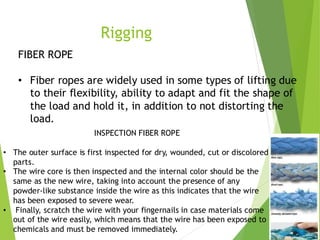
FIBER ROPE
• Fiber ropes are widely used in some types of lifting due
to their flexibility, ability to adapt and fit the shape of
the load and hold it, in addition to not distorting the
load.
INSPECTION FIBER ROPE
• The outer surface is first inspected for dry, wounded, cut or discolored
parts.
• The wire core is then inspected and the internal color should be the
same as the new wire, taking into account the presence of any
powder-like substance inside the wire as this indicates that the wire
has been exposed to severe wear.
• Finally, scratch the wire with your fingernails in case materials come
out of the wire easily, which means that the wire has been exposed to
chemicals and must be removed immediately.
2
3
Rigging
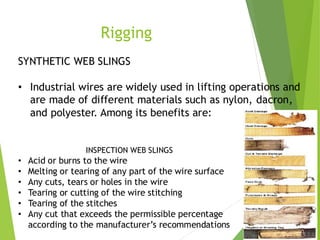
SYNTHETIC WEB SLINGS
• Industrial wires are widely used in lifting operations and
are made of different materials such as nylon, dacron,
and polyester. Among its benefits are:
INSPECTION WEB SLINGS
• Acid or burns to the wire
• Melting or tearing of any part of the wire surface
• Any cuts, tears or holes in the wire
• Tearing or cutting of the wire stitching
• Tearing of the stitches
• Any cut that exceeds the permissible percentage
according to the manufacturer’s recommendations
2
4
Rigging
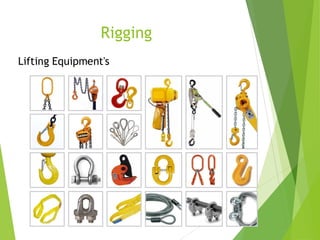
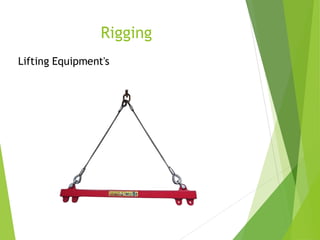
Lifting Equipment's
2
5
Rigging
Lifting Equipment's
2
6
Rigging
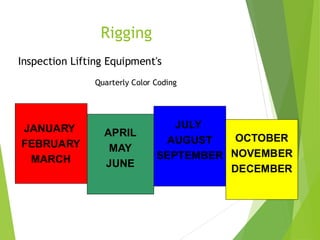
Inspection Lifting Equipment's
Quarterly Color Coding
JANUARY
FEBRUARY
MARCH
APRIL
MAY
JUNE
JULY
AUGUST
SEPTEMBER
OCTOBER
NOVEMBER
DECEMBER
2
7
Rigging
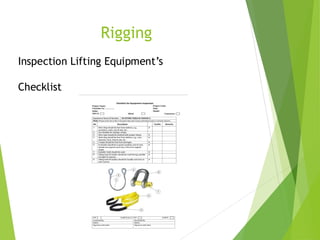
Inspection Lifting Equipment’s
Checklist
2
8
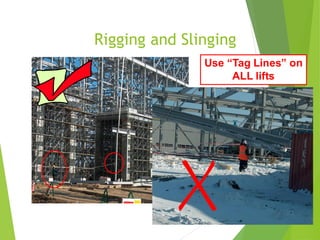
Use “Tag Lines” on
ALL lifts
Rigging and Slinging
2
9
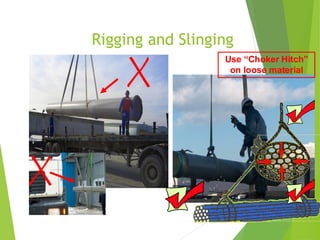
Rigging and Slinging
Use “Choker Hitch”
on loose material
Rigging and Slinging
3
0
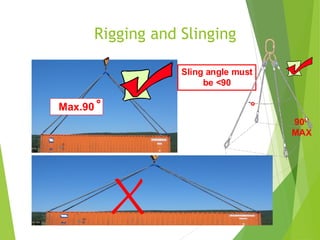
90O
MAX
Max.90
Sling angle must
be <90
Rigging and Slinging
3
1
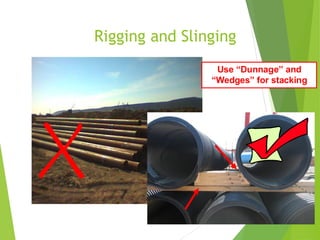
Use “Dunnage” and
“Wedges” for stacking
3
2
Rigging and Slinging
3
3
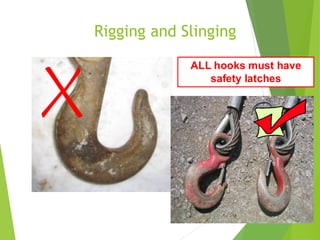
ALL hooks must have
safety latches
Rigging and Slinging
3
4
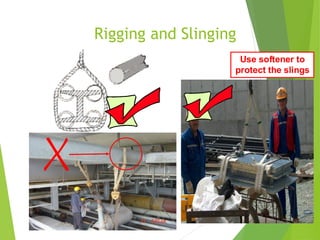
Use softener to
protect the slings
Rigging and Slinging
3
5
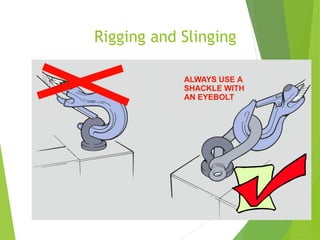
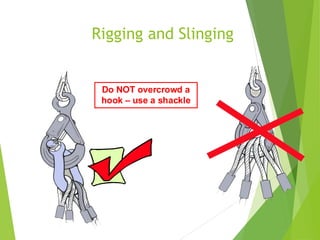
Do NOT overcrowd a
hook – use a shackle
Rigging and Slinging
3
6
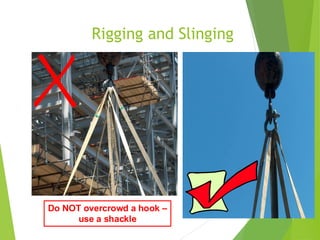
Do NOT overcrowd a hook –
use a shackle
Rigging and Slinging
3
7
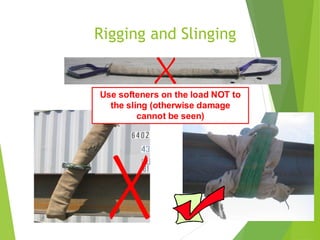
Use softeners on the load NOT to
the sling (otherwise damage
cannot be seen)
Rigging and Slinging
3
8
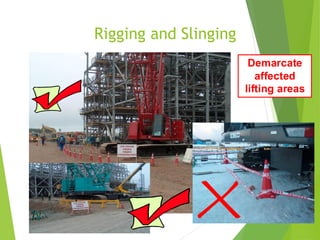
Demarcate
affected
lifting areas
Rigging and Slinging
3
9
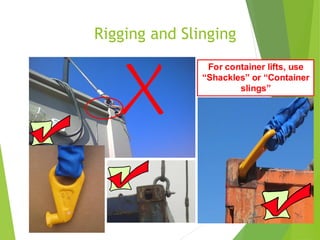
For container lifts, use
“Shackles” or “Container
slings”
4
0
Lifting and Rigging hazards
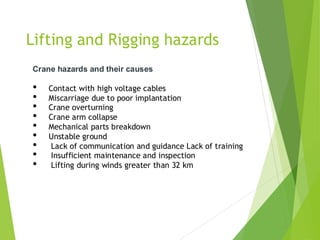
Crane hazards and their causes
• Contact with high voltage cables
• Miscarriage due to poor implantation
• Crane overturning
• Crane arm collapse
• Mechanical parts breakdown
• Unstable ground
• Lack of communication and guidance Lack of training
• Insufficient maintenance and inspection
• Lifting during winds greater than 32 km
4
1
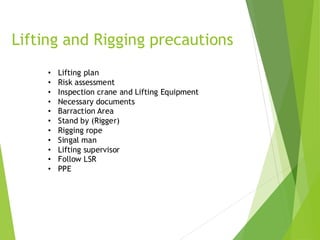
Lifting and Rigging precautions
• Lifting plan
• Risk assessment
• Inspection crane and Lifting Equipment
• Necessary documents
• Barraction Area
• Stand by (Rigger)
• Rigging rope
• Singal man
• Lifting supervisor
• Follow LSR
• PPE
4
2
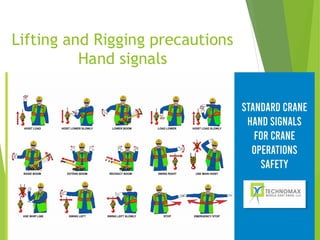
Lifting and Rigging precautions
Hand signals
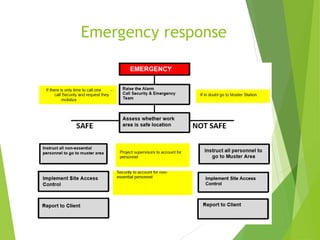
Emergency response
4
3
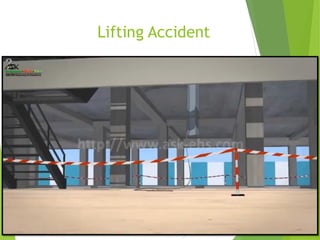
Lifting Accident
4
4
•Hard Hat
•Safety Glasses
•Fluorescent Vest
•Full Body Harness
•Hand Gloves
•Lanyard
•Safety Shoes
4
5
Personal Protective
Equipment (PPE)
Summary
4
6
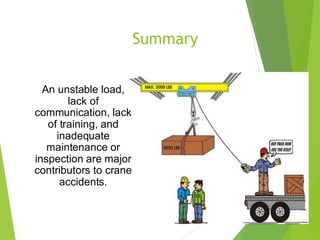
An unstable load,
lack of
communication, lack
of training, and
inadequate
maintenance or
inspection are major
contributors to crane
accidents.
4
7
• Operators or others working in the area can be victims
to “struck by" and "caught in" injuries.
• Contact with power lines causes many accidents.
• A competent person must inspect a crane regularly to
insure it is in proper order.
• Planning and training reduces accidents.
Summary
LIFT SAFELY AND LIVE HAPPY
DW-HSE-TM010 48
Q: What is rigging?
A: Rigging is the process of lifting and moving heavy loads using cranes,
hoists, and other equipment.
Q: Why is rigging safety important?
A: Rigging can be dangerous and requires proper training, equipment, and
procedures to avoid accidents. Proper rigging safety procedures can prevent
accidents, equipment failure, and damage to the load.
Q: What are the common hazards associated with rigging?
A: Common hazards associated with rigging include equipment failure,
improper rigging techniques, falling objects, and unbalanced loads.
Q: Who is responsible for rigging safety?
A: Employers are responsible for providing a safe workplace and ensuring that
workers receive proper training and equipment. Workers are responsible for
following safety procedures and using proper techniques.
Q: What is the role of PPE in rigging safety?
A: Personal protective equipment (PPE) is essential in any rigging operation.
PPE includes hard hats, safety glasses, gloves, and fall protection equipment.
Questions and Answers
DW-HSE-TM010 49
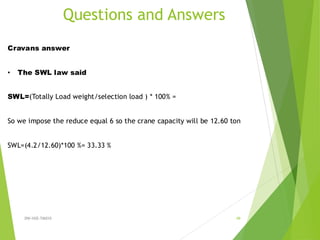
Cravans answer
• The SWL law said
SWL=(Totally Load weight/selection load ) * 100% =
So we impose the reduce equal 6 so the crane capacity will be 12.60 ton
SWL=(4.2/12.60)*100 %= 33.33 %
Questions and Answers
5
0
Thanks

lifting_safely_and_rigging_crane_training_presentation_.pdf

  • 1.
    Lifting Safety and RiggingCrane Prepared By: Hussein Hakam Presented By: Hussein Hakam
  • 2.
    Training Outline •Introduction •Types ofmobile crane •How to Conduct a Crane Safety Inspection •Types of Lifting operations •Lifting plan and Rigging •Lifting and Rigging hazards •Lifting and Rigging Precautions •Emergency response •Lifting Accidents •Personal Protective Equipment (PPE) •Summary •Questions and Answers 2
  • 3.
    Introduction • Lifting isvery common in the construction industry as a method for material transfer. Through mechanical means such cranes, lifting equipment and manual handling. • The risk of injury can be reduced through training and application of correct lifting & handling techniques. 3
  • 4.
    Introduction • Definitions • SWL •WLL • RCI • TPI • Load chart • Radius • Outriggers • Country wight 4
  • 5.
    5 Types of mobilecrane 1.Outrigger crane 2.Crawler Crane
  • 6.
    6 Types of mobilecrane • Outriggers crane
  • 7.
    7 Types of mobilecrane • Crawler Crane
  • 8.
    8 How to Conducta Crane Safety Inspection •Conduct a Visual Inspection •Inspect the Hydraulic System •Inspect the Crane’s Controls •Check the Tires and Brakes •Conduct Functional Tests
  • 9.
    9 How to Conducta Crane Safety Inspection
  • 10.
    1 0 Types of Liftingoperations 1.Routine and Non-Routine 2.Simple 3.Critical Lifting 4.Complex
  • 11.
  • 12.
    1 2 Lifting plan Lifting planmust include as a minimum;  Position of item to be lifted and lifting equipment (Pick up and set down)  Weight and configuration of item to be lifted  Radius of lift  Calculated capacity  Details of lifting equipment  Lifting restrictions  Ground loads
  • 13.
    1 3 Lifting plan Points tobe consider during the lifting plan • Site inspection • Know the load details • Selection crane and slings • Necessary certifications (TPI, Load chart, Operator certificate and….ect) • Load transportation or load radius/Distance • Calculation the SWL • Inspection crane and lifting Equipment • Barraction lifting area • Rigger avaliabe • Supervisor available • start-up
  • 14.
    1 4 Lifting plan Calculation theSWL SWL- (Totally Load weight/selection load ) * 100% = e.g we have Cravans and the weight of load with lifting tools equal 4.2 ton and the Dimension of Caravan 6000.3000.3500mm kindly find the SWL.use this load chart. Note- The cravans will installation on foundation have high 30 cm.
  • 15.
    1 5 Lifting plan LOAD CHART-The manufacturer gives it with each crane to determine the crane load, with the three factors (Boom length, crane tilt angle radius) varying from one crane to another.
  • 16.
  • 17.
  • 18.
    1 8 Rigging • Skilled rigger. •Only persons qualified as riggers. • A rigger must have safe act • A lifting plan above 40 tons.
  • 19.
    1 9 Rigging Types of slings ➢There are six main types of Slings • CHAINS • WIRE ROPE SLINGS • FIBER ROPE • SYNTHETIC WEB SLINGS • MATAL MESH WIRES • NAUTRAL FABRIC ROPE
  • 20.
    2 0 Rigging CHAINS • Chains arewidely used because of their strength and ability to adapt to the shape of the load.
  • 21.
    2 1 Rigging WIRE ROPE SLINGS •Solid wire consists of several individual strands that are twisted together to form Strands: The strands are twisted to form the rolls that wrap around an internal wire. The wire. The steel wire is manufactured with a safety factor (Design Factor) of 5:1, meaning that the wire designed to lift a maximum load of 2 tons is designed and tested to withstand 10 tons in order to withstand the harsh service conditions.
  • 22.
    2 2 Rigging FIBER ROPE • Fiberropes are widely used in some types of lifting due to their flexibility, ability to adapt and fit the shape of the load and hold it, in addition to not distorting the load. INSPECTION FIBER ROPE • The outer surface is first inspected for dry, wounded, cut or discolored parts. • The wire core is then inspected and the internal color should be the same as the new wire, taking into account the presence of any powder-like substance inside the wire as this indicates that the wire has been exposed to severe wear. • Finally, scratch the wire with your fingernails in case materials come out of the wire easily, which means that the wire has been exposed to chemicals and must be removed immediately.
  • 23.
    2 3 Rigging SYNTHETIC WEB SLINGS •Industrial wires are widely used in lifting operations and are made of different materials such as nylon, dacron, and polyester. Among its benefits are: INSPECTION WEB SLINGS • Acid or burns to the wire • Melting or tearing of any part of the wire surface • Any cuts, tears or holes in the wire • Tearing or cutting of the wire stitching • Tearing of the stitches • Any cut that exceeds the permissible percentage according to the manufacturer’s recommendations
  • 24.
  • 25.
  • 26.
    2 6 Rigging Inspection Lifting Equipment's QuarterlyColor Coding JANUARY FEBRUARY MARCH APRIL MAY JUNE JULY AUGUST SEPTEMBER OCTOBER NOVEMBER DECEMBER
  • 27.
  • 28.
    2 8 Use “Tag Lines”on ALL lifts Rigging and Slinging
  • 29.
    2 9 Rigging and Slinging Use“Choker Hitch” on loose material
  • 30.
  • 31.
    Rigging and Slinging 3 1 Use“Dunnage” and “Wedges” for stacking
  • 32.
  • 33.
    Rigging and Slinging 3 3 ALLhooks must have safety latches
  • 34.
    Rigging and Slinging 3 4 Usesoftener to protect the slings
  • 35.
    Rigging and Slinging 3 5 DoNOT overcrowd a hook – use a shackle
  • 36.
    Rigging and Slinging 3 6 DoNOT overcrowd a hook – use a shackle
  • 37.
    Rigging and Slinging 3 7 Usesofteners on the load NOT to the sling (otherwise damage cannot be seen)
  • 38.
  • 39.
    Rigging and Slinging 3 9 Forcontainer lifts, use “Shackles” or “Container slings”
  • 40.
    4 0 Lifting and Rigginghazards Crane hazards and their causes • Contact with high voltage cables • Miscarriage due to poor implantation • Crane overturning • Crane arm collapse • Mechanical parts breakdown • Unstable ground • Lack of communication and guidance Lack of training • Insufficient maintenance and inspection • Lifting during winds greater than 32 km
  • 41.
    4 1 Lifting and Riggingprecautions • Lifting plan • Risk assessment • Inspection crane and Lifting Equipment • Necessary documents • Barraction Area • Stand by (Rigger) • Rigging rope • Singal man • Lifting supervisor • Follow LSR • PPE
  • 42.
    4 2 Lifting and Riggingprecautions Hand signals
  • 43.
  • 44.
  • 45.
    •Hard Hat •Safety Glasses •FluorescentVest •Full Body Harness •Hand Gloves •Lanyard •Safety Shoes 4 5 Personal Protective Equipment (PPE)
  • 46.
    Summary 4 6 An unstable load, lackof communication, lack of training, and inadequate maintenance or inspection are major contributors to crane accidents.
  • 47.
    4 7 • Operators orothers working in the area can be victims to “struck by" and "caught in" injuries. • Contact with power lines causes many accidents. • A competent person must inspect a crane regularly to insure it is in proper order. • Planning and training reduces accidents. Summary LIFT SAFELY AND LIVE HAPPY
  • 48.
    DW-HSE-TM010 48 Q: Whatis rigging? A: Rigging is the process of lifting and moving heavy loads using cranes, hoists, and other equipment. Q: Why is rigging safety important? A: Rigging can be dangerous and requires proper training, equipment, and procedures to avoid accidents. Proper rigging safety procedures can prevent accidents, equipment failure, and damage to the load. Q: What are the common hazards associated with rigging? A: Common hazards associated with rigging include equipment failure, improper rigging techniques, falling objects, and unbalanced loads. Q: Who is responsible for rigging safety? A: Employers are responsible for providing a safe workplace and ensuring that workers receive proper training and equipment. Workers are responsible for following safety procedures and using proper techniques. Q: What is the role of PPE in rigging safety? A: Personal protective equipment (PPE) is essential in any rigging operation. PPE includes hard hats, safety glasses, gloves, and fall protection equipment. Questions and Answers
  • 49.
    DW-HSE-TM010 49 Cravans answer •The SWL law said SWL=(Totally Load weight/selection load ) * 100% = So we impose the reduce equal 6 so the crane capacity will be 12.60 ton SWL=(4.2/12.60)*100 %= 33.33 % Questions and Answers
  • 50.