SAFETY FIRST: HOW TO
APPROACH AND EXECUTE
SAFE MEDIA BUYING ONLINE
2 0 1 8
+
© 2018 by Fullscreen. Privileged and confidential.
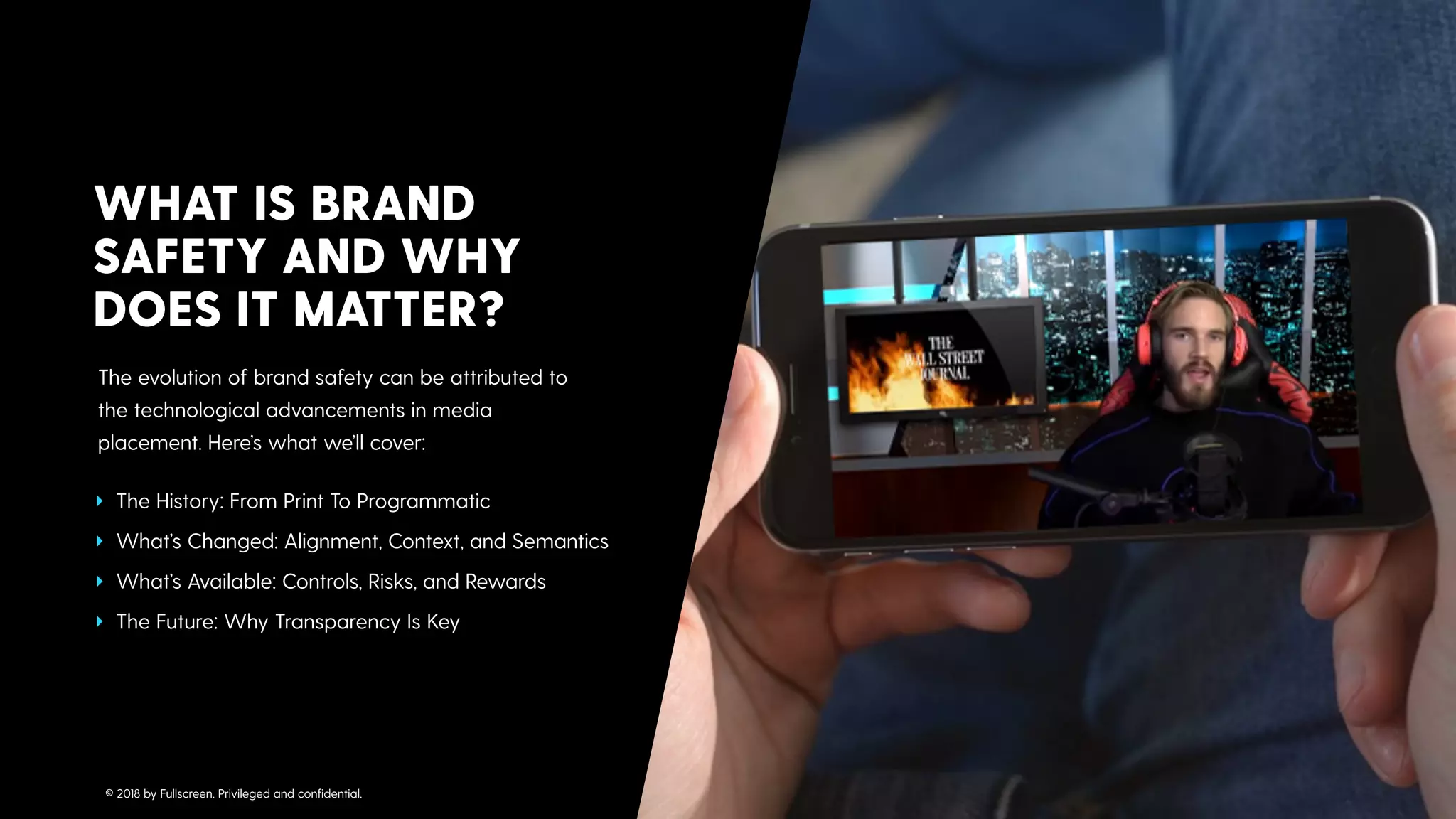
The evolution of brand safety can be attributed to
the technological advancements in media
placement. Here’s what we’ll cover:
WHAT IS BRAND
SAFETY AND WHY
DOES IT MATTER?
‣ The History: From Print To Programmatic
‣ What’s Changed: Alignment, Context, and Semantics
‣ What’s Available: Controls, Risks, and Rewards
‣ The Future: Why Transparency Is Key
© 2018 by Fullscreen. Privileged and confidential.
SUB-SECTION TITLE
CAN GO ON TWO LINES
THE HISTORY
© 2018 by Fullscreen. Privileged and confidential.
BRAND SAFETY CHALLENGES
EXISTED LONG BEFORE THE
INTERNET.
“
“
© 2018 by Fullscreen. Privileged and confidential.
HISTORY OF BRAND SAFETY
HOW WE GOT HERE
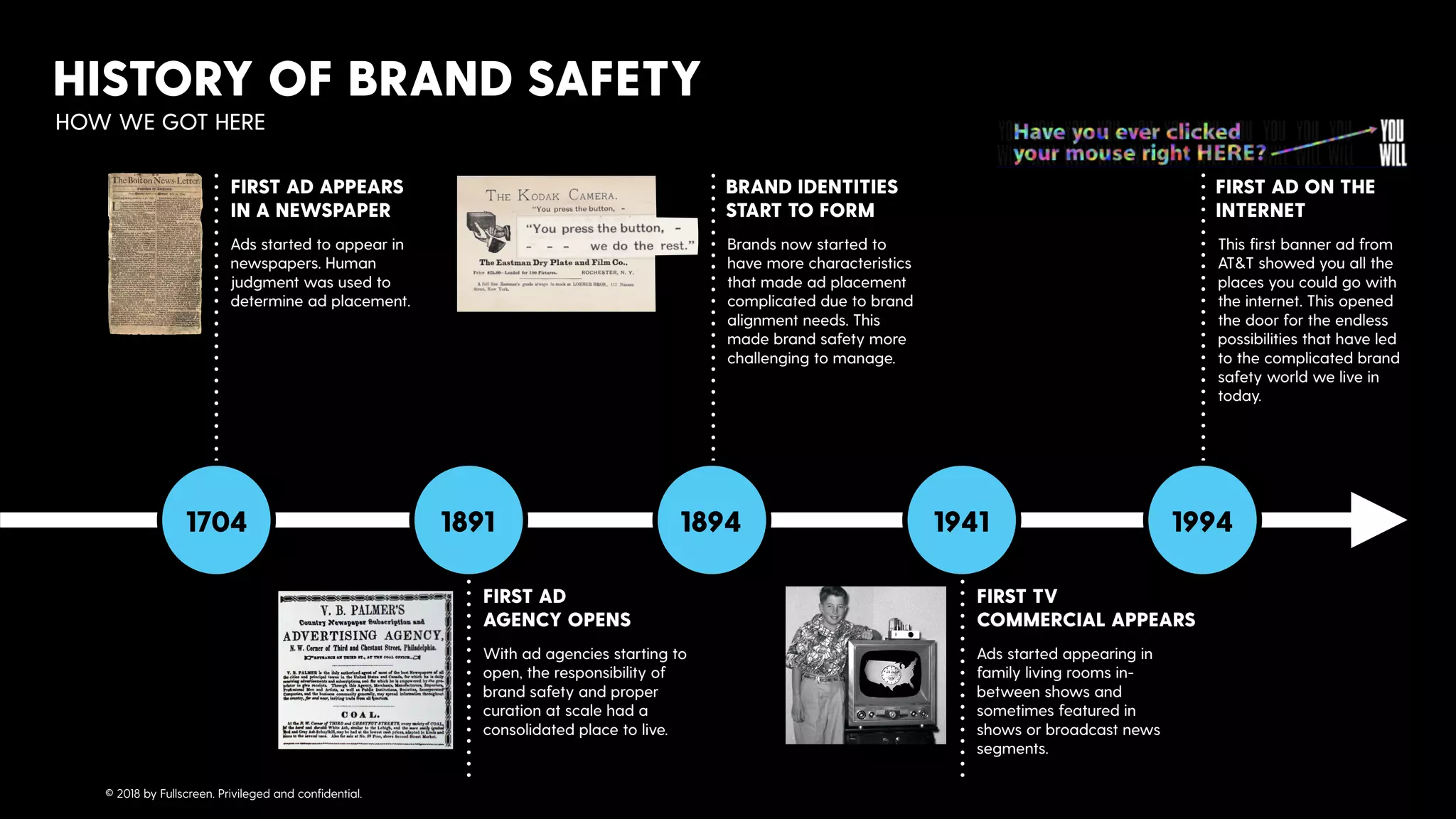
Ads started to appear in
newspapers. Human
judgment was used to
determine ad placement.
FIRST AD APPEARS 

IN A NEWSPAPER
1704 18941891 1941 1994
With ad agencies starting to
open, the responsibility of
brand safety and proper
curation at scale had a
consolidated place to live.
FIRST AD 

AGENCY OPENS
Brands now started to
have more characteristics
that made ad placement
complicated due to brand
alignment needs. This
made brand safety more
challenging to manage.
BRAND IDENTITIES 

START TO FORM
Ads started appearing in
family living rooms in-
between shows and
sometimes featured in
shows or broadcast news
segments.
FIRST TV 

COMMERCIAL APPEARS
This first banner ad from
AT&T showed you all the
places you could go with
the internet. This opened
the door for the endless
possibilities that have led
to the complicated brand
safety world we live in
today.
FIRST AD ON THE
INTERNET
© 2018 by Fullscreen. Privileged and confidential.
HISTORY OF BRAND SAFETY
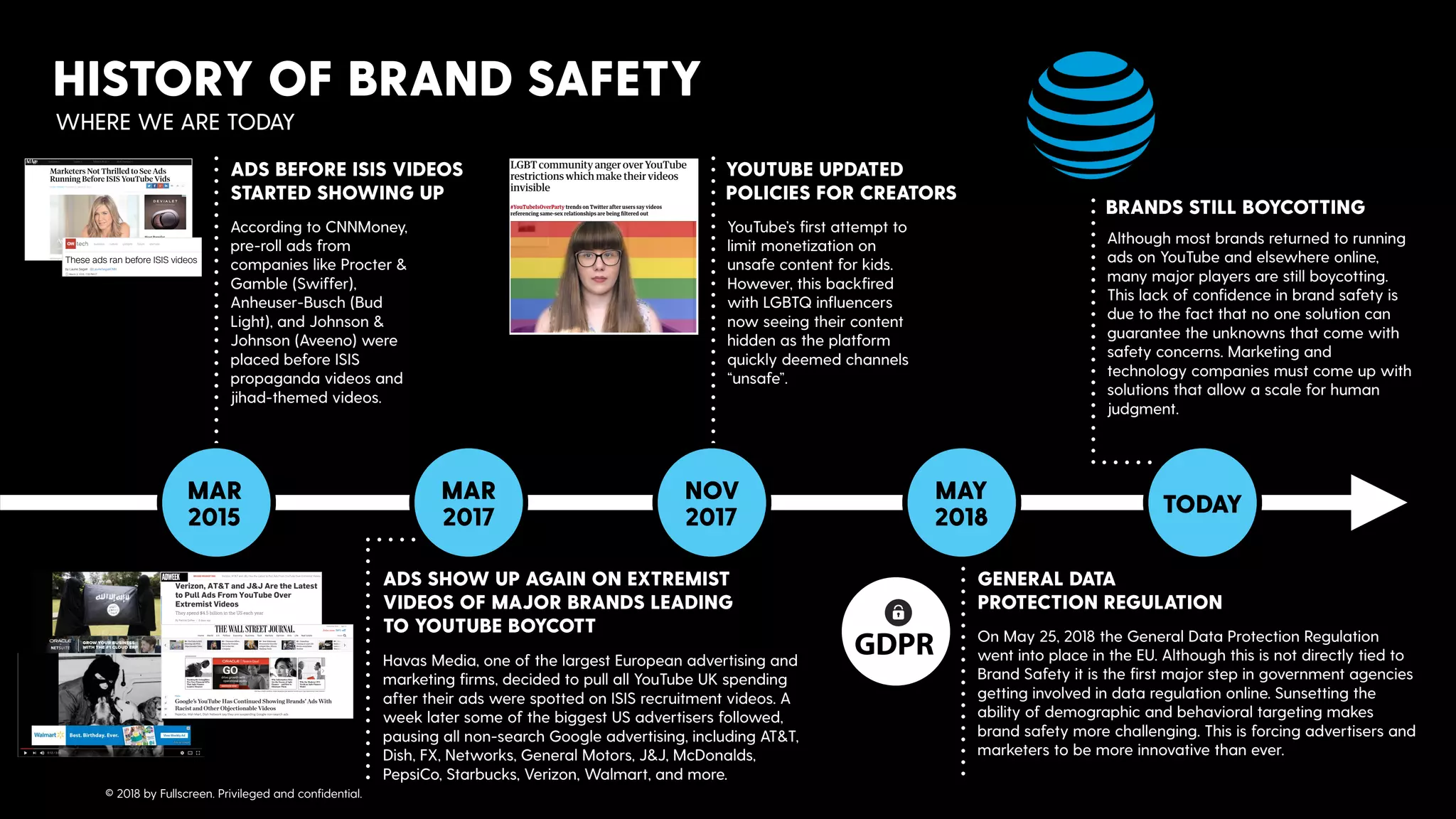
According to CNNMoney,
pre-roll ads from
companies like Procter &
Gamble (Swiffer),
Anheuser-Busch (Bud
Light), and Johnson &
Johnson (Aveeno) were
placed before ISIS
propaganda videos and
jihad-themed videos.
ADS BEFORE ISIS VIDEOS
STARTED SHOWING UP
MAR
2015
Havas Media, one of the largest European advertising and
marketing firms, decided to pull all YouTube UK spending
after their ads were spotted on ISIS recruitment videos. A
week later some of the biggest US advertisers followed,
pausing all non-search Google advertising, including AT&T,
Dish, FX, Networks, General Motors, J&J, McDonalds,
PepsiCo, Starbucks, Verizon, Walmart, and more.
ADS SHOW UP AGAIN ON EXTREMIST
VIDEOS OF MAJOR BRANDS LEADING
TO YOUTUBE BOYCOTT
YouTube’s first attempt to
limit monetization on
unsafe content for kids.
However, this backfired
with LGBTQ influencers
now seeing their content
hidden as the platform
quickly deemed channels
“unsafe”.
YOUTUBE UPDATED
POLICIES FOR CREATORS
On May 25, 2018 the General Data Protection Regulation
went into place in the EU. Although this is not directly tied to
Brand Safety it is the first major step in government agencies
getting involved in data regulation online. Sunsetting the
ability of demographic and behavioral targeting makes
brand safety more challenging. This is forcing advertisers and
marketers to be more innovative than ever.
GENERAL DATA

PROTECTION REGULATION
Although most brands returned to running
ads on YouTube and elsewhere online,
many major players are still boycotting.
This lack of confidence in brand safety is
due to the fact that no one solution can
guarantee the unknowns that come with
safety concerns. Marketing and
technology companies must come up with
solutions that allow a scale for human
judgment.
BRANDS STILL BOYCOTTING
MAR
2017
NOV
2017
MAY
2018
TODAY
WHERE WE ARE TODAY
© 2018 by Fullscreen. Privileged and confidential.
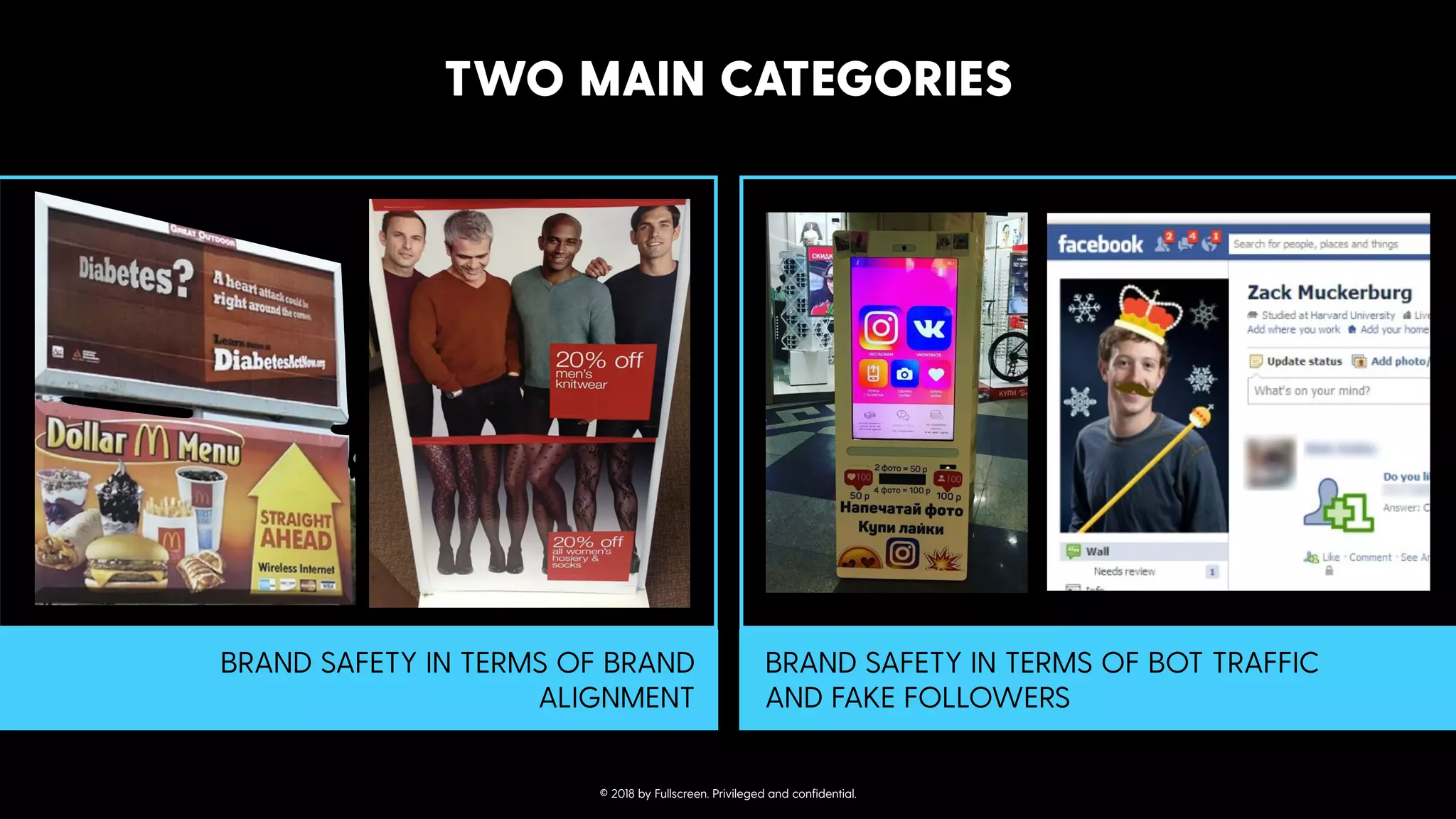
BRAND SAFETY IN TERMS OF BRAND
ALIGNMENT
BRAND SAFETY IN TERMS OF BOT TRAFFIC
AND FAKE FOLLOWERS
TWO MAIN CATEGORIES
© 2018 by Fullscreen. Privileged and confidential.
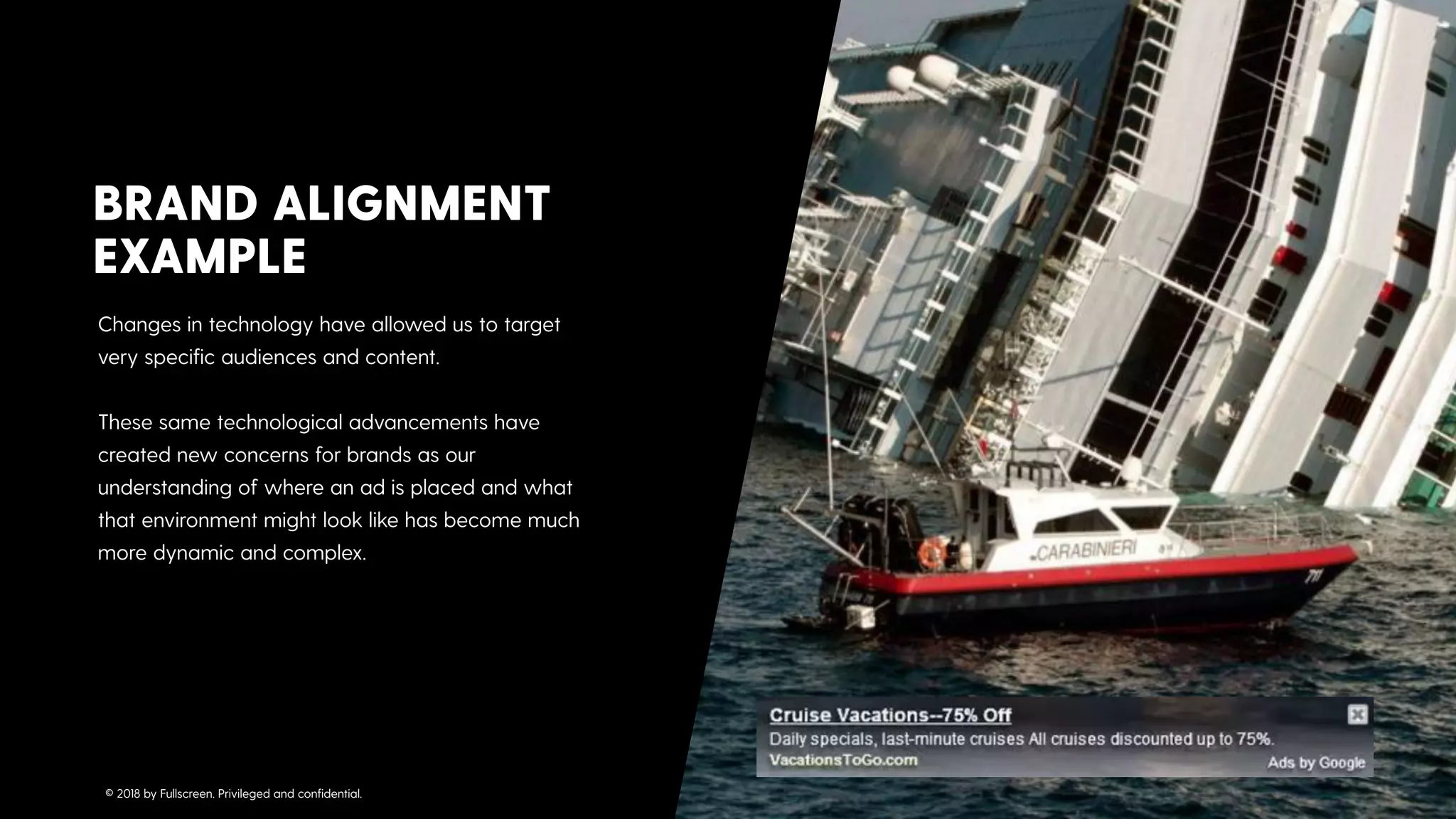
Changes in technology have allowed us to target
very specific audiences and content.


These same technological advancements have
created new concerns for brands as our
understanding of where an ad is placed and what
that environment might look like has become much
more dynamic and complex.
BRAND ALIGNMENT
EXAMPLE
© 2018 by Fullscreen. Privileged and confidential.
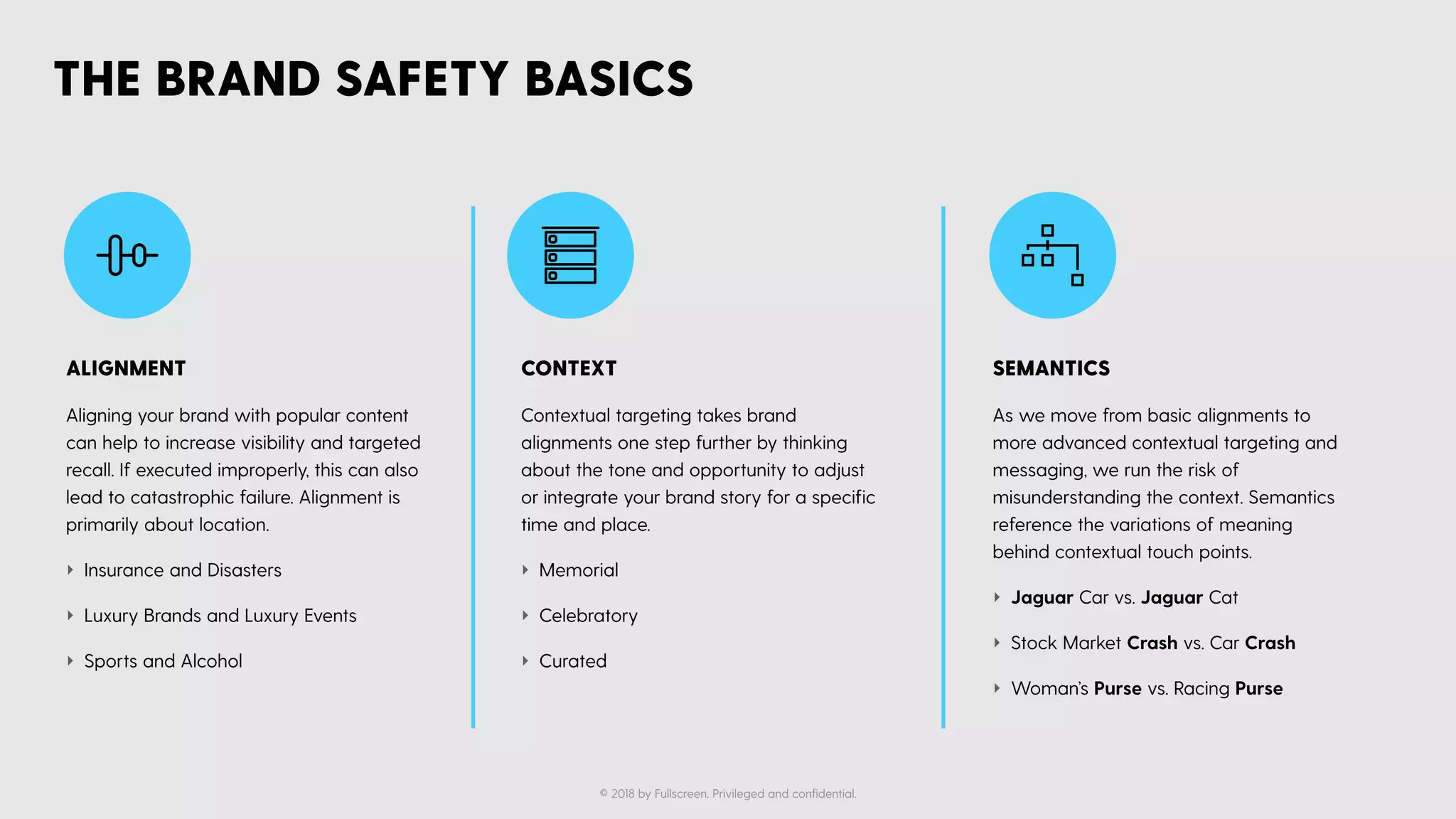
THE BRAND SAFETY BASICS
Aligning your brand with popular content
can help to increase visibility and targeted
recall. If executed improperly, this can also
lead to catastrophic failure. Alignment is
primarily about location.
‣ Insurance and Disasters
‣ Luxury Brands and Luxury Events
‣ Sports and Alcohol
ALIGNMENT
Contextual targeting takes brand
alignments one step further by thinking
about the tone and opportunity to adjust
or integrate your brand story for a specific
time and place.
‣ Memorial
‣ Celebratory
‣ Curated
CONTEXT
As we move from basic alignments to
more advanced contextual targeting and
messaging, we run the risk of
misunderstanding the context. Semantics
reference the variations of meaning
behind contextual touch points.
‣ Jaguar Car vs. Jaguar Cat
‣ Stock Market Crash vs. Car Crash
‣ Woman’s Purse vs. Racing Purse
SEMANTICS
© 2018 by Fullscreen. Privileged and confidential.
SUB-SECTION TITLE
CAN GO ON TWO LINES
WHAT’S CHANGED
© 2018 by Fullscreen. Privileged and confidential.
THE WORLD
HAS CHANGED
400 hours of video
are uploaded to
YouTube every
MINUTE
Daily Active YouTube
users
VIDEOS WATCHED
A DAY
5B
3 0 M I L L I O N
[Source : https://www.omnicoreagency.com/youtube-statistics/]© 2018 by Fullscreen. Privileged and confidential.
TRANSPARENCY IS EVERYTHING.
IF WE CAN’T SEE IT, MEASURE
IT, OR REPORT IT, WE CANNOT
CONTROL IT.
“
“
© 2018 by Fullscreen. Privileged and confidential.
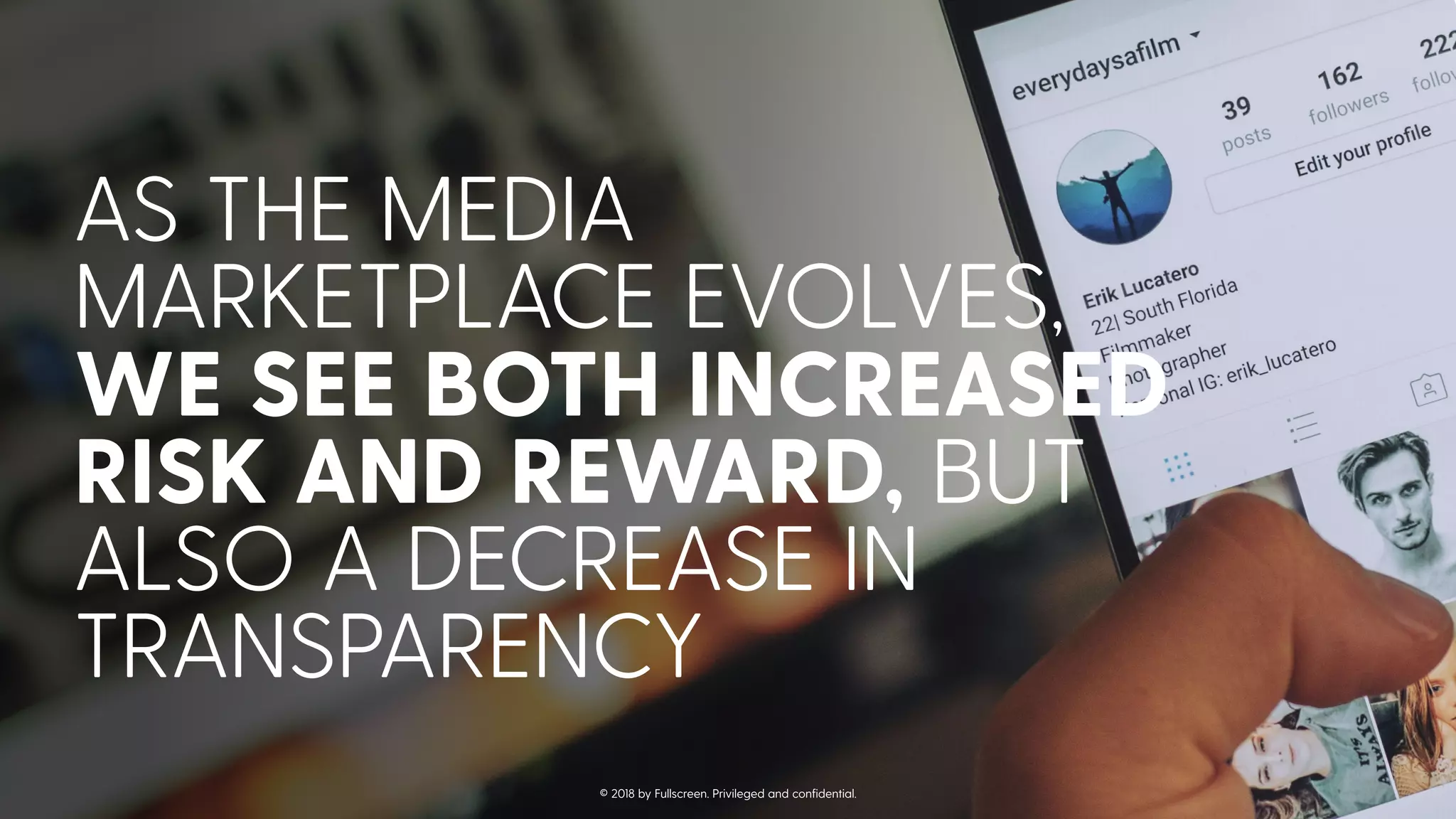
AS THE MEDIA
MARKETPLACE EVOLVES, 

WE SEE BOTH INCREASED
RISK AND REWARD, BUT
ALSO A DECREASE IN
TRANSPARENCY
© 2018 by Fullscreen. Privileged and confidential.
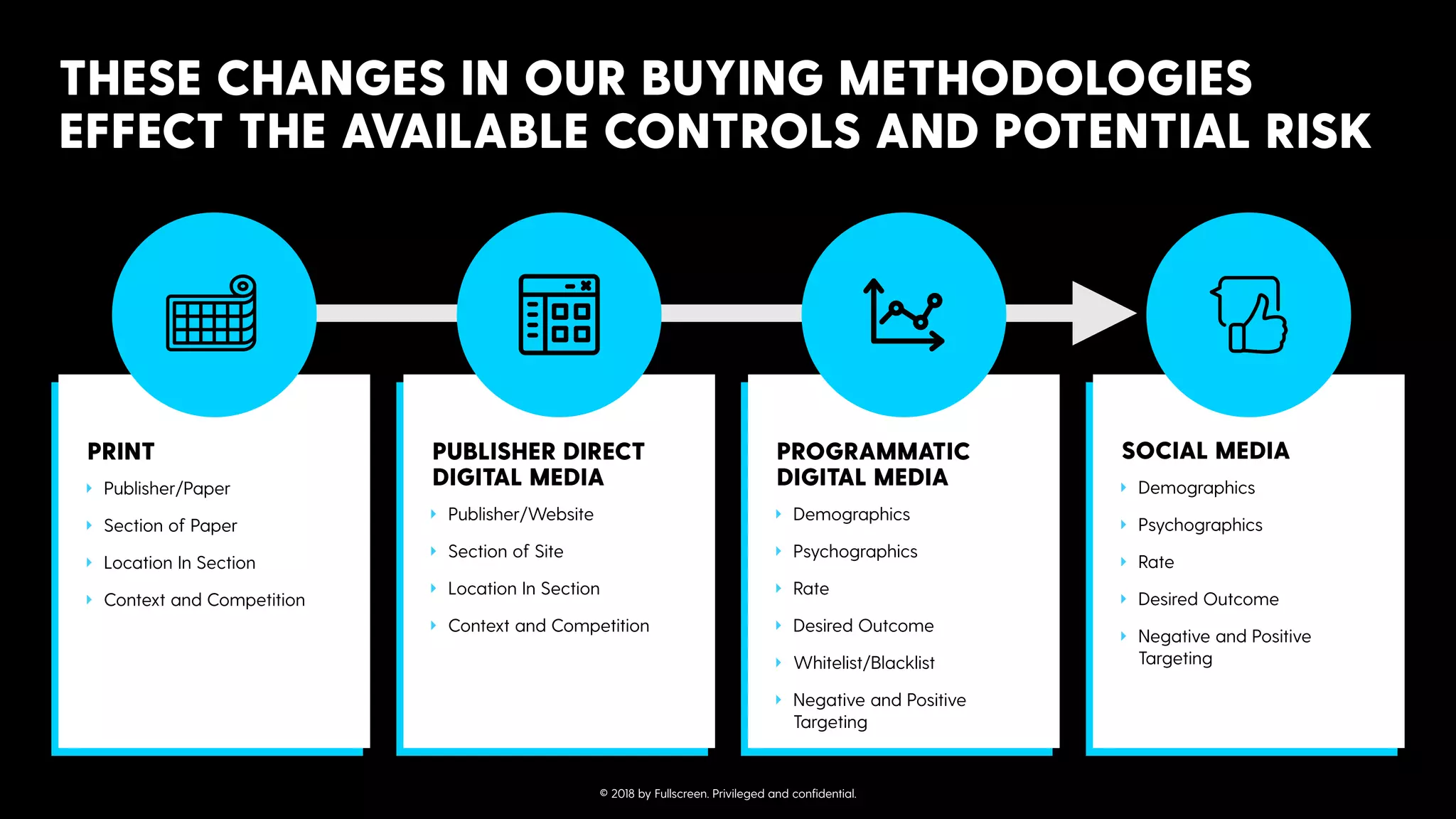
THESE CHANGES IN OUR BUYING METHODOLOGIES
EFFECT THE AVAILABLE CONTROLS AND POTENTIAL RISK
‣ Publisher/Paper
‣ Section of Paper
‣ Location In Section
‣ Context and Competition
PRINT
‣ Publisher/Website
‣ Section of Site
‣ Location In Section
‣ Context and Competition
PUBLISHER DIRECT
DIGITAL MEDIA
‣ Demographics
‣ Psychographics
‣ Rate
‣ Desired Outcome
‣ Whitelist/Blacklist
‣ Negative and Positive
Targeting
PROGRAMMATIC
DIGITAL MEDIA ‣ Demographics
‣ Psychographics
‣ Rate
‣ Desired Outcome
‣ Negative and Positive
Targeting
SOCIAL MEDIA
© 2018 by Fullscreen. Privileged and confidential.
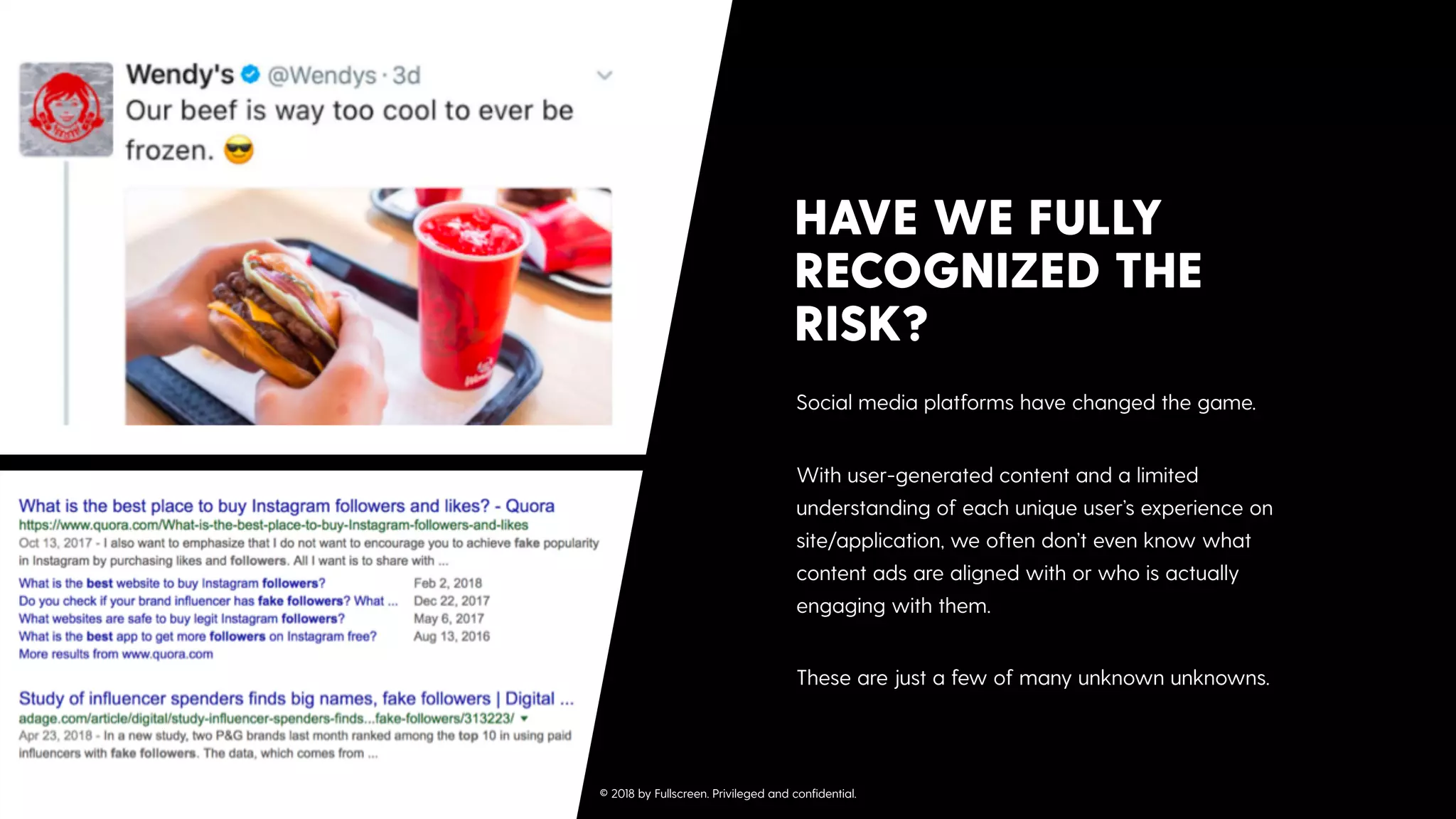
Social media platforms have changed the game.

With user-generated content and a limited
understanding of each unique user’s experience on
site/application, we often don’t even know what
content ads are aligned with or who is actually
engaging with them.

These are just a few of many unknown unknowns.
HAVE WE FULLY
RECOGNIZED THE
RISK?
© 2018 by Fullscreen. Privileged and confidential.
SUB-SECTION TITLE
CAN GO ON TWO LINES
WHAT’S AVAILABLE
© 2018 by Fullscreen. Privileged and confidential.
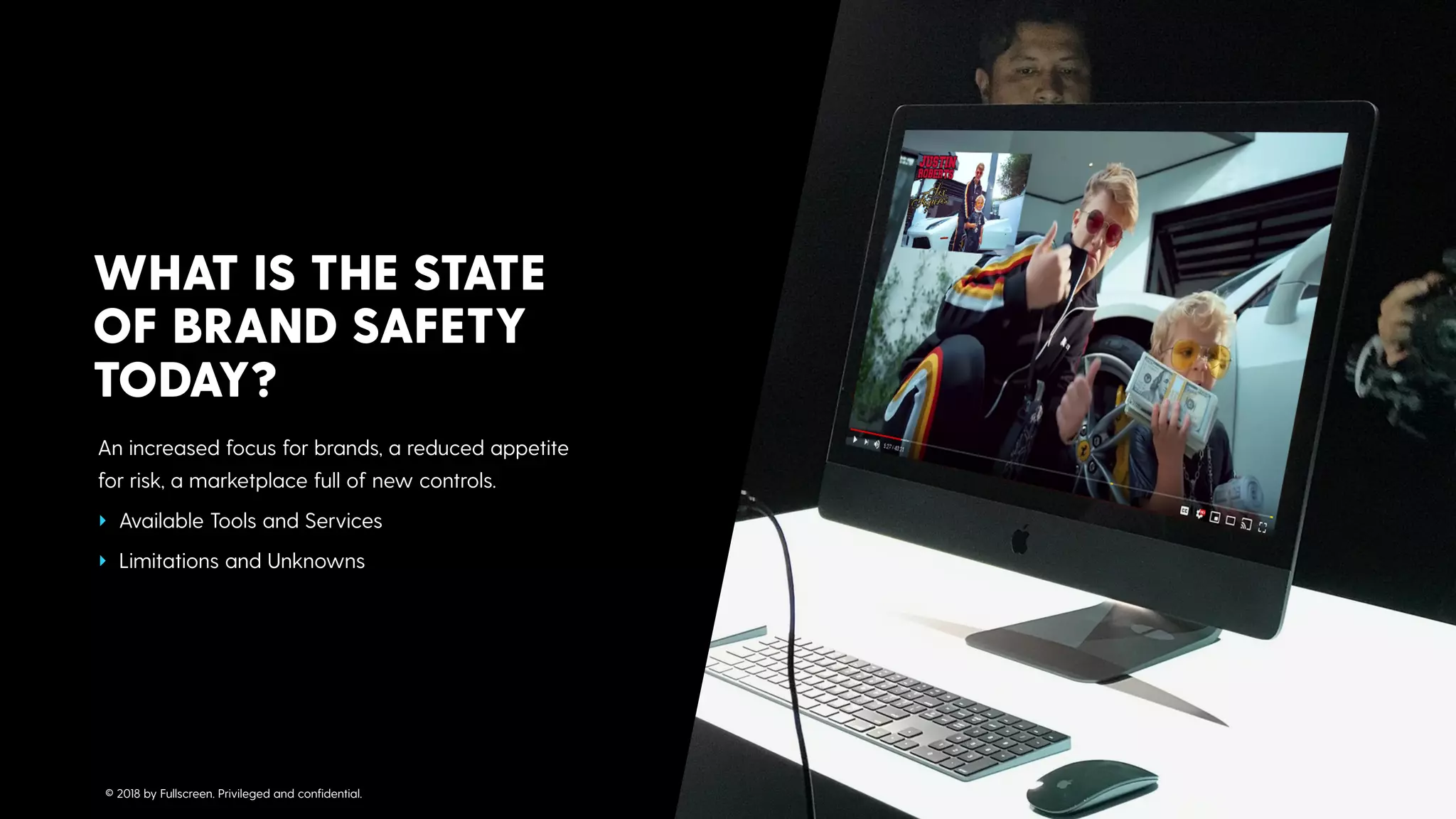
An increased focus for brands, a reduced appetite
for risk, a marketplace full of new controls.
‣ Available Tools and Services
‣ Limitations and Unknowns
WHAT IS THE STATE 

OF BRAND SAFETY
TODAY?
© 2018 by Fullscreen. Privileged and confidential.
BRAND SAFETY TODAY
Brand Safety is a fast-moving segment of
the media industry and some solutions
have become commonplace.
AVAILABLE TOOLS AND SERVICES
While many advanced tools are now
available, they all still have various
limitations. The more complex the content,
the more difficult this becomes.
LIMITATIONS
When entering more dynamic landscapes
such as social media or video content,
whereby advertisers often cannot control
user engagement, we don’t always know
where things may go wrong.
UNKNOWNS
© 2018 by Fullscreen. Privileged and confidential.
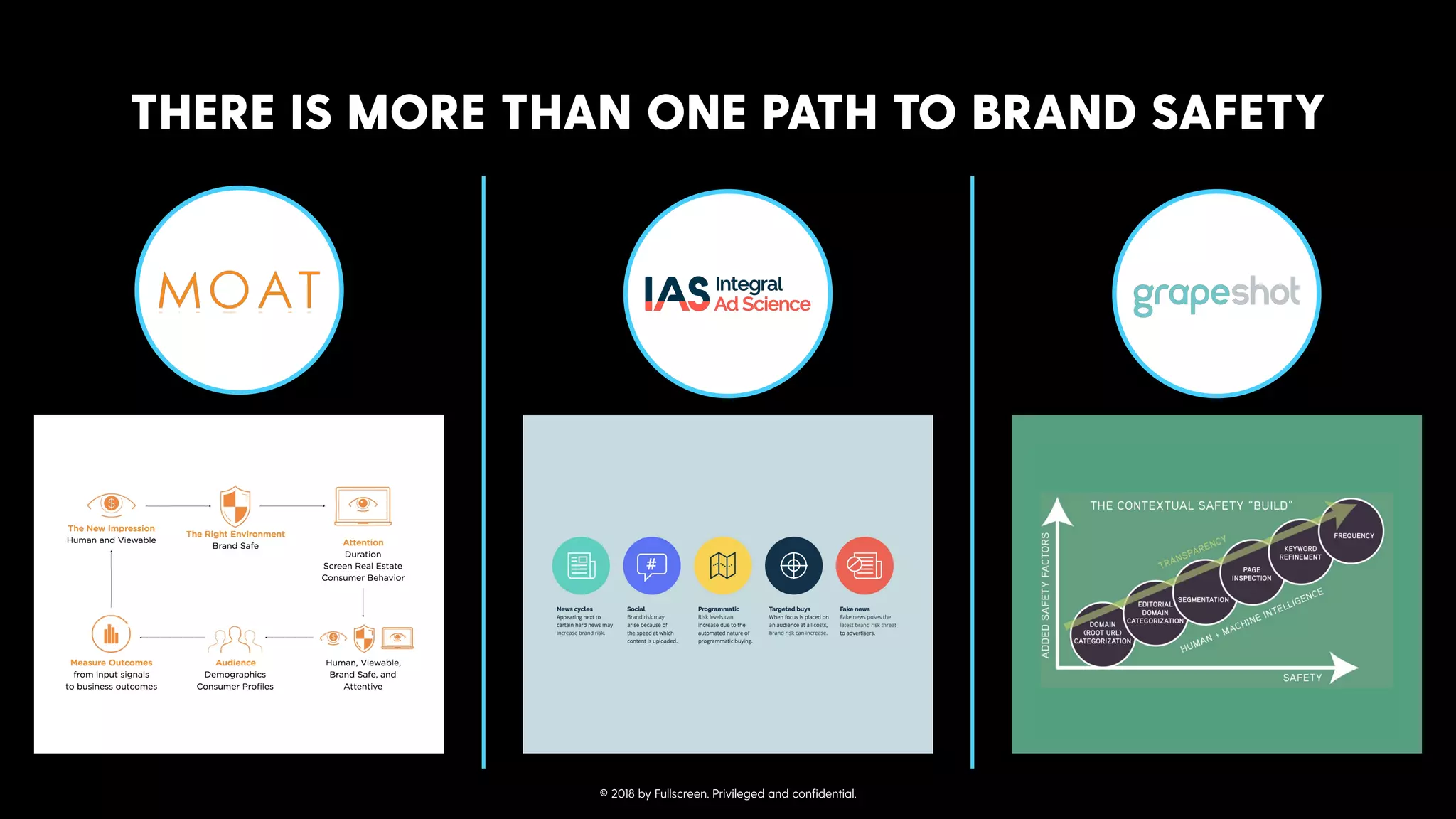
THERE IS MORE THAN ONE PATH TO BRAND SAFETY
© 2018 by Fullscreen. Privileged and confidential.
SUB-SECTION TITLE
CAN GO ON TWO LINES
THE FUTURE
© 2018 by Fullscreen. Privileged and confidential.
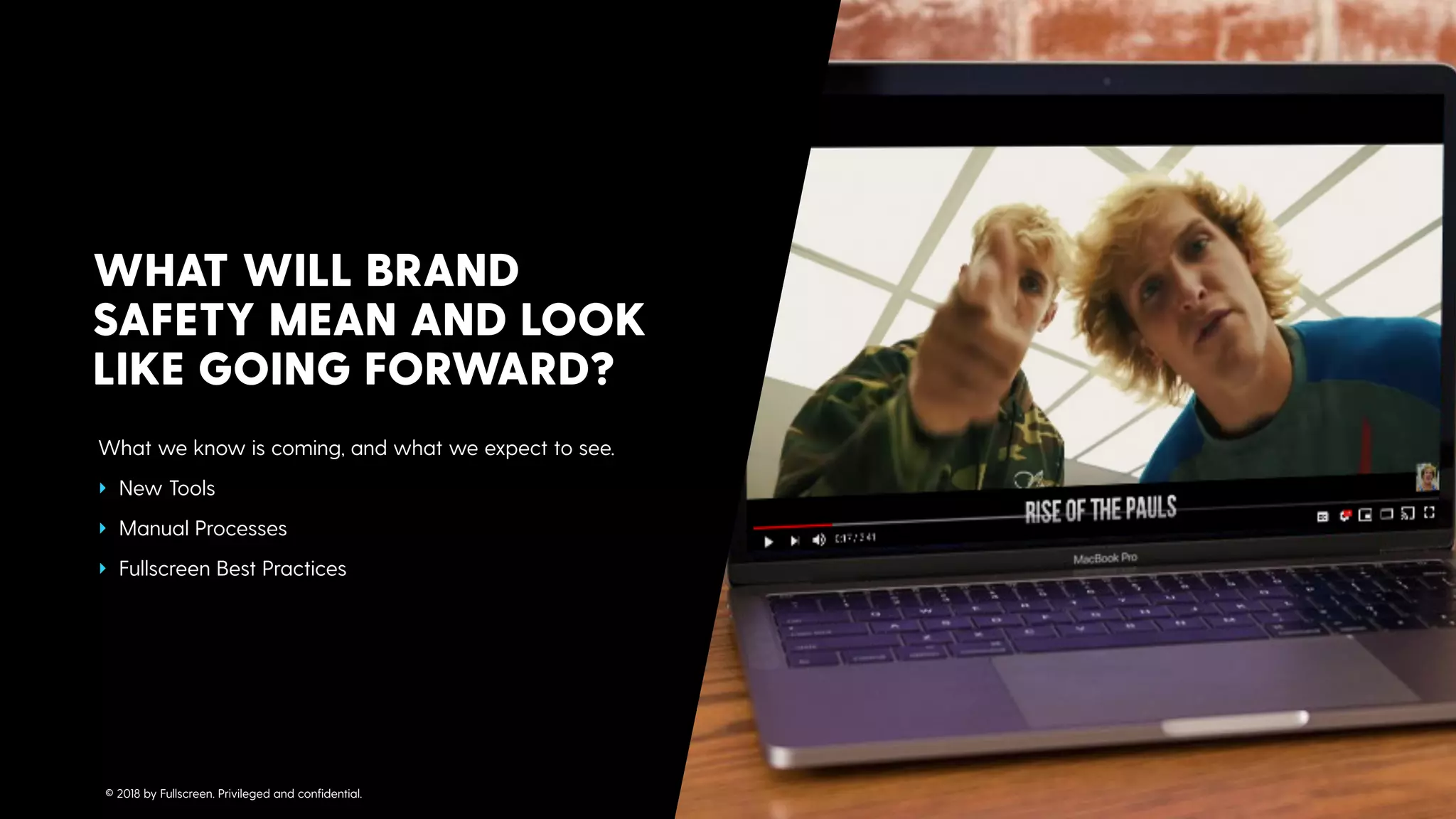
What we know is coming, and what we expect to see.
‣ New Tools
‣ Manual Processes
‣ Fullscreen Best Practices
WHAT WILL BRAND
SAFETY MEAN AND LOOK
LIKE GOING FORWARD?
© 2018 by Fullscreen. Privileged and confidential.
THE CHALLENGE…THE VOLUME OF VIDEO CONTENT IS
TOO LARGE FOR COMPREHENSIVE MANUAL REVIEW.
… [AND] EASY WAYS TO SCAN… ARE RARE.
THE SOLUTION TO THIS CHALLENGE REQUIRES
TECHNOLOGY THAT CAN DETECT CONTENT THAT IS
UNSAFE (SUCH AS THOSE TOPICS RELATED TO DRUGS,
TERRORISM, OR HATE SPEECH) THROUGH A FULL-PAGE
ANALYSIS USING PAGE TEXT AND METADATA AND, IN THE
CASE OF VIDEO PLATFORMS, VISUAL IDENTIFICATION.
– JOHN MONTGOMERY
Global EVP, Brand Safety GroupM
[Source: Moat: Defining Brand Safety-White Paper, September 13, 2017]
“
“
© 2018 by Fullscreen. Privileged and confidential.
RECENT BRAND SAFETY
DEVELOPMENTS
‣ Eligibility requirements for content monetization on YouTube have grown significantly,
increasing the quality threshold required to be included in the YouTube Partner
Program (YPP). Now, only channels with at least 1,000 subscribers and 4,000 watch
hours over the last 12 months will be included.
‣ Google has made a large resource commitment to protect brand safety, as they’ve
promised a huge hiring wave – ultimately, they will have over 10,000 people by the
end of the year.
‣ These hires will be responsible for one of the most impactful changes that Google
has implemented: moving forward, Google Preferred lineup ads will only run on
videos that have been human-verified.
‣ Google is also revising their content filtration settings when targeting ads, allowing for
“conservative”, “standard”, and “edgy” settings, while making the reach implications
clear.
‣ Furthermore, they are promising full transparency by pushing forward integrations
with Integral Ad Science, DoubleVerify, and other independent brand safety tools.
[Source: https://www.iprospect.com/en/us/our-blog/google-youtube-tackle-brand-safety/]© 2018 by Fullscreen. Privileged and confidential.
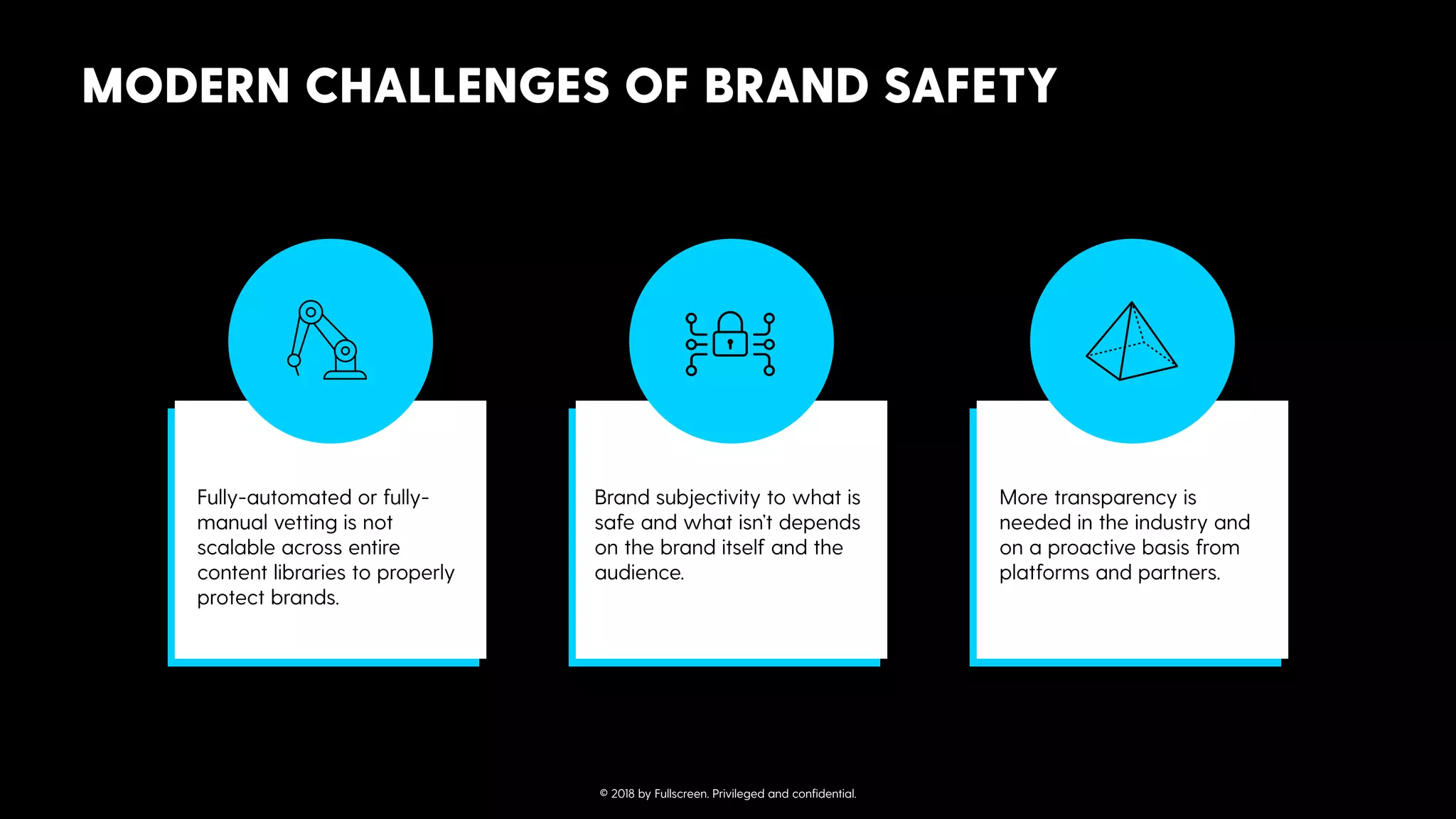
MODERN CHALLENGES OF BRAND SAFETY
Fully-automated or fully-
manual vetting is not
scalable across entire
content libraries to properly
protect brands.
Brand subjectivity to what is
safe and what isn’t depends
on the brand itself and the
audience.
More transparency is
needed in the industry and
on a proactive basis from
platforms and partners.
© 2018 by Fullscreen. Privileged and confidential.
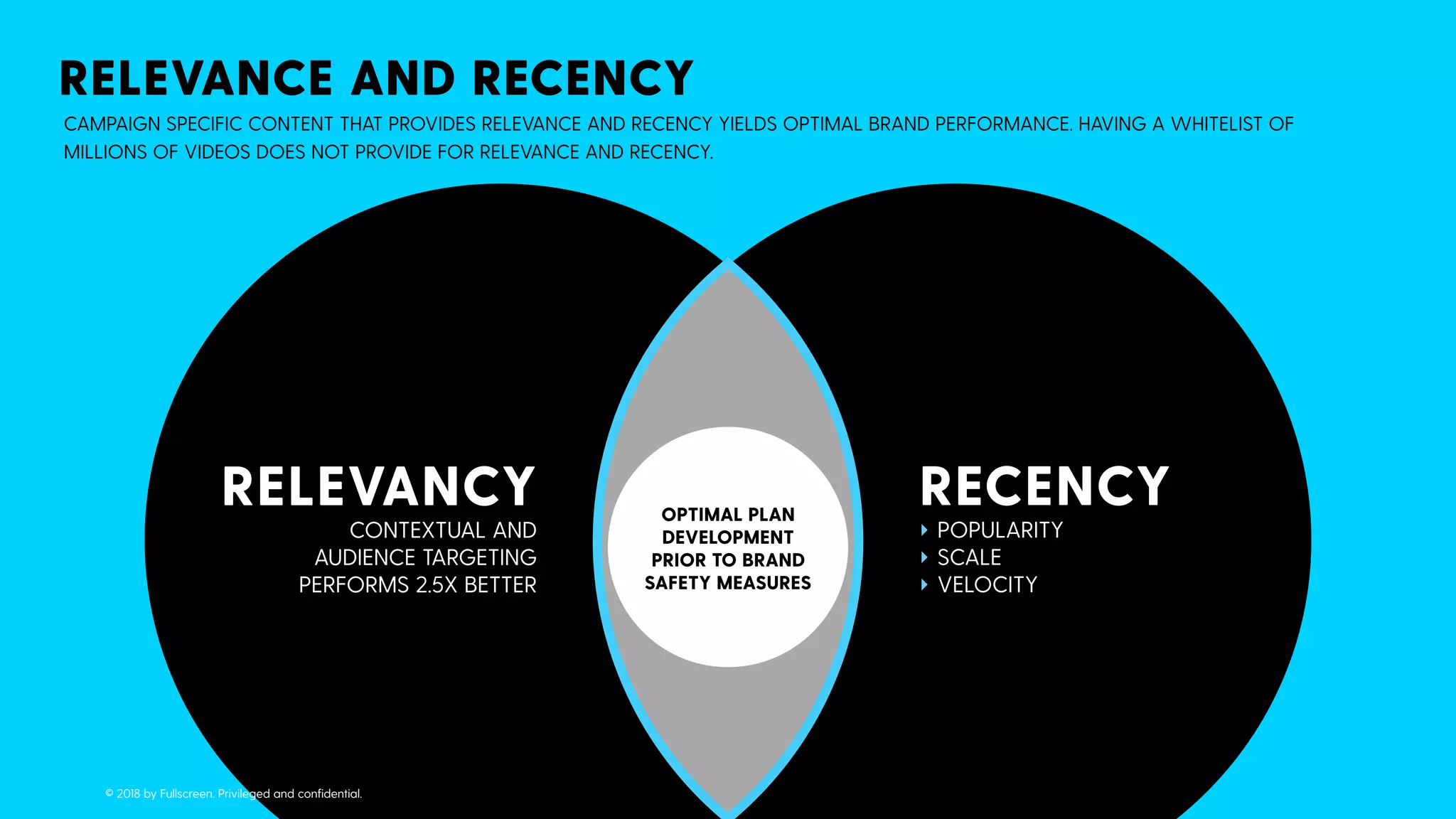
RECENCYRELEVANCY
RELEVANCE AND RECENCY
CAMPAIGN SPECIFIC CONTENT THAT PROVIDES RELEVANCE AND RECENCY YIELDS OPTIMAL BRAND PERFORMANCE. HAVING A WHITELIST OF
MILLIONS OF VIDEOS DOES NOT PROVIDE FOR RELEVANCE AND RECENCY.
OPTIMAL PLAN
DEVELOPMENT
PRIOR TO BRAND
SAFETY MEASURES
‣ POPULARITY
‣ SCALE
‣ VELOCITY
CONTEXTUAL AND
AUDIENCE TARGETING
PERFORMS 2.5X BETTER
© 2018 by Fullscreen. Privileged and confidential.
BRAND SAFETY IS NOT UNIVERSAL
BRAND-SPECIFIC
Brands must define according to
their values and audience.
EXAMPLES
‣ Competitor content
‣ News events
‣ Violent entertainment
UNIVERSAL
Appearing next to unambiguously
unsafe content.
EXAMPLES
‣ Hate speech
‣ Terrorism
‣ Violence and death
WHAT IS IMPORTANT TO YOUR BRAND?
[Source: Moat: Defining Brand Safety-White Paper, September 13, 2017]© 2018 by Fullscreen. Privileged and confidential.
Manual

Review
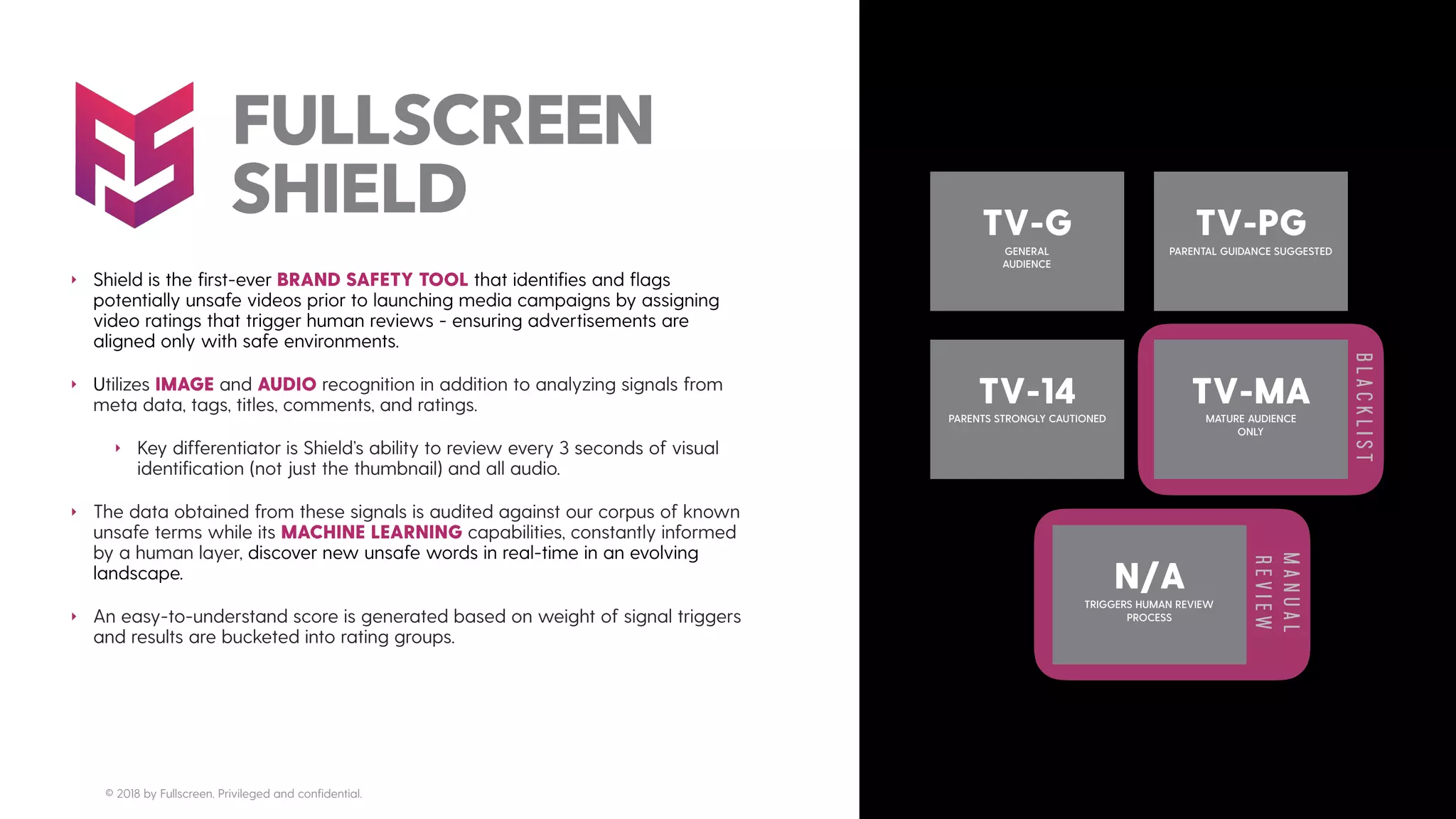
‣ Shield is the first-ever BRAND SAFETY TOOL that identifies and flags
potentially unsafe videos prior to launching media campaigns by assigning
video ratings that trigger human reviews - ensuring advertisements are
aligned only with safe environments.
‣ Utilizes IMAGE and AUDIO recognition in addition to analyzing signals from
meta data, tags, titles, comments, and ratings.
‣ Key differentiator is Shield’s ability to review every 3 seconds of visual
identification (not just the thumbnail) and all audio.
‣ The data obtained from these signals is audited against our corpus of known
unsafe terms while its MACHINE LEARNING capabilities, constantly informed
by a human layer, discover new unsafe words in real-time in an evolving
landscape.
‣ An easy-to-understand score is generated based on weight of signal triggers
and results are bucketed into rating groups.
TV-PG
PARENTAL GUIDANCE SUGGESTED
TV-14
PARENTS STRONGLY CAUTIONED
TV-G
GENERAL 

AUDIENCE
TV-MA
MATURE AUDIENCE 

ONLY
N/A
TRIGGERS HUMAN REVIEW
PROCESS
BLACKLIST
© 2018 by Fullscreen. Privileged and confidential.
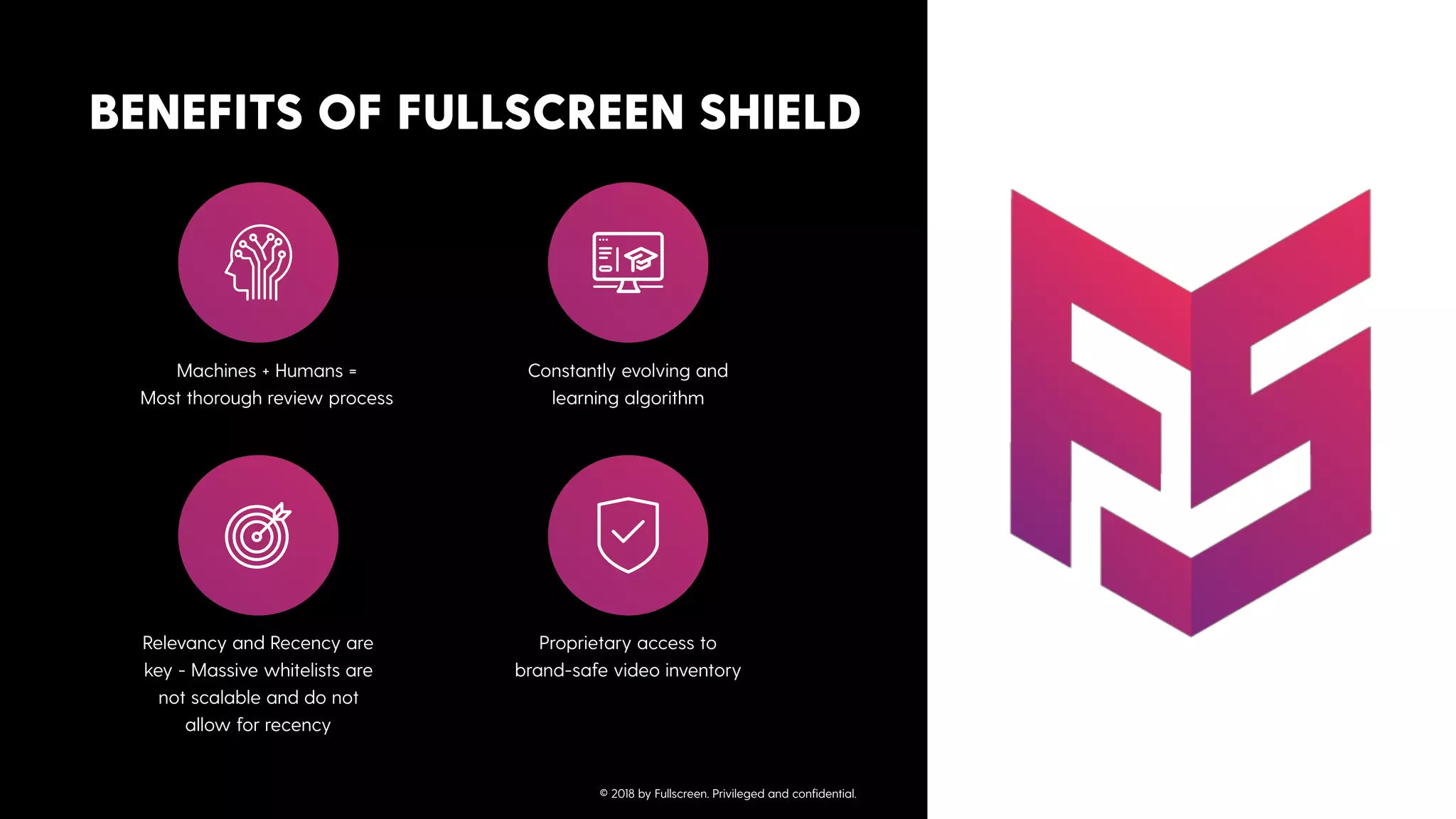
BENEFITS OF FULLSCREEN SHIELD
Machines + Humans =
Most thorough review process
Constantly evolving and
learning algorithm
Relevancy and Recency are
key - Massive whitelists are
not scalable and do not
allow for recency
Proprietary access to
brand-safe video inventory
© 2018 by Fullscreen. Privileged and confidential.
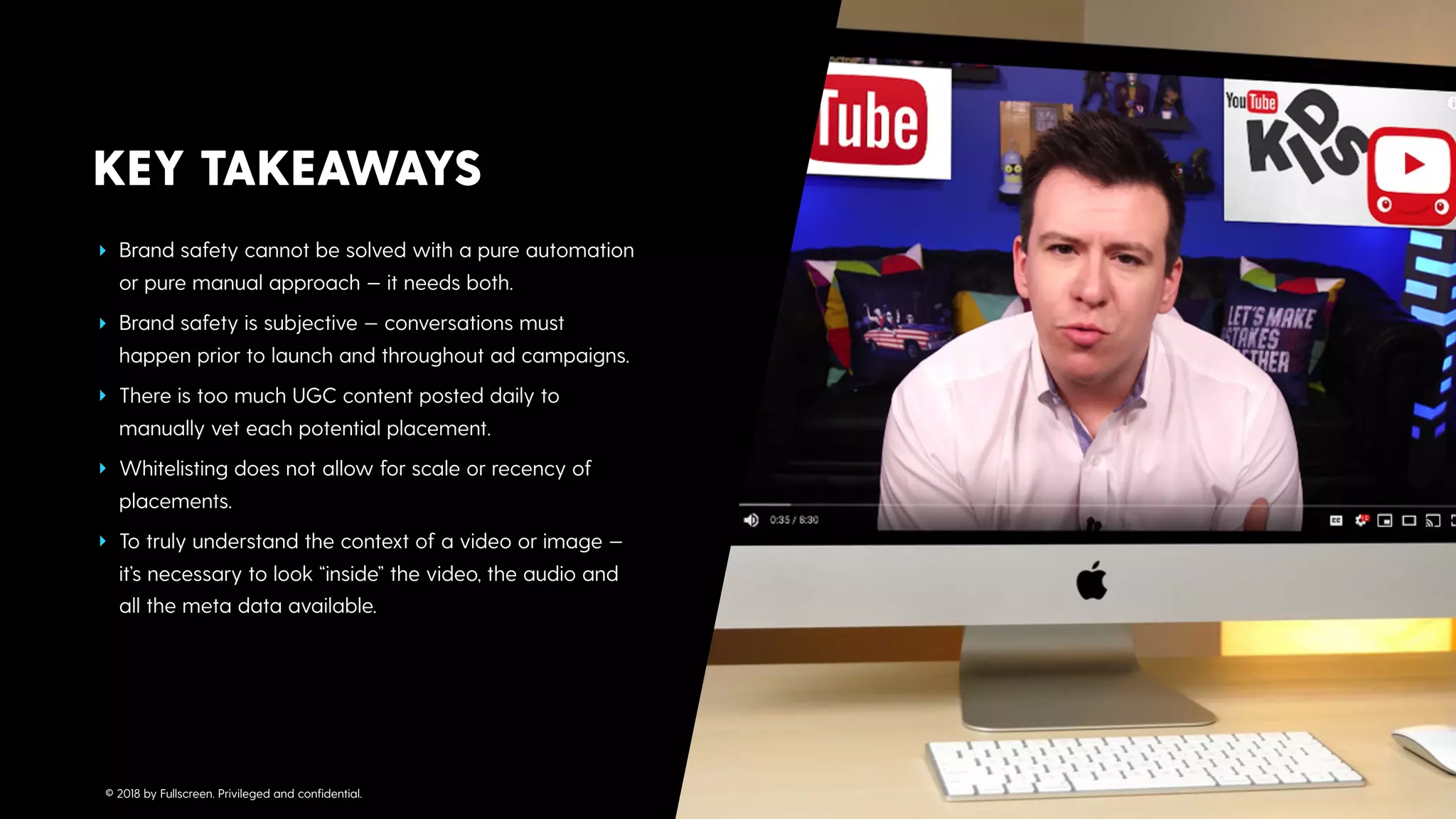
‣ Brand safety cannot be solved with a pure automation
or pure manual approach — it needs both.
‣ Brand safety is subjective — conversations must
happen prior to launch and throughout ad campaigns.
‣ There is too much UGC content posted daily to
manually vet each potential placement.
‣ Whitelisting does not allow for scale or recency of
placements.
‣ To truly understand the context of a video or image —
it’s necessary to look “inside” the video, the audio and
all the meta data available.
KEY TAKEAWAYS
© 2018 by Fullscreen. Privileged and confidential.
WHAT IS BRAND SAFETY
WHAT WE ARE NOT TALKING ABOUT, BUT HOW IS IT RELATED?
Fake news has become highly
politicized the last several years.
Although the battle in mitigating
fake news is not the same as
ensuring brand safety, it is related.
If ads show up on or next to
stories that are revealed to be
fake news, or are even accused
of being fake news, it can be
harmful for brands. This adds a
huge layer of complexity to
ensuring brands are being safe.
FAKE NEWS
The GDPR was implemented as a
result of brands overreaching and
platforms oversharing. It directly
impacted the businesses that
relied on certain demographic
and behavioral targeting. This
inability to target in certain ways,
although somewhat helpful in the
long run, makes brand safety
assurance even more difficult as
brands try to find work-around
targeting tactics.
GDPR
Many influencers and publishers
saw less monetization on their
videos in the last year. This is due
to platform updates that are
working towards rewarding
people that produce successful,
brand-safe content. Publishers
and influencers reliant on this
revenue that weren’t deemed
brand-safe took a hit. Although
this does not fix the issue of
brand safety, it changes the
environment and encourages the
creation of brand-safe content.
DEMONETIZATION
Many platforms and 3rd party
tools have added updates to
whitelist/blacklists channels,
pages or videos directly. These
updates are the first steps to aide
in brand safety but are not the
long term solution as the nuances
are specific to each brand.
PLATFORM CHANGES
© 2018 by Fullscreen. Privileged and confidential.
THANK YOU
FOR MORE INFORMATION, PLEASE CONTACT:
MARK WILLIAMS - MARK.WILLIAMS@FULLSCREEN.COM
© 2018 by Fullscreen. Privileged and confidential.

Safety First: How to Approach and Execute Safe Media Buying Online

  • 1.
    SAFETY FIRST: HOWTO APPROACH AND EXECUTE SAFE MEDIA BUYING ONLINE 2 0 1 8 + © 2018 by Fullscreen. Privileged and confidential.
  • 2.
    The evolution ofbrand safety can be attributed to the technological advancements in media placement. Here’s what we’ll cover: WHAT IS BRAND SAFETY AND WHY DOES IT MATTER? ‣ The History: From Print To Programmatic ‣ What’s Changed: Alignment, Context, and Semantics ‣ What’s Available: Controls, Risks, and Rewards ‣ The Future: Why Transparency Is Key © 2018 by Fullscreen. Privileged and confidential.
  • 3.
    SUB-SECTION TITLE CAN GOON TWO LINES THE HISTORY © 2018 by Fullscreen. Privileged and confidential.
  • 4.
    BRAND SAFETY CHALLENGES EXISTEDLONG BEFORE THE INTERNET. “ “ © 2018 by Fullscreen. Privileged and confidential.
  • 5.
    HISTORY OF BRANDSAFETY HOW WE GOT HERE Ads started to appear in newspapers. Human judgment was used to determine ad placement. FIRST AD APPEARS 
 IN A NEWSPAPER 1704 18941891 1941 1994 With ad agencies starting to open, the responsibility of brand safety and proper curation at scale had a consolidated place to live. FIRST AD 
 AGENCY OPENS Brands now started to have more characteristics that made ad placement complicated due to brand alignment needs. This made brand safety more challenging to manage. BRAND IDENTITIES 
 START TO FORM Ads started appearing in family living rooms in- between shows and sometimes featured in shows or broadcast news segments. FIRST TV 
 COMMERCIAL APPEARS This first banner ad from AT&T showed you all the places you could go with the internet. This opened the door for the endless possibilities that have led to the complicated brand safety world we live in today. FIRST AD ON THE INTERNET © 2018 by Fullscreen. Privileged and confidential.
  • 6.
    HISTORY OF BRANDSAFETY According to CNNMoney, pre-roll ads from companies like Procter & Gamble (Swiffer), Anheuser-Busch (Bud Light), and Johnson & Johnson (Aveeno) were placed before ISIS propaganda videos and jihad-themed videos. ADS BEFORE ISIS VIDEOS STARTED SHOWING UP MAR 2015 Havas Media, one of the largest European advertising and marketing firms, decided to pull all YouTube UK spending after their ads were spotted on ISIS recruitment videos. A week later some of the biggest US advertisers followed, pausing all non-search Google advertising, including AT&T, Dish, FX, Networks, General Motors, J&J, McDonalds, PepsiCo, Starbucks, Verizon, Walmart, and more. ADS SHOW UP AGAIN ON EXTREMIST VIDEOS OF MAJOR BRANDS LEADING TO YOUTUBE BOYCOTT YouTube’s first attempt to limit monetization on unsafe content for kids. However, this backfired with LGBTQ influencers now seeing their content hidden as the platform quickly deemed channels “unsafe”. YOUTUBE UPDATED POLICIES FOR CREATORS On May 25, 2018 the General Data Protection Regulation went into place in the EU. Although this is not directly tied to Brand Safety it is the first major step in government agencies getting involved in data regulation online. Sunsetting the ability of demographic and behavioral targeting makes brand safety more challenging. This is forcing advertisers and marketers to be more innovative than ever. GENERAL DATA
 PROTECTION REGULATION Although most brands returned to running ads on YouTube and elsewhere online, many major players are still boycotting. This lack of confidence in brand safety is due to the fact that no one solution can guarantee the unknowns that come with safety concerns. Marketing and technology companies must come up with solutions that allow a scale for human judgment. BRANDS STILL BOYCOTTING MAR 2017 NOV 2017 MAY 2018 TODAY WHERE WE ARE TODAY © 2018 by Fullscreen. Privileged and confidential.
  • 7.
    BRAND SAFETY INTERMS OF BRAND ALIGNMENT BRAND SAFETY IN TERMS OF BOT TRAFFIC AND FAKE FOLLOWERS TWO MAIN CATEGORIES © 2018 by Fullscreen. Privileged and confidential.
  • 8.
    Changes in technologyhave allowed us to target very specific audiences and content.
 
 These same technological advancements have created new concerns for brands as our understanding of where an ad is placed and what that environment might look like has become much more dynamic and complex. BRAND ALIGNMENT EXAMPLE © 2018 by Fullscreen. Privileged and confidential.
  • 9.
    THE BRAND SAFETYBASICS Aligning your brand with popular content can help to increase visibility and targeted recall. If executed improperly, this can also lead to catastrophic failure. Alignment is primarily about location. ‣ Insurance and Disasters ‣ Luxury Brands and Luxury Events ‣ Sports and Alcohol ALIGNMENT Contextual targeting takes brand alignments one step further by thinking about the tone and opportunity to adjust or integrate your brand story for a specific time and place. ‣ Memorial ‣ Celebratory ‣ Curated CONTEXT As we move from basic alignments to more advanced contextual targeting and messaging, we run the risk of misunderstanding the context. Semantics reference the variations of meaning behind contextual touch points. ‣ Jaguar Car vs. Jaguar Cat ‣ Stock Market Crash vs. Car Crash ‣ Woman’s Purse vs. Racing Purse SEMANTICS © 2018 by Fullscreen. Privileged and confidential.
  • 10.
    SUB-SECTION TITLE CAN GOON TWO LINES WHAT’S CHANGED © 2018 by Fullscreen. Privileged and confidential.
  • 11.
    THE WORLD HAS CHANGED 400hours of video are uploaded to YouTube every MINUTE Daily Active YouTube users VIDEOS WATCHED A DAY 5B 3 0 M I L L I O N [Source : https://www.omnicoreagency.com/youtube-statistics/]© 2018 by Fullscreen. Privileged and confidential.
  • 12.
    TRANSPARENCY IS EVERYTHING. IFWE CAN’T SEE IT, MEASURE IT, OR REPORT IT, WE CANNOT CONTROL IT. “ “ © 2018 by Fullscreen. Privileged and confidential.
  • 13.
    AS THE MEDIA MARKETPLACEEVOLVES, 
 WE SEE BOTH INCREASED RISK AND REWARD, BUT ALSO A DECREASE IN TRANSPARENCY © 2018 by Fullscreen. Privileged and confidential.
  • 14.
    THESE CHANGES INOUR BUYING METHODOLOGIES EFFECT THE AVAILABLE CONTROLS AND POTENTIAL RISK ‣ Publisher/Paper ‣ Section of Paper ‣ Location In Section ‣ Context and Competition PRINT ‣ Publisher/Website ‣ Section of Site ‣ Location In Section ‣ Context and Competition PUBLISHER DIRECT DIGITAL MEDIA ‣ Demographics ‣ Psychographics ‣ Rate ‣ Desired Outcome ‣ Whitelist/Blacklist ‣ Negative and Positive Targeting PROGRAMMATIC DIGITAL MEDIA ‣ Demographics ‣ Psychographics ‣ Rate ‣ Desired Outcome ‣ Negative and Positive Targeting SOCIAL MEDIA © 2018 by Fullscreen. Privileged and confidential.
  • 15.
    Social media platformshave changed the game.
 With user-generated content and a limited understanding of each unique user’s experience on site/application, we often don’t even know what content ads are aligned with or who is actually engaging with them.
 These are just a few of many unknown unknowns. HAVE WE FULLY RECOGNIZED THE RISK? © 2018 by Fullscreen. Privileged and confidential.
  • 16.
    SUB-SECTION TITLE CAN GOON TWO LINES WHAT’S AVAILABLE © 2018 by Fullscreen. Privileged and confidential.
  • 17.
    An increased focusfor brands, a reduced appetite for risk, a marketplace full of new controls. ‣ Available Tools and Services ‣ Limitations and Unknowns WHAT IS THE STATE 
 OF BRAND SAFETY TODAY? © 2018 by Fullscreen. Privileged and confidential.
  • 18.
    BRAND SAFETY TODAY BrandSafety is a fast-moving segment of the media industry and some solutions have become commonplace. AVAILABLE TOOLS AND SERVICES While many advanced tools are now available, they all still have various limitations. The more complex the content, the more difficult this becomes. LIMITATIONS When entering more dynamic landscapes such as social media or video content, whereby advertisers often cannot control user engagement, we don’t always know where things may go wrong. UNKNOWNS © 2018 by Fullscreen. Privileged and confidential.
  • 19.
    THERE IS MORETHAN ONE PATH TO BRAND SAFETY © 2018 by Fullscreen. Privileged and confidential.
  • 20.
    SUB-SECTION TITLE CAN GOON TWO LINES THE FUTURE © 2018 by Fullscreen. Privileged and confidential.
  • 21.
    What we knowis coming, and what we expect to see. ‣ New Tools ‣ Manual Processes ‣ Fullscreen Best Practices WHAT WILL BRAND SAFETY MEAN AND LOOK LIKE GOING FORWARD? © 2018 by Fullscreen. Privileged and confidential.
  • 22.
    THE CHALLENGE…THE VOLUMEOF VIDEO CONTENT IS TOO LARGE FOR COMPREHENSIVE MANUAL REVIEW. … [AND] EASY WAYS TO SCAN… ARE RARE. THE SOLUTION TO THIS CHALLENGE REQUIRES TECHNOLOGY THAT CAN DETECT CONTENT THAT IS UNSAFE (SUCH AS THOSE TOPICS RELATED TO DRUGS, TERRORISM, OR HATE SPEECH) THROUGH A FULL-PAGE ANALYSIS USING PAGE TEXT AND METADATA AND, IN THE CASE OF VIDEO PLATFORMS, VISUAL IDENTIFICATION. – JOHN MONTGOMERY Global EVP, Brand Safety GroupM [Source: Moat: Defining Brand Safety-White Paper, September 13, 2017] “ “ © 2018 by Fullscreen. Privileged and confidential.
  • 23.
    RECENT BRAND SAFETY DEVELOPMENTS ‣Eligibility requirements for content monetization on YouTube have grown significantly, increasing the quality threshold required to be included in the YouTube Partner Program (YPP). Now, only channels with at least 1,000 subscribers and 4,000 watch hours over the last 12 months will be included. ‣ Google has made a large resource commitment to protect brand safety, as they’ve promised a huge hiring wave – ultimately, they will have over 10,000 people by the end of the year. ‣ These hires will be responsible for one of the most impactful changes that Google has implemented: moving forward, Google Preferred lineup ads will only run on videos that have been human-verified. ‣ Google is also revising their content filtration settings when targeting ads, allowing for “conservative”, “standard”, and “edgy” settings, while making the reach implications clear. ‣ Furthermore, they are promising full transparency by pushing forward integrations with Integral Ad Science, DoubleVerify, and other independent brand safety tools. [Source: https://www.iprospect.com/en/us/our-blog/google-youtube-tackle-brand-safety/]© 2018 by Fullscreen. Privileged and confidential.
  • 24.
    MODERN CHALLENGES OFBRAND SAFETY Fully-automated or fully- manual vetting is not scalable across entire content libraries to properly protect brands. Brand subjectivity to what is safe and what isn’t depends on the brand itself and the audience. More transparency is needed in the industry and on a proactive basis from platforms and partners. © 2018 by Fullscreen. Privileged and confidential.
  • 25.
    RECENCYRELEVANCY RELEVANCE AND RECENCY CAMPAIGNSPECIFIC CONTENT THAT PROVIDES RELEVANCE AND RECENCY YIELDS OPTIMAL BRAND PERFORMANCE. HAVING A WHITELIST OF MILLIONS OF VIDEOS DOES NOT PROVIDE FOR RELEVANCE AND RECENCY. OPTIMAL PLAN DEVELOPMENT PRIOR TO BRAND SAFETY MEASURES ‣ POPULARITY ‣ SCALE ‣ VELOCITY CONTEXTUAL AND AUDIENCE TARGETING PERFORMS 2.5X BETTER © 2018 by Fullscreen. Privileged and confidential.
  • 26.
    BRAND SAFETY ISNOT UNIVERSAL BRAND-SPECIFIC Brands must define according to their values and audience. EXAMPLES ‣ Competitor content ‣ News events ‣ Violent entertainment UNIVERSAL Appearing next to unambiguously unsafe content. EXAMPLES ‣ Hate speech ‣ Terrorism ‣ Violence and death WHAT IS IMPORTANT TO YOUR BRAND? [Source: Moat: Defining Brand Safety-White Paper, September 13, 2017]© 2018 by Fullscreen. Privileged and confidential.
  • 27.
    Manual
 Review ‣ Shield isthe first-ever BRAND SAFETY TOOL that identifies and flags potentially unsafe videos prior to launching media campaigns by assigning video ratings that trigger human reviews - ensuring advertisements are aligned only with safe environments. ‣ Utilizes IMAGE and AUDIO recognition in addition to analyzing signals from meta data, tags, titles, comments, and ratings. ‣ Key differentiator is Shield’s ability to review every 3 seconds of visual identification (not just the thumbnail) and all audio. ‣ The data obtained from these signals is audited against our corpus of known unsafe terms while its MACHINE LEARNING capabilities, constantly informed by a human layer, discover new unsafe words in real-time in an evolving landscape. ‣ An easy-to-understand score is generated based on weight of signal triggers and results are bucketed into rating groups. TV-PG PARENTAL GUIDANCE SUGGESTED TV-14 PARENTS STRONGLY CAUTIONED TV-G GENERAL 
 AUDIENCE TV-MA MATURE AUDIENCE 
 ONLY N/A TRIGGERS HUMAN REVIEW PROCESS BLACKLIST © 2018 by Fullscreen. Privileged and confidential.
  • 28.
    BENEFITS OF FULLSCREENSHIELD Machines + Humans = Most thorough review process Constantly evolving and learning algorithm Relevancy and Recency are key - Massive whitelists are not scalable and do not allow for recency Proprietary access to brand-safe video inventory © 2018 by Fullscreen. Privileged and confidential.
  • 29.
    ‣ Brand safetycannot be solved with a pure automation or pure manual approach — it needs both. ‣ Brand safety is subjective — conversations must happen prior to launch and throughout ad campaigns. ‣ There is too much UGC content posted daily to manually vet each potential placement. ‣ Whitelisting does not allow for scale or recency of placements. ‣ To truly understand the context of a video or image — it’s necessary to look “inside” the video, the audio and all the meta data available. KEY TAKEAWAYS © 2018 by Fullscreen. Privileged and confidential.
  • 30.
    WHAT IS BRANDSAFETY WHAT WE ARE NOT TALKING ABOUT, BUT HOW IS IT RELATED? Fake news has become highly politicized the last several years. Although the battle in mitigating fake news is not the same as ensuring brand safety, it is related. If ads show up on or next to stories that are revealed to be fake news, or are even accused of being fake news, it can be harmful for brands. This adds a huge layer of complexity to ensuring brands are being safe. FAKE NEWS The GDPR was implemented as a result of brands overreaching and platforms oversharing. It directly impacted the businesses that relied on certain demographic and behavioral targeting. This inability to target in certain ways, although somewhat helpful in the long run, makes brand safety assurance even more difficult as brands try to find work-around targeting tactics. GDPR Many influencers and publishers saw less monetization on their videos in the last year. This is due to platform updates that are working towards rewarding people that produce successful, brand-safe content. Publishers and influencers reliant on this revenue that weren’t deemed brand-safe took a hit. Although this does not fix the issue of brand safety, it changes the environment and encourages the creation of brand-safe content. DEMONETIZATION Many platforms and 3rd party tools have added updates to whitelist/blacklists channels, pages or videos directly. These updates are the first steps to aide in brand safety but are not the long term solution as the nuances are specific to each brand. PLATFORM CHANGES © 2018 by Fullscreen. Privileged and confidential.
  • 31.
    THANK YOU FOR MOREINFORMATION, PLEASE CONTACT: MARK WILLIAMS - MARK.WILLIAMS@FULLSCREEN.COM © 2018 by Fullscreen. Privileged and confidential.