Four
Areas
Marketers
Can Implement
Neuroscience
to Improve Results
Neuroscience, with its ability to help marketers decode the
way the human brain responds to marketing input, appears
poised to shift how marketers reach consumers. Though this
technology remains avant-garde in the marketing industry,
early-adopter businesses have found using neuroscience is
a big contributor to the bottom line. In fact, a recent study
found that brands that attributed revenue growth to the use of
neuroscience said that the technology contributed, on average,
a 16 percent increase in revenue. If you’re ready to begin
uncovering deeper, more salient data points using neuroscience
technology, read on for four areas where marketers can
implement this futuristic technology with relative ease.
1
Optimizing the
Color of your Ads
4© Copyright 2019 by the Association of National Advertisers, Inc. All rights reserved.
You probably know the colors of your ads are important, but do
you realize just how important? Research shows 85 percent of
consumers place color as the primary factor in their purchase
decisions. More than texture, sound, or smell, visual stimuli
are what draw in consumers and convert them into customers
for your brand. Knowing this, it is incumbent on marketers
to dig into neuroscience research to find which colors illicit
what emotional responses in people and then cater your ad
coloration to the types of people you are targeting.
2
Brand
Building
Through
Audio
6© Copyright 2019 by the Association of National Advertisers, Inc. All rights reserved.
The sound of brands dates back to the first jingle, composed
in the early 20th century. But now, as voice search becomes
more prominent, understanding both the sound of your brand’s
voice and the styles of music you should incorporate in ads is
becoming that much more important. Luckily, neuroscience
can help you identify which sounds are right for your brand.
Like colors, different sounds/songs attract different types of
people. So take some time and figure out which sounds your
key demographics prefer and hone in on them.
3
Right Fonts
Picking the
8© Copyright 2019 by the Association of National Advertisers, Inc. All rights reserved.
Like colors and audio, the style of font you use in your ads
is also going to be crucial in shaping consumer perceptions.
Choose a font that is too cartoonish and consumers may
find your brand to be sillier than you intended. Conversely, a
stoic font can illicit an air of stuffiness that can also put off
consumers. Using neuroscience and focus groups, you can
now determine which fonts are ideal for your target audiences.
Have different font preferences for different target demos? You
can use martech to cater each ad to its intended demographic,
ensuring you’re always hitting the right segment with the right
style of font to win them over.
4
Emotional
Response to
Storytelling
10© Copyright 2019 by the Association of National Advertisers, Inc. All rights reserved.
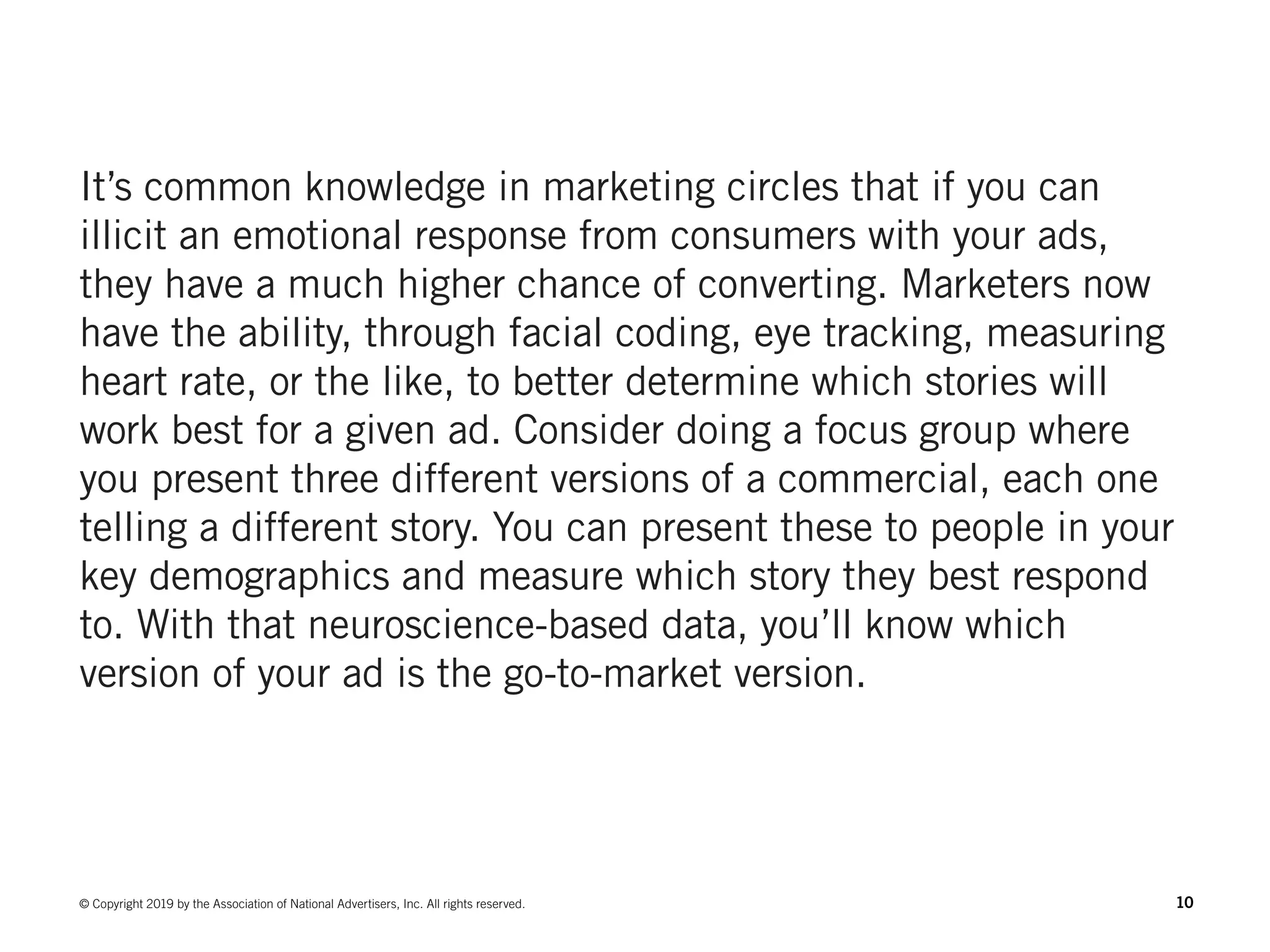
It’s common knowledge in marketing circles that if you can
illicit an emotional response from consumers with your ads,
they have a much higher chance of converting. Marketers now
have the ability, through facial coding, eye tracking, measuring
heart rate, or the like, to better determine which stories will
work best for a given ad. Consider doing a focus group where
you present three different versions of a commercial, each one
telling a different story. You can present these to people in your
key demographics and measure which story they best respond
to. With that neuroscience-based data, you’ll know which
version of your ad is the go-to-market version.
Want to learn more about how your team
can utilize consumer neuroscience?
Our Marketing Knowledge Center can help with that:
Marketing Futures Research Report: Neuroscience
The Future of Consumer Neuroscience:
Bridging the Gap Between Education and Adoption
Marriott International: How to Leverage Neuroscience
to Drive Guest Engagement
Shorter, Better, Cheaper? Neuroscience Can Do That
Surfing the Brainwaves

Four Areas Marketers Can Implement Neuroscience to Improve Results

  • 1.
  • 2.
    Neuroscience, with itsability to help marketers decode the way the human brain responds to marketing input, appears poised to shift how marketers reach consumers. Though this technology remains avant-garde in the marketing industry, early-adopter businesses have found using neuroscience is a big contributor to the bottom line. In fact, a recent study found that brands that attributed revenue growth to the use of neuroscience said that the technology contributed, on average, a 16 percent increase in revenue. If you’re ready to begin uncovering deeper, more salient data points using neuroscience technology, read on for four areas where marketers can implement this futuristic technology with relative ease.
  • 3.
  • 4.
    4© Copyright 2019by the Association of National Advertisers, Inc. All rights reserved. You probably know the colors of your ads are important, but do you realize just how important? Research shows 85 percent of consumers place color as the primary factor in their purchase decisions. More than texture, sound, or smell, visual stimuli are what draw in consumers and convert them into customers for your brand. Knowing this, it is incumbent on marketers to dig into neuroscience research to find which colors illicit what emotional responses in people and then cater your ad coloration to the types of people you are targeting.
  • 5.
  • 6.
    6© Copyright 2019by the Association of National Advertisers, Inc. All rights reserved. The sound of brands dates back to the first jingle, composed in the early 20th century. But now, as voice search becomes more prominent, understanding both the sound of your brand’s voice and the styles of music you should incorporate in ads is becoming that much more important. Luckily, neuroscience can help you identify which sounds are right for your brand. Like colors, different sounds/songs attract different types of people. So take some time and figure out which sounds your key demographics prefer and hone in on them.
  • 7.
  • 8.
    8© Copyright 2019by the Association of National Advertisers, Inc. All rights reserved. Like colors and audio, the style of font you use in your ads is also going to be crucial in shaping consumer perceptions. Choose a font that is too cartoonish and consumers may find your brand to be sillier than you intended. Conversely, a stoic font can illicit an air of stuffiness that can also put off consumers. Using neuroscience and focus groups, you can now determine which fonts are ideal for your target audiences. Have different font preferences for different target demos? You can use martech to cater each ad to its intended demographic, ensuring you’re always hitting the right segment with the right style of font to win them over.
  • 9.
  • 10.
    10© Copyright 2019by the Association of National Advertisers, Inc. All rights reserved. It’s common knowledge in marketing circles that if you can illicit an emotional response from consumers with your ads, they have a much higher chance of converting. Marketers now have the ability, through facial coding, eye tracking, measuring heart rate, or the like, to better determine which stories will work best for a given ad. Consider doing a focus group where you present three different versions of a commercial, each one telling a different story. You can present these to people in your key demographics and measure which story they best respond to. With that neuroscience-based data, you’ll know which version of your ad is the go-to-market version.
  • 11.
    Want to learnmore about how your team can utilize consumer neuroscience? Our Marketing Knowledge Center can help with that: Marketing Futures Research Report: Neuroscience The Future of Consumer Neuroscience: Bridging the Gap Between Education and Adoption Marriott International: How to Leverage Neuroscience to Drive Guest Engagement Shorter, Better, Cheaper? Neuroscience Can Do That Surfing the Brainwaves