SAFETY
ENGINEERING…..
By: Majane Padua
SECURITY PERSONNEL
A person who are employed to
protect people and property
They can assists safety engineers by
reporting safety hazards which they
detect during duty hours.
Ex .
Security guard, security officer etc.
Security Personnel Safety Checks
 Blocked lanes for emergency vehicles
Blocked emergency exits and passage to exits
Unlocked doors or gates to hazardous areas
Obstructed fire doors or escapes
check loose wires, piping, metal or
materials, and equipment which pose
tripping hazards
Check wet, oily or heavy wax floors which
pose slipping hazards
Check broken electrical fittings, outlets,
plugs, and other devices
Unprotected sharp points edges or broken
glasses
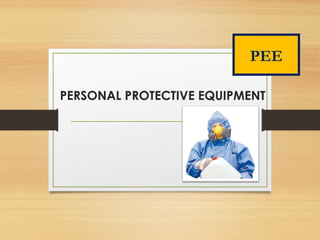
PERSONAL PROTECTIVE EQUIPMENT
PEE
Personal Protective
Equipment
Definition
-is any safety equipment
workers wear to prevent injury in the
workplace
Is This An Appropriate
Hard Hat?
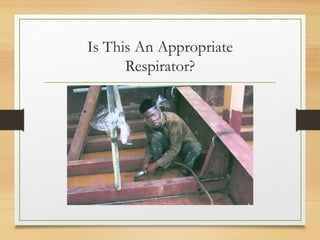
Is This An Appropriate
Respirator?
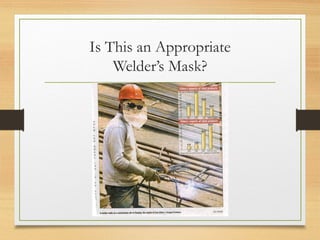
Is This an Appropriate
Welder’s Mask?
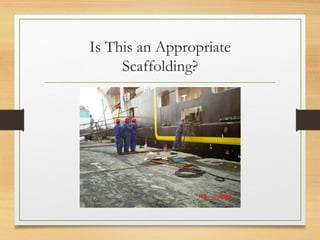
Is This an Appropriate
Scaffolding?
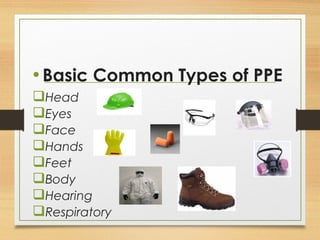
•Basic Common Types of PPE
Head
Eyes
Face
Hands
Feet
Body
Hearing
Respiratory
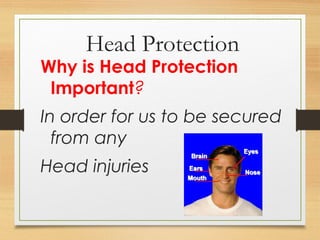
Head Protection
Why is Head Protection
Important?
In order for us to be secured
from any
Head injuries
Head Protection
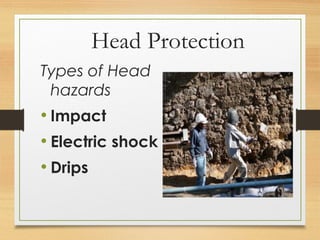
Types of Head
hazards
• Impact
• Electric shock
• Drips
Head Protection
Head Hazards
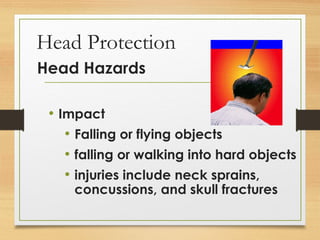
• Impact
• Falling or flying objects
• falling or walking into hard objects
• injuries include neck sprains,
concussions, and skull fractures
Head Protection
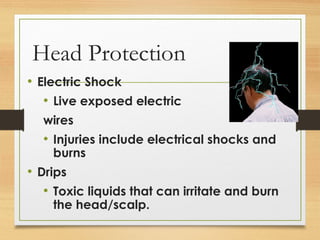
• Electric Shock
• Live exposed electric
wires
• Injuries include electrical shocks and
burns
• Drips
• Toxic liquids that can irritate and burn
the head/scalp.
Exposed Workers Need HEAD
PROTECTION
construction workers
 carpenters
 electricians
 linemen
plumbers
Pipefitters
 timber
 log cutters
 welders & among many others
Head Protection
Types of Head PPE
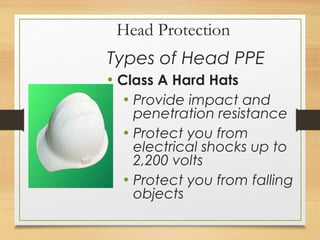
• Class A Hard Hats
• Provide impact and
penetration resistance
• Protect you from
electrical shocks up to
2,200 volts
• Protect you from falling
objects
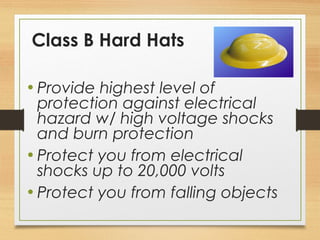
Class B Hard Hats
• Provide highest level of
protection against electrical
hazard w/ high voltage shocks
and burn protection
• Protect you from electrical
shocks up to 20,000 volts
• Protect you from falling objects
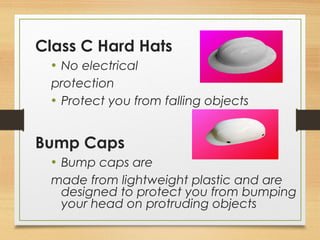
Class C Hard Hats
• No electrical
protection
• Protect you from falling objects
Bump Caps
• Bump caps are
made from lightweight plastic and are
designed to protect you from bumping
your head on protruding objects
Proper use and care of hard hat
• Always wear your hard hat while
you are working in areas where
there are potential head hazards
• Adjust the suspension inside your
hard hat so that the hat sits
comfortably, but securely on your
head
•Inspect the shell of your
hard hat for
cracks, gouges, and
dents. Inspect the
suspension system for
frayed or broken straps.
•Never paint, scratch or drill
"air holes" in your hard hat
•Never carry personal
belongings such
as cigarettes, lighters, or pens
in your hard hat
Eye Protection
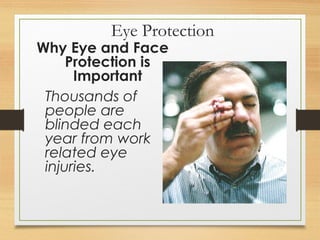
Why Eye and Face
Protection is
Important
Thousands of
people are
blinded each
year from work
related eye
injuries.
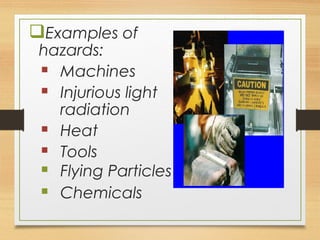
Examples of
hazards:
 Machines
 Injurious light
radiation
 Heat
 Tools
 Flying Particles
 Chemicals
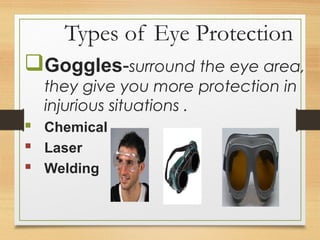
Types of Eye Protection
Goggles-surround the eye area,
they give you more protection in
injurious situations .
 Chemical
 Laser
 Welding
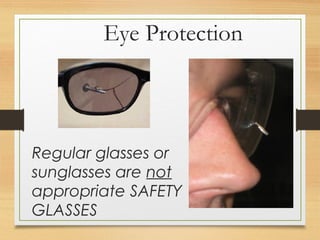
Eye Protection
Regular glasses or
sunglasses are not
appropriate SAFETY
GLASSES
Elimination or Control of Hazards
•Safe work training
•Read and follow all warnings
and precautions that may be
found on equipment and
hazardous materials
•Keep sharp or pointed objects
away from your eyes
• Follow your supervisor's or
safety manager's suggestions
and recommendations
for working 
safely
FACE PROTECTION
Needed when work presents the potential of
causing facial injury from physical, chemical, or
radiation agents.
Examples of hazards:
 Contents under pressure
 Splash hazard
 Flying objects / particles
 Electrical work
Face Protection
Types of Face
Personal Protective
Equipment
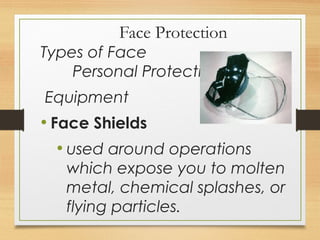
• Face Shields
• used around operations
which expose you to molten
metal, chemical splashes, or
flying particles.
Face Protection
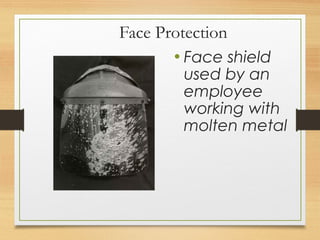
• Face shield
used by an
employee
working with
molten metal
Face Protection
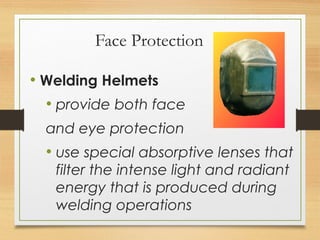
• Welding Helmets
• provide both face
and eye protection
• use special absorptive lenses that
filter the intense light and radiant
energy that is produced during
welding operations
Hand Protection
Why is Hand
Protection
Important?
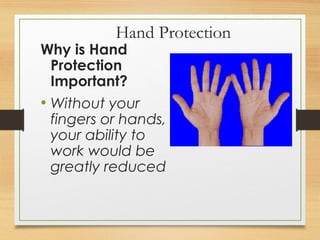
• Without your
fingers or hands,
your ability to
work would be
greatly reduced
Hand Protection
Types of Hand Hazards
• Traumatic Injuries
• Contact Injuries
• Repetitive Motion Injuries
Hand Protection
Potential Incidences
of Hand Hazards
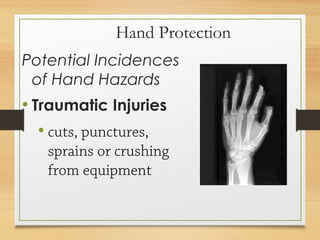
• Traumatic Injuries
• cuts, punctures,
sprains or crushing
from equipment
Hand Protection
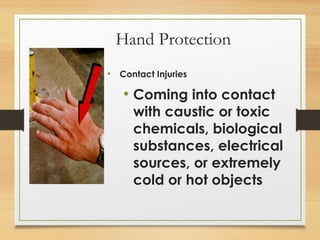
• Contact Injuries
• Coming into contact
with caustic or toxic
chemicals, biological
substances, electrical
sources, or extremely
cold or hot objects
• Repetitive Motion Injuries
Whenever you
repeat the same
hand movement
over a long period of
time, you run the risk
of repetitive motion
problems
Hand Protection
• Never wear gloves around powered
rotating equipment - drills, lathes, etc.
Hand Protection
Types of Hand PPE
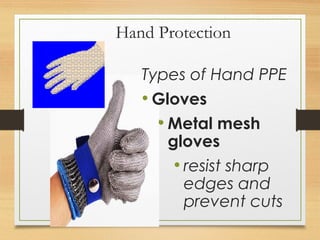
• Gloves
• Metal mesh
gloves
• resist sharp
edges and
prevent cuts
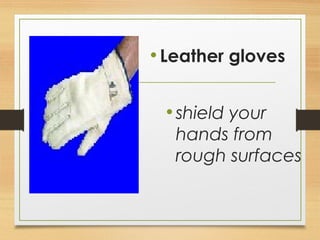
•Leather gloves
•shield your
hands from
rough surfaces
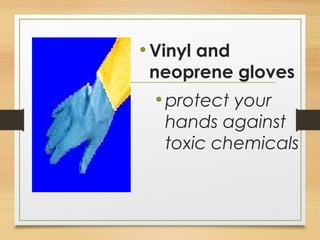
•Vinyl and
neoprene gloves
•protect your
hands against
toxic chemicals
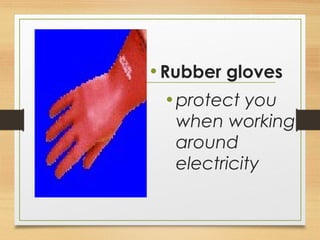
•Rubber gloves
•protect you
when working
around
electricity
Hand Protection
Types of Hand PPE
• Gloves
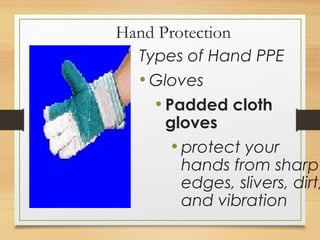
• Padded cloth
gloves
• protect your
hands from sharp
edges, slivers, dirt,
and vibration
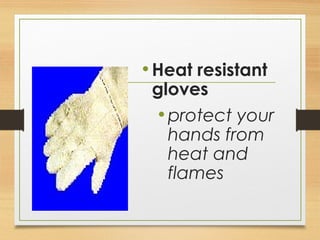
•Heat resistant
gloves
•protect your
hands from
heat and
flames
•Latex disposable
gloves
•used to protect
your hands
from germs
and bacteria
•Lead-lined
gloves
•used to
protect your
hands from
radiation
sources
Hand Protection
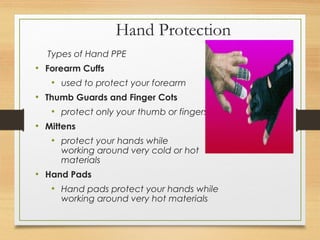
Types of Hand PPE
• Forearm Cuffs
• used to protect your forearm
• Thumb Guards and Finger Cots
• protect only your thumb or fingers
• Mittens
• protect your hands while
working around very cold or hot
materials
• Hand Pads
• Hand pads protect your hands while
working around very hot materials
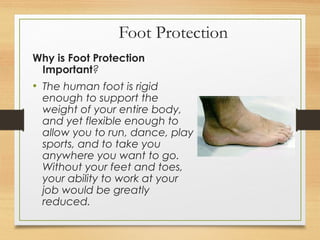
Foot Protection
Why is Foot Protection
Important?
• The human foot is rigid
enough to support the
weight of your entire body,
and yet flexible enough to
allow you to run, dance, play
sports, and to take you
anywhere you want to go.
Without your feet and toes,
your ability to work at your
job would be greatly
reduced.
Foot Protection
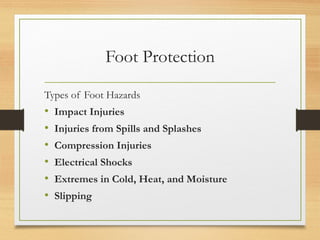
Types of Foot Hazards
• Impact Injuries
• Injuries from Spills and Splashes
• Compression Injuries
• Electrical Shocks
• Extremes in Cold, Heat, and Moisture
• Slipping
Foot Protection
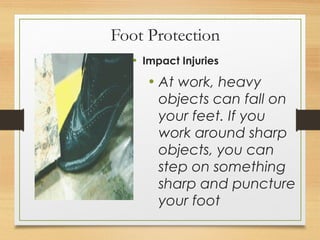
• Impact Injuries
• At work, heavy
objects can fall on
your feet. If you
work around sharp
objects, you can
step on something
sharp and puncture
your foot
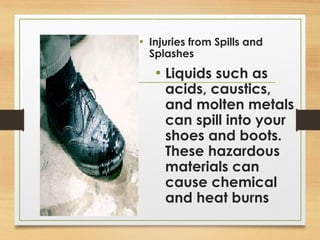
• Injuries from Spills and
Splashes
• Liquids such as
acids, caustics,
and molten metals
can spill into your
shoes and boots.
These hazardous
materials can
cause chemical
and heat burns
Foot Protection
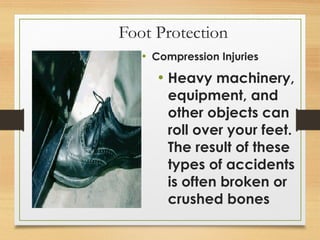
• Compression Injuries
• Heavy machinery,
equipment, and
other objects can
roll over your feet.
The result of these
types of accidents
is often broken or
crushed bones
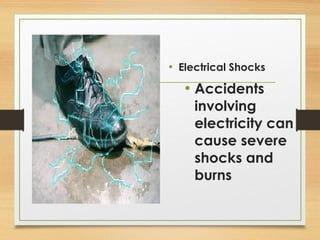
• Electrical Shocks
• Accidents
involving
electricity can
cause severe
shocks and
burns
Foot Protection
Potential Incidences of Foot Hazards
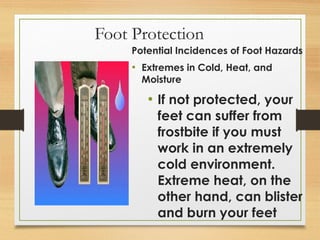
• Extremes in Cold, Heat, and
Moisture
• If not protected, your
feet can suffer from
frostbite if you must
work in an extremely
cold environment.
Extreme heat, on the
other hand, can blister
and burn your feet
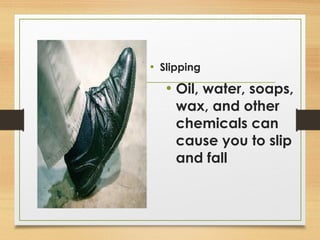
• Slipping
• Oil, water, soaps,
wax, and other
chemicals can
cause you to slip
and fall
Foot Protection
Types of Foot PPE
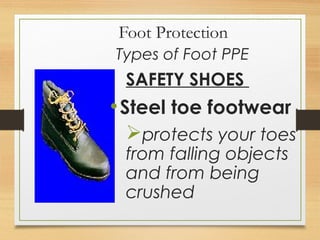
SAFETY SHOES
•Steel toe footwear
protects your toes
from falling objects
and from being
crushed
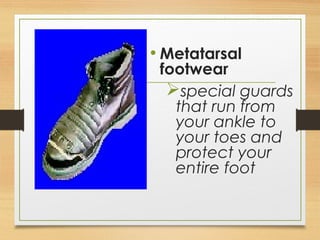
• Metatarsal
footwear
special guards
that run from
your ankle to
your toes and
protect your
entire foot
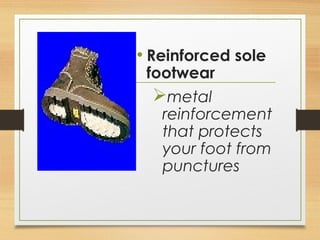
• Reinforced sole
footwear
metal
reinforcement
that protects
your foot from
punctures
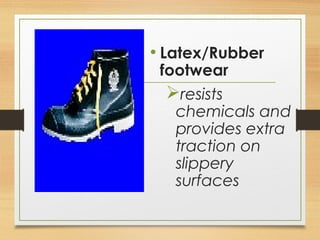
• Latex/Rubber
footwear
resists
chemicals and
provides extra
traction on
slippery
surfaces
Foot Protection
Type of Foot PPE
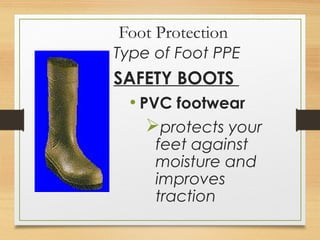
SAFETY BOOTS
• PVC footwear
protects your
feet against
moisture and
improves
traction
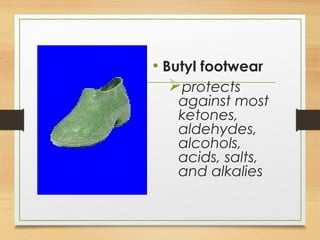
• Butyl footwear
protects
against most
ketones,
aldehydes,
alcohols,
acids, salts,
and alkalies
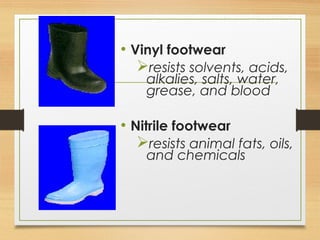
• Vinyl footwear
resists solvents, acids,
alkalies, salts, water,
grease, and blood
• Nitrile footwear
resists animal fats, oils,
and chemicals
Foot Protection
Types of Foot PPE
SAFETY BOOTS
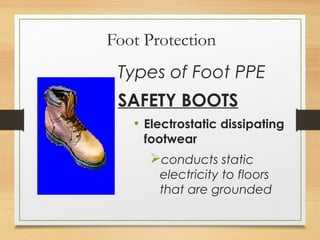
• Electrostatic dissipating
footwear
conducts static
electricity to floors
that are grounded
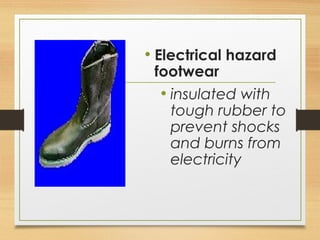
• Electrical hazard
footwear
• insulated with
tough rubber to
prevent shocks
and burns from
electricity
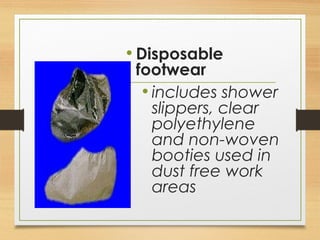
• Disposable
footwear
• includes shower
slippers, clear
polyethylene
and non-woven
booties used in
dust free work
areas
Body / Skin Protection
Why is Body Protection
Important?
• The skin acts as a
natural barrier to the
elements
• Chemicals can break
down the skin barrier
and allow secondary
infections to manifest
Body Protection
Types of Body Hazards
• Temperature stress
• Chemical Contact
• Radiation
Body Protection
• Temperature stress
• Exposure to heat (hot metals) or
cold (dry ice) which results in burns
• Chemical Contact
• Chemical splash
• Contact with potentially infectious
materials
• Radiation
Body Protection
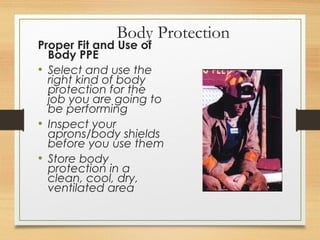
Proper Fit and Use of
Body PPE
• Select and use the
right kind of body
protection for the
job you are going to
be performing
• Inspect your
aprons/body shields
before you use them
• Store body
protection in a
clean, cool, dry,
ventilated area
Body Protection
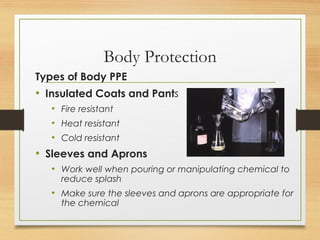
Types of Body PPE
• Insulated Coats and Pants
• Fire resistant
• Heat resistant
• Cold resistant
• Sleeves and Aprons
• Work well when pouring or manipulating chemical to
reduce splash
• Make sure the sleeves and aprons are appropriate for
the chemical
Body Protection
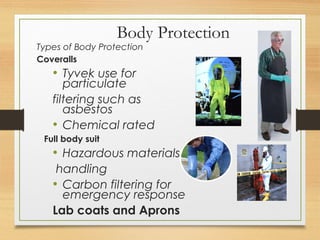
Types of Body Protection
Coveralls
• Tyvek use for
particulate
filtering such as
asbestos
• Chemical rated
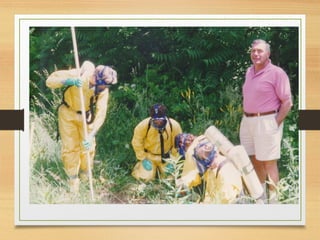
Full body suit
• Hazardous materials
handling
• Carbon filtering for
emergency response
Lab coats and Aprons
Body Protection
HEARING PROTECTION
Needed when the average
(over an 8 hour period) noise
level of an area reaches 90
decibels.
Hearing protection must be
made available to employees
when the average (over an 8
hour period) noise level
reaches 85 decibels.
Examples of high noise areas
can be:
Mechanical rooms
Shops
Construction Sites
When working with
machinery/power tools
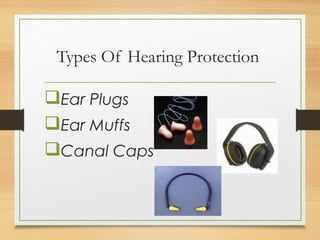
Types Of Hearing Protection
Ear Plugs
Ear Muffs
Canal Caps
RESPIRATORY PROTECTION
Needed when work presents an
inhalation hazard
Required when employees are in
areas where effective engineering
controls are not feasible to protect
the health of the employee from
harmful dusts, fogs, fumes, mists,
gases, smokes, sprays or vapors
Examples of hazards:
Working with uncontained
chemicals.
Working with highly toxic
chemicals.
Working in dusty environment.
Painting.
Welding.
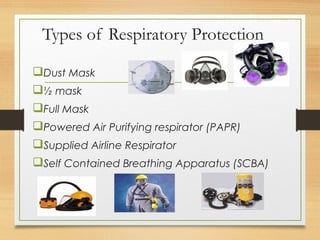
Types of Respiratory Protection
Dust Mask
½ mask
Full Mask
Powered Air Purifying respirator (PAPR)
Supplied Airline Respirator
Self Contained Breathing Apparatus (SCBA)
Examples
Medical Exam
Selection based on hazard
Fit Testing
Facial Hair
Inspection of Equipment
Specific Training on Operation
SAFETY PERSONNEL
Safety man
-a person who was
responsible for filling out
accident reports
-living reminder of all
employees to be safe.
SAFETY ENGINEER
This frequently describes the
person assigned accident
prevention duties
SAFETY PROFESSIONAL
A person who has
knowledgeable, and highly
expert in some cases and
through experience and self-
education
SAFETY MANAGER
It refers to a person responsible for a safety
organization and its activities
RISK MANAGER
A person who is responsible for the function of
safety manager, and also for insurance
program and related activities to minimize
accidental losses.
ANY QUESTIONS????
. . . . . . . . . . .
Thanks For LISTENING
THINK SAFETY and BE SAFE

SAFETY ENGINEERING- Personal Protective Equipment

  • 1.
  • 2.
    SECURITY PERSONNEL A personwho are employed to protect people and property They can assists safety engineers by reporting safety hazards which they detect during duty hours. Ex . Security guard, security officer etc.
  • 3.
    Security Personnel SafetyChecks  Blocked lanes for emergency vehicles Blocked emergency exits and passage to exits Unlocked doors or gates to hazardous areas Obstructed fire doors or escapes
  • 4.
    check loose wires,piping, metal or materials, and equipment which pose tripping hazards Check wet, oily or heavy wax floors which pose slipping hazards Check broken electrical fittings, outlets, plugs, and other devices Unprotected sharp points edges or broken glasses
  • 5.
  • 6.
    Personal Protective Equipment Definition -is anysafety equipment workers wear to prevent injury in the workplace
  • 7.
    Is This AnAppropriate Hard Hat?
  • 8.
    Is This AnAppropriate Respirator?
  • 9.
    Is This anAppropriate Welder’s Mask?
  • 10.
    Is This anAppropriate Scaffolding?
  • 11.
    •Basic Common Typesof PPE Head Eyes Face Hands Feet Body Hearing Respiratory
  • 12.
    Head Protection Why isHead Protection Important? In order for us to be secured from any Head injuries
  • 13.
    Head Protection Types ofHead hazards • Impact • Electric shock • Drips
  • 14.
    Head Protection Head Hazards •Impact • Falling or flying objects • falling or walking into hard objects • injuries include neck sprains, concussions, and skull fractures
  • 15.
    Head Protection • ElectricShock • Live exposed electric wires • Injuries include electrical shocks and burns • Drips • Toxic liquids that can irritate and burn the head/scalp.
  • 16.
    Exposed Workers NeedHEAD PROTECTION construction workers  carpenters  electricians  linemen
  • 17.
    plumbers Pipefitters  timber  logcutters  welders & among many others
  • 18.
    Head Protection Types ofHead PPE • Class A Hard Hats • Provide impact and penetration resistance • Protect you from electrical shocks up to 2,200 volts • Protect you from falling objects
  • 19.
    Class B HardHats • Provide highest level of protection against electrical hazard w/ high voltage shocks and burn protection • Protect you from electrical shocks up to 20,000 volts • Protect you from falling objects
  • 20.
    Class C HardHats • No electrical protection • Protect you from falling objects Bump Caps • Bump caps are made from lightweight plastic and are designed to protect you from bumping your head on protruding objects
  • 21.
    Proper use andcare of hard hat • Always wear your hard hat while you are working in areas where there are potential head hazards • Adjust the suspension inside your hard hat so that the hat sits comfortably, but securely on your head
  • 22.
    •Inspect the shellof your hard hat for cracks, gouges, and dents. Inspect the suspension system for frayed or broken straps.
  • 23.
    •Never paint, scratchor drill "air holes" in your hard hat •Never carry personal belongings such as cigarettes, lighters, or pens in your hard hat
  • 24.
    Eye Protection Why Eyeand Face Protection is Important Thousands of people are blinded each year from work related eye injuries.
  • 25.
    Examples of hazards:  Machines Injurious light radiation  Heat  Tools  Flying Particles  Chemicals
  • 26.
    Types of EyeProtection Goggles-surround the eye area, they give you more protection in injurious situations .  Chemical  Laser  Welding
  • 27.
    Eye Protection Regular glassesor sunglasses are not appropriate SAFETY GLASSES
  • 28.
    Elimination or Controlof Hazards •Safe work training •Read and follow all warnings and precautions that may be found on equipment and hazardous materials •Keep sharp or pointed objects away from your eyes
  • 29.
    • Follow yoursupervisor's or safety manager's suggestions and recommendations for working  safely
  • 30.
    FACE PROTECTION Needed whenwork presents the potential of causing facial injury from physical, chemical, or radiation agents. Examples of hazards:  Contents under pressure  Splash hazard  Flying objects / particles  Electrical work
  • 31.
    Face Protection Types ofFace Personal Protective Equipment • Face Shields • used around operations which expose you to molten metal, chemical splashes, or flying particles.
  • 32.
    Face Protection • Faceshield used by an employee working with molten metal
  • 33.
    Face Protection • WeldingHelmets • provide both face and eye protection • use special absorptive lenses that filter the intense light and radiant energy that is produced during welding operations
  • 34.
    Hand Protection Why isHand Protection Important? • Without your fingers or hands, your ability to work would be greatly reduced
  • 35.
    Hand Protection Types ofHand Hazards • Traumatic Injuries • Contact Injuries • Repetitive Motion Injuries
  • 36.
    Hand Protection Potential Incidences ofHand Hazards • Traumatic Injuries • cuts, punctures, sprains or crushing from equipment
  • 37.
    Hand Protection • ContactInjuries • Coming into contact with caustic or toxic chemicals, biological substances, electrical sources, or extremely cold or hot objects
  • 38.
    • Repetitive MotionInjuries Whenever you repeat the same hand movement over a long period of time, you run the risk of repetitive motion problems
  • 39.
    Hand Protection • Neverwear gloves around powered rotating equipment - drills, lathes, etc.
  • 40.
    Hand Protection Types ofHand PPE • Gloves • Metal mesh gloves • resist sharp edges and prevent cuts
  • 41.
  • 42.
    •Vinyl and neoprene gloves •protectyour hands against toxic chemicals
  • 43.
    •Rubber gloves •protect you whenworking around electricity
  • 44.
    Hand Protection Types ofHand PPE • Gloves • Padded cloth gloves • protect your hands from sharp edges, slivers, dirt, and vibration
  • 45.
  • 46.
    •Latex disposable gloves •used toprotect your hands from germs and bacteria
  • 47.
  • 48.
    Hand Protection Types ofHand PPE • Forearm Cuffs • used to protect your forearm • Thumb Guards and Finger Cots • protect only your thumb or fingers • Mittens • protect your hands while working around very cold or hot materials • Hand Pads • Hand pads protect your hands while working around very hot materials
  • 49.
    Foot Protection Why isFoot Protection Important? • The human foot is rigid enough to support the weight of your entire body, and yet flexible enough to allow you to run, dance, play sports, and to take you anywhere you want to go. Without your feet and toes, your ability to work at your job would be greatly reduced.
  • 50.
    Foot Protection Types ofFoot Hazards • Impact Injuries • Injuries from Spills and Splashes • Compression Injuries • Electrical Shocks • Extremes in Cold, Heat, and Moisture • Slipping
  • 51.
    Foot Protection • ImpactInjuries • At work, heavy objects can fall on your feet. If you work around sharp objects, you can step on something sharp and puncture your foot
  • 52.
    • Injuries fromSpills and Splashes • Liquids such as acids, caustics, and molten metals can spill into your shoes and boots. These hazardous materials can cause chemical and heat burns
  • 53.
    Foot Protection • CompressionInjuries • Heavy machinery, equipment, and other objects can roll over your feet. The result of these types of accidents is often broken or crushed bones
  • 54.
    • Electrical Shocks •Accidents involving electricity can cause severe shocks and burns
  • 55.
    Foot Protection Potential Incidencesof Foot Hazards • Extremes in Cold, Heat, and Moisture • If not protected, your feet can suffer from frostbite if you must work in an extremely cold environment. Extreme heat, on the other hand, can blister and burn your feet
  • 56.
    • Slipping • Oil,water, soaps, wax, and other chemicals can cause you to slip and fall
  • 57.
    Foot Protection Types ofFoot PPE SAFETY SHOES •Steel toe footwear protects your toes from falling objects and from being crushed
  • 58.
    • Metatarsal footwear special guards thatrun from your ankle to your toes and protect your entire foot
  • 59.
  • 60.
  • 61.
    Foot Protection Type ofFoot PPE SAFETY BOOTS • PVC footwear protects your feet against moisture and improves traction
  • 62.
    • Butyl footwear protects againstmost ketones, aldehydes, alcohols, acids, salts, and alkalies
  • 63.
    • Vinyl footwear resistssolvents, acids, alkalies, salts, water, grease, and blood • Nitrile footwear resists animal fats, oils, and chemicals
  • 64.
    Foot Protection Types ofFoot PPE SAFETY BOOTS • Electrostatic dissipating footwear conducts static electricity to floors that are grounded
  • 65.
    • Electrical hazard footwear •insulated with tough rubber to prevent shocks and burns from electricity
  • 66.
    • Disposable footwear • includesshower slippers, clear polyethylene and non-woven booties used in dust free work areas
  • 67.
    Body / SkinProtection Why is Body Protection Important? • The skin acts as a natural barrier to the elements • Chemicals can break down the skin barrier and allow secondary infections to manifest
  • 68.
    Body Protection Types ofBody Hazards • Temperature stress • Chemical Contact • Radiation
  • 69.
    Body Protection • Temperaturestress • Exposure to heat (hot metals) or cold (dry ice) which results in burns • Chemical Contact • Chemical splash • Contact with potentially infectious materials • Radiation
  • 70.
    Body Protection Proper Fitand Use of Body PPE • Select and use the right kind of body protection for the job you are going to be performing • Inspect your aprons/body shields before you use them • Store body protection in a clean, cool, dry, ventilated area
  • 71.
    Body Protection Types ofBody PPE • Insulated Coats and Pants • Fire resistant • Heat resistant • Cold resistant • Sleeves and Aprons • Work well when pouring or manipulating chemical to reduce splash • Make sure the sleeves and aprons are appropriate for the chemical
  • 72.
    Body Protection Types ofBody Protection Coveralls • Tyvek use for particulate filtering such as asbestos • Chemical rated Full body suit • Hazardous materials handling • Carbon filtering for emergency response Lab coats and Aprons
  • 73.
  • 74.
    HEARING PROTECTION Needed whenthe average (over an 8 hour period) noise level of an area reaches 90 decibels. Hearing protection must be made available to employees when the average (over an 8 hour period) noise level reaches 85 decibels.
  • 75.
    Examples of highnoise areas can be: Mechanical rooms Shops Construction Sites When working with machinery/power tools
  • 76.
    Types Of HearingProtection Ear Plugs Ear Muffs Canal Caps
  • 77.
    RESPIRATORY PROTECTION Needed whenwork presents an inhalation hazard Required when employees are in areas where effective engineering controls are not feasible to protect the health of the employee from harmful dusts, fogs, fumes, mists, gases, smokes, sprays or vapors
  • 78.
    Examples of hazards: Workingwith uncontained chemicals. Working with highly toxic chemicals. Working in dusty environment. Painting. Welding.
  • 79.
    Types of RespiratoryProtection Dust Mask ½ mask Full Mask Powered Air Purifying respirator (PAPR) Supplied Airline Respirator Self Contained Breathing Apparatus (SCBA)
  • 80.
    Examples Medical Exam Selection basedon hazard Fit Testing Facial Hair Inspection of Equipment Specific Training on Operation
  • 81.
    SAFETY PERSONNEL Safety man -aperson who was responsible for filling out accident reports -living reminder of all employees to be safe.
  • 82.
    SAFETY ENGINEER This frequentlydescribes the person assigned accident prevention duties SAFETY PROFESSIONAL A person who has knowledgeable, and highly expert in some cases and through experience and self- education
  • 83.
    SAFETY MANAGER It refersto a person responsible for a safety organization and its activities RISK MANAGER A person who is responsible for the function of safety manager, and also for insurance program and related activities to minimize accidental losses.
  • 84.
    ANY QUESTIONS???? . .. . . . . . . . . Thanks For LISTENING THINK SAFETY and BE SAFE