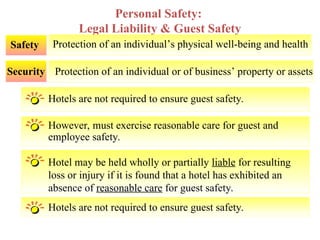
Hotels are notrequired to ensure guest safety.
However, must exercise reasonable care for guest and
employee safety.
Hotel may be held wholly or partially liable for resulting
loss or injury if it is found that a hotel has exhibited an
absence of reasonable care for guest safety.
Personal Safety:
Legal Liability & Guest Safety
Protection of an individual’s physical well-being and health
Safety
Protection of an individual or of business’ property or assets
Security
Hotels are not required to ensure guest safety.
3.
Facility Engineering &Maintenance
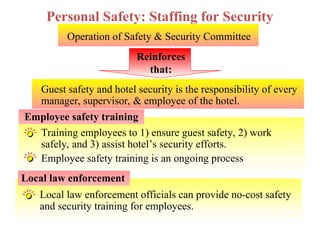
Local law enforcement officials can provide no-cost safety
and security training for employees.
Training employees to 1) ensure guest safety, 2) work
safely, and 3) assist hotel’s security efforts.
Employee safety training is an ongoing process
Reinforces
that:
Guest safety and hotel security is the responsibility of every
manager, supervisor, & employee of the hotel.
Personal Safety: Staffing for Security
Operation of Safety & Security Committee
Employee safety training
Local law enforcement
4.
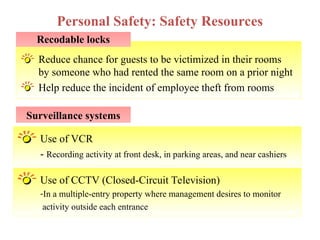
Reduce chance forguests to be victimized in their rooms
by someone who had rented the same room on a prior night
Help reduce the incident of employee theft from rooms
Personal Safety: Safety Resources
Recodable locks
Surveillance systems
Use of VCR
- Recording activity at front desk, in parking areas, and near cashiers
Use of CCTV (Closed-Circuit Television)
-In a multiple-entry property where management desires to monitor
activity outside each entrance
5.
Internal
alarms
Alarm systems
Notify (contact)an external entity such as fire
or police departments if alarm is activated
Contact
alarms
Personal Safety: Safety Resources
Serve to deter criminal or mischief activity
Notify an area within the hotel if alarm is activated
Protect storage areas, hotel facilities (pools, spa, and
exercise areas), and hotel and perimeter
Both federal law and local building codes mandate hotel fire alarms
6.
Fire / poweroutages / severely inclement weather / robbery
/ death or injury to a guest or employee / bomb threat /
intense negative publicity by the media
Personal Safety: Safety Resources
Emergency Plans: the identification of a threat to the safety and
security of the hotel & hotel’s planned response to the threat
Response to events in most hotels’ emergency plans
An emergency plan must be a written document, including:
Type of crisis
Who should be told when the crisis occurs
What should be done and who should do it in the crisis
Who should be informed of the results or impact of the
crisis when it is over
Where practical, hotels should practice implementation of their plan !
7.
Figure 9.3 liststen key practices for parking lot safety
Figure 9.2 lists ten key practices for spa safety
Figure 9.1 lists ten key practices for swimming pool safety
Swimming pools
Personal Safety: Special Safety Issues
Spas
Parking lots
Always remember how to improve guest safety and minimize the
legal liability of the hotel!
8.
All hotels shoulddocument their safety and security related
efforts!
Personal Safety: Documenting Safety Efforts
Prepare & complete MOD checklists for each critical area
of hotel
- Appropriate frequency, content and number of checklist
should be determined
Incident reports listing the “who, what, where, and how”
should be filed and maintained
Document minutes from safety and security committee
meetings, general staff meeting’s notes relevant to safety
issues, records of employee training related to safety and
security, and safety seminars attended by employees
9.
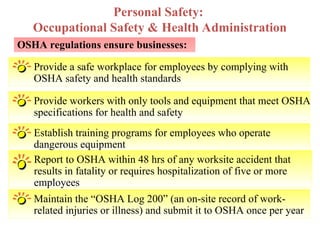
Provide a safeworkplace for employees by complying with
OSHA safety and health standards
Personal Safety:
Occupational Safety & Health Administration
OSHA regulations ensure businesses:
Provide workers with only tools and equipment that meet OSHA
specifications for health and safety
Establish training programs for employees who operate
dangerous equipment
Report to OSHA within 48 hrs of any worksite accident that
results in fatality or requires hospitalization of five or more
employees
Maintain the “OSHA Log 200” (an on-site record of work-
related injuries or illness) and submit it to OSHA once per year
10.
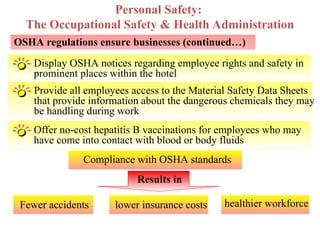
Display OSHA noticesregarding employee rights and safety in
prominent places within the hotel
OSHA regulations ensure businesses (continued…)
Provide all employees access to the Material Safety Data Sheets
that provide information about the dangerous chemicals they may
be handling during work
Personal Safety:
The Occupational Safety & Health Administration
Offer no-cost hepatitis B vaccinations for employees who may
have come into contact with blood or body fluids
Compliance with OSHA standards
Results in
Fewer accidents lower insurance costs healthier workforce
11.
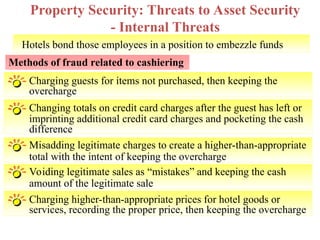
Hotels bond thoseemployees in a position to embezzle funds
Property Security: Threats to Asset Security
- Internal Threats
Methods of fraud related to cashiering
Charging guests for items not purchased, then keeping the
overcharge
Changing totals on credit card charges after the guest has left or
imprinting additional credit card charges and pocketing the cash
difference
Misadding legitimate charges to create a higher-than-appropriate
total with the intent of keeping the overcharge
Voiding legitimate sales as “mistakes” and keeping the cash
amount of the legitimate sale
Facility Engineering & Maintenance 9
Charging higher-than-appropriate prices for hotel goods or
services, recording the proper price, then keeping the overcharge
12.
Property Security: Threatsto Asset Security
- Internal Threats (continued….)
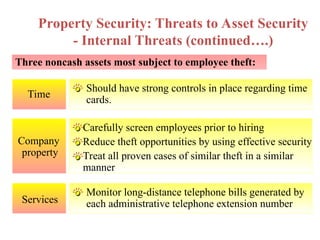
Time
Should have strong controls in place regarding time
cards.
Three noncash assets most subject to employee theft:
Company
property
Carefully screen employees prior to hiring
Reduce theft opportunities by using effective security
Treat all proven cases of similar theft in a similar
manner
Services
Monitor long-distance telephone bills generated by
each administrative telephone extension number
13.
Property Security: Threatsto Asset Security
- External Threats
Cash
Robbery is not the occasion to attempt the protection of
cash assets.
Robbery is the time to protect staff !
During a robbery, complying with robber’s demands and
observing the robber should be the employee’s sole
concern.
If no contact alarm is installed in the cashier’s cash drawer,
an employee who is robbed should, at the earliest safe
opportunity, contact local law enforcement officials as well
as others indicated in the robbery section of the hotel’s
emergency plan.
14.
Other assets: security-consciousmanager:
Property Security: Threats to Asset Security
External Threats (continued….)
Hang all artwork in lobbies & guest rooms with lock-down
style hangers
Avoid placing valuable decorations & décor pieces in areas
where they can be easily taken by guests
Train room attendants to alert management if excessive
amounts of in-room items go missing from stay-over
rooms
Bolt televisions securely to guestroom furniture
Train all employees to be alert regarding loss of hotel
property & to report any suspicious activity
15.
Guest-theft of housekeepingsupplies
Theft from guest rooms by room attendants or other
employees
- best policy is to report the incident to local law enforcement
Largest area of security concern is fraudulent selling of
rooms
Use housekeeping discrepancy report to detect room revenue
fraud
Front Office
Property Security: Threats to Asset Security
Department-Specific Threats to Asset Security
Housekeeping
16.
Employee theft ofhand tools and supplies
Implementing a sign-in/sign-out program for tools
Misstating mileage traveled, clients entertained, or sales trips
taken
Hotel suppliers such as silverware and glassware taken by guests
Employees accepting kickbacks from vendors or by purchasing,
then stealing, food and beverage items intended for the hotel
Food & Beverage
Property Security: Threats to Asset Security
Department-Specific Threats to Asset Security
Sales & Marketing
Maintenance & Engineering
Editor's Notes
#2 Differentiate the meaning between safety and security.
Emphasize that laws do not hold hotels responsible for everything that happens to guests during their stay as long as the hotel has exhibited a legal standard of “reasonable care” for guest safety.
Explain the meaning of “reasonable care” (a legal concept identifying the amount of care a reasonably prudent person would exercise in a specific situation) and liability (being legally bound to compensate for loss or injury)
#3 Safety and Security Committee is an interdepartmental task force comprising hotel managers, supervisors, and hourly employees charged with monitoring and refining a hotel’s safety and security efforts.
Question 2 in “Issues at Work” (Chapter 9) reinforces that all of the hotel’s employees should share concern for guest safety. This question further asks who should be responsible to ensure whether activities for guest safety are implemented successfully or not, depending on the size of hotel.
#4 * Quality recodable locks consist of electronic door locks that “stand-alone”, meaning that there is no need to wire the locks back to a central computer.
#5 When the E&M department implements a “replace as needed” program, it means a parts or equipment replacement plan that delays installing a new, substitute part until the original part fails or is in near failure; on the other hand, a “total replacement” program involves a parts or equipment replacement plan that involves installing new or substitute parts based on a predetermined schedule.
Question 1 in “Issues at Work” (Chapter 11) asks students to discuss factors influencing the decision between “replace as need” approach and systematic “total replacement”.
#6 When safety and security emergencies occur in the hotel, hotel management and employees must deal with those emergent situations quickly and appropriately. To do so, the G.M. together with appropriate managers need to plan ahead for foreseeable crises such as severe weather storms. The emergency plan can be used to prepare the hotel for a crisis.
Emergency plan is a document describing a hotel’s predetermined, intended response to a safety/security threat.
Question 3 in “Issues at Work” (Chapter 9) asks a student’ opinion on whether he or she would include “fire drill” that involve clearing the hotel of all guests as a way of practicing the final plan’s implementation, if he or she were a G.M.?
#7 * Discuss the first case study at “Managers at Work” relating to the safety issues in swimming pools.
#8 MOD (Manager on Duty) is the individual on the hotel property responsible for making any management decisions required during the period he or she is MOD.
Refer to Figure 9.4 to view the sample of the MOD checklist for parking areas. If wished, extend the discussion by creating one more MOD checklist example in the area of swimming pools and/or spas.
Incident report documents details of an accident, injury, or disturbance, and the hotel’s response to it.
Emphasize that the hotel’s documenting efforts relating to the safety and security of guests can be useful to prove that hotel has exercised reasonable care toward protecting guest safety/security.
#9 Material Safety Data Sheet (MSDS) is a written statement describing the potential hazards of, and best ways to handle, a chemical or toxic substance. An MSDS is provided by the manufacturer of the chemical or toxic substance to the buyer of the product and must be posted and made available where it is easily accessible to those who will actually use the product.
#11 Revisit the terms of safety and security here again. Safety-related hotel programs are designed to keep people safe from harm, whereas security-related efforts are directed toward protecting property from theft or damage.
Embezzlement is the theft of a company’s financial assets by an employee.
Bond(ing) means purchasing an insurance policy against the possibility that an employee will steal.
#12 Current technology is available to assist a chief engineer determine what must be maintained and how frequently to schedule preventative maintenance program
#15 * Discrepancy report is a daily comparison between the status of rooms as listed by the PMS at the front office, and the status of rooms as listed by the housekeeping department.
The second case study at “Managers at work” provides a scenario of a guest complaint about theft of her necklace from her room while she was away, and she claims her loss against the hotel. The text presents four possibilities: 1) the guest is mistaken, and the necklace reported stolen has been misplaced, 2) the guest is attempting to defraud the hotel, 3) the theft was committed but by another guest, 4) a hotel employee, in fact, committed the theft. What sort of tools can help to determine such a scenario?