Copyright © 2011 Pearson Education, Inc. Publishing as Pearson Addison-Wesley
Chapter 1
Databases and
Database Users
Copyright © 2011 Ramez Elmasri and Shamkant Navathe
Introduction
 Database
 Collection of related data
• Known facts that can be recorded and that have
implicit meaning
 Implicit properties:
• Represents some aspect of the real world:
Miniworld or universe of discourse (UoD)
• Logically coherent collection of data with inherent
meaning
• Built for a specific purpose
Copyright © 2011 Ramez Elmasri and Shamkant Navathe
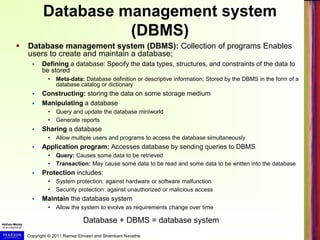
Database management system
(DBMS)
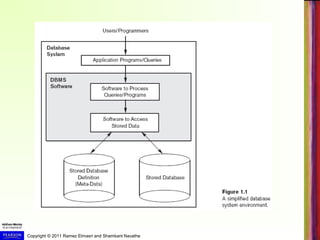
 Database management system (DBMS): Collection of programs Enables
users to create and maintain a database;
 Defining a database: Specify the data types, structures, and constraints of the data to
be stored
• Meta-data: Database definition or descriptive information; Stored by the DBMS in the form of a
database catalog or dictionary
 Constructing: storing the data on some storage medium
 Manipulating a database
• Query and update the database miniworld
• Generate reports
 Sharing a database
• Allow multiple users and programs to access the database simultaneously
 Application program: Accesses database by sending queries to DBMS
• Query: Causes some data to be retrieved
• Transaction: May cause some data to be read and some data to be written into the database
 Protection includes:
• System protection: against hardware or software malfunction
• Security protection: against unauthorized or malicious access
 Maintain the database system
• Allow the system to evolve as requirements change over time
Database + DBMS = database system
Copyright © 2011 Ramez Elmasri and Shamkant Navathe
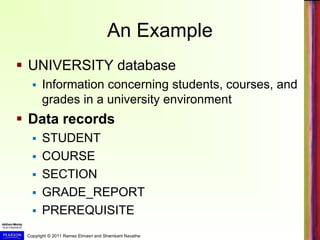
An Example
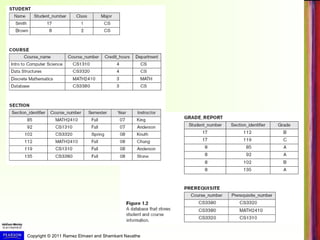
 UNIVERSITY database
 Information concerning students, courses, and
grades in a university environment
 Data records
 STUDENT
 COURSE
 SECTION
 GRADE_REPORT
 PREREQUISITE
Copyright © 2011 Ramez Elmasri and Shamkant Navathe
An Example (cont'd.)
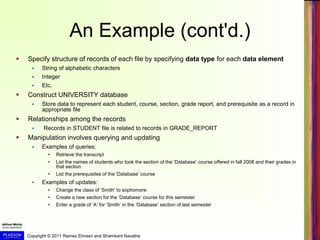
 Specify structure of records of each file by specifying data type for each data element
 String of alphabetic characters
 Integer
 Etc.
 Construct UNIVERSITY database
 Store data to represent each student, course, section, grade report, and prerequisite as a record in
appropriate file
 Relationships among the records
 Records in STUDENT file is related to records in GRADE_REPORT
 Manipulation involves querying and updating
 Examples of queries:
• Retrieve the transcript
• List the names of students who took the section of the ‘Database’ course offered in fall 2008 and their grades in
that section
• List the prerequisites of the ‘Database’ course
 Examples of updates:
• Change the class of ‘Smith’ to sophomore
• Create a new section for the ‘Database’ course for this semester
• Enter a grade of ‘A’ for ‘Smith’ in the ‘Database’ section of last semester
Copyright © 2011 Ramez Elmasri and Shamkant Navathe
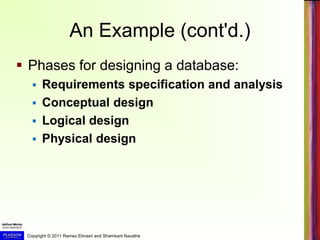
An Example (cont'd.)
 Phases for designing a database:
 Requirements specification and analysis
 Conceptual design
 Logical design
 Physical design
Copyright © 2011 Ramez Elmasri and Shamkant Navathe
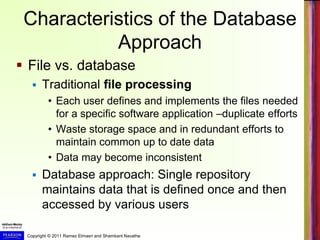
Characteristics of the Database
Approach
 File vs. database
 Traditional file processing
• Each user defines and implements the files needed
for a specific software application –duplicate efforts
• Waste storage space and in redundant efforts to
maintain common up to date data
• Data may become inconsistent
 Database approach: Single repository
maintains data that is defined once and then
accessed by various users
Copyright © 2011 Ramez Elmasri and Shamkant Navathe
Characteristics of the Database
Approach (cont'd.)
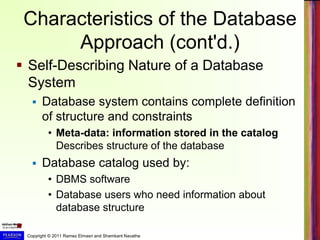
 Self-Describing Nature of a Database
System
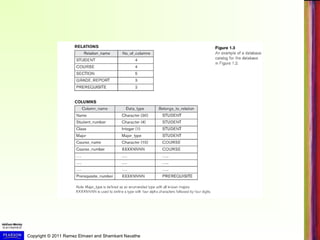
 Database system contains complete definition
of structure and constraints
• Meta-data: information stored in the catalog
Describes structure of the database
 Database catalog used by:
• DBMS software
• Database users who need information about
database structure

Copyright © 2011 Ramez Elmasri and Shamkant Navathe
Characteristics of the Database
Approach (cont'd.)
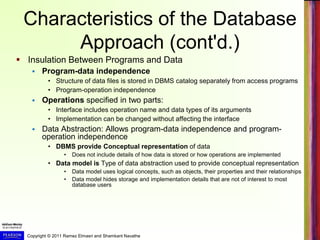
 Insulation Between Programs and Data
 Program-data independence
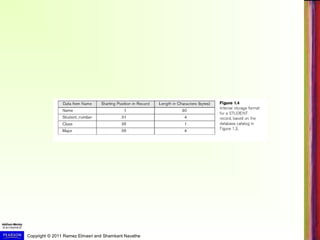
• Structure of data files is stored in DBMS catalog separately from access programs
• Program-operation independence
 Operations specified in two parts:
• Interface includes operation name and data types of its arguments
• Implementation can be changed without affecting the interface
 Data Abstraction: Allows program-data independence and program-
operation independence
• DBMS provide Conceptual representation of data
• Does not include details of how data is stored or how operations are implemented
• Data model is Type of data abstraction used to provide conceptual representation
• Data model uses logical concepts, such as objects, their properties and their relationships
• Data model hides storage and implementation details that are not of interest to most
database users
Copyright © 2011 Ramez Elmasri and Shamkant Navathe
Characteristics of the Database
Approach (cont'd.)
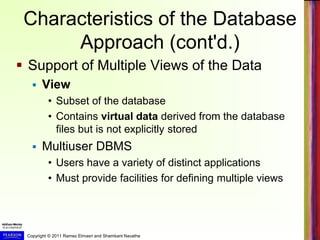
 Support of Multiple Views of the Data
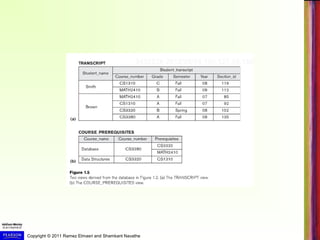
 View
• Subset of the database
• Contains virtual data derived from the database
files but is not explicitly stored
 Multiuser DBMS
• Users have a variety of distinct applications
• Must provide facilities for defining multiple views
Copyright © 2011 Ramez Elmasri and Shamkant Navathe
Characteristics of the Database
Approach (cont'd.)
 Sharing of Data and Multiuser Transaction Processing
 Allow multiple users to access the database at the same time
 Concurrency control software
• Ensure that several users trying to update the same data do so in a controlled
manner
• Result of the updates is correct
 Online transaction processing (OLTP) application
• Multiple agents access to flight ticket for reservation
 Transaction: is an executing program or process that includes one
or more database accesses.
• Central to many database applications
• Executing program or process that includes one or more database
• Transaction properties:
• Isolation property: Each transaction appears to execute in isolation from other
transactions
• Atomicity property: Either all the database operations in a transaction are executed or
none are
Copyright © 2011 Ramez Elmasri and Shamkant Navathe
Actors on the Scene
 Database administrators (DBA) are responsible for:
 Authorizing access to the database
 Coordinating and monitoring its use
 Acquiring software and hardware resources
 Database designers are responsible for:
 Identifying the data to be stored
 Choosing appropriate structures to represent and store this data
 System analysts: Determine requirements of end users, and develop
specifications fro standard canned transactions that meet these requirements.
 Application programmers: Implement these specifications as programs.
 End users: People whose jobs require access to the database
 Casual end users
 Naive or parametric end users
• Reservation agents; bank teller
 Sophisticated end users
 Standalone users
Copyright © 2011 Ramez Elmasri and Shamkant Navathe
Workers behind the Scene
 DBMS system designers and
implementers
 Design and implement the DBMS modules and
interfaces as a software package
 Tool developers
 Design and implement tools
 Operators and maintenance personnel
 Responsible for running and maintenance of
hardware and software environment for
database system
Copyright © 2011 Ramez Elmasri and Shamkant Navathe
Advantages of Using the DBMS
Approach
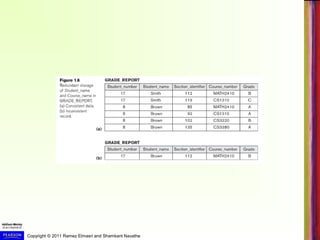
 Controlling redundancy
 Redundancy: storing data multiple times:
• Redundancy is controlled when the DBMS ensures
that multiple copies of the same data are consistent
• If the DBMS has no control over this, we have
uncontrolled redundancy.
 Data normalization: store each logical data
item in only one place
 Denormalization: Sometimes necessary to
use controlled redundancy to improve the
performance of queries
Copyright © 2011 Ramez Elmasri and Shamkant Navathe
Advantages of Using the DBMS
Approach
 Restricting unauthorized access
 Security and authorization subsystem
 Privileged software
 Providing persistent storage for program
objects
 Complex object in C++ can be stored
permanently in an object-oriented DBMS
 Impedance mismatch problem
• Object-oriented database systems typically offer
data structure compatibility
Copyright © 2011 Ramez Elmasri and Shamkant Navathe
Advantages of Using the DBMS
Approach (cont'd.)
 Providing storage structures and search techniques for
efficient query processing
 Indexes
 Buffering and caching
 Query processing and optimization
 Providing backup and recovery
 Backup and recovery subsystem of the DBMS is
responsible for recovery
 Providing multiple user interfaces
 Graphical user interfaces (GUIs)
 Representing complex relationships among data
 May include numerous varieties of data that are interrelated
in many ways
Copyright © 2011 Ramez Elmasri and Shamkant Navathe
Advantages of Using the DBMS
Approach (cont'd.)
 Enforcing integrity constraints
 Referential integrity constraint
• Every section record must be related to a course
record
 Key or uniqueness constraint
• Every course record must have a unique value for
Course_number
 Business rules
 Inherent rules of the data model
Copyright © 2011 Ramez Elmasri and Shamkant Navathe
Advantages of Using the DBMS
Approach (cont'd.)
 Permitting inferencing and actions using rules
 Deductive database systems
• Provide capabilities for defining deduction rules
• Inference new information from the stored database facts
 Trigger: a form of a rule activated by updates
to the table, which results in performing
additional operations to some other tables.
 Stored procedures
• More involved procedures to enforce rules
• Active database system: provide active rules that
can automatically initiate actions when certain
events and condition occur
Copyright © 2011 Ramez Elmasri and Shamkant Navathe
Advantages of Using the DBMS
Approach (cont'd.)
 Additional implications of using the
database approach
 Potential for enforcing standards
 Reduced application development time
 Flexibility
 Availability of up-to-date information
 Economies of scale
Copyright © 2011 Ramez Elmasri and Shamkant Navathe
A Brief History of Database
Applications
 Early database applications using
hierarchical and network systems
 Large numbers of records of similar structure
 Providing data abstraction and application
flexibility with relational databases
 Separates physical storage of data from its
conceptual representation
 Provides a mathematical foundation for data
representation and querying
Copyright © 2011 Ramez Elmasri and Shamkant Navathe
A Brief History of Database
Applications (cont'd.)
 Object-oriented applications and the need
for more complex databases
 Used in specialized applications: engineering
design, multimedia publishing, and
manufacturing systems
 Interchanging data on the Web for e-
commerce using XML
 Extended markup language (XML) primary
standard for interchanging data among various
types of databases and Web pages
Copyright © 2011 Ramez Elmasri and Shamkant Navathe
A Brief History of Database
Applications (cont'd.)
 Extending database capabilities for new
applications
 Extensions to better support specialized
requirements for applications
 Enterprise resource planning (ERP)
 Customer relationship management (CRM)
 Databases versus information retrieval
 Information retrieval (IR)
• Deals with books, manuscripts, and various forms of
library-based articles
Copyright © 2011 Ramez Elmasri and Shamkant Navathe
When Not to Use a DBMS
 More desirable to use regular files for:
 Simple, well-defined database applications not
expected to change at all
 Stringent, real-time requirements that may not
be met because of DBMS overhead
 Embedded systems with limited storage
capacity
 No multiple-user access to data
Copyright © 2011 Ramez Elmasri and Shamkant Navathe
Summary
 Database
 Collection of related data (recorded facts)
 DBMS
 Generalized software package for
implementing and maintaining a computerized
database
 Several categories of database users
 Database applications have evolved
 Current trends: IR, Web, no-sql

FDS (Sixth Edition) | C1 | Databases and Database Users

  • 1.
    Copyright © 2011Pearson Education, Inc. Publishing as Pearson Addison-Wesley Chapter 1 Databases and Database Users
  • 2.
    Copyright © 2011Ramez Elmasri and Shamkant Navathe Introduction  Database  Collection of related data • Known facts that can be recorded and that have implicit meaning  Implicit properties: • Represents some aspect of the real world: Miniworld or universe of discourse (UoD) • Logically coherent collection of data with inherent meaning • Built for a specific purpose
  • 3.
    Copyright © 2011Ramez Elmasri and Shamkant Navathe Database management system (DBMS)  Database management system (DBMS): Collection of programs Enables users to create and maintain a database;  Defining a database: Specify the data types, structures, and constraints of the data to be stored • Meta-data: Database definition or descriptive information; Stored by the DBMS in the form of a database catalog or dictionary  Constructing: storing the data on some storage medium  Manipulating a database • Query and update the database miniworld • Generate reports  Sharing a database • Allow multiple users and programs to access the database simultaneously  Application program: Accesses database by sending queries to DBMS • Query: Causes some data to be retrieved • Transaction: May cause some data to be read and some data to be written into the database  Protection includes: • System protection: against hardware or software malfunction • Security protection: against unauthorized or malicious access  Maintain the database system • Allow the system to evolve as requirements change over time Database + DBMS = database system
  • 4.
    Copyright © 2011Ramez Elmasri and Shamkant Navathe
  • 5.
    Copyright © 2011Ramez Elmasri and Shamkant Navathe An Example  UNIVERSITY database  Information concerning students, courses, and grades in a university environment  Data records  STUDENT  COURSE  SECTION  GRADE_REPORT  PREREQUISITE
  • 6.
    Copyright © 2011Ramez Elmasri and Shamkant Navathe
  • 7.
    Copyright © 2011Ramez Elmasri and Shamkant Navathe An Example (cont'd.)  Specify structure of records of each file by specifying data type for each data element  String of alphabetic characters  Integer  Etc.  Construct UNIVERSITY database  Store data to represent each student, course, section, grade report, and prerequisite as a record in appropriate file  Relationships among the records  Records in STUDENT file is related to records in GRADE_REPORT  Manipulation involves querying and updating  Examples of queries: • Retrieve the transcript • List the names of students who took the section of the ‘Database’ course offered in fall 2008 and their grades in that section • List the prerequisites of the ‘Database’ course  Examples of updates: • Change the class of ‘Smith’ to sophomore • Create a new section for the ‘Database’ course for this semester • Enter a grade of ‘A’ for ‘Smith’ in the ‘Database’ section of last semester
  • 8.
    Copyright © 2011Ramez Elmasri and Shamkant Navathe An Example (cont'd.)  Phases for designing a database:  Requirements specification and analysis  Conceptual design  Logical design  Physical design
  • 9.
    Copyright © 2011Ramez Elmasri and Shamkant Navathe Characteristics of the Database Approach  File vs. database  Traditional file processing • Each user defines and implements the files needed for a specific software application –duplicate efforts • Waste storage space and in redundant efforts to maintain common up to date data • Data may become inconsistent  Database approach: Single repository maintains data that is defined once and then accessed by various users
  • 10.
    Copyright © 2011Ramez Elmasri and Shamkant Navathe Characteristics of the Database Approach (cont'd.)  Self-Describing Nature of a Database System  Database system contains complete definition of structure and constraints • Meta-data: information stored in the catalog Describes structure of the database  Database catalog used by: • DBMS software • Database users who need information about database structure 
  • 11.
    Copyright © 2011Ramez Elmasri and Shamkant Navathe
  • 12.
    Copyright © 2011Ramez Elmasri and Shamkant Navathe Characteristics of the Database Approach (cont'd.)  Insulation Between Programs and Data  Program-data independence • Structure of data files is stored in DBMS catalog separately from access programs • Program-operation independence  Operations specified in two parts: • Interface includes operation name and data types of its arguments • Implementation can be changed without affecting the interface  Data Abstraction: Allows program-data independence and program- operation independence • DBMS provide Conceptual representation of data • Does not include details of how data is stored or how operations are implemented • Data model is Type of data abstraction used to provide conceptual representation • Data model uses logical concepts, such as objects, their properties and their relationships • Data model hides storage and implementation details that are not of interest to most database users
  • 13.
    Copyright © 2011Ramez Elmasri and Shamkant Navathe
  • 14.
    Copyright © 2011Ramez Elmasri and Shamkant Navathe Characteristics of the Database Approach (cont'd.)  Support of Multiple Views of the Data  View • Subset of the database • Contains virtual data derived from the database files but is not explicitly stored  Multiuser DBMS • Users have a variety of distinct applications • Must provide facilities for defining multiple views
  • 15.
    Copyright © 2011Ramez Elmasri and Shamkant Navathe
  • 16.
    Copyright © 2011Ramez Elmasri and Shamkant Navathe Characteristics of the Database Approach (cont'd.)  Sharing of Data and Multiuser Transaction Processing  Allow multiple users to access the database at the same time  Concurrency control software • Ensure that several users trying to update the same data do so in a controlled manner • Result of the updates is correct  Online transaction processing (OLTP) application • Multiple agents access to flight ticket for reservation  Transaction: is an executing program or process that includes one or more database accesses. • Central to many database applications • Executing program or process that includes one or more database • Transaction properties: • Isolation property: Each transaction appears to execute in isolation from other transactions • Atomicity property: Either all the database operations in a transaction are executed or none are
  • 17.
    Copyright © 2011Ramez Elmasri and Shamkant Navathe Actors on the Scene  Database administrators (DBA) are responsible for:  Authorizing access to the database  Coordinating and monitoring its use  Acquiring software and hardware resources  Database designers are responsible for:  Identifying the data to be stored  Choosing appropriate structures to represent and store this data  System analysts: Determine requirements of end users, and develop specifications fro standard canned transactions that meet these requirements.  Application programmers: Implement these specifications as programs.  End users: People whose jobs require access to the database  Casual end users  Naive or parametric end users • Reservation agents; bank teller  Sophisticated end users  Standalone users
  • 18.
    Copyright © 2011Ramez Elmasri and Shamkant Navathe Workers behind the Scene  DBMS system designers and implementers  Design and implement the DBMS modules and interfaces as a software package  Tool developers  Design and implement tools  Operators and maintenance personnel  Responsible for running and maintenance of hardware and software environment for database system
  • 19.
    Copyright © 2011Ramez Elmasri and Shamkant Navathe Advantages of Using the DBMS Approach  Controlling redundancy  Redundancy: storing data multiple times: • Redundancy is controlled when the DBMS ensures that multiple copies of the same data are consistent • If the DBMS has no control over this, we have uncontrolled redundancy.  Data normalization: store each logical data item in only one place  Denormalization: Sometimes necessary to use controlled redundancy to improve the performance of queries
  • 20.
    Copyright © 2011Ramez Elmasri and Shamkant Navathe
  • 21.
    Copyright © 2011Ramez Elmasri and Shamkant Navathe Advantages of Using the DBMS Approach  Restricting unauthorized access  Security and authorization subsystem  Privileged software  Providing persistent storage for program objects  Complex object in C++ can be stored permanently in an object-oriented DBMS  Impedance mismatch problem • Object-oriented database systems typically offer data structure compatibility
  • 22.
    Copyright © 2011Ramez Elmasri and Shamkant Navathe Advantages of Using the DBMS Approach (cont'd.)  Providing storage structures and search techniques for efficient query processing  Indexes  Buffering and caching  Query processing and optimization  Providing backup and recovery  Backup and recovery subsystem of the DBMS is responsible for recovery  Providing multiple user interfaces  Graphical user interfaces (GUIs)  Representing complex relationships among data  May include numerous varieties of data that are interrelated in many ways
  • 23.
    Copyright © 2011Ramez Elmasri and Shamkant Navathe Advantages of Using the DBMS Approach (cont'd.)  Enforcing integrity constraints  Referential integrity constraint • Every section record must be related to a course record  Key or uniqueness constraint • Every course record must have a unique value for Course_number  Business rules  Inherent rules of the data model
  • 24.
    Copyright © 2011Ramez Elmasri and Shamkant Navathe Advantages of Using the DBMS Approach (cont'd.)  Permitting inferencing and actions using rules  Deductive database systems • Provide capabilities for defining deduction rules • Inference new information from the stored database facts  Trigger: a form of a rule activated by updates to the table, which results in performing additional operations to some other tables.  Stored procedures • More involved procedures to enforce rules • Active database system: provide active rules that can automatically initiate actions when certain events and condition occur
  • 25.
    Copyright © 2011Ramez Elmasri and Shamkant Navathe Advantages of Using the DBMS Approach (cont'd.)  Additional implications of using the database approach  Potential for enforcing standards  Reduced application development time  Flexibility  Availability of up-to-date information  Economies of scale
  • 26.
    Copyright © 2011Ramez Elmasri and Shamkant Navathe A Brief History of Database Applications  Early database applications using hierarchical and network systems  Large numbers of records of similar structure  Providing data abstraction and application flexibility with relational databases  Separates physical storage of data from its conceptual representation  Provides a mathematical foundation for data representation and querying
  • 27.
    Copyright © 2011Ramez Elmasri and Shamkant Navathe A Brief History of Database Applications (cont'd.)  Object-oriented applications and the need for more complex databases  Used in specialized applications: engineering design, multimedia publishing, and manufacturing systems  Interchanging data on the Web for e- commerce using XML  Extended markup language (XML) primary standard for interchanging data among various types of databases and Web pages
  • 28.
    Copyright © 2011Ramez Elmasri and Shamkant Navathe A Brief History of Database Applications (cont'd.)  Extending database capabilities for new applications  Extensions to better support specialized requirements for applications  Enterprise resource planning (ERP)  Customer relationship management (CRM)  Databases versus information retrieval  Information retrieval (IR) • Deals with books, manuscripts, and various forms of library-based articles
  • 29.
    Copyright © 2011Ramez Elmasri and Shamkant Navathe When Not to Use a DBMS  More desirable to use regular files for:  Simple, well-defined database applications not expected to change at all  Stringent, real-time requirements that may not be met because of DBMS overhead  Embedded systems with limited storage capacity  No multiple-user access to data
  • 30.
    Copyright © 2011Ramez Elmasri and Shamkant Navathe Summary  Database  Collection of related data (recorded facts)  DBMS  Generalized software package for implementing and maintaining a computerized database  Several categories of database users  Database applications have evolved  Current trends: IR, Web, no-sql