Sabbath (1):
 Understanding Our Days


by Timothy Chan
 (August 2012)
Sabbath
 (Ex 20:8-11 ESV) Remember the Sabbath day, to
 keep it holy. Six days you shall labor, and do all
 your work, but the seventh day is a Sabbath to
 the LORD your God. On it you shall not do any
 work, you, or your son, or your daughter, your
 male servant, or your female servant, or your
 livestock, or the sojourner who is within your
 gates. For in six days the LORD made heaven
 and earth, the sea, and all that is in them, and
 rested on the seventh day. Therefore the LORD
 blessed the Sabbath day and made it holy.
Sabbath
 Why should we study about the Sabbath?
   Sabbath = most neglected commandment
      We don’t neglect worshipping God,
      honoring parents, not killing people.
      We are not even conscious of it.
   Sabbath is often misunderstood, followed
   legalistically (rules!), or treated as a burden.
   The keeping of Sabbath has important
   impact on our daily life, and for our future.
Our Relationship with “Time”
 Q: What is a typical answer for “How are you?”
    “Busy” is now the new “Fine”.
Our Relationship with “Time”
 Q: Do you tend to agree when people say
 “Twenty four hours a day is not enough”?
 Typical solution: Time management
    i.e. visualizing time as a sequence of little
    boxes, and determining what tasks go into
    which boxes.
 But... we still find it hard to
 complete our tasks and our
 plans no matter how much
 time we have.
    Q: Why?
The problem with “Time Management”
 “Time management” doesn’t work because:
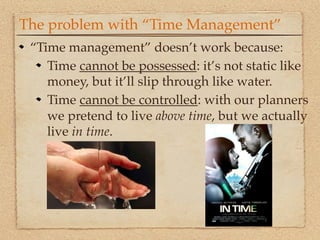
    Time cannot be possessed: it’s not static like
    money, but it’ll slip through like water.
    Time cannot be controlled: with our planners
    we pretend to live above time, but we actually
    live in time.
The problem with “Time Management”
 “Our problem with time is social, cultural, and
 economic, to be sure. But it is also a spiritual
 problem ... we come to believe that we, not
 God, are the masters of time. We come to
 believe that our worth must be proved by the
 way we spend our hours and that our ultimate
 safety depends on our own good
 management.” (Dorothy Bass)
The Lexicon of Time
 (Eph 5:15-17 ESV) Look carefully then how you
 walk, not as unwise but as wise, making the
 best use of the time, because the days are evil.
 Therefore do not be foolish, but understand
 what the will of the Lord is.
 (Eph 5:15-17 NIV) Be very careful, then, how
 you live — not as unwise but as wise, making
 the most of every opportunity, because the days
 are evil. Therefore do not be foolish, but
 understand what the Lord’s will is.
The Lexicon of Time
 There are two different Greek words for “time”:
   Chronos
   Kairos
Time: Chronos vs. Kairos
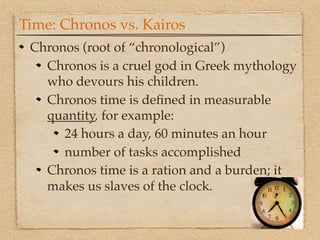
 Chronos (root of “chronological”)
   Chronos is a cruel god in Greek mythology
   who devours his children.
   Chronos time is defined in measurable
   quantity, for example:
      24 hours a day, 60 minutes an hour
      number of tasks accomplished
   Chronos time is a ration and a burden; it
   makes us slaves of the clock.
Time: Chronos vs. Kairos
 Kairos (used in Eph 5:16)
   Kairos means: the right moment, or an
   opportune moment.
   Kairos time is defined in quality and
   purpose.
   We can receive Kairos time as a gift and as
   an abundance.
Time: Chronos vs. Kairos
 (Eph 5:15-17 ESV) Look carefully then how you
 walk, not as unwise but as wise, making the
 best use of the time, because the days are evil.
 Therefore do not be foolish, but understand
 what the will of the Lord is.
    We can redeem Chronos time into Kairos
    time if we:
       Live carefully, paying attention.
       Make wise choices.
       Discern God’s will, and use our time
       accordingly.
Unit of Time in the Bible
 Q: What is the basic unit of time in the Bible?
    (Gen 1:5 ESV) God called the light Day, and
    the darkness he called Night. And there was
    evening and there was morning, the first
    day.
    (Ps 90:12 ESV) So teach us to number our
    days that we may get a heart of wisdom.
    (Matt 6:34 ESV) Therefore do not be anxious
    about tomorrow, for tomorrow will be
    anxious for itself. Sufficient for the day is its
    own trouble.
Receiving the Day as a Gift
 (Ps 118:24 ESV) This is the day that the LORD
 has made; let us rejoice and be glad in it.
    Q: Do you find it hard to obey this, that is, to
    rejoice every single day?
 We find it hard to rejoice every day because:
    We focus on the
    circumstances.
    We fail to see each day as
    God’s gift.
    We don’t understand the
    rhythm of our days.
Receiving the Day as a Gift
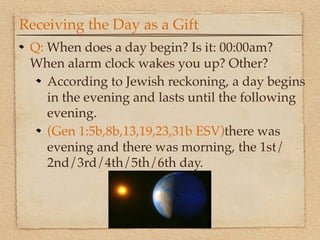
 Q: When does a day begin? Is it: 00:00am?
 When alarm clock wakes you up? Other?
    According to Jewish reckoning, a day begins
    in the evening and lasts until the following
    evening.
    (Gen 1:5b,8b,13,19,23,31b ESV)there was
    evening and there was morning, the 1st/
    2nd/3rd/4th/5th/6th day.
Receiving the Day as a Gift
 Evening = start of the day
   Therefore, we begin the day with sleep.
   Sleep is an act of self-abandonment: of
   control, of power. It is also an act of faith.
   (Ps 3:1,5 ESV) O LORD, how many are my
   foes! Many are rising against me; ... I lay
   down and slept; I woke again, for the LORD
   sustained me.
   (Ps 4:8 ESV) In peace I will both lie down
   and sleep; for you alone, O LORD, make me
   dwell in safety.
Receiving the Day as a Gift
 Q: Do you go to sleep, out of sheer exhaustion,
 or out of complete confidence in God?
 Also: Evening = God works while we sleep
    (Num 11:9 ESV) When the dew fell upon the
    camp in the night, the manna fell with it.
    (Matt 6:11 ESV) Give us this day our daily
    bread
Receiving the Day as a Gift
 Morning = we join in the work that God has
 already begun without us.
    (Ps 90:14-17 ESV) Satisfy us in the morning
    with your steadfast love, that we may rejoice
    and be glad all our days. Make us glad for as
    many days as you have afflicted us, and for
    as many years as we have seen evil. Let your
    work be shown to your servants, and your
    glorious power to their children. Let the
    favor of the Lord our God be upon us, and
    establish the work of our hands upon us;
    yes, establish the work of our hands!
Receiving the Day as a Gift
 Q: When someone says “God’s work,” what
 comes to mind?
    It isn’t limited to the work of a pastor or a
    missionary.
    (Ps 127:1 ESV) Unless the LORD builds the
    house, those who build it labor in vain.
    Unless the LORD watches over the city, the
    watchman stays awake in vain.
Receiving the Day as a Gift
 In response to God’s work, we work, as an act
 of faith.
 (Eph 6:5-7 ESV) !Bondservants, obey your
 earthly masters with fear and trembling, with a
 sincere heart, as you would Christ, not by the
 way of eye-service, as people-pleasers, but as
 bondservants of Christ, doing the will of God
 from the heart, rendering service with a good
 will as to the Lord and not to man
Receiving the Day as a Gift
 “This Hebrew evening/morning sequence
 conditions us to the rhythms of grace. We go to
 sleep, and God begins his work. ...... We wake
 and are called to participate in God’s creative
 action. We respond in faith, in work. But always
 grace is previous. Grace is primary. We wake
 into a world we didn’t make, into a salvation
 we didn’t earn. Evening: God begins, without
 our help, his creative day. Morning: God calls
 us to enjoy and share and develop the work he
 initiated.” (Eugene Peterson)
 Q: How’d this daily rhythm change your life?
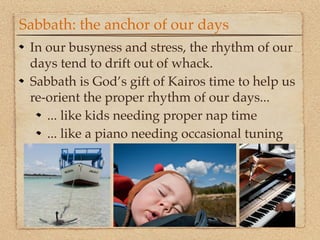
Sabbath: the anchor of our days
 In our busyness and stress, the rhythm of our
 days tend to drift out of whack.
 Sabbath is God’s gift of Kairos time to help us
 re-orient the proper rhythm of our days...
    ... like kids needing proper nap time
    ... like a piano needing occasional tuning
Sabbath: the anchor of our days
 The word “Sabbath” means: stop, rest
 (Ps 46:10 ESV) Be still, and know that I am God
    “God gave us the gift of Sabbath -- not just
    as a day, but as an orientation, a way of
    seeing and knowing.” (Mark Buchanan)
 (Isaiah 30:15 ESV) For thus said the Lord GOD,
 the Holy One of Israel, “In returning and rest
 you shall be saved; in quietness and in trust
 shall be your strength.”
    Those who keep the Sabbath live with more
    purpose, more resolve, more resiliency.
Sabbath: the anchor of our days
 (Isaiah 30:15-17a ESV) For thus said the Lord
 GOD, the Holy One of Israel, “In returning and
 rest you shall be saved; in quietness and in trust
 shall be your strength.” But you were
 unwilling, and you said, “No! We will flee upon
 horses”; therefore you shall flee away; and, “We
 will ride upon swift steeds”; therefore your
 pursuers shall be swift. A thousand shall flee at
 the threat of one; at the threat of five you shall
 flee
Sabbath: the anchor of our days
 In the face of troubles and burdens, our
 tendency is to flee.
     But fleeing is false safety. With each flight, it
     gets harder and harder to avoid fleeing.
 “God’s solution is surprising. He offers rest. But
 it’s a unique form of rest. It’s to rest in him in
 the midst of our threats and our
 burdens.” (Mark Buchanan)
     (Matt 11:28 ESV) Come to me, all who labor
     and are heavy laden, and I will give you rest.
Examples of Sabbath Keepers: Jews
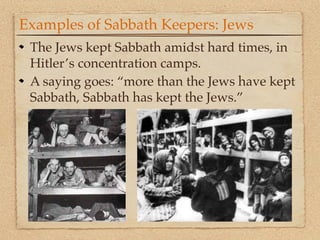
 The Jews kept Sabbath amidst hard times, in
 Hitler’s concentration camps.
 A saying goes: “more than the Jews have kept
 Sabbath, Sabbath has kept the Jews.”
Examples of Sabbath Keepers: Wilberforce
 William Wilberforce was famous for helping
 abolish slave trade.
 When he first entered British parliament, he
 was intoxicated with political ambitions, and he
 struggled with it.
 After a Sabbath day of solitude and
 rest, he wrote, “Blessed be to God
 for the day of rest and religious
 occupation wherein earthly things
 assume their true size. Ambition is
 stunted.”
References
 Receiving the Day (Dorothy Bass)
 The Rest of God (Mark Buchanan)
 “The Pastor’s Sabbath” (Eugene Peterson)
 “A Biblical View of Time” (Loren Pinilis)
 “Wisdom and Sabbath Rest” (Tim Keller)
 “Your Most Important Conversation” (Gordon
 McDonald)

Sabbath 1 - Understanding Our Days

  • 1.
    Sabbath (1): UnderstandingOur Days by Timothy Chan (August 2012)
  • 2.
    Sabbath (Ex 20:8-11ESV) Remember the Sabbath day, to keep it holy. Six days you shall labor, and do all your work, but the seventh day is a Sabbath to the LORD your God. On it you shall not do any work, you, or your son, or your daughter, your male servant, or your female servant, or your livestock, or the sojourner who is within your gates. For in six days the LORD made heaven and earth, the sea, and all that is in them, and rested on the seventh day. Therefore the LORD blessed the Sabbath day and made it holy.
  • 3.
    Sabbath Why shouldwe study about the Sabbath? Sabbath = most neglected commandment We don’t neglect worshipping God, honoring parents, not killing people. We are not even conscious of it. Sabbath is often misunderstood, followed legalistically (rules!), or treated as a burden. The keeping of Sabbath has important impact on our daily life, and for our future.
  • 4.
    Our Relationship with“Time” Q: What is a typical answer for “How are you?” “Busy” is now the new “Fine”.
  • 5.
    Our Relationship with“Time” Q: Do you tend to agree when people say “Twenty four hours a day is not enough”? Typical solution: Time management i.e. visualizing time as a sequence of little boxes, and determining what tasks go into which boxes. But... we still find it hard to complete our tasks and our plans no matter how much time we have. Q: Why?
  • 6.
    The problem with“Time Management” “Time management” doesn’t work because: Time cannot be possessed: it’s not static like money, but it’ll slip through like water. Time cannot be controlled: with our planners we pretend to live above time, but we actually live in time.
  • 7.
    The problem with“Time Management” “Our problem with time is social, cultural, and economic, to be sure. But it is also a spiritual problem ... we come to believe that we, not God, are the masters of time. We come to believe that our worth must be proved by the way we spend our hours and that our ultimate safety depends on our own good management.” (Dorothy Bass)
  • 8.
    The Lexicon ofTime (Eph 5:15-17 ESV) Look carefully then how you walk, not as unwise but as wise, making the best use of the time, because the days are evil. Therefore do not be foolish, but understand what the will of the Lord is. (Eph 5:15-17 NIV) Be very careful, then, how you live — not as unwise but as wise, making the most of every opportunity, because the days are evil. Therefore do not be foolish, but understand what the Lord’s will is.
  • 9.
    The Lexicon ofTime There are two different Greek words for “time”: Chronos Kairos
  • 10.
    Time: Chronos vs.Kairos Chronos (root of “chronological”) Chronos is a cruel god in Greek mythology who devours his children. Chronos time is defined in measurable quantity, for example: 24 hours a day, 60 minutes an hour number of tasks accomplished Chronos time is a ration and a burden; it makes us slaves of the clock.
  • 11.
    Time: Chronos vs.Kairos Kairos (used in Eph 5:16) Kairos means: the right moment, or an opportune moment. Kairos time is defined in quality and purpose. We can receive Kairos time as a gift and as an abundance.
  • 12.
    Time: Chronos vs.Kairos (Eph 5:15-17 ESV) Look carefully then how you walk, not as unwise but as wise, making the best use of the time, because the days are evil. Therefore do not be foolish, but understand what the will of the Lord is. We can redeem Chronos time into Kairos time if we: Live carefully, paying attention. Make wise choices. Discern God’s will, and use our time accordingly.
  • 13.
    Unit of Timein the Bible Q: What is the basic unit of time in the Bible? (Gen 1:5 ESV) God called the light Day, and the darkness he called Night. And there was evening and there was morning, the first day. (Ps 90:12 ESV) So teach us to number our days that we may get a heart of wisdom. (Matt 6:34 ESV) Therefore do not be anxious about tomorrow, for tomorrow will be anxious for itself. Sufficient for the day is its own trouble.
  • 14.
    Receiving the Dayas a Gift (Ps 118:24 ESV) This is the day that the LORD has made; let us rejoice and be glad in it. Q: Do you find it hard to obey this, that is, to rejoice every single day? We find it hard to rejoice every day because: We focus on the circumstances. We fail to see each day as God’s gift. We don’t understand the rhythm of our days.
  • 15.
    Receiving the Dayas a Gift Q: When does a day begin? Is it: 00:00am? When alarm clock wakes you up? Other? According to Jewish reckoning, a day begins in the evening and lasts until the following evening. (Gen 1:5b,8b,13,19,23,31b ESV)there was evening and there was morning, the 1st/ 2nd/3rd/4th/5th/6th day.
  • 16.
    Receiving the Dayas a Gift Evening = start of the day Therefore, we begin the day with sleep. Sleep is an act of self-abandonment: of control, of power. It is also an act of faith. (Ps 3:1,5 ESV) O LORD, how many are my foes! Many are rising against me; ... I lay down and slept; I woke again, for the LORD sustained me. (Ps 4:8 ESV) In peace I will both lie down and sleep; for you alone, O LORD, make me dwell in safety.
  • 17.
    Receiving the Dayas a Gift Q: Do you go to sleep, out of sheer exhaustion, or out of complete confidence in God? Also: Evening = God works while we sleep (Num 11:9 ESV) When the dew fell upon the camp in the night, the manna fell with it. (Matt 6:11 ESV) Give us this day our daily bread
  • 18.
    Receiving the Dayas a Gift Morning = we join in the work that God has already begun without us. (Ps 90:14-17 ESV) Satisfy us in the morning with your steadfast love, that we may rejoice and be glad all our days. Make us glad for as many days as you have afflicted us, and for as many years as we have seen evil. Let your work be shown to your servants, and your glorious power to their children. Let the favor of the Lord our God be upon us, and establish the work of our hands upon us; yes, establish the work of our hands!
  • 19.
    Receiving the Dayas a Gift Q: When someone says “God’s work,” what comes to mind? It isn’t limited to the work of a pastor or a missionary. (Ps 127:1 ESV) Unless the LORD builds the house, those who build it labor in vain. Unless the LORD watches over the city, the watchman stays awake in vain.
  • 20.
    Receiving the Dayas a Gift In response to God’s work, we work, as an act of faith. (Eph 6:5-7 ESV) !Bondservants, obey your earthly masters with fear and trembling, with a sincere heart, as you would Christ, not by the way of eye-service, as people-pleasers, but as bondservants of Christ, doing the will of God from the heart, rendering service with a good will as to the Lord and not to man
  • 21.
    Receiving the Dayas a Gift “This Hebrew evening/morning sequence conditions us to the rhythms of grace. We go to sleep, and God begins his work. ...... We wake and are called to participate in God’s creative action. We respond in faith, in work. But always grace is previous. Grace is primary. We wake into a world we didn’t make, into a salvation we didn’t earn. Evening: God begins, without our help, his creative day. Morning: God calls us to enjoy and share and develop the work he initiated.” (Eugene Peterson) Q: How’d this daily rhythm change your life?
  • 22.
    Sabbath: the anchorof our days In our busyness and stress, the rhythm of our days tend to drift out of whack. Sabbath is God’s gift of Kairos time to help us re-orient the proper rhythm of our days... ... like kids needing proper nap time ... like a piano needing occasional tuning
  • 23.
    Sabbath: the anchorof our days The word “Sabbath” means: stop, rest (Ps 46:10 ESV) Be still, and know that I am God “God gave us the gift of Sabbath -- not just as a day, but as an orientation, a way of seeing and knowing.” (Mark Buchanan) (Isaiah 30:15 ESV) For thus said the Lord GOD, the Holy One of Israel, “In returning and rest you shall be saved; in quietness and in trust shall be your strength.” Those who keep the Sabbath live with more purpose, more resolve, more resiliency.
  • 24.
    Sabbath: the anchorof our days (Isaiah 30:15-17a ESV) For thus said the Lord GOD, the Holy One of Israel, “In returning and rest you shall be saved; in quietness and in trust shall be your strength.” But you were unwilling, and you said, “No! We will flee upon horses”; therefore you shall flee away; and, “We will ride upon swift steeds”; therefore your pursuers shall be swift. A thousand shall flee at the threat of one; at the threat of five you shall flee
  • 25.
    Sabbath: the anchorof our days In the face of troubles and burdens, our tendency is to flee. But fleeing is false safety. With each flight, it gets harder and harder to avoid fleeing. “God’s solution is surprising. He offers rest. But it’s a unique form of rest. It’s to rest in him in the midst of our threats and our burdens.” (Mark Buchanan) (Matt 11:28 ESV) Come to me, all who labor and are heavy laden, and I will give you rest.
  • 26.
    Examples of SabbathKeepers: Jews The Jews kept Sabbath amidst hard times, in Hitler’s concentration camps. A saying goes: “more than the Jews have kept Sabbath, Sabbath has kept the Jews.”
  • 27.
    Examples of SabbathKeepers: Wilberforce William Wilberforce was famous for helping abolish slave trade. When he first entered British parliament, he was intoxicated with political ambitions, and he struggled with it. After a Sabbath day of solitude and rest, he wrote, “Blessed be to God for the day of rest and religious occupation wherein earthly things assume their true size. Ambition is stunted.”
  • 28.
    References Receiving theDay (Dorothy Bass) The Rest of God (Mark Buchanan) “The Pastor’s Sabbath” (Eugene Peterson) “A Biblical View of Time” (Loren Pinilis) “Wisdom and Sabbath Rest” (Tim Keller) “Your Most Important Conversation” (Gordon McDonald)