Sabbath (3):
         Lord of the Sabbath


by Timothy Chan
 (October 2012)
Sabbath: What? How?
 By now, you might like to ask: “What practical
 things should I do in order to keep the
 Sabbath”?
 The Bible does contain some scant instructions
 and general practical guidelines on the Sabbath
 day, but it’s mostly silent or vague on the
 specifics.
 From the last study, you should know by now
 that Sabbath is more of a heart attitude than a
 set of do’s and don’ts.
 But, by nature, we all tend toward legalism ......
Legalism
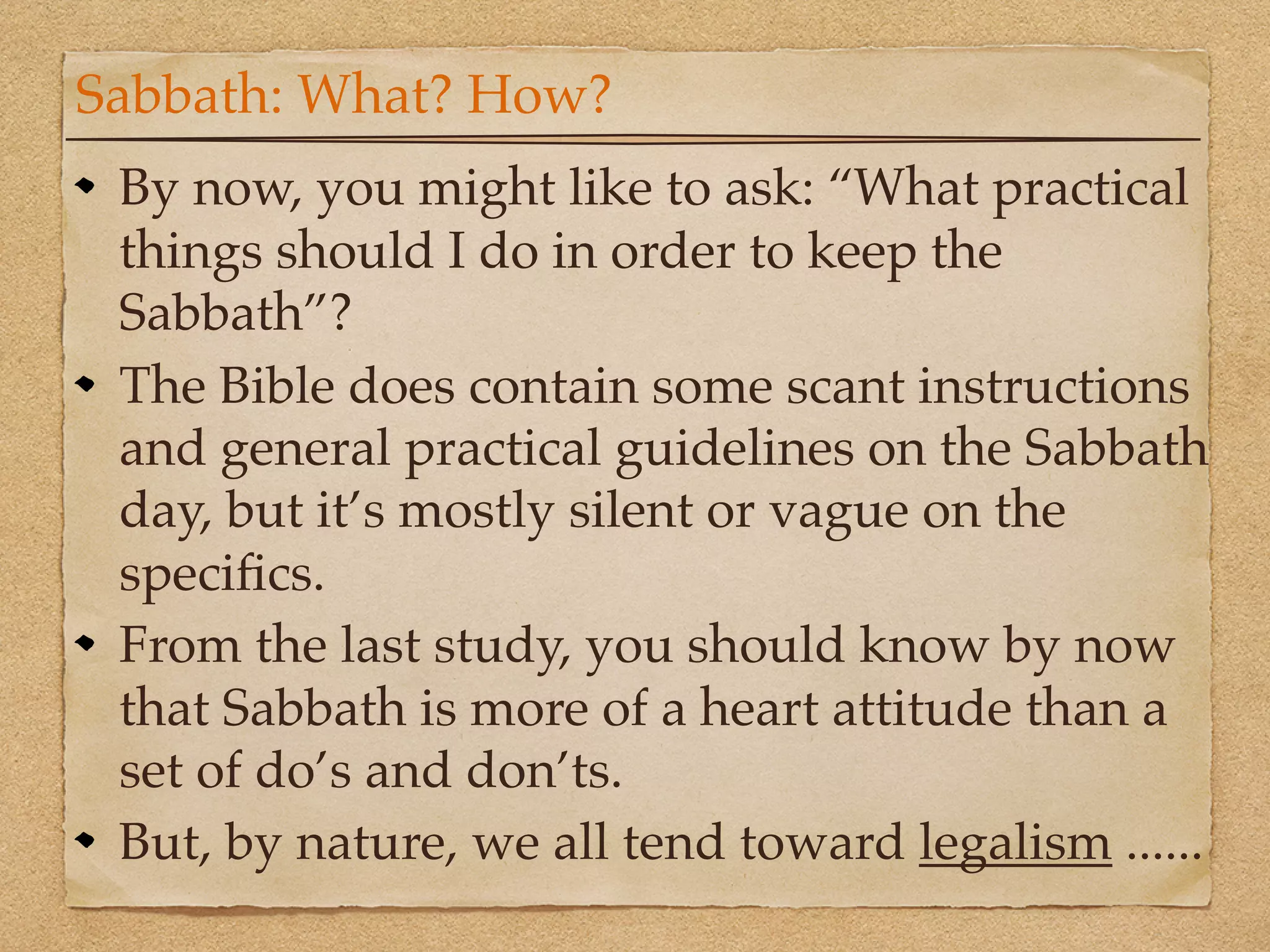
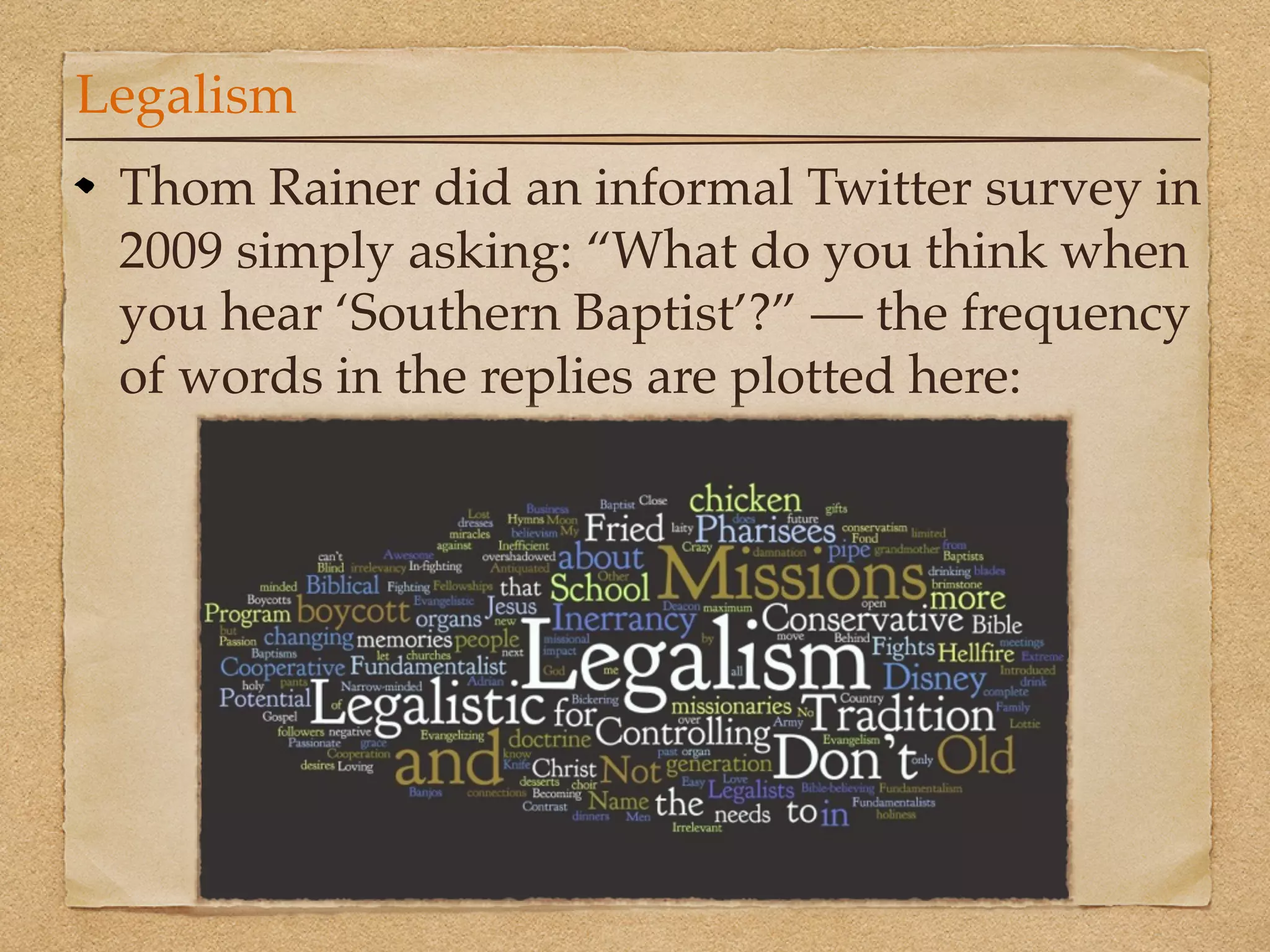
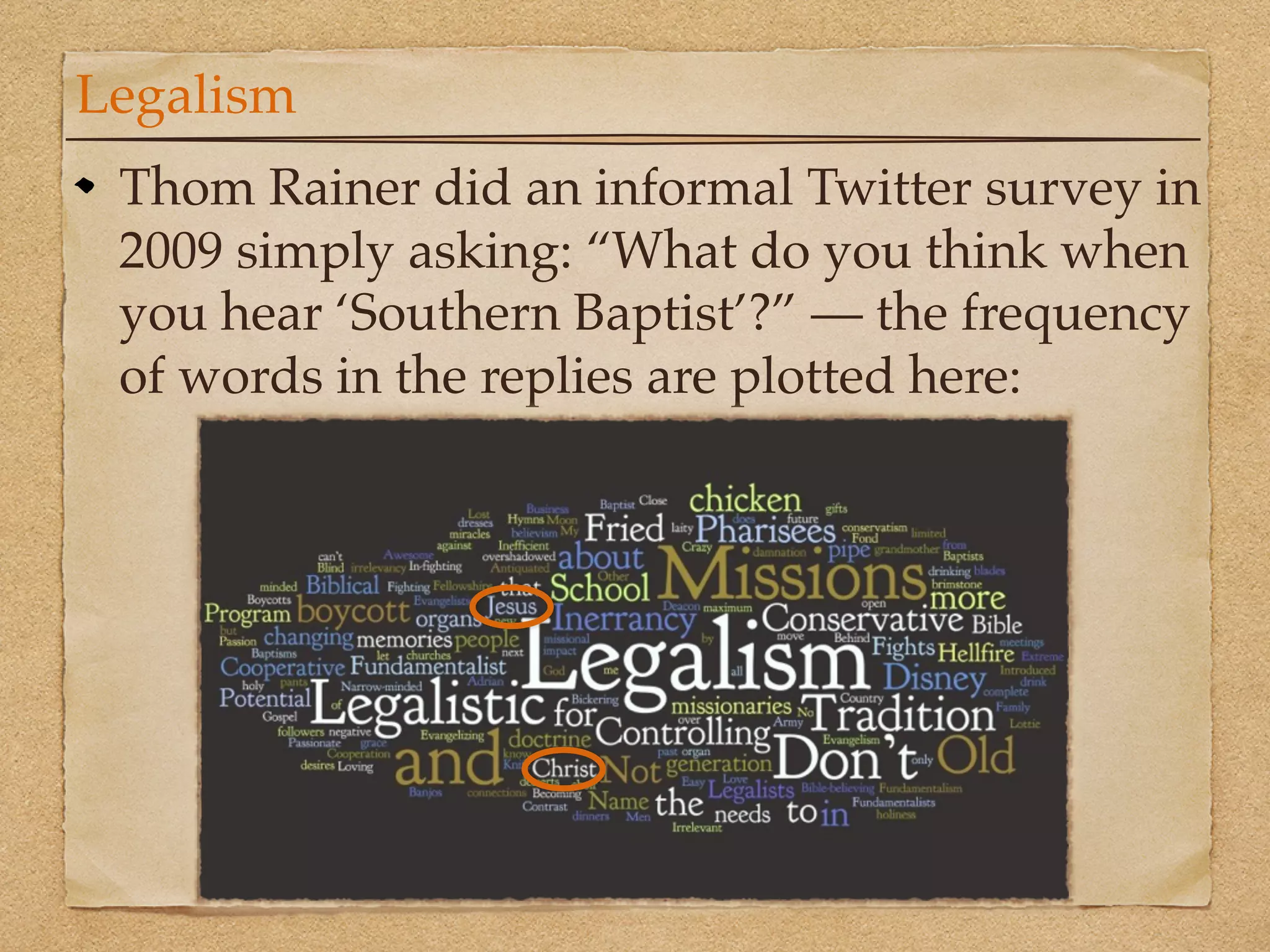
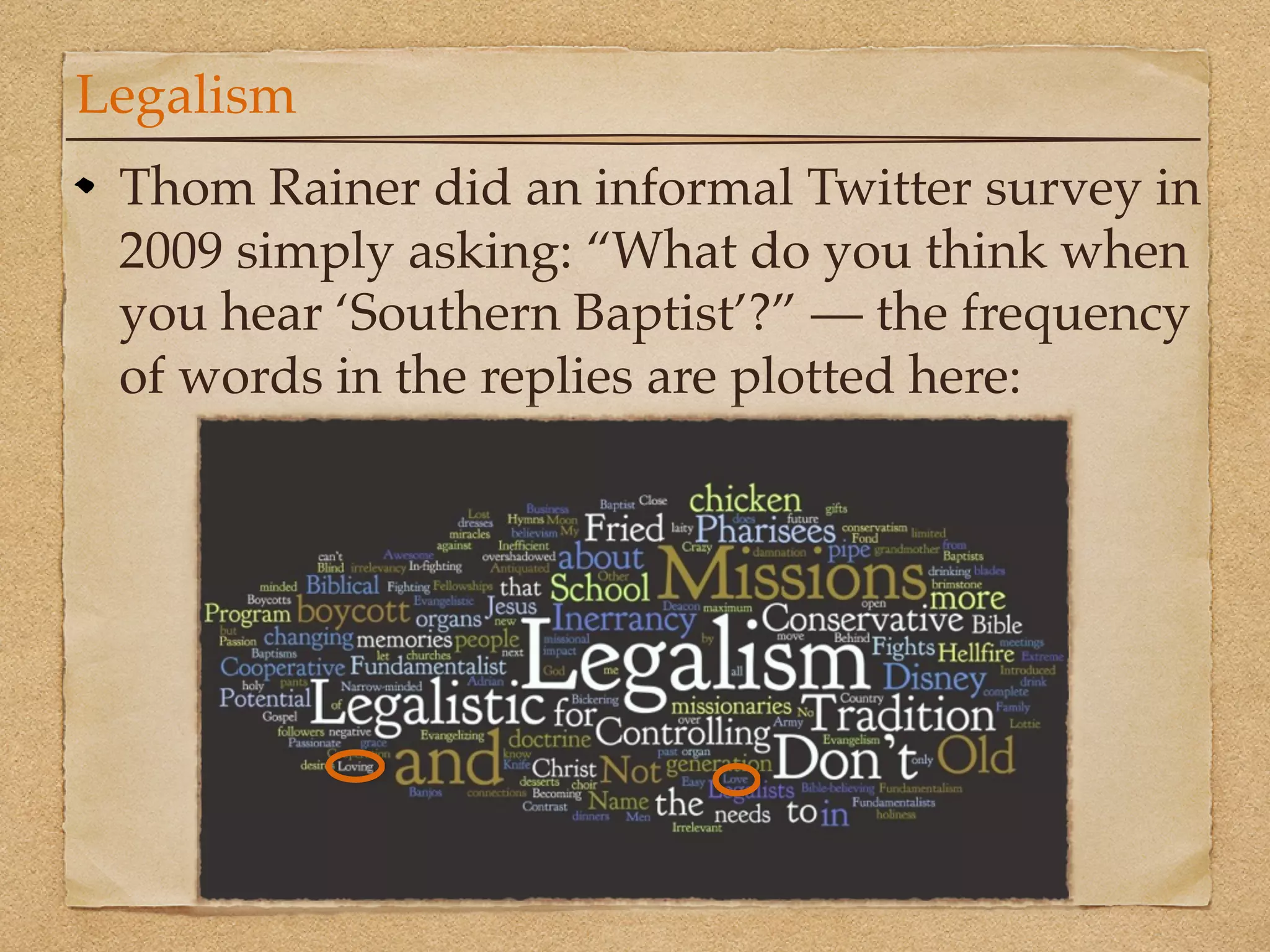
 Thom Rainer did an informal Twitter survey in
 2009 simply asking: “What do you think when
 you hear ‘Southern Baptist’?” — the frequency
 of words in the replies are plotted here:
Legalism
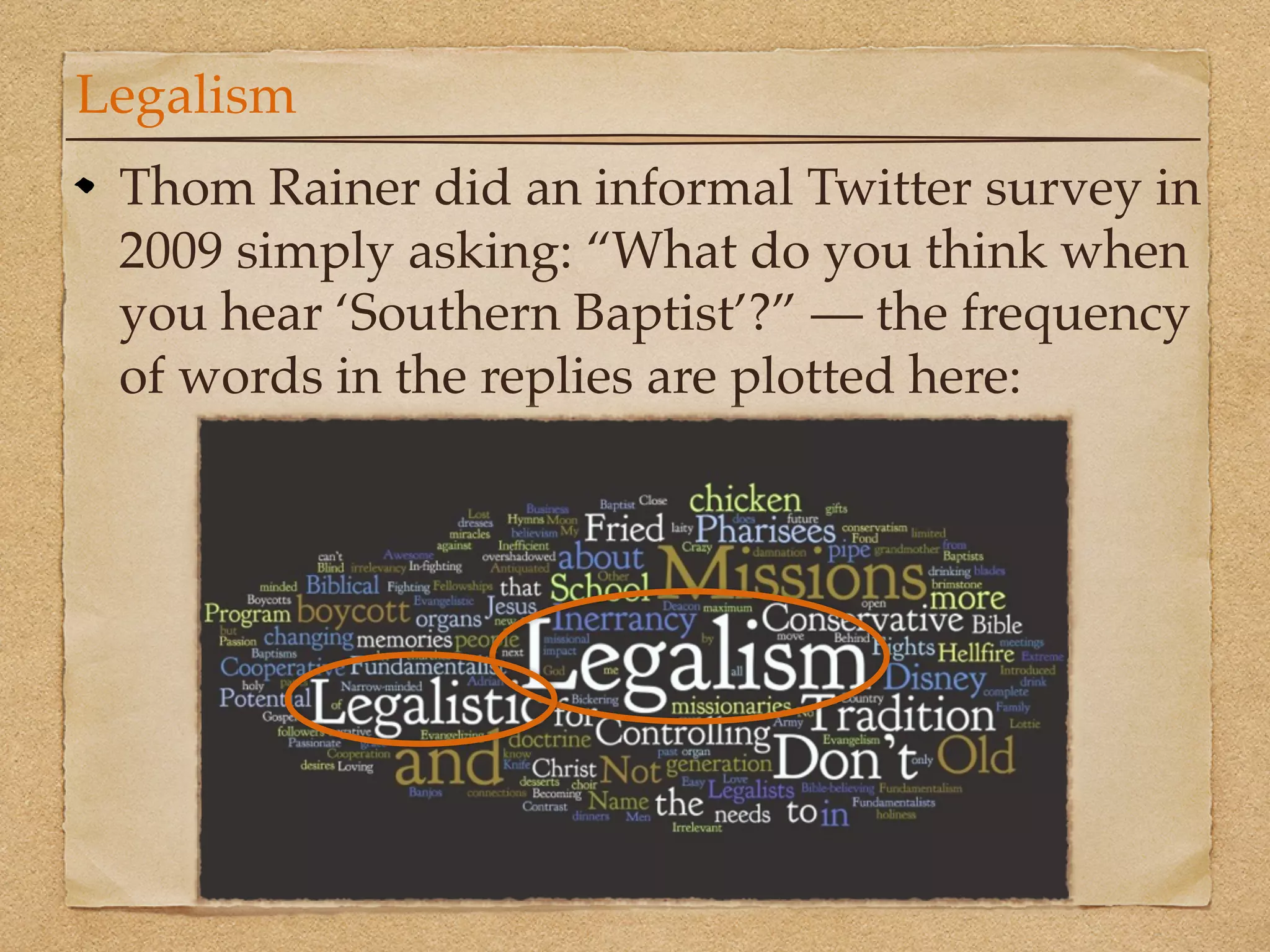
 Thom Rainer did an informal Twitter survey in
 2009 simply asking: “What do you think when
 you hear ‘Southern Baptist’?” — the frequency
 of words in the replies are plotted here:
Legalism
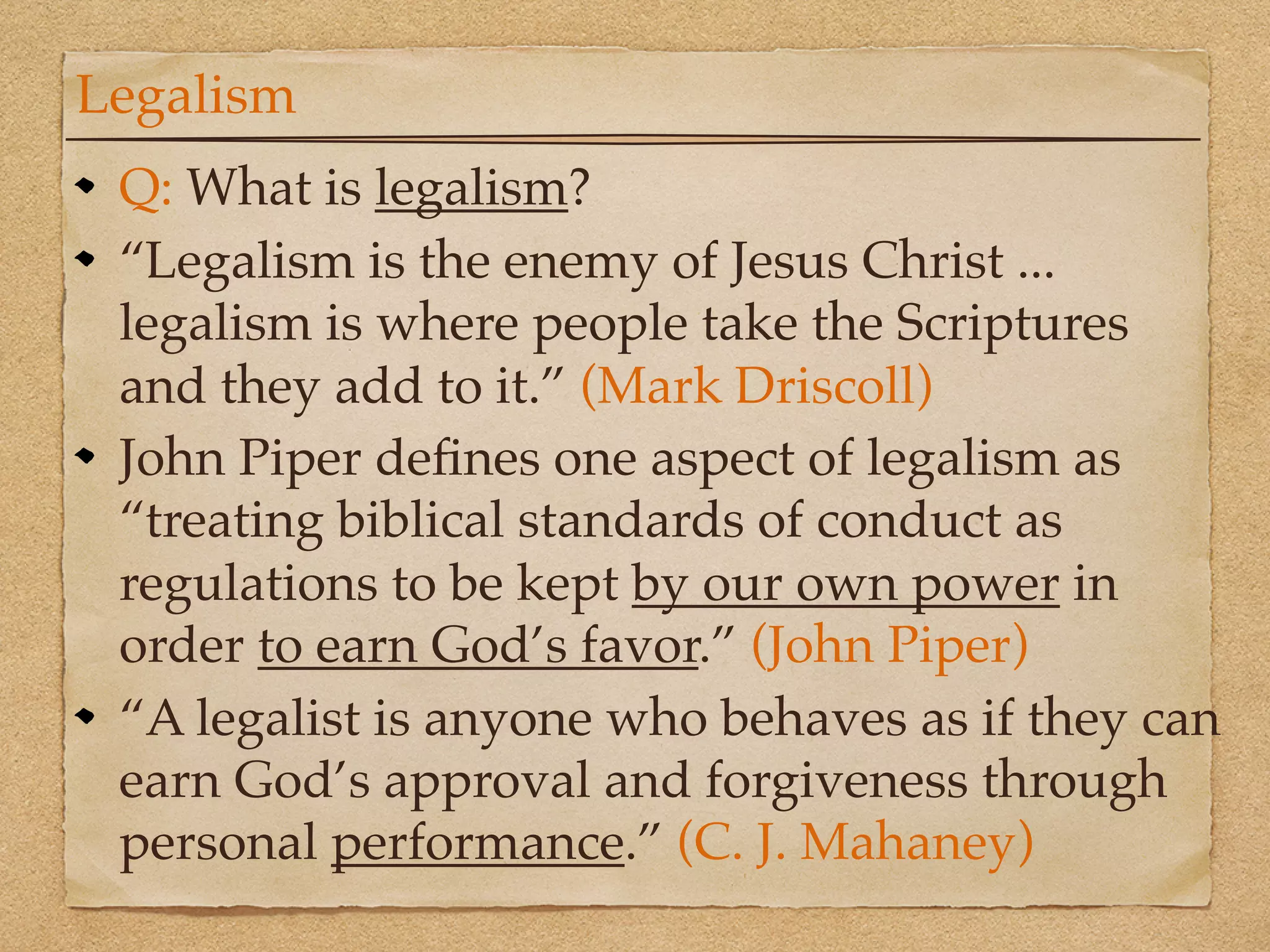
 Thom Rainer did an informal Twitter survey in
 2009 simply asking: “What do you think when
 you hear ‘Southern Baptist’?” — the frequency
 of words in the replies are plotted here:
Legalism
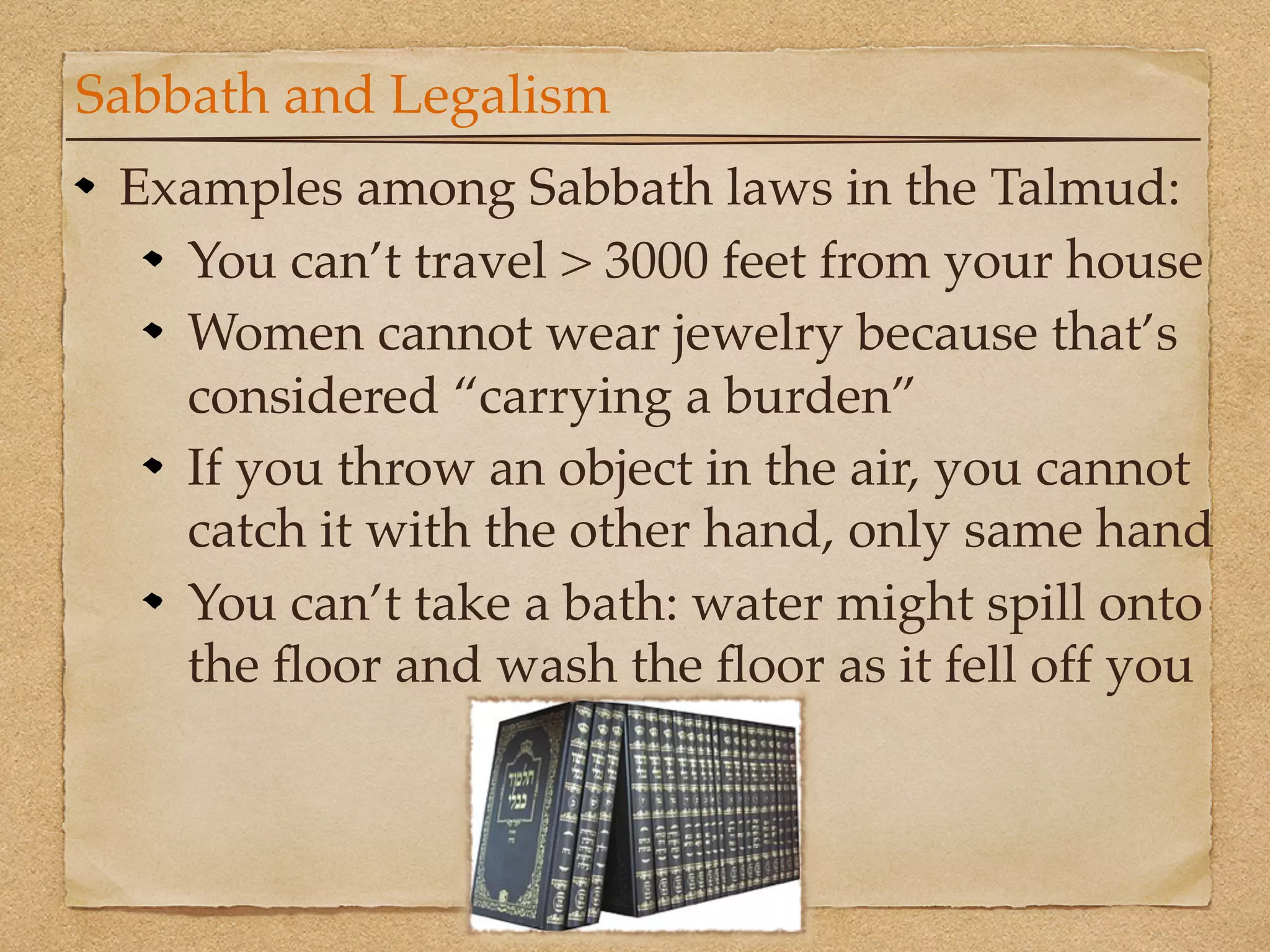
 Thom Rainer did an informal Twitter survey in
 2009 simply asking: “What do you think when
 you hear ‘Southern Baptist’?” — the frequency
 of words in the replies are plotted here:
Legalism
 Q: What is legalism?
 “Legalism is the enemy of Jesus Christ ...
 legalism is where people take the Scriptures
 and they add to it.” (Mark Driscoll)
 John Piper defines one aspect of legalism as
 “treating biblical standards of conduct as
 regulations to be kept by our own power in
 order to earn God’s favor.” (John Piper)
 “A legalist is anyone who behaves as if they can
 earn God’s approval and forgiveness through
 personal performance.” (C. J. Mahaney)
Sabbath and Legalism
 Examples among Sabbath laws in the Talmud:
   You can’t travel > 3000 feet from your house
   Women cannot wear jewelry because that’s
   considered “carrying a burden”
   If you throw an object in the air, you cannot
   catch it with the other hand, only same hand
   You can’t take a bath: water might spill onto
   the floor and wash the floor as it fell off you
Sabbath and Legalism
 (Isaiah 28:12-13a ESV) [The LORD] has said,
 “This is rest; give rest to the weary; and this is
 repose”; yet they would not hear. And the word
 of the LORD will be to them precept upon
 precept, precept upon precept, line upon line,
 line upon line, here a little, there a little.
 So: “What I can do and can’t do on Sabbath?” is
 often the wrong question, the wrong focus.
 The correct question/focus is “Who”
 (as we study Matthew 11:28-12:14) ...
Jesus Gives Rest (Matthew 11:28-30)
(Matt 11:28-30 ESV) Come to me, all who labor and
are heavy laden, and I will give you rest. Take my
yoke upon you, and learn from me, for I am gentle
and lowly in heart, and you will find rest for your
souls. For my yoke is easy, and my burden is light.
  Rest does not come about by following rules, but
  by following Christ.
  Rest is not earned, but “given” and “found”.
  “Sabbath is about more than external rest of the
  body; it is about inner rest of the soul.” (Tim
  Keller)
Jesus Gives Rest (Matthew 11:28-30)
 The word translated “labor” is kopiaō, which
 “signifies labor to the point of sweat and
 exhaustion. As Jesus uses it here, it is a
 reference to the futility of attempting to please
 God through human effort. It describes one
 weary of the search for truth, one who has
 despaired of trying to earn salvation.” (John
 MacArthur)
    In other words, the source of labor can be
    our legalism.
    Q: Do you think you struggle with legalism?
Jesus Gives Rest (Matthew 11:28-30)
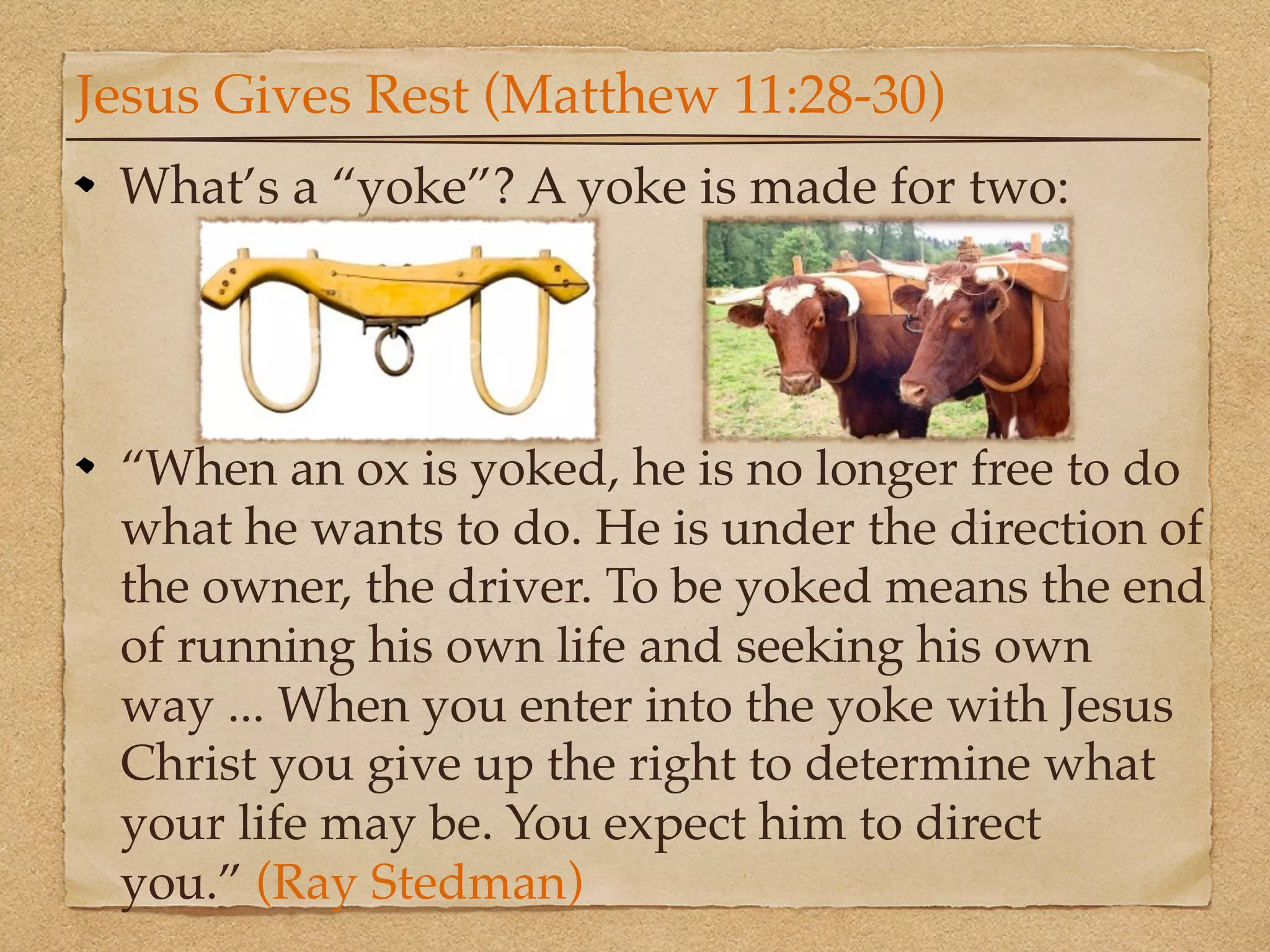
 What’s a “yoke”? A yoke is made for two:


 “When an ox is yoked, he is no longer free to do
 what he wants to do. He is under the direction of
 the owner, the driver. To be yoked means the end
 of running his own life and seeking his own
 way ... When you enter into the yoke with Jesus
 Christ you give up the right to determine what
 your life may be. You expect him to direct
 you.” (Ray Stedman)
Jesus Gives Rest (Matthew 11:28-30)
 “The reason why you cannot enter into the joy
 and glory and excitement of the rest which God
 has provided in ceasing from your own
 activities and resting upon his, is because, in
 some way or another, you are protecting some
 area of the ego, the self-life, saying, ‘This is
 mine; keep your hands off.’ As long as you do
 that you cannot have rest.” (Ray Stedman)
 Q: How much do you let Christ direct your life?
 In what areas in your life do you tend to say,
 “Hands off, Jesus! Hands off, God!”?
Jesus Gives Rest (Matthew 11:28-30)
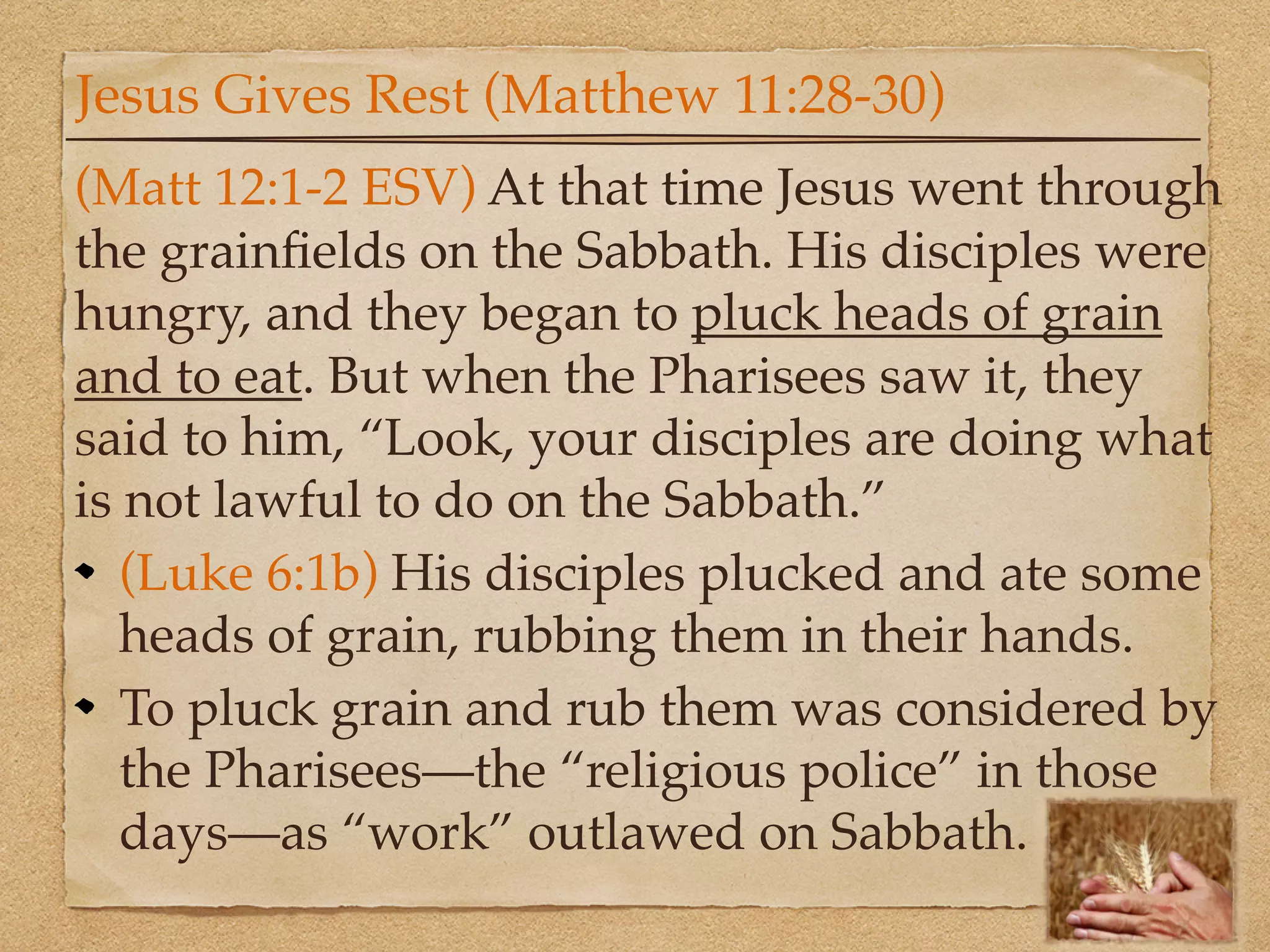
(Matt 12:1-2 ESV) At that time Jesus went through
the grainfields on the Sabbath. His disciples were
hungry, and they began to pluck heads of grain
and to eat. But when the Pharisees saw it, they
said to him, “Look, your disciples are doing what
is not lawful to do on the Sabbath.”
   (Luke 6:1b) His disciples plucked and ate some
   heads of grain, rubbing them in their hands.
   To pluck grain and rub them was considered by
   the Pharisees—the “religious police” in those
   days—as “work” outlawed on Sabbath.
Lord of the Sabbath (Matthew 12:1-8)
(Matt 12:3-5 ESV) He said to them, “Have you not read
what David did when he was hungry, and those who
were with him: how he entered the house of God and
ate the bread of the Presence, which it was not lawful
for him to eat nor for those who were with him, but
only for the priests? Or have you not read in the Law
how on the Sabbath the priests in the temple profane
the Sabbath and are guiltless?
  “Have you not read?”—of course the Pharisees
  know the Scriptures—but they merely read the
  words yet do not discern the meaning of the law.
  What’s wrong with the Pharisees is not mainly in
  what they do, but in their reasons for doing so.
Lord of the Sabbath (Matthew 12:1-8)
 Often we’re like the Pharisees: we make up and
 obey a bunch of rules, but we don’t know why,
 and we accuse others for not doing what we do.
      “Church members are not allowed to dance,
      watch movies, drink alcohol, and smoke.”
      “Mature Christians should attend the weekly
      prayer meeting.”
      “Everyone should commit to serve God more.”
      Q: What do you think? Any other examples?
 It is a trap: if we succeed in performing our rules,
 it’ll lead to pride; if we fail, it’ll lead to guilt.
Lord of the Sabbath (Matthew 12:1-8)
 “The Christian community is largely a
 performance-based culture today. And the more
 deeply committed we are to following Jesus,
 the more deeply ingrained the performance
 mindset is.” (Jerry Bridges)
Lord of the Sabbath (Matthew 12:1-8)
(Matt 12:6-8 ESV) I tell you, something greater than
the temple is here. And if you had known what this
means, ‘I desire mercy, and not sacrifice,’ you
would not have condemned the guiltless. For the
Son of Man is lord of the Sabbath.”
  (Hosea 6:6 KJV) I desired mercy, and not sacrifice
  “In other words the whole law exists for the sake
  of mercy. All the law is summed up in this one
  word: You shall love your neighbor as yourself.
  The Pharisees couldn’t see the true meaning of
  the sabbath because they didn't have hearts of
  love.” (John Piper)
Lord of the Sabbath (Matthew 12:1-8)
 (Mark 2:27-28 ESV) And he said to them, “The
 Sabbath was made for man, not man for the
 Sabbath. So the Son of Man is lord even of the
 Sabbath.”
 “If your heart isn’t a heart for man—if it is not a
 heart of love—you cannot see the meaning of
 the sabbath. For the sabbath is a gift of love to
 meet man’s need, not an oppressive burden to
 make him miserable or proud.” (John Piper)
Healing on the Sabbath (Matthew 12:9-13)
(Matt 12:9-13 ESV) He went on from there and entered
their synagogue. And a man was there with a
withered hand. And they asked him, “Is it lawful to
heal on the Sabbath?”—so that they might accuse him.
He said to them, “Which one of you who has a sheep,
if it falls into a pit on the Sabbath, will not take hold of
it and lift it out? Of how much more value is a man
than a sheep! So it is lawful to do good on the
Sabbath.” Then he said to the man, “Stretch out your
hand.” And the man stretched it out, and it was
restored, healthy like the other.
   Jesus turned the question of permission into a
   question of compassion.
Healing on the Sabbath (Matthew 12:9-13)
 “When Jesus broke man-made Sabbath
 regulations, he always went in this direction: he
 healed, he fed, he claimed the right to rescue
 creatures fallen into wells or to lead to wells
 creatures falling down with thirst. Jesus
 pursued those things that give life. ...... So I
 submit this as Sabbath’s golden rule: Cease from
 what is necessary. Embrace that which gives
 life.” (Mark Buchanan)
Killing on the Sabbath (Matthew 12:14)
(Matt 12:14 ESV) But the Pharisees went out and
conspired against him, how to destroy him.
  (Mark 3:6 ESV) The Pharisees went out and
  immediately held counsel with the Herodians
  against him, how to destroy him.
     Note: the Pharisees and Herodians were
     supposed to despise each other.
  “As they see it, healing on the Sabbath is
  forbidden, but plotting murder is perfectly
  acceptable. This is legalism at its most
  flagrant.” (Mark Buchanan)
  Q: Why do you think they need to kill Jesus?
Killing on the Sabbath (Matthew 12:14)
 Two reasons they want to kill Jesus are found in:
 John 5:16-18
 (John 5:16-18 ESV) And this was why the Jews
 were persecuting Jesus, because he was doing
 these things on the Sabbath. But Jesus answered
 them, “My Father is working until now, and I am
 working.” This was why the Jews were seeking all
 the more to kill him, because not only was he
 breaking the Sabbath, but he was even calling God
 his own Father, making himself equal with God.
  1. Jesus equated himself with God.
  2. Jesus broke their Sabbath laws.
Killing on the Sabbath (Matthew 12:14)
 The Pharisees plan to kill Jesus to maintain the
 safety of their legalistic beliefs and practices.
 “Our rules become our substitute savior, and
 keeping those rules becomes our self-salvation
 project, with Jesus safely outside the picture.
 With enough rules and regulations set up, we
 don’t need Jesus. After all, Jesus scares us—he’s
 so unpredictable, so uncontrollable. ... So we
 spend our lives trying to manufacture an
 existence that we can control.” (Tullian
 Tchividjian)
Killing on the Sabbath (Matthew 12:14)
 “Most of us convince ourselves that we’re
 actually honoring Jesus with our rules and
 regulations, that we’re paying attention to him
 and pleasing him more than ever. But all the
 while, we’re only demonstrating that we
 believe in ourselves much more than we do in
 Jesus.” (Tullian Tchividjian)
 Q: Which of your “religious practices” and
 “moral codes” could stay the same regardless
 of whether Jesus is your crucified and
 resurrected Savior or not?
Sabbath: What Christ Has Done
 To summarize the lesson about Sabbath in Matthew
 11:28-12:14, Sabbath rest is all about what Christ has
 done, not what you do.
 Psalm 92 is a “Song for the Sabbath”; it goes:
     (Ps 92:1-5 ESV) (A Psalm. A Song for the Sabbath.)
     It is good to give thanks to the LORD, to sing
     praises to your name, O Most High; to declare your
     steadfast love in the morning, and your faithfulness
     by night, to the music of the lute and the harp, to
     the melody of the lyre. For you, O LORD, have
     made me glad by your work; at the works of your
     hands I sing for joy. How great are your works, O
     LORD! Your thoughts are very deep!
Story of Samuel and Eli
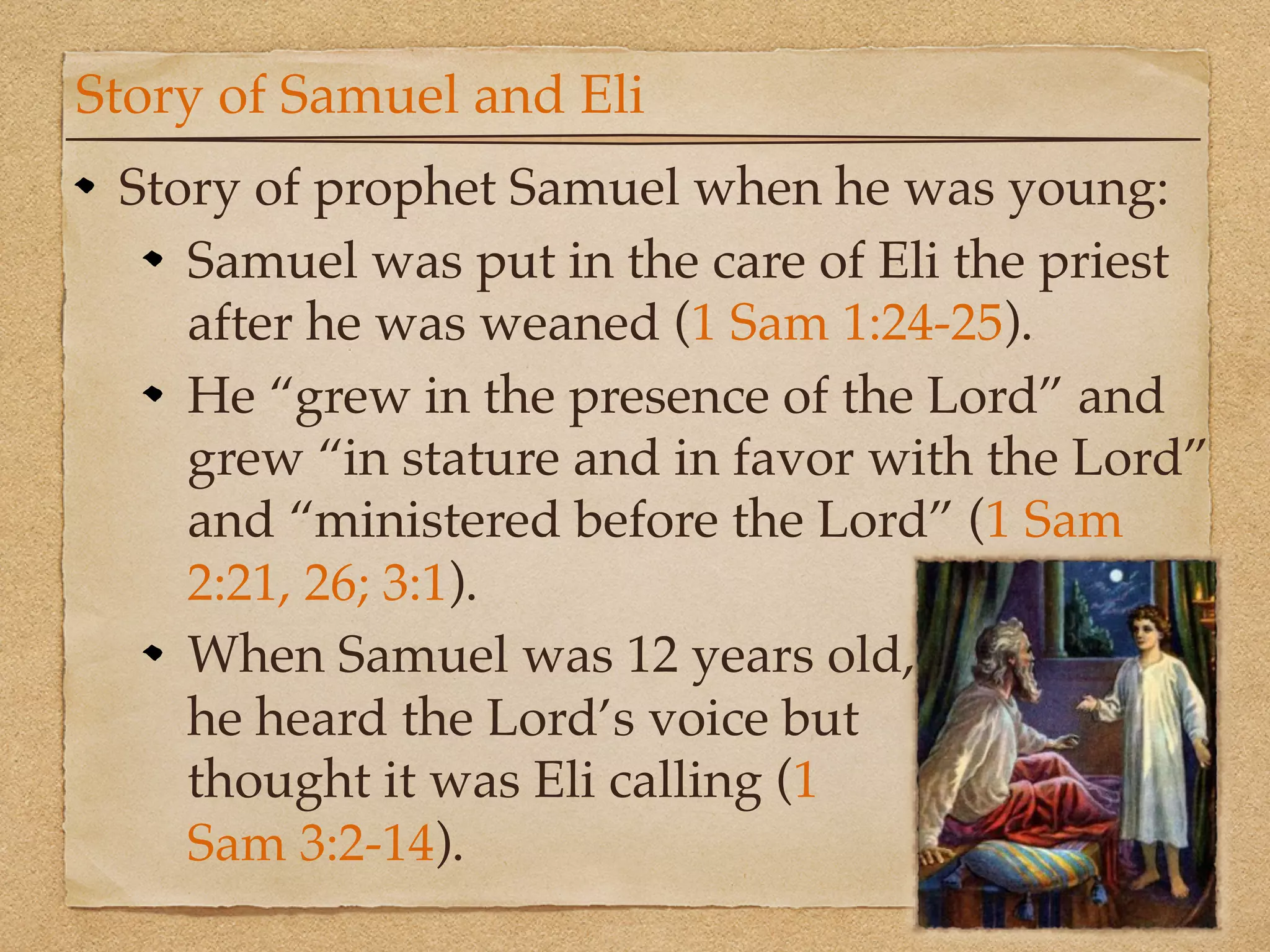
 Story of prophet Samuel when he was young:
    Samuel was put in the care of Eli the priest
    after he was weaned (1 Sam 1:24-25).
    He “grew in the presence of the Lord” and
    grew “in stature and in favor with the Lord”
    and “ministered before the Lord” (1 Sam
    2:21, 26; 3:1).
    When Samuel was 12 years old,
    he heard the Lord’s voice but
    thought it was Eli calling (1
    Sam 3:2-14).
Story of Samuel and Eli
 The most curious verse in this story is 3:7:
    (1 Sam 3:7 ESV) Now Samuel did not yet
    know the Lord, and the word of the Lord
    had not yet been revealed to him.
 “We encounter an ancient problem that plagues
 us still, that is as old as the garden and as
 contemporary as this morning’s news: we can be
 very busy for God and still not know him. ......
 Absurd.” (Mark Buchanan)
 Q: Have you neglected to know God?
References
 The Rest of God (Mark Buchanan)
 Jesus + Nothing = Everything (Tullian
 Tchividjian)
 “Remember the Sabbath Day to Keep It
 Holy” (John Piper)
 “Flesh Tank and Peashooter Regulations” (John
 Piper)
 “The Lord of the Sabbath” (John MacArthur)
 “The Seventh Day” (Ray Stedman)
 “Gospel-Driven Sanctification” (Jerry Bridges)

Sabbath 3 - Lord of the Sabbath

  • 1.
    Sabbath (3): Lord of the Sabbath by Timothy Chan (October 2012)
  • 2.
    Sabbath: What? How? By now, you might like to ask: “What practical things should I do in order to keep the Sabbath”? The Bible does contain some scant instructions and general practical guidelines on the Sabbath day, but it’s mostly silent or vague on the specifics. From the last study, you should know by now that Sabbath is more of a heart attitude than a set of do’s and don’ts. But, by nature, we all tend toward legalism ......
  • 3.
    Legalism Thom Rainerdid an informal Twitter survey in 2009 simply asking: “What do you think when you hear ‘Southern Baptist’?” — the frequency of words in the replies are plotted here:
  • 4.
    Legalism Thom Rainerdid an informal Twitter survey in 2009 simply asking: “What do you think when you hear ‘Southern Baptist’?” — the frequency of words in the replies are plotted here:
  • 5.
    Legalism Thom Rainerdid an informal Twitter survey in 2009 simply asking: “What do you think when you hear ‘Southern Baptist’?” — the frequency of words in the replies are plotted here:
  • 6.
    Legalism Thom Rainerdid an informal Twitter survey in 2009 simply asking: “What do you think when you hear ‘Southern Baptist’?” — the frequency of words in the replies are plotted here:
  • 7.
    Legalism Q: Whatis legalism? “Legalism is the enemy of Jesus Christ ... legalism is where people take the Scriptures and they add to it.” (Mark Driscoll) John Piper defines one aspect of legalism as “treating biblical standards of conduct as regulations to be kept by our own power in order to earn God’s favor.” (John Piper) “A legalist is anyone who behaves as if they can earn God’s approval and forgiveness through personal performance.” (C. J. Mahaney)
  • 8.
    Sabbath and Legalism Examples among Sabbath laws in the Talmud: You can’t travel > 3000 feet from your house Women cannot wear jewelry because that’s considered “carrying a burden” If you throw an object in the air, you cannot catch it with the other hand, only same hand You can’t take a bath: water might spill onto the floor and wash the floor as it fell off you
  • 9.
    Sabbath and Legalism (Isaiah 28:12-13a ESV) [The LORD] has said, “This is rest; give rest to the weary; and this is repose”; yet they would not hear. And the word of the LORD will be to them precept upon precept, precept upon precept, line upon line, line upon line, here a little, there a little. So: “What I can do and can’t do on Sabbath?” is often the wrong question, the wrong focus. The correct question/focus is “Who” (as we study Matthew 11:28-12:14) ...
  • 10.
    Jesus Gives Rest(Matthew 11:28-30) (Matt 11:28-30 ESV) Come to me, all who labor and are heavy laden, and I will give you rest. Take my yoke upon you, and learn from me, for I am gentle and lowly in heart, and you will find rest for your souls. For my yoke is easy, and my burden is light. Rest does not come about by following rules, but by following Christ. Rest is not earned, but “given” and “found”. “Sabbath is about more than external rest of the body; it is about inner rest of the soul.” (Tim Keller)
  • 11.
    Jesus Gives Rest(Matthew 11:28-30) The word translated “labor” is kopiaō, which “signifies labor to the point of sweat and exhaustion. As Jesus uses it here, it is a reference to the futility of attempting to please God through human effort. It describes one weary of the search for truth, one who has despaired of trying to earn salvation.” (John MacArthur) In other words, the source of labor can be our legalism. Q: Do you think you struggle with legalism?
  • 12.
    Jesus Gives Rest(Matthew 11:28-30) What’s a “yoke”? A yoke is made for two: “When an ox is yoked, he is no longer free to do what he wants to do. He is under the direction of the owner, the driver. To be yoked means the end of running his own life and seeking his own way ... When you enter into the yoke with Jesus Christ you give up the right to determine what your life may be. You expect him to direct you.” (Ray Stedman)
  • 13.
    Jesus Gives Rest(Matthew 11:28-30) “The reason why you cannot enter into the joy and glory and excitement of the rest which God has provided in ceasing from your own activities and resting upon his, is because, in some way or another, you are protecting some area of the ego, the self-life, saying, ‘This is mine; keep your hands off.’ As long as you do that you cannot have rest.” (Ray Stedman) Q: How much do you let Christ direct your life? In what areas in your life do you tend to say, “Hands off, Jesus! Hands off, God!”?
  • 14.
    Jesus Gives Rest(Matthew 11:28-30) (Matt 12:1-2 ESV) At that time Jesus went through the grainfields on the Sabbath. His disciples were hungry, and they began to pluck heads of grain and to eat. But when the Pharisees saw it, they said to him, “Look, your disciples are doing what is not lawful to do on the Sabbath.” (Luke 6:1b) His disciples plucked and ate some heads of grain, rubbing them in their hands. To pluck grain and rub them was considered by the Pharisees—the “religious police” in those days—as “work” outlawed on Sabbath.
  • 15.
    Lord of theSabbath (Matthew 12:1-8) (Matt 12:3-5 ESV) He said to them, “Have you not read what David did when he was hungry, and those who were with him: how he entered the house of God and ate the bread of the Presence, which it was not lawful for him to eat nor for those who were with him, but only for the priests? Or have you not read in the Law how on the Sabbath the priests in the temple profane the Sabbath and are guiltless? “Have you not read?”—of course the Pharisees know the Scriptures—but they merely read the words yet do not discern the meaning of the law. What’s wrong with the Pharisees is not mainly in what they do, but in their reasons for doing so.
  • 16.
    Lord of theSabbath (Matthew 12:1-8) Often we’re like the Pharisees: we make up and obey a bunch of rules, but we don’t know why, and we accuse others for not doing what we do. “Church members are not allowed to dance, watch movies, drink alcohol, and smoke.” “Mature Christians should attend the weekly prayer meeting.” “Everyone should commit to serve God more.” Q: What do you think? Any other examples? It is a trap: if we succeed in performing our rules, it’ll lead to pride; if we fail, it’ll lead to guilt.
  • 17.
    Lord of theSabbath (Matthew 12:1-8) “The Christian community is largely a performance-based culture today. And the more deeply committed we are to following Jesus, the more deeply ingrained the performance mindset is.” (Jerry Bridges)
  • 18.
    Lord of theSabbath (Matthew 12:1-8) (Matt 12:6-8 ESV) I tell you, something greater than the temple is here. And if you had known what this means, ‘I desire mercy, and not sacrifice,’ you would not have condemned the guiltless. For the Son of Man is lord of the Sabbath.” (Hosea 6:6 KJV) I desired mercy, and not sacrifice “In other words the whole law exists for the sake of mercy. All the law is summed up in this one word: You shall love your neighbor as yourself. The Pharisees couldn’t see the true meaning of the sabbath because they didn't have hearts of love.” (John Piper)
  • 19.
    Lord of theSabbath (Matthew 12:1-8) (Mark 2:27-28 ESV) And he said to them, “The Sabbath was made for man, not man for the Sabbath. So the Son of Man is lord even of the Sabbath.” “If your heart isn’t a heart for man—if it is not a heart of love—you cannot see the meaning of the sabbath. For the sabbath is a gift of love to meet man’s need, not an oppressive burden to make him miserable or proud.” (John Piper)
  • 20.
    Healing on theSabbath (Matthew 12:9-13) (Matt 12:9-13 ESV) He went on from there and entered their synagogue. And a man was there with a withered hand. And they asked him, “Is it lawful to heal on the Sabbath?”—so that they might accuse him. He said to them, “Which one of you who has a sheep, if it falls into a pit on the Sabbath, will not take hold of it and lift it out? Of how much more value is a man than a sheep! So it is lawful to do good on the Sabbath.” Then he said to the man, “Stretch out your hand.” And the man stretched it out, and it was restored, healthy like the other. Jesus turned the question of permission into a question of compassion.
  • 21.
    Healing on theSabbath (Matthew 12:9-13) “When Jesus broke man-made Sabbath regulations, he always went in this direction: he healed, he fed, he claimed the right to rescue creatures fallen into wells or to lead to wells creatures falling down with thirst. Jesus pursued those things that give life. ...... So I submit this as Sabbath’s golden rule: Cease from what is necessary. Embrace that which gives life.” (Mark Buchanan)
  • 22.
    Killing on theSabbath (Matthew 12:14) (Matt 12:14 ESV) But the Pharisees went out and conspired against him, how to destroy him. (Mark 3:6 ESV) The Pharisees went out and immediately held counsel with the Herodians against him, how to destroy him. Note: the Pharisees and Herodians were supposed to despise each other. “As they see it, healing on the Sabbath is forbidden, but plotting murder is perfectly acceptable. This is legalism at its most flagrant.” (Mark Buchanan) Q: Why do you think they need to kill Jesus?
  • 23.
    Killing on theSabbath (Matthew 12:14) Two reasons they want to kill Jesus are found in: John 5:16-18 (John 5:16-18 ESV) And this was why the Jews were persecuting Jesus, because he was doing these things on the Sabbath. But Jesus answered them, “My Father is working until now, and I am working.” This was why the Jews were seeking all the more to kill him, because not only was he breaking the Sabbath, but he was even calling God his own Father, making himself equal with God. 1. Jesus equated himself with God. 2. Jesus broke their Sabbath laws.
  • 24.
    Killing on theSabbath (Matthew 12:14) The Pharisees plan to kill Jesus to maintain the safety of their legalistic beliefs and practices. “Our rules become our substitute savior, and keeping those rules becomes our self-salvation project, with Jesus safely outside the picture. With enough rules and regulations set up, we don’t need Jesus. After all, Jesus scares us—he’s so unpredictable, so uncontrollable. ... So we spend our lives trying to manufacture an existence that we can control.” (Tullian Tchividjian)
  • 25.
    Killing on theSabbath (Matthew 12:14) “Most of us convince ourselves that we’re actually honoring Jesus with our rules and regulations, that we’re paying attention to him and pleasing him more than ever. But all the while, we’re only demonstrating that we believe in ourselves much more than we do in Jesus.” (Tullian Tchividjian) Q: Which of your “religious practices” and “moral codes” could stay the same regardless of whether Jesus is your crucified and resurrected Savior or not?
  • 26.
    Sabbath: What ChristHas Done To summarize the lesson about Sabbath in Matthew 11:28-12:14, Sabbath rest is all about what Christ has done, not what you do. Psalm 92 is a “Song for the Sabbath”; it goes: (Ps 92:1-5 ESV) (A Psalm. A Song for the Sabbath.) It is good to give thanks to the LORD, to sing praises to your name, O Most High; to declare your steadfast love in the morning, and your faithfulness by night, to the music of the lute and the harp, to the melody of the lyre. For you, O LORD, have made me glad by your work; at the works of your hands I sing for joy. How great are your works, O LORD! Your thoughts are very deep!
  • 27.
    Story of Samueland Eli Story of prophet Samuel when he was young: Samuel was put in the care of Eli the priest after he was weaned (1 Sam 1:24-25). He “grew in the presence of the Lord” and grew “in stature and in favor with the Lord” and “ministered before the Lord” (1 Sam 2:21, 26; 3:1). When Samuel was 12 years old, he heard the Lord’s voice but thought it was Eli calling (1 Sam 3:2-14).
  • 28.
    Story of Samueland Eli The most curious verse in this story is 3:7: (1 Sam 3:7 ESV) Now Samuel did not yet know the Lord, and the word of the Lord had not yet been revealed to him. “We encounter an ancient problem that plagues us still, that is as old as the garden and as contemporary as this morning’s news: we can be very busy for God and still not know him. ...... Absurd.” (Mark Buchanan) Q: Have you neglected to know God?
  • 29.
    References The Restof God (Mark Buchanan) Jesus + Nothing = Everything (Tullian Tchividjian) “Remember the Sabbath Day to Keep It Holy” (John Piper) “Flesh Tank and Peashooter Regulations” (John Piper) “The Lord of the Sabbath” (John MacArthur) “The Seventh Day” (Ray Stedman) “Gospel-Driven Sanctification” (Jerry Bridges)